
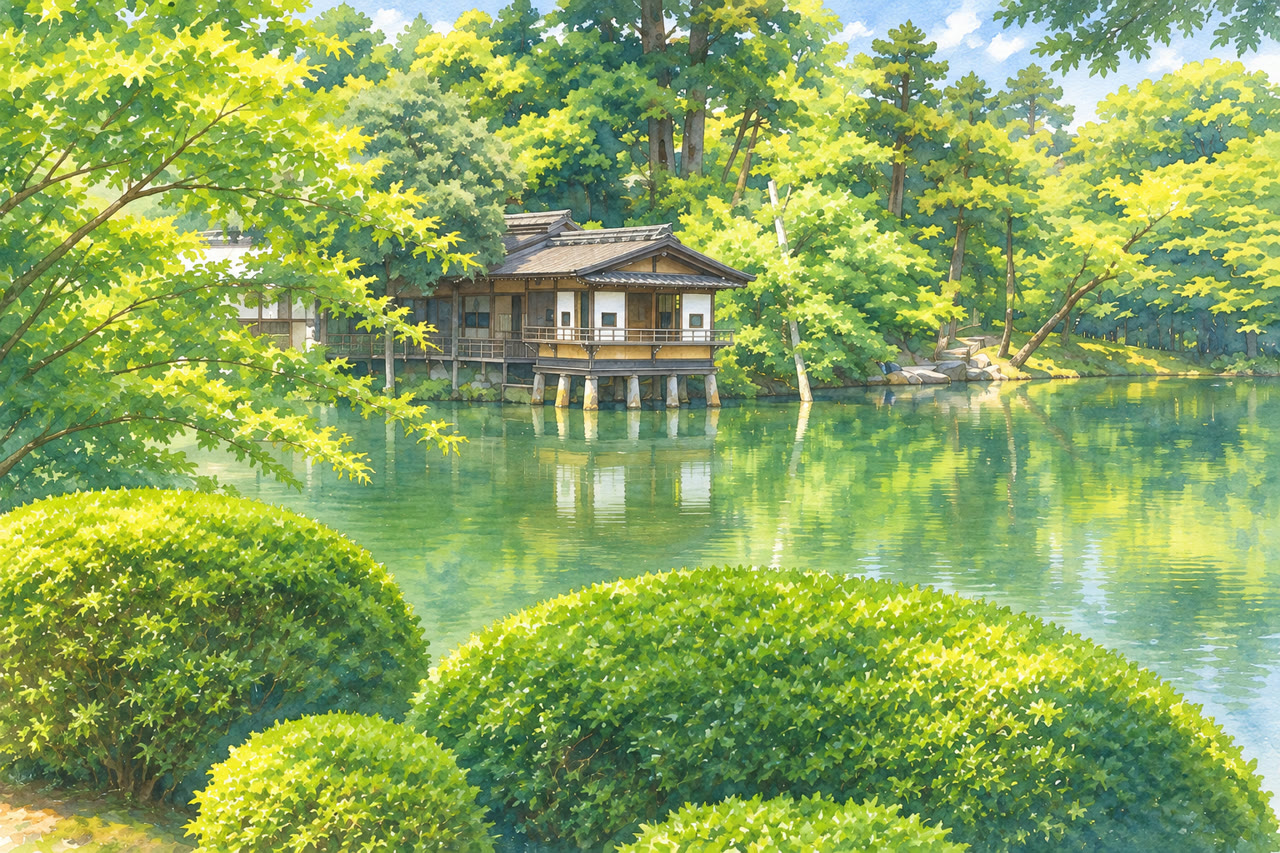
Kenroku-en, in the center of Kanazawa in Ishikawa Prefecture, is the stroll garden of the Maeda family, the daimyo of the Kaga domain. Laid out on a rise just across from Kanazawa Castle, it covers about 11.7 hectares by the common figure (older accounts say about 10) and is usually counted, with Kairaku-en in Mito and Kōraku-en in Okayama, among the "Three Great Gardens of Japan." Its name, meaning "the garden that combines six," dates only from the early 19th century, long after the first pavilion went up.
01A garden built over generations
The story begins in 1676, when Maeda Tsunanori, the fifth lord, built a villa pavilion called the Renchi-tei on the slope facing the castle and landscaped the ground around it. A great fire swept Kanazawa in 1759 and left little of the garden intact. The eleventh lord, Maeda Harunaga, restored it, adding the Midori-taki waterfall and the Yūgao-tei teahouse in 1774.
The twelfth lord, Maeda Narinaga, built a large retirement residence, the Takezawa Palace, on the garden’s upper level, completed in 1822. That year he asked Matsudaira Sadanobu, the former senior councillor of the shogunate, to name the grounds. Sadanobu turned to a Song-dynasty Chinese essay on the gardens of Luoyang, which held that a garden could rarely have both spaciousness and seclusion, both human artifice and the patina of age, both water features and broad views. A garden that combined all six deserved the name Kenroku.
After Narinaga’s death, the thirteenth lord, Maeda Nariyasu, pulled down the palace in stages (the last of it was gone by 1851), enlarged the Kasumi-ga-ike pond (usually dated to 1837), planted pines, and in 1863 built a residence for his mother, now known as the Seisonkaku. By the end of his rule the garden had largely taken its present shape. Its streams and ponds are fed by the Tatsumi Canal, dug in 1632 to bring water to the castle from an intake on the upper Sai River about ten kilometers away.
02From private garden to public park
After the Meiji Restoration the garden passed out of the family’s hands and was fully opened to the public in 1874. In 1880 a monument to Ishikawa men killed in the Satsuma Rebellion was raised in the garden, topped by a bronze statue of the legendary prince Yamato Takeru, said to be the first bronze statue erected in Japan. Kenroku-en was designated a Place of Scenic Beauty in 1922 and a Special Place of Scenic Beauty in 1985.
Visitors today look for the Kotoji stone lantern, with one leg standing in the pond and the other on a rock; the spreading Karasaki pine; the Neagari pine, raised on its exposed roots; and a fountain fed from the Kasumi-ga-ike and driven only by the drop in height, said to have been built late in the Edo period as a trial for piping water into the castle and generally thought to be the oldest fountain in Japan. The Yūgao-tei, built in 1774 and preserved in its original form, is thought to be the oldest surviving building in the garden, while the Shigure-tei teahouse is a 2000 reconstruction based on old records. In winter, gardeners rig yukitsuri, cone-shaped webs of rope that keep heavy snow from breaking the pine branches. The Seisonkaku, next to the garden, is an Important Cultural Property.
Kenroku-en
01A garden across the road from the castle
Walk out of Kanazawa Castle through the Ishikawa Gate, cross the road, and you are at the Katsurazaka entrance of Kenroku-en. The closeness is the first clue to what this place is. It was not a temple garden or a merchant’s retreat but the private garden of the Maeda family, lords of the Kaga domain, built on the high ground directly facing their castle.
The Maeda were the richest daimyo of the Edo period (1603–1868), with a domain assessed at over one million koku of rice; "Kaga’s million koku" became a byword for wealth. Maeda Toshiie, the founder of the house’s fortunes, entered Kanazawa in 1583, and his descendants ruled from here until the domains were abolished in 1871. The family and its castle have their own guide on this site. What matters here is that Kenroku-en was not designed in one stroke by a single master. It grew over roughly two centuries, added to by one lord after another, and almost every feature you see can be tied to a particular ruler and a particular decade.
Today the garden’s area is usually given as about 11.7 hectares, though older accounts put it at about 10. It is usually counted, together with Kairaku-en in Mito and Kōraku-en in Okayama, as one of the "Three Great Gardens of Japan." It is a stroll garden (kaiyū-shiki teien): a landscape of ponds, streams, artificial hills and teahouses meant to be seen by walking a path through it, the view changing at every turn. Many daimyo built gardens of this kind in the Edo period. Kenroku-en is among the largest and best preserved.
02The water came first
The garden’s ponds, streams, waterfall and fountain all draw on one source, a canal that is more than forty years older than the garden itself.
In 1631 a fire swept through the castle town and reached the castle. The lord at the time was Maeda Toshitsune, counted as the third head of the house. The fire exposed how short of water the castle was, and in 1632 the domain dug a channel to bring water from the upper reaches of the Sai River. This became the Tatsumi Canal (Tatsumi Yōsui). The work is traditionally credited to Itaya Heishirō, a townsman from Komatsu. The canal runs for about eleven kilometers from an intake roughly ten kilometers from the garden, partly through a tunnel cut into the hills, and had to hold a steady gradient without modern surveying instruments. Once in town, the water still had to cross the castle moats. It is said to have done so by a siphon, in which water drops into a sealed pipe and rises again on the far side, pushed by the difference in height between the two ends.
The canal passes over the plateau east of the castle where the garden now lies. As the garden grew and its ponds were widened, the canal remained its only source. Most of the water you see moving through Kenroku-en has come about ten kilometers from the mountains. The canal is still in use. In 2010 about 8.7 kilometers of it were designated a National Historic Site, and remains of an inverted siphon survive in the garden.
03Renchi-tei: Tsunanori’s beginning
The garden’s founding date is usually given as 1676. In that year Maeda Tsunanori, the fifth lord, moved the domain’s construction office into the castle and on its old site built a villa pavilion called the Renchi-tei ("lotus pond pavilion") on the slope facing the castle and landscaped the ground around it. The result, known as the Renchi Garden, was a place for the lord and his household to enjoy the view, hold banquets and give tea gatherings.
Tsunanori ruled for a long time and is remembered as one of Kaga’s great patrons of learning. He collected and cataloged old books, invited scholars to his domain, and encouraged the crafts; part of Kanazawa’s later reputation for fine craftsmanship is commonly traced to his era. His garden was far smaller than the present one, roughly the area near the castle around today’s Hisago-ike pond.
The Renchi Garden was altered over the following decades. Its first real catastrophe came in 1759, when a fire, remembered as the Hōreki Fire, burned across much of Kanazawa. The castle suffered heavy damage, and only a small part of the garden survived.
04After the fire: Midori-taki and Yūgao-tei
For some years the garden lay neglected. Its restoration was the work of the eleventh lord, Maeda Harunaga, who in 1774 built a waterfall, the Midori-taki, falling into the Hisago-ike, and a small teahouse on the pond’s east shore, the Yūgao-tei. The Uchihashi-tei followed in 1776. The waterfall, 6.6 meters high, carries water down from the Kasumi-ga-ike.
The Hisago-ike takes its name from its shape, like a gourd (hisago). On an island in the pond stands a stone pagoda about 4.1 meters tall with six roof stones, the Kaiseki-tō. Two stories explain its origin. One says the third lord, Toshitsune, had it made, and that it is part of a thirteen-story stone pagoda moved from a garden in Kanazawa Castle. The other claims the general Katō Kiyomasa brought it back from Korea during Toyotomi Hideyoshi’s invasions, and that Hideyoshi later gave it to Maeda Toshiie. Neither can be confirmed.
The Yūgao-tei is named for an openwork carving of a moonflower (yūgao), a gourd blossom, in its wall. One of the four pavilions of the old Renchi Garden, it keeps its original form and is generally said to be the oldest surviving building in Kenroku-en. With the waterfall and the pagoda it forms the oldest-feeling corner of the garden, shaded, quiet, and noticeably different from the open, busy area around the main pond. This is closest to what the garden looked like in its first century.
05Narinaga: a school, a palace and a name
The high ground above the Renchi Garden was called Chitose-dai. In 1792 Harunaga established the domain school, the Meirindō, and a school of martial arts, the Keibukan, there. After Harunaga’s death the twelfth lord, Maeda Narinaga, moved the schools elsewhere and used the site for a large residence for his own retirement, the Takezawa Palace.
The palace was completed in 1822 and is recorded as covering about 13,000 square meters, with more than 200 rooms and its own gardens and streams. The stream, hill and snow-viewing lantern around the Shichifukujin-yama today are a surviving part of the palace garden; the winding Kyokusui stream on the upper level was later reworked under Nariyasu. In the year the palace was finished, 1822, Narinaga asked Matsudaira Sadanobu to give the garden a name.
Sadanobu, formerly lord of Shirakawa and senior councillor (rōjū) of the shogunate, had led the Kansei Reforms of the late 18th century. By 1822 he had long retired and was respected among the daimyo as a man of letters. He named the garden Kenroku-en and is said to have written a short text explaining the choice. The name plaque, in his hand, once hung over the Renchi Gate and is now kept at a prefectural crafts museum.
06Which six?
The idea comes from Record of the Famous Gardens of Luoyang, written by the Song-dynasty scholar Li Gefei at the end of the 11th century. Describing one garden in Luoyang, Li observed that the virtues of a garden come in pairs that work against each other. A garden that strives for spaciousness loses seclusion; one that shows much human artifice lacks the look of age; one with abundant water has difficulty offering long views. Only rarely does a single garden have all six. Sadanobu borrowed the passage and declared that this garden did.
In Kenroku-en the six can be read roughly like this. Spaciousness and seclusion: the open water and wide sky around the main pond, against the dense, shaded paths near the waterfall. Artifice and antiquity: lanterns, bridges and stone-lined banks that are plainly the work of human hands, against moss and old pines that look as if they have always been there. Water and views: streams running through nearly every part of the garden, and, because the garden sits on high ground, a lookout from which you can see across Kanazawa toward the hills and, on a clear day, the sea.
There is an irony in the timing. When Sadanobu named it in 1822, much of the upper garden was still Narinaga’s palace and the main pond had not yet been enlarged. The name came first; in a sense, the garden was finished afterward to live up to it.
07Nariyasu and the garden we see
Narinaga died in 1824. His successor, the thirteenth lord, Maeda Nariyasu, carried out the last and largest remaking of the garden. He demolished the Takezawa Palace in stages, finishing in 1851, and folded its land into the garden, joining Chitose-dai to the Renchi Garden. He greatly enlarged the central pond, the Kasumi-ga-ike ("misty pond"), making it the largest body of water in the grounds, about 5,800 square meters today. The enlargement is usually dated to 1837, in the Tenpō era, and the spoil was heaped into the Sazae-yama hill beside the pond.
Many of the garden’s best-known sights cluster around the pond he enlarged. On the north shore stands the Kotoji lantern, a stone lantern 2.67 meters tall with two legs, one set in the water and one on a rock on the bank. Its outline resembles the bridge that holds up the strings of a koto, the Japanese zither, which gives it its name, and it has become the emblem of the garden. The legs are of unequal length; the usual story is that they were once equal and that one broke, though how and when is not recorded. In the pond is Hōrai-jima, also called Kikkō-jima, an island shaped like a tortoise, a symbol of long life.
Beside the pond grows the Karasaki pine, a black pine raised by Nariyasu from seed of the famous Karasaki pine on the shore of Lake Biwa. Its long branches reach low over the water, and in winter it receives the most elaborate yukitsuri, the cone-shaped rigging of ropes tied from a central pole to the branches to keep heavy, wet snow from snapping them. Another famous tree, the Neagari pine, stands on more than forty roots that rise about two meters above the ground. The story is that Nariyasu planted a young pine on a mound of earth and had the soil removed once it had grown, exposing the roots.
The Uchihashi-tei teahouse stands partly over the pond’s southwest shore on stone legs. It was one of the four Renchi Garden pavilions, built as a viewing stand for the riding ground, and was moved here in 1874. Elsewhere in the garden is a fountain built late in the Edo period, often dated to 1861, and generally described as the oldest fountain in Japan. It has no pump. Water is piped from the Kasumi-ga-ike down to the lower ground where the fountain stands, and the difference in height alone pushes it upward, to about 3.5 meters; the jet rises higher or lower with the level of the pond. Tradition says it was built as a trial for piping water into the castle’s Ni-no-maru.
In 1863 Nariyasu built a residence on the southeast side of the garden for his mother, Shinryūin, known then as the Tatsumi Palace and now as the Seisonkaku. It is an Important Cultural Property and one of the best surviving examples of a daimyo family’s living quarters from the end of the Edo period. By the later years of Nariyasu’s rule, the garden had essentially taken its present form.
08After 1868: from private garden to public park
The Meiji Restoration of 1868 and the abolition of the domains in 1871 ended Maeda rule. The family moved to Tokyo, and the garden passed into public hands. After a period of partial opening, Ishikawa Prefecture made it a public park, fully open to all, in 1874, and teahouses opened in the grounds. A garden that only the lord, his family and his invited guests had entered was now open to anyone.
In 1880 a tall monument, the Meiji Kinen no Hyō, was raised in the garden to honor soldiers from Ishikawa killed in the Satsuma Rebellion of 1877. It is crowned with a bronze statue of Yamato Takeru, the legendary warrior prince, 5.5 meters tall and said to be the first bronze statue erected in Japan. A monument to the new Meiji state planted in the middle of a daimyo’s garden is a striking sight today, and it has become part of the garden’s history in its own right.
Beside the garden stands Kanazawa Shrine, built in 1794 by Harunaga to pray for the success of the Meirindō school. It enshrines Sugawara no Michizane, the scholar deified as a god of learning, from whom the Maeda claimed descent. Nearby is a spring, the Kinjō Reitaku, given its round stone curb and roof by Narinaga. Legend says that long ago a man named Imohori Tōgorō, "Tōgorō the yam digger," washed yams here and found gold dust in the water, and that this is the origin of the name Kanazawa, "marsh of gold." It is a legend, not history, but the spring still flows.
Kenroku-en was designated a Place of Scenic Beauty in 1922 and raised to a Special Place of Scenic Beauty in 1985. The garden once had several teahouses. One of them, the Shigure-tei, which went back to Tsunanori’s time, was dismantled in the early Meiji period and rebuilt in 2000 from old plans and records, as part of a new garden area around the Hase-ike pond.
09What is original, what is not
The garden’s landforms and water system, the Kasumi-ga-ike and Hisago-ike, the Kyokusui stream, the Midori-taki and the channels from the Tatsumi Canal, follow a layout fixed in the Edo period, though banks and paths have been repaired many times since. The Yūgao-tei is original, from 1774. The Uchihashi-tei is also an Edo-period building, though it was moved to its present spot in 1874. The Kotoji lantern, the Kaiseki-tō pagoda and the fountain are generally taken to survive from the Edo period as well. The great pines are living history, well over a century old, but trees age and die, and the garden’s keepers raise successors for them.
The Shigure-tei is a 2000 reconstruction. The Meiji Kinen no Hyō is an 1880 addition, not part of the lords’ garden. The Seisonkaku, just outside, is an original building of 1863. The winter yukitsuri, the straw wrappings that protect plants in the cold, and the cherry and plum trees are the work of continuing horticulture, the living side of the garden.
10A walk through the garden
Enter from the castle side at Katsurazaka and climb a short slope to the north shore of the Kasumi-ga-ike. Look first at the Kotoji lantern and the small Niji-bashi bridge beside it, the classic view of Kenroku-en. A little farther is the Karasaki pine, in winter wrapped in its rope cone like an umbrella. Walk along the shore past Hōrai-jima and the Uchihashi-tei.
Head southeast to the lookout. From here, on the garden’s highest edge, you see over the city toward Mount Utatsu: this is the "views" of the six qualities. Nearby are the Meiji monument with Yamato Takeru on top, and the Neagari pine.
The upper garden is the open ground where the Kyokusui winds, the site of Narinaga’s palace and in spring the most crowded with blossom. Follow the stream toward Yamazaki-yama, a wooded hill that is at its best in autumn color. From this side you can leave for the Seisonkaku.
Finish on the western, lower side of the garden at the Hisago-ike, with the Midori-taki, the Kaiseki-tō and the Yūgao-tei. This is the old Renchi Garden, where the story began in 1676. The fountain is close by. Leave through the Renchi Gate, and the castle is a short walk away.
A full circuit takes you through the garden’s history roughly in reverse: Nariyasu’s great pond, Narinaga’s stream, and finally the pond and teahouse of Tsunanori and Harunaga. The name was settled halfway through; the garden grew into it afterward.