
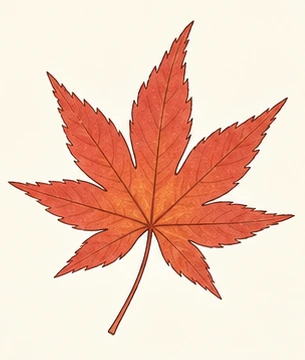
At a glance
Why Japanese autumn color is so vivid, the maple at its center, a thousand years of leaf-viewing poetry and outings, and how to time a visit.
- Read kōyō, 紅葉 means leaves changing color; read momiji, it usually means red maple leaves.
- The foliage front starts on Hokkaidō’s Daisetsuzan in mid-September and moves south and downhill, ending in early December.
- Color needs cold nights: leaves start turning below a minimum of 8°C and speed up below 5°C.
- The JMA uses the iroha maple as its standard tree; on figures up to 2025, color dates are about two weeks later than fifty years ago.
- Central Kyoto’s temples usually peak in late November, and the best window lasts only about a week to ten days.
In spring Japan follows the cherry blossoms north; in autumn it follows the maples south. The color starts on the slopes of Hokkaidō’s Daisetsuzan in mid-September and spends the next two and a half months working its way down the archipelago and down the mountains, finishing in the temple gardens of Kyoto and the street trees of Tokyo in late November and early December. For those weeks Kyoto temples run timed entry and night illuminations, railway posters are all scarlet, and a whole vocabulary comes out of storage. This is a guide to that season: what momiji means, why Japanese autumn color is so intense, the small, star-shaped Japanese maple at the center of it, the thousand-year history of going out to look at leaves, and how to see them well.
01Two Readings of One Word
The Japanese word written 紅葉, literally "crimson leaves," has two readings. Read kōyō, it means the phenomenon itself: leaves changing color in autumn, whether that is a ginkgo going gold or a sumac going red. Read momiji, it means the colored leaves, and very often the maple tree in particular. When someone in Japan says they are going to see the momiji, they mean maples.
Momiji comes from an old verb, momitsu, "to turn color in autumn." In the Man’yōshū, the eighth-century poetry anthology, the word is usually written with characters meaning "yellow leaves," not red. For Nara-period poets the autumn mountain was, first of all, golden. By the Heian period (794–1185) the "crimson" spelling had won, and red became the color of autumn. Scholars have read this as a shift in taste, or simply as a reflection of the maple-rich hills around the new capital at Kyoto; it is probably a bit of both.
The other common word for maple is kaede, from kaeru-de, "frog’s hand," for the way the leaf spreads like a webbed foot. Gardeners tend to call the deeply cut, many-lobed kinds momiji and the shallow-lobed kinds kaede, but botanically there is no line between them. All are species of Acer.
02Why Japan Does Autumn So Well
Leaves change color because trees are shutting down for winter. As days shorten and temperatures drop, the green chlorophyll in the leaf breaks down. The yellow and orange carotenoid pigments that were there all along are unmasked, which is why ginkgo and birch turn gold. Maples go a step further. A corky layer forms at the base of the leaf stalk, trapping sugars in the leaf, and in sunlight those sugars are turned into a new pigment, anthocyanin. That is the red.
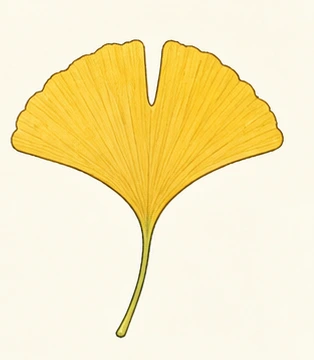
Ginkgo: as chlorophyll breaks down, the yellow already in the leaf shows through
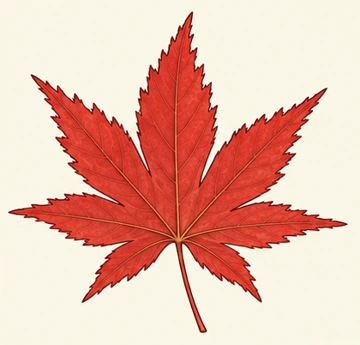
Maple: sugars trapped in the leaf make new anthocyanins, turning it red
Because the red is manufactured, it depends on the weather. The best color comes from a run of clear, sunny days and sharply cold nights. Leaves begin to turn once overnight lows fall below about 8°C, and the change speeds up below 5°C. There needs to be enough moisture that the leaves don’t simply wither brown before they color, and a dry summer or a typhoon that tears the foliage can dull a whole season. Japan’s steep, folded mountains, its basins with big swings between day and night temperatures, and its generous rainfall give it these conditions in many places at once.
The other reason is diversity. Japan has more than twenty native maple species, from the small-leaved Japanese maple to the broad, fan-shaped full-moon maple (hauchiwa-kaede) and the yellow-turning itaya-kaede. Add shrubs that go a startling red, like the lacquer tree, the wax tree, the rowan (nanakamado) and the enkianthus (dōdan-tsutsuji), and stands of beech, zelkova and ginkgo that turn yellow and russet, and a single hillside can hold every shade from crimson to lemon. The classical word for it is nishiki, brocade. Autumn in Europe leans towards yellow; eastern North America and East Asia are known for their reds, and Japan sits in the middle of the East Asian range.
The Japan Meteorological Agency tracks the season with a designated Japanese maple at each of its observatories. The "maple coloring date" is the day most of that tree’s leaves have turned red. Join the dates on a map and you get the kōyō zensen, the autumn-leaf front, which travels the opposite way to the cherry-blossom front: north to south, and high to low. The high mountains of Hokkaidō and Tōhoku peak in late September and early October; places between about 1,200 and 1,500 meters, like Oku-Nikkō and Kamikōchi, follow in mid to late October; and the lowland cities of Honshū and further south wait until November. Kyoto’s temples usually peak in the last third of November, Tokyo at about the same time, sometimes into early December. According to Japan Meteorological Agency figures up to 2025, warmer autumns have pushed these dates back by roughly two weeks compared with half a century ago.
- 1High mountains of Hokkaido and TohokuLate Sep to early Oct
- 2Oku-Nikkō, KamikōchiAbout 1,200–1,500 m; mid to late Oct
- 3Lowland cities of Honshu and southNovember
- 4Kyoto, TokyoLate November, sometimes early December
The front travels north to south and high to low, the opposite way to the cherry-blossom front.
03The Japanese Maple
The tree most people picture is iroha-momiji, Acer palmatum, known in English simply as the Japanese maple. Its leaves are small, rarely more than five or six centimeters across, and deeply cut into five to seven slender, finely toothed lobes, like a hand with its fingers spread. The name comes, so the story goes, from counting those lobes with the opening syllables of the iroha, the old poem that uses every kana once: i, ro, ha, ni, ho, he, to. Seven lobes, seven syllables. Whether anyone actually named the tree that way is doubtful, but it is a good way to remember the leaf.
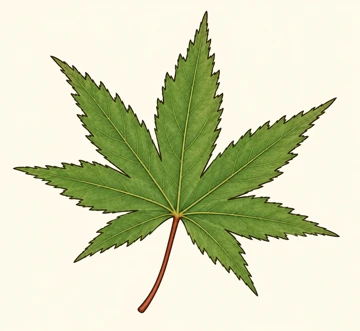
The iroha maple leaf is deeply palmate, usually with five to seven slender lobes
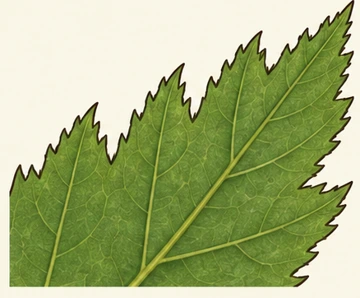
The margin is doubly serrated: small teeth on larger teeth
In the wild it grows in the hills of Honshū from roughly Fukushima southwards, and in Shikoku and Kyūshū, most often along streams and in ravines, and it can reach ten meters or more. The new leaves in spring are often flushed red; summer leaves are a clear, light green; in autumn they go deep red or orange-red. The side of the tree facing the sun turns first, so for a week or so a single tree shades from scarlet through orange to green.
In April and May it produces tiny dark-red flowers that most people never notice. What they do notice are the fruits. Each is a samara: two seeds joined at the base, each with a thin wing, the pair spread in a shallow V. In early summer these are often bright red and hang among the green leaves like a second flowering. By autumn they dry and turn brown, split in two, and each half spins down like a helicopter blade, riding the wind away from the parent tree. Children in Japan, like children everywhere maples grow, throw them up to watch them whirl.
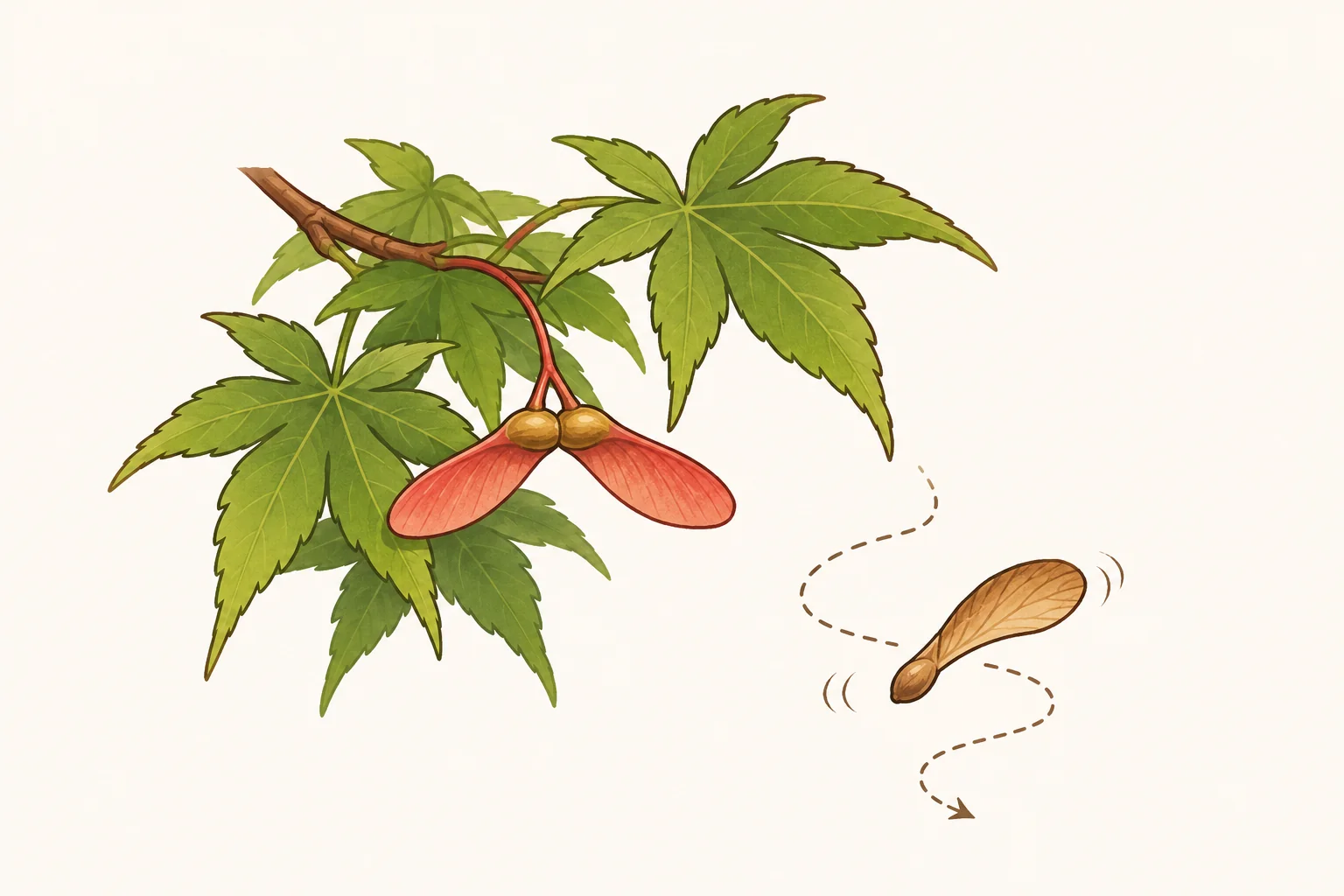
Iroha-momiji samaras: red pairs among green leaves in early summer, brown halves spinning down in autumn.
The Japanese maple is the backbone of the Japanese garden, and it has been bred for centuries. The Edo period (1603–1868) saw a craze for horticulture among both samurai and townspeople, and maples were a favorite. In 1695 Itō Ihei, a nurseryman in the Somei district of Edo, published Kadan chikinshō, a gardening manual that already listed 23 maple varieties. Many classic cultivars survive under their Japanese names: 'Nomura', whose spring leaves are purple-red; 'Deshōjō', with startlingly scarlet new growth; 'Shishigashira', the "lion’s head," with crinkled leaves packed tight on the twigs; 'Sango-kaku', the coral-bark maple, grown for its pink-red winter branches. From the nineteenth century these went to Europe and North America through Dutch and British nurseries, and today the Japanese maple is one of the most widely planted ornamental trees in Western gardens.
Japanese gardeners have their own seasons for it beyond autumn. In recent years ao-momiji, "green maples," has become a draw in its own right: in May and June Kyoto temples promote their gardens of fresh green maple leaves, lit through by early-summer sun, with a fraction of the November crowds.
04From Court Poetry to Leaf Hunting
The argument over whether spring or autumn is the better season is very old in Japan. The Man’yōshū records a long poem by Princess Nukata, composed when Emperor Tenji asked his courtiers to compare the blossoms of the spring hills with the colored leaves of autumn. Spring flowers, she says, grow tangled in the grass and can’t be properly enjoyed; autumn leaves can be picked up and held. Her verdict closes the poem: aki-yama zo ware wa, "for me, the autumn hills." The debate became a fixture of court culture for centuries afterwards.
In Heian poetry, colored leaves became one of the standard images of autumn, and several of the best-known poems ended up in the Hyakunin isshu, the thirteenth-century anthology of a hundred poets that every Japanese schoolchild meets through the New Year card game. Ariwara no Narihira wrote of the Tatsuta River in Nara, its surface so thick with red leaves that it looked as if the water had been tie-dyed crimson, something unheard of "even in the age of the gods." Another, attributed to the semi-legendary Sarumaru Dayū, has a deer calling deep in the mountains as someone treads through fallen leaves: that, the poet says, is when autumn is saddest. Maples with deer, maples on the Tatsuta River: these pairings became fixed and are still used on kimono patterns, lacquerware and sweets. The Tale of Genji has a chapter called "Momiji no Ga," "An Autumn Excursion," in which Genji dances the court dance Seigaiha beneath the colored leaves and moves the onlookers to tears.
The Japanese for going to see autumn leaves is momijigari, literally "maple hunting." Kari means hunting, but it also came to mean going out into the country to gather or find something; Japanese still speak of mushroom hunting and strawberry hunting. With maples, the hunting is done with the eyes. Heian aristocrats rode out to the hills to drink, compose poems and look at the leaves. In the Edo period the outing spread to ordinary townspeople. Around the city of Edo, the temple of Kaian-ji in Shinagawa and the ravine at Takinogawa near Ōji were famous maple spots, and later accounts add Shōtō-ji in Shitaya as another; guidebooks and woodblock prints (reportedly including the illustrated Edo meisho zue) show crowds with picnic mats and sake under the trees, scenes not very different from cherry-blossom parties.
The leaves also have a darker side. The Noh play Momijigari tells of the warrior Taira no Koremochi, who, out hunting on Mount Togakushi in Shinano, comes upon a party of beautiful women feasting under the maples. They ply him with sake; he falls asleep; and the chief beauty turns out to be a demon. Warned in a dream by a god, he wakes and kills her. The story was adapted as a kabuki dance in 1887 for the great actor Ichikawa Danjūrō IX and is still regularly performed.
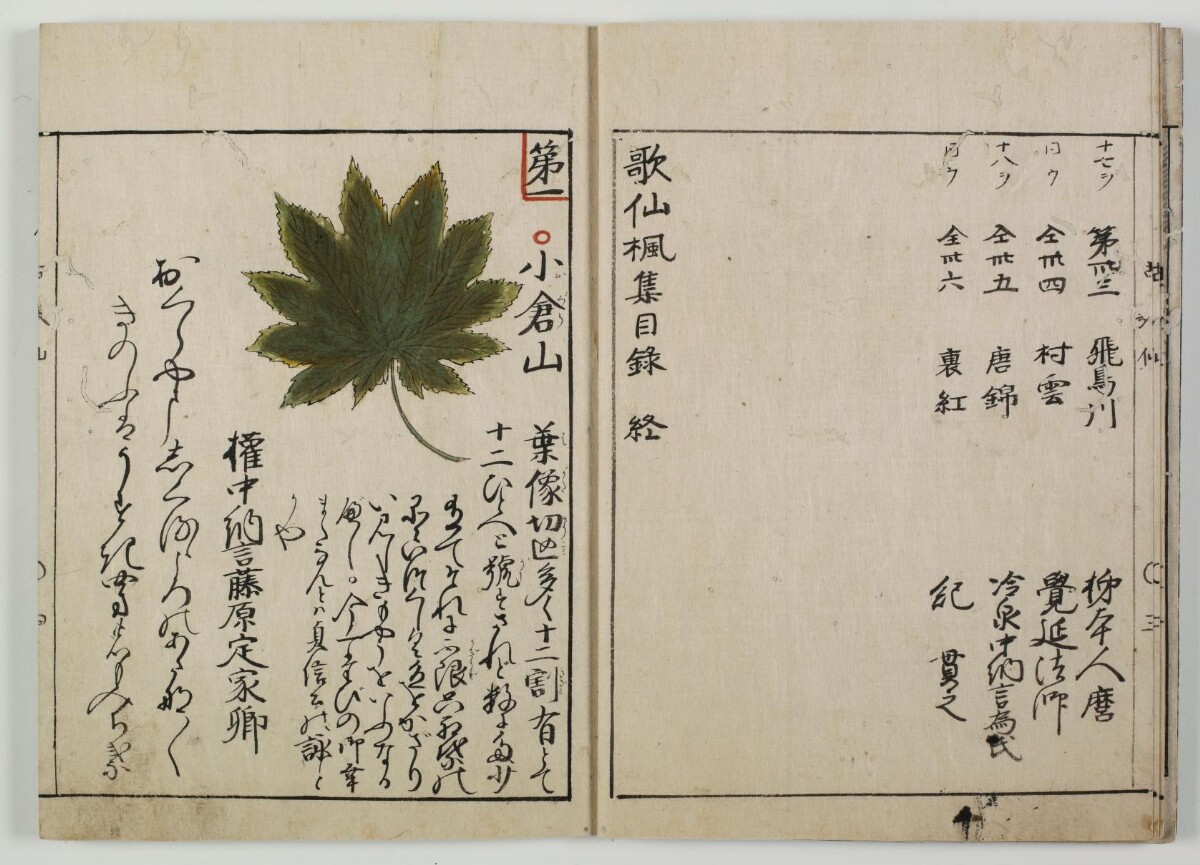
An Edo-period maple album: each leaf is paired with a poem, here 'Ogurayama' with Fujiwara no TeikaChiba University, Kokasen fūshū manuscript (Edo period, catalog dated 1710)
05Maples in Everyday Life
Once you know the shape, you start seeing maple leaves everywhere in Japan. A baby’s spread fingers are "momiji hands," because a small Japanese maple leaf is exactly that size and shape.
In hanafuda, the flower-card deck used for games like koi-koi, October is represented by maples and a deer. The deer is looking back over its shoulder, ignoring the viewer. The card is called shika-tō, "deer ten," and this is the usual explanation for the slang shikato, to deliberately ignore someone.
On the menu, momiji means venison. During the Edo period, eating the meat of four-legged animals was officially frowned on, and people who ate it anyway used flower names: wild boar was botan, peony; horse was sakura, cherry; deer was momiji. A venison hotpot is still called momiji-nabe. In Minoh, in the hills north of Ōsaka, shops along the path to the waterfall fry salted maple leaves in a sweet batter to make momiji tempura, a crunchy snack sold by the bag. And on Miyajima, the island of the floating torii near Hiroshima, the local sweet is momiji manjū, small maple-leaf-shaped cakes filled with sweet bean paste, said to have been created around 1906, in the late Meiji period, by a local confectioner, Takatsu Tsunesuke. Every souvenir shop on the island sells them, and you can watch them being baked in leaf-shaped molds.
Even road signs got involved. Japan’s badge for elderly drivers, introduced in 1997 as a teardrop shape in orange and yellow, was nicknamed the "momiji mark" because it looked like a turning leaf. A four-leaf-clover design was added in 2011, but as of 2026 the old badge is still valid and plenty of people still use the old name.
06Where and How to See Them
Kyoto is the center of autumn-leaf travel. At Tōfuku-ji, some 2,000 maples fill a ravine crossed by the covered wooden bridge Tsūtenkyō, and from the bridge you look down on what seems like a cloud of red; on a peak-season morning the bridge is packed shoulder to shoulder. The temple’s own variety, the tsūten-momiji, has three-lobed leaves and is said to have been brought from Song China by the temple’s founder. Eikandō (properly Zenrin-ji), on the eastern edge of the city, has long been called "Eikandō of the maples." Its main image is an Amida Buddha with its head turned back over its left shoulder; legend says the Buddha turned to the monk Eikan, who had fallen behind him in procession, and said, "Eikan, you are slow." To the west, Arashiyama has Tenryū-ji and its subtemple Hōgon-in; to the north-west, the three mountain temples of Takao, Makinoo and Toganoo, together called the Sanbi, have been famous for maples for centuries, by some accounts the first places in Kyoto to win that fame (Takao already by the early fifteenth century); and in Ōhara, Sanzen-in and Hōsen-in lay red leaves over moss. Many temples hold special night openings in season, lighting the maples from below; the evening illuminations at Kiyomizu-dera, Eikandō and Kōdai-ji draw long queues.
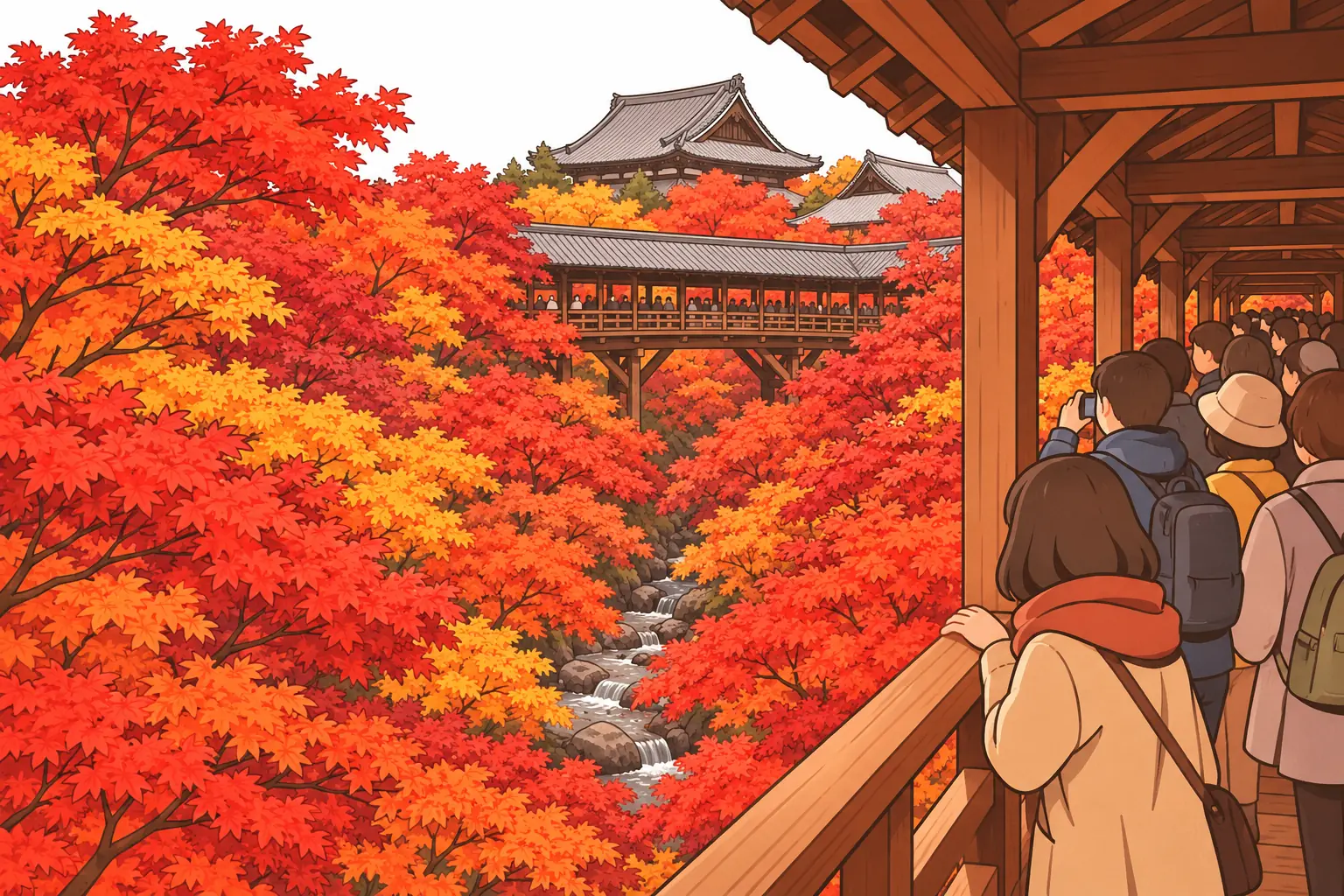
Looking down from Tōfuku-ji's covered wooden Tsūtenkyō bridge into the Sengyokukan ravine, filled with autumn maples (illustration).
Near Tokyo, the classic trip is Nikkō. The Irohazaka, a pair of one-way roads between the town and Lake Chūzenji, has 48 hairpin bends between its up and down routes, said to match the 48 syllables of the iroha, and in mid-October the slopes along it change color in bands. Because the route climbs from the town past Kegon Falls to the marshland of Senjōgahara, you can find several stages of the season in a single day. In Tokyo itself, the ginkgo avenue in the Meiji Jingū Gaien turns into a golden tunnel in late November, Rikugien and Koishikawa Kōrakuen gardens are lit up at night, and Mount Takao is the standard day hike for city dwellers wanting autumn color. Further north, the Oirase Gorge in Aomori sets red and yellow leaves above fast white water, and Hakkōda and Hokkaidō’s Daisetsuzan are the first places in Japan to turn. To the west, Momijidani Park on Miyajima, Minoh near Ōsaka and Kenrokuen in Kanazawa all have their devotees; at Kenrokuen the maple season runs straight into early winter, when gardeners rig the pines with conical rope frames, yukitsuri, to protect their branches from snow.
Timing matters more than anything. The peak at any one place lasts perhaps a week to ten days: too early and the trees are patchy green and yellow, too late and the branches are bare. From September the Japan Weather Association and private forecasters publish leaf forecasts, and temples and tourist offices post daily updates on how far the color has come, using the word migoro, "best time to see." If you arrive late, it is not wasted. Japanese has words for that too: chiri-momiji, falling leaves, and shiki-momiji, leaves spread like a carpet over moss, stone steps or a pond. Some gardens are at their best in that last week.
Kyoto at peak season is crowded beyond what most visitors expect, and the best defense is to get up early. Be at the gate of Tōfuku-ji or Eikandō when it opens, go on a weekday, or pick a smaller temple without a famous name; many are just as beautiful and far quieter. Some spots, Tsūtenkyō included, run one-way foot traffic and may ban stopping for photographs at the busiest times. In gardens and in the mountains, stay on the paths, don’t step onto moss for a better angle, and leave leaves and branches where they are. Mountain temperatures are much lower than in the cities: by November, mornings in Nikkō or on Kōyasan can be close to freezing, so bring a proper coat.
The leaf season is also the season of chestnuts, persimmons, new rice and matsutake mushrooms, and at a ryokan dinner you may find a single small maple leaf laid on the edge of a dish. It isn’t there to be eaten. It is there to tell you what time of year it is.