
At a glance
A matsuri is the day a god tours its district: what mikoshi, floats, drums and flutes do, plus Chichibu’s night festival, Akita’s Kantō lanterns and etiquette.
- A matsuri is the day a god leaves its shrine to tour the neighborhood; carrying, hauling and music all serve to welcome, entertain and send off the god.
- A mikoshi is a miniature shrine, and a large one often weighs about a ton; the first record is usually traced to 749, when Hachiman was brought to Nara.
- In 2016, 33 float festivals across Japan were inscribed together on UNESCO’s Intangible Cultural Heritage list.
- Edo festival hayashi uses a standard five-player set: one large drum, two rope-tensioned shime-daiko, one shinobue and one kane gong.
- The Chichibu Night Festival falls on December 2 and 3; Akita Kantō runs August 3 to 6, and the largest kantō stands about 12 meters tall.
Somewhere in Japan, nearly every weekend of the year, a neighborhood is holding a matsuri. The word is usually translated as "festival," and on the surface that is what you see: crowds, food stalls, drums, men and women in matching cotton jackets shouting in unison. Underneath, a matsuri is a religious event with a simple plot. A god leaves its shrine, travels through the district it protects, is entertained along the way, and goes home. The portable shrines that lurch through the streets, the towering wooden floats, the flutes and drums are all parts of that journey. This piece explains how those parts work, then follows two very different festivals, the Chichibu Night Festival in December and the Akita Kantō in August, and ends with some advice on how to watch one well.
01What a Matsuri Is For
The noun matsuri comes from the verb matsuru, to worship or to serve a deity. At the center of every shrine festival is a rite most visitors never see. Inside the shrine, priests present offerings of rice, sake, salt, water, fish and vegetables, recite a formal prayer called a norito, and make the shrine’s annual report to its god. This is the shinji, the sacred business, and it is quiet and short.
What happens outside is the other half. Having been honored, the god is invited to come out and see its people. It rides through the streets in a portable shrine, stays for a while at a temporary lodging, and is treated to music, dance, spectacle and noise. The folklorist Yanagita Kunio, in his 1942 book Nihon no matsuri (Japan’s Festivals), drew a line between the matsuri proper, which belonged to the community that worshipped a god, and the sairei, the version that had acquired spectators. Once outsiders came to watch, festivals grew showier. From the medieval period onward, that showiness had a name, furyū, meaning elaborate decoration and display, and it is the reason modern festivals carry so much ornament.
The calendar shapes the mood. Rural shrines tend to hold spring festivals to ask for a good growing season and autumn festivals to give thanks for the harvest. Big city festivals cluster in summer, because summer was the season of epidemics, and epidemics were thought to be the work of angry spirits and plague deities who had to be placated and sent away. Kyoto’s Gion Matsuri traces itself to a rite said to have been held in 869, when, during an outbreak of disease, 66 halberds, one for each province, were made and sent to the Shinsen’en garden to drive off the epidemic. That is the festival’s own origin story, passed down in later tradition; the Gion rite became an annual event from 970. Ōsaka’s Tenjin Matsuri and Tokyo’s Kanda and Sannō festivals occupy similar places in the lives of their cities, and the Gion, Tenjin and Kanda festivals are often called Japan’s three great festivals. Kanda and Sannō take turns holding their full-scale "main festival," a custom inherited from the Edo period; Kanda Myōjin’s falls in May of odd-numbered years. Seasonal observances like New Year, Obon and Tanabata, and dance-and-lantern festivals like Aomori’s Nebuta or Tokushima’s Awa Odori, have their own stories, but they share the same grammar: a procession, music, and something that must be welcomed and then sent off.
02Mikoshi: How a God Leaves Its Shrine
A mikoshi is a portable shrine, a palanquin for a god. It is built as a miniature shrine building: a curved roof topped with a gilded phoenix or an onion-shaped finial, walls with little doors, a tiny torii gate and fence around the base, and long carrying poles running beneath. The wooden body is lacquered black and covered with gilt-bronze fittings, tassels and bells. A large one can weigh around a ton and needs dozens of bearers working in shifts.
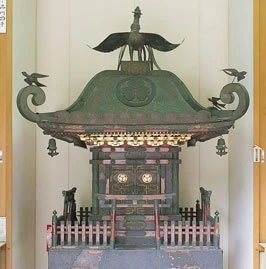
An old mikoshi of Shinagawa Shrine: a phoenix on top, with roof, doors and railings like a miniature shrine.
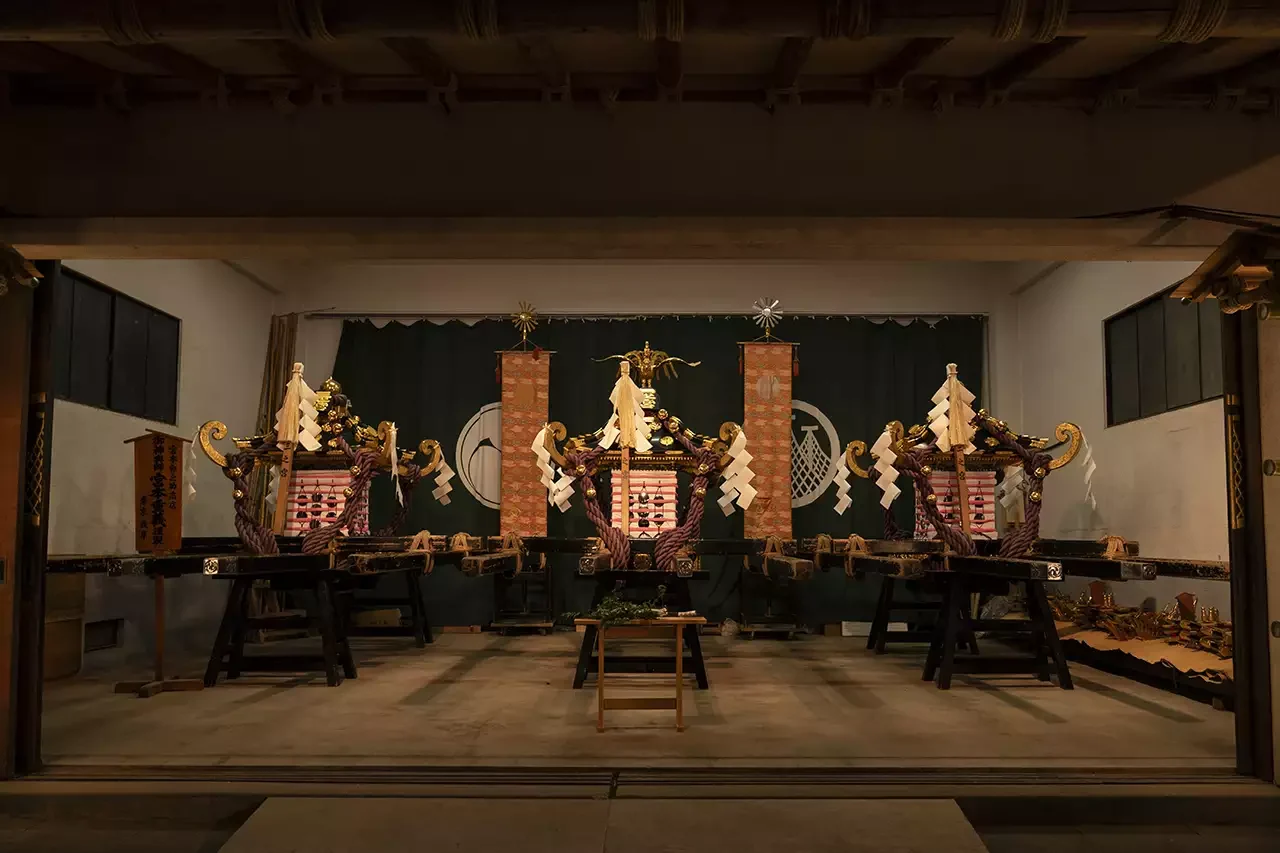
The three main mikoshi of Asakusa Shrine at rest on trestles, with their carrying poles in place.
The object itself is not sacred until it is occupied. Before the procession, in a darkened main hall, priests perform the mitama-utsushi, the transfer of the god’s spirit from the sanctuary into the mikoshi, while everyone present bows. From then on, the mikoshi is treated as the god. Its departure from the shrine is the miyade, its return the miyairi, and in between it rests at an otabisho, a temporary lodging in the neighborhood. The usual story of origins goes back to 749, when the deity Hachiman was brought from Usa in Kyūshū to Nara to support the casting of the Great Buddha at Tōdai-ji; according to the court chronicle Shoku Nihongi, his priestess, Ōmiwa no Morime, came to worship at the temple riding a purple palanquin, an episode often cited as the first recorded mikoshi. By the Heian period, warrior monks from Mount Hiei were carrying the mikoshi of the Hie Shrine down into Kyoto to press their demands on the court, counting on the fact that no one dared lay hands on a god.
The thing visitors notice first is that the bearers do not carry the mikoshi smoothly. They bounce it, sway it from side to side, and heave it overhead, chanting all the while. One common explanation is tamafuri, "shaking the spirit": jostling the god is thought to rouse and strengthen it, and a lively god is a more generous one. The chants vary from place to place. "Wasshoi!" is the one most people know; in the Edo style of Tokyo’s old downtown you will hear a clipped "Seiya! Soiya!" The bearers press shoulder to shoulder and move with short, shuffling steps.
Asakusa’s Sanja Matsuri, held over 3 days around the third weekend of May, is one of the best places to see this. Asakusa Shrine brings out its 3 main mikoshi, along with about 100 neighborhood mikoshi from 44 local associations, which own and store them and bring them out once a year. Many festivals also have children’s mikoshi, small and loud, and some have mikoshi carried by women.
The way a god travels varies a great deal. At the Hamaori Festival in Chigasaki, Kanagawa, about 40 mikoshi from Samukawa Shrine and other local shrines gather on the beach at dawn on Marine Day in July and are carried into the sea so the gods can be purified in salt water. At Ōsaka’s Tenjin Matsuri, the god goes down the Ōkawa River by boat, escorted by a fleet of lit vessels. At the Nada Fighting Festival in Himeji, every October 14 and 15, 3 mikoshi are rammed into each other again and again; the harder the collisions, it is said, the more pleased the god. Some communities want their god to make a calm circuit of the streets; others want it to show its power in the surf, on the river, or in the crack of splintering wood.
03Floats: Stages on Wheels
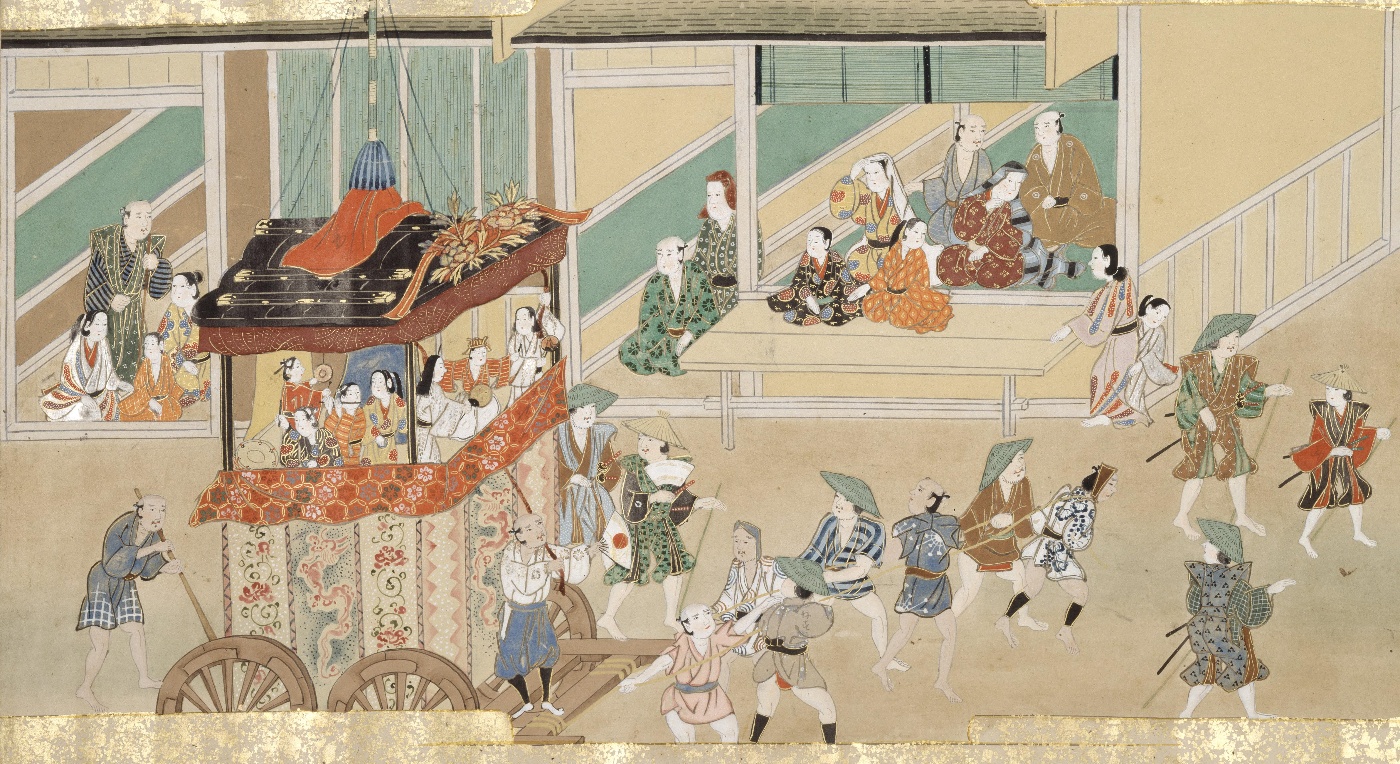
If the mikoshi is the god’s vehicle, the float is the offering: a moving structure built to please the god and dazzle the crowd. Floats go by many names. Kyoto has yamahoko; Chichibu and Takayama have yatai; much of the Hokuriku region and Kansai uses hikiyama; Kishiwada near Ōsaka has danjiri; Hakata has yamakasa; and around Tokyo the general word is dashi. The basic form is shared: a tall wooden platform on solid wheels, often with a roof or a soaring decoration on top, musicians riding inside, and thick ropes in front for dozens or hundreds of people to haul.
| Where | Name |
|---|---|
| Kyoto | Yamaboko |
| Chichibu, Takayama | Yatai |
| Hokuriku, Kansai | Hikiyama |
| Kishiwada | Danjiri |
| Hakata | Yamakasa |
| Around Tokyo | Dashi |
The names differ, the form is shared: a tall platform on wheels, a roof or soaring decoration, musicians, and thick hauling ropes.
The character for "mountain" (yama) that appears in so many of these names hints at their origin. Scholars generally connect floats to the shimeyama, a decorated artificial mountain used in ancient court rites as a place for a deity to descend. A float’s upper decoration, whether the tall halberd on the Naginata-hoko at the Gion Matsuri or the figures on the Takayama floats, serves as a yorishiro, a landing point for the divine. In the Edo period, as townspeople prospered, floats became the arena in which neighborhoods competed. They hired the best carvers, embroiderers, lacquerers and metalworkers they could afford. The Gion Matsuri floats are hung with tapestries that came from as far as Belgium, Persia and China (and, by some accounts, India), among them a pair of 16th-century Belgian tapestries on the Koi-yama float, which is why they are called "moving museums." The Takayama floats carry karakuri mechanical puppets worked by puppeteers hidden inside; on the Hotei float in autumn, little Chinese-boy puppets flip from bar to bar and land on the shoulders of the god Hotei, and on the Shakkyō float in spring, by most descriptions, a puppet of a beautiful woman turns into a lion in an instant. Takayama holds its festival twice, the Sannō Festival on April 14–15 and the Hachiman Festival on October 9–10, with different floats in each.
In Edo, the Sannō and Kanda festivals were known as tenka matsuri, "festivals of the realm," because their processions entered the shogun’s castle for him to watch. Their floats were tall, with figures of gods and heroes on top. The castle gates were only about 4.4 meters high, so the puppet and the upper frame were built to lower into the body of the float and rise again once through. After the Meiji Restoration, many of these floats were sold off to provincial towns, and streetcar lines and overhead wires are generally thought to have made the rest impractical; Tokyo’s float culture faded. The best place to see Edo-style dashi today is the Kawagoe Festival in Saitama, which grew up under the influence of the tenka matsuri and still parades floats with a large figure standing atop a two-tiered tower.
- 1
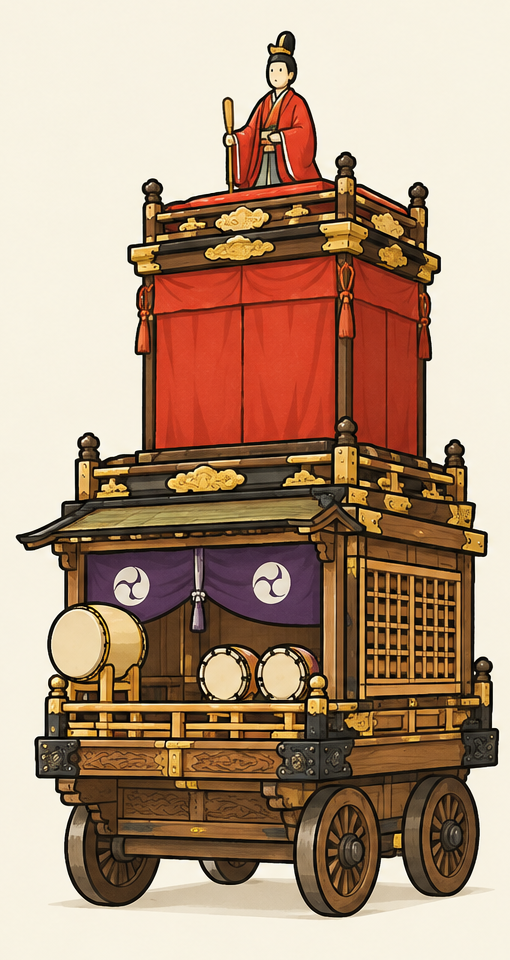 Normally the figure and upper tier stand high above the base.
- 2
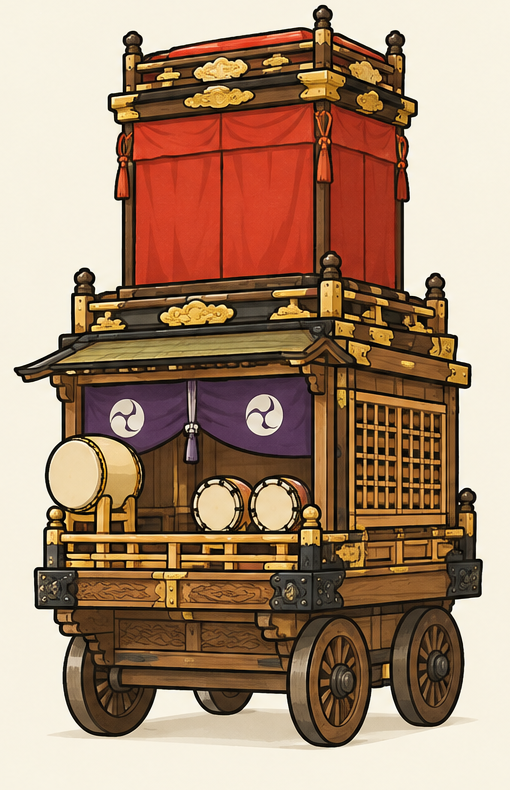 Before the gate, the figure is lowered into the upper tier.
- 3
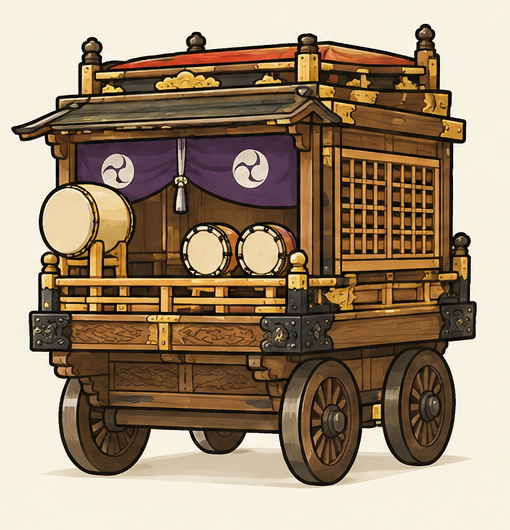 The upper tier, figure and all, sinks into the lower tier, then rises again past the gate.
- 4
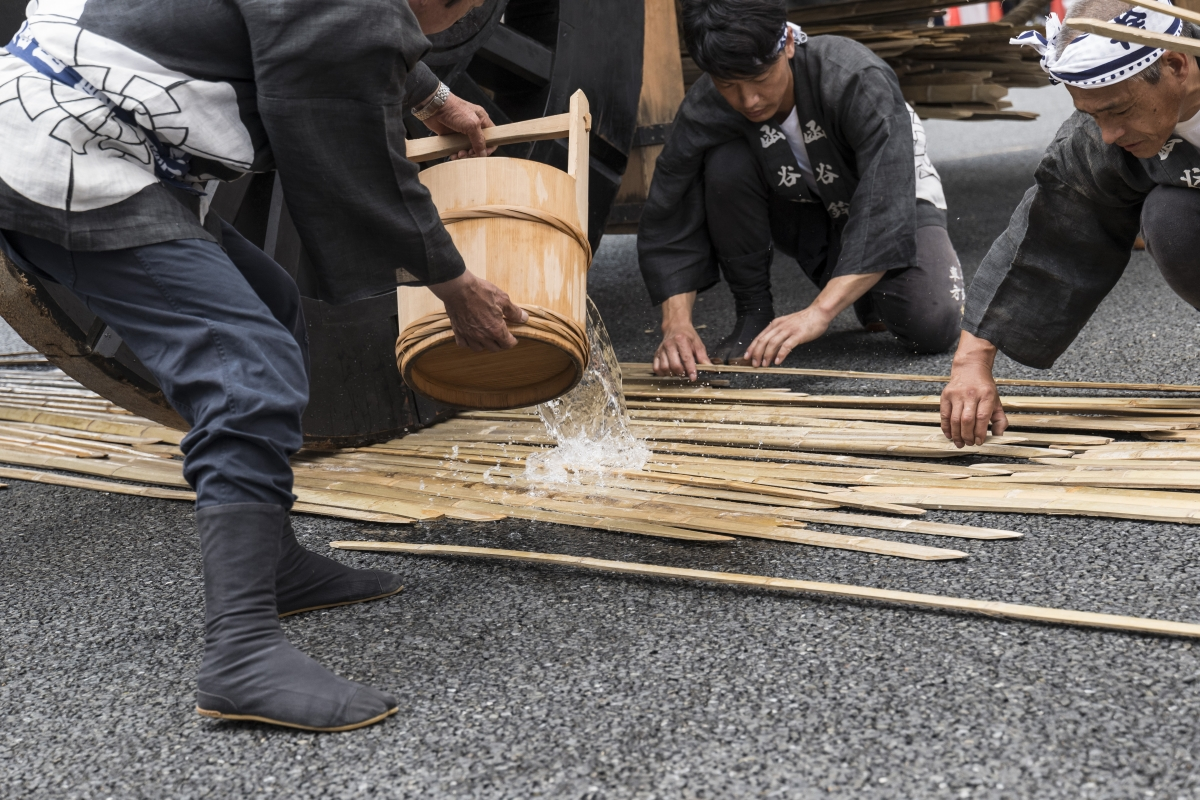 Before a tsuji-mawashi turn, water is poured over split bamboo laid under the wheel.
- 5
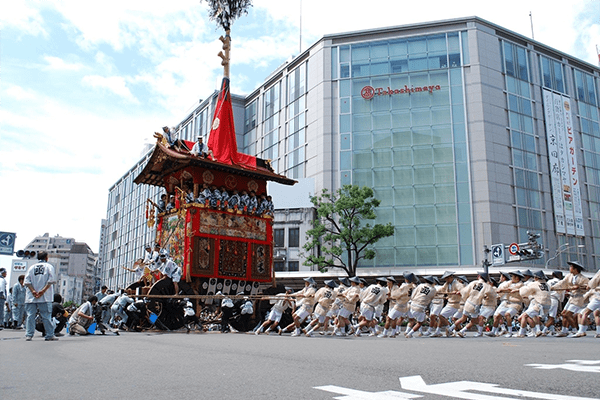 At the intersection, a crowd hauls on the ropes to drag the hoko round.
Not every float has wheels. At the Hakata Gion Yamakasa in Fukuoka, the kakiyama floats, about 1 ton each, are carried on the shoulders of men in loincloths. In the climactic race before dawn on July 15, the first team sets off at 4:59 a.m. and each neighborhood runs a course of about 5 kilometers through the city against the clock, while spectators throw buckets of water over them to keep them cool. A few seconds separate a good year from a bad one.
The hardest part of moving a float is turning it. The wheels are fixed and cannot steer. In Kyoto, at each corner the crews lay split bamboo under the wheels, wet it down, and drag the yamahoko, some 10 tons each, around in stages, a maneuver called tsuji-mawashi. In Chichibu, crews lever the float up and pivot it on a central point, the giri-mawashi. In Kishiwada, they do the opposite and take the corner at a run, swinging the danjiri around by sheer momentum, the famous and dangerous yarimawashi, which has caused injuries and deaths over the years; according to press reports, hardly a year passes without someone being hurt. In 2016, 33 float festivals across Japan were inscribed together on UNESCO’s Representative List of the Intangible Cultural Heritage of Humanity as "Yama, Hoko, Yatai, float festivals in Japan."
04Hayashi and the Shinobue
A matsuri without sound is unthinkable. Festival music is called matsuri-bayashi, and at its simplest it is drums and a flute. In the Tokyo area, the standard ensemble has 5 players: 1 large barrel drum (ōdō), 2 small rope-tensioned drums (shime-daiko), 1 bamboo flute, and 1 small hand-held gong (kane) struck with a mallet. Tradition says this style, Kasai-bayashi, was created in the Kyōhō era (1716–36) by Nose Tamaki, the head priest of Kasai Shrine east of Edo, and spread from there into schools across the city; it was the music of the great Kanda and Sannō processions. Its pieces form a fixed suite, opening with "Uchikomi," moving through "Yatai," "Shōden," "Kamakura" and "Shichōme," and returning to "Yatai" at the end, with separate pieces for greeting a mikoshi or accompanying a lion dance.
Hayashi is not background music. It tells the procession what to do. When the tune changes, so does the action: departure, walking, halting, turning, going home. Kyoto’s Gion music is known by the onomatopoeia konchikichin, after the bright clang of its gongs. Several dozen musicians sit packed on the upper level of each float during the procession, playing as it pitches and sways, and through July the rehearsals drift out of the float-building quarters every evening. On the way back from the main procession the players switch to lighter, quicker "return" tunes. Chichibu’s float music is built on rolling patterns from a big drum, a low rumble that you feel through the soles of your feet, and it is what drives the hauling crews up the slope at the climax of the night.
The shinobue is the only melodic instrument in most of these ensembles. It is a transverse flute made from thin shino bamboo, its ends bound with cherry bark or rattan and lacquered to keep the tube from splitting (the bore is usually said to be lacquered as well), with a blowing hole and usually 7 finger holes (6-hole flutes are common in folk festival music), and nothing else: no keys, no reed. Flutes come in more than a dozen pitches, named by number as ippon-chōshi ("one"), nihon-chōshi ("two") and so on; the higher the number, the shorter the flute and the higher its pitch, and festival players commonly use sixes and sevens. Traditional festival flutes, called koten-chō, are not tuned to the Western scale. Their intervals sound slightly off to Western ears, and that wavering quality is much of their charm. In the early Shōwa period, it is generally said, makers also began producing uta-yō flutes tuned to the Western scale, for playing with shamisen and folk songs.
- 1
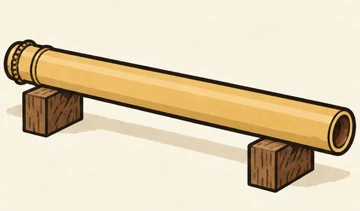 The body is a length of thin shino bamboo.
- 2
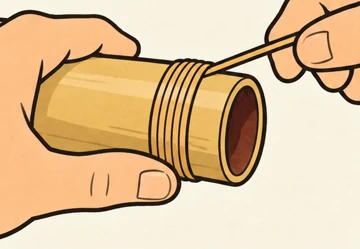 Rattan or cherry bark is wound around the ends and lacquered to stop the tube splitting.
- 3
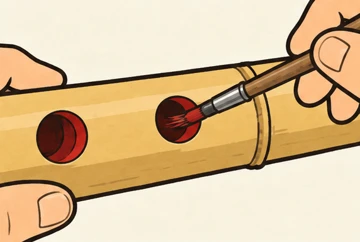 The inside of the bore is usually lacquered too.
- 4
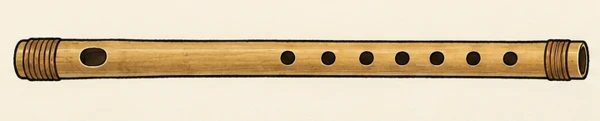 One blowing hole and seven finger holes, with no keys and no reed.
Technique differs from the Western flute too. To repeat a note, a shinobue player often does not tongue it; instead, a finger strikes a hole for an instant, a "beating" technique, sometimes called uchiyubi, that separates the notes without stopping the air. The result is a melody that never quite breaks, flowing like breath. Breath also chooses the register: gentle air gives the low register, ro; stronger air jumps to the upper register, kan; and above that lies the piercing daikan. Children learn by ear, singing the tunes in shōga, strings of vocal syllables that encode the melody and fingering (traditionally something like "hyā, hyaitoro"), before they ever pick up a flute, so the melody and the breathing are memorized together. At a festival, a flutist may play for hours while walking in a noisy crowd. The drums keep the time, but the thin line of the flute riding over the shouting is what people tend to remember.
05A Winter Night in Chichibu
The Chichibu Night Festival (Chichibu Yomatsuri) is the annual grand festival of Chichibu Shrine, in the mountains of western Saitama, about an hour and a half from central Tokyo by train. It takes place on December 2 and 3, with the main events on the night of the 3rd, and it is counted, with the Gion Matsuri and the Takayama Festival, among Japan’s three great float festivals.
The festival has 6 floats: 2 kasaboko (from Nakachika and Shitagō) and 4 yatai (from Miyaji, Kamimachi, Nakamachi and Motomachi). Each weighs more than 10 tons, is covered in carving and metalwork, and at night glows with hundreds of lanterns. The yatai can unfold side platforms into a stage, and in the daytime local troupes perform kabuki on them.
A local story explains why the festival happens at night. The deity of Chichibu Shrine, identified with the bodhisattva Myōken, is female; the god of Mount Bukō, the great limestone mountain looming over the town, is a male dragon. The two are said to meet once a year, on this night. So on the evening of the 3rd, the god’s procession and the 6 floats leave the shrine for the otabisho in Chichibu Park, which faces the mountain. The story has a complication: the dragon god already has a wife, the deity of the small Suwa Shrine in town, and when the Motomachi float passes that shrine, its musicians fall silent so as not to provoke her. The final approach is Dangozaka, a short, steep slope. Hundreds of people on the ropes haul each float up it in one rush, driven by the drums and the shouts of the haulers (the call is said to be "Hōryai!"), while winter fireworks burst overhead. December nights in Chichibu are often around freezing, and spectators in down jackets watch the lantern-lit floats rise through clouds of their own breath.
There is an economic story here as well. Chichibu had little flat farmland and lived by sericulture and silk weaving. In the Edo period, the festival coincided with the year’s great silk market, when merchants came from far away to buy Chichibu cloth, and the festival was nicknamed the "silkworm festival." The splendor of the floats was paid for by silk.
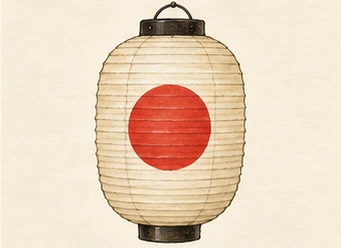
Paper lanterns hang in rows from the crossbars and are likened to bags of rice.
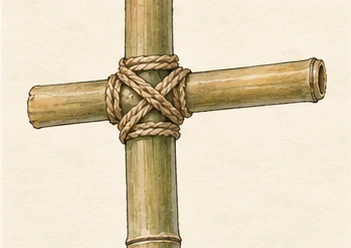
Many short bamboo crossbars are lashed to the long main pole.
06A Summer Night in Akita
The Akita Kantō Festival, held every year from August 3 to 6 in the city of Akita in northern Honshū, could hardly be more different. There is no float to haul and no god’s procession to follow. Instead, on a wide avenue closed to traffic, about 280 kantō (as of 2026) rise at once: long bamboo poles with crossbars hung with paper lanterns, about 10,000 lanterns in all.
The largest kantō, the ōwaka, stands about 12 meters tall, carries 46 lanterns on 9 crossbars and weighs around 50 kilograms. Smaller sizes, the chūwaka, kowaka and yōwaka, are handled by teenagers and children. The whole thing is meant to look like a heavy ear of rice, and the lanterns are said to stand for bales of rice, a prayer for a good harvest.
The show is entirely about the human body. A performer lifts the pole and balances it on an open palm, then transfers it to the forehead, the shoulder, the lower back. These positions have names: hirate (palm), hitai (forehead), kata (shoulder), koshi (hip). Some 12 meters above, the lanterns sway; below, the performer makes tiny adjustments with the feet and torso to keep the center of gravity in place. Once the pole is steady, teammates fit extension sections, tsugidake, onto the base, making it taller and harder still. When the wind catches it, the whole kantō bends like a bow, and sometimes it comes down, to a gasp from the crowd. The lanterns hold real candles, and when a pole falls the paper sometimes catches fire. Each lantern is painted with the crest of the neighborhood or company that owns the pole, so from a distance you can tell whose kantō is whose. Hayashi musicians play nonstop, and the crowd chants "Dokkoisho, dokkoisho."
The kantō grew out of a midsummer custom called neburi nagashi, "sending away sleepiness." Summer drowsiness and illness were attached to lanterns and branches and floated away down the river, along with prayers for the autumn harvest. An early record is usually traced to Yuki no furu michi, a 1789 travel account by the Edo merchant Tsumura Sōan, which describes the neburi nagashi held on the sixth day of the seventh lunar month. Today the Kantō is grouped with Aomori’s Nebuta and Sendai’s Tanabata as one of the three great festivals of Tōhoku, and in the daytime there are skill competitions where teams are judged on their technique.
07Who Makes a Festival
Behind each matsuri is a year of work by a neighborhood. Every shrine has its ujiko, the residents of the area it protects, and festivals are shared between the shrine and them: priests handle the rites, while neighborhood associations and preservation societies handle the mikoshi, floats and music. They store, repair and assemble the floats, rehearse the music, raise money, cook, and negotiate with the police over road closures. Before the festival, each district sets up a mikisho, a temporary station with sake for the god, and posts the names of donors and the amounts they gave, a very public ledger of who supports the community. Afterward comes the naorai, a meal where everyone shares the food and drink that were offered to the god.
Participants wear the happi coat, printed with the name or crest of their district, a twisted cotton towel around the head, close-fitting pants and split-toed jika-tabi boots. Many people start out carrying a children’s mikoshi or beating a small drum and grow up to shoulder the main mikoshi as adults; a person’s life and a neighborhood’s festival move forward together.
The problem now is people. Young people leave the countryside, old city neighborhoods are aging, and some mikoshi can no longer be lifted by the locals alone. Clubs of mikoshi enthusiasts travel to festivals to lend their shoulders. Some festivals now invite outside volunteers, including foreign residents and visitors, and many have moved from fixed dates to the nearest weekend so that people who work elsewhere can come home. In 2020 and 2021, the pandemic canceled most festivals or reduced them to private rites, and when they returned, some communities found that two years without practice had left gaps in the passing down of music and skills.
08How to Watch a Matsuri
Check the schedule and the route. Large festivals publish the paths and approximate times of their mikoshi and floats, and the best moments are usually specific: the mikoshi leaving or returning to the shrine, a float turning at an intersection, the climb up Dangozaka in Chichibu, the moment the kantō all rise together in Akita. The best spots fill early, so rather than waiting in one place, it often pays to walk the route and follow the sound of the hayashi.
Give the procession room. A mikoshi crowd is heavy and unpredictable, so do not stand in the middle of the street or crowd in for a photo. Do not touch the mikoshi, and never try to climb on it; at the Sanja Matsuri, people standing on top of the main mikoshi have been criticized for years, and some have been arrested. The same goes for float ropes unless you are invited. Some festivals do let visitors carry or haul, and lend you a happi coat for the day.
The other half of the fun is the stalls. Along shrine approaches and procession routes, vendors sell takoyaki, yakisoba, grilled squid, candied apples and shaved ice, and run goldfish scooping and target shooting. In summer, a cotton yukata is the right thing to wear. Trash cans tend to be scarce, so plan to carry your garbage home.
And if you stumble across a small, unknown festival in a country town, stop and watch. There may be only one modest mikoshi, an old float and a few children on drums, but the seriousness is the same as at the famous ones. For one day, the god is out of its shrine and making its rounds, and the neighborhood is out to meet it.