
At a glance
Why Japanese fireworks burst as perfect spheres, how the Edo-era Sumida River show grew into national contests and memorial displays, and how to watch one.
- Fireworks festivals cluster from late July through August, usually on riverbanks, lakeshores or harbors, peaking around Obon.
- Traditional Japanese warimono shells burst into a perfect sphere from any angle; a shakudama, or No. 10 shell, opens about 300 m across.
- Fireworks festivals are generally traced to 1733, when a water-god rite and the river-opening fireworks were held at Ryōgoku on the Sumida.
- The cries 'Tamaya!' and 'Kagiya!' come from two Edo fireworks makers; Kagiya survives today in its 15th generation.
- The 'three great fireworks festivals’ are usually named as Ōmagari, Nagaoka and Tsuchiura; Ōmagari and Tsuchiura are national competitions.
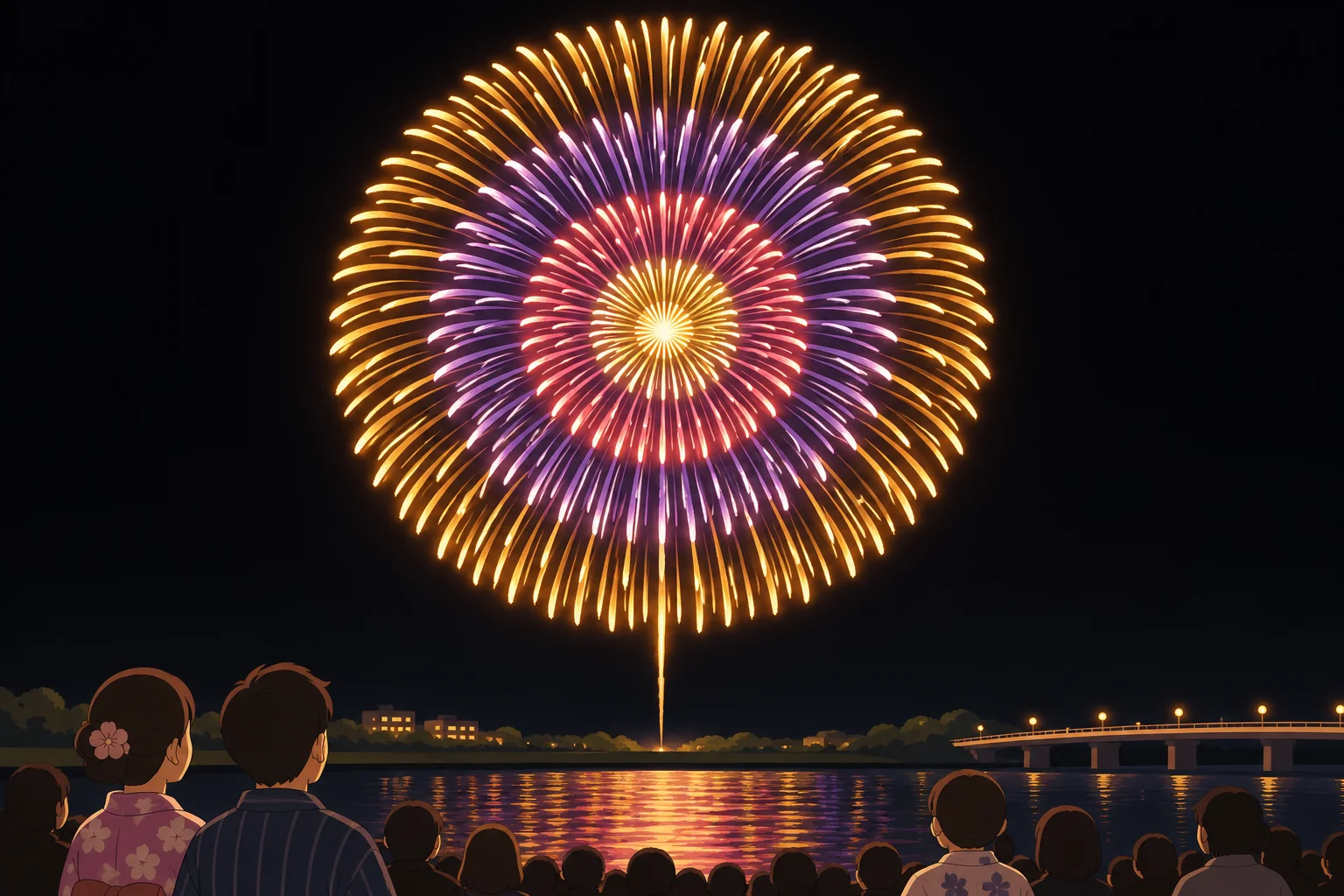
On almost any summer Saturday in Japan, somewhere a riverbank is filling up with people waiting for dark. They have spread blue tarps on the grass since the afternoon, they are wearing cotton summer kimono, and they are eating fried noodles from a stall. When the first shell goes up, the whole crowd says "ooh" at once. Japanese fireworks festivals, hanabi taikai, are among the largest public gatherings in the country, and the fireworks themselves are made in a way that is distinctly Japanese: round, symmetrical, and judged with a craftsman’s eye. This piece explains what a hanabi night is like, how the shells are built, where the tradition came from, and how to go to one yourself.
01A Night on the Riverbank
The word hanabi is written with the characters for "flower" and "fire". The season runs from late July through August, peaking around Obon, the midsummer festival when families welcome back the spirits of their ancestors. Most shows are held over rivers, lakes or harbors, for a practical reason: fireworks need a large empty safety zone, and water provides one, while the banks can hold tens or hundreds of thousands of spectators.
The Sumida River show in Tokyo has drawn close to a million people in recent years (about 920,000 in 2026, according to reports). Ōsaka has the Yodogawa show, Yokohama and Tokyo Bay have harbor shows, and Lake Biwa has its own. But much of the character of the tradition lives in small towns, where a show of a few thousand shells is the single liveliest night of the year and everyone who has moved away tries to come home for it.
By late afternoon the embankments are a patchwork of tarps, each weighted with shoes or marked with a name in tape. Along the roads to the station, food stalls called yatai sell yakisoba, takoyaki (octopus dumplings), chicken skewers, shaved ice drenched in syrup, and candied apples; children try to scoop goldfish with paper nets. Many people, especially teenagers and young couples, wear a yukata, the light cotton kimono of summer, with wooden sandals called geta. In Japanese pop songs, films and manga, a summer romance almost always has a fireworks scene; going to the hanabi together is a rite of first dates.
After dark the program begins. Shells go up in sets, with pauses between them, and an announcer reads the name of each set and its sponsor: a construction company, a shopping street, a local bank, sometimes a family celebrating a child’s birth or remembering a parent who died. The large shows end with a star-mine, a rapid-fire barrage in which hundreds of shells burst in a minute or two, filling the whole sky. Then it goes quiet, people applaud, and a slow exodus begins.
02Why Japanese Fireworks Are Round
What Japanese fireworks makers are proudest of is the perfect sphere. A classic Japanese shell bursts into a globe that looks circular from any direction: from the riverbank, from a bridge, from the window of a tower a kilometer away. Many Western fireworks traditions favored cylindrical shells and effects designed to be seen from one side; the Japanese ideal is the full round flower.
The traditional large shell is called a warimono, a "breaking" shell. It is a ball of laminated paper. Packed against its inner wall, layer by layer, are the hoshi, or "stars": small pellets of pyrotechnic composition that burn and glow. At the center sits the bursting charge. The shell is fired from a mortar, its time fuse burning as it climbs, and at the very top of its arc the fuse ignites the burst. The paper ball splits and every star flies outward at the same speed in every direction, so that the burning stars trace the surface of an expanding sphere.
- 1
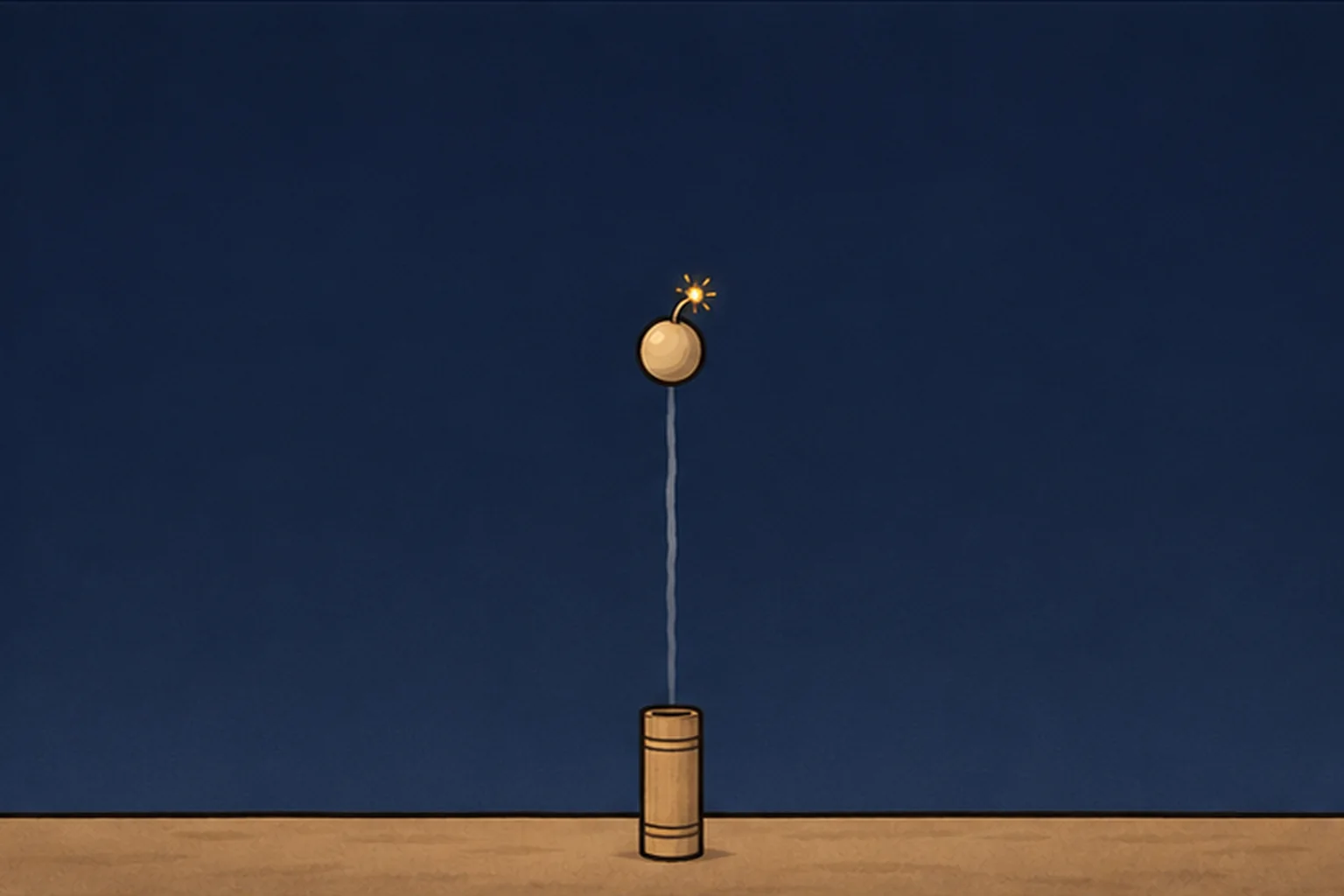 The shell is fired from a mortar, its time fuse burning as it climbs.
- 2
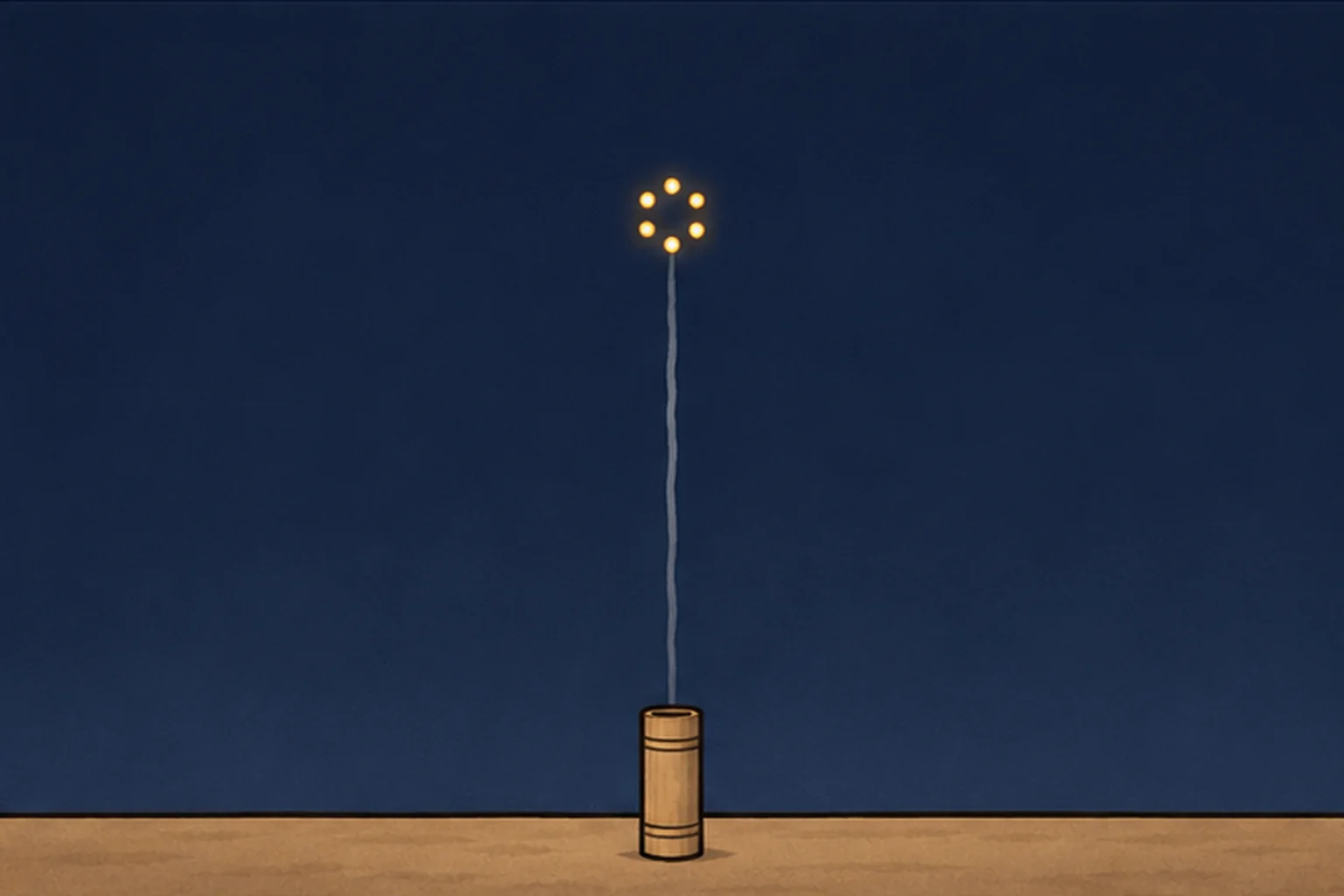 At the very top of its arc the fuse ignites the burst and the paper ball splits.
- 3
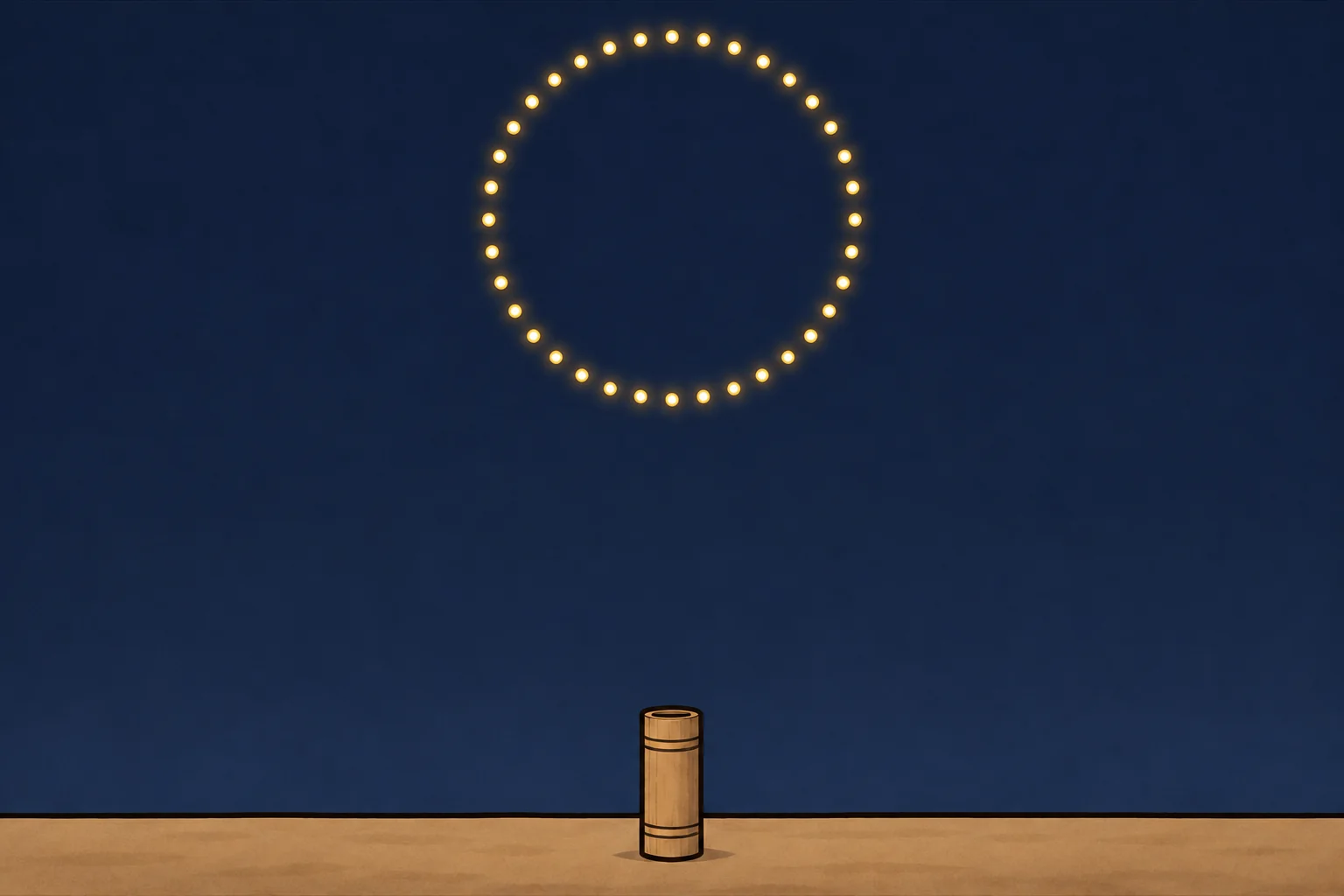 Every star flies outward at the same speed in every direction, tracing a sphere.
- 1Fired from a mortar
- 2Time fuse burns during the climb
- 3At the top, the fuse ignites the burst
- 4The ball splits; stars fly out evenly in every direction
- 5Stars burn, change color, go outthe best change together and vanish at once
Every star flies outward at the same speed in every direction, tracing the surface of an expanding sphere.
Craftsmen judge a shell on a handful of things. Did it open at the apex? Is the circle true, with no gaps or stragglers? Did all the stars change color at the same instant, and did they go out together? A shell whose stars die one by one, like a fading sparkler, is considered clumsy. The best have a crisp ending: the whole globe vanishes at once.
The basic forms have flower names. A kiku, or chrysanthemum, has stars that leave trailing tails, like petals. A botan, or peony, has stars that burn as bright points without tails. A master can nest smaller spheres inside the shell, so that two or three concentric rings appear at once; these are called yae-shin and mie-shin, double-core and triple-core. Four- and five-core shells are showpieces of individual makers. Other families of shells split open to release falling willows, glittering effects or small sub-shells, and katamono, or pattern shells, draw shapes in the sky: smiley faces, butterflies, hearts, cartoon characters.

A botan, or peony: the stars burn as bright points without tails.
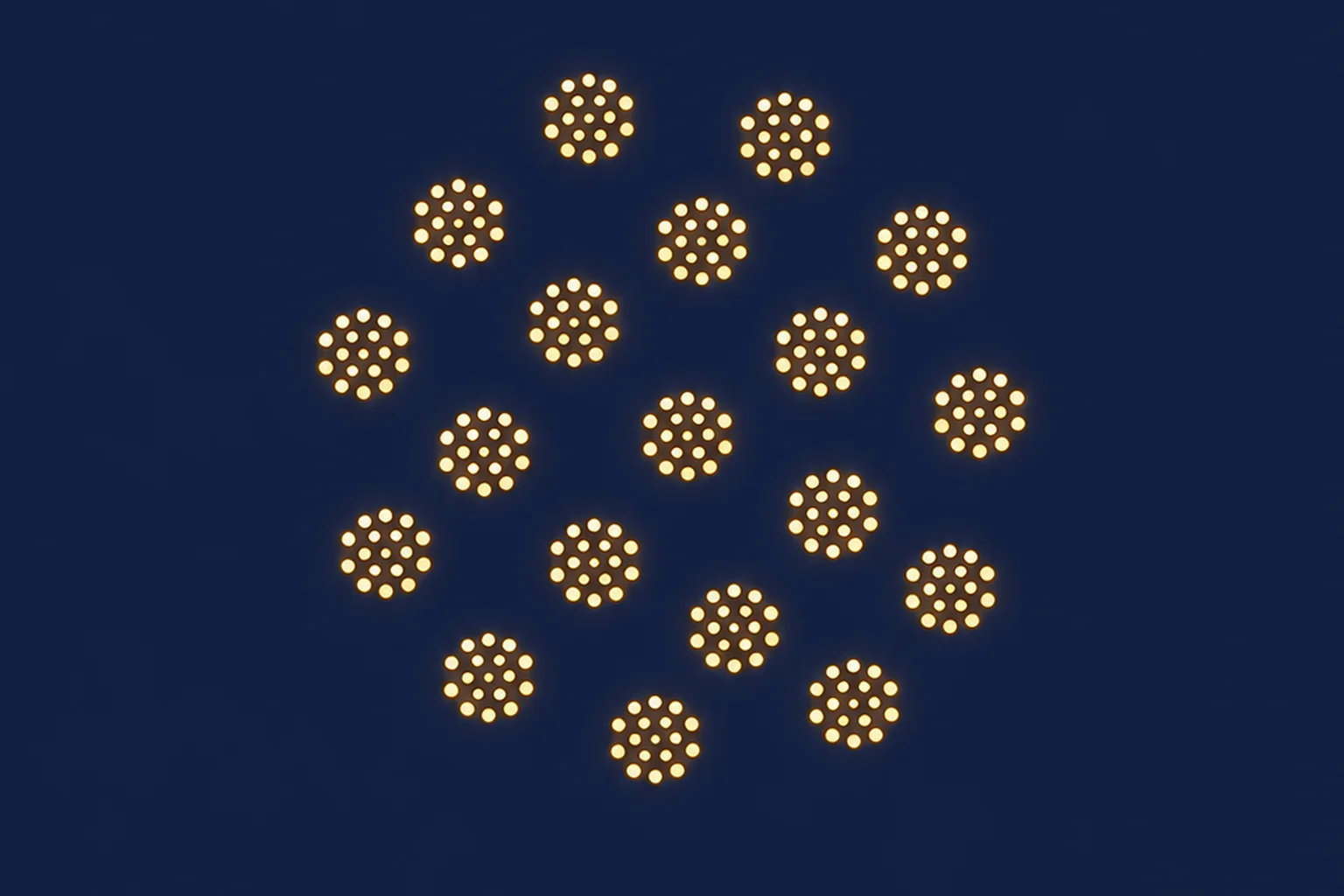
A shell that splits open to release small sub-shells, which bloom together as a scatter of little flowers.
Shells are sized by the diameter of the mortar, measured in gō; one gō is about 3 centimeters. The standard big shell is the shakudama, a "one-foot shell" of 10 gō, roughly 30 centimeters across. It climbs over 300 meters and opens into a flower about 300 meters wide. From launch to burst takes only a few seconds, often said to be seven or eight, and the boom reaches the riverbank a second or so after the light, a thump you feel in your chest. A few festivals specialize in giants: Katakai in Niigata Prefecture and Kōnosu in Saitama are known for yonshakudama, four-foot shells more than a meter across and weighing several hundred kilograms, whose bursts span some 700 to 800 meters.
Color is a relatively modern addition. Edo-period fireworks were made from charcoal, sulfur and saltpeter, and burned in shades of warm orange. These are now called wabi, "Japanese fire". From the Meiji era (1868–1912), imported chemicals such as potassium chlorate and salts of strontium, barium and copper gave reds, greens and blues, known as yōbi, "Western fire". Some makers still include a set of wabi in their programs, so audiences can see the soft amber glow that Edo crowds knew.
03From Edo’s River to the Present
Gunpowder came to Japan with firearms in the mid-sixteenth century, and fireworks followed. A frequently told story is set at Sunpu (modern Shizuoka) in 1613: Ming Chinese merchants brought an envoy of the English king to meet the retired shogun Tokugawa Ieyasu, and a few days later Chinese men set off fireworks for Ieyasu in the castle’s second enclosure. Fireworks then became fashionable among the warrior elite. In the city of Edo, now Tokyo, fireworks soon became a popular pastime, so popular that the shogunate repeatedly banned setting them off in the streets because of the fire risk in a city of wooden houses.
The origin of the hanabi taikai is usually traced to 1733. The previous year, famine had struck western Japan and epidemic disease had swept Edo, killing many. In 1733 the shogunate held a water-god festival by the Sumida River at Ryōgoku to console the dead and drive away misfortune, and fireworks are said to have been set off (some accounts say the fireworks began the following year, and some recent historians doubt this origin story altogether). The date coincided with kawabiraki, the "river opening" that started the summer season of pleasure boats and evening cooling-off on the water. Fireworks became the centerpiece of the river opening every year after, and the Ryōgoku fireworks grew into Edo’s biggest summer spectacle. Ukiyo-e prints by Hiroshige and others show Ryōgoku Bridge packed with people, the river crowded with boats, and bursts of fire hanging in the night sky.
Two fireworks houses supplied the show. Kagiya, traditionally said to have been founded in 1659 by a man named Yahei, was the older. A Kagiya apprentice later set up on his own as Tamaya, and the two firms took the upstream and downstream sides of the bridge and competed shell by shell. The crowd cheered the house that impressed them by shouting its name: "Tamaya!" or "Kagiya!" Japanese people still shout "Tamaya!" half in jest when a big shell bursts. Tamaya was the more popular for a time, but in 1843 a fire broke out at its premises and spread to the surrounding neighborhood, and the house was banished from Edo. It lasted only one generation. Kagiya survives to this day, now in its fifteenth generation.
The Sumida show weathered the Meiji transformation and returned after a wartime suspension, but after 1961 it was halted because of worsening traffic, at a time when the river was also badly polluted. It was revived in 1978 as the Sumida River Fireworks Festival, moved upstream near Asakusa, and as of 2026 is still held on the last Saturday of July.
04The Big Three: Ōmagari, Nagaoka, Tsuchiura
The Sumida show descends from Edo’s pleasure culture. Another kind of hanabi taikai is a contest among craftsmen. Of the three shows often grouped together as Japan’s greatest, Ōmagari and Tsuchiura are national competitions; Nagaoka is not a contest, and is famous for its scale and its memorial meaning.
The National Fireworks Competition at Ōmagari, in the city of Daisen in Akita Prefecture, is still held on the last Saturday of August as of 2026, and traces its history to 1910. The country’s leading fireworks companies enter shells and programs that are scored by expert judges, and the top prize is the Prime Minister’s Award. Ōmagari is also unusual for its daytime fireworks, which use colored smoke to paint patterns against the sky. In big years around 700,000 people have come, many times the town’s population.
The Nagaoka Festival fireworks in Niigata are fixed on August 2 and 3 rather than moved to a weekend, and the dates matter. On the night of August 1, 1945, American bombers burned most of Nagaoka, killing more than 1,400 people. The following year the city held the Nagaoka Reconstruction Festival, and in 1947 the fireworks returned. Today both nights open with Shiragiku ("white chrysanthemum"), pure white fireworks fired in memory of the dead of the air raid and the war (some accounts describe them as white one-foot shells). After the Chūetsu earthquake struck the region in 2004, Nagaoka added "Phoenix" in 2005, an enormously wide barrage spread about 2 kilometers along the Shinano River and set to Hirahara Ayaka’s song "Jupiter". It has become the emotional peak of the night.
The Tsuchiura National Fireworks Competition in Ibaraki Prefecture is held in autumn, usually October or November, and is best known for its star-mine category, where makers show off new techniques in rapid-fire programs.
Beyond these three, the hot-spring town of Atami on the Izu Peninsula holds harbor shows through much of the year, and Lake Suwa in Nagano and the Miyagawa in Mie have their own famous nights. The underwater fireworks festival at Miyajima in Hiroshima Prefecture is staged with the shrine’s great torii standing in the sea behind it; it was suspended after 2019 and returned in October 2025 as an autumn event under the name Itsukushima Underwater Fireworks Festival, but the 2026 edition was called off because safety concerns could not be resolved.
05Why It Matters
Japanese people often explain their love of fireworks the way they explain their love of cherry blossoms: the beauty ends at its height. A one-foot shell blooms for a few seconds; then the stars go out and the sky is black again. Modern haiku almanacs list hanabi as a seasonal word for summer, though Edo-period haikai mostly placed it in autumn, as a sight of the Obon season. Poets tend to write less about the brilliance than about the darkness and silence that follow it.
Fireworks are also bound up with mourning and prayer. The Sumida show began as a rite for victims of famine and plague. Nagaoka’s white chrysanthemum is for the dead of an air raid. Many shows around Obon carry a sense of seeing off the ancestral spirits who have come home for the holiday. After the earthquake and tsunami of March 2011, coastal towns in the northeast held fireworks within months: on August 11, 2011, Light Up Nippon, a project started by a group of volunteers in Tokyo, set off memorial fireworks simultaneously at about 10 sites along the Tōhoku Pacific coast, and it continued to do so around that date every year through 2021. For many people a hanabi night is both a summer treat and a way of remembering together under the same sky.
And it is deeply local. A town’s show is paid for by its shops, businesses and residents, and every set on the program carries the name of whoever paid for it. Listening to the announcer read out those names, between bursts, is part of the experience: it is a town introducing itself to itself.
06Going to One
If you are in Japan in summer, check what is on near you; big festivals announce their dates in spring. Shows are postponed or canceled for strong wind or heavy rain, so look at the official site on the day. More and more festivals now offer paid reserved seating, which spares you the wait and puts you closer to the launch site. Watching for free is still possible, but at the big city shows people stake out spots by early afternoon.
A yukata is the right thing to wear; department stores sell complete sets in summer, and rental shops in places like Kyoto and Asakusa will dress you. Bring a tarp or something to sit on, a fan, insect repellent and water. Toilet lines are long, so go early. Try to sit upwind of the launch site: downwind, the smoke drifts toward you and blurs the second half of the show.
The real challenge is leaving. When several hundred thousand people head for the trains at once, stations restrict entry, and waiting an hour or more is normal. Some people leave a little before the finale; others sit and wait for the crowd to thin. Follow police and staff instructions in crowded spots. In 2001, after a fireworks show in Akashi, Hyōgo Prefecture, a crush on a pedestrian bridge killed eleven people, and crowd management has been far stricter since.
If you miss the big shows, convenience stores and supermarkets sell handheld fireworks for the backyard or the beach. Save the senkō hanabi for last. It is a thin twist of paper with a bead of powder at the tip; lit, it forms a tiny glowing ball that spits delicate branching sparks, softens, flickers, and finally drops. Friends crouch in a circle to see whose bead holds on longest, and for many Japanese it is the last image of summer.