
At a glance
Where Japan’s era names came from, how they are chosen and why they change, from Taika to Reiwa, and how to read them on coins, forms and lanterns.
- Era names (gengō) originated in China; Japan is the only country that still uses them officially.
- The first era name, Taika, began in 645; since Taihō in 701 era names have been used without a break.
- Counting from Taika, Reiwa is the 248th era name; add 2018 to a Reiwa year to get the Western year.
- Since 1868 the rule has been one era per emperor, changed only when a new emperor takes the throne.
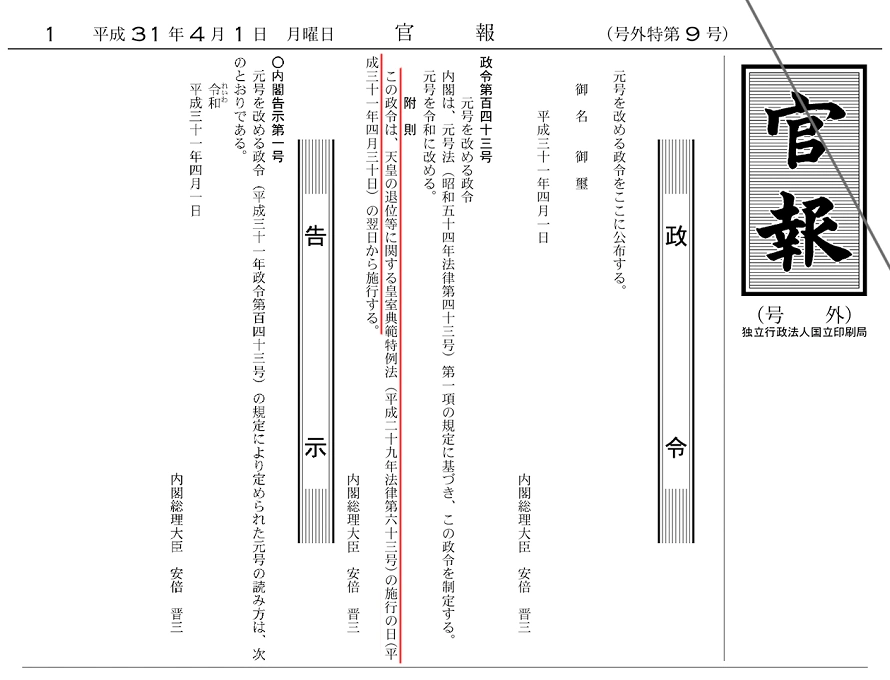
- Reiwa is the first era name drawn from a Japanese classic: the preface to the 32 plum-blossom poems in Book 5 of the Man’yōshū.
Look closely at a letter from a Japanese city office, a form at a bank or a ¥100 coin and you will often find a year that does not match the calendar on your phone. Instead of the Western year, an official notice will give the Reiwa year: Reiwa 8, for example, corresponds to 2026. Japan is the last country in the world that officially numbers its years by era names, a system borrowed from imperial China some 1,400 years ago. The names are chosen with great care, drawn from classical texts and announced on national television, and they shape how Japanese people think about their own past. To call something "very Shōwa" is to say a great deal in two words. This is a guide to what era names are, where they came from, how a new one is chosen, and where you will run into them on a trip to Japan.
01What an era name is
An era name, called gengō or nengō in Japanese, is a title given to a span of years. The first year of the era is year one (written gannen, "the origin year"), and the count runs on from there until a new name is proclaimed. Reiwa 1 was 2019, Reiwa 2 was 2020, and so on. The Western calendar is used alongside it, and converting between the two is a piece of mental arithmetic most Japanese people learn early: add 2018 to a Reiwa year, 1988 to a Heisei year and 1925 to a Shōwa year.
The idea goes back to China. Emperor Wu of the Han dynasty is credited with the first era name, Jianyuan, around 140 BCE, and Chinese dynasties kept the practice for two thousand years until the last emperor’s reign, Xuantong, ended with his abdication in 1912, after the revolution of 1911. Korea and Vietnam used era names too. All of them gave the system up. Japan kept it.
Behind it lay a political idea. In the Chinese world, the ruler governed not only land and people but time itself. Issuing the calendar and naming the years were acts of sovereignty, and adopting your own era names rather than China’s was a quiet statement of independence. When Japan took up the system, it took up that meaning too, which is why the history of era names is also a history of who held power in Japan.
02From Taika to the Meiji Restoration
Japan’s first recorded era name is Taika, "Great Change," which began in 645. That year Prince Naka no Ōe and Nakatomi no Kamatari assassinated the powerful courtier Soga no Iruka inside the palace and launched a program of reforms modeled on Tang China, known as the Taika Reforms. The custom did not take hold at once; there were long gaps with no era name at all. Only with Taihō, beginning in 701, the year the Taihō legal code was issued, did era names run continuously, and they have done so ever since. Counting from Taika, Reiwa is the 248th.
For most of Japanese history, eras changed far more often than emperors did. One common reason was a lucky omen. In 708 the province of Musashi presented the court with a lump of naturally occurring copper from Chichibu, and the era was renamed Wadō, "Japanese copper"; the court celebrated by minting one of Japan’s earliest coins. An auspicious turtle, a white pheasant and an auspicious cloud each prompted a new name, giving Japan eras called Reiki ("Spirit Turtle"), Hakuchi ("White Pheasant") and Keiun ("Auspicious Cloud").
The opposite reason was disaster. When earthquakes, fires, epidemics or famines piled up, the court concluded that the current name was unlucky and replaced it in the hope of better fortune. From the Heian period on, these changes became frequent, and some eras lasted barely a year or two. Chinese cosmology added a further trigger: years with certain positions in the sixty-year cycle, known in Japanese as kanoto-tori and kinoe-ne, were thought to bring upheavals in the mandate of heaven, and the court often changed the era when one came round. Add the change that usually marked a new emperor’s accession, and it is no surprise that the average Japanese era lasted only about five years.
Choosing a name was a scholarly ritual. Court scholars, usually experts in Chinese literature, combed the classics for promising phrases and submitted written proposals. The nobles then debated them in a session called nanchin, picking apart each candidate: one character might appear in an ill-omened passage of an ancient text, another might sound too much like an unlucky word. As warrior governments rose, they took a hand in the process, and in the Edo period the shogunate in practice had to approve the court’s choice before it was proclaimed.
The system had its oddities. In the fourteenth century, during the period of the Northern and Southern Courts, two rival imperial lines each issued their own era names, so a single year could have two. And outside official channels, people sometimes used unofficial era names, known as shinengō, which turn up on temple bells and stone inscriptions and are prized by local historians.
03One reign, one era
In 1868 the new Meiji government decreed that each emperor would have a single era name for his whole reign, a rule called issei ichigen, "one reign, one era." Omens and disasters would no longer prompt a change; only a new emperor would. The model was Ming and Qing China, where emperors almost always kept one era name each, which is why Western books speak of the "Kangxi Emperor."
The rule had a lasting side effect. After an emperor dies, the name of his era becomes his name. The emperors known as Meiji, Taishō and Shōwa are called that posthumously. While an emperor is alive, Japanese people refer to him simply as Tennō Heika, "His Majesty the Emperor," never by the era name. By the same custom, the present emperor, Naruhito, is expected to be called the Reiwa Emperor only after his death.
According to a widely told account, the name Meiji, "enlightened rule," was chosen by the young emperor himself drawing lots from a set of candidates. It comes from the Book of Changes: the sage faces south, listens to the realm, and governs turned toward the light. Taishō, "great rightness," also comes from the Book of Changes, and Shōwa, "illustrious harmony," from the Book of Documents, in a line about the people being enlightened and all nations living in concord. Every era name from Taika to Heisei whose source is known was taken from a Chinese classic. The Book of Documents and the Book of Changes are generally said to be the most frequently quoted.
Under the new rule, the length of an era simply matched the reign. Emperor Shōwa (known in the West as Hirohito) reigned for over sixty years, so Shōwa became the longest era in Japanese history, running from December 25, 1926, to January 7, 1989. Its final year, Shōwa 64, lasted just seven days.
The Shōwa era also began with an embarrassment. On the day Emperor Taishō died in 1926, the Tokyo Nichi Nichi newspaper rushed out a scoop that the new era would be called Kōbun. The Imperial Household Ministry then announced Shōwa. The paper was humiliated and its editor-in-chief resigned. Whether Kōbun was ever on the official shortlist, and whether the leak caused it to be dropped, is still argued over.
04Heisei and Reiwa: era names on live television
After the Second World War, the legal basis for era names lapsed along with the old Imperial House Law, and for decades Shōwa continued by custom alone. After a long political debate, the Diet passed the Era Name Law in 1979. It has just two provisions: the era name is set by cabinet order, and it changes only when a new emperor succeeds. The choice passed from the court to the government, which consults scholars before deciding.
The government also adopted guidelines. A new name should carry a good meaning suited to the ideals of the nation; consist of two kanji; be easy to write and to read; not have been used before as an era name or an emperor’s posthumous name; and not be a word in everyday use. Officials were also reported to avoid names whose romanized initial clashed with the recent eras, because Japanese forms routinely abbreviate them as M, T, S and H. Reiwa’s R avoided that problem.
Emperor Shōwa died on the morning of January 7, 1989. That afternoon Chief Cabinet Secretary Obuchi Keizō faced the cameras and held up a white board on which the characters for Heisei were brushed in ink. The image became one of the most recognizable moments in modern Japanese television, and Obuchi was nicknamed "Uncle Heisei." The name combines phrases from the Records of the Grand Historian and the Book of Documents meaning peace achieved at home and abroad, in heaven and on earth. Heisei began the next day, January 8.
The next transition was entirely different. In 2016 Emperor Akihito, then in his eighties, gave a rare televised address hinting that he wished to step down. The government passed a one-off law to allow it, and on April 30, 2019, Akihito abdicated; his son Naruhito succeeded the following day. It was the first abdication in about two hundred years, since Emperor Kōkaku in the early nineteenth century.
Because the date was known in advance, the name could be announced ahead of time, and it became a national event. On April 1, 2019, Chief Cabinet Secretary Suga Yoshihide repeated Obuchi’s gesture and held up a board reading Reiwa. Millions watched live, and guessing games, and reportedly even betting pools, had run online for weeks beforehand.
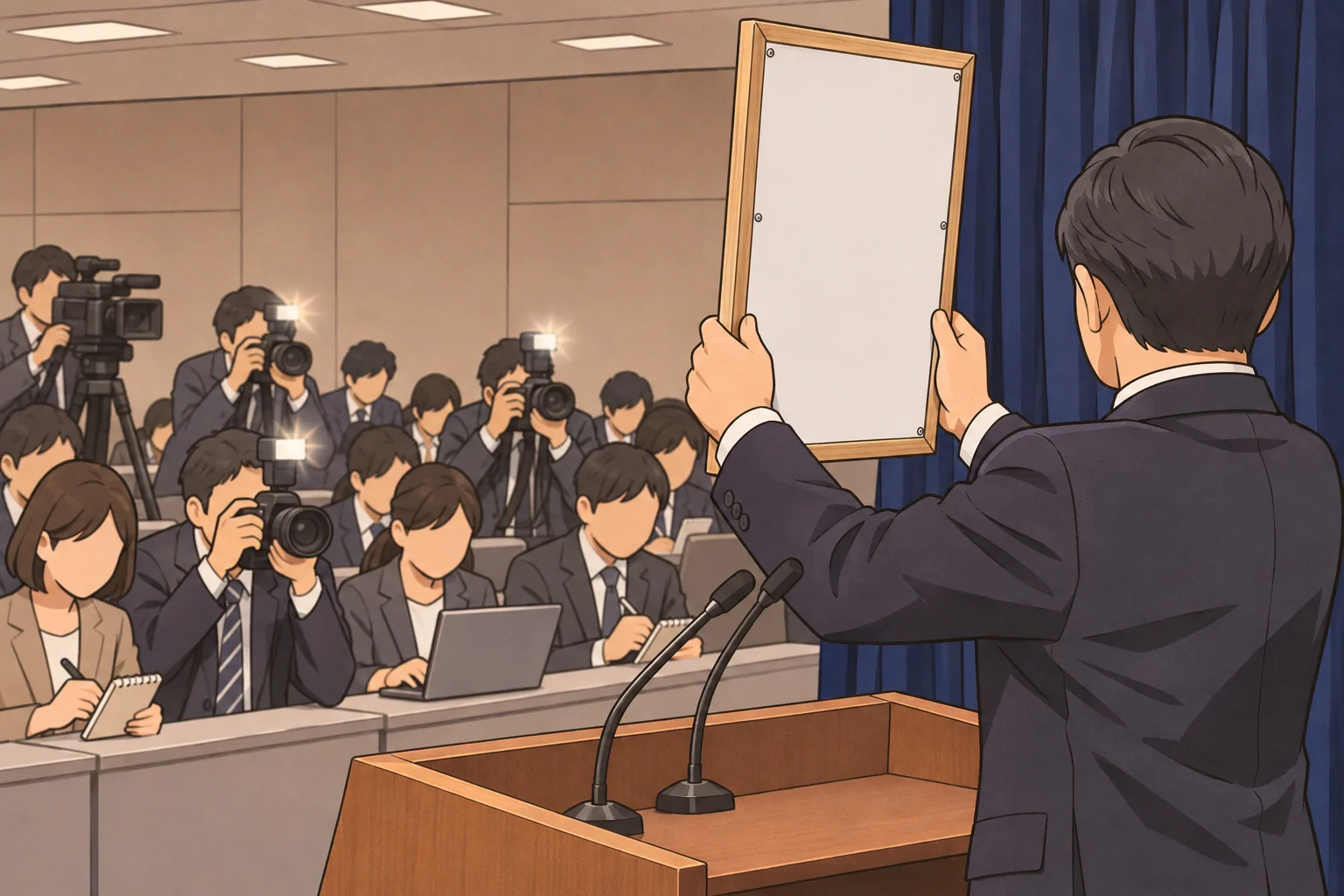
At a press conference announcing a new era name, an official holds up the brushed board to the press (illustration, seen from behind).
Reiwa broke a habit of more than 1,300 years. It was the first era name taken from a Japanese rather than a Chinese source: the preface to a group of thirty-two poems on plum blossoms in the Man’yōshū, Japan’s oldest anthology of poetry. In early 730, Ōtomo no Tabito, governor of Dazaifu in Kyūshū, hosted a plum-viewing party at his residence, and the preface describes the scene: it was a fine month in early spring, the air was clear and the breeze was gentle. The rei of Reiwa comes from "fine month" and the wa from "gentle." The government said the name expressed the hope that culture would be born and flourish as people’s hearts came beautifully together.
Not everyone was satisfied. Rei had never been used in an era name before, and its most familiar meaning in modern Japanese is "order" or "command," which some found an odd note to strike; officials stressed its older sense of "beautiful" or "auspicious." Scholars also pointed out that the Man’yōshū preface was itself modeled on a line by the Chinese poet Zhang Heng, from his "Rhapsody on Returning to the Fields," which also pairs a "fine month" in spring with harmonious, clear air. Reiwa’s roots, in other words, still reach back to China.
05Living with two calendars
For all the talk of modernization, era names remain deeply embedded in Japanese paperwork. Driver’s licenses, residence certificates and many government and bank forms use them. Coins are stamped with the era year. Many Japanese people can tell you instantly that they were born in Heisei 3 but need a moment to work out that it was 1991.
At the same time, the Western calendar has steadily gained ground in business, the media and online services, and many people find the double system a nuisance. The 2019 change forced companies and agencies to update software that had been written with the Heisei name built in, a scramble some compared to the Y2K problem. The Unicode Consortium even reserved a code point in advance so that the new name could be shown as a single combined character, and after the announcement it was filled with ㋿, the two characters of Reiwa squeezed into one square.
Era names have also become the units by which Japanese people divide their own history. Shōwa conjures up the war, the ruins, then the decades of high-speed growth: old-fashioned coffee shops with red velvet seats, neon signs, boxy television sets. "Shōwa retro" is a whole aesthetic, sold in cafés, theme streets and design. More recently "Heisei retro," the look of flip phones, purikura photo booths and 1990s fashion, has had its own revival among young people who barely remember it. People speak of a "Shōwa man" to mean a certain stubborn, old-school type, and talk about generations in terms of the era they were born in.
That is why the change of era can feel like a collective farewell. On the night of April 30, 2019, crowds packed the Shibuya crossing in Tokyo to count down the final seconds of Heisei, much as they would on New Year’s Eve. Shrines issued special goshuin, the stamped calligraphy seals pilgrims collect, dated the first day of Reiwa, and people queued for hours to get one. Marriage registrations spiked as couples chose to begin their new lives with the new era.
06Spotting era names on your travels
Once you start looking, era names are everywhere in Japan. Turn over the coins in your pocket and you will find Heisei or Reiwa years, and on older ones Shōwa. Old shops in traditional shopping streets display their pedigree on their signs with phrases like "founded in Meiji 20" or "established Taishō 5," a claim of longevity Japanese customers immediately understand.
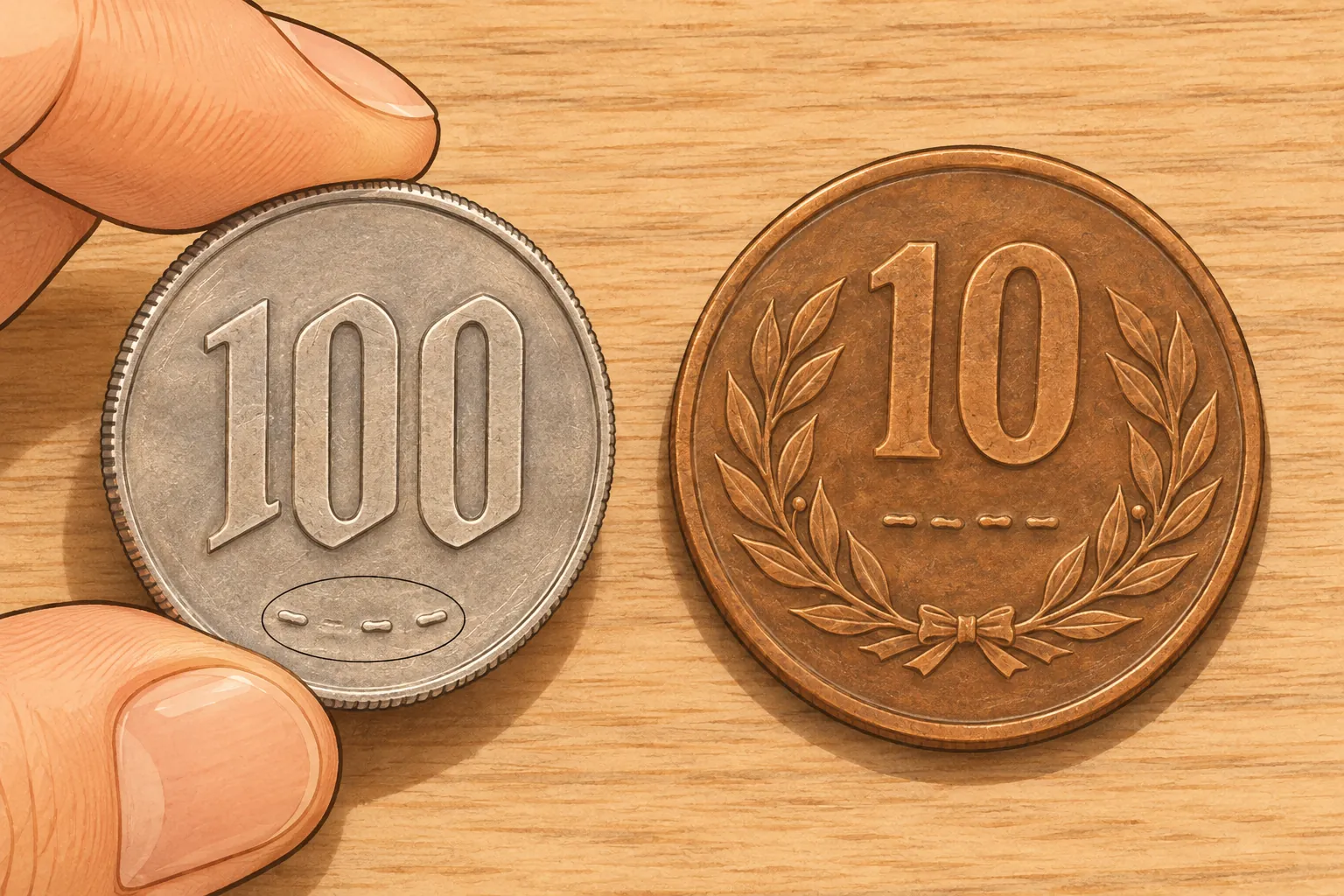
On Japanese coins, the small line under the denomination gives the year of issue in the era system (illustration).
Shrines and temples are the richest hunting ground. Stone lanterns, torii gates and bell towers often carry inscriptions with Edo-period era names such as Kansei, Bunka, Bunsei or Tenpō, together with the names of the donors who paid for them. Knowing the rough dates of a few of these lets you read the age of a lantern at a glance. In museums, documents, sword tangs and the bases of ceramics are dated the same way.
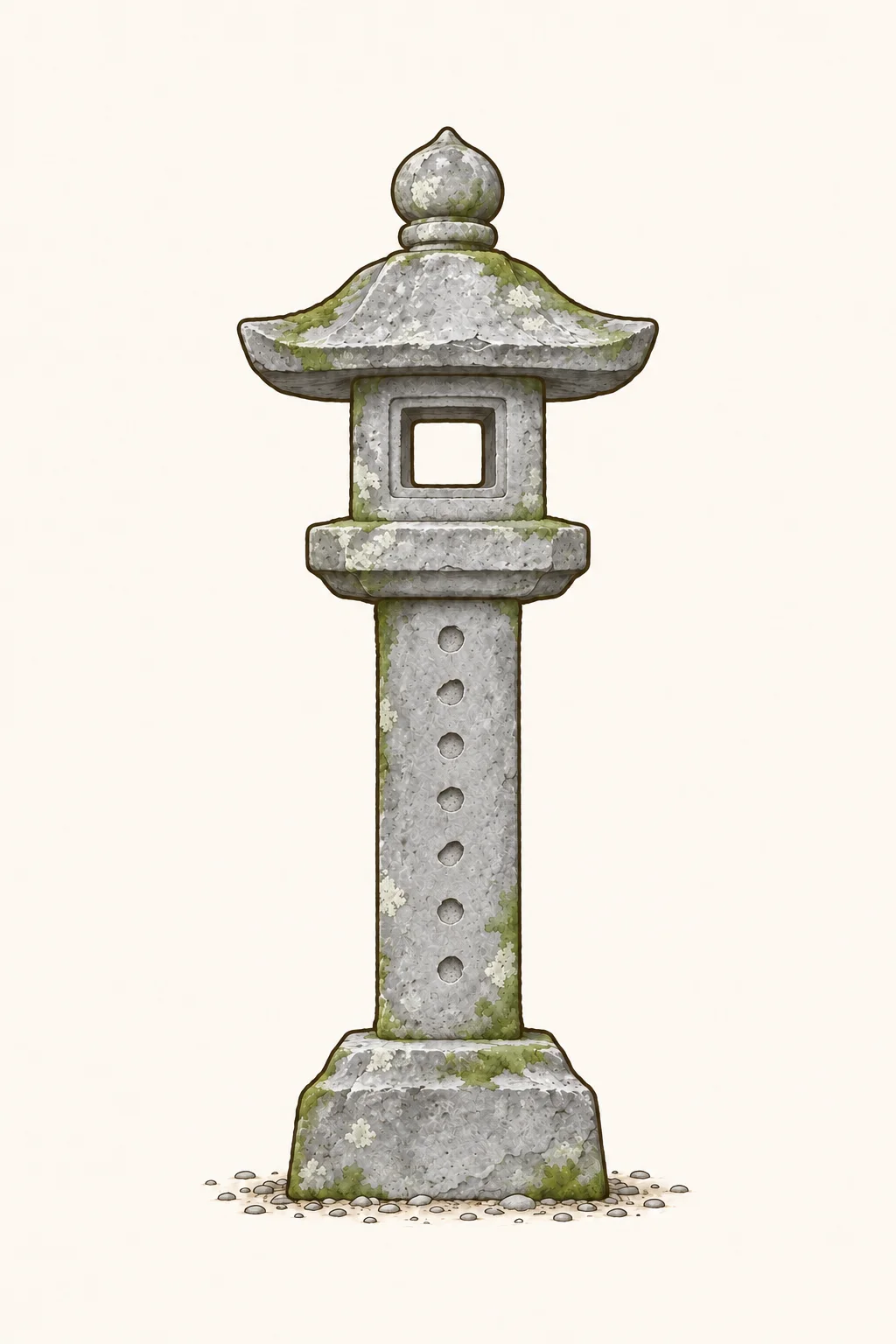
The shaft of a stone lantern often carries an era name, which tells you roughly how old it is.
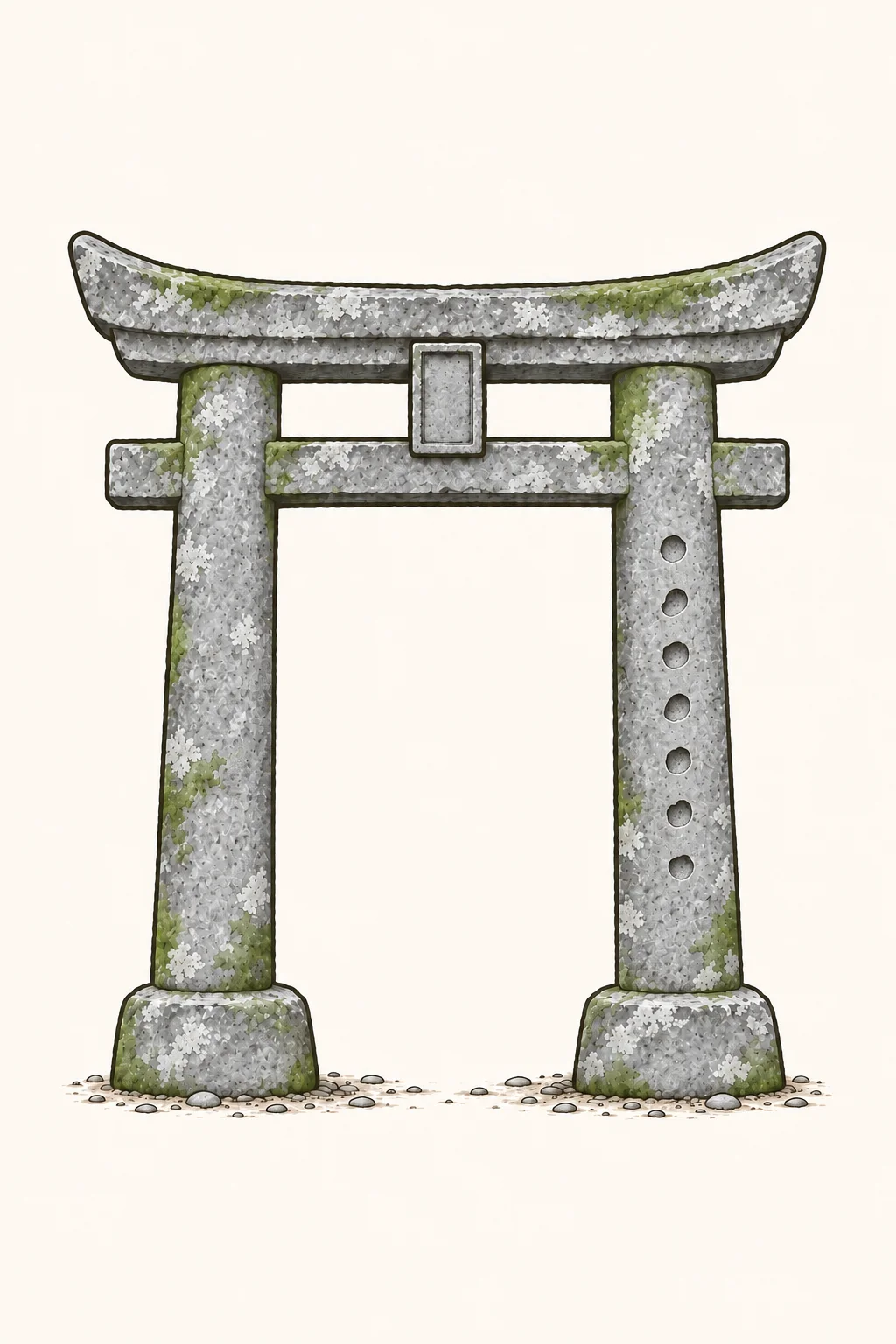
A stone torii often has the same kind of inscription on a pillar, with an era name and the donors’ names.
Era names have also become the labels of history. The Ōnin War that devastated Kyoto in the fifteenth century, the Kyōhō Reforms of the eighteenth century, the Tenmei famine and the Ansei earthquakes are all named after the era in which they happened. In Kyoto and Nara you will meet names like Tenpyō and Enryaku constantly in guidebooks and temple signage. A handful of them, learned once, makes Japanese history far easier to follow.
To see where Reiwa came from, visit Dazaifu, a short train ride from Fukuoka. Near the ruins of the old government headquarters stands the small Sakamoto Hachimangū shrine, considered one of the possible sites of Ōtomo no Tabito’s residence; it was overwhelmed with visitors after the announcement. Come in February or early March, when the plum trees at nearby Dazaifu Tenmangū are in bloom, and you can stand in the scene the preface describes.