
At a glance
How Aomori’s giant paper lanterns grew from a custom of floating away summer drowsiness, how nebuta masters build them, and why any visitor can join the dancers.
- As of 2026, the Aomori Nebuta Festival runs from August 2 to 7, with an eve event on August 1; the night parades of the 4th to the 6th are the biggest.
- A large nebuta is a three-dimensional lantern of wire frame, washi paper and lights inside, limited to 9 meters wide, 7 deep and 5 high.
- The nebuta-shi draws ink outlines, traces melted wax where light should glow through, then adds color; work on a float begins the autumn or winter before.
- Anyone in the prescribed haneto costume can join a group’s dancers without registering, hopping and chanting "Rassera."
- The first firm record is a 1722 entry in the Hirosaki domain diary; the festival was designated an Important Intangible Folk Cultural Property in 1980.
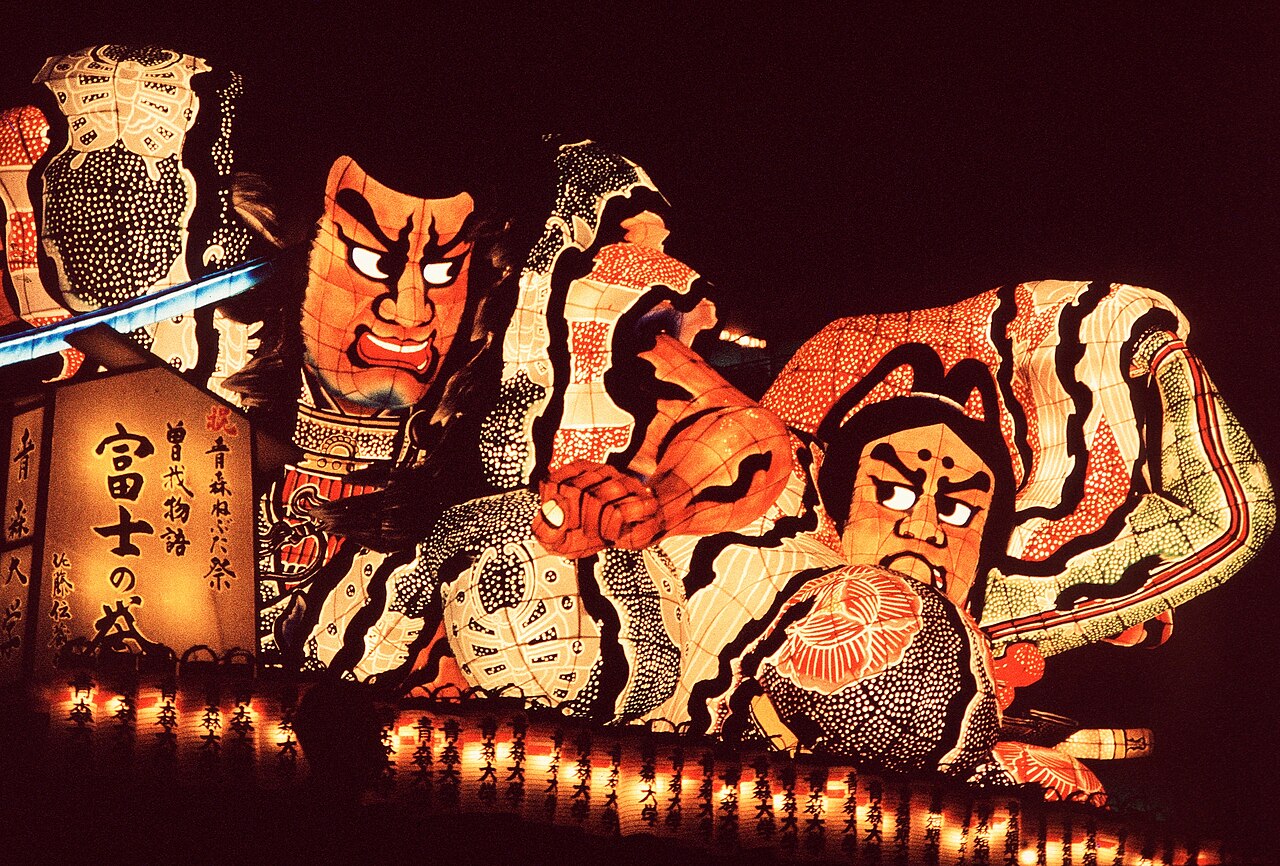
For six nights in early August, the city of Aomori, at the northern tip of Japan’s main island, hands its downtown streets over to a procession of glowing giants. Each one is a lantern the size of a small house: a frame of wire covered in hand-painted paper and lit from inside, showing a scowling warrior, a demon or a dragon caught mid-battle. Around them, thousands of people in flower-decked hats bounce up and down, chanting "Rasseraa! Rasseraa!" This is the Aomori Nebuta Matsuri, one of the great summer festivals of Japan’s northeast (Tōhoku). What follows explains where the lanterns came from, how they are made, why anyone can join the dancing, and how to make the most of a visit.
01Six Nights of Light and Drums
As of 2026, the festival still runs from August 2 to 7. On August 1 there is an eve-of-festival event where all of the year’s large floats, lit up, are lined up at the waterfront building grounds near Aomori Station so people can see them up close. On the 2nd and 3rd, children’s nebuta parade alongside the big ones. The 4th through the 6th are the main nights: around twenty large floats set off from two starting points at about 6:45 p.m. and move slowly around a loop through the city center. On the 7th the floats parade in daylight, and that evening about four floats, including prize winners, are loaded onto barges and taken around Aomori Port while the city’s fireworks display goes off overhead.
The word nebuta is usually written with characters chosen for their sound, such as 佞武多 or 睡魔, the latter meaning roughly "sleep demon." The sound came first. Most explanations connect it to nemutai, "sleepy," and to an old midsummer custom of driving drowsiness away, which the next section explains.
A big nebuta never travels alone. In front walk standard-bearers carrying the sponsoring group’s name on lanterns, along with the sensu-mochi, a person waving a giant fan who signals the float’s turns. Behind comes the hayashi, the festival band, and around everything swarms a crowd of dancers called haneto, "the jumpers." A single entry can involve a thousand people or more. From the roadside, what you see is a series of luminous figures drifting on a sea of bodies, each carrying its own storm of drumming and shouting.
Sound is half of the experience. The band has three parts: big taiko drums mounted on a cart and pounded by several drummers in rotation; bamboo flutes playing a short, looping melody; and teburi-gane, small hand-held bronze or brass gongs, shaped rather like saucers, that keep up a bright, metallic clatter. The haneto hop from foot to foot in time and shout "Rassera, rassera" over and over. Nobody is quite sure what the word originally meant. One explanation links it to the old cry of children pulling nebuta and begging for candles and sweets, "dase, dase" ("hand it over"); before the war the chant was still "Rasse, rasse." Others have been proposed. Aomori people do not worry much about the etymology. They just shout it louder.
02From Sending Away Sleep to Lantern Giants
Nebuta grew out of a summer custom once found across Japan called nemuri-nagashi, "washing away sleep." Around the seventh day of the seventh lunar month, in the hardest stretch of the farming year, people would float lanterns, branches or straw figures down rivers or out to sea, sending off with them the drowsiness and sluggishness of summer and any lingering impurity. The date ties it to Tanabata, the star festival, and to the purification that comes before Obon, when ancestral spirits return. At heart, nebuta is a ritual of sending something away, and the final night’s voyage onto the bay keeps that meaning alive.
The origin story most people in Aomori know is a heroic one. In the early ninth century the general Sakanoue no Tamuramaro, sent north to subdue the Emishi people, supposedly built huge glowing figures and beat drums to lure his enemies out of hiding. This is a later legend; Tamuramaro’s campaigns are generally thought to have stopped around present-day Iwate, well short of the Tsugaru region. But it became part of the festival’s identity. For decades the top prize for the best float was named the Tamuramaro Prize, before it was renamed the Nebuta Grand Prize in 1995.
Reliable records come much later. By the middle of the Edo period, the official diaries of the Hirosaki domain, which ruled this area, record the lord watching nebuta in his castle town in 1722, and around the same era there is a record of people near Aomori carrying lanterns and dancing in imitation of Hirosaki. Early nebuta were made of bamboo and paper and lit by candles. They were smaller and simpler, by one account mostly fan- or box-shaped, and usually carried on the shoulders of young men from each neighborhood. As rivalry between neighborhoods grew, so did the lanterns. In the early Meiji era one float from Aomori’s Hamamachi district is recorded as about 20 meters tall and carried by a hundred men. Heights later came down, usually explained by overhead electric wires and, after the war, wider roads. Builders went wide and deep instead, which produced the sprawling, sculptural group scenes of today.
The mid-twentieth century made nebuta what it is now. After the Second World War the festival was revived and reorganized by the city and local business groups as a major tourist event. Wire gradually replaced bamboo for the frames, allowing far finer curves and detail. Candles gave way to electric lights, first run on batteries from 1947 and now powered by generators on the float carts, ending the risk of a gust of wind setting the whole thing alight. In 1980 the festival was designated an Important Intangible Folk Cultural Property by the national government. Before the pandemic, organizers reported more than 2.8 million visitors a year; since 2023 they have estimated crowds with cameras and smartphone location data, and as of 2024 the published figure was about 1 million.
03The Nebuta Masters and a Year’s Work
Every large float carries the name of its designer, a nebuta-shi, or nebuta master. It is a tiny profession. Only a dozen or so people in the city can take charge of a large float, many of them holding other jobs as well, and most spent many years as apprentices before working on their own, reportedly more than a decade. The most accomplished are formally recognized as nebuta meijin, nebuta grand masters; only seven have received the title since Kitagawa Kinsaburō in 1958, and in Aomori their names are widely known.
Work on a float starts the autumn or winter before. The designer chooses a subject and draws a full-color plan. Subjects are almost always dramatic scenes from stories: the storm god Susanoo slaying the eight-headed serpent from Japanese myth, generals from Romance of the Three Kingdoms or The Water Margin, famous moments from kabuki, demons and deities from local legend. The figures are frozen at the peak of action with eyes glaring, mouths open and limbs flung wide, much like a kabuki actor striking a mie pose to face the audience.
In early summer the teams move into large temporary hangars by the harbor known as Rasseland. They build a timber base and main supports, then bend wire piece by piece into the outlines of bodies, faces and flowing robes, tying the joints with cotton thread. Wiring and lights go in at the same stage. Today mostly LED bulbs are used, with some fluorescent lamps, several hundred to a thousand or so to a float. Then sheets of washi, Japanese paper, are glued over the frame like a skin.
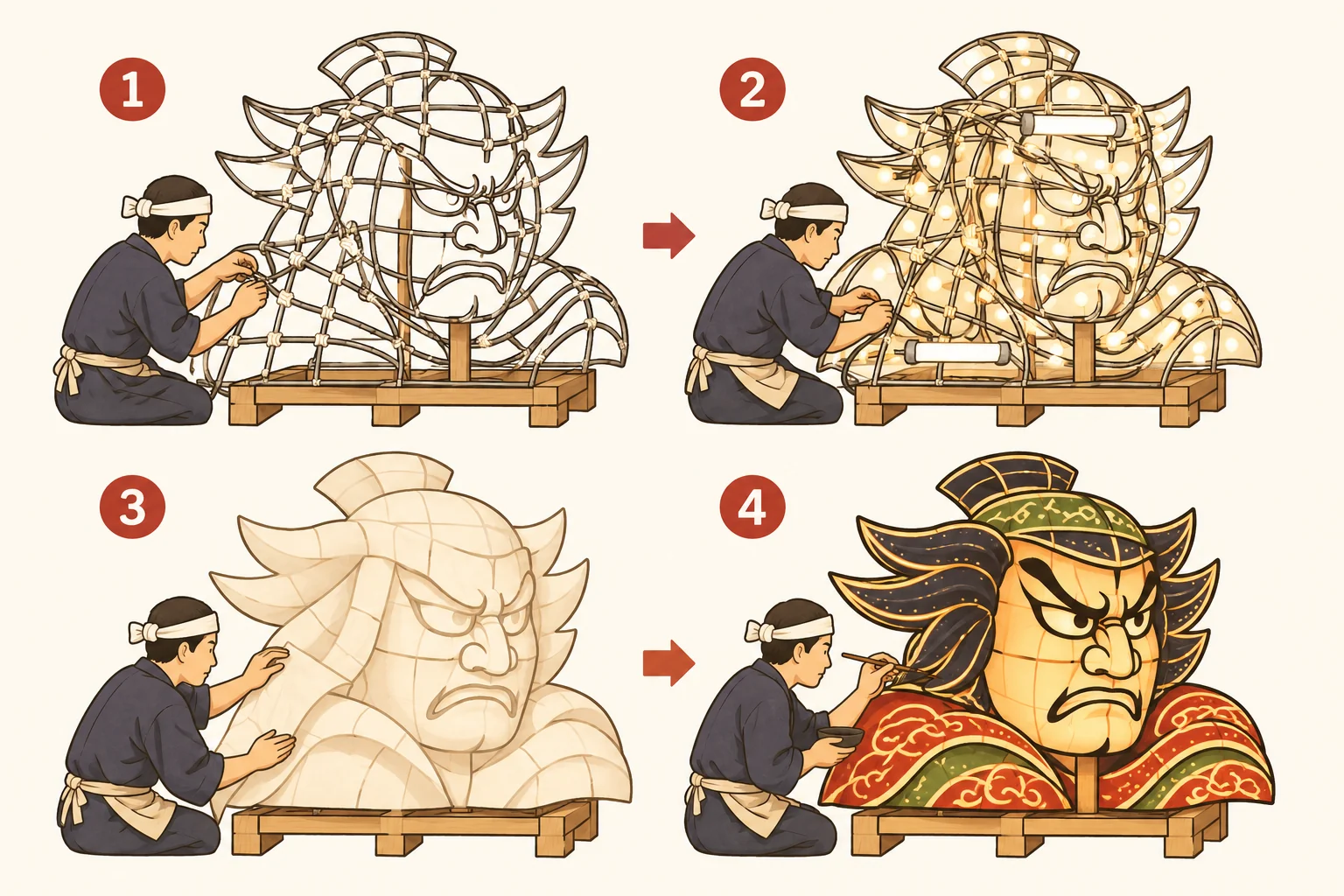
Building a nebuta: bending the wire frame, installing lights, pasting on washi, then lining and coloring (illustration).
Painting is where the real skill shows. The master first lays down thick black outlines in sumi ink; these lines give the figure its force. Next, melted wax is brushed along certain lines and patterns. The wax soaks into the paper so that, once lit, those areas glow especially bright, and it also stops the dyes from bleeding. Finally color goes on with brushes and spray guns. By daylight a nebuta looks a little crude and smudged. At night, with the lights on, the ink lines become a dark skeleton, the wax lines shine like veins of light, and the reds, blues and yellows glow like stained glass. A nebuta is a painting made for the dark.
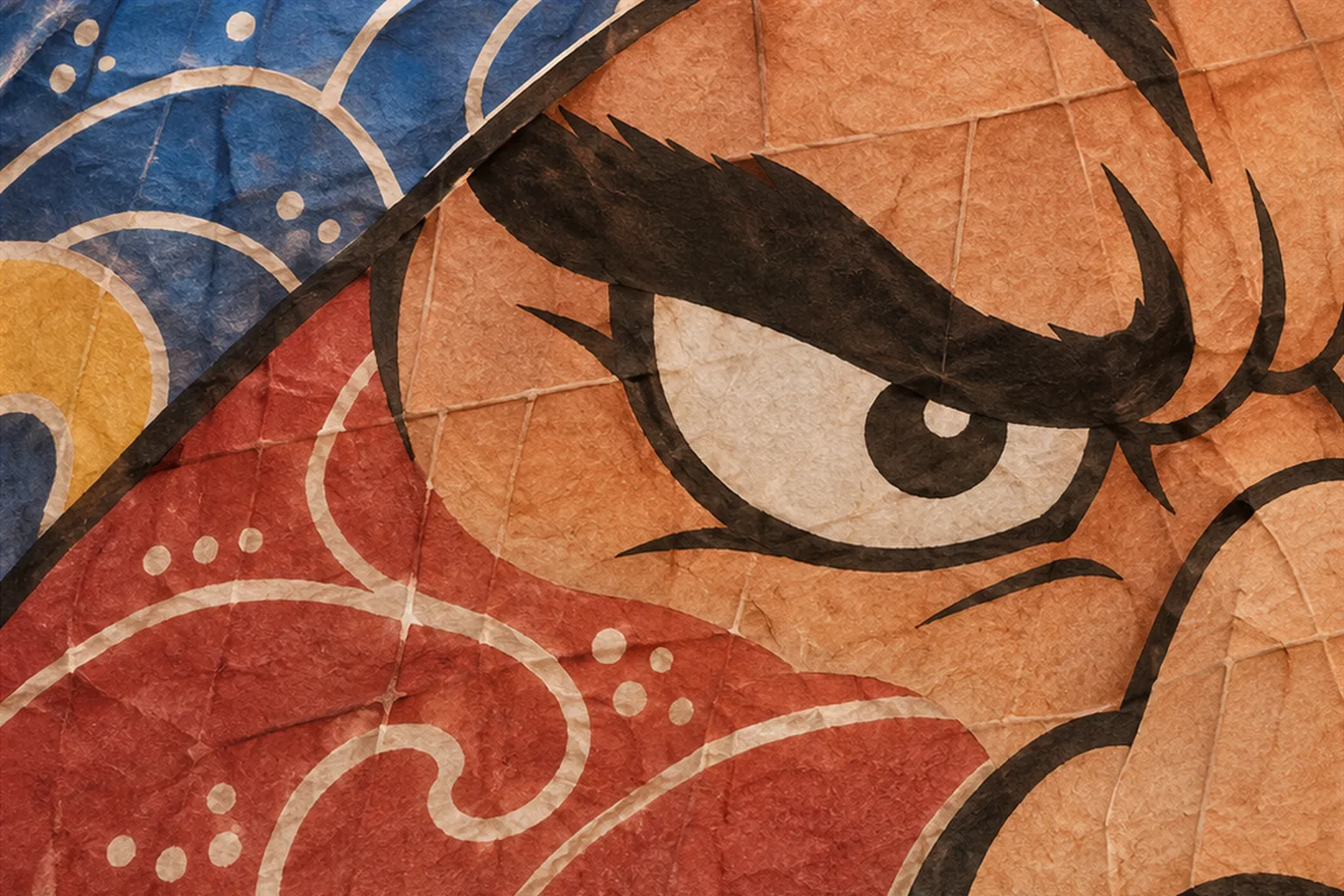
By daylight, unlit, the ink outlines, wax lines and dyes look a little crude.
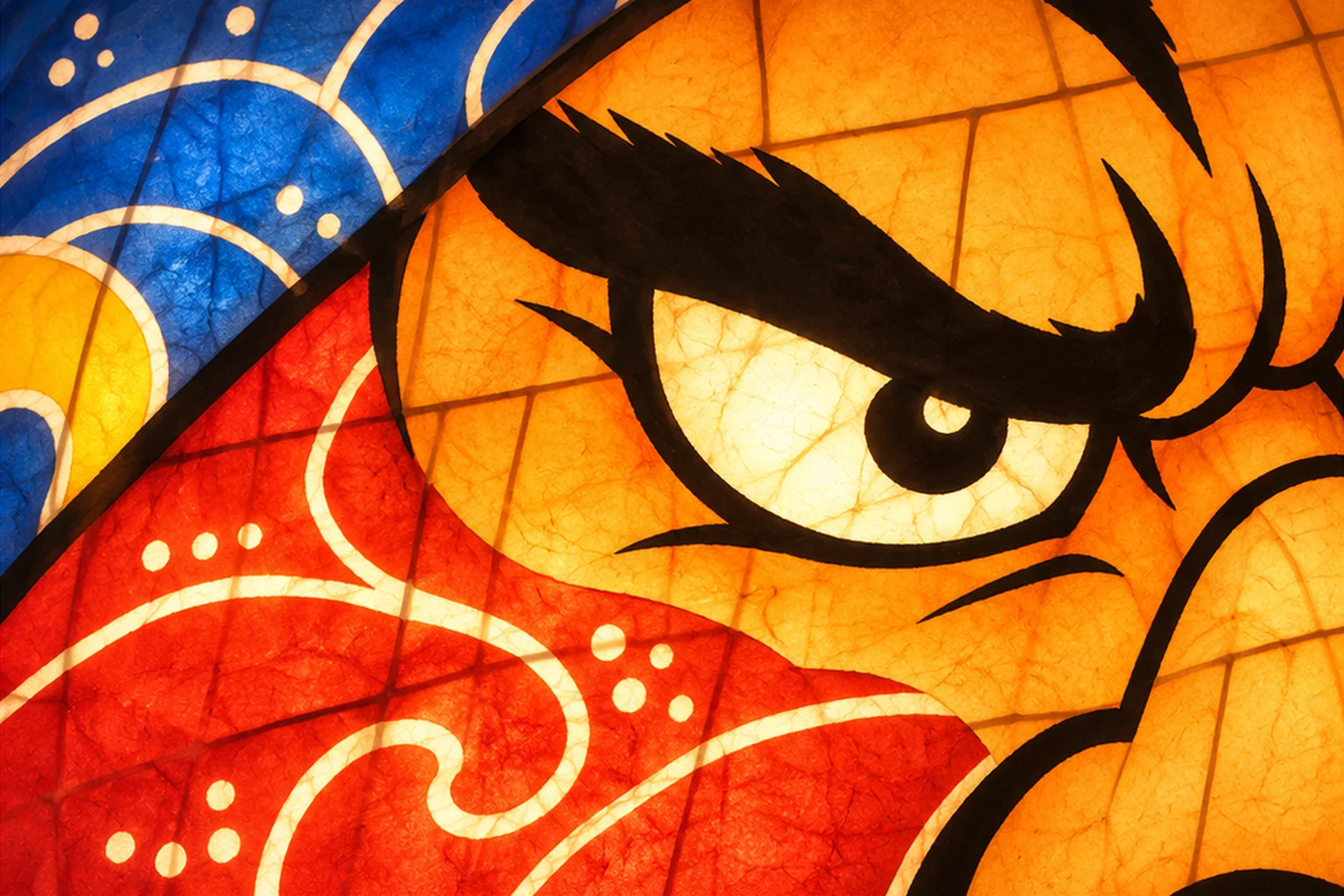
Lit from inside at night, the ink lines become a dark skeleton and the wax lines shine like veins of light.
A finished large float can be at most 9 meters wide, 7 meters deep and 5 meters tall (by some accounts not counting the base), and with its cart and generator it can weigh up to 4 tonnes. It is pushed, pulled and spun by a team of pullers following the fan-bearer’s signals, reportedly some twenty or thirty of them. Building and running one is expensive, with some reports putting the cost of a single float in the tens of millions of yen, and the cost is borne by the sponsoring groups, which include companies, public bodies and civic associations; that is why you see names of power companies, banks and TV stations at the front of the processions. After the festival most floats are dismantled, with only a few kept for display, often, it is said, just the heads or other best parts. A year’s work shines for six nights.
- 1Choose a subject, draw the planthe autumn or winter before
- 2Build the frameearly summer at Rasseland; timber and wire
- 3Wire the lightsseveral hundred to a thousand or so
- 4Paper the framelike a skin
- 5Paintink outlines, wax, then dyes and spray guns
- 6Out for six nightsat most 9 m wide, 7 m deep, 5 m tall; some twenty or thirty pullers
- 7Dismantleda few kept for display
From the plan drawn the autumn or winter before to dismantling, a year’s work shines for six nights.
04The Haneto: A Festival Anyone Can Join
What sets Aomori apart from many Japanese festivals is how open it is. At Kyoto’s Gion Matsuri, the great floats belong to neighborhoods that have maintained them for generations, and outsiders watch from the curb. In Aomori, anyone wearing the proper haneto costume can join the dancers following any of the floats. No registration is needed and there are no steps to learn in advance.
The costume is easy to spot. It is a white yukata, a light cotton kimono, printed with blue patterns and hitched up to show a colored underskirt, tied with bright sashes, with a cord slung across the shoulders and a hanagasa, a hat covered in paper flowers. Dancers wear white tabi socks with zōri sandals and tie strings of small bells to their outfits. The bells jingle with every jump and often fall off; picking one up from the street is said to bring luck. Kimono shops, department stores and festival-goods stores in town rent or sell complete costumes. Some hotels are said to rent costumes too, and a few will help guests dress.
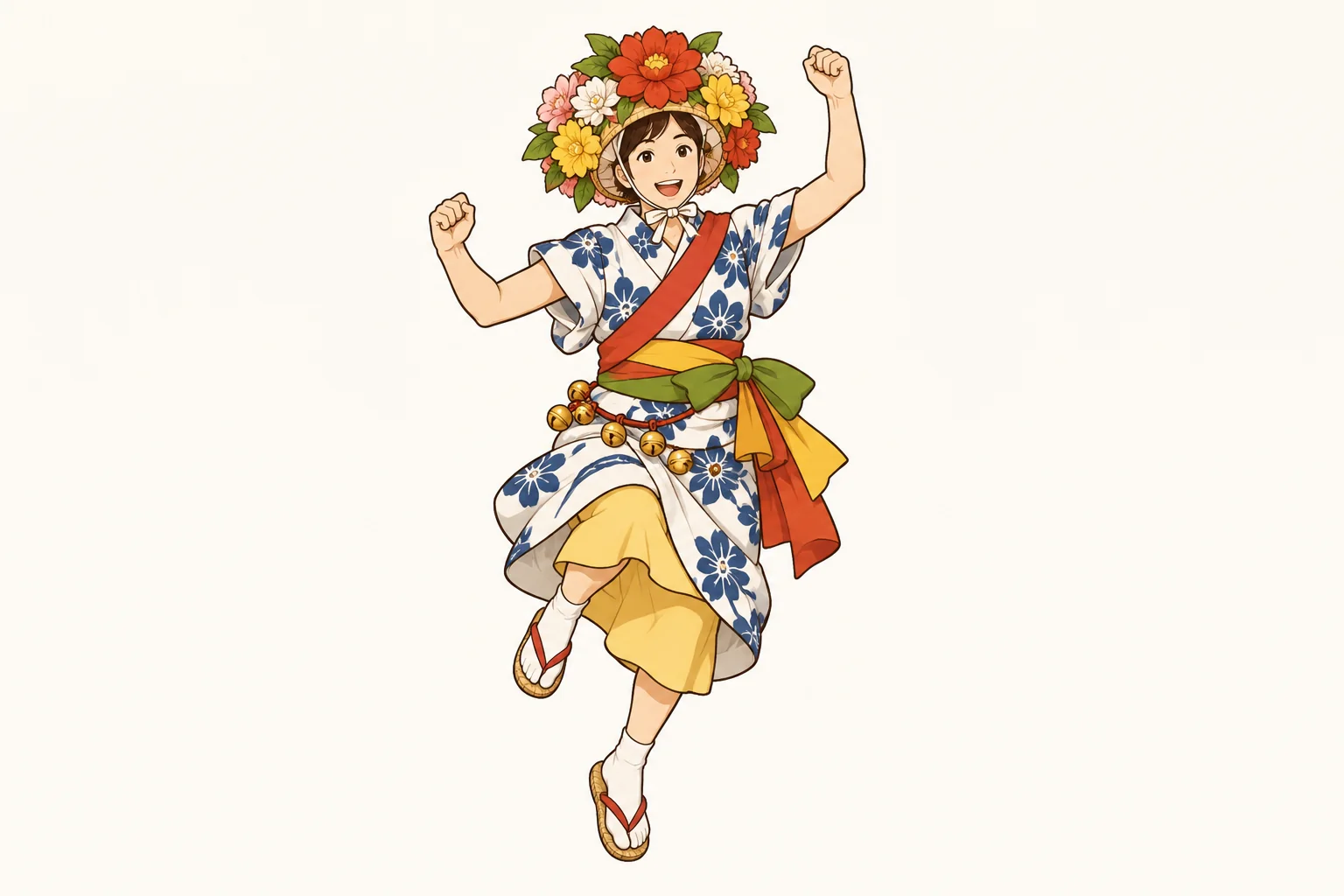
A haneto dancer: hanagasa flower hat, white yukata with blue patterns, bright sashes and strings of small bells.
The dance itself is simple. Hop twice on one foot, twice on the other, swing your arms, and shout "Rassera." The challenge is stamina. A circuit can take an hour or two, and by the second half your throat and calves will both be complaining. Because anyone can dance, the line between audience and performers nearly disappears, and you will often see spectators suddenly dive into the crowd.
That openness has caused trouble at times. From the late 1980s into the early 2000s, groups of young people in black clothes, nicknamed karasu-zoku, "crow tribe," joined the processions and caused disorder. The organizers banned black outfits from the procession in 1989, the city passed a nebuta preservation ordinance in 2001, and stricter rules and more security, including a requirement that haneto wear the official costume, gradually eased the problem. The costume, in other words, is also a pledge to dance by the rules.
05Nebuta Across Tsugaru
Lantern festivals of this kind are found throughout the Tsugaru region of western Aomori Prefecture; Aomori City’s is simply the largest. The one most often compared with it is in Hirosaki, about forty minutes away by train, where the festival is called neputa with a "p," a difference locals care about. Hirosaki’s floats are mostly fan-shaped. The front shows a fierce warrior scene, and the back carries a quieter painting, often a beautiful woman, called the miokuri-e, the "send-off picture." The mood is more measured, the chant is "Yaa yado," and there are no leaping haneto.
Goshogawara, further west, goes for height. Its Tachineputa, "standing neputa," revives very tall lanterns that disappeared in the electric-wire era. A Meiji-era design drawing for a float base was found in 1993, a tall float was rebuilt and named in 1996, and the parade returned in 1998. The tallest now stand around 23 meters, as high as a seven- or eight-story building, and they are kept year-round in a purpose-built hall in the city center where a spiraling ramp lets you look at them from feet to head.
All of these take place in the first week of August, around the same time as Akita’s Kantō festival with its towering poles of lanterns and Sendai’s Tanabata. Many summer visitors to Tōhoku string them together into one trip. Each grows from the same root of Tanabata lanterns and sending away sleep. Aomori pushed the idea toward size, sculpture and noise; Hirosaki toward painting on a fan; Goshogawara toward height.
06Watching and Dancing in Aomori
If you can only manage one night, choose the 4th, 5th or 6th, when the full evening parade runs. The route circles the downtown area southeast of Aomori Station. There is grandstand seating along the route, and from a seat you get a clear, front-on view of every float as it turns toward you. You can also stand at the roadside, but the good spots fill early, so arrive before 6 p.m. The most thrilling moments come at intersections, where floats spin in place and lunge toward the crowd.
To dance, rent a costume in the afternoon, change in the early evening, and once the parade starts, fall in with the haneto behind one of the floats. Most groups welcome outsiders, and a couple of minutes watching the people in front is all the training you need. Keep your phone and wallet in a small pouch tied close to your body; everything else will be shaken loose.
Outside festival season you can still see nebuta. Next to Aomori Station on the waterfront stands a red-ribbed building called Nebuta Museum Wa Rasse, which displays four of the year’s large floats in a darkened hall. You can walk right around them and study the ink and wax lines in detail, and the museum also offers live hayashi performances and a chance to try the haneto steps. A daytime visit there shows the craftsmanship more clearly than any parade; an August night on the streets shows the floats come alive.
On the last night, August 7, several floats, including prize winners, are set on barges and drawn slowly across the harbor as fireworks rise behind them. Along the shore, much of the crowd falls quiet to watch them drift away. It is the festival returning to where it began: lights set on the water to carry a summer off.