
At a glance
Tokushima’s four-night Bon dance explained: the two-beat music, the men’s and women’s styles, the troupes called ren, its history, and how visitors can dance too.
- Awa Odori is Tokushima’s Bon dance, held August 12–15; as of 2025, counting the eve-of-festival events on August 11, it drew about 1.11 million visits.
- Groups parade along closed streets instead of dancing in a ring; about 800 ren take part.
- The music, called zomeki, is in two-beat time, played on shamisen, ōdaiko, shimedaiko, kane gong and shinobue flute.
- Its signature line: the dancers are fools and the watchers are fools, so if you’re a fool anyway, you lose out by not dancing.
- Visitors can join a niwaka-ren, learn the basic steps in a few minutes and dance in the street in everyday clothes.
For four nights in August, the city of Tokushima on the island of Shikoku gives itself over to a single rhythm. From early evening until close to midnight, troupes of dancers move down closed-off streets to the clatter of shamisen, drums, gongs and bamboo flutes: men crouched low and swinging their arms, women on the tips of their wooden clogs with their hands raised high under broad straw hats. This is Awa Odori, the most famous of Japan’s summer Bon dances and one of the largest street festivals in the country. Its spirit is summed up in a line of song that every dancer knows: the dancers are fools and the watchers are fools, so if you’re going to be a fool anyway, you might as well dance.
01A City That Dances
Tokushima is a mid-sized prefectural capital of about 240,000 people (as of 2025), the kind of place most visitors to Japan pass through without stopping. From August 12 to 15, during the Obon holiday, it becomes something else. Grandstands go up along the main avenues and beside the Shinmachi River. Traffic is cleared from the center of town in the late afternoon. As the light fades, the first troupes line up, each behind a paper lantern bearing its name, and, as of 2026, the city still fills with more than a million visitors over the four days.
Awa Odori is a bon odori, a dance held during Obon, the midsummer period when Japanese families welcome the spirits of their ancestors home and then send them back. Bon dances are held all over Japan, usually in a temple courtyard or a schoolyard, with villagers circling a raised drum tower. Awa Odori breaks that mold. Instead of a circle, the dancers form processions that advance down the street. Instead of a neighborhood pastime, it is a performance, with audiences, ticketed seating, television coverage and some 800 organized dance groups taking part (some travel sources put the figure at over a thousand). Together with Gujō Odori in Gifu and the Nishimonai Bon Odori in Akita it is counted among Japan’s "three great Bon dances," and it is the biggest of them in dancers and spectators.
"Awa" is the old provincial name for what is now Tokushima Prefecture. In the Edo period (1603–1868) it was ruled by the Hachisuka family, and its wealth came from indigo. Farmers along the Yoshino River grew the indigo plant and fermented its leaves into sukumo, a dye paste that Awa merchants shipped across the country. Indigo and the dance remain the two things Tokushima people are proudest of.
02The Rhythm and the Song
The music of Awa Odori is called zomeki, a word that suggests noise and bustle. It is built on a driving two-beat rhythm, strong-weak, strong-weak, fast but steady. The shamisen, a three-stringed lute, carries the melody. A large barrel drum and smaller tightly laced drums lay down the beat. The kane, a small hand-held brass gong struck with a slender mallet, cuts through everything with a bright metallic ring, and the shinobue, a bamboo transverse flute, rides on top. Together these instruments are called narimono, "the things that make sound." The two-beat pattern is so simple and insistent that spectators find their feet tapping within a minute of standing on the curb, and that is the point. Anyone can follow it.
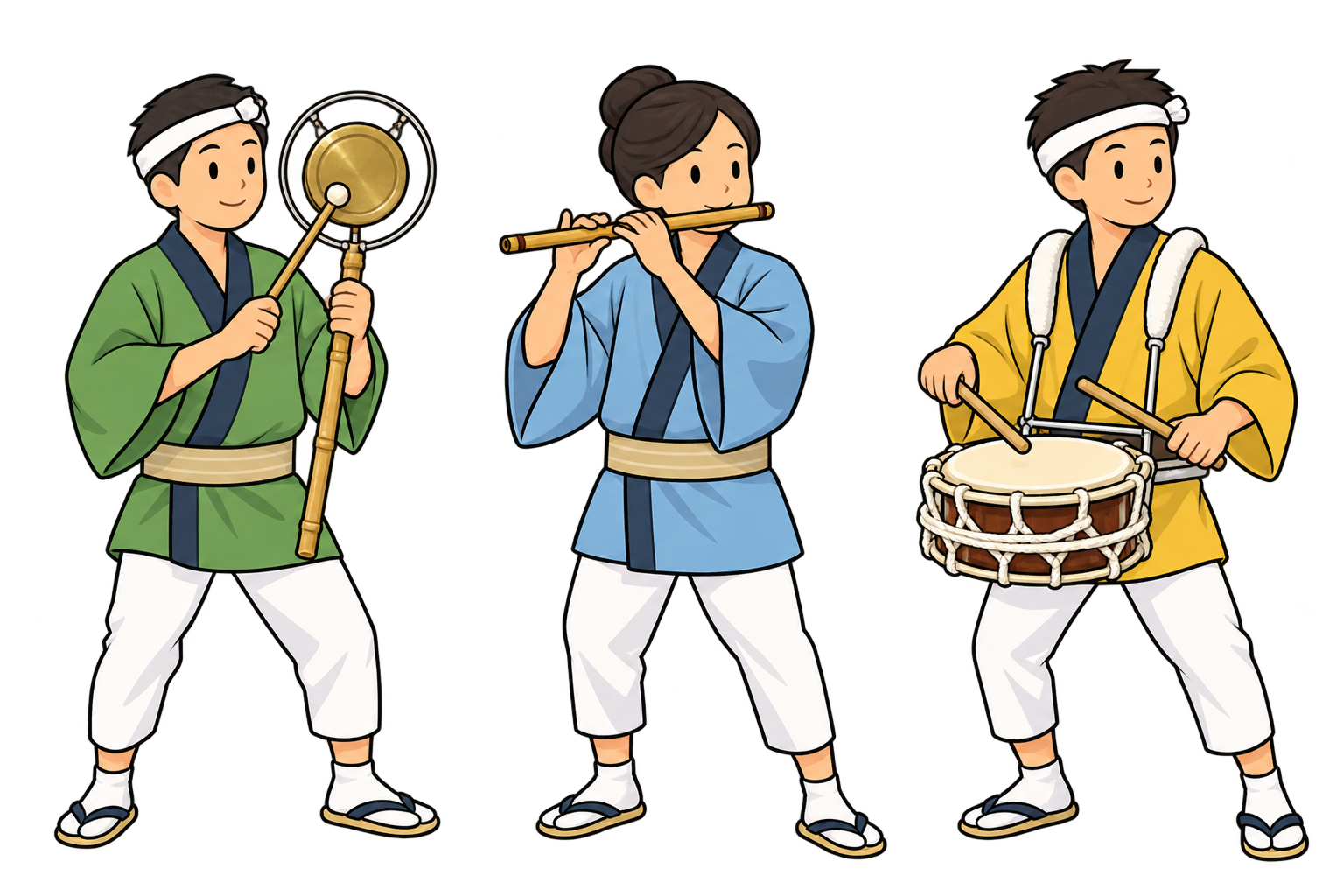
The kane gong rings out under a slim mallet, the shinobue plays the high line, and the shimedaiko keeps the beat.
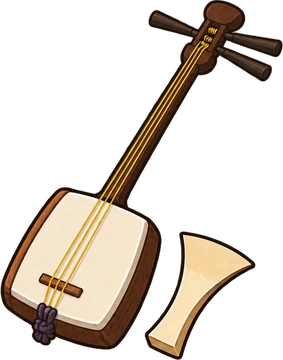
The shamisen carries the melody.
The song that goes with the dance is "Awa Yoshikono," descended from yoshikono-bushi, a popular song in late-Edo western Japan, and its best-known verse is the line every dancer knows:
Odoru ahō ni miru ahō, onaji ahō nara odoranya son son.
"Dancing fools and watching fools, if we’re all fools, it’s a loss not to dance." The line works as a manifesto. It erases the line between performer and audience and invites the onlooker into the street. For a society that values decorum and knowing one’s place, it names exactly what a festival offers: a few nights when dignity can be set aside and everyone is allowed to be a fool together.
The troupes also shout as they go. The most common call is "Yattosā, yattosā!" Another is "Erai yaccha, erai yaccha, yoi yoi yoi yoi!", roughly "What a thing, what a thing!" The calls trade off with the drums, and a troupe’s energy rises and falls on them.
03Men’s Dance and Women’s Dance
The basic step is almost childishly simple. The right hand and right foot move forward together, then the left hand and left foot, while both hands are held above the shoulders and flicked in time. Tokushima people teach it with a saying: raise your hands, move your feet, and you’re dancing Awa Odori. That simplicity is what allows a whole city to take part. Doing it well is another matter, and the difference between groups lies in how much style and control they bring to the same few movements.
Otoko odori, the men’s dance, is low and loose. The dancer sinks his hips, bends his knees deeply and takes big, springy steps. He wears a cotton summer kimono, a yukata, with the hem hitched up into the sash, or a happi coat, usually said to show white close-fitting pants beneath the hitched-up hem, white split-toed tabi socks on his feet and a towel knotted around his head, sometimes with a paper fan in one hand. The men’s dance prizes boldness and improvisation. Some dancers spin, crouch, leap or pull comic faces, and get a laugh from the stands.
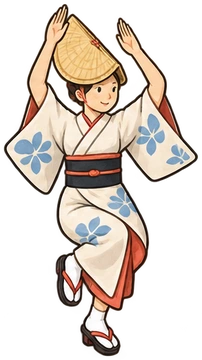
Onna odori, the women’s dance, is a different kind of beauty altogether. The dancers wear matching yukata and a folded straw hat, the torioi-gasa, shaped like a half moon and pulled so low that their eyes are almost hidden. On their feet are wooden geta clogs, but they dance only on the front edge, so that the whole body is lifted onto tiptoe. Their hands stay raised above their heads, fingers together, turning at the wrist on each beat. A row of thirty women advancing in perfect line, hats tilted at the same angle and fingers flicking in unison, is the image most people carry away from Awa Odori. It looks effortless. Holding that posture on tiptoe in clogs for hours on a humid August night is anything but.

Otoko-odori: hips low, knees bent, right hand and right foot forward together.
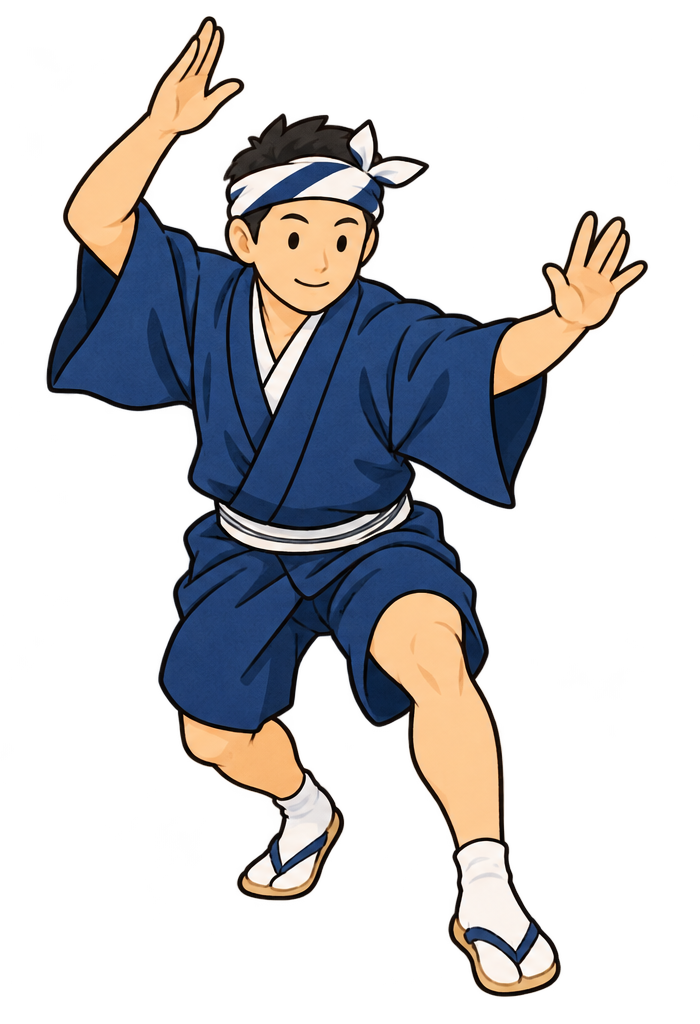
Then left hand and left foot, with a towel round the head and white tabi.
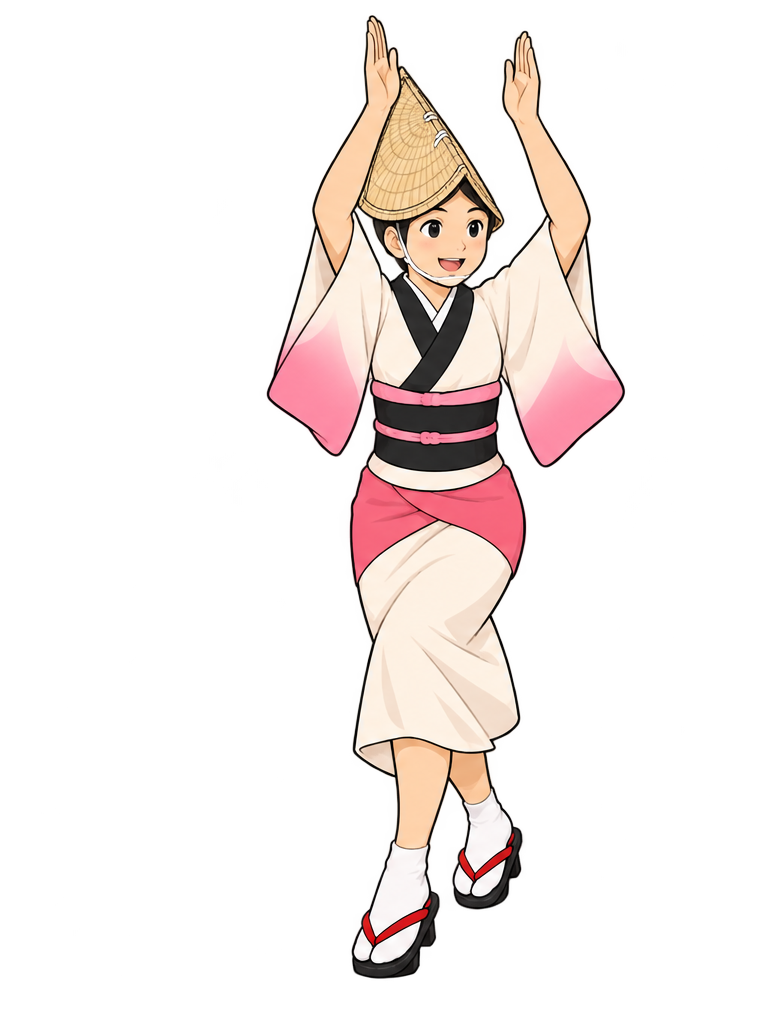
Onna-odori: amigasa hat and geta, hands held high above the head throughout.
Over recent decades, more women have taken up the men’s dance, wearing a short happi coat instead of a kimono and dancing with the same low, powerful stance. Children dance in miniature versions of the costumes, some of them barely old enough to walk.
04The Ren
The dance troupes are called ren. A ren is an independent group with its own name, costume, musicians and style. Its members might work for the same company, attend the same school or live in the same neighborhood, or they might simply be friends who like to dance. A ren on the move typically has a lantern-bearer at the front, then the women dancers, then the men, and at the back the narimono band that sets the pace for everyone.
- 1Lantern-bearerat the front
- 2Women dancers
- 3Men dancers
- 4Narimono bandsets the pace
Front to back: the lantern leads, and the narimono band at the back sets the pace for everyone.
The most admired are the yūmei-ren, the "famous ren," long-established groups of high skill, most of them affiliated with one of the city’s Awa Odori associations. Names such as Gojahei, Ahō-ren, Tensui-ren, Nonki-ren, Hachisuka-ren and Uzuki-ren are known to nearly everyone in Tokushima. Each has its signature: one is known for the wild power of its men, another for the precision of its women, another for an unusually large band. Membership often runs in families, with children dancing in the same ren as their parents and grandparents.
Beyond the famous groups are hundreds of company ren, university ren and community ren that rehearse in parking lots and community halls through the early summer. The four nights in August are only the visible part of a year-round culture sustained by these groups.
05Where It Came From
The story most often told in Tokushima is that the dance began in 1586 (some accounts say 1585), when Hachisuka Iemasa completed Tokushima Castle and, to celebrate, let the townspeople drink and dance as they pleased. It is a good story, but it is a later tradition, not something supported by records from the time. Historians generally see Awa Odori as the product of a long evolution from medieval Buddhist nenbutsu dances, the extravagant furyū dances of the late medieval period and the Bon dances that spread through Japan, with no single moment of origin.
What is clear is that by the Edo period the Bon dancing in the castle town was lively enough to worry the authorities. A domain rule of 1671 limited dancing to three days, barred samurai from taking part and banned dancing on temple grounds. The domain is also said to have forbidden overly showy clothing, and the prohibitions reportedly multiplied over time. Town officials also regulated kumi-odori, ensemble dances with set costumes and choreography, and the restrictions pushed people toward zomeki, a boisterous street dance performed day and night that is seen as the forerunner of today’s Awa Odori. Indigo money helped: wealthy merchants could afford fine costumes and hire musicians, and the dance drifted from a rite for the dead toward an annual celebration.
Into the early twentieth century it was still simply called the Bon dance. The name "Awa Odori" only took hold in the early Shōwa period, around the late 1920s and 1930s (the name is said to have been suggested by the painter Hayashi Korō), when Tokushima began promoting the dance as a local attraction and visitors started coming specifically to see it. The festival was suspended just before and during the war and revived in 1946. In the decades of postwar growth it took on its modern form, with fixed performance venues, ticketed stands, broadcast coverage and visitors from all over the country.
The dance has also traveled. In Kōenji, a neighborhood in western Tokyo, young shopkeepers started a street dance in 1957 to bring customers to their shopping streets; first called the Kōenji Baka Odori ("fools’ dance"), it formally took the name Awa Odori in 1963. It grew into one of Tokyo’s biggest summer events, as of 2026 still held over a weekend in late August and drawing huge crowds, and is now one of the largest Awa Odori festivals outside Tokushima. Smaller versions are held in towns across Japan, some of them taught by instructors from Tokushima ren.
In 2020 the festival was canceled because of the COVID-19 pandemic, the first cancellation since the war. In 2021 it was held on a reduced scale at a single venue in Aibahama, before gradually returning to its usual form; as of 2026 it is held as normal. According to reports, when the venues reopened in 2022, many people in Tokushima said that summer had finally returned.
06Seeing It and Joining In
The core of the festival happens at the enbujō, performance venues created by closing a stretch of street and lining it with tiered seating. Troupes enter one after another and dance down a course of, by common account, a hundred meters or more in front of the stands. As of 2026, some venues, such as Aibahama, Minami-Uchimachi and Kon’yamachi, have paid grandstands. A seat there gives you a comfortable view and a parade of dozens of ren over an evening, including the famous ones. Other venues, such as Shinmachibashi, are free and standing-room only, more crowded and more raucous.
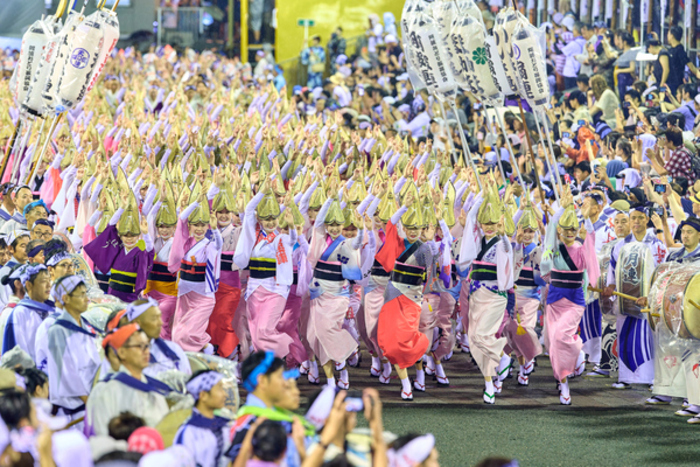
Women dancers in an enbujō, straw hats low and hands raised, with spectators filling the stands behind.
Away from the stands, the rest of the city is just as much part of the show. Ren dance freely through the side streets in what is called nagashi, passing within arm’s reach of the people on the pavement. At dance plazas and elsewhere, famous ren sometimes perform kumi-odori, choreographed pieces in which dozens of dancers shift through formations, closer to a stage production than a street parade.
If you want to dance yourself, look for a niwaka-ren, a pick-up troupe for visitors and anyone else who turns up. A member of a local ren teaches the basic step in a few minutes, then leads the group out into the street. No costume is required; ordinary clothes are fine. Here "it’s a loss not to dance" is meant literally.
A few practical points. Mid-August is the Obon holiday, the busiest travel week of the Japanese summer, and hotels in Tokushima fill up early. Many visitors stay in Ōsaka or Kōbe, both reachable by highway bus across the Akashi Kaikyō and Naruto bridges, and come for the evening. It is hot and humid even after dark, so bring water and a towel. Photography is welcome from the stands, but stay out of the dancers’ path and don’t fire a flash into their faces. When a ren passes, clap along and call out "Yattosā!" and the dancers will often shout it back.
If you can’t be there in August, the Awa Odori Kaikan at the foot of Mount Bizan has regular performances by its resident troupe, Awa no Kaze, and at the end the audience is invited onto the floor to learn the step. A ropeway from the building’s fifth floor climbs Bizan for views over the city and the sea. It is not the same as a summer night in the streets, but once the two-beat rhythm starts, it is easy to see why this city spends the whole year waiting for those four nights.