
At a glance
How a Japanese wedding runs from betrothal gifts to the reception, why the Shinto ceremony is a modern creation, and what guests should bring.
- A typical Japanese wedding today has two parts, the ceremony and the reception, and the reception usually runs 2.5 to 3 hours.
- The church-style wedding overtook the Shinto wedding in the mid-1990s and became the most common form, though very few couples are Christian.
- The Shinto wedding took the Crown Prince’s 1900 wedding before the gods as its model; from the next year Hibiya Daijingū offered it to ordinary couples.
- San-san-kudo: from three red lacquer cups, small, medium and large, the couple each take three sips, nine in all.
- As of 2024, the going gift from a friend or colleague is ¥30,000 in new notes, in an envelope tied with a knot that cannot be undone.
Walk the gravel approach of Meiji Jingū in Tokyo on a spring weekend and you may have to step aside for a slow procession: a Shinto priest and shrine maidens in front, then a bride entirely in white, her face framed by a white silk hood, a large vermilion parasol held over her head, and beside her a groom in a black crested kimono and pleated hakama trousers, with both families following behind. It looks ancient. In fact this kind of shrine wedding took its present shape a little over a century ago, and the most common choice for Japanese couples today is something else entirely: a "chapel wedding" in a hotel, with a hired minister, a white gown and a hymn. This piece walks through the whole sequence of a Japanese wedding, from the old engagement gift exchange called yuinō to the reception where guests hand over cash in decorated envelopes, and explains what the white shiromuku and the trailing uchikake robe are, and what to do if you are invited.
01Two Halves: the Ceremony and the Reception
A conventional Japanese wedding has two parts. The first is the kyoshiki, the ceremony itself, usually attended only by close family and perhaps a few very close friends. The second is the hirōen, the reception, where the marriage is formally announced to a much larger circle of relatives, colleagues, bosses and friends. The ceremony may take twenty or thirty minutes. The reception takes two and a half to three hours, and it is where most of the money and planning go. Younger couples often add a nijikai, an "after-party," at a restaurant or bar, where more friends join and the tone loosens considerably.
There are three common styles of ceremony. A shinzen-shiki, "before the kami," is held at a Shinto shrine or in a shrine room built into a hotel and is led by a priest. A kyōkai-shiki, or church-style ceremony, takes place in a church or, far more often, in a purpose-built chapel at a hotel or wedding hall, with the bride in a white Western gown walking down the aisle on her father’s arm. A jinzen-shiki, "before the people," makes its vows not to a deity but to the assembled guests, who act as witnesses.
The chapel wedding took off from the 1980s and overtook the shrine wedding as the most popular choice by the mid-1990s, even though only around one percent of Japanese are Christian. This strikes many visitors as odd, but it fits a pattern most Japanese families find unremarkable: a baby is taken to a shrine for its first visit, children return to a shrine for Shichi-Go-San, adults marry in a chapel and have Buddhist funerals. For most couples, the style of the ceremony is a question of atmosphere and taste rather than belief. Many weddings are also getting smaller. Photo-only weddings, family dinners in place of a reception, and simple "jimikon" (modest weddings) became common in the 2010s and even more so during the pandemic. But when a couple does hold a formal wedding, the two-part structure of ceremony plus reception remains firmly in place.
02The Shinto Wedding: An Old-Looking Modern Invention
Until the Meiji era, and for many families well into the Shōwa period, ordinary Japanese did not get married at shrines. A wedding, called shūgen, was a household event. The bride was brought to the groom’s house, usually in the evening; a scroll with the names of deities or an auspicious image hung in the alcove; the couple exchanged cups of sake under the guidance of a go-between; and a feast followed for relatives and neighbors. No priest was needed, because marriage was above all an alliance between two households, and it naturally happened at home.
The change came at the end of the Meiji era. In 1900, Crown Prince Yoshihito, the future Emperor Taishō, married Kujō Sadako in a ceremony held before the sacred mirror in the Kashiko-dokoro, the palace sanctuary. The imperial wedding was widely publicized and created a demand for something similar among ordinary people. Beginning in 1901, Hibiya Daijingū in Tokyo, the shrine now known as Tokyo Daijingū, devised a shrine ceremony for the public modeled on the imperial rite, and this is generally treated as the starting point of the Shinto wedding as a popular custom, though there are rival claims, including earlier shrine-style ceremonies devised at Izumo Taisha. Through the Taishō and Shōwa periods, shrines, commercial wedding halls and later hotels built ceremonial rooms of their own, and by the middle of the twentieth century the shrine wedding was the standard Japanese wedding.
What it assembled were older pieces: the procedures of Shinto worship, the sake-sharing of samurai wedding etiquette, the bride’s traditional white costume, and the imperial ceremony as a template. The order of a typical ceremony runs like this. A priest performs shubatsu, purification, waving a wand hung with white paper streamers over the participants. He then recites a norito, a prayer informing the kami of the marriage. Next comes the most famous moment, san-san-kudo, "three-three-nine times": a shrine maiden pours sake into three stacked red lacquer cups of increasing size, and the bride and groom each sip from every cup in three small sips, nine in all, sealing the bond. The groom reads a written vow, the couple offers a tamagushi, a sprig of the sacred sakaki tree tied with paper streamers, and rings are exchanged, a later addition that shows how freely the rite has kept absorbing new elements. Sometimes a shrine maiden performs a short kagura dance. Finally, members of both families drink sacred sake together, marking that the two households are now related.
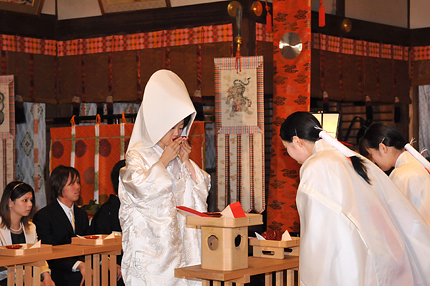
The san-san-kudo rite at a Shinto wedding: the bride drinks sacred sake from a vermilion cup as shrine maidens attend.
Large shrines put on a fine show. The procession at Meiji Jingū has become one of Tokyo’s familiar sights; Heian Jingū and Yasaka Shrine in Kyoto and Tsurugaoka Hachimangū in Kamakura are popular venues as well. The red parasol is called a shugasa, and the walk from the approach into the hall is the sanshin no gi, the "rite of advancing."
03Yuinō: Sealing an Engagement with Gifts
In the traditional scheme, an engagement was not made with a ring but with a formal exchange of gifts called yuinō. The groom’s family assembled a set of symbolic objects together with a sum of money, and a go-between carried them to the bride’s family. When the bride’s side accepted, the engagement was official. The bride’s family usually sent a return gift. The point was to make the arrangement public and binding between the two families, something weightier than a private promise between two young people.
The gifts themselves are a delightful exercise in punning. A typical Kantō set has nine items. There is a written inventory. There is naganoshi, originally a strip of dried, stretched abalone, a symbol of long life and a token of respect. There is the money envelope, called obiryō, "sash money," as if it were meant to buy the bride an obi. Katsuobushi, dried bonito, is written with characters that read "victorious man." Surume, dried squid, keeps for a long time and must be chewed slowly, so it stands for a lasting marriage. Konbu, kelp, echoes yorokobu, "to rejoice," and is also written with characters suggesting a woman who bears children. Tomoshiraga, a bundle of white hemp thread, wishes the couple a life together until both their hair is white. Suehiro is a white folding fan, which widens toward its edge the way a family’s fortune should grow. And yanagidaru, originally a pair of sake casks, is now usually replaced by cash. Each piece is wrapped and tied with elaborate gold and silver cords shaped into cranes, turtles, pine, bamboo and plum blossom, and laid out on unvarnished wooden stands. In the Kantō region both families tend to exchange gifts arranged on a single stand; Kansai sets are more lavish, with each item on its own stand.
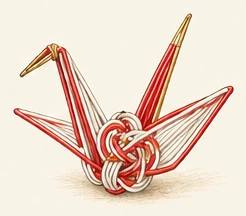
Betrothal gifts are tied with mizuhiki cord in shapes such as cranes, tortoises, pine, bamboo and plum; this is a mizuhiki crane.
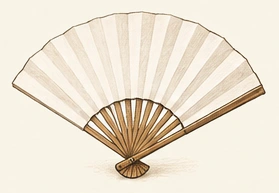
Suehiro is a white folding fan that widens towards its edge, a wish for a family’s growing fortune.
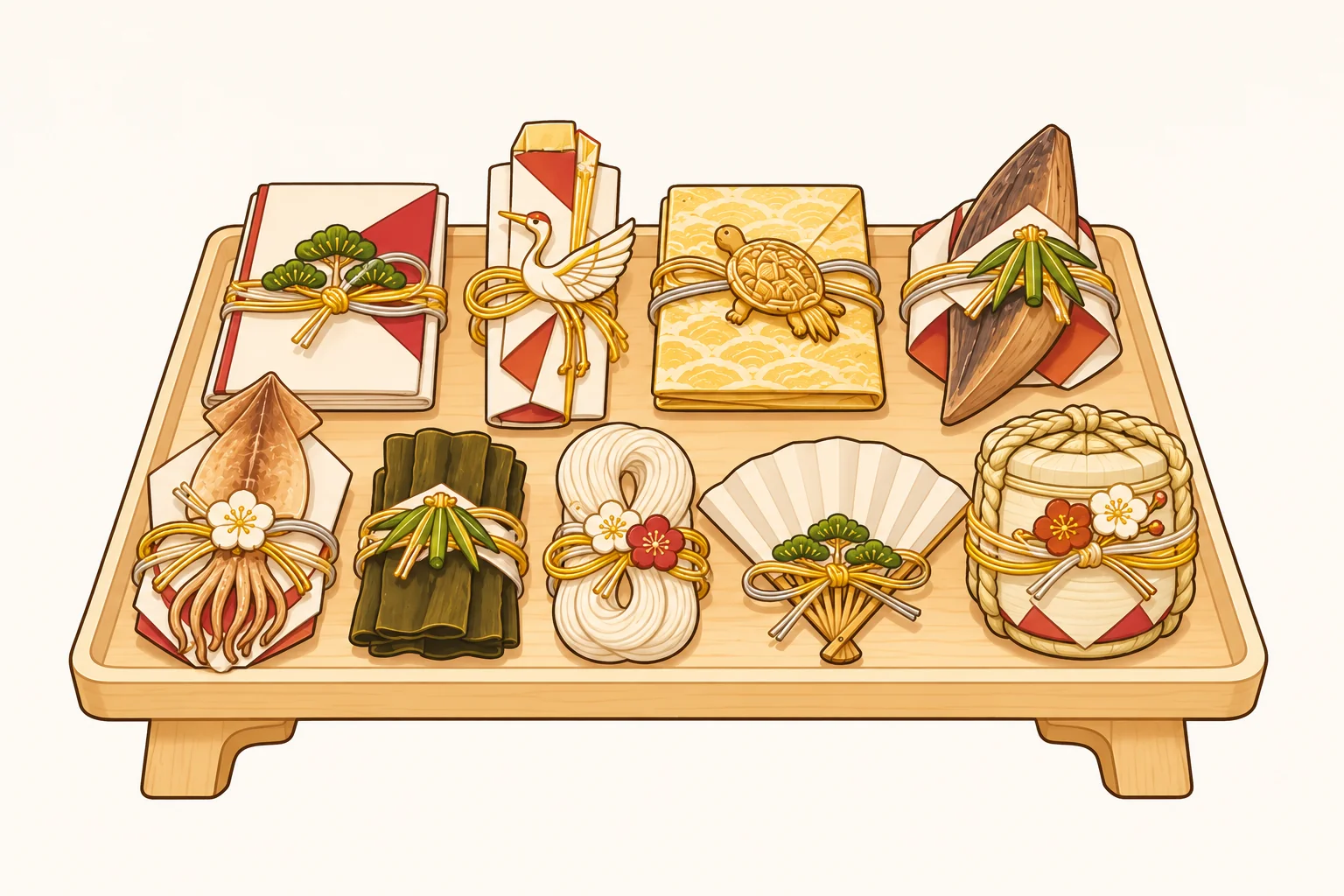
A nine-item Kantō yuinō set, tied with gold and silver cords, laid out on a single wooden stand.
The engagement money was a favorite subject of gossip. A common rule of thumb put it at two or three months of the groom’s salary, often around ¥1 million, with round sums such as ¥500,000 also common, and families were said to prefer amounts beginning with odd numbers or the "spreading" number eight. Very few families today carry out a full yuinō. Most couples instead arrange a kaoawase, a meal at a restaurant or a traditional ryōtei where the two sets of parents meet; the groom may give an engagement ring and the bride a watch in return. Department stores still sell compact five- or seven-piece yuinō sets for families who want a touch of the old ceremony.
04Shiromuku and Uchikake: White on White, and the Robe on Top
The white outfit worn for a Shinto ceremony is the shiromuku, literally "pure white without blemish." Everything is white: the under-kimono, the long kimono called a kakeshita that forms the main garment, the obi, the outer robe, and most of the small accessories. Two meanings are usually given for the color. White is pure, appropriate before the kami. And white can be dyed any color, so the bride is ready to take on the ways of her new family. The second explanation is widely repeated and is probably a later gloss, but it tells you how people think of the garment. Up close, the white is anything but plain: the silk is woven or embroidered all over with cranes, pine, phoenixes and peonies that appear and disappear as the light shifts.
The outermost layer of a shiromuku is in fact a white uchikake. An uchikake is a long outer robe worn over a kimono that has already been tied with its obi. It is left open at the front with no sash of its own, and its hem is heavily padded so it trails and sweeps along the floor. It grew out of the formal dress of samurai-class women: from the Muromachi period, high-ranking women draped an extra robe over their clothing on formal occasions, and in the Edo period the uchikake became the grand attire of daimyo households and the wedding finery of wealthy merchant brides. Because it is not tied, the bride has to hold the front edges in her hands as she walks, which makes her steps small and slow, and that careful gait has become part of the look of a Japanese wedding.
- 1Under-kimono
- 2KakeshitaThe long kimono
- 3Obi
- 4UchikakeNo sash; padded hem trails on the floor
Every layer is white; the outermost is a white uchikake, open at the front with a trailing hem.
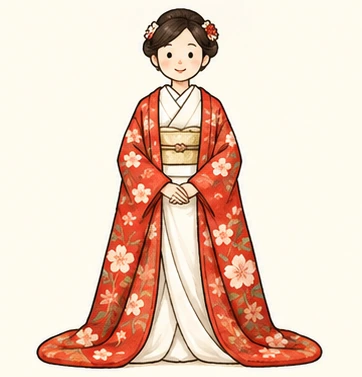
The colorful counterpart is the iro-uchikake, a colored uchikake in brilliant red, gold, or black with polychrome embroidery, covered in auspicious motifs such as cranes and turtles, pine, bamboo and plum, ox-drawn court carriages, and open fans. It is usually the most spectacular garment of the day. Traditionally the bride wore shiromuku for the ceremony and changed into an iro-uchikake partway through the reception, a change called oironaoshi, as though she had now taken on her new family’s color. Today the oironaoshi is just as likely to be a switch into a colored Western dress.
Two headdresses go with these robes. The watabōshi is a large white silk hood that covers the whole hairstyle and frames the face; it is worn only with shiromuku. The tsunokakushi is a band of white cloth wrapped across the front of the hair, and can be worn with either white or colored robes. Its name means "horn-hider," and folk explanation says it hides a bride’s "horns" of jealousy or temper, though that too is a popular reading. Underneath is the tall bunkin takashimada hairstyle, nearly always a wig nowadays. Tucked into the bride’s collar is a small decorative pouch called a hakoseko; in her sash is a kaiken, a small dagger in a white sheath; and in her hand is a fan. All three are leftovers from samurai bridal dress. The groom wears montsuki haori hakama, a black kimono and jacket bearing five family crests, the most formal men’s attire.
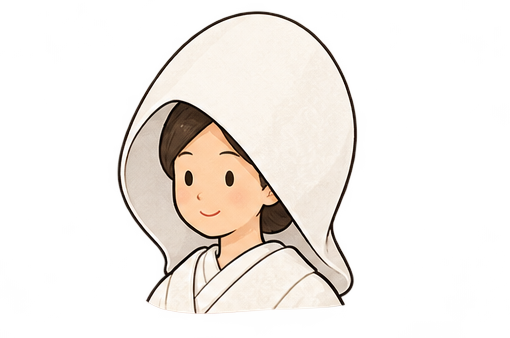
Watabōshi: a large white silk hood covering the whole hairstyle, worn only with shiromuku.
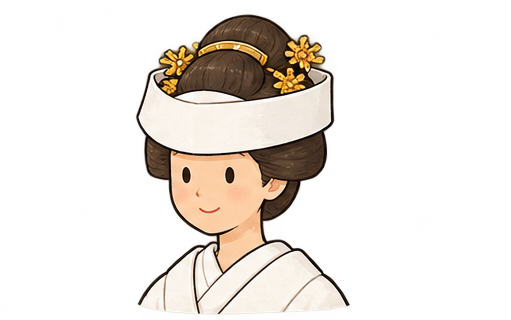
Tsunokakushi: a rectangular white band wrapped across the front of the hairstyle, worn with shiromuku or iro-uchikake.
These garments are very expensive. A fine iro-uchikake can cost over ¥1 million to buy, so almost every bride rents. Rental, dressing and makeup together run from roughly ¥100,000 to several hundred thousand yen. Dressing takes over an hour, and the full ensemble is heavy.
05The Reception: Envelopes, Speeches and a Letter
If you are invited to a Japanese wedding, the first thing to prepare is goshūgi, a cash gift. For a friend or colleague, the standard amount, according to surveys as of 2024, is still ¥30,000, a figure almost every Japanese adult knows. Odd numbers are preferred because they cannot be divided evenly, a hint that the couple will not split; ¥20,000 is sometimes acceptable if made up of three bills, one ¥10,000 and two ¥5,000. The notes should be new, showing that you prepared in advance, and go into a special envelope called a shūgibukuro, tied with gold-and-silver or red-and-white cords in a musubikiri knot, a knot that cannot be undone, because a marriage should happen only once. The bow-shaped knot used for ordinary gifts can be untied and retied, which makes it wrong for a wedding. At the reception desk you hand the envelope to the receptionists and sign the guest book.
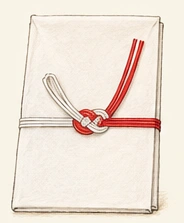
A gift wrapped with red-and-white mizuhiki. For weddings the cord must be tied in a knot that cannot be undone.
Women guests avoid white, which belongs to the bride, and avoid all-black outfits unless brightened by a colorful wrap or jewelry. Men wear a dark suit with a white or light-colored tie.
Seating follows a careful plan. The couple sits at the head table, called the takasago, after the Noh play Takasago, which celebrates a long and happy marriage; lines from it were once commonly chanted at weddings. A master of ceremonies, sometimes a professional, sometimes a friend, runs a familiar program: a speech by the guest of honor, often the groom’s or bride’s boss, a toast, the cake cutting and the "first bite" when the couple feed each other, the bride’s exit to change and her dramatic re-entrance under spotlights, performances by friends, and a slideshow of the couple growing up. Near the end comes the moment many Japanese remember most: the bride reads aloud a letter of thanks to her parents, usually in tears, and the couple presents bouquets to both sets of parents before the groom’s father gives a closing speech of thanks.
On the way out each guest receives hikidemono, a return gift, typically tableware or a household item plus a box of sweets. Increasingly it is a catalog from which the guest chooses a gift to be delivered at home. According to a 2025 survey, food, drink and the return gift cost the couple about ¥27,000 per guest on average, so most of a ¥30,000 gift goes straight back to the guest, and the economics of a Japanese wedding rest heavily on those envelopes.
06Seeing a Wedding in Japan
The easiest place for a visitor to see a Japanese wedding is a shrine. On weekends and holidays, especially on taian days in spring and autumn, Meiji Jingū, Tokyo Daijingū, Tsurugaoka Hachimangū and Heian Jingū may host several ceremonies a day. Taian, "great peace," is the luckiest day of the six-day rokuyō cycle printed on Japanese calendars, and many couples book it specifically; butsumetsu, the unluckiest, is when wedding venues offer discounts. When a procession passes, watch quietly from the side of the approach and take photos from a distance. Don’t block the way or follow the party into the hall, which is reserved for invited family.
Those who want to try it themselves have options. Photo studios in Kyoto, Kamakura and Asakusa offer kimono wedding portraits in shiromuku and iro-uchikake, often shot in a garden or on shrine grounds, and many foreign couples travel to Japan for exactly this. Some shrines also accept foreign couples for a full Shinto ceremony, usually with a planner who speaks English. If you get close to an iro-uchikake at a shoot, look at the embroidery: the cranes’ feathers are built up in raised gold and silk thread that photographs never quite capture.
In Japan, the rites of a life are closely tied to shrines: the first shrine visit after birth, Shichi-Go-San in childhood, the Coming of Age Day ceremony at twenty, and then the wedding, each one an occasion to put on kimono and have a photograph taken. The wedding is the grandest of them.