
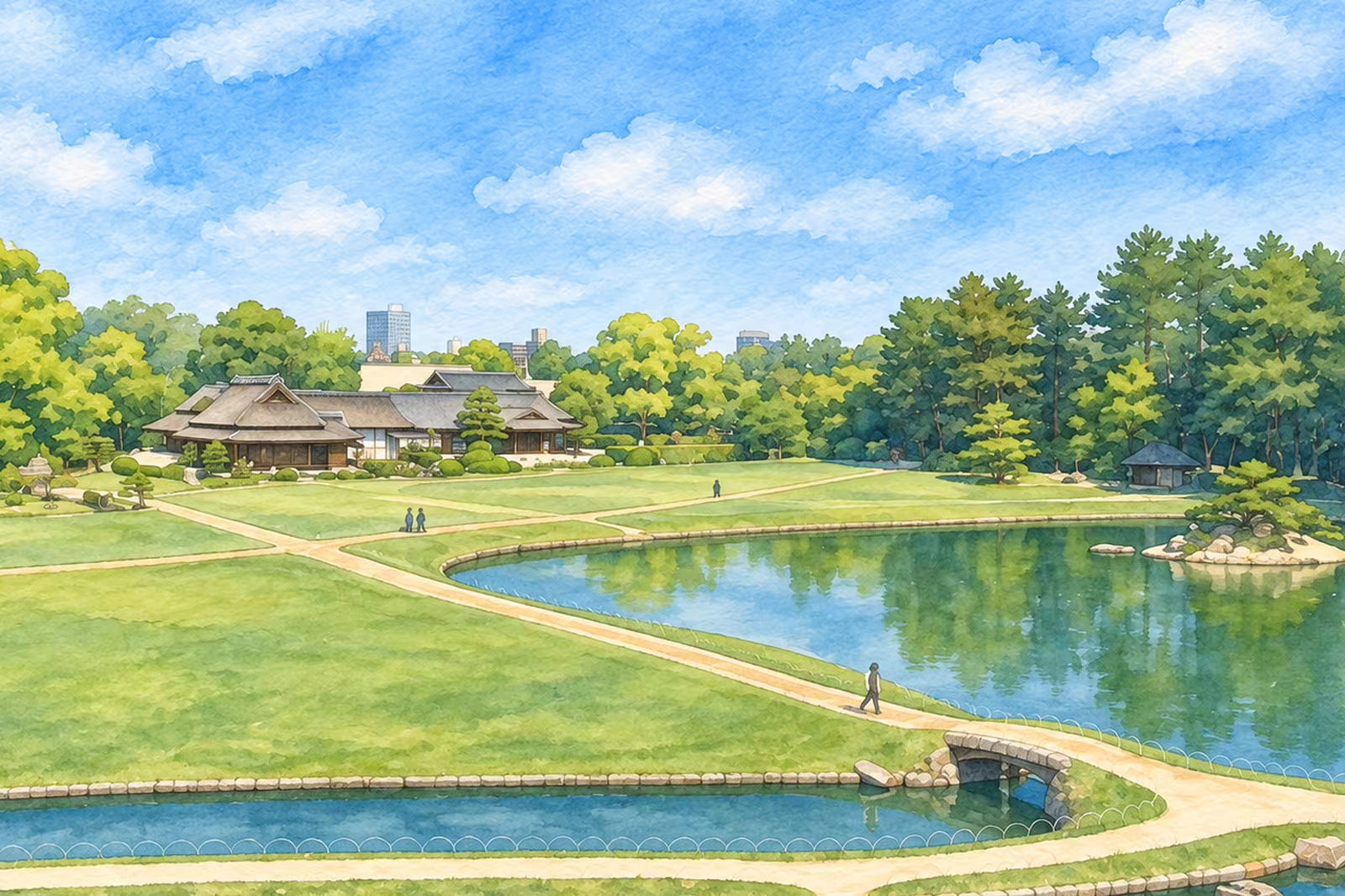
Okayama Kōrakuen is a garden in the city of Okayama, Okayama Prefecture, laid out on a sandbank in the Asahi River opposite Okayama Castle. Built by the Ikeda lords of the Okayama domain in the Edo period, it is counted with Kenroku-en in Kanazawa and Kairaku-en in Mito as one of the "three great gardens of Japan," and is designated a Special Place of Scenic Beauty.
01Ikeda Tsunamasa’s garden
In 1687 Ikeda Tsunamasa, the second lord of the domain, ordered his retainer Tsuda Nagatada to build a garden north of the castle, and it was largely complete by about 1700. It was first called Kōen, "the garden behind," because it lay behind the castle, and served as a place for the lord to rest and to receive guests. Under the next lord, Ikeda Tsugumasa, features such as the artificial hill Yuishin-zan were added, and later lords kept altering the design; Edo-period painted plans record how it looked at different times. The name Kōrakuen was adopted in 1871. It is generally explained as coming from the Chinese statesman Fan Zhongyan’s maxim that those who govern should take their pleasure only after everyone else has taken theirs.
02The garden
Kōrakuen is a stroll garden built around open lawns and the Sawa-no-ike pond, with paths linking ponds, hills, tea houses and pavilions so that the views change as visitors walk. It covers about 13 hectares and is threaded by a winding stream about 640 meters long. Rice paddies and a tea plantation remain inside the grounds, a reminder that a lord’s garden combined pleasure with farming. The main building, the Enyōtei, was where the lord stayed during visits; from it the lawn, the water and Mount Misao beyond the walls are framed in a single view. The garden also has a Noh stage, where the lords often watched performances.
03Modern history
In 1884 the garden passed to Okayama Prefecture and was opened to the public. Floods brought by the Muroto typhoon damaged it in 1934. In the 1945 air raid on Okayama, the Enyōtei and other buildings burned. They were restored after the war using Edo-period plans and records, and the Enyōtei was rebuilt in 1960. Several structures, including the Ryūten pavilion and the Renchiken, escaped the fire and survive. The garden was designated a Special Place of Scenic Beauty in 1952. Across the river, Okayama Castle was completed by Ukita Hideie in the late 16th century; its black keep burned in the 1945 air raid, was rebuilt in reinforced concrete in 1966, and is visible from the garden.
Okayama Kōrakuen (with Okayama Castle)
01A Garden and a Castle Across the River
Kōrakuen is a daimyo garden, the private landscape park of a feudal lord, laid out on a sandbar island in the Asahi River in the city of Okayama. Stand on its central lawn and look southwest over the treetops: a black, five-roofed keep rises on the far bank. That is Okayama Castle, nicknamed U-jō, "Crow Castle," for its dark walls. The two belong together. The garden was built behind the castle by the lords who lived in it, and for most of its history it was simply called the Go-kōen, the "rear garden."
Kōrakuen is counted, with Kenrokuen in Kanazawa and Kairakuen in Mito, among the "Three Great Gardens of Japan," and it is designated a Special Place of Scenic Beauty, the highest national category for gardens and landscapes. The castle’s keep is a 1966 concrete reconstruction; the original burned in an American air raid in 1945. Two turrets and long runs of stone wall are genuine survivors. This account starts with the castle, because without the castle there would be no garden.
02Ukita Naoie and the Making of Okayama
In the sixteenth century the province of Bizen, on the Inland Sea coast of western Japan, was contested ground. Ukita Naoie, a retainer of the Urakami family, rose through a career of intrigue and assassination remarkable even for the Warring States period (Sengoku, the era of near-constant war from the late fifteenth to the late sixteenth century). He turned on his own lord, Urakami Munekage, and made himself master of Bizen.
In 1570 Naoie destroyed Kanemitsu Munetaka, who held a small castle called Ishiyama on the west bank of the Asahi River, beside a low hill named Okayama. In the autumn of 1573 he moved his base there from Numa Castle. He drew merchants into the new town and routed the main highway through it, laying the commercial foundations of the city that still bears the hill’s name. Caught between the Mōri family to the west and Oda Nobunaga’s expanding power to the east, he eventually threw in his lot with Nobunaga’s general Hashiba (later Toyotomi) Hideyoshi. Naoie died of illness around the start of 1582, leaving a young son.
03Ukita Hideie and the Black Keep
That son, Ukita Hideie, grew up under Hideyoshi’s wing. He received the character "hide" from Hideyoshi’s own name, married Gō-hime, a daughter of Maeda Toshiie whom Hideyoshi had adopted, and became one of the Five Elders (Go-tairō), the council of great lords Hideyoshi appointed to govern for his infant heir. His domain, centered on Bizen and Mimasaka, was assessed at about 570,000 koku (a koku being the rice measure used to rate a domain’s wealth).
From 1591, with Hideyoshi’s guidance, Hideie rebuilt Okayama Castle on a grand scale. He moved the main enclosure from Ishiyama onto the Okayama hill itself and, by most accounts, diverted the Asahi River so that it curved around the castle’s north and east sides as a moat. The keep was completed in 1597. Its base followed the irregular outline of the hilltop, giving it an unusual pentagonal footprint. It had six floors inside; the number of roof tiers is counted variously as three, four or five. Its walls were clad in black-lacquered weatherboards, and its roofs carried gilded tiles, which earned it a second nickname, Kin’u-jō, "Golden Crow Castle." The stone walls Hideie raised on the south side of the main enclosure were said to be the tallest in Japan at the time. Writers have often suggested Hideie modeled his keep on Nobunaga’s Azuchi Castle, though this is an inference rather than a documented fact.
Hideie’s fortunes collapsed in 1600. He led one of the largest contingents of the Western Army at the Battle of Sekigahara and was defeated. He fled to Satsuma in the far south and sheltered with the Shimazu family until he was handed over to the Tokugawa. Spared execution, he was exiled in 1606 to Hachijōjima, an island far out in the Pacific south of Edo. He lived there for almost half a century and died in 1655, the last surviving commander of Sekigahara.
04Kobayakawa Hideaki and the Ikeda
Okayama went to Kobayakawa Hideaki, whose switch to the Tokugawa side mid-battle had helped decide Sekigahara. He held it only about two years, but is credited with digging an outer moat so quickly that it was nicknamed the Hatsuka-bori, the "Twenty-Day Moat." He died in 1602, aged twenty-one by the traditional Japanese count, without an heir, and his house was abolished.
The domain then passed to the Ikeda family. In 1603 Ikeda Tadatsugu, a son of Ikeda Terumasa, the builder of Himeji Castle, was appointed lord at the age of five, with the domain governed in practice by his father and elder brother. After Tadatsugu’s death in 1615 his brother Tadakatsu succeeded him and substantially enlarged the castle. The Tsukimi Yagura, or Moon-Viewing Turret, which survives today, was built under Tadakatsu in the 1620s. In 1632 the family reshuffled its holdings: Tadakatsu’s young heir was moved to Tottori, and his cousin Ikeda Mitsumasa came from Tottori to Okayama. Mitsumasa’s line ruled the domain, assessed at 315,000 koku, until the Meiji Restoration of 1868.
05Mitsumasa, the Confucian Lord
Ikeda Mitsumasa became one of the model rulers of the early Edo period. A committed Confucian, he invited the scholar Kumazawa Banzan to advise him, opened a lecture hall in 1641 and a domain school in 1669, and the following year founded the Shizutani School, a school for commoners in the countryside east of Okayama whose lecture hall is now a National Treasure. He cut the number of Buddhist temples, encouraged Confucian funerals, and invested heavily in flood control and land reclamation.
His chief engineer was Tsuda Nagatada, a retainer of extraordinary practical ability. Nagatada built the Shizutani School, reclaimed new rice land along the coast, and turned Banzan’s idea of a flood bypass, prompted by a disastrous flood in 1654, into the Hyakken-gawa. Overflow banks were built on the Asahi in 1669, and a major reconstruction began in 1686, creating an artificial floodway east of the city that carried excess water away from the river when it rose. When the next lord wanted a garden, it was Nagatada he turned to.
06Ikeda Tsunamasa Builds the Rear Garden
Mitsumasa retired in 1672 in favor of his son Ikeda Tsunamasa. Where the father was austere, the son loved Noh drama and the arts. In 1687 Tsunamasa had Nagatada begin a garden on land across the Asahi from the castle, much of it then rice paddies and vegetable plots. The groundwork was complete by 1700, with buildings added over the following years. Early on it was also known by humbler names such as the O-chaya, the "tea house."
The design is a "stroll garden" (kaiyū-shiki): a circuit of paths around a central pond, where the view changes at every turn. Kōrakuen differs from the enclosed temple gardens of Kyoto in its openness. Broad lawns, wide water and distant hills give it a spacious, almost parkland feel. Water drawn from the Asahi winds through the whole garden in a long, meandering channel before returning to the river.
The garden’s main building was the Enyō-tei, where the lord stayed and received guests when he came over from the castle. Tsunamasa, who performed Noh himself, also built a Noh stage. But the garden was not purely ornamental. It held rice paddies and tea fields, so the lord could observe farming at close hand. Later lords kept adding to it. Tsunamasa’s son and successor, Ikeda Tsugumasa, raised an artificial hill about six meters high, the Yuishin-zan, in the middle of the garden, giving the flat site a viewpoint, and cut a channel linking two of its ponds. Even in the Edo period, people of the domain were admitted on certain occasions.
07"Behind the Pleasure": a New Name
In 1871, after the fall of the shogunate, the Go-kōen was renamed Kōrakuen. The name echoes a famous line by the Song-dynasty Chinese statesman Fan Zhongyan in his Record of Yueyang Tower: a ruler should be the first to worry about the world’s troubles and the last to enjoy its pleasures. "Kōraku" means "pleasure afterwards." It kept the "rear" of the old name while giving it a Confucian meaning fitting for the Ikeda. The Tokugawa of Mito had used the same phrase for their garden in Edo, today’s Koishikawa Kōrakuen in Tokyo.
In 1884 the Ikeda family transferred the main part of the garden to Okayama Prefecture, and it opened to the public; the transfer was completed in 1919. In 1922 it was designated a national Place of Scenic Beauty. The castle fared worse. After the Meiji government ordered the abolition of castles, most of the castle’s buildings were pulled down, its outer moats filled in for streets, and its grounds given over to schools and offices. The keep, the Tsukimi Yagura and a few other structures survived. In 1931 the keep was designated a National Treasure under the National Treasures Preservation Law of the time.
08Flood, Fire and Restoration
Two disasters struck in the twentieth century. In 1934 the Muroto Typhoon flooded the Asahi River and swamped the garden, damaging buildings and trees. Then, in the early hours of June 29, 1945, American bombers firebombed Okayama. Much of the city burned. The castle keep was destroyed, leaving only its stone base; the Tsukimi Yagura and the Nishi-no-maru Nishite Yagura survived. In Kōrakuen the Enyō-tei and the Noh stage were lost.
The garden was restored after the war using Edo-period drawings and records preserved by the Ikeda family. The Noh stage was rebuilt in 1958 and the Enyō-tei in 1960, both in their old form, and in 1952 the garden was designated a Special Place of Scenic Beauty. The castle keep was rebuilt in reinforced concrete in 1966 on its original stone base, following pre-war photographs and surveys; its interior is a museum. Some gates were reconstructed at the same time, and in 1987 the castle site was designated a national Historic Site.
09Cranes
Red-crowned cranes, symbols of longevity, were kept in the garden from its earliest years. All of them were gone after the 1945 air raid. In 1956 Guo Moruo, the Chinese writer and scholar who had studied in Okayama as a young man, sent two cranes as a gesture of thanks to the city, and keeping cranes resumed; a poem by Guo is inscribed beside the aviary. The garden still keeps them, and on New Year’s Day and some other occasions they are released to walk across the lawns, a popular local tradition.
10Walking the Garden and the Castle
Enter by the main gate and the classic view opens at once: lawn, water and, on the skyline, the castle keep, borrowed into the garden as scenery. Walk to the Enyō-tei, the lord’s seat when he visited. From its rooms the composition was meant to be seen: the Sawa-no-ike pond in the foreground, the Yuishin-zan hill, and Mount Misao beyond. The Noh stage stands nearby.
Further east is the Ryūten, one of the few Edo-period buildings to survive the bombing. It is a small two-story pavilion whose ground floor is open on all sides, with a stream running straight through the middle past six stones of different color, size and shape. It served as a rest stop on the lord’s rounds of the garden, and it has few parallels in Japanese garden architecture. The Renchi-ken, a pondside pavilion that was Tsunamasa’s favorite, also escaped the fire.
The Sawa-no-ike is the garden’s largest pond, with three small islands. By the smaller Kayō-no-ike pond stands the Ōdate-ishi, a granite stone about seven meters tall. According to the garden’s own account, in the early Genroku era (around 1690) a huge rock was split into more than ninety pieces, carried here, and reassembled; the seams are still visible. Climb the Yuishin-zan for a view over the whole garden, with Mount Misao to the east and the castle to the west. Elsewhere are tea bushes that have grown on the same spot since the garden was made, plum and cherry groves, the Seiden fields laid out in the nineteenth century on the ancient Chinese "well-field" pattern of nine plots, and the Jigen-dō, a Kannon hall Tsunamasa built in 1697 to pray for his house and the townspeople; its statues are now in the Okayama Prefectural Museum.
Leave by the south gate, cross the Tsukimi-bashi bridge, and you are at the castle. Look at the stone walls first: Hideie’s high walls on the south side of the main enclosure, Kobayakawa-period work on the east side, and later Ikeda masonry, whose expansion buried some of the Ukita walls underground. Climb to the main enclosure and the rebuilt keep, with exhibits on the domain and the Ikeda. The Tsukimi Yagura, the only Edo-period building left in the main enclosure and an Important Cultural Property, has an upper gallery for viewing the moon. From the castle you can look back across the river to the trees of the garden, which is how the lords of Okayama saw it.