
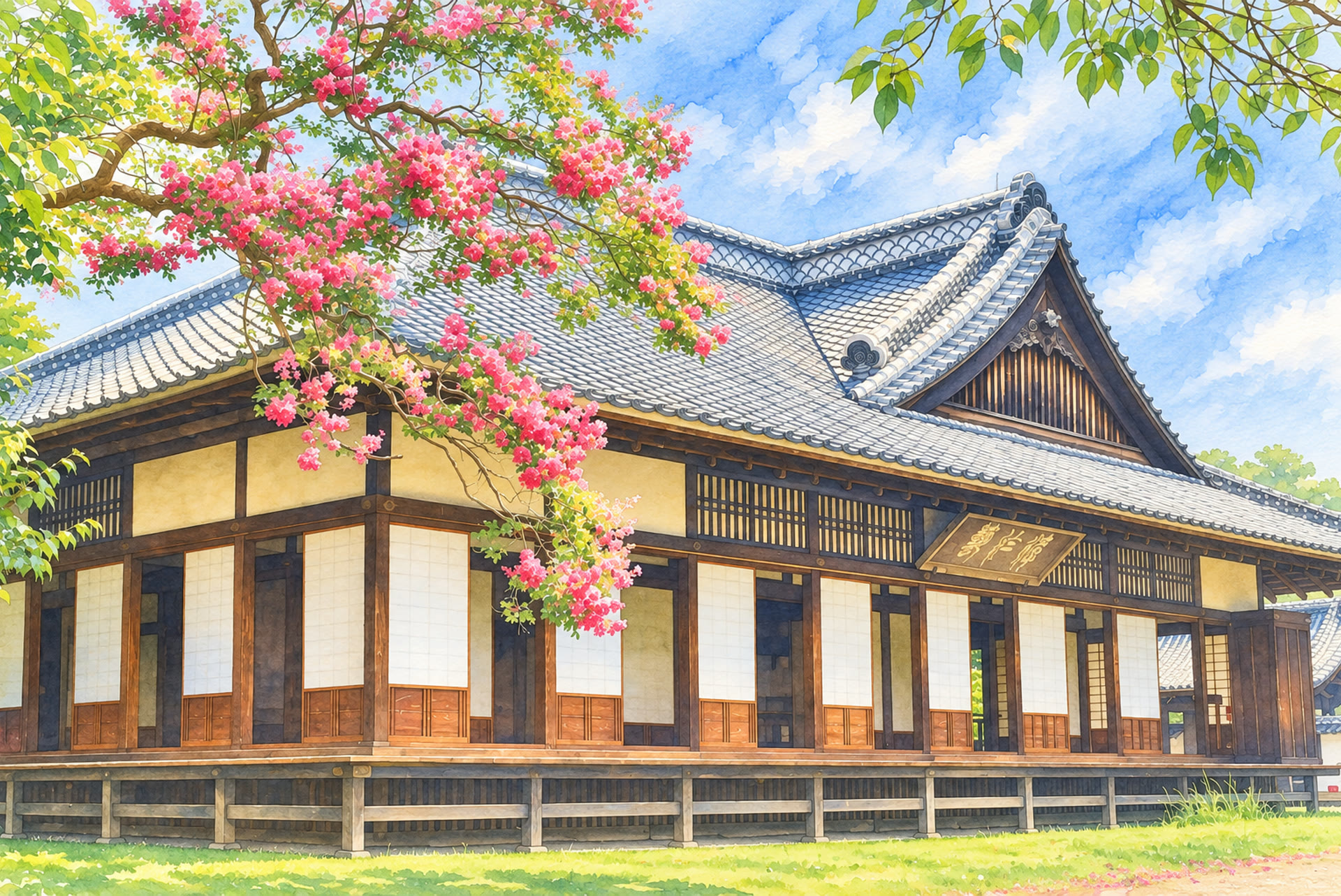
Kairaku-en and the Kōdōkan, both in the city of Mito in Ibaraki Prefecture, were created by the same man: Tokugawa Nariaki, ninth lord of the Mito domain in the late Edo period. The Kōdōkan was his domain school; Kairaku-en was a plum garden he opened to the people of the domain. He meant them as a pair: one for study, the other for rest. Mito was also the home of Mitogaku, the school of thought behind the call to "revere the emperor, expel the barbarians."
01A school and a garden
Nariaki became lord in 1829 and set about reforming the domain. The Kōdōkan, built inside the third enclosure of Mito Castle, opened provisionally in 1841 and formally in 1857; it is generally described as the largest domain school of its time. Its name comes from a line in the Confucian Analects, "It is man who can broaden the Way." Its founding statement, the Kōdōkan-ki, issued under Nariaki’s name and drafted by his adviser Fujita Tōko, called for the unity of letters and arms, of Shinto and Confucian learning, and of study and practical affairs. Sons of Mito retainers studied the classics, history, medicine and astronomy alongside the martial arts.
Kairaku-en opened in 1842. Its name, "a garden to enjoy together," echoes Mencius on rulers who share their pleasures with the people, and it was opened to commoners on days of the month ending in 3 or 8, unusual for a daimyo garden. Nariaki planted plum trees in large numbers: they bloom at the end of winter, and their fruit could be pickled as a reserve against famine and war.
02Mito in the last years of the shogunate
Most of the assassins who killed Ii Naosuke, the shogunate’s great elder (tairō), outside Edo Castle’s Sakurada Gate in 1860 were former Mito retainers. Nariaki’s seventh son, Tokugawa Yoshinobu, the last shogun, was raised in Mito and educated at the Kōdōkan. After surrendering Edo Castle in 1868 he returned to Mito and stayed in confinement in the Kōdōkan’s Shizendō until the seventh month, when he moved to Sunpu (Shizuoka). In the tenth month rival Mito factions fought in and around the school, and many of its buildings burned.
03What survives
The Kōdōkan’s Seichō (main hall), Shizendō and main gate are original Edo-period structures, all designated Important Cultural Properties, and the site as a whole is a Special Historic Site. The Confucian shrine and the Hakkedō burned in the 1945 air raid on Mito; the Hakkedō was rebuilt in 1953 and the shrine in 1970.
Kairaku-en is counted with Kenroku-en in Kanazawa and Kōraku-en in Okayama as one of the "three great gardens of Japan." It is known for roughly 3,000 plum trees of about a hundred varieties. Its villa, the Kōbuntei, where Nariaki held poetry gatherings, burned in 1945 and was restored between 1955 and 1958. A path from the northwest gate through dark bamboo and cedar groves to the bright plum orchard is generally taken to follow Nariaki’s intended sequence. Both sites were damaged in the 2011 Great East Japan Earthquake and have since been repaired.
Kairaku-en and the Kōdōkan
01Tension and release
The plum garden on the bluff above Lake Senba and the old school buildings inside the grounds of Mito Castle were planned by the same man in the same few years. Tokugawa Nariaki, ninth lord of the Mito domain, opened the Kōdōkan, his domain school, in 1841, and Kairaku-en, his garden, in 1842. He thought of them as a pair. The school was for effort: study, examinations, drill. The garden was for release, a place where the people trained at the school, and the people of the domain in general, could rest. The pairing is usually explained with a phrase from the Book of Rites: "one tightening, one loosening: that is the way of Wen and Wu," the model kings of ancient China.
The two sites matter beyond their own walls because of what was taught at one of them. The Kōdōkan was the institutional home of Mitogaku, the "Mito learning" that supplied much of the vocabulary of the movement to "revere the emperor and expel the barbarians" (sonnō jōi) in the 1850s and 1860s. Men formed by it killed the shogunate’s chief minister in the snow outside Edo Castle, raised a rebel army on Mount Tsukuba, and then tore their own domain apart. Nariaki’s son became the last shogun, and after giving up power he came home to sit in confinement in a room at the Kōdōkan. A visitor walking through these places is walking through the intellectual engine room of the end of the Tokugawa order.
02The Mito house and the Dai Nihon shi
Mito was one of the three senior branch houses of the Tokugawa family, the gosanke, alongside Owari and Kii. Its founder was Tokugawa Yorifusa, the eleventh son of Tokugawa Ieyasu. Mito was smaller than the other two houses, assessed at 350,000 koku after an increase in 1701, but it had an unusual privilege: its lords normally lived permanently in Edo rather than alternating between Edo and their domain. That closeness to the shogun earned the lord of Mito the informal nickname "vice-shogun," though no such office existed.
The second lord, Tokugawa Mitsukuni (1628–1701), is where Mito learning begins. In 1657 he set up a historiographical office at his Edo residence to compile a comprehensive history of Japan in the Chinese annals-and-biographies format. The office, later named the Shōkōkan, drew scholars from across the country, and Mitsukuni also patronized Zhu Shunshui, a Ming loyalist scholar who had fled the Manchu conquest, whose Confucianism left a mark on Mito. The resulting Dai Nihon shi (History of Great Japan) took more than two centuries to finish; its 397 fascicles were completed only in 1906.
The history took positions that later generations found stirring. It treated Prince Ōtomo as a reigning emperor, removed Empress Jingū from the line of sovereigns, and, most consequentially, recognized the Southern Court as legitimate during the fourteenth-century schism. That last judgment turned the Southern Court’s general Kusunoki Masashige into a model of loyalty; Mitsukuni himself raised a monument at Minatogawa, where Kusunoki died, inscribed "Alas, the grave of the loyal retainer Kusunoki." Historians call this first, history-centered phase "early Mitogaku."
Most Japanese know Mitsukuni as "Mito Kōmon," the disguised old lord who wanders the provinces righting wrongs in a long-running television drama. The travels are an invention of later storytellers; the real Mitsukuni did not tour the country. But the legend kept the Mito name in every household.
03Later Mitogaku: from history to national crisis
By the late eighteenth century the history project had stalled, and the character of Mito scholarship changed. In 1791 a young Shōkōkan scholar, Fujita Yūkoku, wrote Seimeiron (On the Rectification of Names), which argued that order depended on everyone keeping to their proper station: the shogun revering the emperor, the daimyo revering the shogun, and so on down. This was not an attack on the shogunate. It was an argument that the shogunate’s authority rested on its reverence for the throne.
Yūkoku’s student Aizawa Seishisai pushed these ideas into the field of foreign affairs. In 1824 crewmen from British whaling ships landed at Ōtsuhama on the Mito coast to ask for food and water, and the domain was alarmed. The next year Aizawa finished Shinron (New Theses). It set out the idea of kokutai, the "national body," a Japan defined by an unbroken imperial line and the unity of ruler and subject, and called for coastal defense, moral renewal and the repulsion of Western powers. In Aizawa’s writing "revering the emperor" and "expelling the barbarians" became a single program. Shinron was not formally published for decades, but it circulated in manuscript among activists across Japan. The young Yoshida Shōin traveled to Mito to meet Aizawa, one sign of how far its influence reached.
Yūkoku’s son Fujita Tōko combined scholarship with politics. He became Nariaki’s closest adviser and was admired by activists from many domains for his poetry and his fervor. This second phase of Mito thought, concerned less with history than with how to hold the country together under pressure, is called "later Mitogaku."
04Nariaki and the Tenpō reforms
Tokugawa Nariaki was born in 1800, the third son of the seventh lord, Harutoshi, and spent his twenties as a younger son with few prospects. In 1829 his elder brother, the eighth lord Narinobu, was dying without an heir. One faction in the domain wanted to adopt a son of the shogun’s family; a group of middle- and lower-ranking samurai led by Fujita Tōko and Aizawa Seishisai pushed for Nariaki. Nariaki won, and the men who had backed him became the core of his reform party.
His program, carried out during the Tenpō era, is usually called the Mito Tenpō reforms. He resurveyed land, cut expenses, promoted able men of modest rank and preached frugality. He poured resources into coastal defense, built batteries, cast cannon and staged large-scale military exercises disguised as hunts. To get bronze for the guns he requisitioned temple bells, and he closed or merged many Buddhist temples in the name of reform while encouraging Shinto funerals. These policies reflected Mito learning’s preference for Shinto over Buddhism, and they made enemies.
Education sat at the center of the program. Nariaki believed that capable officials had to be trained rather than born, and that learning was useless if it never left the study. The Kōdōkan and Kairaku-en grew out of that conviction.
05The Kōdōkan: letters and arms as one
Planning began in the 1830s. In the third month of 1838 Nariaki issued the Kōdōkan-ki (Record of the Kōdōkan), the school’s founding statement, written in his name but drafted mainly by Fujita Tōko; the draft is recorded as having been reviewed by Aizawa Seishisai, Aoyama Nobuyuki and Satō Issai before Nariaki settled the text. The name comes from the Analects: "It is man who can broaden the Way, not the Way that broadens man." The statement’s principles were later summed up in a series of slogans: the unity of Shinto and Confucianism, of loyalty and filial piety, of letters and arms, of learning and practical affairs, and of government and education. Tōko later wrote a long commentary on it.
The school opened provisionally on September 15, 1841 (the first day of the eighth month) in the third enclosure of Mito Castle, with teaching beginning while construction continued. The formal opening came only on May 31, 1857, long after Nariaki had been forced from power. The grounds covered about 10.5 hectares; the Kōdōkan is usually described as the biggest domain school in Japan. Its layout expressed its philosophy. At the center stood the Seichō, the main hall used for ceremonies and examinations, joined to the Shizendō, the lord’s quarters. Around them were halls for literary study (Confucian classics, Japanese learning, history, astronomy, mathematics, music) and for martial training (sword, spear, grappling, archery, horsemanship, gunnery). A medical school taught medicine and prepared drugs. Deeper in the grounds stood a Shinto shrine with a deity brought from Kashima Shrine and, beside it, a Confucian shrine, so that the two traditions stood side by side. The text of the Kōdōkan-ki was carved on a stone housed in an octagonal pavilion, the Hakkedō.
Students were sons of Mito retainers, entering in their mid-teens and required to attend a set number of days according to their family rank. The Kōdōkan had no graduation: retainers were expected to keep studying and sitting examinations even after they entered service. Aizawa Seishisai and Aoyama Nobuyuki were the first heads of instruction. Nariaki also founded local schools around the domain, with the Kōdōkan at the center of the network.
Plum trees were planted here too. In an essay on planting plums, Nariaki praised the tree for blooming before all other flowers and for fruit that could be pickled and stored against famine or war. The same thinking shaped his garden.
06Kairaku-en: a garden to share
Kairaku-en opened on the first day of the seventh month of 1842. The name comes from Mencius, who told King Hui of Liang that the worthy rulers of old could truly enjoy their parks because they shared them with the people. Nariaki set out his intentions in the Kairaku-en-ki, carved on a stone in the garden: the Kōdōkan was for training body and mind, but no one can stay tense forever, and the place of rest should belong not only to the lord but to the people of the domain. Under the rules of the day the garden was opened to commoners on days of the month ending in 3 or 8, which set it apart from daimyo gardens reserved for their owners and guests.
The garden sits on a plateau on the north shore of Lake Senba and borrows the lake as scenery. Nariaki gathered plum trees from many places and planted them by the thousand. His villa, the Kōbuntei, takes its name from kōbunboku, "the tree that loves learning," an old Chinese name for the plum, from a legend that plums bloomed when the emperor studied and withered when he neglected his books. The Kōbuntei, said to have been designed by Nariaki himself, is a wooden building of two roof tiers and three floors; its top floor, the Rakujurō, looks out over the lake, and a single-story wing for the lord’s household adjoins it. Nariaki held poetry gatherings here with retainers and scholars, entertained elderly people from the domain, and is said to have let the women of his household enjoy the garden as well.
The route through the garden was designed. In the usual account, Nariaki meant visitors to enter by the Omotemon, the front gate on the northwest side, and walk first through a shadowy grove of bamboo and tall cedars, past the spring called Togyokusen. This was the world of in (yin). Then the path climbs to the plateau and opens onto the bright plum orchard and the lake: the world of yō (yang). Most visitors today enter elsewhere and see the plums at once, missing the effect.
07Fall, return and confinement
Nariaki’s reforms were too bold for the shogunate. In 1844 it ordered him to retire and remain in confinement, citing his cannon casting, military exercises and treatment of temples. His young son Tokugawa Yoshiatsu became lord, and conservatives took control of the domain. Reformers campaigned for years on Nariaki’s behalf, and he was gradually allowed back into domain affairs.
Commodore Perry’s arrival in 1853 changed everything. The senior councilor Abe Masahiro brought Nariaki into the shogunate as an adviser on coastal defense. Nariaki was the best-known hard-liner in the country, arguing against opening the ports, but the shogunate signed the Treaty of Kanagawa with the United States in 1854. In the Ansei Edo earthquake of 1855, Fujita Tōko was killed by a falling beam while saving his mother, and Nariaki lost his most trusted adviser.
In 1858 two crises collided: a commercial treaty with the United States, and the succession to the sickly, childless thirteenth shogun, Tokugawa Iesada. Nariaki, together with Matsudaira Yoshinaga of Echizen and Shimazu Nariakira of Satsuma, backed his own seventh son, Hitotsubashi Yoshinobu. The rival party backed Tokugawa Yoshitomi of Kii. Ii Naosuke, newly appointed great elder (tairō), settled the succession on Yoshitomi, who became the fourteenth shogun, Iemochi, and signed the Harris treaty without the emperor’s sanction. Nariaki and his allies went to Edo Castle on an unscheduled day to confront Ii and were punished with confinement. That autumn the imperial court sent a secret edict directly to the Mito domain, bypassing the shogunate, a move that alarmed Edo and helped set off the Ansei Purge. In 1859 Nariaki was ordered into permanent confinement in Mito.
He died in Mito on the fifteenth day of the eighth month of Man’en 1, or September 29, 1860, at the age of 60. He was posthumously known as Rekkō, "the ardent lord."
08Where the ideas went
After the secret edict, the shogunate demanded that Mito hand it back, and the domain split over whether to obey. Some of the most determined opponents left the domain. On March 24, 1860, in falling snow outside Edo Castle’s Sakurada Gate, seventeen former Mito retainers and one Satsuma man attacked Ii Naosuke’s procession and killed him. The incident has its own article on this site; what matters here is that the assassins’ convictions had been shaped by the later Mitogaku taught in and around the Kōdōkan.
The split within Mito only deepened. The radical reformers came to be called the Tengu party; their opponents, centered on students of the Kōdōkan, were called the Shosei party. In 1864 Fujita Koshirō, Tōko’s fourth son, raised a force on Mount Tsukuba demanding that the shogunate expel foreigners. Under the later leadership of Takeda Kōunsai the rebels marched west, hoping to petition Yoshinobu in Kyoto, but surrendered in Echizen; more than 350 were executed at Tsuruga in 1865. Back in Mito the Shosei party took power and punished the rebels’ families harshly.
The Meiji Restoration reversed the situation. Surviving Tengu men returned to Mito with imperial backing and the Shosei leaders fled. On November 14–15, 1868 (the first and second days of the tenth month), the Shosei party fought its way back into the town and made a stand at the Kōdōkan, in what is called the Battle of the Kōdōkan. The halls for letters, arms and medicine and many other buildings burned; the Seichō and Shizendō survived, and the pillars of the main gate still bear bullet marks. Years of purges and reprisals had stripped Mito of much of its talent, which is often given as the reason that few Mito men held high office in the Meiji government. The domain that had done most to put "revere the emperor" into circulation was nearly absent from the new state.
09Yoshinobu: a schoolroom and a place of confinement
Tokugawa Yoshinobu was born in 1837 at the Mito residence in Edo, Nariaki’s seventh son. Nariaki held that his sons should grow up in Mito rather than amid the comforts of Edo, so the boy was sent to Mito the year after his birth and spent about nine years there, studying the classics and martial arts under teachers of the Kōdōkan circle. In 1847 he was adopted into the Hitotsubashi house and left Mito.
His career as guardian to the shogun, commander of the imperial palace guard, fifteenth shogun from the twelfth month of 1866 (January 1867), and the man who returned governing authority to the court in 1867 and withdrew from Ōsaka after the Battle of Toba–Fushimi in 1868, is told elsewhere on this site. Its connection to Mito comes at the end. When Edo Castle was surrendered without a fight on the eleventh day of the fourth month of 1868, Yoshinobu left Edo the same day for Mito and went into confinement in the Shizendō, the lord’s quarters of the school where he had studied as a child. Mito was then still torn by the Tengu–Shosei feud. On the nineteenth day of the seventh month he left for Sunpu (present-day Shizuoka), where he lived in retirement for about thirty years.
10After the domain
The Kōdōkan ceased to function as a school after the Restoration. In 1873 Kairaku-en became a public park under Ibaraki Prefecture, known with its surroundings as Tokiwa Park, and in 1874 Tokiwa Shrine was built beside it to enshrine Mitsukuni and Nariaki. In modern times Kairaku-en came to be counted with Kenroku-en in Kanazawa and Kōraku-en in Okayama as one of the "three great gardens of Japan." Its plum festival dates back to the Meiji period.
In August 1945 American bombers burned most of Mito. The Kōbuntei, and the Kōdōkan’s Confucian shrine and Hakkedō, were destroyed. The Kōbuntei was restored to its old plan between 1955 and 1958. At the Kōdōkan the Hakkedō was rebuilt in 1953 and the Confucian shrine in 1970, and the Kashima shrine was re-created in the mid-1970s with an old building transferred from Ise. The Kōdōkan, a Historic Site since 1922, was upgraded to a Special Historic Site in 1952; its Seichō, Shizendō and main gate are recorded as having been designated Important Cultural Properties in the 1960s. Tokiwa Park had been designated a Historic Site and Place of Scenic Beauty as early as 1922.
The 2011 Great East Japan Earthquake hit Mito hard and damaged the Kōdōkan’s buildings and its Kōdōkan-ki stone as well as the Kōbuntei, all since repaired. In 2015 the Kōdōkan and Kairaku-en were recognized as Japan Heritage, together with the Ashikaga Gakkō, Shizutani School and Kangien, as part of a group representing early modern education. In 2020 and 2021 Mito Castle’s Ōte Gate and a corner turret of the second enclosure were reconstructed, giving the area around the Kōdōkan back something of its castle setting.
11A walk through both sites
At the Kōdōkan, start with the main gate, a tile-roofed gate reserved for the lord. Inside, the entrance of the Seichō carries a plaque in Nariaki’s hand reading "Find recreation in the arts," a phrase from the Analects. The Seichō hosted ceremonies and examinations; its formal room is said to display a large calligraphy of the two characters son-jō, "revere and expel." The connected Shizendō, simple and plain, is where Yoshinobu spent his months of confinement in 1868.
Beyond the hall are the Hakkedō with the Kōdōkan-ki stone, the Confucian shrine and the Kashima shrine, Shinto and Confucian buildings side by side as the founding statement prescribed. The school’s own plum trees bloom in late winter.
At Kairaku-en, if you have time, enter through the Omotemon on the northwest side and follow Nariaki’s sequence: bamboo grove, cedars, the Togyokusen spring, then up into the plums. The Kōbuntei is a postwar reconstruction, but it follows the original plan, and from the top floor of the Rakujurō you can look over Lake Senba as Nariaki did. Look for the Kairaku-en-ki stone and the Sen’ekidai, a terrace where Nariaki is said to have played go and enjoyed the view. Tokiwa Shrine, next to the garden, honors Mitsukuni and Nariaki, the beginning and the culmination of Mito learning.