
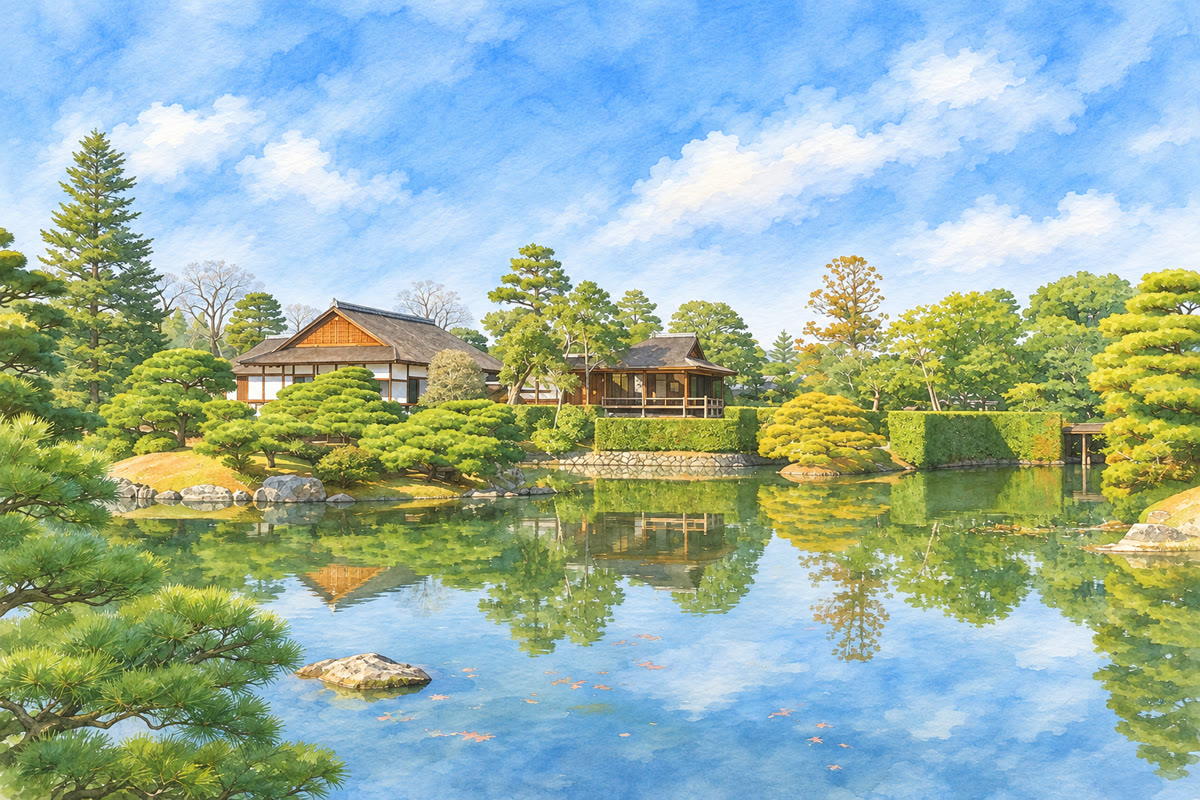
Katsura Imperial Villa (Katsura Rikyū) stands on the west bank of the Katsura River in Nishikyō Ward, Kyoto. Built in the early seventeenth century as a country retreat for the Hachijō-no-miya, a princely branch of the imperial family, it combines connected shoin halls, teahouses and a stroll garden around a pond. It is regarded as a masterpiece of sukiya-style architecture and garden design, and is now administered by the Imperial Household Agency.
01A Prince’s Retreat
The founder was Prince Hachijō-no-miya Toshihito, a younger brother of Emperor Go-Yōzei. As a boy he was adopted by Toyotomi Hideyoshi, who dissolved the adoption after his own son was born and set the prince up with a house of his own. Toshihito was an accomplished poet and a devoted reader of The Tale of Genji. Fujiwara no Michinaga had kept a villa at Katsura, and in Genji the hero has a retreat here. These associations probably drew the prince to the site.
Around 1615, Toshihito began building a small teahouse on his land by the river, which developed into what is now the Old Shoin. After his death in 1629 the villa was neglected for years. His son, Prince Toshitada, married Fū-hime, a daughter of Maeda Toshitsune, lord of the wealthy Kaga domain, in 1642, and with Maeda support restored and enlarged the estate. The Middle Shoin is usually dated to about 1641; the Gakki-no-ma (Music Room), the New Palace and teahouses such as Shōkintei and Shōiken followed, largely complete by about 1662. The New Palace is generally believed to have been built to receive the retired Emperor Go-Mizunoo, who visited in 1663.
02From Princely House to Imperial Villa
The house was later renamed several times, becoming the Katsura-no-miya in 1810. When its last head, Princess Sumiko, died in 1881, the house came to an end. In 1883 the Imperial Household Ministry took over the estate and named it Katsura Rikyū, "detached palace"; after the Second World War it passed to the Imperial Household Agency.
No record names a designer. A tradition dating from the later Edo period credits the tea master and garden designer Kobori Enshū, but there is no reliable evidence for it, and the villa is now usually credited to the two princes and their craftsmen. The German architect Bruno Taut visited in 1933 and praised its simplicity, making it famous among modernist architects.
03What You See Today
The four shoin buildings stand in a staggered diagonal line west of the pond, an arrangement likened to geese in flight. A bamboo moon-viewing platform projects from the Old Shoin toward the water. Around the pond stand four teahouses, Shōkintei, Shōkatei, Shōiken and Gepparō, along with a small Buddhist hall, the Onrindō. Stepping stones and bridges lead visitors along a route designed so that the view keeps changing.
The main buildings are mostly seventeenth-century originals, though between 1976 and 1991 they were dismantled, repaired and reassembled in a major program often called the Shōwa restoration. As imperial property, Katsura is not designated a National Treasure or Important Cultural Property, and it is not among the components of the "Historic Monuments of Ancient Kyoto" World Heritage listing.
Katsura Imperial Villa
01Behind the Bamboo Fence
Katsura Imperial Villa lies on the western edge of Kyoto, just across the Katsura River in Nishikyō Ward. Approaching it, you see almost nothing of what is inside. A long hedge of living bamboo, its stems bent over and woven together, runs beside the road; this is the Katsura fence, and it does its job well. The villa was never meant to impress passers-by. It was a private retreat for a branch of the imperial family, and much of its art lies in how it hides and then reveals.
The name "Katsura Rikyū," meaning Katsura Detached Palace, is barely 140 years old. For most of its history the estate belonged to a princely house called the Hachijō-no-miya, later the Katsura-no-miya, and people referred to it simply as the Katsura villa or the Lower Katsura teahouse. To understand the buildings and garden in front of you, it helps to meet the two men who made them: Prince Toshihito and his son, Prince Toshitada.
02A Place Already Full of Stories
Long before any of the present buildings went up, Katsura carried literary associations that any educated courtier would recognize. In the Heian period (794–1185), the riverbanks southwest of the capital were a favorite resort of the nobility, who built villas here for boating, moon-viewing and watching cormorant fishing on the river. Fujiwara no Michinaga, the most powerful courtier of his age, had a villa at Katsura.
The key text, though, was The Tale of Genji, written by Murasaki Shikibu in the early eleventh century. In the chapter "Wind in the Pines," the hero Hikaru Genji builds a retreat at Katsura, uses it as an excuse to visit the Akashi Lady living nearby, and holds a moon-viewing banquet there. Genji’s Katsura villa is usually thought to have been modeled on Michinaga’s real one. For an aristocrat of the early 1600s steeped in the classics, Katsura was not a farming village but the place where Genji watched the moon.
The name itself suggested the moon. Katsura is the Japanese reading of a character used for a tree that, in Chinese legend, grows on the moon. Japanese courtiers knew the allusion, and the villa is full of designs for moon-viewing, from a bamboo platform facing the pond to a teahouse whose name includes the word for "moon."
03Prince Toshihito: The Man Who Was Almost Emperor
Prince Toshihito was born in 1579, a son of Prince Sanehito (also read Masahito) and grandson of Emperor Ōgimachi. His elder brother became Emperor Go-Yōzei. Twice, the prince came close to the very top.
In 1586 (some accounts say 1588), Toyotomi Hideyoshi, then the dominant warlord of Japan and still without an heir, adopted the boy, reportedly with the idea that he might one day succeed to Hideyoshi’s position as imperial regent (kanpaku). In 1589, however, Hideyoshi’s consort Yodo-dono gave birth to a son, Tsurumatsu, and the adoption was dissolved. By way of compensation, Hideyoshi established a new princely house for Toshihito, with lands to support it, in the twelfth month of 1589. It was called the Hachijō-no-miya, reportedly after the location of its residence near Hachijō, the Eighth Avenue of the capital.
Later, Emperor Go-Yōzei more than once wished to abdicate in his brother’s favor. According to the records, he raised the idea when he fell ill around 1598, but it met resistance at court and, it is said, from Tokugawa Ieyasu, partly because Toshihito had once been Hideyoshi’s adopted son. In 1611 the throne passed instead to Go-Yōzei’s own son, who became Emperor Go-Mizunoo. Toshihito ended up as the emperor’s uncle rather than the emperor.
With political doors closing, Toshihito turned to scholarship and the arts. He was an accomplished poet in waka and linked verse, and in 1600 he received the Kokin denju from Hosokawa Yūsai. This was a body of secret teachings on the interpretation of the tenth-century poetry anthology Kokinshū, then regarded as the highest lineage of poetic learning. The same year, during the conflict that led to the Battle of Sekigahara, Yūsai was besieged in Tanabe Castle in Tango Province by forces of the western coalition. Fearing that the teachings might die with him, Toshihito worked to have the siege lifted, and Emperor Go-Yōzei eventually sent envoys who arranged a settlement, allowing Yūsai to leave the castle. The episode is often cited to show how seriously the court treated classical learning.
Toshihito was also a dedicated student of Genji. It is hardly surprising that such a man chose to build his retreat at the place where Genji watched the moon.
04"A Simple Teahouse in a Melon Field"
The Katsura area lay within the lands of the Hachijō-no-miya. Around 1615, at the start of the Genna era, Toshihito began building there (some accounts give about 1620). In a letter usually dated to about 1618, inviting the courtier Konoe Nobuhiro to visit, he described the place as a simple teahouse in the melon field at Lower Katsura, and it was probably at first a small rest house among the fields.
Over the following decade or so the estate grew. The Old Shoin, the oldest of today’s main halls, is generally believed to date from Toshihito’s time. Here the prince held poetry gatherings and parties for his friends at court. His records describe guests viewing the moon, boating on the pond, and composing verse together.
This was the prelude to what historians call Kan’ei culture, named after the Kan’ei era (1624–1644). The Tokugawa shogunate had just established its rule and kept the imperial court on a tight political leash. Courtiers, along with wealthy townsmen and artists, found room to move in poetry, tea, flower arrangement, calligraphy and painting. Emperor Go-Mizunoo, Toshihito, the artist Hon’ami Kōetsu and the tea master Kobori Enshū all belonged to this world, and Katsura is often seen as one of its finest products.
Toshihito died in 1629 at the age of 50. His heir, Toshitada, was only about ten years old, and the villa fell into neglect.
05Prince Toshitada and the Wealth of Kaga
Toshitada, born in 1619, married Fū-hime, a daughter of Maeda Toshitsune, in 1642; Toshitsune was lord of the Kaga domain. The Maeda were the richest daimyo house in Japan, and Toshitsune’s wife was a daughter of the second shogun, Tokugawa Hidetada, so the bride was the shogun’s granddaughter. The marriage tied the Hachijō-no-miya to the wealthiest warrior family in the country and gave the prince the means to revive his father’s villa.
Building on the Old Shoin, Toshitada restored the estate and added the Middle Shoin beside it, usually dated to around 1641. The garden was reworked and extended, and by about 1662 Gepparō, Shōkintei, Shōkatei, Shōiken and other teahouses had been built or rebuilt. Much of what visitors see today is thought to have taken its final form under Toshitada.
Toshitada was a cousin of Go-Mizunoo, who by then had abdicated, and the two shared literary and artistic interests. Go-Mizunoo later built his own retreat, the Shūgakuin Imperial Villa, in the hills of northeastern Kyoto; together the two are regarded as the great imperial villas of the early Edo period.
06The New Palace and an Imperial Visit
The last part of the shoin complex to be built was the New Palace at its far end, together with the Gakki-no-ma, or Music Room, which links it to the Middle Shoin. It is usually dated to about 1662, though a date of 1660 has been found on paper inside its sliding doors. The New Palace is generally believed to have been built, or at least finished, in preparation for a visit from Go-Mizunoo.
According to the records, the retired emperor came to Katsura in 1663. Toshitada had died the previous year, in 1662, and the host was his successor, Prince Yasuhito, a son of Go-Mizunoo adopted into the Hachijō-no-miya. The visit is remembered as the high point of the villa’s history.
The main room of the New Palace has a raised section, and beside it a set of staggered shelves made of many rare woods, known as the Katsura shelves. They are counted among the "three famous shelves" of Japan, along with the Kasumi shelves at Shūgakuin and the Daigo shelves at Sanbō-in, a sub-temple of Daigo-ji. Metal fittings throughout the New Palace, door pulls and nail covers among them, are worked with great care, some reportedly in the form of flowers or of the character for "moon."
07Halls in Flight: The Architecture
Seen from across the pond, the four halls (Old Shoin, Middle Shoin, Music Room and New Palace) do not form a straight line. Running from east to west, each steps back diagonally from the one before, their roofs overlapping, in a pattern known as gankō, "geese in flight." The arrangement gives every building a view of the garden and good light and air, and it prevents the complex from ever presenting a long, flat wall.
The halls follow the shoin style of formal residential architecture, loosened by the freer approach of the tea room. This blend is called sukiya-style shoin architecture. Posts are often left with rounded or bark-marked edges; walls are plain clay plaster and white paper screens; roofs are of thin wooden shingles. There is no painted decoration and no gold leaf on the exterior. The contrast with the Nikkō Tōshōgū, the lavishly carved and painted shrine to Tokugawa Ieyasu completed in roughly the same decades, could hardly be greater.
The floors are raised well above the ground. This is generally explained as a precaution against the Katsura River, which flooded the low-lying land repeatedly; water could pass beneath the buildings without entering them.
In front of the Old Shoin projects a platform of bamboo, the famous moon-viewing platform. It faces the pond, and its orientation is thought to have been chosen so that guests could watch the moon rise in the east and its reflection appear on the water. Sitting here, you look across the pond and its islands to the Shōkintei teahouse on the far shore, one of the classic views of Katsura.
08The Stroll Garden: A View That Keeps Changing
The garden is a stroll garden laid out around a large pond with an intricate shoreline and several islands. A path circles the water, passing teahouses, stone lanterns and bridges along the way. The pond is said to have been fed from the Katsura River.
What the garden is most admired for is its control of sightlines. Visitors entering through the main gate walk along the Miyuki-michi, the "imperial visit path," pass the Miyuki-mon gate, and reach a small open space where a single pine, the Sumiyoshi Pine, stands. It blocks the view of the pond almost completely; only glimpses of water show behind it. The view opens up gradually as you walk on. This technique of concealing and then revealing is repeated throughout the garden.
The paths themselves are carefully composed. Stepping stones, paved walkways made of fitted stones, slab bridges and earthen bridges alternate, with every stone’s shape and spacing considered. Later writers borrowed the three styles of calligraphy, formal, semi-cursive and cursive, to describe three of the paved walks: one near the shoin uses neatly cut stone, one near the outer waiting bench mixes cut and natural stones, and another uses mostly natural stones. The classification is a later one, but it captures how the paths move from formal to relaxed.
Near the outer waiting bench, a beach of flat black stones juts into the pond, with a stone lantern at its tip like a lighthouse on a cape. Beyond it, near Shōkintei in the northeast of the pond, small islands linked by stone bridges are said to imitate Amanohashidate, one of the "three views of Japan." Opposite the outer waiting bench, where tea guests waited before being called, a small mound is planted with cycads, a southern plant rare in Kyoto at the time; the cycads are traditionally said to have been a gift from the Shimazu lords of Satsuma.
09Four Teahouses and a Small Temple
Shōkintei, on the east side of the pond facing the Old Shoin, is the largest and most formal of the teahouses. The approach from the waiting bench crosses a bridge made of a single long stone slab. Inside, the alcove and sliding doors of the main room are covered in a bold checkerboard of blue and white paper, a pattern that modern visitors often compare to twentieth-century design. The name comes from a poem in the Shūishū anthology that likens the sound of a koto to the wind in the pines on a peak; the name plaque under the gable is said to be in the hand of Emperor Go-Yōzei.
Shōkatei stands on a hilltop on one of the islands, the highest point in the garden. It is a simple, open-sided pavilion, deliberately modeled on a rustic roadside tea stall.
Shōiken, at the southern end, has windows on the side facing the fields beyond the villa, borrowing the farmland into the view. Its lower walls are faced with a diagonal pattern of gold leaf and velvet, its door pulls are shaped like boat oars, and six round windows pierce the wall above its entrance. It is thought to have been used for rest and small banquets.
Gepparō, next to the Old Shoin on the northwest shore, takes its name from "moon" and "waves": it was a place for watching moonlight on the water. Its ceiling is left open, exposing a framework that resembles the underside of a boat.
The Onrindō is a small Buddhist hall at the foot of Shōkatei’s hill, its name plaque written by Go-Mizunoo. It once housed the memorial tablets of the princely house, along with an image of the Willow Kannon and a portrait of Hosokawa Yūsai. Unlike the teahouses, it served as a kind of family chapel; today nothing is enshrined there and only the building remains.
10Who Designed Katsura?
Many guidebooks still state that Katsura was designed by Kobori Enshū, the celebrated tea master and garden designer who served the shogunate as commissioner of works and was involved in many building projects. The attribution seems to have been circulating by the later Edo period.
Yet no reliable evidence of Enshū’s involvement has been found in the records of the Hachijō-no-miya or other contemporary sources. Scholars today generally see Katsura as the creation of Toshihito and Toshitada, who directed the work according to their own tastes, carried out by retainers, carpenters and gardeners over several decades. It was not planned in one stroke by a single designer. Enshū’s influence may be present in the general taste of the period, but "designed by Enshū" belongs to legend.
11The End of the Princely House
The Hachijō-no-miya continued for more than two centuries, though its name changed several times: first to Tokiwai-no-miya, then to Kyōgoku-no-miya, and in 1810 to Katsura-no-miya. Many of its heirs were princes adopted from the main imperial line, and several died young. When the last head, Princess Sumiko, died in 1881, the house came to an end.
In 1883 the Imperial Household Ministry took over the estate and named it Katsura Rikyū. After the Second World War it came under the Imperial Household Agency, along with the Shūgakuin villa and the Kyoto Imperial Palace. As imperial property it is not designated a National Treasure or Important Cultural Property, and it is not included in the "Historic Monuments of Ancient Kyoto" World Heritage listing of 1994. Its place in the history of Japanese architecture and gardens is nonetheless second to none.
The princely house had limited means through most of those centuries and never undertook major rebuilding. That relative poverty is a large part of why the villa still looks essentially as it did in the seventeenth century.
12Bruno Taut and the Modernist Gaze
In 1933 the German architect Bruno Taut, under pressure from the new Nazi regime, came to Japan. He landed at Tsuruga on May 3 and, on May 4, the day after he arrived, Japanese architects took him to see Katsura; he returned the following May. In his writings Taut praised the villa’s simplicity, functional clarity and harmony with nature. He grouped Katsura with the Ise Shrine as "imperial art" and set both against the Nikkō Tōshōgū, which he called "shogun art," very much to Nikkō’s disadvantage. In his notes on the first visit he wrote that tears came to his eyes of their own accord; the popular line that Katsura was so beautiful it made him want to weep is a paraphrase of such remarks.
Taut’s verdict brought Katsura into the international conversation about modern architecture. In 1954 Walter Gropius, founder of the Bauhaus, visited as well. In the 1950s the photographer Ishimoto Yasuhiro made a series of black-and-white photographs of the villa that emphasized the geometry of its facades and paving, and the architect Tange Kenzō, among others, wrote about it. For many, Katsura became a kind of ancestor of modern Japanese architecture.
That reading has also been questioned. The plain, rational Katsura of the modernists is only part of the picture. The blue-and-white checkerboard at Shōkintei, the gold and velvet at Shōiken, and the intricate shelves and metalwork of the New Palace belong to the villa just as much, and they reflect the decorative tastes of the early Edo court.
13Katsura Today
The halls and teahouses you see are, in their structure, seventeenth-century buildings. By the mid-twentieth century, aging timbers, insect damage and uneven settling had become serious. From 1976 the Imperial Household Agency carried out a full dismantling repair of the shoin complex, completed in 1982, followed from 1985 by work on Shōkintei and the other teahouses that ended in 1991; the whole program is often called the Shōwa restoration. The buildings were taken down to their frames, each member examined, sound timbers kept and badly damaged ones replaced, and everything reassembled as before. The work also clarified much about how and when the buildings had been constructed and altered. What stands today is thus original, but with new material wherever repair required it.
The trees, by contrast, have been replaced and pruned continually, and the pond banks and paths are constantly maintained. The pines, moss and bamboo fences are not seventeenth-century survivals but the result of centuries of care.
If you follow the garden’s intended route, the walk unfolds like this: in through the main gate, along the Miyuki-michi and through the Miyuki-mon, to the Sumiyoshi Pine and a first glimpse of water; past the outer waiting bench and the cycad mound, across the stone bridge to Shōkintei, looking back at the stepped line of the shoin; up to Shōkatei, past the Onrindō to Shōiken and its view of the fields; and finally back to the shoin side, to Gepparō and the moon-viewing platform of the Old Shoin, where you can picture the princes and their guests waiting for the moon to rise over the pond.