
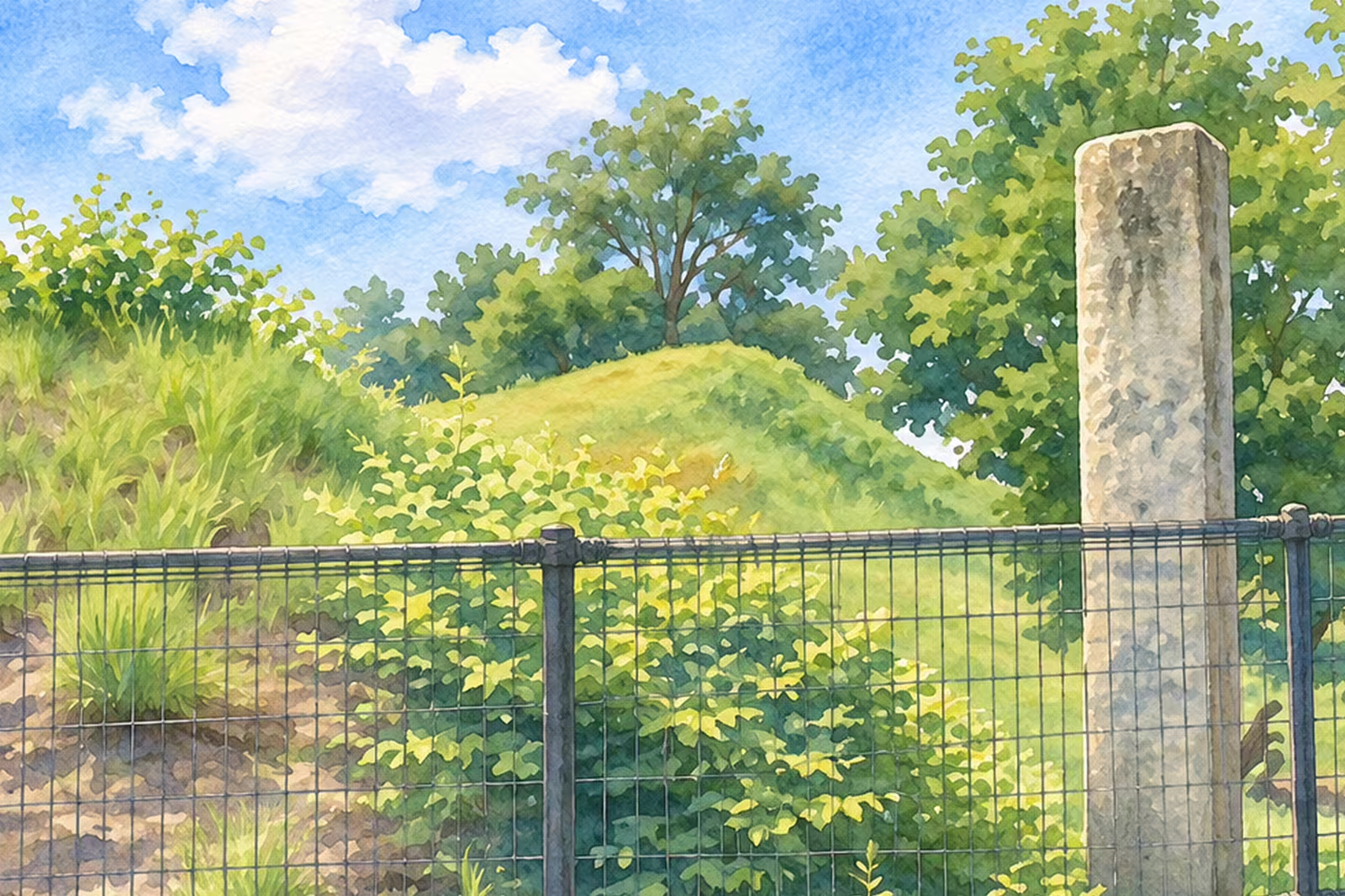
The Ōmiya site, on Kawaramachi-dōri in Nakagyō Ward, Kyoto, is where Sakamoto Ryōma and Nakaoka Shintarō, two activists from Tosa domain, were attacked in 1867. The shogunate had just returned governing authority to the court when assassins cut the two men down here. Ryōma died that night and Nakaoka two days later. It is one of the best-known political killings of the late Edo period, and who carried it out, and on whose orders, is still debated.
01Ōmiya and Ryōma
Ōmiya was a soy-sauce merchant’s house. Its owner, Iguchi Shinsuke, had close ties to Tosa domain and often lodged its men. Ryōma moved in during the autumn of 1867. According to tradition he first stayed in the storehouse at the back, which offered an escape route, and moved to the second floor of the main house after catching a cold. At the time he was involved in the push for the return of authority to the court and was sketching out the leadership of a new government, which made him a target.
02The night of the attack
On the night of the fifteenth day of the eleventh month of Keiō 3 (December 10, 1867), several men called at the house posing as visitors. They cut down Ryōma’s servant Tōkichi and rushed upstairs, where Ryōma and Nakaoka were talking. Ryōma suffered severe head wounds and died that night, aged 31 (33 by traditional count). Tradition holds that it was his birthday. Nakaoka, wounded many times, lived for two more days and died on the seventeenth, aged 29 (30 by traditional count).
Suspicion first fell on the Shinsengumi. In the early Meiji years, Imai Nobuo, a former member of the Kyoto Mimawarigumi, testified that the Mimawarigumi had carried out the attack under the command of Sasaki Tadasaburō. This is now regarded as the strongest account. Even so, the sources disagree over who took part and who gave the order, and other theories, including one that blames Satsuma domain, circulate without firm evidence.
03The site today
The Ōmiya building is long gone, and the site is now an ordinary shopfront on a commercial street. A stone marker reading "Site where Sakamoto Ryōma and Nakaoka Shintarō met disaster" stands by the road; it is generally said to have been erected in 1927. There is no historic building to visit, only the marker. The graves of Ryōma and Nakaoka are at Kyoto Ryōzen Gokoku Shrine in Higashiyama.
Ōmiya site
01A Stone on a Shopping Street
Kawaramachi-dōri is one of Kyoto’s busiest commercial streets, lined with department stores, chain cafés and bus stops. Walk north from the Shijō intersection, and just before the corner with Takoyakushi-dōri you will find, on the west side of the street, a stone post engraved with the words "Site where Sakamoto Ryōma and Nakaoka Shintarō met disaster." Most passers-by do not notice it.
On the night of the 15th day of the 11th month of Keiō 3, which corresponds to December 10, 1867, this spot was a soy-sauce shop called Ōmiya. Its owner, Iguchi Shinsuke, had given his upstairs rooms to Sakamoto Ryōma, a samurai from the Tosa domain (modern Kōchi Prefecture) who had become one of the most energetic political brokers of the last years of the Tokugawa shogunate. That night a group of swordsmen climbed the stairs and cut down Ryōma and his visitor, Nakaoka Shintarō. Ryōma died within hours; Nakaoka lived two more days.
Nothing of the shop survives. The building behind the marker is modern, and the street itself has been widened. What remains is the location, and the location turns out to explain a great deal about how Ryōma lived and why he died.
02The Political Moment
The killing came at a strange pause in Japanese history. A month earlier, on the 14th day of the 10th month (November 9, 1867), the fifteenth shogun, Tokugawa Yoshinobu, had formally offered to return governing authority to the imperial court, a step known as taisei hōkan, the "return of political rule." The proposal had been urged on him by the Tosa domain, and Ryōma had worked behind the scenes to bring it about.
The return of power settled very little. Yoshinobu still commanded the largest military force in the country and expected to dominate whatever council replaced the shogunate. The domains of Satsuma and Chōshū, allied since early 1866, were preparing for war. Kyoto was full of armed men from both sides: shogunal police units, domain troops, and masterless samurai (ronin) of every political stripe. Within a month of Ryōma’s death, a palace coup would proclaim the "restoration of imperial rule," and in January 1868 the Boshin War would begin at Toba and Fushimi, just south of the city. Ōmiya sits right in that interval.
03Who Was Sakamoto Ryōma?
Ryōma was born in 1836 in Kōchi castle town, the second son of a family of gōshi, rural or "country" samurai. The Sakamoto were in fact a branch of a wealthy merchant house that had purchased samurai status. In Tosa, gōshi ranked well below the upper samurai and resented it, and many of the domain’s radical activists came from this layer.
As a young man Ryōma went to Edo to train in swordsmanship at the Chiba school of the Hokushin Ittō-ryū style. In 1861 he joined the Tosa Loyalist Party led by Takechi Hanpeita, and in 1862 he left the domain without permission, an act called dappan that made him an outlaw from his own lord. Instead of becoming a sword-swinging terrorist, he attached himself to Katsu Kaishū, a shogunal naval officer, and helped with the navy training school at Kōbe. When that closed, he formed a shipping and trading company in Nagasaki, the Kameyama Shachū, which in 1867 was reorganized under Tosa sponsorship as the Kaientai, the "Naval Auxiliary Force."
His best-known achievement was helping to broker the secret alliance between Satsuma and Chōshū in early 1866, two domains that had been bitter enemies. Days later, at the Teradaya inn in Fushimi, officers of the Fushimi magistrate’s office tried to arrest him. He fought his way out with a pistol, badly wounded in the hand, helped by his wife Ryō (born Narasaki Ryō), who warned him, and by the Chōshū samurai Miyoshi Shinzō. From then on the shogunate’s police regarded him as a man who had shot their officers.
In 1867 he worked with Gotō Shōjirō, a senior Tosa official, on the plan that became the return of political rule. Tradition holds that on a ship bound from Nagasaki he dictated an eight-point program for a new government, later called the Senchū Hassaku ("Eight Proposals Drafted Aboard Ship"). No original text in Ryōma’s hand exists, and historians debate whether the document existed in that form. A related outline, the Shinseifu Kōryō Hassaku ("Eight-Point Outline for a New Government"), written in the 11th month of 1867, does survive in his hand.
04Nakaoka Shintarō
Nakaoka Shintarō was born in 1838, the son of a village headman in eastern Tosa. He too belonged to the loyalist party, left the domain, and spent years with Chōshū, fighting in the 1864 attempt to seize the imperial palace (the Kinmon Incident). He worked alongside Ryōma, and in some phases ahead of him, in bringing Satsuma and Chōshū together.
In 1867 Tosa recognized a land force under his command, the Rikuentai, or "Land Auxiliary Force," a counterpart to Ryōma’s maritime Kaientai. Nakaoka was more openly committed to overthrowing the shogunate by force than Ryōma, who had invested in a negotiated transfer of power. On the 15th he came to Ōmiya to see Ryōma; the usual account is that he wanted to discuss a comrade, Miyagawa Sukegorō, who was in custody.
05Why Ōmiya?
The Tosa domain’s Kyoto residence stood only a short walk away, between Kawaramachi and the Takase River. Other domain compounds clustered nearby: Chōshū’s was a few blocks north. The Takase River, a canal dug in the early 1600s to bring cargo boats up from Fushimi, ran just east of Kawaramachi, and the district along it was full of merchants who supplied the domain residences.
Ōmiya was one of Tosa’s official suppliers. Activists in Kyoto often lodged with such merchants rather than inside their domain compounds, where they would be subject to official rules and observation. Ryōma had earlier stayed upstairs at the Suya, a timber merchant’s house just south of Sanjō, which served as the Kaientai’s Kyoto base, and moved to Ōmiya around the 10th month of 1867.
Friends urged him to move into the Tosa residence for safety. He did not. The usual explanations are that his position as a former runaway, although pardoned, made life inside the compound awkward, and that he simply did not want to live under supervision. Iguchi Shinsuke, according to the usual account, made other arrangements: a hiding place in the earthen storehouse (dozō) at the back of the property, from which a man could slip out toward the grounds of Seigan-ji, a temple behind the shop. Ryōma lived in the storehouse for a time. In the middle of the 11th month, however, he caught a cold, and the storehouse was cold and damp. He moved to the front building’s upper floor, where he was more comfortable and much easier to reach.
06The Attack
The 15th of the 11th month is traditionally said to have been Ryōma’s birthday. It was a chilly day, and he was wrapped in padded clothing beside a brazier in an eight-mat room upstairs. Visitors that day included Nakaoka, the Tosa samurai Okamoto Kenzaburō, and the painter Itakura Kaidō. Ryōma sent Minekichi, a boy from the Kikuya bookshop across the street who ran errands for him, out to buy gamecock meat (shamo) for a hot-pot supper.
Around eight or nine in the evening, several men came to the door and said they were gōshi from Totsukawa, a mountain district in southern Yamato (modern Nara Prefecture) whose men had a reputation as imperial loyalists and some of whom did know Ryōma. They handed over a visiting card. Ryōma’s servant, Yamada Tōkichi, a former sumo wrestler, carried it up the stairs. The visitors followed him and cut him down from behind.
Hearing the noise, Ryōma is said to have called out in Tosa dialect for whoever was horsing around to stop. The attackers burst into the room. The first stroke caught Ryōma across the forehead. He turned to reach his sword, which lay behind him, and was cut across the back. He raised the sword, still in its scabbard, to parry, and the attacker’s blade sliced through the scabbard; another blow struck his head. Nakaoka’s sword was out of reach behind a folding screen, and he defended himself with a short blade, taking more than a dozen wounds.
The attackers left quickly, believing they had finished the job. According to Nakaoka’s account as relayed by those who heard it, Ryōma came to, called for help, and told Nakaoka that his brain had been hit and he was done for. Other records say he died almost at once. He died that night, aged thirty-one by Western reckoning (thirty-three by the traditional Japanese count).
07The Survivors’ Testimony
Nakaoka was still conscious when men from the Tosa residence and the Rikuentai arrived, and over the next day he described what had happened. One detail he reported mattered a great deal afterward: one attacker had shouted "Konakuso!", an expression from Iyo, today’s Ehime Prefecture on Shikoku. Nakaoka died on the 17th, aged twenty-nine by Western reckoning.
Tōkichi died of his wounds on the 16th. He is often left out of the story, but he was the first person cut down that night.
The three were buried together on the slopes of Higashiyama, at Ryōzen. Ryōma’s and Nakaoka’s graves stand side by side in the cemetery of the Kyoto Ryōzen Gokoku Shrine, with Tōkichi’s nearby.
08Who Killed Ryōma?
The question has been argued ever since.
Suspicion fell at first on the Shinsengumi, the shogunate-backed band of swordsmen who policed Kyoto. A scabbard and a pair of wooden clogs were found at the scene; Iguchi said the clogs bore the mark of a restaurant called Hyōtei, a lead that went nowhere. Members of the faction that had recently split from the Shinsengumi under Itō Kashitarō identified the scabbard as belonging to Harada Sanosuke, a Shinsengumi captain from Matsuyama in Iyo, which fitted the dialect clue. But Itō’s men were the Shinsengumi’s bitter enemies, which makes their testimony doubtful. When the Shinsengumi commander Kondō Isami was captured by the new government’s army in 1868, the charges against him included Ryōma’s murder, and he was beheaded at Itabashi outside Edo.
The Kaientai also suspected the Kii domain. In the 4th month of 1867 a ship chartered by the Kaientai, the Iroha Maru, sank after colliding with a Kii vessel, the Meikō Maru. Ryōma pressed the case using international maritime law and forced Kii to pay heavy compensation. In the 12th month, Kaientai members including Mutsu Yōnosuke (later the Meiji foreign minister Mutsu Munemitsu) attacked the Tenmaya inn in Kyoto to kill Miura Kyūtarō, a Kii official they blamed. Shinsengumi men guarding Miura fought them off.
The answer most historians now accept came in 1870. Imai Nobuo, a former member of the Kyoto Mimawarigumi, was tried after surrendering at the end of the war in Hakodate. The Mimawarigumi was a police unit made up of direct retainers of the shogun, socially quite different from the Shinsengumi, whose ranks were filled with ronin and commoners. Imai testified that the Mimawarigumi, under Sasaki Tadasaburō, had carried out the killing and that he himself had kept watch downstairs. He was sentenced to imprisonment and later released. Another former member, Watanabe Atsushi, wrote a family record in 1880, revised in 1911, saying that he too had taken part, though the two versions name different accomplices. Exactly who struck the blows remains unsettled.
Theories that someone else gave the order, whether Satsuma, rival factions in Tosa, or Gotō Shōjirō himself, appear regularly in novels and television dramas. None has solid documentary support.
09What Survived
The Iguchi family went on running their business on the site after the incident, but the building where Ryōma died was later altered and eventually replaced, and part of the land changed hands. Some objects from the room survive. A hanging scroll, Plum and Camellia, painted by Itakura Kaidō, the visitor of that afternoon, is said to have hung behind Ryōma; its lower mounting carries bloodstains. A two-panel folding screen from the room is also stained at the bottom. These, with Ryōma’s letters and Kaientai documents, were donated by a family connected to him to what is now the Kyoto National Museum, and in 1999 they were designated an Important Cultural Property as the "Sakamoto Ryōma Materials." The museum shows them from time to time.
The stone marker was set up in 1927 by the Kyoto Municipal Education Association. The buildings behind it have changed hands many times: a travel agency, a convenience store, a conveyor-belt sushi restaurant from 2015 to 2023, and a karaoke business from 2024. The marker’s exact relation to Ōmiya’s lot is disputed. One account says it stands on part of the old Ōmiya land later bought by a neighbor; another says Ōmiya itself stood just to the south and the marker went on the northern lot because the landowner there would not allow it.
10Walking the Neighborhood
Stand at the marker and face the street. Ōmiya was on the west side of Kawaramachi, its front facing east. The upstairs room where Ryōma died was within a few meters of where you stand. In 1867 the street was much narrower, and the Kikuya bookshop, where Minekichi came from, stood just across it.
Cross Kawaramachi and walk east along Takoyakushi-dōri. You soon reach Misaki Shrine, known as Tosa Inari, once the guardian shrine of the Tosa residence, with a small statue of Ryōma. Continue to the Takase River and Kiyamachi-dōri to find the marker for the Tosa domain residence. Then go back to Kawaramachi and head north: just south of Sanjō, in a lane now called Ryōma-dōri, is the Suya, Ryōma’s earlier lodging, which still sells woodcraft and has a gallery about him upstairs. Each of these walks takes only a few minutes, and together they show how compact Ryōma’s world in Kyoto was and how close he lived to the safety he declined.
If you have more time, cross the Kamo River and climb into Higashiyama to the Kyoto Ryōzen Gokoku Shrine, where Ryōma, Nakaoka and Tōkichi are buried. The graves look out over the city. A commemorative festival is held around November 15 each year. Next door, the Ryōzen Museum of History is devoted to the late Tokugawa period and the Meiji Restoration and has displayed material related to the Ōmiya incident.
Back on Kawaramachi, among the shoppers, there is only the stone to see. It marks the place where a man who had done much to arrange a peaceful end to the shogunate was killed a few streets from his own domain’s gates, weeks before the new government was proclaimed.