
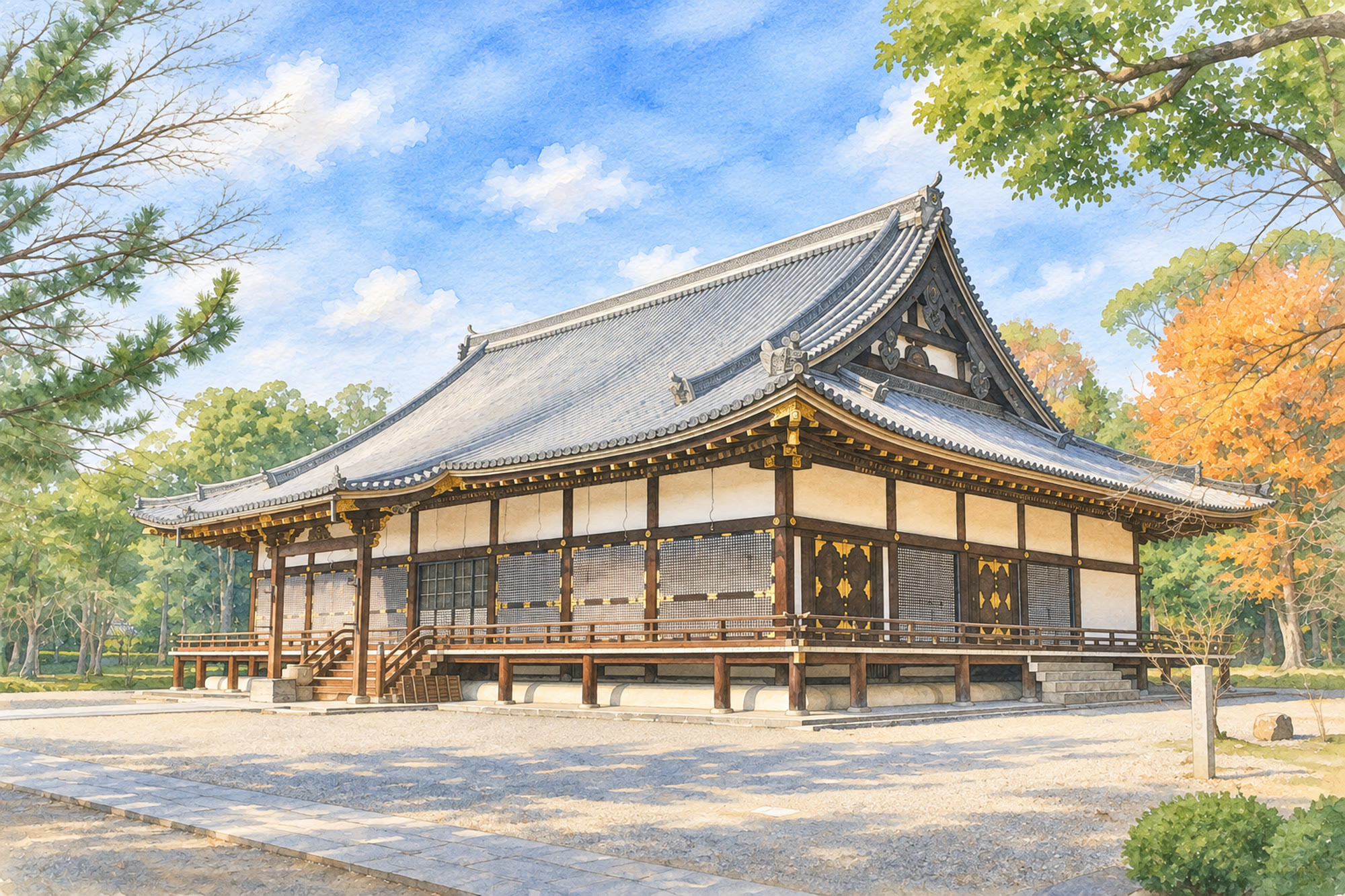
Ninna-ji is the head temple of the Omuro school of Shingon Buddhism at the foot of Mount Ōuchi in Ukyō Ward, northwest Kyoto. Founded by emperors in the 880s and run for most of its history by imperial princes, it is often described as the first monzeki, a temple whose abbots came from the imperial family or high nobility. Since 1994 it has been part of the World Heritage listing "Historic Monuments of Ancient Kyoto."
01An Emperor’s Temple
Emperor Kōkō vowed to build a temple here in 886 but died the following year. His son, Emperor Uda, completed it in 888 and named it after the era name of the day, Ninna. Uda abdicated in 897, became a monk in 899, and built himself a residence in the precincts. People called it the Omuro, "the honorable chamber"; the temple became known as the Omuro Gosho (Omuro Palace), and the district is still called Omuro.
From the late Heian period a prince customarily served as abbot; sons of Shirakawa, Toba and Go-Shirakawa all held the post. After the Hōgen War of 1156, the defeated Retired Emperor Sutoku came here and asked his brother, the abbot Kakushō, to intercede; Kakushō refused, and Sutoku was exiled. In the early fourteenth century the essayist Kenkō poked fun at its monks in Tsurezuregusa (Essays in Idleness).
02Destruction and Rebuilding
Almost everything burned in 1468, during the Ōnin War, and the temple stayed in ruins for more than a century and a half. Recovery came in 1634, when the abbot Kakushin appealed to the third shogun, Tokugawa Iemitsu,. The Kyoto Imperial Palace was then being rebuilt, and older palace buildings were given to Ninna-ji: the Shishinden ceremonial hall was reassembled as its Kondō (Golden Hall), and timber from the Seiryōden went into its Miedō (Founder’s Hall). The work was essentially complete by 1646.
The last imperial abbot, Prince Junnin, returned to lay life in January 1868. As Prince Ninnaji-no-miya Yoshiaki, he was appointed commander-in-chief of the new government’s forces at the Battle of Toba–Fushimi later that month.
03What You Can See Today
The Kondō, the former palace Shishinden, is a National Treasure and the oldest surviving example of a Shishinden. The Niōmon gate, the Chūmon (Middle Gate), the five-storied pagoda (1644, about 36 meters tall), the Miedō, the Kannon-dō, the sutra repository and bell tower are Important Cultural Properties. The Goten, the former palace quarters in the southwest of the grounds, burned in 1887; its main hall, the Shinden, was rebuilt and completed in 1914 between a white-sand garden and a pond garden.
Inside the Chūmon grow the Omuro cherries, late-blooming and unusually low trees, a national Place of Scenic Beauty since 1924. The temple museum holds National Treasures including a Heian-period Amida triad, thought to be the temple’s original main image, and the Sanjūjō sasshi, booklets said to have been copied by Kūkai in Tang China. A pilgrimage path on Mount Jōju behind the temple, laid out in 1827, reproduces the 88 temples of Shikoku in miniature.
Ninna-ji
01The Name on the Station Signs
Ride the little Randen tram line into northwest Kyoto and you will pass stations and streets with the word Omuro in their names. Omuro means something like "the honorable chamber." It was never meant as a place-name. It was a polite way of referring to the rooms of one particular monk, who happened to be a former emperor. Over the centuries the word attached itself first to the temple where he lived, then to its abbots, and finally to the whole neighborhood.
That temple is Ninna-ji, which you are now standing in front of. Today it is the head temple of the Omuro school of Shingon, the esoteric Buddhist tradition brought from China by Kūkai in the early ninth century. For most of its history, however, Ninna-ji was something more specific: a temple founded by emperors and run by imperial princes, so closely tied to the court that people called it the Omuro Gosho, the Omuro Palace.
The story falls into four parts. There is the Heian-period temple of retired emperors and princes; the great fire of the Ōnin War, which wiped that temple out; the seventeenth-century revival, which brought buildings here from the imperial palace itself; and a coda in 1868, when the last prince-abbot left the temple and rode out at the head of an army. Almost everything you see standing today belongs to the third part.
02A Vow and Its Fulfillment
Ninna-ji was the project of two emperors, father and son.
Emperor Kōkō came to the throne in 884, already in his fifties, chosen by the powerful minister Fujiwara no Mototsune after the previous emperor was forced out. In 886 Kōkō vowed to build a temple at the foot of the hills northwest of the capital, to pray for the peace of the realm. He died in 887 before it was finished.
His son, Emperor Uda, took up the work. Uda’s own path to the throne had been unusual. He had been removed from the imperial family and given the surname Minamoto, as many surplus princes were, and was restored to princely rank only as his father lay dying. Early in his reign he clashed with Mototsune in the so-called Akō Dispute, an argument over the wording of an edict that was really a test of who held authority. The experience left Uda keen to govern on his own terms, and after Mototsune’s death he promoted men from outside the Fujiwara circle, most famously the scholar Sugawara no Michizane.
In 888 Uda completed his father’s temple and named it after the era in which it was founded, Ninna. The original main image was a seated Amida Buddha flanked by two attendant bodhisattvas. That triad survives in the temple museum and is generally believed to be the founding image, a National Treasure and one of the key works of early Heian sculpture.
03The Emperor Who Became a Monk
In 897 Uda abdicated in favor of his son, Emperor Daigo. Two years later, in 899, he shaved his head and took Buddhist vows. He is usually counted as the first retired emperor to bear the title hōō, "dharma sovereign," the term for a retired emperor who had become a monk, and later generations knew him as the Kanpyō Hōō, after the era of his reign.
Uda did not treat his vows as a quiet retirement. He trained seriously in Shingon practice and in the twelfth month of Engi 1 (January 902) received full transmission (denbō kanjō, the consecration that qualifies a master to teach) from the monk Yakushin at Tō-ji. A former emperor was now a fully qualified esoteric master.
In 904 he built a residence for himself in the southwest of the temple grounds. This was the Omuro. Uda lived and practiced there for many years and died in 931. His presence fixed the character of Ninna-ji for the next thousand years: it was first of all a temple of the imperial house, and only secondarily one Shingon temple among many. In later centuries Shingon ritual practice divided into two main lineages, the Hirosawa line centered on Ninna-ji and the Ono line centered on Daigo-ji in southeast Kyoto, and Ninna-ji’s line carried particular prestige.
04Princes in Robes
After Uda, Ninna-ji continued to be led by monks of high birth. In the eleventh century Prince Shōshin, a son of Emperor Sanjō, became abbot, and from then on it gradually became the rule that an imperial prince would head the temple.
A son of Emperor Shirakawa, Kakugyō, was proclaimed a prince in 1099, after he had become a monk, and so received the title hō-shinnō, "dharma prince." This is generally regarded as the first use of the title, which marked a prince who was granted princely rank after he had already become a monk. Later abbots included Kakushō, a son of Emperor Toba, and Shukaku, a son of Go-Shirakawa. In the age of rule by retired emperors, when the senior retired emperor rather than the reigning one held real power, the prince-abbot of Ninna-ji was both a member of the ruling family and the guardian of one of Shingon’s leading lineages.
Temples headed by princes or by sons of the top Fujiwara houses came to be called monzeki, and Ninna-ji is often described as the first of them and the senior one. In the Heian period several other temples founded by emperors were built in the surrounding area, each with the character en in its name: En’yū-ji, Enkyō-ji, Enjō-ji and Enshū-ji, remembered collectively as the Four En Temples. All had fallen into ruin by the late fourteenth century, and none survives, but they show that this corner of the capital was once a cluster of imperial foundations.
05A Defeated Emperor at the Gate
Ninna-ji’s most dramatic moment in political history came in 1156.
When the senior retired emperor Toba died that summer, the long rivalry between his sons, Retired Emperor Sutoku and the reigning Emperor Go-Shirakawa, broke into open fighting, tangled up with a feud inside the Fujiwara regent’s house. Go-Shirakawa’s side called on warriors including Taira no Kiyomori and Minamoto no Yoshitomo, who attacked Sutoku’s headquarters at night. Sutoku’s forces collapsed within hours. The clash is known as the Hōgen War.
The fleeing Sutoku shaved his head and two days later made his way to Ninna-ji, where his full younger brother Kakushō was abbot, and asked him to intercede. Kakushō refused. Sutoku was lodged under guard in one of the temple’s monastic residences and then exiled to Sanuki Province on the island of Shikoku, where he died in 1164 without ever returning to the capital. Legends later turned him into one of Japan’s most feared vengeful spirits, but that is another story.
The episode shows the double edge of being a monzeki. Closeness to the imperial family brought wealth and rank; it also meant the temple was drawn in whenever the family fought itself.
06Tsunemasa Returns a Lute
A gentler scene comes from The Tale of the Heike, the great war narrative of the Taira clan’s fall.
Taira no Tsunemasa, a nephew of Kiyomori, had served at Ninna-ji as a boy attendant under the abbot Kakushō. He was a gifted player of the biwa, the Japanese lute, and Kakushō gave him one of the temple’s treasured instruments, a biwa named Seizan, "Green Mountain."
In 1183, with Kiso Yoshinaka’s army closing in, the Taira abandoned Kyoto, taking the child emperor Antoku with them. In the Heike’s account, Tsunemasa, in the middle of that hurried departure, rode to Ninna-ji with a few companions to take leave of the abbot, now Shukaku, and return Seizan. He said he could not bear for such an instrument to be lost in the provinces. Poems were exchanged, and the monks wept as he rode away. Tsunemasa was killed the following year at the Battle of Ichi-no-tani.
This is literature rather than a record, and the details may be embellished. But the scene, paired in the Heike with a similar farewell by the poet-warrior Taira no Tadanori, has kept Ninna-ji’s name alive for readers of the tale.
07The Monks in Essays in Idleness
By the early fourteenth century Ninna-ji turns up in literature in quite a different mood.
The monk-essayist Kenkō, author of Tsurezuregusa (Essays in Idleness), is said to have lived at Narabigaoka, a low hill just south of the temple. He included a run of anecdotes about "a monk of Ninna-ji," told with the dry affection of a neighbor.
The most famous concerns an elderly monk who had never visited the great Iwashimizu Hachimangū shrine south of Kyoto. One day he finally walked there alone, worshipped at the temples and shrines at the foot of the hill, and came home satisfied. He told his friends that he had fulfilled a lifelong wish, though he wondered why so many other pilgrims were climbing the mountain; he had been curious, but since he had come to worship, he did not go up. The main shrine, of course, stood at the top. Kenkō closes with a short moral: even in small matters, it is good to have a guide. Generations of Japanese schoolchildren have read the passage.
Another tells of a farewell party for a boy about to become a monk, at which a drunken monk jammed a three-legged metal pot over his head and danced, then could not get it off. No one, including a physician, could help, and in the end it was simply wrenched free, at the cost of his ears and nose; he survived.
These stories were not attacks on the temple. Kenkō used the monastery next door as a stage for human foolishness, and the result is that many Japanese still think of these hapless monks before anything else when they hear the name Ninna-ji.
08The Ōnin War
Ninna-ji suffered fires and rebuilding through the Heian and medieval periods, but its true catastrophe was the Ōnin War, which began in 1467 and turned Kyoto into a battlefield for eleven years. The temple’s position on the northwest edge of the city put it in contested ground, and in 1468, by the usual account, troops of the Eastern Army burned it almost entirely. None of the Heian buildings survived.
For more than 150 years the temple could not be restored, and the abbots and monks carried on in makeshift quarters. Some statues, sutras and documents had been moved beforehand to the subtemple Shinkō-in and elsewhere, which is why the museum can still show Heian-period treasures today.
09A Palace Moves to the Temple
Revival came in the early Edo period. In 1634, when the third shogun Tokugawa Iemitsu was in Kyoto, the abbot Kakushin, a son of Emperor Go-Yōzei, asked him to fund the rebuilding of Ninna-ji. Iemitsu agreed.
The timing was lucky. The imperial palace was being rebuilt in the same years, and halls taken down from the older palace were granted to Ninna-ji. The Shishinden, the ceremonial hall where enthronements and other great state rites took place, built in the Keichō era in the 1610s, was moved here and reassembled as the Kondō, the Golden Hall. Timber from the Seiryōden, the emperor’s residential hall, was used to build the Miedō, the Founder’s Hall. The Niōmon gate, the Chūmon gate, the five-storied pagoda, the Kannon-dō, the sutra repository and the bell tower went up in the same campaign, which was essentially complete by about 1646.
The Kondō is the heart of the result. When it was converted into a Buddhist hall its cypress-bark roof was replaced with tiles and its interior refitted, but its proportions are still those of a palace hall. It is the oldest surviving Shishinden building and a National Treasure.
The five-storied pagoda dates from 1644 and stands about 36 meters tall. Its roofs shrink very little from bottom to top, giving it a straight, almost columnar profile that is typical of Edo-period pagodas and quite different from the tapering silhouettes of older ones.
10The Last Prince-Abbot Goes to War
Through the Edo period Ninna-ji kept its standing as the senior monzeki. At the very end of the shogunate, its imperial ties pulled it into politics one last time.
The last imperial abbot was Prince Junnin, from the Fushimi-no-miya princely house. On January 3, 1868 (the ninth day of the twelfth month of Keiō 3), when the court proclaimed the restoration of imperial rule, he was ordered to return to lay life and took the name Prince Ninnaji-no-miya Yoshiaki.
When fighting broke out at Toba and Fushimi, south of Kyoto, in January 1868, Yoshiaki was appointed commander-in-chief of the expedition against the former shogunate and rode out bearing the imperial brocade banner and a ceremonial sword of command. The appearance of the banner told everyone that the Satsuma and Chōshū forces were now the emperor’s army and their opponents were rebels against the throne, and it did much to tip the balance of loyalties. So the man who had been abbot of Ninna-ji a few weeks earlier stood at the opening of the Boshin War. He was restyled Prince Higashifushimi in 1870 and Prince Komatsu Akihito in 1882, and held senior army posts in the Meiji period.
With his departure, the line of prince-abbots that had lasted nearly a thousand years came to an end. In 1887 fire destroyed the palace quarters of the temple, and the present Shinden and related buildings were rebuilt, the Shinden being completed in 1914.
11A Walk Through the Grounds
Enter through the Niōmon at the south. This huge gate from the 1640s is an Important Cultural Property, guarded by two fierce temple guardians at the front and a pair of lion-dogs behind. It is often ranked with the gates of Chion-in and Nanzen-ji as one of the three great gates of Kyoto, though lists of the three vary. Ninna-ji writes the gate’s name with the characters for "two kings" rather than the usual characters for "benevolent kings"; both are read Niōmon.
Just inside, to the left, is the entrance to the Goten, the former palace quarters. Its halls, the Shinden, the Shiro-shoin and the Kuro-shoin, are linked by roofed corridors. South of the Shinden lies a garden of raked white sand with a cherry tree and a mandarin orange tree, imitating the trees in front of the palace Shishinden; to the north is a pond garden with a small waterfall, from which you can see the pagoda rising beyond the wall. The Goten also has two teahouses, the Hitōtei and the Ryōkakutei, the latter traditionally associated with the painter Ogata Kōrin; both are Important Cultural Properties.
Back on the main path, walk north through the Chūmon into the core of the precinct. On the left is the grove of Omuro cherries. They bloom later than almost anywhere else in Kyoto, and the trees are strikingly short, so that the blossoms are at eye level. The usual explanation is that the soil here is shallow over hard clay, which keeps the roots from going deep, though the exact cause is still being studied. The grove was designated a national Place of Scenic Beauty in 1924.
The pagoda stands to the right of the path. Ahead, raised on a stone platform at the end of the axis, is the Kondō; looking at its broad, gently sloping roof and the wide front steps, it is not hard to imagine it as the throne hall it once was. To the west is the modest Miedō, dedicated to Kūkai, built with timber from the Seiryōden. East of the Kondō is the sutra repository, which contains a revolving sutra case. On the west side of the precinct is the Kannon-dō, with images of the Thousand-Armed Kannon and its attendants and Edo-period wall paintings; it was closed to the public for a long time, and its restoration was completed in 2019.
The museum, the Reihōkan, holds the temple’s treasures. Besides the founding Amida triad, there is the Sanjūjō sasshi, thirty booklets of esoteric texts traditionally said to have been copied by Kūkai and his companions in Tang China and brought back to Japan, and a Northern Song Chinese painting of the Peacock Wisdom King, both National Treasures.
On Mount Jōju behind the temple, a footpath known as the Omuro Hachijūhachi-kasho links 88 small halls. According to the temple, in 1827 the twenty-ninth abbot, Prince Sainin, had sand brought from each of the 88 temples of the Shikoku pilgrimage and buried it here, so that the whole circuit could be walked in about two hours.
In 1994 Ninna-ji was inscribed as part of the World Heritage listing "Historic Monuments of Ancient Kyoto," and the grounds are also a national Historic Site. The buildings around you are mostly from the 1640s, but the ground they stand on has belonged to this temple since Uda first settled into his chamber more than eleven centuries ago.