
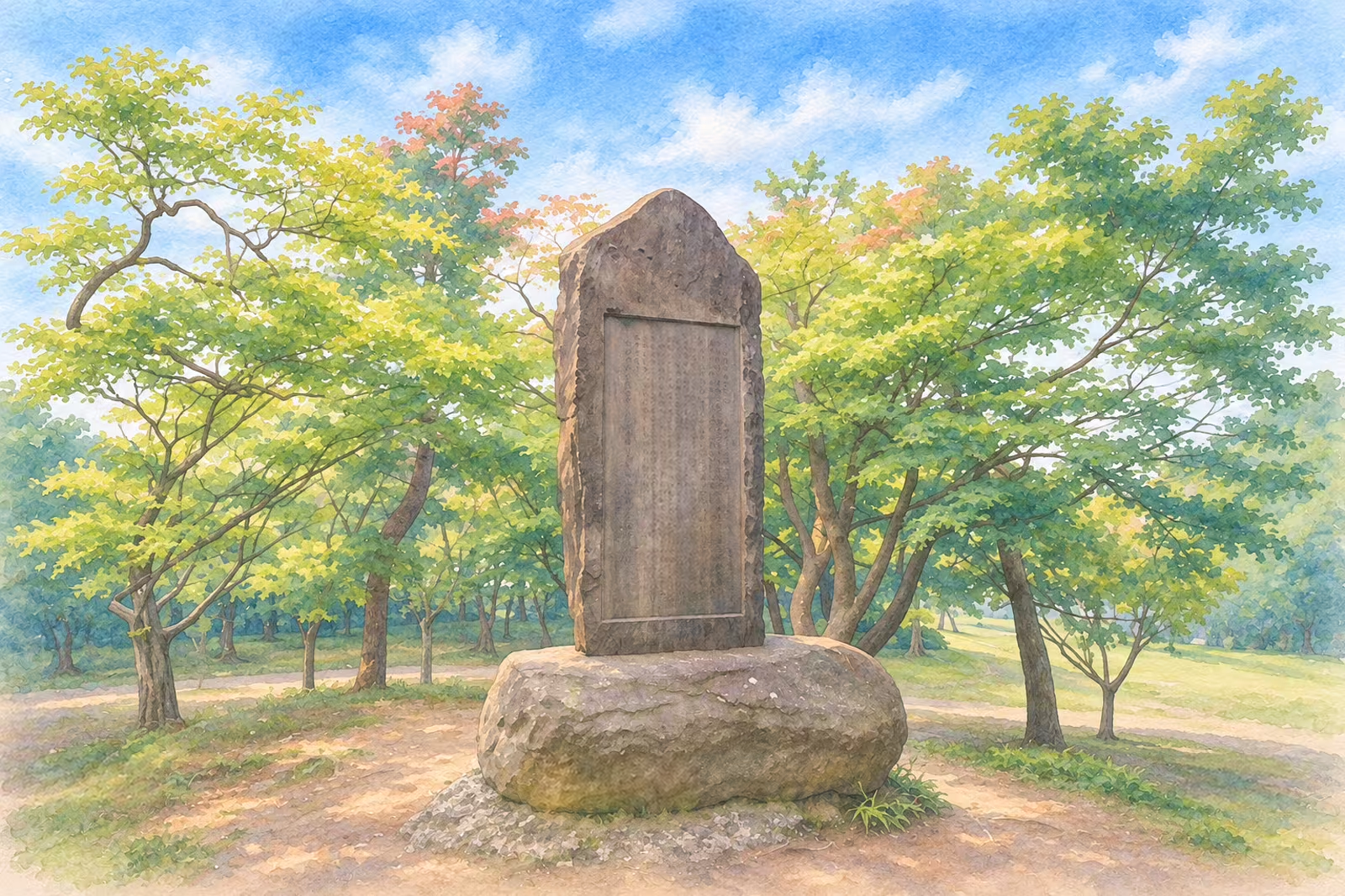
The Toba-Fushimi Battlefield is a scattered group of sites from the Battle of Toba-Fushimi in 1868, spread along the old Toba Road, through the former town of Fushimi, and south to Yodo, all in Fushimi Ward in the south of Kyoto, Kyoto Prefecture. It was the opening battle of the Boshin War. The former shogunate’s army was driven back within four days, Tokugawa Yoshinobu left Ōsaka for Edo, and the anti-shogunate side took the initiative. There is no single battlefield park; the story is carried by monuments, shrines, temples and old streets.
01The battle
The return of governing authority to the court in 1867 and the restoration of imperial rule that followed did not resolve the conflict between Satsuma, Chōshū and their allies and the former shogunate. On the third day of the first month of Keiō 4 (January 27, 1868), shogunate troops marching north from Ōsaka were stopped by Satsuma forces near Koeda Bridge on the Toba Road, and fighting broke out. The same day, fighting began at Fushimi as well. Aizu troops and the Shinsengumi held the Fushimi magistrate’s office, while Satsuma placed artillery on the higher ground around Gokōnomiya Shrine; the magistrate’s office and the surrounding streets burned under the bombardment.
The shogunate side is generally thought to have had about 15,000 men, far more than the roughly 5,000 on the Satsuma-Chōshū side, but its command was divided. On the fourth day, the new government’s forces raised the brocade imperial banner, which made their opponents enemies of the court. The shogunate army fell back toward Yodo, where the Yodo domain refused to open its castle, and the Tsu domain, stationed at Yamazaki, turned its guns on the retreating troops. That settled the outcome. On the night of the sixth day, Yoshinobu slipped out of Ōsaka Castle and sailed back to Edo on the warship Kaiyō Maru.
02What can be seen today
Near Koeda Bridge stands a monument to the Toba-Fushimi battle, and another near Jōnangū Shrine marks where the fighting began. Gokōnomiya Shrine in Fushimi has a stone monument to the fighting there. The site of the Fushimi magistrate’s office later became army land and is now a housing area, marked only by a stone. The Uosaburō restaurant in Fushimi is said to keep bullet marks in its latticework, and Myōkyō-ji temple in Yodo preserves what is said to be a hole made by a cannonball from the battle. Near Yodo, the Senryōmatsu area has a memorial to fallen shogunate soldiers. The Teradaya inn and other buildings burned in the fighting; what stands today was rebuilt later.
Toba–Fushimi battlefield
01A battlefield without a park
If you come looking for the Toba–Fushimi battlefield expecting a visitor center, a preserved field and a viewing platform, you will not find one. The battle of Toba–Fushimi, fought over four days in January 1868, sprawled along the roads and riverbanks of what is now southern Kyoto: the Minami and Fushimi wards, and on into the city of Yawata. Today that ground is covered by housing estates, sake breweries, expressway ramps and suburban rail lines. What survives is scattered: a dozen or so stone markers, a few shrines and temples, an inn, a cannonball, and bullet scars in the wooden lattice of a restaurant.
The battle itself was small by the standards of what followed. Perhaps four hundred men died in total. But it was the opening engagement of the Boshin War (1868–69), the civil war that destroyed the Tokugawa shogunate, the warrior government that had ruled Japan since 1603. Within a week of the first shot, the last shogun had abandoned his army and fled by sea to Edo, and most of the domains of western Japan had declared for the new imperial government. Few battles in Japanese history did so much political damage in so little time.
02The roads south of the capital
To understand why the fighting happened where it did, picture the geography of the 1860s. Kyoto, the imperial capital, sat in a basin. Ōsaka, the commercial capital, lay about 45 kilometers to the southwest, down the Yodo River. Two main approaches led from the Ōsaka side into Kyoto’s southern edge.
The western route was the Toba Highway (Toba Kaidō), which ran north from the town of Yodo across low, wet ground near the confluence of the Katsura and Kamo rivers, past the village of Shimo-Toba, and into the city at its southern gate. The eastern route ran through Fushimi, a river port that had grown up around a castle built by the warlord Toyotomi Hideyoshi in the 1590s. Fushimi was the landing place for the riverboats that shuttled passengers and goods between Kyoto and Ōsaka, a town of inns, warehouses and sake brewers. Both routes converged near Yodo, where a castle guarded the river crossings, and continued down the left bank of the Yodo River through Hashimoto toward Ōsaka.
An army marching on Kyoto from Ōsaka would naturally split between these two roads. That is exactly what happened.
03A shogun who gave back power and kept his army
In the autumn of 1867, the fifteenth shogun, Tokugawa Yoshinobu, made a startling move. On the fourteenth day of the tenth month of Keiō 3 (November 9, 1867) he formally offered to return governing authority to the imperial court, an act known as taisei hōkan, the "restoration of rule." The court had no administration of its own, and Yoshinobu calculated that he would remain the dominant figure in whatever council of lords replaced the shogunate. He would still be the greatest landholder in the country.
His opponents saw the trap. A faction led by Saigō Takamori and Ōkubo Toshimichi of the Satsuma domain in southern Kyūshū, working with the court noble Iwakura Tomomi, staged a coup on the ninth day of the twelfth month (January 3, 1868). Troops from Satsuma and several allied domains seized the palace gates, and the court proclaimed the "restoration of imperial rule" (ōsei fukko), abolishing the shogunate and the old court regency offices. That night, at a council held in the Kogosho hall of the palace, Iwakura and Ōkubo pressed for Yoshinobu to resign his court rank and surrender his lands. Yamauchi Yōdō, the retired lord of Tosa, argued fiercely on his behalf, but the demand stood.
Yoshinobu chose not to fight it out in the capital. In mid-month he withdrew to Ōsaka Castle with his troops and with his two most committed allies: Matsudaira Katamori, lord of Aizu and until recently military protector of Kyoto, and Katamori’s brother Matsudaira Sadaaki, lord of Kuwana. From Ōsaka he assured the foreign envoys that he still handled Japan’s diplomacy, while sympathetic lords negotiated to soften the terms against him. By the end of the year his position looked surprisingly strong. There was talk at court of inviting him back to Kyoto as a member of the new government.
04Fire in Edo
The spark came from the other end of the country. Through the autumn of 1867, Satsuma’s residence in the Mita district of Edo had been sheltering bands of ronin (masterless samurai) who robbed and burned their way across the Kantō region. It is generally believed that Saigō sponsored this campaign to provoke the shogunate into striking first. On the twenty-fifth day of the twelfth month (January 19, 1868), troops of the Shōnai domain, responsible for policing Edo, together with shogunal forces, attacked the Satsuma residence and burned it.
When the news reached Ōsaka Castle, the officers and men gathered there demanded war on Satsuma. Yoshinobu did not restrain them. A formal indictment of Satsuma, the "Declaration Against Satsuma" (Tōsatsu no hyō), was drafted, charging the domain with crimes and calling for the removal of evil advisers from the emperor’s side. The inspector-general Takigawa Tomotaka was to carry it to Kyoto.
On the second day of the first month of 1868, the army began moving north. It is usually estimated at about 15,000 men: shogunal infantry, including units drilled by French instructors, alongside troops from Aizu and Kuwana and the shogunate’s Kyoto police units, the Shinsengumi and the Mimawarigumi. Waiting for them were somewhere between 4,000 and 5,000 Satsuma and Chōshū soldiers, depending on the estimate, with a handful from Tosa. The shogunate had three to one in numbers. Satsuma and Chōshū had modern rifles, artillery they knew how to use, and, as it turned out, the high ground.
05The first shot at Koeda Bridge
On the third day of the first month of Keiō 4 (January 27, 1868), Takigawa’s column came up the Toba Highway and reached the area of Koeda Bridge, which crosses the Kamo River near Shimo-Toba, where Satsuma troops blocked the road. Takigawa demanded passage; he was, he said, on his way to the court. The Satsuma officers replied that they needed instructions and asked him to wait. The two sides stood facing each other on the road for hours.
Around five in the afternoon the shogunal column decided to force its way through. Satsuma guns opened fire from positions beside the road and around the Jōnangū shrine, followed by volleys of rifle fire. Packed into a narrow road in marching order, the shogunal vanguard could not deploy. According to a frequently repeated account, many of the men had not even loaded their weapons, so certain were they that Satsuma would not dare to shoot. Takigawa’s horse, startled by the gunfire, bolted and carried him back through his own lines; he then left the field, and the column was left without a commander.
06Fushimi: the magistrate’s office and the shrine on the hill
The sound of the guns at Toba set off fighting at Fushimi, a few kilometers to the east. There, the shogunal forces under Takenaka Shigekata had made their base in the Fushimi magistrate’s office (Fushimi bugyōsho), the shogunate’s administrative compound for the town. Aizu troops, shogunal infantry and the Shinsengumi held it. The Shinsengumi’s commander, Kondō Isami, had been shot and wounded in an ambush at Sumizome, just outside Fushimi, a few weeks earlier and was recovering in Ōsaka, so the unit was led by his deputy, Hijikata Toshizō.
Just north of the magistrate’s office, across a single street, rises the ground on which stands Gokōnomiya, the principal shrine of Fushimi. Satsuma placed artillery there and on other heights nearby and fired down into the compound. Aizu men and the Shinsengumi charged out with swords and spears again and again, trying to take the guns, and were driven back each time by rifle fire.
That night shells set the magistrate’s office alight, and the shogunal forces abandoned Fushimi, falling back south toward Yodo. The fire spread into the town. Among the buildings that burned was the Teradaya, the boatmen’s inn where Sakamoto Ryōma, the Tosa activist who had helped broker the Satsuma–Chōshū alliance, had narrowly escaped assassination in 1866.
07The brocade banner
On the fourth day, the court appointed Prince Ninnaji-no-miya Yoshiaki commander-in-chief of a punitive expedition and entrusted him with the nishiki no mihata, the imperial brocade banner: red silk bearing images of the sun and moon, signifying that the emperor himself was making war on rebels. On the fifth day the banner appeared at the front. It is generally believed that the banners had been prepared in advance, in secret, by Iwakura Tomomi’s circle, with designs traditionally attributed to the scholar Tamamatsu Misao and Shinagawa Yajirō of Chōshū involved in having them made.
Raised over the Satsuma and Chōshū lines, the banner changed the meaning of the battle. The Satsuma and Chōshū troops were now the "imperial army" (kangun), and the shogunal forces were enemies of the throne. For domains that had been waiting to see which way things would go, the choice became much easier. For Yoshinobu, raised in the Mito domain, a center of reverence for the emperor, the label of "enemy of the court" was something he could not bear, as he said in recollections late in life.
Fighting on the Toba front on the fourth day surged back and forth around Shimo-Toba. Kuwana and Aizu troops and shogunal infantry pushed forward but could not break through, and fell back to regroup at Tominomori.
08Yodo and Senryōmatsu: the gate that stayed shut
On the fifth day Satsuma and Chōshū took Tominomori, and the fighting moved south to Yodo. The castle there belonged to the Inaba family, and its lord, Inaba Masakuni, was a senior councillor of the shogunate, then in Edo. The retreating army expected to regroup under the castle’s protection. Instead, Yodo shut its gates against them. With the imperial banner in the field, the domain would not take sides against it.
The shogunal troops turned to fight on the riverbank north of the castle, at a place called Senryōmatsu, a narrow strip between the Uji River embankment and marshy ground. Aizu men, shogunal infantry and the Shinsengumi fought hard here; Inoue Genzaburō, captain of the Shinsengumi’s sixth unit and one of Kondō’s oldest comrades, was killed. By the end of the day the shogunal army had fallen back again, across the Kizu River toward Yawata and Hashimoto.
09Hashimoto and the guns across the river
Hashimoto was a post town on the south bank of the Yodo River at the western foot of Mount Otokoyama, crowned by the great shrine of Iwashimizu Hachimangū. Across the river stood Yamazaki and Mount Tennōzan, where the shogunate had built coastal-defense batteries. Those batteries were manned by troops of the Tsu domain, ruled by the Tōdō family.
On the sixth day the shogunal army made a stand at Hashimoto, relying on Tsu to cover its flank. But Tsu had received orders from the court and had decided to side with the new government. Its guns at the Takahama battery opened fire across the river into the shogunal lines. Under fire from front and flank, the army broke and streamed back toward Ōsaka. Supporters of the shogunate never forgave Tsu, and for a long time "Tōdō" was used as a byword for betrayal.
10The shogun leaves by night
Ōsaka Castle still held a substantial force, and the shogunal navy lay in Ōsaka Bay. The troops expected Yoshinobu to lead them in person, and he spoke as though he would. Then, on the night of the sixth day, he slipped out of the castle with Matsudaira Katamori, Matsudaira Sadaaki, the senior councillor Itakura Katsukiyo and a few others, went down to the harbor near Tenpōzan and looked for the warship Kaiyō Maru. Unable to find her in the dark, the party took refuge aboard an American warship in the bay and transferred to the Kaiyō Maru the next day. He reached Edo on the twelfth day of the month.
Why he left has been debated ever since. The most common explanation is the one he gave himself in later life: he would not fight an army that carried the imperial banner, and he feared that a prolonged civil war would invite foreign intervention. Whatever his reasons, the men left behind found themselves without a commander. On the seventh day the court issued an order to chastise Yoshinobu as a rebel. On the ninth, Chōshū troops entered the emptied Ōsaka Castle, and fire destroyed most of its buildings in the confusion around that time.
The war went on for more than a year. Edo Castle was surrendered without a fight in the fourth month of 1868; Aizu was besieged and fell that autumn; the last shogunal holdouts surrendered at Hakodate in Hokkaidō in the fifth month of 1869. But the outcome had been settled on the roads south of Kyoto.
11Counting the cost
Figures vary. One frequently cited tally gives about 280 dead on the shogunal side, more than 120 of them from Aizu, and about 110 on the new government side, most of them from Satsuma. Later battles, at Aizu and Hakodate, were far bloodier.
What made Toba–Fushimi decisive was not the casualty count but its effect on the lords who had been sitting on the fence. Owari, Echizen and Tosa, who had been mediating on Yoshinobu’s behalf, came over to the new government; domain after domain in the west followed. Historians also often point out that the shogunal army was not badly equipped. Its infantry had modern rifles and French drill, and Aizu and Kuwana were far from primitive. What it lacked was command: no unified plan, columns marching into contact in road formation, a commander-in-chief who never appeared at the front. The smaller Satsuma–Chōshū force held the heights beside the roads, used its artillery well, and carried the emperor’s banner.
12What you see today
Almost nothing of the 1868 battlefield stands as it was. The site of the Fushimi magistrate’s office became army land after the Meiji Restoration and a housing estate after the Second World War; a stone marker and an explanatory sign in the estate are all that remain. Koeda Bridge is a modern bridge, with a monument beside it marking where the war began. The Teradaya still operates as an inn, but the present building is a reconstruction put up after the 1868 fire, as the Kyoto City Historical Archives concluded after an investigation in 2008.
Some things are genuine survivors. The main hall of Gokōnomiya was built in 1605 under Tokugawa Ieyasu and stood behind the Satsuma guns. At Uosaburō, a restaurant in Fushimi’s Kyōmachi district, the front lattice still bears marks said to be bullet holes from the battle. At Myōkyō-ji, a temple in Yodo, the main hall still shows where a cannonball passed through, and the ball itself is kept. The small Ko-Tenmangū shrine within the Gokōnomiya precinct also bears marks said to be from bullets.
The monuments came later. After 1868 the dead of the winning side were honored as imperial soldiers with graves on the Ryōzen hill in eastern Kyoto; at Sokushū-in, a subtemple of Tōfuku-ji, there is a memorial to the Satsuma dead whose inscription was written by Saigō Takamori. The shogunal dead were long neglected and only gradually given graves and memorials, such as the monument to the "Eastern Army" dead of the Boshin War at Myōkyō-ji in Yodo, its inscription written by Enomoto Takeaki, the former shogunal naval commander. In 1968, the centenary of the Meiji Restoration, another wave of markers went up, including a stone at Gokōnomiya whose inscription is usually credited to the then prime minister, Satō Eisaku.
13Walking the line of battle
With half a day, you can follow the battle in order.
Start at Koeda Bridge in Shimo-Toba, about twenty minutes’ walk west of Takeda Station. Standing by the monument, imagine Takigawa’s column strung out along the narrow road, waiting for hours for permission that never came. Nearby is Jōnangū, an ancient shrine around which Satsuma placed its guns, and the Toba Imperial Villa Ruins Park, where a small mound called Aki-no-yama, originally an artificial hill in the villa’s garden, marks the kind of high ground on which Satsuma is thought to have placed guns.
Then head east to Fushimi. From Fushimi-Momoyama Station on the Keihan line, or Momoyamagoryōmae on the Kintetsu line, walk to Gokōnomiya. Its front gate was moved here from Fushimi Castle. Look south down the street toward the housing estate that occupies the site of the magistrate’s office, and notice how close it is. The Satsuma gunners were firing at almost point-blank range.
Walk southwest into Kyōmachi to see the lattice at Uosaburō, then on to the Teradaya and the old boat landing on the canal.
If you have more time, take the Keihan train south to Yodo. In the castle ruins park you can see the stone walls and inner moat of the castle that refused to open its gates. Myōkyō-ji, with its cannonball scars and the Eastern Army monument, is close by, and along the embankment to the north is the memorial marking the fighting at Senryōmatsu. Finally, continue to Iwashimizu-hachimangū Station in Yawata, where the old street of Hashimoto begins. Look across the Yodo River to Tennōzan and Yamazaki. On the sixth day, that is where the guns of Tsu were firing from.
From Koeda Bridge to Hashimoto is little more than fifteen kilometers. In four days, the balance of power in Japan tipped along that stretch of road.