
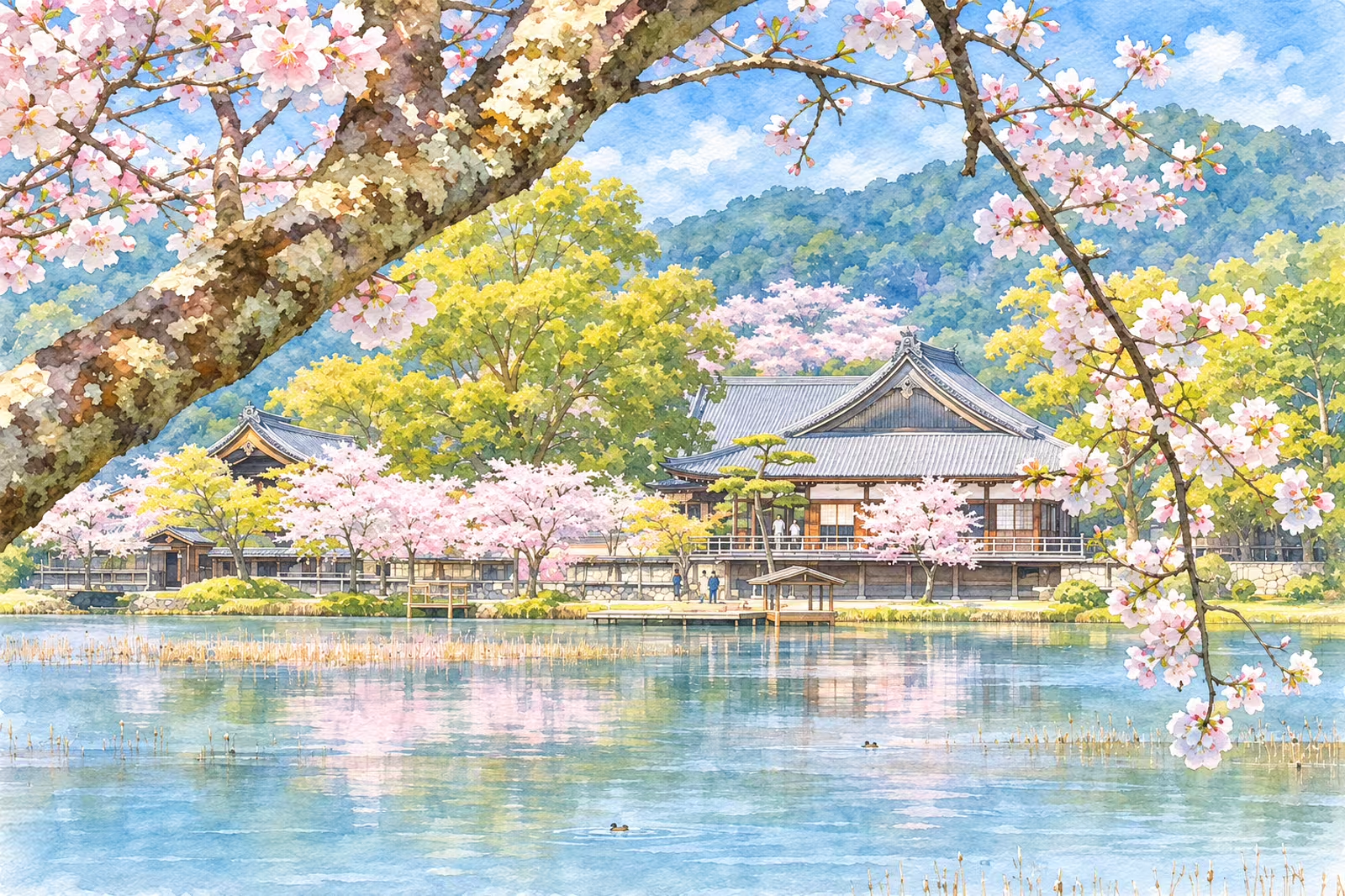
Daikaku-ji stands in the Saga district of Ukyō Ward, Kyoto, and is the head temple of the Daikaku-ji branch of Shingon Buddhism. It began as a villa of Emperor Saga and was later turned into a temple whose abbots were often members of the imperial family, making it a monzeki temple. When the imperial line split in the late Kamakura period, one branch took its name from the temple and became known as the Daikaku-ji line.
01From villa to imperial temple
In the early 9th century Emperor Saga built a villa called Saga-in on the western edge of the capital and often lived there after his abdication. In 876 his daughter Princess Masako, empress of Emperor Junna, had the villa converted into a temple named Daikaku-ji. Her son Prince Tsunesada, who had become a monk under the name Gōjaku, was installed as its first abbot. According to temple tradition, during the famine and epidemics of 818 Saga copied the Heart Sutra on the advice of Kūkai, and that copy is still kept sealed at the temple.
02The Daikaku-ji line and the reunion of the courts
In the second half of the 13th century the throne alternated between two branches descended from Emperors Go-Fukakusa and Kameyama. Kameyama’s son Emperor Go-Uda lived at Daikaku-ji after abdicating and directed government from there as retired emperor, so his branch came to be called the Daikaku-ji line. The later Southern Court grew out of it. In 1392 the two courts made peace: Emperor Go-Kameyama of the Southern Court came from Yoshino to Kyoto and entered Daikaku-ji, and from there the imperial regalia were handed over to Emperor Go-Komatsu of the Northern Court, ending a division of about 60 years. Go-Kameyama later lived at the temple for a time.
03What can be seen today
Fire and war destroyed the temple’s buildings more than once, and most of the present halls were rebuilt in the Edo period or moved here from elsewhere. The Shinden is said to be a palace building given to the temple by Emperor Go-Mizunoo, and the Shōshinden contains more than ten rooms; both are Important Cultural Properties. The peony paintings and other sliding-door paintings in the Shinden are by Kanō Sanraku. The Shingyōden, which houses the sealed sutras, is an octagonal building rebuilt in 1925.
East of the temple lies Ōsawa Pond, a garden pond surviving from the Saga-in villa, together with the remains of the Nakoso Waterfall; the two are designated a national Place of Scenic Beauty. Each autumn the temple holds a moon-viewing event on the pond. Daikaku-ji is also the headquarters of the Saga Goryū school of flower arrangement.