
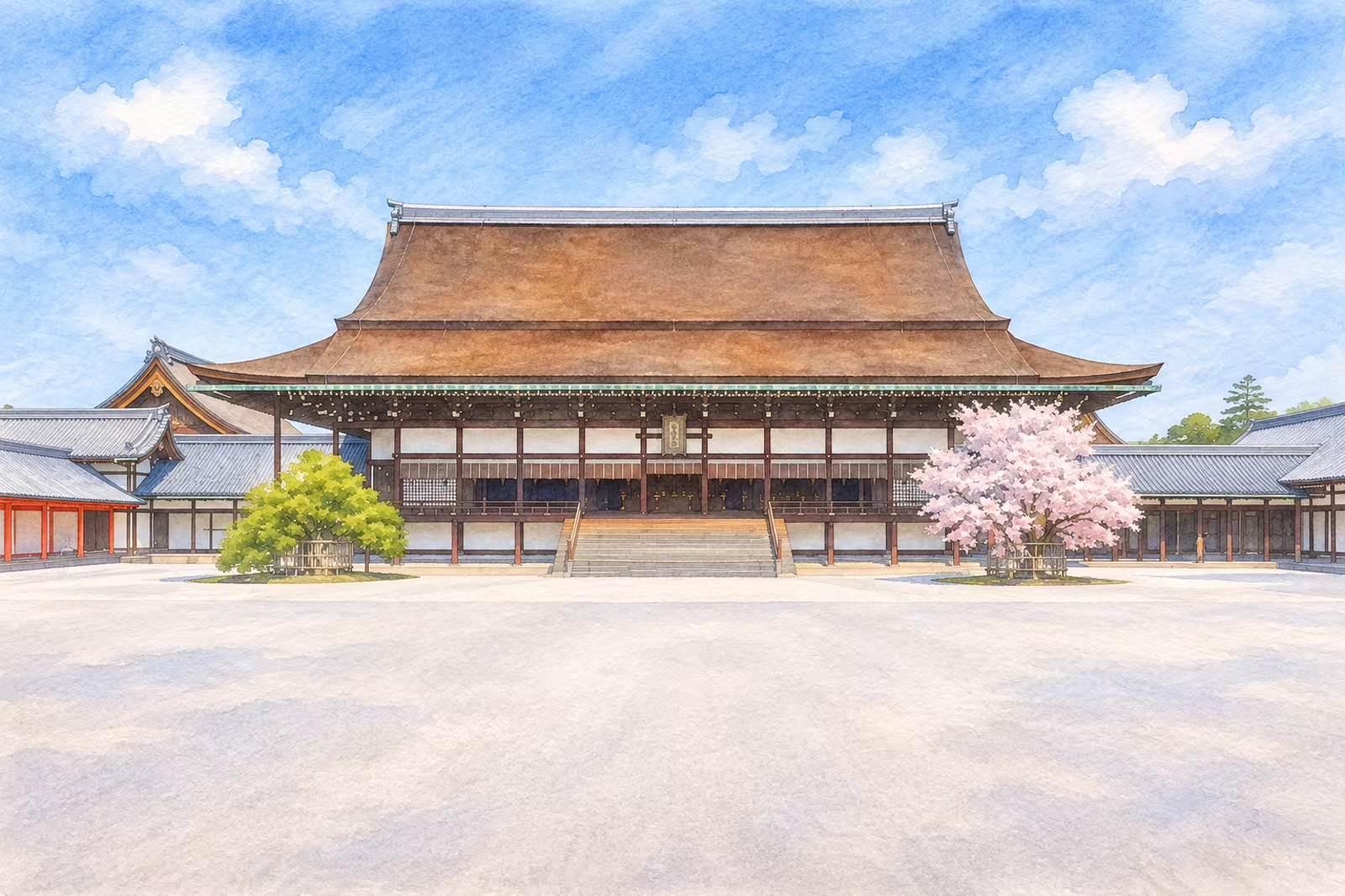
The Kyoto Imperial Palace (Kyoto Gosho) is the former residence of the emperors in Kyoto, set inside the open parkland of Kyoto Gyoen in Kamigyō Ward, Kyoto Prefecture. Emperors lived here for more than five hundred years, from the early 14th century until Emperor Meiji moved to Tokyo in 1869. Most of the present buildings date from a rebuilding in 1855, and many of the decisive moments of the late Tokugawa court took place in them.
01From temporary residence to permanent palace
The official palace compound of the Heian period, the Daidairi, stood west of the present site. After repeated fires it fell out of use, and emperors lived instead in aristocratic mansions converted into temporary palaces, known as sato-dairi. The present palace grew out of one of these, the Tsuchimikado Higashinotōin mansion. Emperor Kōgon of the Northern Court was enthroned here in 1331, and the site gradually became the fixed palace. During the Warring States period the impoverished court let it decline badly, and Oda Nobunaga, Toyotomi Hideyoshi and Tokugawa Ieyasu in turn paid for repairs and expansion. Fires struck repeatedly in the Edo period. A rebuilding around 1790, overseen by Matsudaira Sadanobu and based on antiquarian research into the Heian palace, restored ancient forms to the Shishinden and Seiryōden. After another fire in 1854, the palace was rebuilt the following year largely to that plan, and those are the main buildings seen today.
02Stage of the Bakumatsu years
In the 1850s and 1860s rival factions came to Kyoto to win the court’s backing on treaty approval, shogunal succession and expelling foreigners. In 1864 Chōshū troops attacked the city and fought Aizu, Satsuma and other domains around the Hamaguri Gate on the palace’s west side, in what is called the Kinmon Incident. At the end of 1867 the court proclaimed the Restoration of Imperial Rule, and that night a council in the Kogosho hall decided to demand that Tokugawa Yoshinobu give up his court rank and lands.
03What can be seen today
The enthronements of the Meiji, Taishō and Shōwa emperors were all held in the Shishinden. After the emperor left, the surrounding noble mansions were cleared and the land became Kyoto Gyoen, now a national garden open to the public. The palace itself is managed by the Imperial Household Agency; its main halls include the Shishinden, Seiryōden, Kogosho, Ogakumonsho and Otsunegoten, which visitors generally see only from outside. The Kogosho burned in 1954 and was rebuilt in 1958. As imperial property, the palace is not designated a National Treasure or Important Cultural Property under the Cultural Properties Protection Law.
Kyoto Imperial Palace
01What You Are Looking At
The Kyoto Imperial Palace (Kyōto Gosho) is the walled compound at the heart of Kyoto Gyoen, the large public park in the middle of the city. The park is open to anyone at any hour and is run by the Ministry of the Environment as a national garden. The palace itself, a rectangle of roughly 11 hectares enclosed by long plastered earthen walls, belongs to the Imperial Household and is administered by the Kyoto office of the Imperial Household Agency.
From the fourteenth century until 1869, when the Meiji emperor moved to Tokyo, this was where Japan’s emperors lived, held court, and were enthroned. Yet almost everything you see inside dates from 1855. The palace burned many times and was rebuilt many times; the current version was put up in the last years of the Tokugawa shogunate, deliberately copying the architecture of the ninth- and tenth-century palace described in old court records. Standing in front of the main hall, you are looking at a Heian-period palace as imagined, and carefully researched, by builders of the 1780s and reproduced in the 1850s.
Because it is imperial property, the palace is outside the national system of cultural property designations. It is not a National Treasure or an Important Cultural Property, simply because that law does not apply to it. Since 2016 it has been open to the public year-round; visitors enter through the Seishomon Gate on the west side.
02The Palace That Moved
When Emperor Kanmu founded Heian-kyō, the capital that became Kyoto, in 794, the imperial palace precinct (the Daidairi) stood at the northern end of Suzaku Avenue, the city’s central boulevard. Inside it was the Dairi, the emperor’s private residential compound. That site lies about two kilometers west of today’s palace, around the modern intersection of Senbon and Marutamachi streets, where only a few markers remain.
The Heian Dairi first burned in 960 and burned again and again afterwards. Each time, emperors moved into the mansions of powerful aristocrats, usually relatives of the Fujiwara regents who dominated the court. Such a temporary residence was called a sato-dairi, a "palace in the town." Over the eleventh and twelfth centuries these town palaces became the normal place for emperors to live, and the original compound fell out of use. After a fire in 1227, the old Dairi was never rebuilt.
The present palace began as one of these town residences: the Tsuchimikado Higashinotōin mansion, named after the two streets at whose crossing it stood. In the late Kamakura period it was used repeatedly by emperors of the Jimyōin line, one of the two branches into which the imperial family had divided.
03A Temporary Palace Becomes Permanent
In 1331 Emperor Go-Daigo rose against the Kamakura shogunate. The shogunate responded by placing Emperor Kōgon of the rival Jimyōin line on the throne, and Kōgon was enthroned at the Tsuchimikado mansion. After the fall of Kamakura and the collapse of Go-Daigo’s own regime, Ashikaga Takauji backed the Jimyōin emperors, and Japan had two courts: the Northern Court in Kyoto and Go-Daigo’s Southern Court in the mountains of Yoshino.
The Northern Court emperors lived at the Tsuchimikado mansion. When the two courts were reunited in 1392, the arrangement simply continued. No emperor ever chose this site for a grand new palace. A temporary residence of a disputed line became, by default, the permanent home of the imperial family.
The palace grew in stages. The third Ashikaga shogun, Ashikaga Yoshimitsu, enlarged it, but for centuries it was much smaller than today’s compound, hemmed in by the houses of court nobles.
04Poverty and Repair
The Ōnin War, which began in 1467, turned Kyoto into a battlefield. Emperor Go-Tsuchimikado took refuge in the shogun’s Muromachi residence and stayed there for about a decade. The following century was the low point of imperial fortunes. Funerals and enthronement ceremonies were postponed for years for lack of money; Emperor Go-Kashiwabara waited more than twenty years for his enthronement ceremony, and Emperor Go-Nara is remembered for selling samples of his calligraphy. Later accounts describe crumbling walls through which passers-by could see into the palace grounds. These stories are probably embroidered, but the palace was clearly in poor repair.
The warlords who unified Japan restored it. Oda Nobunaga, after entering Kyoto in 1568, repaired the palace between 1569 and about 1571. Toyotomi Hideyoshi carried out a larger rebuilding around 1590 and gathered the courtier families into a district around the palace, the kuge-machi, or nobles’ quarter. Tokugawa Ieyasu rebuilt and enlarged the palace again around 1613. Under the Tokugawa, the shogunate paid for the palace and its repairs, and also watched the court closely through its Kyoto deputy and bound it with written regulations. The upkeep was both a gift and a leash.
Fires continued. During the Edo period the palace was rebuilt eight times. The earlier rebuildings followed the domestic architecture of the day, with tatami rooms and sliding doors, and bore little resemblance to the classical palace of the Heian court.
05The Great Fire of 1788 and the Return to Antiquity
In early 1788 the Great Tenmei Fire swept through Kyoto and destroyed most of the city, including the palace. Emperor Kōkaku moved temporarily to Shōgo-in, a temple east of the river.
Kōkaku was an emperor with strong views about restoring the ceremonies and dignity of the ancient court, and he wanted the new palace to follow Heian models. The shogunate’s chief councillor at the time, Matsudaira Sadanobu, was in the middle of a strict austerity program and was reluctant, but in the end the shogunate agreed. The plans rested on the work of a courtier-scholar, Uramatsu Mitsuyo (known by his Buddhist name Kozen), who had spent decades reconstructing the layout of the Heian palace from texts. His study, Dai-dairi zu kōshō (An Investigation of Plans of the Great Palace), gave the carpenters their references.
The new palace was completed in 1790, and Kōkaku returned in a grand procession. Its formal ceremonial buildings, above all the Shishinden (Hall for State Ceremonies) and the Seiryōden (the old imperial residential hall), together with the gates and roofed corridors around the main courtyard, were built to classical designs. The rooms the emperor actually lived in were kept in the comfortable contemporary style. That combination of an antique public face and a practical private interior is what you still see today.
06The 1855 Palace
The Kansei-era palace lasted just over sixty years. In 1854 a fire again destroyed it. Emperor Kōmei fled the flames and, while the palace was rebuilt, lived first at Shōgo-in and then in the residence of the Katsura princely house. The shogunate rebuilt quickly, following the 1790 designs closely, and the work was finished in 1855. The Shishinden, Seiryōden, Otsunegoten, Ogakumonsho and most of the gates you walk past date from this rebuilding.
Two later changes are worth knowing. For the enthronement of Emperor Taishō in 1915, a new entrance porch, the Shin-Mikurumayose, was added as the emperor’s formal entrance; it is still used by the emperor and empress today. And the Kogosho, scene of the most famous meeting in the palace’s history, burned on August 16, 1954 when sparks from a fireworks display on the Kamo River landed on its cypress-bark roof. It was rebuilt to the old design in 1958.
07Into the Storm
The rebuilt palace was barely finished before it became the center of national politics. In 1858 the shogunate signed a commercial treaty with the United States without imperial approval. Emperor Kōmei’s opposition to opening the country turned the court from a ceremonial institution into a political prize. Activists under the slogan "revere the emperor, expel the barbarians" poured into Kyoto, and the great domains competed for influence around the palace.
On the eighteenth day of the eighth month of 1863, Satsuma and Aizu domain troops, acting with moderate court nobles, sealed the palace gates and expelled the radical Chōshū domain and seven of its allies among the court nobility from Kyoto. The following summer, on August 20, 1864, Chōshū forces marched on the capital to recover their position. They were beaten back in fierce fighting around the palace precinct, most famously at the Hamaguri Gate on the west side of the park. The battle is known as the Kinmon (Forbidden Gate) Incident or the Hamaguri Gate Rebellion. The Chōshū leader Kusaka Genzui died, and fires started in the fighting burned for three days and destroyed some 28,000 houses across the city. Marks on the Hamaguri Gate are traditionally pointed out as bullet scars. The gate belongs to the outer wall of the park, not the palace itself.
Emperor Kōmei died in the palace in early 1867, aged 35 by Western reckoning. His son, the future Emperor Meiji, was fourteen. Meiji had been born in 1852 not in the palace but in the house of his maternal grandfather, the courtier Nakayama Tadayasu, whose site lies in the northern part of the park.
08The Kogosho Conference
In late 1867 the shogun Tokugawa Yoshinobu returned his governing authority to the court, hoping to keep real power as head of the largest house in the land. His opponents, led by Satsuma, Chōshū and the court noble Iwakura Tomomi, moved first.
On January 3, 1868 (the ninth day of the twelfth month by the old calendar), troops from Satsuma and several allied domains took control of the palace gates. In the Ogakumonsho, the court proclaimed the Restoration of Imperial Rule, abolishing the shogunate and the old court regency offices and creating a new government. That night the new government’s leaders met in the Kogosho, a hall used for audiences with warriors. The young emperor is recorded as present, though some historians doubt that he attended.
The question was what to do with Yoshinobu. Yamauchi Yōdō, the former lord of Tosa, argued that the shogun should be present and accused the plotters of using a boy emperor to seize power. Iwakura rebuked him for implying that the emperor was not acting on his own judgment, though this exchange may have been sharpened in later retellings. Matsudaira Shungaku of Echizen also argued for leniency. During a recess, according to a well-known story that appears only in the memoirs of the Hiroshima lord Asano Nagakoto, dictated some fifty years later, Saigō Takamori, commanding the guard outside, remarked that the matter could be settled with a single short sword, and the message helped bring the opponents round. Whatever was actually said, the meeting ended with an order that Yoshinobu resign his court rank and surrender his lands.
The order made armed conflict almost certain. Within a month the Battle of Toba-Fushimi began the Boshin War, which ended the Tokugawa regime. The Kogosho you see today is the 1958 reconstruction, but it stands on the same spot and follows the same design.
09After the Emperor Left
In 1868 the young emperor took part in the ceremony of the Charter Oath in the Shishinden, and later that year was enthroned there. He then traveled to Edo, now renamed Tokyo, returned briefly, and in 1869 left again for good. No formal decree ever moved the capital, a fact that some Kyoto residents still enjoy pointing out.
Without the court, the nobles’ quarter around the palace decayed rapidly as its families followed the emperor east. On a visit in 1877 the emperor ordered that the palace be preserved and its surroundings put in order. The nobles’ mansions were cleared, trees were planted and walls built, and over the following years the area became the park you walk through today.
The Imperial House Law of 1889 specified that enthronement ceremonies were to be held in Kyoto. As a result, the enthronements of Emperor Taishō in 1915 and Emperor Shōwa in 1928 took place in the Shishinden. The postwar law dropped that rule, and the enthronements of 1990 and 2019 were held in Tokyo. The Takamikura, the canopied imperial throne used at enthronements, and the Michōdai, the matching throne for the empress, normally stand inside the Shishinden; they were taken to Tokyo for both modern ceremonies and returned afterwards.
10A Walk Through the Palace
The visitor route begins at the Seishomon Gate. Ahead is the Gishūmon Gate, through which courtiers came to the palace. Inside, the Okurumayose is the formal entrance porch for those permitted an audience, and next to it the Shodaibu-no-ma, the waiting rooms, are divided by rank. Their sliding doors are painted with tigers, cranes and cherry blossoms, so the rooms are known as the Tiger, Crane and Cherry rooms. Beyond them is the 1915 carriage porch.
The route then leads to the Shishinden courtyard. The hall, with its sweeping hip-and-gable roof of cypress bark, faces south across a court of raked white gravel. On either side stand a cherry tree and a mandarin orange tree, known as the Cherry of the Left and the Orange of the Right; left and right are counted from the emperor’s seat inside, looking out. Through the Jōmeimon Gate in the south corridor, and beyond it the Kenreimon Gate in the outer wall, the axis runs straight out toward the city. The Kenreimon is opened only for the emperor and visiting heads of state. The processions of the Aoi Festival in May and the Jidai Festival in October set out from in front of it. Inside the Shishinden, behind the throne, stand painted panels showing thirty-two worthies of ancient China.
To the northwest is the Seiryōden, the emperor’s daily residence in the Heian period. Later emperors lived elsewhere and it became a ceremonial building. Two clumps of bamboo stand in the courtyard in front of it.
Walking northeast, you reach the Kogosho, scene of the 1868 conference, and the Ogakumonsho, first built in the 1610s and used for study, entertainments and audiences with courtiers; the Restoration decree was announced here. East of them is the Oikeniwa, a pond garden with a stone bridge and a pebbled shoreline. Last comes the Otsunegoten, the emperor’s actual living quarters from the late sixteenth century on, and the largest building in the compound, with the more private Onaitei garden behind it.
Back outside, look at the palace walls. The five horizontal white lines along their plaster mark the highest rank of building. A short walk west brings you to the Hamaguri Gate; to the north is the site of the Nakayama house where Emperor Meiji was born.