
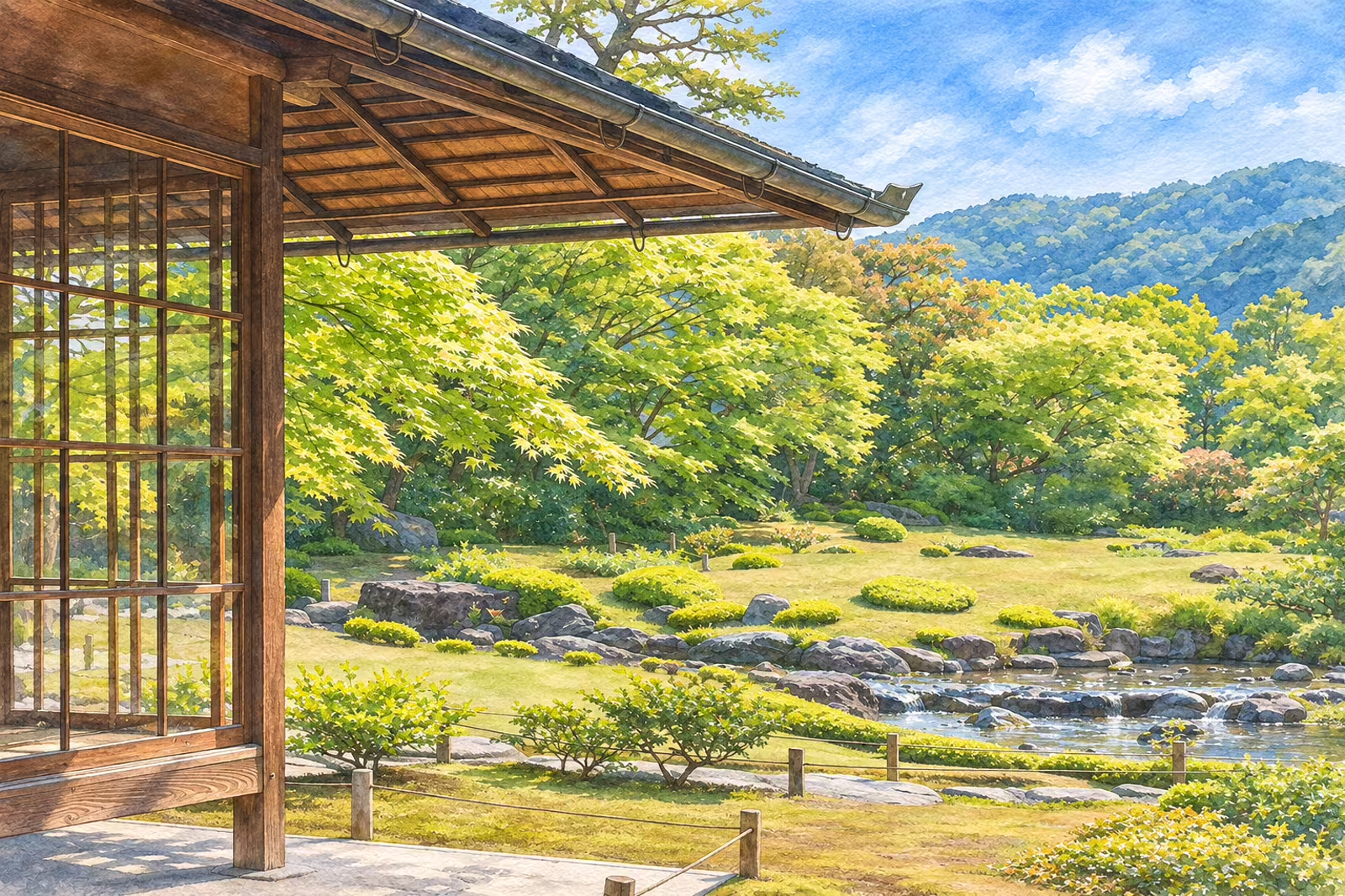
Murin-an is the Kyoto villa of the Meiji statesman Yamagata Aritomo, located near Nanzen-ji in Sakyō Ward. Its garden, laid out by Ogawa Jihei VII to Yamagata’s ideas, draws a stream from the Lake Biwa Canal and borrows the Higashiyama hills as its backdrop, and it is generally counted among the starting points of the modern Japanese garden in Kyoto. The villa’s Western-style house was also the setting for a 1903 meeting on policy toward Russia.
01Yamagata’s third Murin-an
Yamagata used the name Murin-an, "hermitage without neighbors," more than once. The usual account holds that the first was a modest retreat in his home domain of Chōshū and the second stood near Kiyamachi Nijō in Kyoto; the villa near Nanzen-ji is the third, completed in roughly 1894–1896. The Lake Biwa Canal had opened only a few years earlier, and villas using its water were beginning to appear around Nanzen-ji. Murin-an was one of the earliest.
Yamagata disliked the conventional arrangement of a large pond with symbolic islands. He preferred bright, open lawns and shallow running water. Ogawa responded with a three-tiered waterfall, a winding stream and sparse planting that let the garden merge visually with the hills beyond its walls. Ogawa went on to design the gardens of Heian Jingū and many others, becoming the most influential garden maker in modern Kyoto.
02The Murin-an Conference
On April 21, 1903, Yamagata, Itō Hirobumi, Prime Minister Katsura Tarō and Foreign Minister Komura Jutarō met in an upstairs room of the Western-style house to discuss policy toward Russia. The meeting, often called the Murin-an Conference, is generally understood to have confirmed a firm negotiating line with Russia over Korea. The Russo-Japanese War broke out the following year.
03Murin-an today
Three buildings survive: the main house, a Japanese timber structure; the two-story brick Western-style house; and a tea house. The conference room upstairs keeps its period furniture and wall decoration. Yamagata died in 1922, and in 1941 his family donated the villa to the City of Kyoto. The garden was designated a national Place of Scenic Beauty in 1951. Over the past century moss has replaced part of the lawn, so the garden today differs from the one Yamagata knew, and its caretakers continue to maintain it according to the original design intent.