
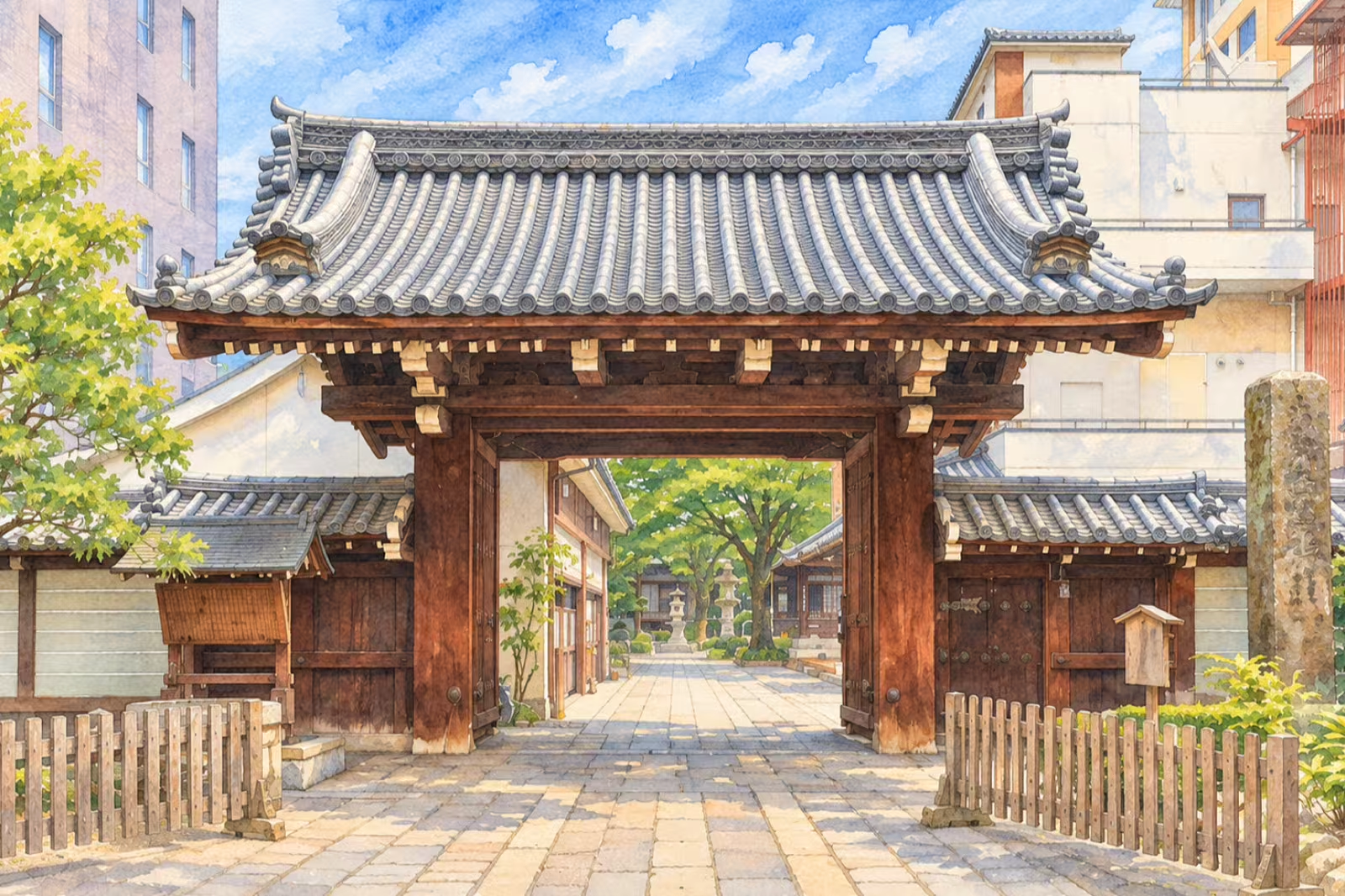
Honnō-ji is a temple of the Hokke (Lotus) school of Nichiren Buddhism in Kyoto, now the head temple of the Hokke-shū Honmon-ryū. It is famous as the place where Oda Nobunaga died in 1582, attacked by his own general Akechi Mitsuhide in what is called the Honnō-ji Incident. The temple that stands today in Teramachi-Oike, Nakagyō Ward, is not the scene of that event, however. In 1582 the temple occupied a site about a kilometer to the southwest, near Shijō-Nishinotōin, which is now an ordinary city neighborhood marked only by a stone post. Understanding Honnō-ji means keeping the original site and the present temple apart.
01Founding and the temple of Nobunaga’s day
The temple is generally said to have been founded in 1415 by the monk Nichiryū, first under the name Honnō-ji written with different characters, and renamed later. It moved several times within Kyoto and was burned in the Tenbun Hokke Disturbance of 1536, then rebuilt in the Shijō-Nishinotōin and Aburanokōji area as a large compound enclosed by a moat and earthen walls. Nobunaga used it repeatedly as his lodging in the capital. Early on the second day of the sixth month of Tenshō 10 (June 21, 1582 in the Julian calendar), Mitsuhide’s troops surrounded the temple. Nobunaga had only a small retinue; the buildings caught fire and he took his own life at the age of 48 (49 by traditional count). His remains were never identified. Less than two weeks later Mitsuhide was defeated by Hashiba (later Toyotomi) Hideyoshi at the Battle of Yamazaki.
02Hideyoshi’s relocation and later losses
Around 1591, as part of his reshaping of Kyoto, Hideyoshi ordered Honnō-ji moved to its present location in Teramachi, where many temples were gathered along the eastern edge of the city. The relocated temple burned again in the Great Tenmei Fire of 1788 and in the fighting of the Kinmon Incident in 1864; the present main hall dates from 1928. The temple customarily writes the character 能 in its name with a variant form that omits the two 匕 elements on the right, said to avoid a shape suggesting 火 (fire) after so many disasters.
03What can be seen today
The present precinct contains a memorial tower for Nobunaga and the Daihōden treasure hall, whose collection includes objects traditionally associated with him. At the original site a stone post reads "Site of Honnō-ji." Excavations around 2007 uncovered traces of a moat and stone walling together with large quantities of burnt roof tiles, some reportedly bearing the temple’s name, which confirmed the location. No sixteenth-century buildings survive above ground.
Honnō-ji
01Two Places Called Honnō-ji
Visitors who go looking for Honnō-ji in Kyoto usually end up at a busy temple gate on Teramachi-dōri, just south of Oike-dōri, squeezed between the covered shopping arcades of central Kyoto. Behind the gate are a large main hall, a treasure museum and a memorial to Oda Nobunaga, the warlord who did more than anyone to end Japan’s century of civil war. This is the working temple today.
But Nobunaga did not die here. The Honnō-ji in which he was trapped and killed in the early hours of a summer morning in 1582 stood about a kilometer to the southwest, in the blocks north of Shijō-dōri between Nishinotōin-dōri and Aburanokōji-dōri. That neighborhood is now residential. A small stone post and an information board are all that mark it.
Nine years after Nobunaga’s death, the temple was ordered to move to its present location. Nothing standing at the modern temple was there in 1582, and almost nothing remains above ground at the old site. To understand Honnō-ji, you need both places.
02A Temple of the Lotus Sect
Honnō-ji belongs to the tradition founded by the thirteenth-century monk Nichiren, who taught that the Lotus Sutra alone contained the Buddha’s full teaching. Today it is a head temple (daihonzan) of the Hokkeshū Honmon-ryū, one of the Nichiren-lineage denominations.
It was founded in 1415 by the monk Nichiryū, first under the name Honnō-ji written with a different character (本応寺), in the area of Aburanokōji and Takatsuji. In 1418 it was wrecked by followers of a rival Nichiren temple, Myōhon-ji. Nichiryū rebuilt in the Uchino district in 1429, and in 1433, with backing from a patron named Nyoiōmaru, the community moved to Rokkaku-Ōmiya and adopted the name written 本能寺. The temple explains the new name as drawn from a phrase about spreading the teaching of the Lotus Sutra.
In fifteenth- and sixteenth-century Kyoto the Nichiren school, then usually called the Hokke ("Lotus") sect, was the faith of much of the town’s merchant class. Its large urban temples, twenty-one of them by the 1530s, were rich, organized and in some cases armed. That brought them into conflict with the great monastery of Enryaku-ji on Mount Hiei, which regarded Kyoto as its sphere. In 1536 Hiei’s warrior monks, allied with the Rokkaku clan of Ōmi province, attacked the city and burned every one of the Hokke temples. This is known as the Tenbun Hokke Disturbance, after the era name. Honnō-ji’s monks took refuge in the port city of Sakai.
When the sect returned to Kyoto, Honnō-ji was rebuilt in 1545 under its chief priest Nichijō on a large block near Shijō and Nishinotōin, roughly bounded by Nishinotōin, Aburanokōji, Rokkaku and Shijō-bōmon (today’s Takoyakushi-dōri). This is the temple Nobunaga knew.
03Nobunaga’s Lodging in the Capital
Oda Nobunaga entered Kyoto in 1568 at the head of an army, installing Ashikaga Yoshiaki as shogun. Over the following fourteen years he came and went from the capital constantly, but he never built himself a permanent palace there to match his great castle at Azuchi on Lake Biwa. Instead he usually lodged in temples. Myōkaku-ji, another Hokke temple, was a favorite in the early years. A residence he built at Nijō was later given to Crown Prince Sanehito and became known as the Nijō Shin-gosho, the "New Nijō Palace." Honnō-ji became one of his lodgings in his later years, though the temple counts only four recorded stays, the last of them in 1582.
The temple suited him for practical reasons. Its chief priest Nichijō was of imperial birth, which gave it close ties to the court. Hokke temples had close ties with merchant networks in Sakai and elsewhere, and Honnō-ji had branch temples as far away as Tanegashima, the island where Portuguese firearms first arrived in Japan in 1543. Some historians suggest the connection helped Nobunaga obtain gunpowder and guns, though this is an inference rather than something the sources state outright.
To make the temple fit for a ruler, it was given a moat, earthen embankments and stone walls. It was defensible against a riot or a small raid. It was not a castle, and in June 1582 Nobunaga brought only a small party of attendants with him; estimates in the sources range from a few dozen to over a hundred and fifty.
04Summer 1582
In the spring of 1582 Nobunaga destroyed the Takeda clan of Kai province, his most dangerous rival in the east. His generals were spread across the country. Shibata Katsuie faced the Uesugi in the north. Takigawa Kazumasu had just been sent to Kōzuke. Niwa Nagahide and Nobunaga’s third son Oda Nobutaka were gathering an army near Ōsaka to cross to Shikoku and attack the Chōsokabe. Hashiba Hideyoshi, the future Toyotomi Hideyoshi, was besieging Takamatsu Castle in Bitchū province, held for the Mōri clan.
In May Hideyoshi asked for reinforcements. Nobunaga decided to go west himself and ordered Akechi Mitsuhide, one of his most senior commanders and lord of Tanba province, to lead an advance force. Mitsuhide had just been in charge of entertaining Tokugawa Ieyasu, Nobunaga’s ally, at Azuchi. He returned to his castle, Kameyama in Tanba (in today’s city of Kameoka), to prepare his troops.
Nobunaga arrived in Kyoto on the 29th day of the fifth month and settled into Honnō-ji. On the first day of the sixth month he hosted some forty court nobles, among them Konoe Sakihisa, at the temple and showed off his famous collection of tea utensils. His eldest son and heir, Oda Nobutada, was also in the city, lodging at Myōkaku-ji a short walk away, and visited his father that evening. The plan was to spend a few days in Kyoto before heading west. There was no visible danger: the whole region around the capital was under Oda control.
05The March from Kameyama
On the evening of the first day of the sixth month, Mitsuhide marched out of Kameyama Castle with something over ten thousand men, usually estimated at 13,000. Officially they were bound west to support Hideyoshi. Instead, after crossing the Oinosaka pass and halting near Kutsukake, the army turned east toward Kyoto.
How and when Mitsuhide told his men is not clear. The usual account says he confided in a handful of senior retainers, such as his kinsman Akechi Hidemitsu and Saitō Toshimitsu, and that the ordinary soldiers did not know who their target was until they reached the city. The famous phrase "The enemy is at Honnō-ji!" comes from later war tales and literature, not from contemporary records.
06The Attack, Dawn on June 21, 1582
At dawn on the second day of the sixth month of Tenshō 10, which corresponds to June 21, 1582 in the Julian calendar then still used in Europe, Akechi troops surrounded Honnō-ji.
The best account of what happened inside is the Shinchō Kōki (Chronicle of Lord Nobunaga), written by Ōta Gyūichi, a former retainer who gathered testimony from survivors, including women of the household. According to it, Nobunaga and his pages at first thought the noise outside was a quarrel among servants. Then came war cries and gunfire into the buildings. Nobunaga asked whose rebellion this was. His page Mori Ranmaru (Mori Naritoshi) answered that the banners were Akechi’s. Nobunaga replied "Ze hi ni oyobazu," roughly "It cannot be helped" or "There is nothing more to say." It is the best-known line of the whole affair.
The chronicle says Nobunaga fought first with a bow until the string broke, then with a spear, until he was wounded in the elbow by a spear. He told the women to escape, withdrew into the inner rooms, and as the buildings burned, took his own life. He was 49 by the Japanese count, 48 by modern reckoning. Mori Ranmaru and his younger brothers Bōmaru and Rikimaru died with most of the other attendants.
The Jesuit missionary Luís Fróis, then in Japan, also described the event in reports to Europe and later in his History of Japan. His information came through the Kyoto mission and differs in details from Ōta’s; he says, for example, that Nobunaga was washing his face when he was struck in the back by an arrow. Jesuit letters also mention Yasuke, the African-born man who had served Nobunaga since the previous year. He fought at Honnō-ji, then made his way to Nobutada’s position and fought on there until he was captured. Mitsuhide reportedly spared him on the grounds that he was not Japanese, and had him taken to the Jesuit church.
By morning the fighting was over. The temple was in ashes, and Nobunaga’s body was never identified, a gap that has fed legends ever since.
07Nobutada at the Nijō Palace
Hearing the news at Myōkaku-ji, Nobutada first tried to go to his father’s aid, then learned that Honnō-ji had already fallen. He moved instead to the Nijō Shin-gosho, a stronger position nearby, sent Crown Prince Sanehito and his family out to safety, and prepared to fight alongside the Kyoto magistrate Murai Sadakatsu and others. The Akechi army attacked, and by the end of the day Nobutada too had killed himself, at 26 by the Japanese count.
Losing both the head of the house and his heir on the same day turned the assassination into a political collapse. Mitsuhide took Azuchi Castle and courted the imperial court and the lords of the central provinces, but few joined him.
08Thirteen Days
Hideyoshi heard the news at Takamatsu on the night of the 3rd or early on the 4th of the sixth month. He quickly made peace with the Mōri and drove his army back east at extraordinary speed, an episode remembered as the "Great Return from Chūgoku." On the 13th of the sixth month, joined by Nobutaka and Niwa Nagahide, he met Mitsuhide at Yamazaki, between Kyoto and Ōsaka, and routed him. Fleeing toward his castle at Sakamoto, Mitsuhide was attacked by local villagers near Ogurusu and died. His seizure of power had lasted less than two weeks, giving Japanese the expression "three-day rule" (mikka tenka) for a short-lived triumph.
Why Mitsuhide did it is still argued over. The Edo-period favorite was revenge: stories of Nobunaga humiliating or striking him in public, often set during the reception for Ieyasu. Most of these come from later war tales. Modern historians have proposed personal ambition; the "Shikoku theory," which links the coup to Nobunaga’s sudden reversal of policy toward the Chōsokabe clan, with whom Mitsuhide’s side had close ties; and theories of a hidden backer, from the imperial court to the deposed shogun Yoshiaki. The surviving evidence does not settle the question.
09The Original Site
In 1591, nine years after the fire, Toyotomi Hideyoshi, now ruler of Japan, carried out a sweeping reorganization of Kyoto, gathering many temples along the city’s eastern edge in the district still called Teramachi, "temple town." Honnō-ji was ordered to its current site at Teramachi and Oike, where the new temple was completed in 1592. The old grounds became ordinary townhouses.
Neighborhood names such as Moto-Honnōji-chō ("former Honnō-ji ward") kept the memory alive. In the modern period Honnō Elementary School stood here; after it closed in 1992, the buildings passed to the Honnō campus of Horikawa High School and a welfare facility. A stone marker reading "Site of Honnō-ji" stands on Aburanokōji-dōri just south of Takoyakushi.
In the summer and autumn of 2007 the Kyoto City Archaeological Research Institute dug three times in the area. The excavations showed that the precinct was enclosed by a moat and divided inside by further moats lined with stone walls. They also turned up large quantities of roof tiles burned red, burnt wall plaster, a demon-face ridge tile, and eave tiles stamped with the temple’s own variant of the character 能. Representative finds were designated a Kyoto City Tangible Cultural Property in 2019. The remains were reburied after investigation.
10The Present Temple
The move to Teramachi did not end Honnō-ji’s misfortunes. The Great Tenmei Fire of 1788, which destroyed most of Kyoto, burned it, and it was not rebuilt until 1840. In 1864 the fighting of the Kinmon Incident, when forces from Chōshū attacked the imperial palace, set off another great fire, and the temple burned again. The present main hall dates from 1928 and was designed by the architectural historian Amanuma Shun’ichi.
The center of attention for most visitors is the Nobunaga memorial tomb (Nobunaga-kō byō). According to the temple it was built by Nobunaga’s third son, Nobutaka. It is a memorial rather than a grave containing his remains; it is said to enshrine a sword he owned. Several other places in Kyoto also claim Nobunaga, including Amida-ji, whose founder Seigyoku is said by temple tradition to have recovered his remains on the day of the attack, and Sōken-in at Daitoku-ji, founded by Hideyoshi as Nobunaga’s memorial temple. Beside the memorial at Honnō-ji is a joint grave for Mori Ranmaru and the others who died in the attack. The cemetery also holds the graves of the literati painter Urakami Gyokudō and his son Shunkin.
A great ginkgo in the grounds is known as the "fire-quenching ginkgo." Temple tradition says that during the Tenmei Fire it sprayed water and saved the people sheltering beneath it.
Look closely at the temple’s name on its gate and signboards. The character 能 (nō) is written with its right-hand part changed: instead of two shapes resembling the katakana "hi" (匕), which together look a little like the character for fire, it uses 去. The temple explains the variant as a charm against the fires that destroyed it five times. The form was in fact common before the Meiji era, and it already appears on tiles excavated from the pre-1582 site.
11The Treasure Hall
The Daihōden treasure hall displays objects handed down at the temple. The best known is a bronze three-legged frog incense burner, which, according to legend, croaked on the eve of the attack to warn the monks. There are also tea utensils and letters that belonged to Nobunaga, a qilin incense burner said to have been his gift, a large Ming-dynasty Jingdezhen vase given by the Chaya merchant family, a folding screen by the painter Kanō Naonobu, and a bronze mirror with plum, pheasant and sparrow designs that is an Important Cultural Property. Many of these items came to the temple after 1582 and should not all be imagined as things carried out of the flames. Displays change, so the labels are worth reading.
12Walking Between the Two Sites
Start at the old site. From Shijō subway station or Karasuma station on the Hankyū line, walk about ten minutes west and north into the blocks between Nishinotōin and Aburanokōji. On Aburanokōji just south of Takoyakushi you will find the stone post; there is also an information board by the Horikawa High School Honnō campus. The Nijō Palace where Nobutada died stood a short distance to the north. It is a quiet residential area and the marker is easy to miss.
Then walk northeast to Teramachi and Oike. Inside the gate, the main hall faces you. Behind it to the right are the Nobunaga memorial and the grave of the fallen attendants, usually with fresh flowers. The great ginkgo stands nearby. The treasure hall is to one side.
On the way out, look back at the gate and find the 能 written with 去. The walk you have just made, a little over a kilometer, is the distance between where Nobunaga died and where the temple that bears his memory stands today.