
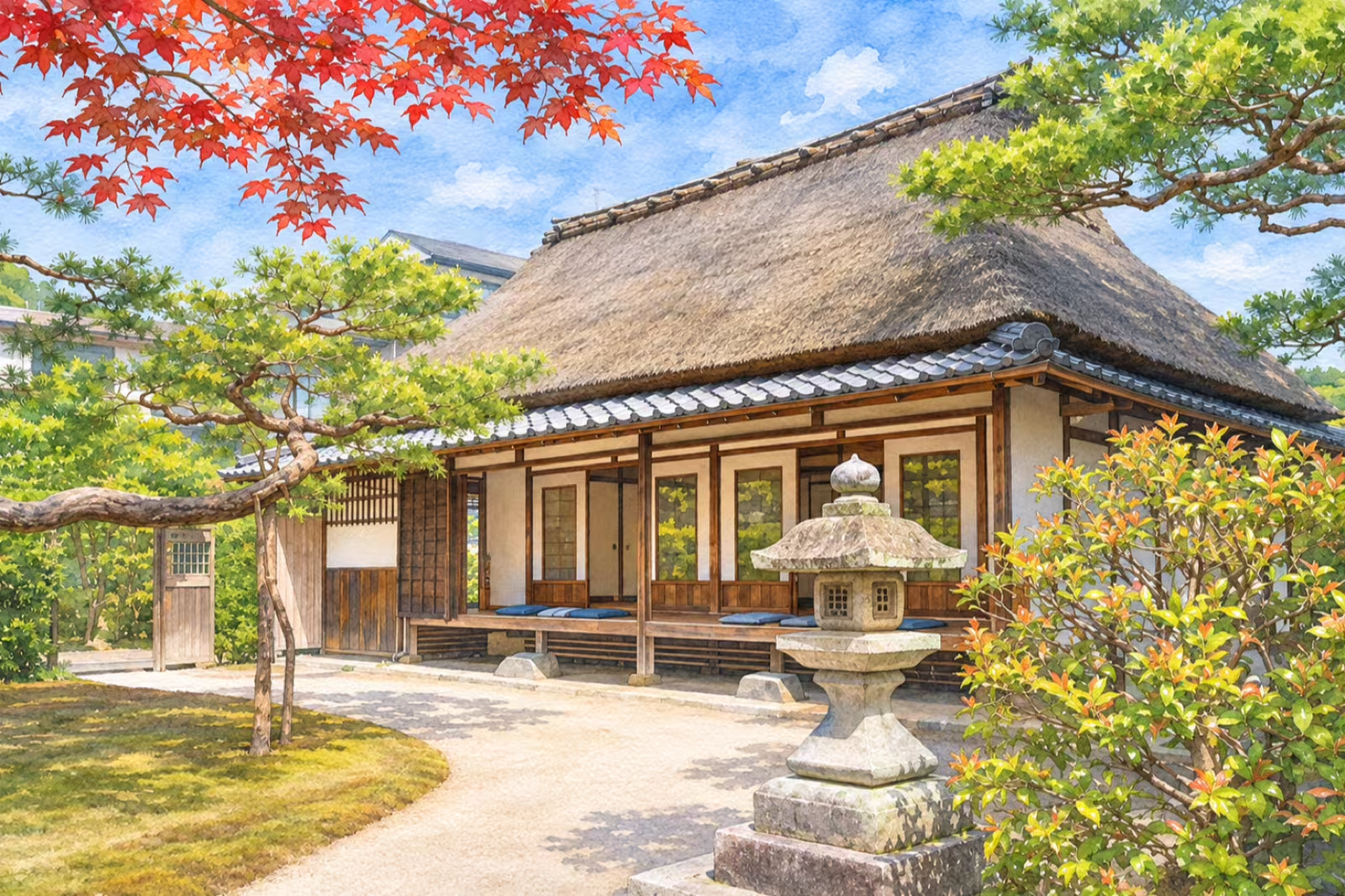
Iwakura Tomomi’s Secluded Residence, in the Iwakura district of Sakyō Ward in northern Kyoto, is the house where the court noble Iwakura Tomomi lived after being driven from the imperial court in the last years of the Tokugawa shogunate. He stayed here until 1867, receiving activists from many quarters, and it was from here that he returned to politics to help bring about the Meiji Restoration. The residence is a National Historic Site. Its buildings are plain; what makes it worth knowing is how an exiled noble rebuilt his political connections from the edge of the city.
01A court noble in exile
Iwakura Tomomi (1825–1883) came from a middle-ranking court family and rose to prominence at court in the late 1850s. He favored cooperation between the court and the shogunate and promoted the marriage of Princess Kazunomiya, younger sister of Emperor Kōmei, to the shogun Tokugawa Iemochi. In 1862, as the "revere the emperor, expel the barbarians" movement gained strength, radicals branded him a pro-shogunate traitor. He was forced to resign his offices, shave his head and leave the city, eventually settling in the village of Iwakura north of Kyoto. At first he lodged in borrowed quarters; in 1864 he bought the house of a local carpenter, added a main wing, and made it his home.
02Back into politics from the countryside
From around 1865 Iwakura resumed political activity here, writing memorials on national affairs and meeting courtiers and men from Satsuma and other domains. Records indicate that Nakaoka Shintarō, Sakamoto Ryōma and Ōkubo Toshimichi were among his visitors in 1867. That year he was permitted to return to the city, and working with Satsuma he played a central part in the coup that proclaimed the restoration of imperial rule in the twelfth month of the year (early 1868). Under the Meiji government he held the highest offices and led the Iwakura Mission to the United States and Europe in 1871–1873.
03What can be seen today
The residence consists of a thatched main house, a tile-roofed annex (said to be the carpenter’s house he bought), a small connecting structure between them, and a garden, all on a modest scale. The buildings underwent a major repair from the late 2000s into the early 2010s. Also in the grounds is the Taigaku Bunko, completed in 1928 to a design by the architect Takeda Goichi: a reinforced-concrete building put up later to honor Iwakura and house materials about him, and not part of the house as he knew it. Most of Iwakura’s papers, designated Important Cultural Properties, are kept elsewhere. As of 2026, the Yūtai-an teahouse, salvaged from Ōkubo Toshimichi’s former residence in Kyoto, was being reassembled within the grounds; it has no original connection to Iwakura’s years here.