
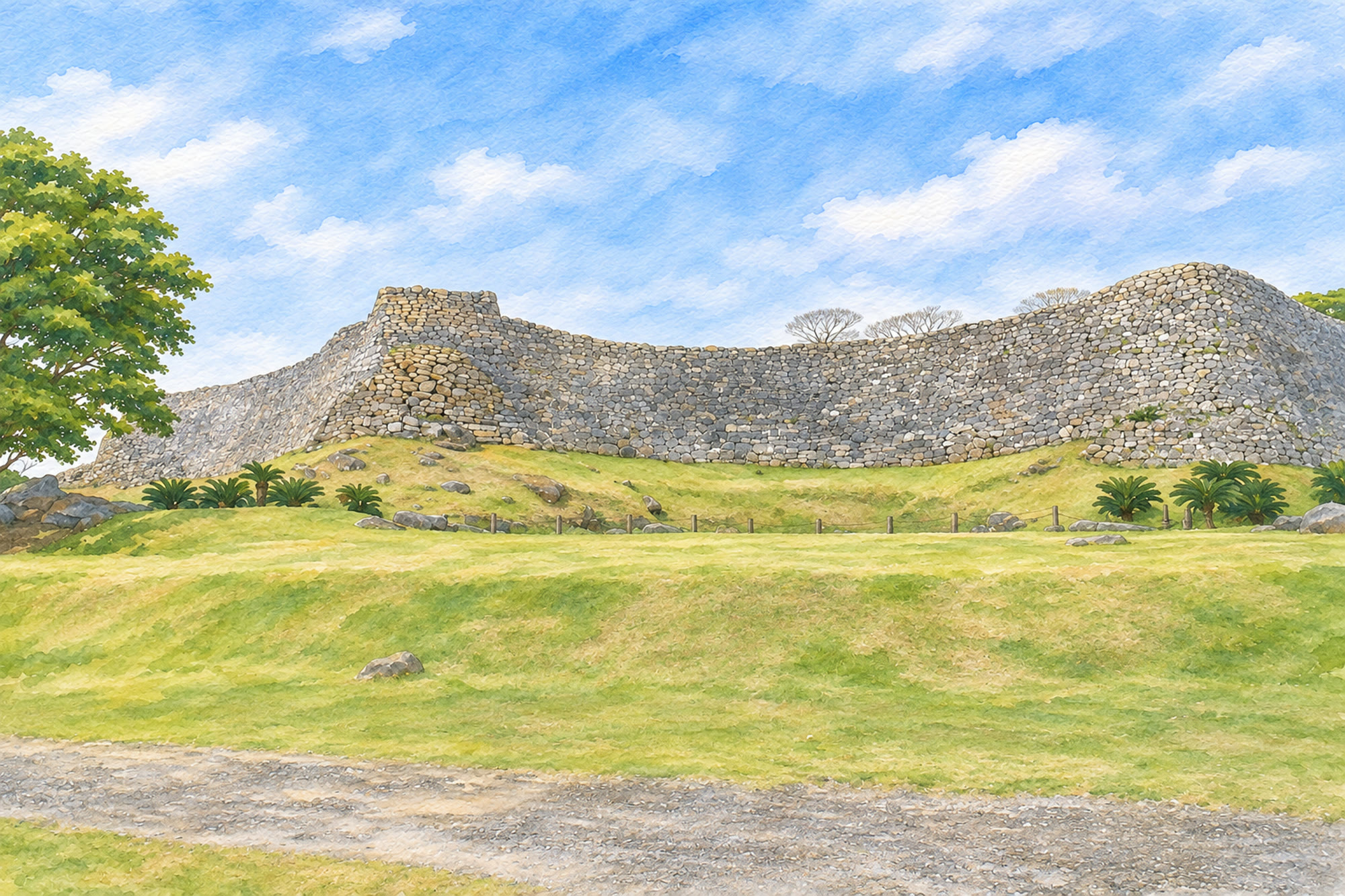
The Nakijin Castle Ruins stand on a limestone ridge on the Motobu Peninsula in northern Okinawa Island, in the village of Nakijin, Kunigami District, Okinawa Prefecture. Known locally as Nakijin Gusuku (gusuku is the Okinawan word for a fortified site), it was the seat of the kings of Hokuzan, the northern of the three rival powers that divided Okinawa Island in the fourteenth century. Its long, curving stone walls, about 1.5 km in total and up to about 8 meters high, make it one of the largest gusuku in the Ryūkyū Islands, and since 2000 it has been part of the World Heritage listing Gusuku Sites and Related Properties of the Kingdom of Ryukyu.
01Seat of the Northern Kings
Excavations suggest the ridge was occupied by the late thirteenth century and greatly enlarged in the fourteenth, when the terraced enclosures and their walls took shape. In the Sanzan (Three Kingdoms) period, the rulers of the north governed from here. Chinese records of the Ming dynasty name three "kings of Shanbei" who sent tribute missions: Haniji, Min and Han’anchi. In 1416 (some sources give 1422), Shō Hashi of Chūzan, the central kingdom, attacked with the support of northern local lords (aji). Han’anchi was killed and Hokuzan came to an end. According to Ryūkyūan legend, before dying he struck the castle’s guardian stone with his treasured sword Chiyoganemaru.
02Wardens, Fire and Worship
After the conquest, the court at Shuri installed a warden of the north, the Hokuzan kanshu, at Nakijin. The first was Shō Chū, a son of Shō Hashi; under the Second Shō dynasty the post went to members of the royal family. In 1609, when the Shimazu house of Satsuma invaded Ryūkyū, its troops landed at nearby Unten harbor, found the castle deserted and burned it. The last warden was ordered to move to Shuri in 1665, and the site ceased to be a residence. Its sacred groves (utaki) and the hearth-deity shrine continued to be used for ritual, and local priestesses and descendants of the warden’s lineage still come to worship.
03What You See Today
What survives is the shell of the castle: walls and the levelled enclosures, with no standing buildings. Most of the undulating walls, built of Paleozoic limestone, are original fabric, though many stretches have been repaired or rebuilt. The main gate, Heirōmon, was restored and rebuilt in 1962 under the Government of the Ryukyu Islands, and the straight stone stairway beyond it was laid in 1960; the original steep, narrow approach was only rediscovered in excavations in 1980. The main enclosure holds building foundations and a hearth-deity shrine built in the eighteenth century. A stone inscribed in 1749 with the history of the wardens once stood in the castle; the original is now kept by Nakijin village. The site was designated a national Historic Site on May 15, 1972, the day Okinawa reverted to Japan, and the protected area was later extended. A village-run museum near the entrance displays finds from the excavations, including Chinese ceramics, and a replica of the sword Chiyoganemaru.
Nakijin Castle Ruins
01Walls on a Limestone Ridge
Nakijin Castle sits on a limestone ridge about 100 meters above sea level near the northern tip of the Motobu Peninsula, in the village of Nakijin on the northwest coast of Okinawa Island. To the north, the East China Sea opens out toward the islands of Iheya and Izena. To the south and east rise the forested hills of Yanbaru, the rugged northern third of the island. Cliffs guard most of the north, east and south sides, and the main gate opens on the gentler west. On the eastern flank the ground drops sharply into the ravine of the Shijima River, a natural moat that made the site hard to approach from that side.
The first thing a visitor notices is the wall. It is built of pale gray limestone blocks, and it never runs straight for long. It bends and swells with the contour of the ridge, rising and falling in long curves that have been compared to a folding screen or to waves. The total length is usually given as about 1.5 kilometers, and at its tallest it stands about 8 meters high. Inside are a series of flat terraces at different levels, linked by stairs and gateways. No buildings survive. What you walk through today are the walls, the levelled enclosures, and a handful of places of worship that have been in use for centuries.
In the fourteenth century this was the seat of the kings of Hokuzan, the "Northern Mountain," one of three rival powers on Okinawa Island. Its capture by Shō Hashi of the central kingdom, usually dated to 1416, was a decisive step toward the unified Kingdom of Ryūkyū. The castle then served for another two centuries as the base of a royal governor of the north, until it was burned during the Satsuma invasion of 1609 and finally abandoned as a residence in 1665. In 2000 it was inscribed, together with Shuri Castle, Nakagusuku and other sites, as part of the World Heritage property Gusuku Sites and Related Properties of the Kingdom of Ryukyu.
02What Is a Gusuku?
Okinawans call the site Nakijin Gusuku. Gusuku is usually translated as "castle," and the same Chinese character is used to write it, but the word covers a wider range of places than a Japanese castle does. There are hundreds of gusuku across the Ryūkyū Islands. A few, such as Nakijin, Nakagusuku, Zakimi and Katsuren, are massive stone fortresses. Many others are small hilltops ringed by low walls, and some have no walls at all.
Scholars have long debated what a gusuku originally was. One view holds that gusuku were the fortified residences of local chieftains. Another emphasizes that many began as sacred places, groves where ancestors and deities were worshipped, and that walls were added later. A third view treats the two functions as intertwined from the start. Nakijin shows both faces clearly: it has royal living quarters and formidable defenses, and it also contains utaki, the sacred groves and rocks of Ryūkyūan religion, and a shrine to the hearth deity.
The great age of gusuku building ran from roughly the twelfth to the fourteenth century, a span archaeologists call the Gusuku period. Farming of rice and other grains spread, iron tools became common, and trade with China, Japan and Southeast Asia grew. Across Okinawa, local lords known as aji built strongholds, gathered villages under their control, and fought one another. Nakijin grew out of this world, from the base of one northern aji into the capital of the strongest power in the north.
03How the Castle Grew
Nakijin was not built in a single campaign. Excavations since the late twentieth century, especially in the main enclosure, show that the top of the ridge was occupied by the late thirteenth century, first as a stronghold protected by wooden palisades. In the fourteenth century the site expanded dramatically. Stone walls went up, and the main enclosure was raised with fill and rebuilt several times; archaeologists have identified the foundations of buildings from successive phases.
The castle is usually described in terms of several enclosures. The highest is the main enclosure, where the kings and later the royal governors lived and conducted business. Below it lies the Ūmyā, a broad open court thought to have been used for ceremonies and assemblies. Beside the court is the Ūchibaru, traditionally described as a quarter for court ladies and a sacred precinct that men could not freely enter. Behind the main enclosure, above the Shijima ravine, is the Shijima Gate enclosure, believed to have housed retainers, with a rear gate leading down into the valley. To the west, nearest the main gate, lies the Ūshimi, the largest of the inner enclosures, traditionally said to have been used for training troops and horses; horse bones have been found there, though some doubt it was big enough for large-scale drill. An outer enclosure wraps around much of the whole.
The finds tell a story of their own. Excavators have recovered large quantities of Chinese ceramics, including celadon, white porcelain and blue-and-white ware, as well as pottery from Thailand and Vietnam and goods from mainland Japan. The rulers of Nakijin were not isolated hill chiefs. They took part in the maritime trade of East Asia, and nearby Unten harbor, one of the best anchorages in northern Okinawa, probably gave them access to the sea.
04The Three Kingdoms and the Kings of Hokuzan
In the fourteenth century Okinawa Island was divided among three powers: Nanzan in the south, Chūzan in the center (based first at Urasoe and later at Shuri), and Hokuzan in the north. Each had a "king," though in practice each was the leader of a coalition of aji. This is known as the Sanzan, or Three Kingdoms, period.
Much of what we know comes from Ming China. In 1372 the first Ming emperor sent an envoy to Ryūkyū, and Satto, the king of Chūzan, responded by sending tribute. Nanzan and Hokuzan soon followed, and the Ming court recognized the leader of each as a king and sent them seals. Ming records, which call Hokuzan "Shanbei," name three of its kings in turn: Haniji, Min and Han’anchi. Hokuzan’s tribute missions appear in these records from the 1380s until about 1415. The names survive only in Chinese characters, and how the people of Ryūkyū pronounced them at the time is uncertain. Nor do the records make clear whether the three were father, son and grandson.
The official histories later compiled by the Ryūkyūan court at Shuri, such as Chūzan seikan (1650) and Chūzan seifu (eighteenth century), add more colorful accounts. They describe earlier lines of Nakijin rulers, some of which died out or were overthrown. Written more than two centuries after Hokuzan fell, and by the court that had destroyed it, these accounts are best read as the way later Ryūkyūans remembered the north rather than as reliable chronicle.
Hokuzan’s territory covered northern Okinawa Island, today’s Nago, Motobu, Nakijin and Kunigami areas. The north was mountainous, with less farmland and fewer people than the center and south, but it had timber and harbors. Some historians think Hokuzan’s influence reached the southern Amami Islands, such as Yoron and Okinoerabu, though the evidence is thin.
051416: Han’anchi’s Last Stand
The story every visitor to Nakijin hears is the fall of Han’anchi, the last king of the north.
According to the Shuri court histories, Han’anchi was a formidable warrior but an arrogant ruler, and several of his own aji resented him. Meanwhile, in the center, Shō Hashi had overthrown the old king of Chūzan, Bunei, installed his father Shō Shishō as king, and held real power himself. The lords of Nago, Haneji and Kunigami in the north went over to Chūzan and asked it to intervene. Shō Hashi gathered the forces of the central aji, joined them with the northern defectors, and marched on Nakijin.
The castle’s walls and its ridge-top site held off the attackers for a time. In the traditional account, the castle fell through treachery. One of Han’anchi’s chief retainers, a strongman named Motobu Tēhara, had secretly come to terms with Chūzan. He persuaded the king to lead a sortie outside the walls while he stayed behind. Once the king was gone, Tēhara set fire to the castle and let the enemy in. Han’anchi realized he had been deceived and fought his way back, but the castle was already lost. He killed Tēhara.
Then comes the scene that has made Nakijin famous. According to legend, Han’anchi went to the sacred stone that served as the castle’s guardian spirit, reproached it for failing to protect the castle, and struck it with his treasured sword, Chiyoganemaru. He then tried to take his own life with it, but the blade would not cut him, so he threw it over the wall into the Shijima River and killed himself with his short sword. The sword, the story continues, drifted downstream glowing every night until it was found and presented to Shō Hashi, becoming a treasure of the royal house. A sword identified as Chiyoganemaru survives today. Its blade is thought from its temper pattern to have been forged in mainland Japan in the fourteenth century, with hilt and scabbard probably made in Ryūkyū. Descendants of the Shō family gave it to the city of Naha in 1996, and in 2006 it was designated a National Treasure as part of the Shō family materials of the Ryūkyū kings. It is kept at the Naha City Museum of History, and a replica is displayed at Nakijin.
The date of Hokuzan’s fall is given as 1416 in Chūzan seifu, and that is the date most often cited. Some historians argue for 1422, pointing to problems in reconciling the court histories with the Ming record of Hokuzan’s tribute missions. Both dates remain in circulation.
Almost every detail of this story comes from the winning side, written down long after the event. Han’anchi appears as a proud and unworthy ruler, Tēhara as a traitor, and the tale has the shape of a moral lesson. What is certain is that in the early fifteenth century Chūzan absorbed Hokuzan and took Nakijin. Around 1429 Shō Hashi also destroyed Nanzan, bringing all of Okinawa Island under one crown: the Kingdom of Ryūkyū under the First Shō dynasty.
06Two Centuries of Royal Wardens
Conquering the north was one thing; holding it was another. Nakijin was far from Shuri, and its people had no particular loyalty to the new dynasty. The court therefore installed a royal warden, the Hokuzan kanshu, at Nakijin Castle to govern the northern districts. The first warden was Shō Chū, Shō Hashi’s second son (by one account appointed in 1422), who later returned to Shuri and became the third king of the First Shō dynasty.
In 1469 the First Shō dynasty was overthrown and a court official named Kanemaru took the throne as King Shō En, founding the Second Shō dynasty. The wardenship survived the change of dynasty and passed to members of the new royal house. It is generally said that Shō Shōi (Nakijin Ōji Chōten), the third son of King Shō Shin, was given Nakijin around the turn of the sixteenth century, and that his descendants held the post for generations under the titles Nakijin Aji and Nakijin Ōji (prince).
During the long reign of Shō Shin (1477–1526), the court centralized power, requiring the aji to leave their own gusuku and live in Shuri while royal officials administered the provinces. Nakijin was an exception: its warden stayed in residence. Even in the sixteenth century, the court evidently felt the north needed a royal presence on the spot. Many of the building foundations visible in the main enclosure today date from this period of the wardens.
07The Fire of 1609
In 1609 the Shimazu house, lords of the Satsuma domain in southern Kyūshū, invaded Ryūkyū. In the third month of that year a Satsuma fleet sailed south, seized Amami Ōshima and other islands on the way, and landed at Unten harbor in northern Okinawa. Two days later the invaders reached Nakijin Castle, a short distance from the harbor, found it deserted, and burned it. The Satsuma army then moved down the island’s west coast toward Shuri, where King Shō Nei surrendered. He was taken to Satsuma and then to Edo, and was allowed home only after more than two years. The campaign is covered on this site under "Satsuma Invades Ryūkyū and Captures Shō Nei."
The castle never recovered its former importance. The wardens remained at Nakijin for some decades more, but in 1665 King Shō Shitsu abolished the post and the last warden was ordered to move to Shuri, and the castle ceased to be anyone’s residence. The villages that had stood around the castle, including Nakijin and Shijima, are said to have moved down to the lowlands in the eighteenth century; their sites can still be traced outside the walls.
08From Fortress to Sacred Ground
An empty castle was not a forgotten one. Nakijin had always been a sacred place, with utaki inside its walls and a shrine to the hearth deity, Hinukan, in the main enclosure. After moving to Shuri, the warden’s family continued to return to worship their ancestors and the castle’s deities. In 1749 a stone inscribed with the history of the Hokuzan wardens was set up in the castle, generally thought to have been erected by the wardens’ line. The original is now kept by the Nakijin village board of education.
Local religious life continued as well. Village ritual in Ryūkyū was led by priestesses called noro, and the noro of Nakijin held one of the most senior positions in the north. Ceremonies for good harvests and safe voyages were held at the castle’s sacred sites according to the lunar calendar. Across Okinawa, families with ties to the old north, or who trace their ancestry there, have long made a pilgrimage known as Nakijin Nubui, "going up to Nakijin," visiting the castle and other sacred places in the area. The practice continues today.
In modern times the castle grounds became overgrown. The Battle of Okinawa in 1945 brought heavy fighting to the Motobu Peninsula. After the war, under US administration, the Government of the Ryukyu Islands began restoring the site in the 1960s, laying a new stairway in 1960 and rebuilding the main gate in 1962. On May 15, 1972, the day Okinawa reverted to Japan, the castle ruins were designated a national Historic Site. Excavation and wall restoration have continued since, and in 2000 came World Heritage inscription. The castle is also planted with Taiwan cherry trees, whose deep pink blossoms open early in the year and draw many visitors.
09A Walk Through the Castle
From the entrance, the path climbs through the outer enclosure toward the main gate, Heirōmon. It is a passage through the wall roofed with stone slabs, with loopholes on either side. The present gate was restored and rebuilt in 1962 under the Government of the Ryukyu Islands. Its form is a useful guide, but the gate as a whole is a reconstruction.
Beyond the gate, a broad, straight flight of stone steps lined with cherry trees leads uphill. It looks old but was built in 1960. The original approach, called the old road, was only identified beside it in excavations in 1980: a narrow, steep path that twists between outcrops of bedrock, wide enough for single file and deliberately blocked with boulders. Walking it gives a much better sense of the ground an attacker would have faced.
At the top of the steps is the Ūmyā, the great court, the widest open space in the castle, with traces of building foundations around it. To the north, on a raised terrace behind the building foundations, is the Ūchibaru, one of the highest points in the castle, whose edge looks out over the East China Sea toward Iheya. It contains an utaki called Tenchiji-Amachiji, also known as the Upper Utaki, the most important sacred place at Nakijin, believed to be the dwelling of the castle’s guardian deity; major rites are still held there twice a year.
Above the court is the main enclosure, a levelled terrace where stones on the ground mark the outlines of excavated buildings, showing their size and orientation. In one corner stands the hearth-deity shrine, built in the eighteenth century and moved a short distance in the 1980s to allow excavation. The legend of Han’anchi striking the guardian stone has been attached to a sacred stone within the castle.
Steps behind the main enclosure lead down to the Shijima Gate enclosure, perched above the ravine of the Shijima River. This is the back of the castle, protected by the cliff. Looking back from here, you can see how the enclosures step up the ridge one above another.
Finally, it is worth walking part of the way around the outside of the walls. This is where Nakijin is most distinctive. The walls do not meet in sharp corners; they are built in linked curves, rounded at each turn, their tops rising and falling with the land. Most of the masonry is original Gusuku-period work, but many stretches have been repaired or rebuilt over recent decades, and the newer stones are often lighter in color and can be picked out with a careful eye. These walls are the greatest monument the kings of the north left behind.
Near the entrance, a museum run by Nakijin village displays ceramics from the excavations and a model of the castle, which helps make sense of what you have just walked through.