
At a glance
How shogi is played, why the rule letting captured pieces return to the board makes draws rare, and how the professional world and Fujii Sōta drew a nation in.
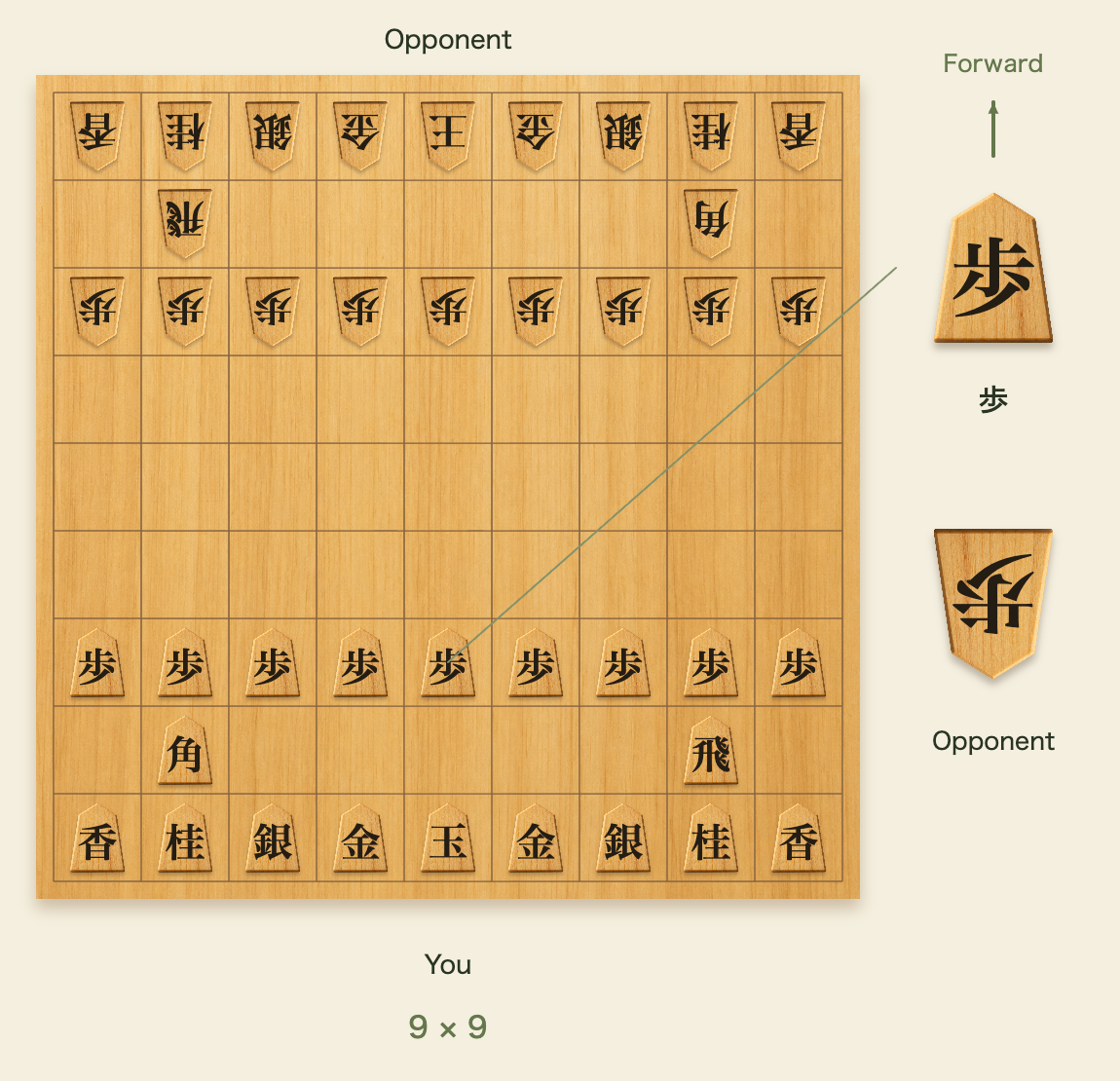
- Shogi is played on a nine-by-nine grid with twenty five-sided pieces a side; only the direction a piece points shows whose it is.
- A captured piece goes into your hand and can later be dropped onto any empty square as your own.
- Because of drops, professional games are rarely drawn; most end with one player resigning.
- The oldest shogi pieces found in Japan came from Kōfuku-ji in Nara, alongside a wooden tablet dated 1058.
- In 2023 Fujii Sōta took the Ōza title and became the first player to hold all eight major titles at once.
Shogi is Japan’s version of chess, a cousin of the Western game and of Chinese xiangqi that grew up on a nine-by-nine board with flat, wedge-shaped wooden pieces. One rule sets it apart from every other chess in the world: a piece you capture becomes yours, and you can drop it back onto the board on any later turn. That single idea makes shogi fast, violent and almost impossible to draw, and it has kept the game at the center of Japanese intellectual life for four centuries. Today it fills newspaper columns, streams live for two days at a time, and has a national hero in Fujii Sōta, the young player who in 2023 held every major title at once. This guide explains how the game works, why the Japanese love it, and how a visitor can watch or play.
01The Board and the Pieces
A shogi board, or ban, is a grid of nine files and nine ranks, eighty-one squares in all. Pieces sit inside the squares, as in Western chess. A serious board is a solid block of kaya, a fragrant yellow wood from the Japanese nutmeg-yew, several inches thick and standing on four short legs carved to look like the fruit of the gardenia. The gardenia is kuchinashi in Japanese, a word that can also be heard as "no mouth," and players like to say the legs are a reminder that spectators must keep quiet. It is a later folk explanation, but anyone who has sat near a professional game understands it.
Each side has twenty pieces: one king, one rook, one bishop, two gold generals, two silver generals, two knights, two lances and nine pawns. The pieces are five-sided wooden tiles, pointed at one end, with the name brushed or carved on the face in Chinese characters. Both armies are the same color. What tells you whose piece is whose is the direction it points: your pieces point toward your opponent. Even the kings differ only in wording. One is written ōshō, "king general," and the other gyokushō, "jewel general," and by custom the senior or stronger player takes the ōshō.
The moves are easy to learn. The king steps one square in any direction. The rook moves any distance along ranks and files, and the bishop any distance diagonally, exactly as in Western chess. After that, shogi has its own vocabulary. The gold general moves one square in any direction except diagonally backward. The silver general moves one square forward or to any of the four diagonals, but cannot step sideways or straight back. The knight jumps only forward, two squares ahead and one to the side, and it can leap over other pieces. The lance shoots straight forward any distance. The pawn steps one square forward and, unlike its Western counterpart, also captures straight ahead.
- 1
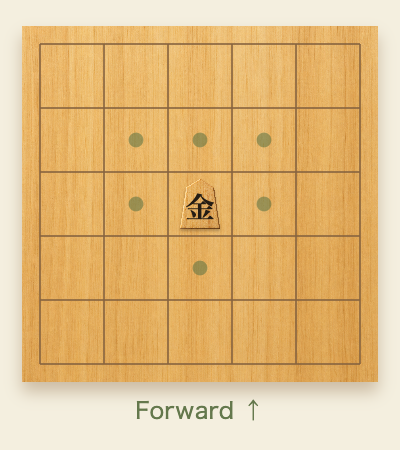 Gold general: one square in any direction except diagonally backward
- 2
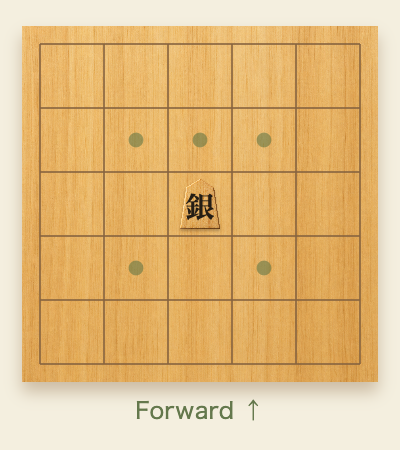 Silver general: one square forward or to any of the four diagonals, never sideways or straight back
- 3
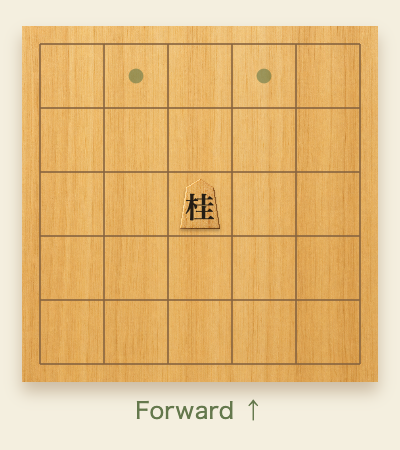 Knight: jumps only forward, two squares ahead and one to the side, over any piece
- 4
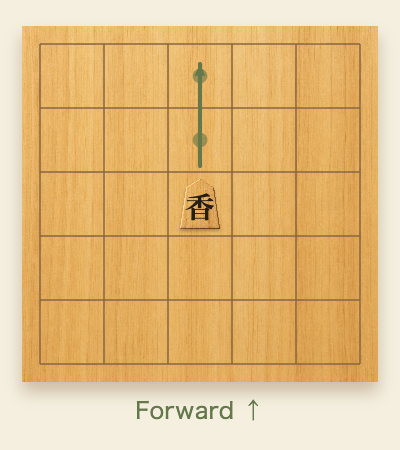 Lance: straight forward any distance
- 5
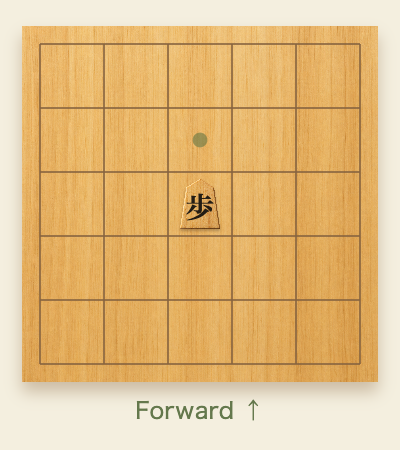 Pawn: one square forward, and it captures straight ahead too
Most of these smaller pieces can only go forward. A knight that jumps too deep into enemy territory has no way home, and Japanese players have a proverb for it: the high-flying knight becomes the pawn’s dinner. Shogi armies advance as slow, interlocking walls, and the art of the opening lies largely in arranging them.
02Turning Pieces Over: Promotion
The three ranks farthest from you form the promotion zone. When a piece enters, moves within, or leaves that zone, you may choose to promote it, and you do so by simply turning it over. The back of each piece carries its promoted identity.
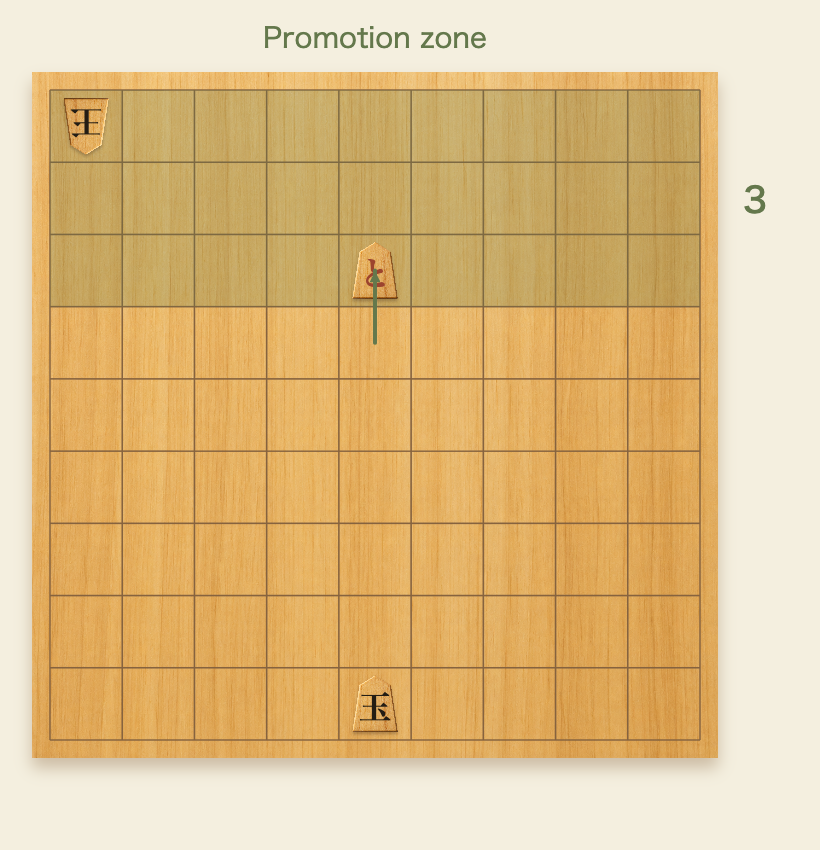
The three ranks farthest from you form the promotion zone
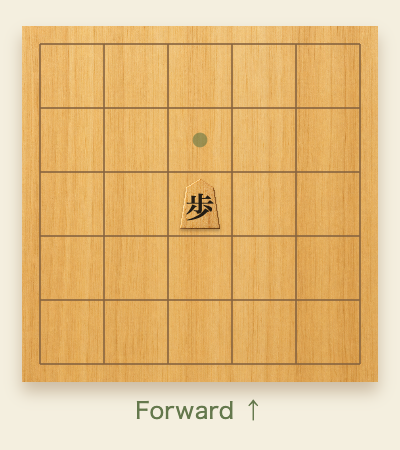
Before promotion: the pawn steps one square forward
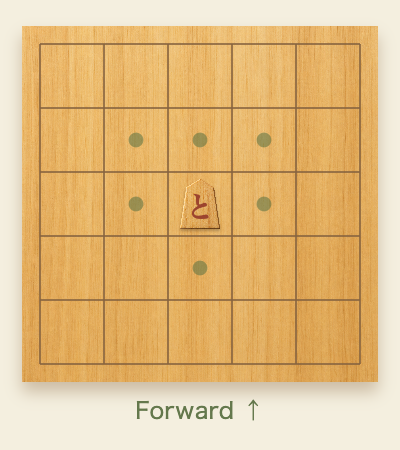
Turned over, it becomes a tokin and moves like a gold general
A promoted rook becomes a dragon king, keeping its long straight moves and adding a single diagonal step. A promoted bishop becomes a dragon horse, adding a single orthogonal step. The silver, knight, lance and pawn all promote into pieces that move exactly like a gold general. The gold general and the king never promote, and their backs are blank.
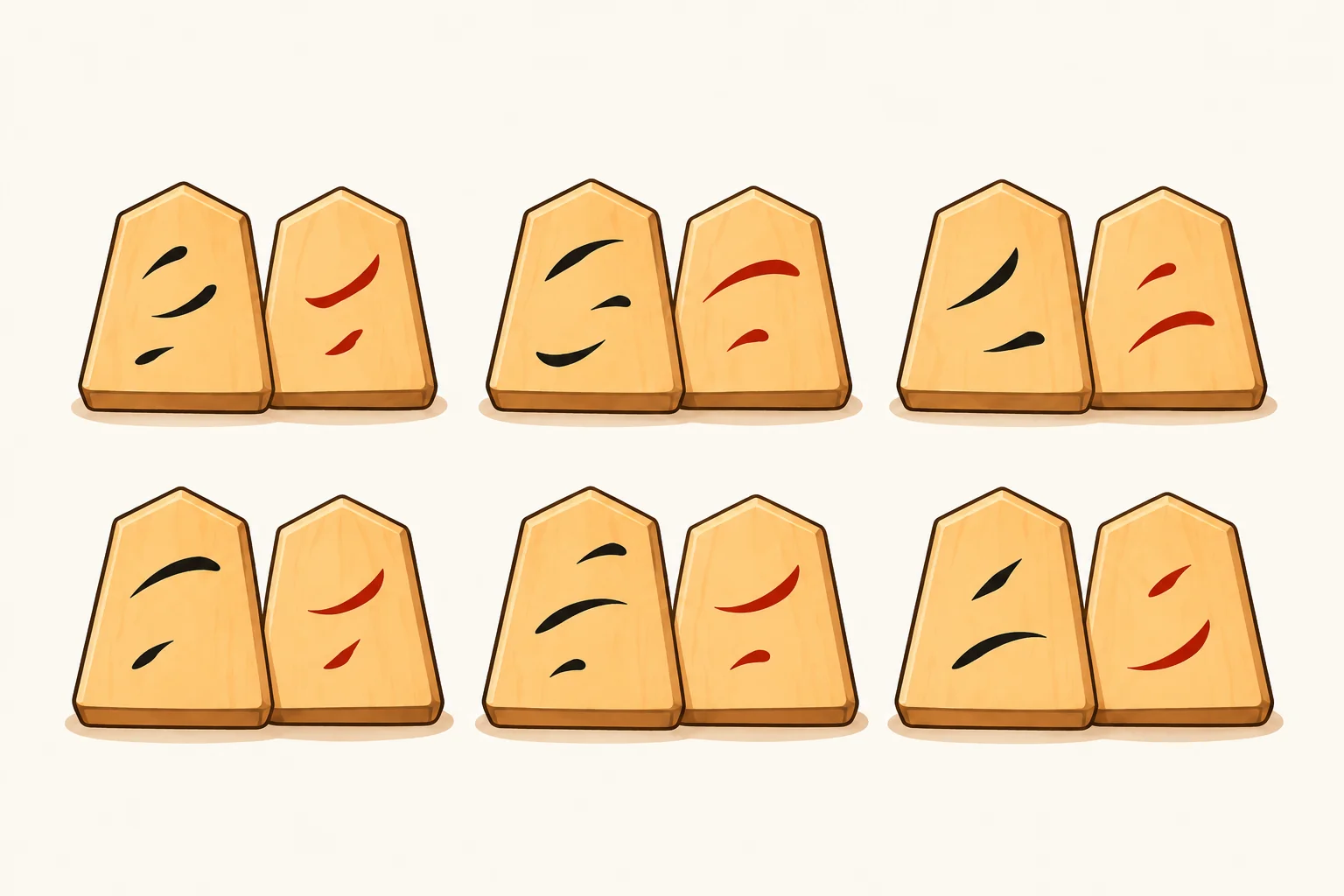
Six shogi pieces shown front and back, the reverse marking each promoted form.
The writing on the reverse rewards a closer look. The promoted pawn is marked with a symbol that looks like the hiragana と, and the piece is called tokin, and the mark is usually explained as a heavily abbreviated cursive form of the character for gold, though some argue it comes from a cursive 今, once used as a stand-in for 金. The silver, knight and lance also carry the character for gold on their backs, each in a different cursive style, so an experienced eye can tell what a promoted piece used to be. The promoted side is usually written in red, so a flipped piece stands out at once.
Promotion is optional, and sometimes declining is the better move: a silver that promotes loses its ability to retreat diagonally. But a pawn or lance that reaches the last rank, or a knight that reaches either of the last two, must promote, since otherwise it would be stuck forever with no legal move.
03The Drop
Here is where shogi leaves the rest of the chess family behind. When you capture an enemy piece, you do not set it aside for good. You place it on a small stand beside the board, where it becomes a piece in hand, or mochigoma. On any later turn, instead of moving a piece on the board, you may take one from your hand and set it down on any empty square, now facing the other way and fighting for you. This is called a drop, uchi. Dropped pieces always enter unpromoted: a captured dragon king goes back on the board as a plain rook.
- 1
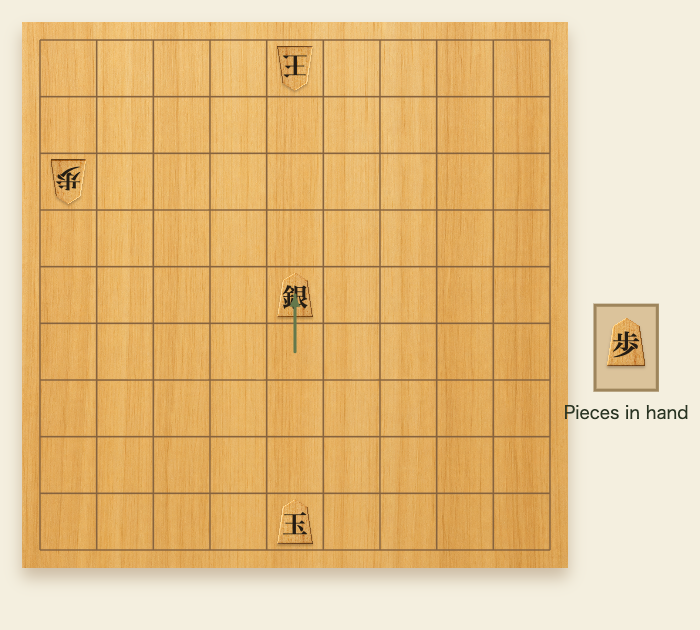 The silver captures an enemy pawn, which goes onto the stand as a piece in hand
- 2
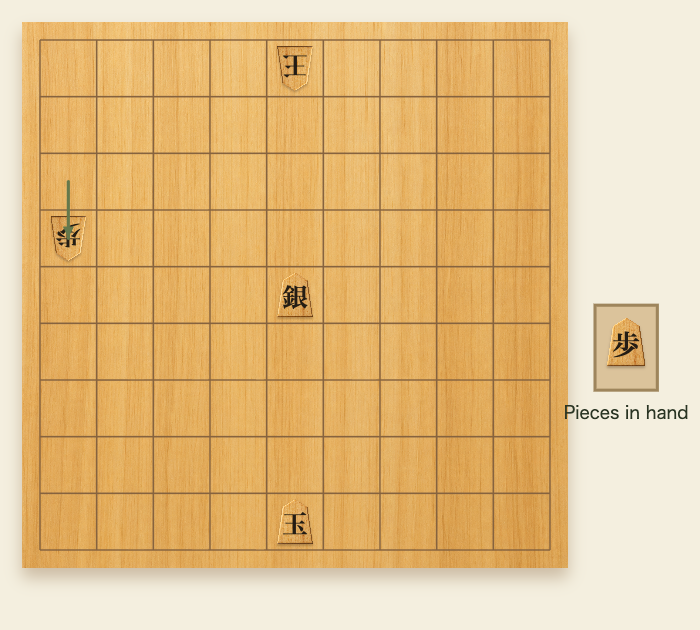 That move is over, and the opponent plays
- 3
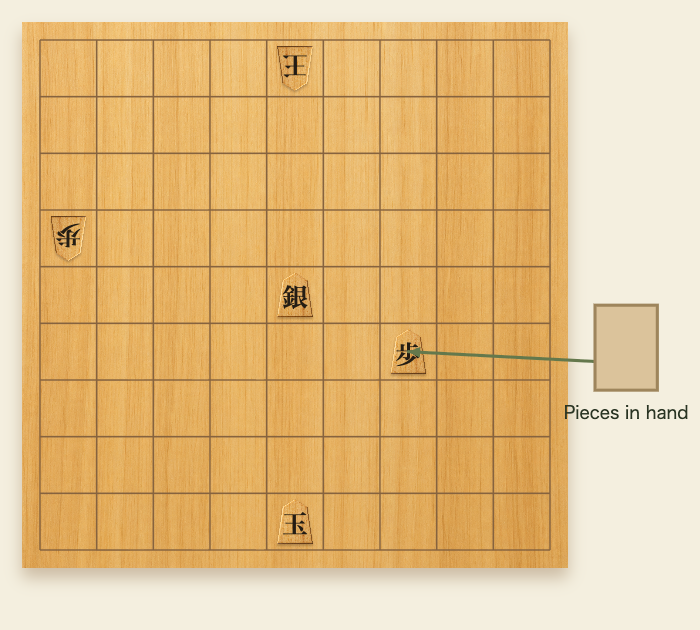 On your next turn you drop the pawn onto an empty square, now pointing the other way
The drop is possible precisely because the armies share a color. Turning a captured piece around is all it takes to change its allegiance, a fact that has inspired endless comparisons with the samurai era, when defeated retainers could serve a new lord. Whatever the truth of that image, the effect on play is dramatic. In Western chess, material drains away as the game goes on, and endgames often peter out into draws. In shogi, captured material never leaves the fight. The later the game, the more pieces both players are holding, and the sharper the attacks become. A king is never really safe, because a single gold general in the opponent’s hand can appear next to it out of nowhere. Draws are rare at the professional level, and most games end with one player resigning in the face of an unstoppable mating attack.
Three restrictions keep drops from becoming absurd. You may not drop a pawn onto a file where you already have an unpromoted pawn, a foul called nifu, "two pawns," which even professionals occasionally commit, losing the game on the spot. You may not deliver checkmate by dropping a pawn, though a pawn that walks forward to give mate is fine. And you may not drop a piece where it could never move again, such as a pawn or lance on the last rank.
Nobody knows exactly when the drop rule appeared. Most historians place its emergence somewhere between the thirteenth and sixteenth centuries, while the game was still evolving, and it was in place by the time the modern set of forty pieces on a nine-by-nine board settled into its final form in the fifteenth or sixteenth century.
04From Temple Trash to the Shogun’s Castle
Shogi descends, like all chess, from the Indian game chaturanga. How it reached Japan is still debated. Some scholars favor a route through China; others point to Southeast Asia, noting that Thai makruk also places its pawns on the third rank and has a piece that moves much like the shogi silver.
The oldest shogi pieces found in Japan came out of the ground at Kōfuku-ji, the great temple in Nara, in 1993. Lying with them was a wooden tablet dated 1058. The pieces are already five-sided and inscribed with names such as jewel general, gold general and pawn, and they look remarkably like the ones sold today. The Nichūreki, an encyclopedia compiled in the early Kamakura period from Heian-era sources, describes a small shogi with only six kinds of piece and no rooks or bishops (the text gives no board size, though one view holds the board was smaller than today’s), as well as a "large shogi" with more. Over the following centuries Japan produced a whole family of oversized variants, some with boards of fifteen squares or more, the largest thirty-six squares across, and well over a hundred pieces. Chū shōgi, "middle shogi," was especially popular in the Muromachi period and still has a small following. The version that won out, hon shōgi, added the rook, the bishop and the drop.
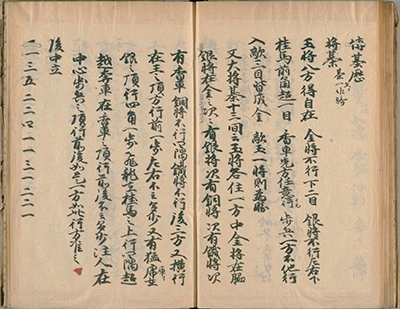
A page of the Nichūreki, which records a small shogi and a large shogiNational Diet Library, Nichūreki, vol. 13 (compiled early Kamakura period)
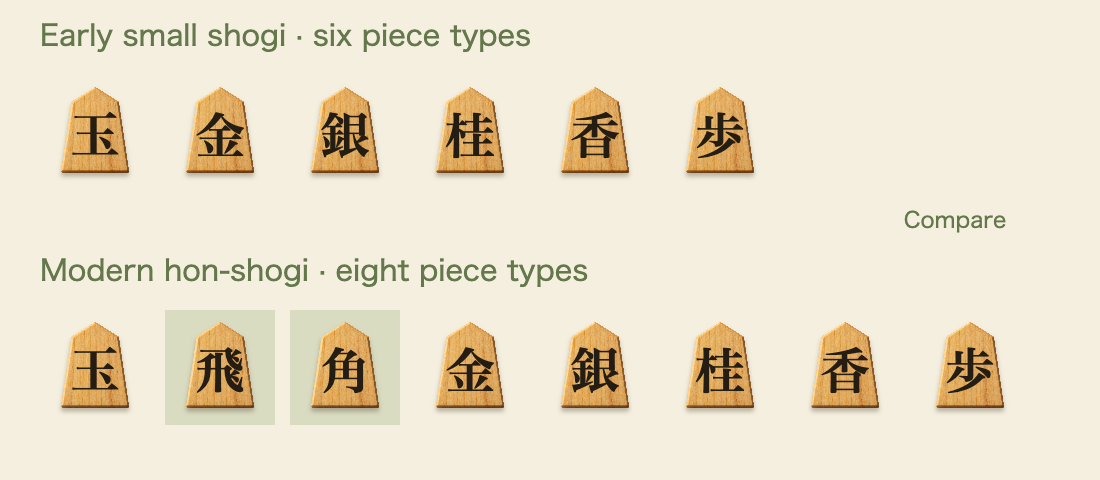
Heian shogi had six kinds of piece; modern shogi adds the rook and bishop, for eight.
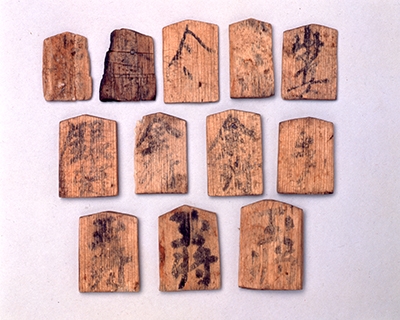
Wooden shogi pieces excavated at the former Kōfuku-ji grounds, already pentagonal; a tablet found with them is dated 1058.
In the Edo period, shogi became an officially sponsored art. The first Ōhashi Sōkei won the favor of Tokugawa Ieyasu and received a stipend, and three families, the main Ōhashi house, a branch Ōhashi house and the Itō house, handed down the title of meijin, "master," among themselves. From 1716, each year on the seventeenth day of the eleventh lunar month, leading players performed games before the shogun at Edo Castle. That date survives today as Shogi Day, November 17.
After the Meiji Restoration ended the shogunate’s stipends, players found a new patron in the press. Newspapers paid to publish games, and newspapers still sponsor nearly every major tournament. The hereditary line of meijin had died out in 1893, and the title then passed for life; in 1935 the thirteenth meijin, Sekine Kinjirō, stepped down, and the title was opened to competition. Kimura Yoshio became the first meijin by merit in 1937. The Japan Shogi Association, founded in 1924 and named in 1927, was briefly renamed during the war and took back its name in 1947; it has governed the professional game ever since. In Ōsaka, the self-taught Sakata Sankichi, a poor man who could barely read, became a legend for his unorthodox play against the Tokyo establishment, and his life was later turned into songs, plays and films, much of it embroidered.
05Tsume Shogi: Mating Puzzles
Tsume shōgi are shogi problems, the equivalent of chess compositions, but with stricter rules. You are given a position with the defending king and some pieces on the board, and a few pieces in the attacker’s hand. Playing the attacker, every move you make must be a check. The defender may use every piece not otherwise accounted for, and will always choose the reply that delays mate the longest. You must force mate in the minimum number of moves, and by the end all the pieces in your hand must have been used.
Those constraints turn the puzzle into pure logic. Three- and five-move problems are everyday exercise for beginners, printed in newspapers and sold in pocket books at station kiosks; professionals solve them to warm up before games. The pleasure usually lies in a first move that looks insane, a rook sacrificed or a gold dropped where it can simply be taken, until seven moves later it becomes clear that nothing else works.
Tsume shogi is also a form of composition, judged for elegance as much as difficulty. In the eighteenth century, the Itō family presented collections of a hundred problems each to the shogunate. Itō Sōkan’s Shōgi musō and his younger brother Itō Kanju’s Shōgi zukō are still regarded as the twin peaks of the art. The Zukō includes a problem called "Kotobuki," a mate in 611 moves in which the king is chased up and down the board. Modern composers have gone further still: "Microcosmos," published in 1986, runs to more than 1,500 moves.
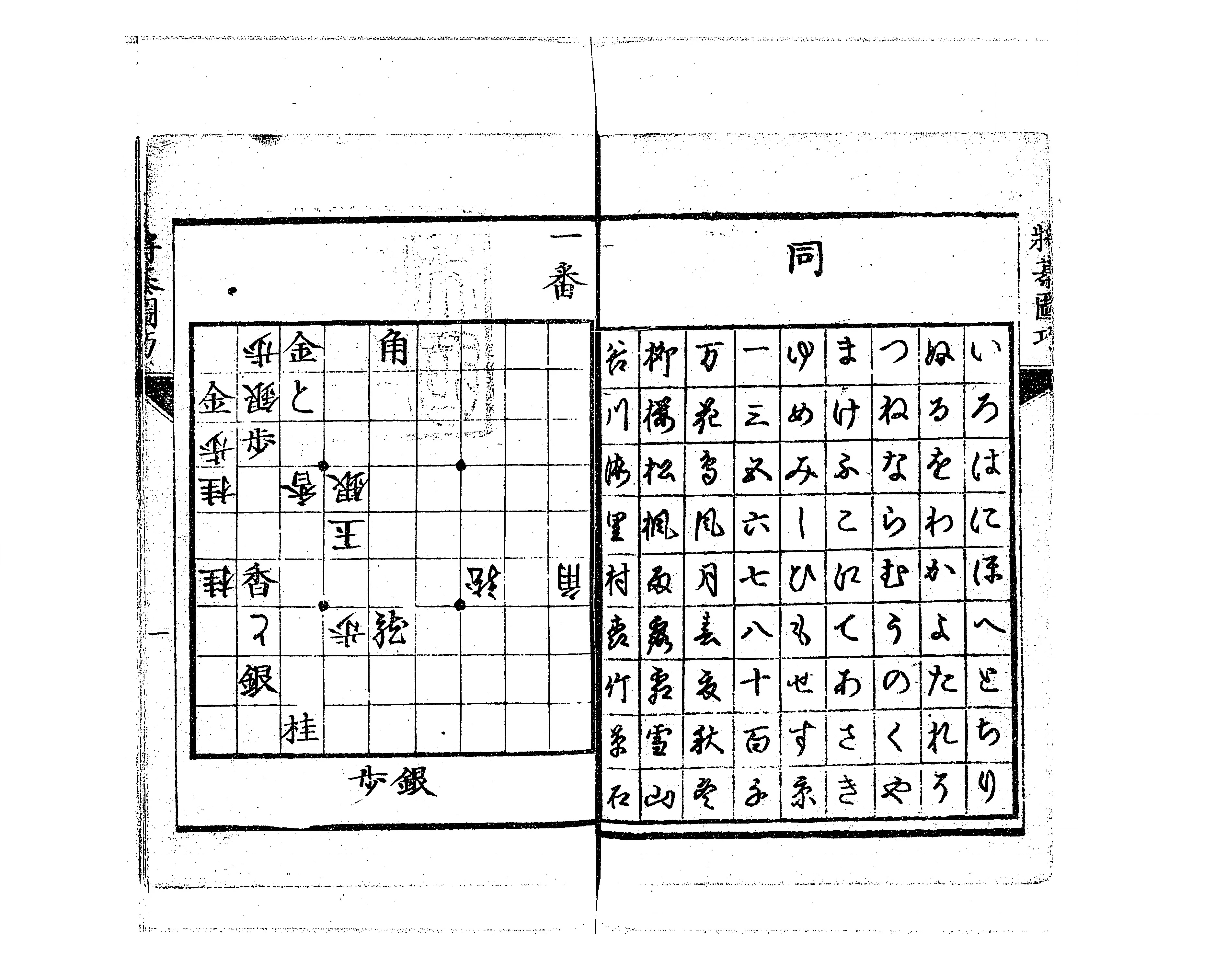
A printed page of Itō Kanju’s Shogi Zukō: problem no. 1 on the left, with the attacker’s pieces in hand below the boardNational Diet Library, Itō Kanju, Shōgi zukō (Bungyokuho edition, date unknown)
06The Professionals and Fujii Sōta
Becoming a professional shogi player in Japan is brutally hard. Candidates usually enter the Japan Shogi Association’s training league, the shōreikai, as children, and climb through the ranks to the third-dan league. Only the top two finishers in each half-year season are promoted to fourth dan and full professional status, and anyone who has not made it by the age of twenty-six is, with narrow exceptions, out. As of 2026, around 170 active professionals play, alongside a separate circuit of women professionals.
The professional year revolves around eight major titles: Ryūō, Meijin, Ōi, Ōza, Kiō, Ōshō, Kisei and Eiō. The Meijin match is the oldest and grandest, a best-of-seven series in which each game lasts two days and each player has nine hours on the clock. At the end of the first day the player whose turn it is writes the next move on a slip of paper and seals it in an envelope, to be opened the next morning. Title games are often held in hot-spring inns and temples, and the media report what each player ordered for lunch and afternoon snacks, a minor genre fans call shōgi meshi, "shogi meals."
The great names of the postwar era form a line: Ōyama Yasuharu, Nakahara Makoto, Tanigawa Kōji. In 1996 Habu Yoshiharu held all seven titles that then existed, a feat that made the evening news. In 2016 Fujii Sōta turned professional at fourteen years and two months, the youngest ever, then won his first twenty-nine official games in a row, setting off a shogi boom across the country. In October 2023 he took the Ōza title and became the first player to hold all eight at once.
Computers have changed how the game is watched and studied. In 2017 the program Ponanza defeated the reigning Meijin, Satō Amahiko, and engines now sit at the heart of every professional’s preparation. Online broadcasts show an engine’s evaluation in the corner of the screen, so even viewers who cannot read the position can see which way the game is tilting. Far from killing interest in human play, this has made it easier to follow.
07Watching and Playing in Japan
The easiest way to watch is online. During title matches, sponsoring newspapers and streaming services broadcast the whole game with commentary from professionals, and the swings in the engine evaluation carry the drama even for beginners. For something live, look for an ōban kaisetsukai, a public commentary session held near a title match, where a professional explains the game on a large hanging board, often with quizzes and prize drawings.
Sendagaya in Tokyo is shogi’s home ground, where the Japan Shogi Association’s headquarters stand. Its dojo is open to the public: tell the staff your strength, and you will be matched with other guests. The Kansai Shogi Hall, which moved to Takatsuki in Ōsaka Prefecture in 2024, offers the same. Many cities also have private shogi clubs and shogi cafés, and beginners are often taught first with simplified games using only the nine pawns on each side.
For a set worth taking home, the place is Tendō in Yamagata Prefecture, which has made shogi pieces since the Edo period and today produces the great majority of Japan’s sets. Fine pieces are cut from boxwood, with characters carved, carved and filled with lacquer, or, in the most prized moriage style, built up in raised lacquer; a set by a master craftsman can cost hundreds of thousands of yen. In April, when the cherry trees bloom, Tendō stages ningen shōgi (still held as of 2026), "human shogi," in which people in samurai and court costume stand on a giant board as living pieces while two professionals direct the game.
If you sit down to play with Japanese opponents, a few customs help. Players bow at the start and end, saying onegaishimasu before and arigatō gozaimashita after. The loser resigns aloud, with makemashita, "I have lost," rather than playing on until mated; resigning at the right moment is considered a courtesy to the opponent and to the game. Pieces are held between the index and middle fingers and set down with a crisp click, the defining sound of a shogi room. There are no take-backs: once your hand leaves a piece, the move is made. Many players also hold that a piece you touch is a piece you must move, though this is a matter of etiquette rather than a rule of official play.