
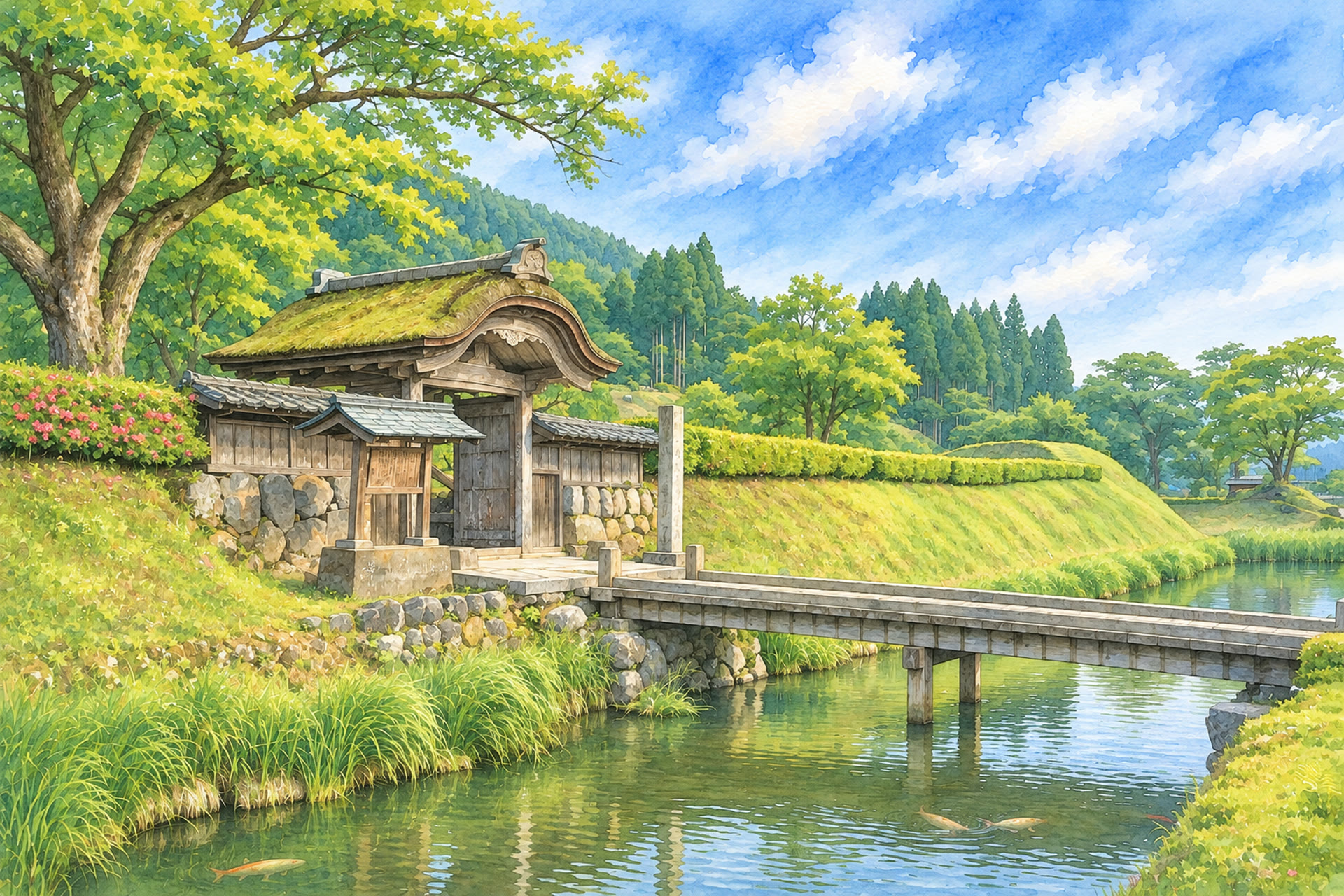
The Ichijōdani Asakura Ruins lie in a narrow valley in the southeastern part of Fukui City, Fukui Prefecture. For about a century this was the seat of the Asakura, a warrior house that ruled Echizen Province through five generations in the Sengoku (Warring States) period. When Oda Nobunaga destroyed the family in 1573, the town was burned and later turned into rice fields, which kept its foundations sealed underground for some four hundred years. Excavated since the 1960s, it is now one of the best places in Japan to see what a sixteenth-century castle town actually looked like.
01A Town Inside a Valley
The Asakura began as retainers of the Shiba, the military governors (shugo) of Echizen. During the Ōnin War, Asakura Takakage switched to the Eastern Army and took effective control of the province. By the usual account he made Ichijōdani his base around 1471, though some argue that the family had a foothold here earlier. The house passed from Takakage through Ujikage, Sadakage and a second Takakage to Yoshikage. Earthen ramparts with gates, called kido, closed the valley at its upper and lower ends. In the roughly 1.7 kilometers between them stood the Asakura residence, the houses of retainers, temples and merchants’ and artisans’ dwellings, while a mountain fortress crowned the ridge to the east. Courtiers, scholars and poets who left Kyoto during and after the Ōnin War found patronage here, and the town was sometimes called a "Kyoto of the north."
02Prosperity and Destruction
In 1566 the fugitive Ashikaga Yoshiaki came to Echizen, moving late in 1567 to Anyō-ji, a temple just outside Ichijōdani’s upper gate. After almost two years under Yoshikage’s protection he turned to Oda Nobunaga, who escorted him into Kyoto in 1568. The Asakura then became Nobunaga’s enemies, allied with the Azai of northern Ōmi. Nobunaga invaded Echizen in 1570 but had to retreat from Kanegasaki when Azai Nagamasa turned against him. In the eighth month of 1573 Yoshikage marched to relieve the Azai at Odani Castle, was routed on the way back, and lost Ichijōdani to fire. He fled to Ōno, where his cousin Asakura Kageakira betrayed him, and he took his own life. Under Shibata Katsuie the provincial center moved to Kitanoshō, today’s central Fukui, and the valley became farmland.
03What You Can See Today
Systematic excavation began in 1967, and in 1971 about 278 hectares were designated a Special Historic Site. Four gardens, at the sites of the Yoshikage residence, the Yudono, the Suwa residence and Nan’yō-ji, became a Special Place of Scenic Beauty in 1991, and 2,343 excavated objects were designated Important Cultural Properties in 2007. At the Yoshikage residence site you see ramparts, moats, foundation stones and garden rocks; the Karamon gate in front was built in the Edo period in Yoshikage’s memory and is not from Asakura times. Along one street, about 200 meters of samurai houses and townhouses have been rebuilt on the excavated foundations. These are reconstructions, not survivals. The Fukui Prefectural Ichijōdani Asakura Family Site Museum, opened in 2022 near the lower gate, displays the finds and recreates part of the Yoshikage residence at full scale.
Ichijōdani Asakura Ruins
01A Town That Stopped
In the eighth month of 1573, troops of Oda Nobunaga marched into the valley of Ichijōdani in Echizen Province, today’s Fukui Prefecture, and set it on fire. Later accounts say the town burned for three days and nights. Before the fires had died down, Asakura Yoshikage, the fifth and last Asakura lord to rule from the valley, took his own life at a temple in the mountains to the east. A family that had governed Echizen for about a century was gone.
Most destroyed towns are rebuilt on the same spot, and each new layer erases the old one. Ichijōdani was not. The new rulers of Echizen built their headquarters on the open plain downstream, where the city of Fukui stands now, and the valley went back to farming. The burned houses were covered with soil and turned into rice paddies. Foundation stones, stone walls, wells, drains, garden rocks and a great mass of broken pottery, lacquerware and wood stayed in place under the fields for some four hundred years.
When systematic excavation began in the late 1960s, it uncovered not a castle but an entire town: streets, residences, workshops and temples, laid out more or less as they were on the day the fire came. Visitors sometimes hear it called "Japan’s Pompeii." The comparison is loose, since Pompeii was sealed in an instant by volcanic ash and Ichijōdani was burned and then slowly buried by farming, but the point holds: what survives here is a town that was cut off in the middle of its life, not one that was rebuilt again and again.
02Who the Asakura Were
According to their own tradition the Asakura took their name from Asakura in Tajima Province, in what is now northern Hyōgo. In the fourteenth century, during the Nanboku-chō wars between rival imperial courts, Asakura Hirokage followed Shiba Takatsune, a kinsman of the Ashikaga shoguns, into Echizen. From then on the Asakura served the Shiba family as senior retainers.
The Shiba were among the grandest houses of the Muromachi shogunate. They served as shogunal deputies (kanrei) in Kyoto and held the post of military governor, or shugo, for several provinces, including Echizen. Like most great shugo, they lived mainly in the capital and left the running of their provinces to deputies and local retainers. That arrangement gave families like the Asakura room to grow.
When the Asakura first settled at Ichijōdani is less certain than is often said. The traditional date of around 1471 comes from a later war chronicle. Asakura family records claim the valley was already theirs in the fourteenth century, and some historians argue from documents and excavation that the family had a foothold there by the early fifteenth century at the latest, and only later developed it into a provincial capital. Either way, the town’s great period ran from the late fifteenth century to the mid-sixteenth.
03Takakage and the Ōnin War
The man who turned the Asakura from retainers into rulers was Asakura Takakage, often called Eirin Takakage after his Buddhist name, to distinguish him from a great-grandson of the same name.
When the Ōnin War broke out in Kyoto in 1467, the Shiba house was itself split between two claimants, Shiba Yoshikado and Shiba Yoshitoshi. Takakage backed Yoshikado and fought for the Western Army of Yamana Sōzen, winning a name as a ferocious commander in the street battles of the capital. In 1471 he changed sides and joined the Eastern Army of Hosokawa Katsumoto. The usual explanation is that he was offered recognition as governor of Echizen. He returned to the province and spent the following years fighting rival claimants and the Kai family, the Shiba deputies there. By the time of his death in 1481, Echizen was essentially in Asakura hands.
Courtiers in Kyoto wrote of the defection with distaste. From the Asakura point of view it was the move that won them a province, and from then on they behaved as Sengoku daimyo, whatever titles they formally held.
A set of house rules attributed to Takakage, known as the Asakura Takakage jōjō or the "wall writings" of Eirin, survives in later copies, most of them in seventeen articles. Its best-known article tells the leading vassals not to build castles of their own in the province, but to move to Ichijōdani and leave stewards in charge of their lands. Historians debate how much of the text comes from Takakage himself; one view holds that Asakura Sōteki compiled it in the early sixteenth century. The policy it describes, though, matches what the excavations show: a valley packed with the residences of retainers clustered around their lord.
04Five Generations
From Takakage the house passed to Ujikage, then Sadakage, then a second Takakage (known by his Buddhist name Sōjun), and finally to Yoshikage. For most of that century Echizen was comparatively stable, and Asakura rule was one of the longer-lasting regimes of the period.
The chief external threat came from the north. In 1488 followers of the Ikkō (True Pure Land) sect in neighboring Kaga overthrew their governor, Togashi Masachika, and for almost a hundred years Kaga was run by the sect’s leagues, a situation described as "a province held by commoners." Echizen had many temples and believers of the same sect, and fighting between the Asakura and the Ikkō leagues flared on and off for decades. In 1506 a large Ikkō force crossed into Echizen and was driven back along the Kuzuryū River. The Asakura commander was Asakura Sōteki, a son of Eirin Takakage, who remained the family’s leading general for half a century until he fell ill on campaign in Kaga and died in 1555.
The Asakura also took part in conflicts in Ōmi, Wakasa and Mino, and at times sent troops to Kyoto at the shogun’s request. The fourth lord had close ties with the shogunate and was granted honors normally reserved for the oldest governor houses. Yoshikage’s own name is generally thought to contain a character granted by the shogun Ashikaga Yoshiteru. For a family of retainer origins, a link with the shogunal order in Kyoto clearly mattered.
05A Northern Capital of Culture
The Ōnin War left Kyoto a battlefield for years, and many courtiers, monks, scholars and poets went to the provinces in search of patrons. Ichijōdani was one of the places they went.
The great linked-verse (renga) master Sōgi visited Echizen and was in contact with the Asakura. The Confucian scholar Kiyohara Nobukata spent his last years in the valley and died there in 1550. Tanino Ippaku, a physician invited to the valley by the fourth Asakura lord, is recorded as having edited and printed a Ming Chinese commentary on the medical classic Nanjing (Classic of Difficult Issues) at Ichijōdani in 1536. It was the first book printed in Echizen and one of the earliest medical books printed in Japan. Poetry, tea, flower arrangement and Noh all had followers among the Asakura and their circle, and tea wares and incense burners turn up in the excavations.
In the third month of 1568 Yoshikage held a cherry-blossom poetry gathering at the temple of Nan’yō-ji for his guest, Ashikaga Yoshiaki. It is often taken as the image of Ichijōdani at its height. The temple’s garden still survives and is one of the four designated gardens in the valley.
Phrases such as "Kyoto of the north" are mostly later descriptions rather than names people used at the time. Still, the layout of the lord’s residence, the style of the gardens and the range of everyday goods all show how much of Kyoto’s culture had been carried up into this valley.
06Inside the Gates
To understand Ichijōdani, start with the ground. The Ichijōdani River flows northwest through a narrow valley and joins the Asuwa River at its mouth. The slopes on both sides are steep, and the flat floor is at most a few hundred meters wide. The Asakura closed the valley with two massive earthen ramparts, each with a gate: the Shimo-kido, or lower gate, near the river mouth, and the Kami-kido, or upper gate, farther up. The stretch between them, about 1.7 kilometers long, was called the Kido-no-uchi, "inside the gates," and formed the heart of the town.
On the east side, the Asakura residence stood with its back to the hills, facing the river and the main road. Around it were the houses of the lord’s relatives and senior vassals, and beyond them the homes of ordinary samurai, temples and the houses of merchants and craftsmen. Excavation shows regular streets, house plots lined up along them and divided by earthen walls or stone, and orderly drains and wells. This was a planned town, not a village that happened to grow.
Houses and temples spread outside the gates too, so the town was larger than the Kido-no-uchi alone. On the mountain to the east, a little over 470 meters high, stood a fortress of earthworks meant for last-ditch defense. In peacetime the lord lived in the residence at the foot of the mountain; the mountain castle was for war. This pairing of a lowland residence and a hilltop refuge was typical of the age.
Estimates of the population at its peak run to around ten thousand, and some go higher. They are based on the number of house plots; no census survives.
07Everyday Life in the Ground
What makes Ichijōdani special is how much of ordinary life has come out of the soil.
The finds run to well over a million pieces. Most are ceramics: large storage jars and grinding bowls made locally in Echizen ware, pottery from Seto and Mino, celadon, white porcelain and blue-and-white from China, and wares from Korea. Imported pieces appear not only in the lord’s residence and the houses of high retainers but also in ordinary townhouses, a sign of a well-developed trade network.
The townhouse sites show traces of particular trades. Some have rows of large jars sunk into the floor, usually explained as dyeing, brewing or oil-storage workshops. One produced half-finished Buddhist rosary beads and the tools to make them. Others show casting, lacquer work and woodworking. Samurai houses have yielded go stones, shogi pieces, inkstones, tea utensils, incense burners, cosmetics and toys. Among the shogi pieces is one marked suizō, "drunken elephant," a piece no longer used in modern shogi, which makes the finds important for the history of the game.
Excavators also found latrines. By studying parasite eggs and seeds in the soil they can say something about what people ate. Wells, stone-lined drains and rubbish pits make it plain that this was a place where people lived, not only a place where a war ended.
08A Shogun-in-Waiting
In 1565 the shogun Ashikaga Yoshiteru was killed in Kyoto by partisans of the Miyoshi. His younger brother Kakukei, a monk at Kōfuku-ji in Nara who would later be known as Ashikaga Yoshiaki, escaped and wandered through Ōmi and Wakasa before arriving in Echizen in the ninth month of 1566 to seek Yoshikage’s help. He spent more than a year at Tsuruga and only in the eleventh month of 1567 moved to Ichijōdani, where he lodged at a temple called Anyō-ji just outside the upper gate and was entertained by the Asakura. In the fourth month of 1568 he held his coming-of-age ceremony at the Asakura residence and took the name Yoshiaki.
Yoshiaki wanted Yoshikage to march on Kyoto and install him as shogun. Yoshikage held back. The Ikkō leagues in Kaga were still a threat, and Echizen itself was not entirely secure. It is often said that the death of Yoshikage’s young heir in 1568 left him grief-stricken and unwilling to act, but this explanation comes mainly from later accounts.
In the seventh month of 1568 Yoshiaki left Echizen for Mino to join Oda Nobunaga. Akechi Mitsuhide, who moved between the Asakura and Yoshiaki’s circle at the time, is generally thought to have helped arrange the move. Mitsuhide is said to have lived in Echizen for some years before this, though the details of his life there are poorly documented. In the ninth month Nobunaga escorted Yoshiaki into Kyoto, and Yoshiaki became the fifteenth Ashikaga shogun.
For almost two years the future shogun had lived in Asakura territory, about nine months of it in the valley itself. The Asakura did not use the opportunity. Nobunaga did.
09Against Nobunaga
Once Yoshiaki was installed, Nobunaga summoned the provincial lords to Kyoto. Yoshikage did not come. In the fourth month of 1570 Nobunaga used this as grounds to invade Echizen. Advancing from Wakasa into Tsuruga, he took the castles of Tezutsuyama and Kanegasaki. As he prepared to cross the Kinome Pass toward Ichijōdani, word came that Azai Nagamasa of northern Ōmi, his brother-in-law through his sister Oichi, had turned against him and sided with the Asakura, old allies of the Azai. Caught between two enemies, Nobunaga fell back hurriedly to Kyoto. This was the Kanegasaki retreat, also covered in the entry on Kanegasaki Castle and Fujishima Shrine.
Two months later, in the sixth month of 1570, the Oda and Tokugawa armies defeated the combined Azai and Asakura forces at the Ane River in Ōmi. For the next few years the Asakura and Azai acted in concert with Hongan-ji, the monks of Enryaku-ji on Mount Hiei and Takeda Shingen against Nobunaga, and Asakura armies repeatedly camped in Ōmi. One reason Nobunaga burned Enryaku-ji in 1571 was that its monks had sheltered Azai and Asakura troops.
In 1573 the balance shifted quickly. Takeda Shingen died during his campaign westward, and Yoshiaki’s armed rising against Nobunaga failed, leaving him driven out of Kyoto. In the eighth month Nobunaga’s army besieged the Azai at Odani Castle. Yoshikage came south to relieve them and took up positions in northern Ōmi, but could not break the siege and withdrew by night. Nobunaga led the pursuit himself and caught the Asakura army near Tonezaka, on the border of Ōmi and Echizen. The Asakura were routed and many senior vassals were killed.
Yoshikage reached Ichijōdani with only a small following. He abandoned the town and withdrew east to Ōno District to join his cousin Asakura Kageakira. Oda troops entered the valley and burned it. Kageakira, however, had already gone over to Nobunaga, and he surrounded the temple of Kenshō-ji where Yoshikage was sheltering. On the twentieth day of the eighth month of Tenshō 1 (September 16, 1573, in the Julian calendar), Yoshikage killed himself. He was 39, or 41 in the traditional East Asian count.
His head was sent to Nobunaga. According to the Shinchō kōki, the chronicle of Nobunaga’s life by his retainer Ōta Gyūichi, at a New Year banquet in Gifu in 1574 Nobunaga displayed the lacquered and gilded heads of Yoshikage, Azai Hisamasa and Azai Nagamasa. The later story that he drank from the skulls is not in the chronicle and is generally treated as embellishment. Nobunaga turned back to take Odani Castle, where Azai Hisamasa and then Nagamasa took their own lives, Nagamasa by the usual account on the first day of the ninth month.
10The Valley Goes to Sleep
Nobunaga first left Echizen in the hands of former Asakura vassals who had surrendered, but in 1574 an Ikkō rising swept the province and killed his deputy. In 1575 Nobunaga returned and crushed the uprising with great brutality, then granted most of Echizen to Shibata Katsuie.
Katsuie did not rebuild Ichijōdani. He built Kitanoshō Castle on the plain by the Asuwa River downstream, where roads met and there was room for a large town. A narrow valley no longer suited the scale of warfare and government in the new age. Many of Ichijōdani’s temples and merchants are said to have moved to Kitanoshō, which was later renamed Fukui and became the castle town of the Fukui domain in the Edo period.
Ichijōdani became a farming village. On the site of the Asakura residence a small temple, Shōun-in, named after Yoshikage’s Buddhist name, was later established to pray for him, and his grave stands there. By the usual account villagers first built a small shrine on the spot in 1576, and in 1663 Matsudaira Mitsumichi, lord of Fukui domain, erected the grave marker. The Karamon, the ornamental gate in front of the residence site, is generally thought to have been built in the Edo period as the gate of Shōun-in in Yoshikage’s memory. A story that Toyotomi Hideyoshi donated it has no solid basis. Either way, it is not a survival from the Asakura era.
11Excavation and Protection
The residence site drew attention before the war. In 1930 the area around it, together with the Nan’yō-ji site, was designated a national Historic Site, and the gates and the mountain castle were added in 1964. The real turning point came with the start of systematic excavation in 1967. As streets and houses emerged from under the paddies, it became clear that a whole Sengoku town had survived.
In 1971 about 278 hectares were designated a Special Historic Site, the highest national category for historic sites. In 1991 four gardens, at the Asakura Yoshikage residence, the Yudono, the Suwa residence and Nan’yō-ji, were designated a Special Place of Scenic Beauty. In 2007, 2,343 excavated objects were designated Important Cultural Properties. Few places in Japan hold all three kinds of national designation. Excavation continues.
12Walking the Valley
Begin at the Shimo-kido, the lower gate. Its earthen ramparts are still tall, and the large stones of the gate passage show how entry into the town was controlled. The Fukui Prefectural Ichijōdani Asakura Family Site Museum, opened in 2022, stands nearby. It displays the finds, recreates part of Yoshikage’s residence at full scale, and shows excavated features preserved below the building. Seeing it first makes the fields in the valley much easier to read.
Walk south. On the west side of the river is the reconstructed street, about 200 meters of samurai houses and townhouses rebuilt on excavated foundations, roads and drains, with earthen walls, gates, wells and workshops. Keep in mind what is real here: the foundations are original, while the buildings above them are modern reconstructions based on research.
Across the river, on the east side, is the site of the Asakura Yoshikage residence. Moats and earthen ramparts enclose it on three sides, and it backs onto the hillside. Foundation stones remain in their original positions, showing the layout of the main hall, reception rooms and kitchens. A garden and the remains of a flower bed, thought to be the oldest known in Japan, are traces of Yoshikage’s household. The Karamon gate and Yoshikage’s grave are later memorials.
On the slope behind the residence are the Yudono garden and the Suwa residence garden. The rough, powerful rock arrangement of the Yudono garden is generally thought to be the oldest of the four. The Suwa garden is the largest, and tradition links it to the residence of Yoshikage’s consort Koshōshō. The Nan’yō-ji garden, on higher ground near the residence, is where the cherry-blossom gathering of 1568 took place.
Continue south to the Kami-kido, the upper gate, whose ramparts are also well preserved. Temple and townhouse sites continue beyond it, including the site of Anyō-ji, where Yoshiaki lodged. If you have the energy, climb Ichijō-jōyama, the castle mountain to the east. Its terraces and dry moats are still visible, and from above you can see how completely the hills enclosed the town and how the two gates sealed it.
From the paths between the fields, the valley looks like any quiet farming district. In the sixteenth century it held perhaps ten thousand people, poets and scholars from Kyoto, porcelain from China and, for two years, a future shogun. The fire of 1573 took away everything above ground; what lay beneath it has lasted until now.