
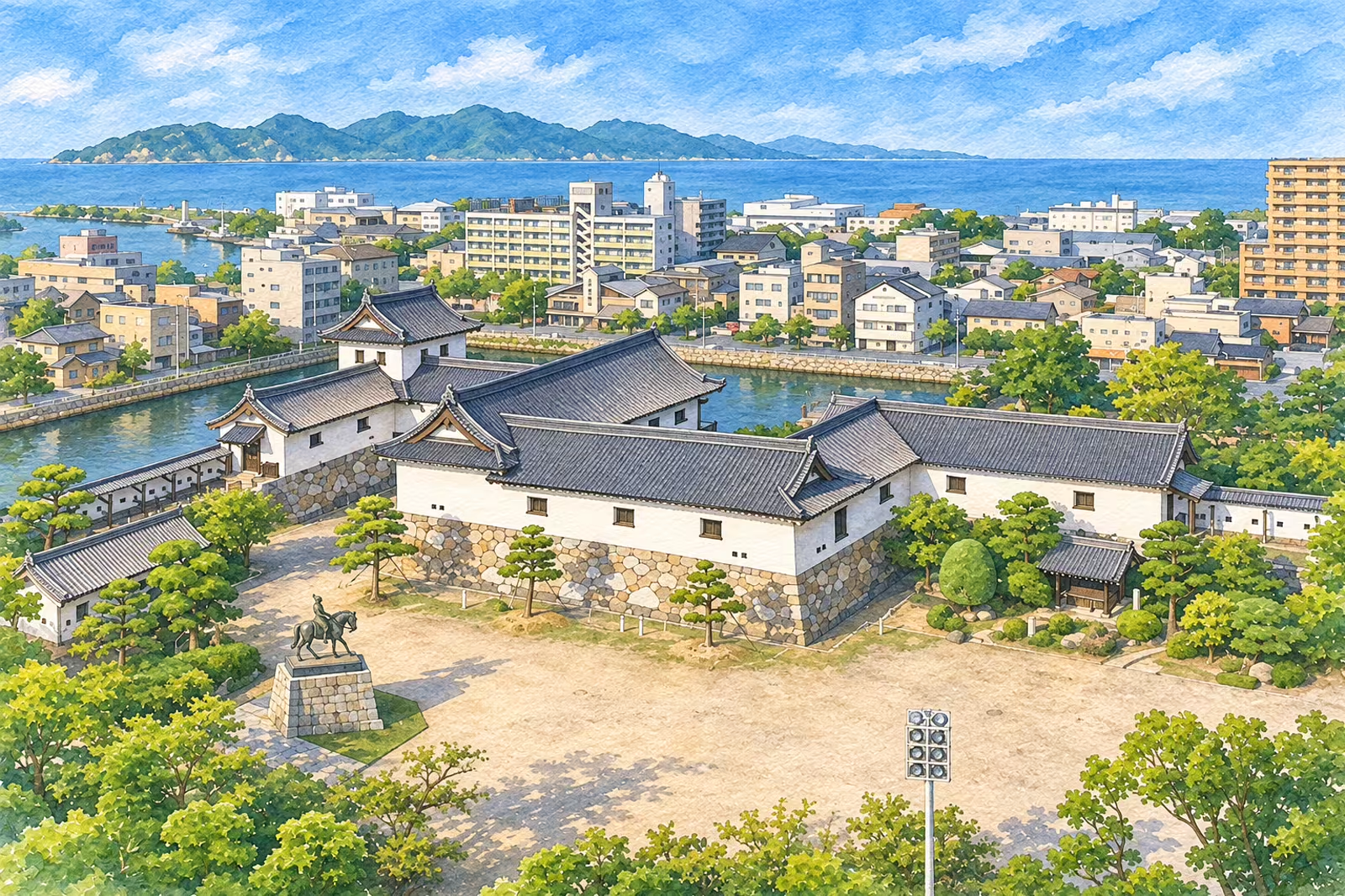
This entry covers two sites in Fukui Prefecture linked to the Southern Court commander Nitta Yoshisada: the ruins of Kanegasaki Castle in Tsuruga, and Fujishima Shrine together with the traditional site of Yoshisada’s death in Fukui City. Kanegasaki was the hilltop castle where Nitta forces held out with two imperial princes in 1336–1337 before it fell, and where Oda Nobunaga later carried out a famous retreat in 1570. Fujishima Shrine was founded in the early Meiji period to enshrine Yoshisada. Together the two sites tell of the Southern Court’s struggle in the Hokuriku region, its defeat and its later commemoration.
01Two Battles at Kanegasaki
Kanegasaki Castle stood on a small hill jutting into Tsuruga Bay on its eastern shore. It had the sea on three sides. In the winter of 1336, when Emperor Go-Daigo came to terms with Ashikaga Takauji, Nitta Yoshisada escorted Prince Tsuneyoshi and Prince Takanaga north to Echizen and occupied Kanegasaki. Ashikaga forces soon surrounded it by land and sea. When the defenders’ food ran out, the castle fell in the third month of 1337. Prince Takanaga and Yoshisada’s eldest son, Nitta Yoshiaki, took their own lives, while Prince Tsuneyoshi was captured, taken to Kyoto, and died soon afterward. Yoshisada had already broken out of the castle and escaped.
In the fourth month of 1570, Nobunaga invaded Echizen to attack the Asakura and took Tezutsuyama and Kanegasaki castles. News then arrived that his ally Azai Nagamasa had turned against him. Threatened from front and rear, Nobunaga hurried back to Kyoto, a withdrawal known as the Kanegasaki retreat. Later accounts say that Kinoshita Tōkichirō, the future Toyotomi Hideyoshi, stayed behind at Kanegasaki to command the rearguard, though the details of this story are debated.
02Yoshisada’s Death and Fujishima Shrine
In the intercalary seventh month of 1338, Yoshisada fought the army of Shiba Takatsune near Fujishima in Echizen and was killed by an arrow around Tōmyōji-nawate. In the early Edo period, according to tradition, a local farmer dug up a helmet in the area; the Fukui domain judged it to be Yoshisada’s and erected a memorial stone on the spot. In 1870 Fujishima Shrine was founded to enshrine Yoshisada. It was later moved twice and around 1901 settled at its present site on Mount Asuwa.
03What Can Be Seen Today
The Kanegasaki Castle Ruins are a National Historic Site, with the terrain of enclosures and dry moats preserved on the hill but no buildings. Kanegasakigū, a shrine at the foot of the hill founded in the Meiji period, enshrines the two princes. In Fukui City, the traditional site of Yoshisada’s death at Tōmyōji-nawate is also a National Historic Site and has an Edo-period memorial stone. Fujishima Shrine keeps the helmet attributed to Yoshisada, which is generally understood to be designated an Important Cultural Property.