
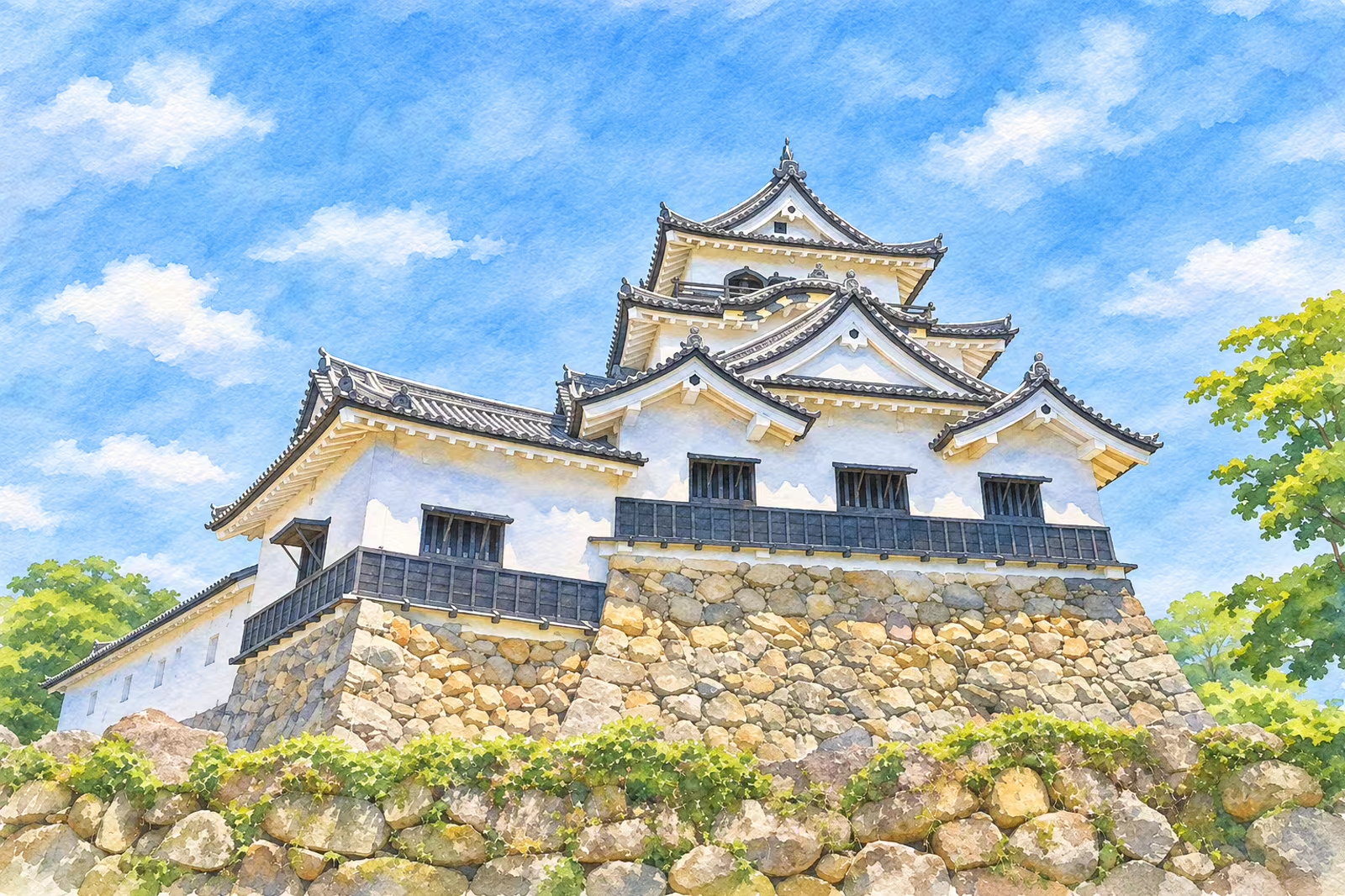
Hikone Castle was the seat of the Ii family, on a hill above the eastern shore of Lake Biwa in Hikone, Shiga Prefecture. It is one of twelve castles whose keeps survive from before the end of the Edo period, and its keep is a National Treasure. Below it stands Umoregi-no-ya, where Ii Naosuke, later the shogunate’s chief minister, spent fifteen years as a younger son with little hope of inheriting. Together they show a great daimyo house and one member who seemed fated to stay on its margins.
01The Ii and the building of the castle
After the Battle of Sekigahara in 1600, Tokugawa Ieyasu gave his general Ii Naomasa the domain of Sawayama in Ōmi, formerly Ishida Mitsunari’s stronghold. Naomasa died in 1602, and under his son Naotsugu (later Naokatsu) the shogunate approved a new castle on nearby Hikone Hill. Work began around 1603, with neighboring daimyo generally thought to have contributed labor. The keep was finished around 1606–1607; the full castle and town took until the early 1620s. From here the Ii guarded the roads to Kyoto and the shipping on Lake Biwa until domains were abolished in 1871.
The keep is small, three stories under three roofs, with gables of several shapes. Reused timbers found during Shōwa-era repairs support the long-held view that it was moved from Ōtsu Castle, a strong inference rather than settled fact.
02Umoregi-no-ya and Ii Naosuke
Naosuke was born in 1815, the fourteenth son of the lord Ii Naonaka. Sons without a path to succession were adopted elsewhere or given a stipend and a house in town. Naosuke lived here from age 17 to 32 by traditional count (about 16 to 31), calling the house "the buried tree," wood underground that would never flower. He studied Zen, iaido, waka, Noh, and tea; his writing on tea made the phrase ichigo ichie, "one time, one meeting," widely known. In 1846 his elder brother died and he became heir. He succeeded as lord in 1850, became Tairō in 1858, signed the commercial treaty with the United States, led the Ansei Purge, and was assassinated outside Edo Castle’s Sakurada Gate in 1860.
03What survives today
Many castles were torn down in early Meiji, but Hikone’s main buildings were spared, reportedly helped by appeals around Emperor Meiji’s visit in 1878. The keep and its attached turret are a National Treasure. The Tenbin turret, the Taiko gate turret, the Nishi-no-maru three-story turret, and the stable are Important Cultural Properties; the stable is considered the only surviving large stable of its kind in an early modern castle. The grounds are a Special Historic Site, with stone walls and inner and middle moats largely intact, though most of the outer moat is filled in. The Genkyū-en and Rakuraku-en gardens below are a Place of Scenic Beauty. Umoregi-no-ya, beside the middle moat, is a restored Edo-period samurai residence whose plain rooms contrast sharply with the keep above.
Hikone Castle and Umoregi-no-ya
01Two Places Across a Moat
Hikone Castle stands on a low hill beside Lake Biwa, Japan’s largest lake, in Shiga Prefecture. Its white keep, small but intricately roofed, is one of only twelve castle keeps in Japan that survive from the Edo period (1603–1868), and one of five designated National Treasures. For more than two and a half centuries it was the seat of the Ii (pronounced "ee-ee") family, the highest-ranking of the fudai daimyo, the hereditary vassal lords of the Tokugawa shoguns.
A short walk from the castle’s Sawaguchi entrance, on the far bank of the middle moat, is a modest samurai house with a plain black gate. This is Umoregi-no-ya, "the House of the Buried Tree." Here a younger son of the Ii family spent about fifteen years with no prospects of inheritance. His name was Ii Naosuke. He later became lord of Hikone, then Great Elder (tairō), the shogunate’s highest office; he signed Japan’s first commercial treaty with the United States and was assassinated in the snow outside Edo Castle in 1860.
The castle and the house tell two sides of the same family story: one of power held for generations, and one of a man who expected to have none.
02The Ii Clan and the Red Devils
The Ii came from Iinoya in Tōtōmi Province, in the hills north of present-day Hamamatsu. In the sixteenth century they were a minor local house caught between the Imagawa, the Takeda and the Tokugawa, and several of their heads died violently. The family survived largely through Ii Naotora, a woman who held the household together and protected the young heir, Ii Naomasa. Her story was dramatized in NHK’s 2017 historical drama Onna Jōshu Naotora.
Naomasa entered the service of Tokugawa Ieyasu as a teenager and rose quickly. When the Takeda clan was destroyed in 1582, Ieyasu assigned many former Takeda warriors to him, and Naomasa adopted the Takeda practice of dressing his whole unit in red lacquered armor. The "Red Devils of Ii" became famous, and Naomasa is counted as one of the Four Heavenly Kings of the Tokugawa, alongside Sakai Tadatsugu, Honda Tadakatsu and Sakakibara Yasumasa.
At the Battle of Sekigahara in 1600, Naomasa was wounded by a gunshot while pursuing the retreating Shimazu forces. Ieyasu rewarded him with Sawayama Castle in Ōmi Province and 180,000 koku (a measure of rice yield used to rank domains). Sawayama had been the castle of Ishida Mitsunari, the leader of the defeated Western army. The location mattered: Ōmi controlled the roads between Kyoto and eastern Japan, and the Toyotomi family still held Ōsaka Castle. Ieyasu wanted his most trusted commander guarding that corridor.
Naomasa’s wound never fully healed. He died in 1602, aged 42 by the traditional count.
03Building a New Castle, 1603–1622
Sawayama was an old-fashioned mountaintop castle associated with the defeated Mitsunari, and it was poorly suited to governing a town. Naomasa had already been considering a new site. After his death, his heir Ii Naotsugu and senior retainers chose Hikone-yama, also called Konki-yama, a small hill on the lakeshore that had been the site of a Buddhist temple, Hikone-dera.
Construction began in 1603. It was a tenka bushin, a project ordered by the shogunate in which other daimyo were required to contribute labor and materials; the usual account counts twelve lords from seven provinces. Speed was essential while Ōsaka remained a threat, so builders reused materials from nearby castles that were no longer needed. By tradition the keep came from Ōtsu Castle, the Tenbin-yagura gate tower from Nagahama Castle, and the Nishi-no-maru three-story turret from Odani Castle. Sawayama itself was stripped almost bare, which is why so little remains on its summit today.
The keep was completed around 1606. A second phase began in 1616, after the fall of Ōsaka, and was carried out by the Hikone domain itself: the lord’s palace at the foot of the hill, the outer moats and the castle town. The castle was essentially complete by 1622.
Meanwhile the family leadership changed. Naotsugu was sickly and struggled to control his father’s veteran retainers. During the Ōsaka campaigns his younger brother Ii Naotaka led the Ii troops, and in 1615 the shogunate made Naotaka head of the main Ii line, while Naotsugu was given a separate domain at Annaka in Kōzuke Province. Naotaka distinguished himself in the summer siege of Ōsaka, and the domain’s assessed yield grew over the following years to 300,000 koku, often described as 350,000 when rice held for the shogunate is included. No other fudai house was larger, and the Ii never moved from Hikone until the domains were abolished in 1871.
04The Keep and What Survives
The keep has three roofs and three floors inside, with an attached turret and a long corridor-turret (tamon-yagura). It is not large, but its roofline is unusually busy: some eighteen gables of several types, including triangular chidori gables and curved kara gables, plus bell-shaped katōmado windows and a decorative balcony on the top floor. The effect is ornamental rather than massive.
When the keep was dismantled and rebuilt for repairs between 1957 and 1960, workers found that many beams carried mortises and marks that did not fit their present positions, showing that the building had been reassembled from an earlier structure. This fits the Ii family chronicle Ii Nenpu, which records that the keep came from Ōtsu Castle, where it is thought to have had more stories and was cut down to three to fit its new site.
The keep was designated a National Treasure in 1952. The other four National Treasure castles are Himeji, Matsumoto, Inuyama and Matsue. Several other buildings at Hikone are Important Cultural Properties: the Tenbin-yagura, the Taiko-mon gate tower, the Nishi-no-maru three-story turret, the Sawaguchi tamon-yagura along the middle moat, and the umaya, a long L-shaped stable that is the only castle stable surviving in Japan.
The Tenbin-yagura ("balance-scale tower") is named for its symmetrical shape: a gate in the center with matching two-story wings on either side. It sits above a deep dry moat cut through the ridge, crossed by a bridge that defenders could destroy to cut off attackers. Look at the stone walls beneath the two wings: they are built in different styles, because half of the wall was rebuilt during repairs in 1854.
Hikone is also known for its nobori-ishigaki, "climbing stone walls" that run straight down the hillside to stop attackers from moving sideways along the slope. Japanese commanders used this technique in the castles they built in Korea during Toyotomi Hideyoshi’s invasions in the 1590s, but few examples survive in Japan itself, and Hikone’s are among the best preserved.
05The Palace, the Gardens and the Town
The castle was ringed by three moats, and Lake Biwa and an inner lagoon (since drained) originally lapped at its northern and western sides. The lord and his household lived within the inner moat; senior retainers lived between the inner and middle moats; lesser samurai and townspeople lived beyond. The middle and inner moats survive; most of the outer moat has been filled.
The lord’s administrative palace, the Omote-goten, stood at the foot of the castle hill. It was demolished in the Meiji era and reconstructed in 1987 as the Hikone Castle Museum, which displays the Ii family’s armor, Noh costumes, tea utensils and documents. Its Noh stage is an original structure returned to the site.
Northeast of the keep lies Genkyū-en, a stroll garden around a pond, with the adjoining Rakuraku-en residence. Both were built in the 1670s by the fourth lord, Ii Naooki, as a secondary residence known as the Keyaki Goten. The garden’s name is said to derive from a detached palace of the Tang emperor Xuanzong. From the pond’s edge the keep appears above the trees. The two are designated a national Place of Scenic Beauty.
Ii Naosuke was born in this residence in 1815, the fourteenth son of the eleventh lord, Ii Naonaka.
06A Fourteenth Son
In a daimyo family, only one son inherited. Others might be adopted into another lord’s family or a retainer’s household; those who were not lived on a stipend, with no role in government and little chance of marriage or a household of their own. They were called heyazumi, roughly "those who live in a room."
Naosuke’s mother was a concubine of modest rank. After his father’s death, in 1831, the seventeen-year-old Naosuke (by the traditional count) moved with a younger brother to a house on the middle moat, with an allowance of 300 hyō (bales) of rice. In 1834 the two brothers went to Edo as candidates for adoption by another daimyo house. The younger brother was chosen by the Naitō family of Nobeoka; Naosuke was not, and returned to Hikone alone.
He named the house Umoregi-no-ya. An umoregi is a tree buried in earth, unseen. He wrote a poem on the name, roughly: "Watching the world as something apart from me, I will stay buried like a buried tree, a man without ambition." The name is self-mocking, and it also suggests a decision to cultivate himself out of sight.
07Fifteen Years of Study
Naosuke lived at Umoregi-no-ya from about 1831 to 1846, between the ages of seventeen and thirty-two. He used the time with unusual discipline. He practiced Zen at Seiryō-ji, a temple in Hikone; trained in iai swordsmanship and later founded his own school; studied military science, archery, horsemanship and spear; wrote waka poetry; and composed Noh and kyōgen pieces.
His deepest commitment was to the tea ceremony. He trained in the Sekishū school and developed his own approach under the tea name Sōkan. In his treatise Chanoyu Ichie Shū he wrote that host and guest should treat each gathering as a meeting that will never happen again. The phrase ichigo ichie, "one time, one meeting," has older roots in the circle of the tea master Sen no Rikyū, but it was Naosuke’s book that made it widely known.
In 1842 he met Nagano Shuzen, a scholar of kokugaku (National Learning, the study of Japanese classics), and became his student. Nagano became Naosuke’s closest adviser and later his agent in Kyoto.
Later novels and television dramas gave this period a romance with Murayama Taka, a woman connected to both Naosuke and Nagano. Taka was real, and she later gathered information in Kyoto on Naosuke’s behalf, but the details of their relationship during the Umoregi-no-ya years come mostly from fiction.
In 1846 his circumstances changed abruptly. The reigning lord, his elder brother Ii Naoaki, had no son and had adopted another brother, Naomoto, as heir. Naomoto died that year, and Naosuke was the only suitable candidate left. He was summoned to Edo as the new heir. In 1850 Naoaki died, and Naosuke became the thirteenth lord of Hikone.
08Great Elder
Three years later, Commodore Matthew Perry’s squadron arrived at Uraga. When the shogunate asked the daimyo for their opinions, Naosuke argued that refusing all contact was no longer possible and that Japan should open trade while building its strength.
By 1858 the shogunate faced two problems at once. The American consul Townsend Harris was pressing for a commercial treaty, and the shogun Tokugawa Iesada was sickly and childless. One faction backed Hitotsubashi Yoshinobu, son of the former Mito lord Tokugawa Nariaki, as heir; another backed the young lord of Kii, Tokugawa Yoshitomi. Naosuke led the second faction.
On the 23rd day of the 4th month of 1858 (June 4), Naosuke was appointed tairō. The post was above the ordinary council of elders and was filled only occasionally, from a handful of houses; the Ii supplied most of the men who held it.
On the 19th day of the 6th month (July 29), without the approval of Emperor Kōmei, the shogunate signed the Treaty of Amity and Commerce with the United States. Days later Yoshitomi was announced as heir; he became the shogun Tokugawa Iemochi. Nariaki and his allies came to Edo Castle uninvited to protest, and were punished with house arrest and forced retirement.
When the emperor sent a secret edict to the Mito domain urging cooperation outside shogunal channels, Naosuke responded with the Ansei Purge of 1858–59. Court nobles, daimyo, retainers and activists were arrested; more than a hundred were punished. Among those executed were Yoshida Shōin, Hashimoto Sanai and Rai Mikisaburō. Nagano Shuzen directed investigations in Kyoto.
09The Sakuradamon Incident
On the 3rd day of the 3rd month of 1860 (March 24), the daimyo were due at Edo Castle to offer seasonal greetings to the shogun. Snow was falling. Naosuke’s procession left the Hikone domain’s residence and headed for the Sakurada Gate, only a few hundred meters away.
Eighteen men were waiting: seventeen former Mito retainers and one man from Satsuma, Arimura Jizaemon. A pistol shot signaled the attack. Because of the snow, Naosuke’s guards had covered their sword hilts and scabbards with protective sleeves and could not draw quickly. Naosuke, reportedly wounded by the first shot, was dragged from his palanquin and beheaded. He was 46 by the traditional count. Arimura carried off the head but, badly wounded, soon took his own life. Several attackers died at the scene or afterward; most of the others were later captured and executed.
To avoid the forfeiture that could follow a lord’s violent death, and to head off a feud between Hikone and Mito, the shogunate initially reported that Naosuke had only been injured, announcing his death some weeks later. The era name was changed that year to Man’en, so the event is often dated to Man’en 1. Naosuke was buried at Gōtoku-ji in Setagaya, Edo, a temple of the Ii family.
The killing of the shogunate’s chief minister at the gate of its own castle was a blow from which its authority never recovered. Within eight years the shogunate had fallen.
10How the Castle Survived
After Naosuke’s death the shogunate, holding him responsible for the policies of his regime, cut 100,000 koku from the Hikone domain. In the civil war of 1868–69 Hikone fought on the side of the new imperial government.
In the early Meiji years most of Japan’s castles were demolished or sold. Hikone was slated for demolition too. In October 1878, when Emperor Meiji passed through on a tour of the Hokuriku region, the councilor Ōkuma Shigenobu, who was traveling with him, urged that the castle be preserved, and it was kept. Another story credits a woman connected to the imperial family with pleading for the castle; it is widely repeated but hard to confirm. The castle became imperial property and in 1894 was granted back to the former lord, Ii Naonori.
After the Second World War the keep became a National Treasure and the castle grounds a Special Historic Site. In 2007, for the castle’s 400th anniversary, the town introduced Hikonyan, a white cat wearing the Ii family’s red helmet, who became one of Japan’s best-known local mascots.
11The House of the Buried Tree Today
After Naosuke left, Umoregi-no-ya remained an Ii property. In 1871 it was sold to the Ōkubo family, long-serving Ii retainers, who have owned, lived in and cared for it ever since. Heavy snow brought the house down in 1984; it was dismantled and rebuilt over several years, reopening in 1991 restored to its appearance in Naosuke’s time. The house lies within the Special Historic Site.
In the early 1950s the novelist Funahashi Seiichi published Hana no Shōgai ("A Life in Flower"), a novel of Naosuke’s life from Umoregi-no-ya to Sakuradamon. In 1963 it became NHK’s first taiga historical drama, with Onoe Shōroku II as Naosuke. Before then, popular memory cast Naosuke mainly as the dictator who crushed patriots; the novel introduced many readers to the young man practicing tea and Zen in a house by the moat. Both images remain part of how he is remembered.
12A Walk Through the Site
Start at the Sawaguchi entrance and look at the long tamon-yagura on the stone wall along the middle moat. Before crossing the bridge, walk a short way along the moat to Umoregi-no-ya. The house is small: a study, a tea room and living rooms around a little garden.
Cross back over the moat. On your left is the umaya stable. At the foot of the hill is the Hikone Castle Museum in the rebuilt palace. Climb the stone steps, cross the bridge over the dry moat, and pass beneath the Tenbin-yagura, then through the Taiko-mon gate into the main enclosure. Inside the keep the stairs are steep; from the top floor you can see Lake Biwa and the town. Walk on to the Nishi-no-maru turret above a second great dry moat.
On the way down, look for the time bell on the hillside, still rung on schedule. Then follow the inner moat to Genkyū-en and Rakuraku-en, where Naosuke was born. To the east, the ridge of Sawayama is visible: Ishida Mitsunari’s castle, whose stones and timbers, by tradition, went into the one you have just walked through.