
At a glance
Japan’s drums from shrine festivals to the postwar ensemble style: the main types, how they are made, and where visitors can hear or play them.
- Japanese drums usually have cowhide heads and are struck with wooden sticks (bachi), not with the hands.
- The nagadō-daiko is hollowed from a single zelkova log, its heads tacked down, so its pitch is fixed when it is made.
- The center of the head gives a deep don, the rim a dry ka; drummers learn rhythms by chanting them (kuchi shōga), not from notation.
- Ensemble drumming (kumi-daiko) was invented in the 1950s; Oguchi Daihachi of Okaya, Nagano, is usually credited.
- Kodo, based on Sado, debuted in 1981 and has held its Earth Celebration festival on the island every summer since 1988.
Most visitors meet taiko the same way: a sound arrives before they can see where it is coming from, a deep pulse that seems to come up through the pavement. It might be a summer dance in a temple courtyard, a festival float being hauled through a side street, or a troupe of drummers on a concert stage, stripped to the waist and swinging sticks the size of baseball bats. The word taiko simply means "big drum," and Japanese drums are very old. Yet the ensemble drumming that most people now picture when they hear the word is surprisingly young, a postwar invention that spread from a few towns in Japan to thousands of groups around the world. This is an introduction to the drums themselves, to why their sound affects people the way it does, and to how that sound moved from shrines and festivals onto the stage.
01A Family of Drums
In Japanese the instruments are just taiko; wadaiko, "Japanese drum," is used when a contrast with Western drums is needed. Outside Japan, "taiko" has come to mean both the drums and the art of playing them in groups. What unites the family is that the heads are usually cowhide and the drums are struck with wooden sticks called bachi, not with the hands.
The drum most people have in mind is the nagadō-daiko, the "long-bodied drum," also called miya-daiko or "shrine drum." Its body is hollowed out of a single section of tree trunk, traditionally Japanese zelkova (keyaki), a hard, heavy wood; once the log has been hollowed out, it is left to dry for several years so that it will not crack. Two cowhide heads are stretched over the ends and fixed in place with rows of decorative tacks. Because the heads are tacked down, the drum cannot be retuned; its pitch is set once and for all on the day the maker stretches the skin. This is the drum that hangs in shrine halls, sits on the scaffold at summer dances, and anchors almost every taiko group.
The largest of these are called ōdaiko, "great drums." Heads more than a meter across are not unusual, and the biggest are cut from trees several centuries old. On stage, the ōdaiko usually stands at the center, often played by a single drummer facing away from the audience, arms raised high, delivering long passages of slow, enormous strokes. That image, more than any other, has become the visual signature of taiko.
At the opposite end of the family is the shime-daiko, a shallow drum with heads stretched on hoops and pulled tight by rope or bolts. It can be tuned very high and sounds crisp and cutting, almost like a snare drum, and in an ensemble it usually keeps time for everyone else. The stick-struck drum used in Noh and kabuki music is a form of shime-daiko. Between the two sit the okedō-daiko, barrel drums built from staves like a bucket, with rope-tensioned heads; they are light enough to carry on a strap and play while walking, and they turn up in folk performing arts and in the kabuki ensemble, and by some accounts are especially common at festivals in the Tōhoku region and Okinawa.
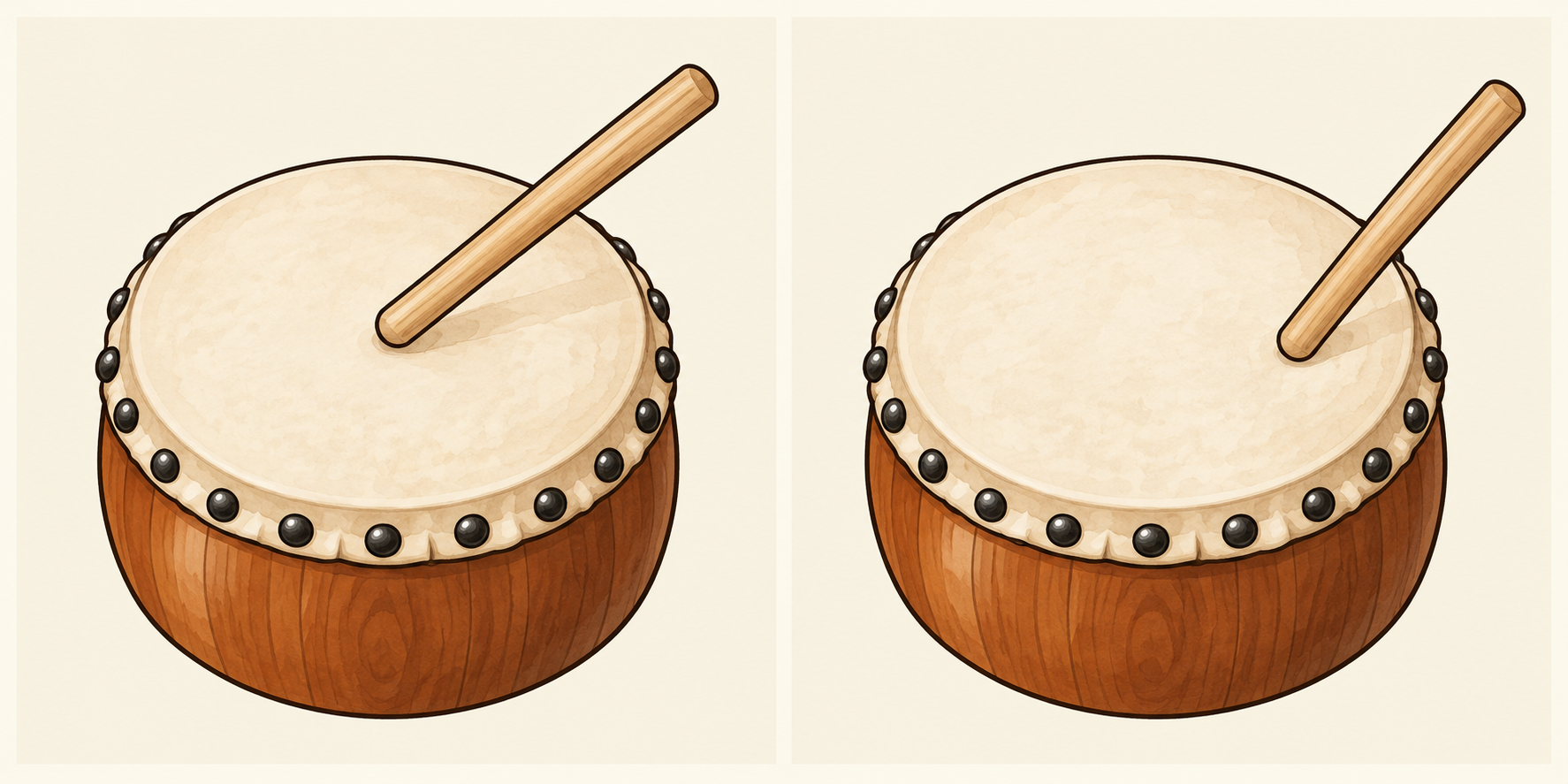
Nagadō-daiko: the head is tacked down all round; the center gives the deep don.
A drum with rope pulling both heads tight, so the pitch can be tuned.
A taiko has two basic sounds: the deep don from the center of the head and the dry ka from striking the wooden rim. Drummers learn rhythms not from written notation but by chanting them in a syllable system called kuchi shōga, "mouth singing": don don ka ka, don ka don. Once the phrase is in the mouth, it is in the hands. The same method is used across Japanese traditional music, from flute to shamisen.
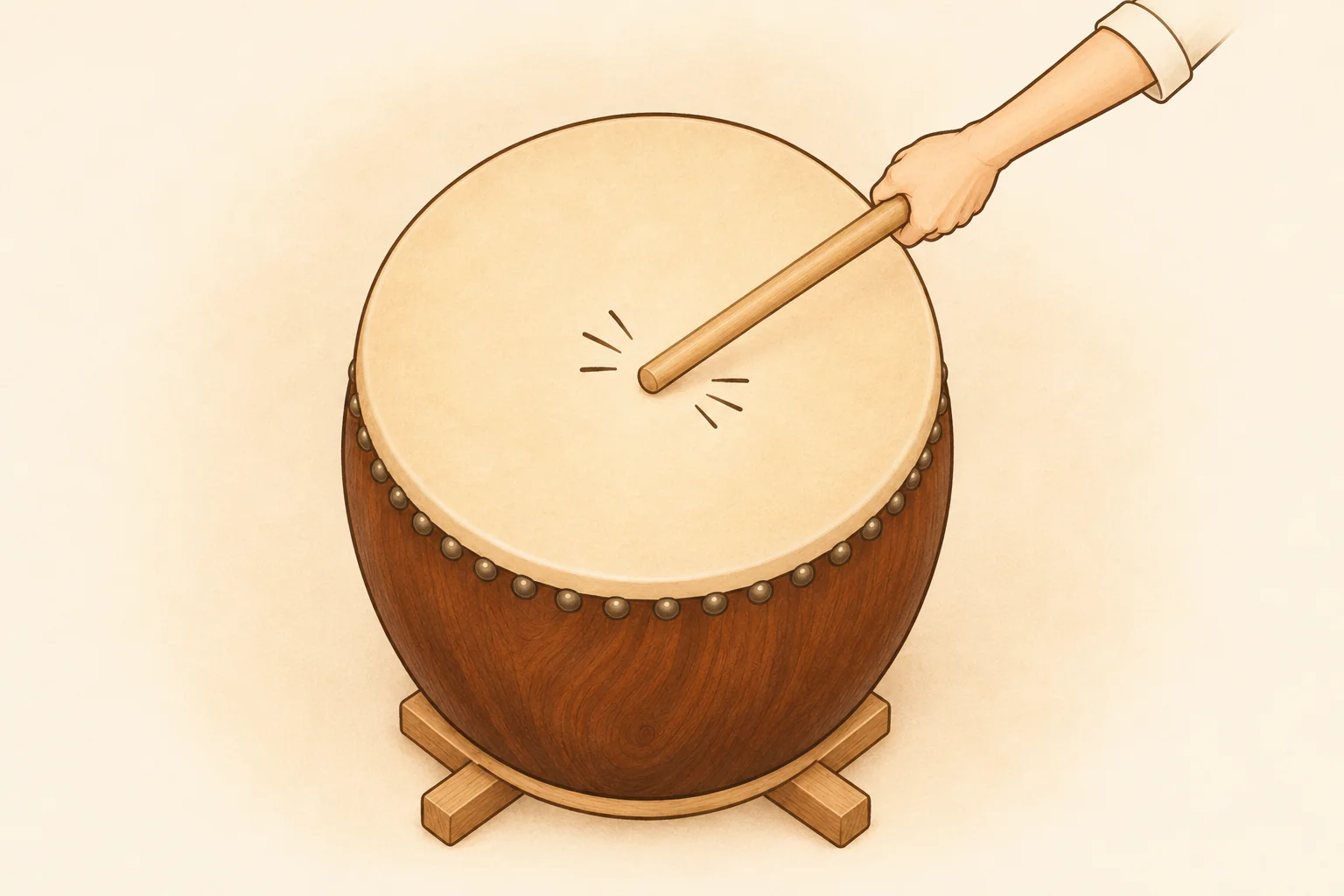
Don: the stick strikes the center of the drumhead for the deep sound.
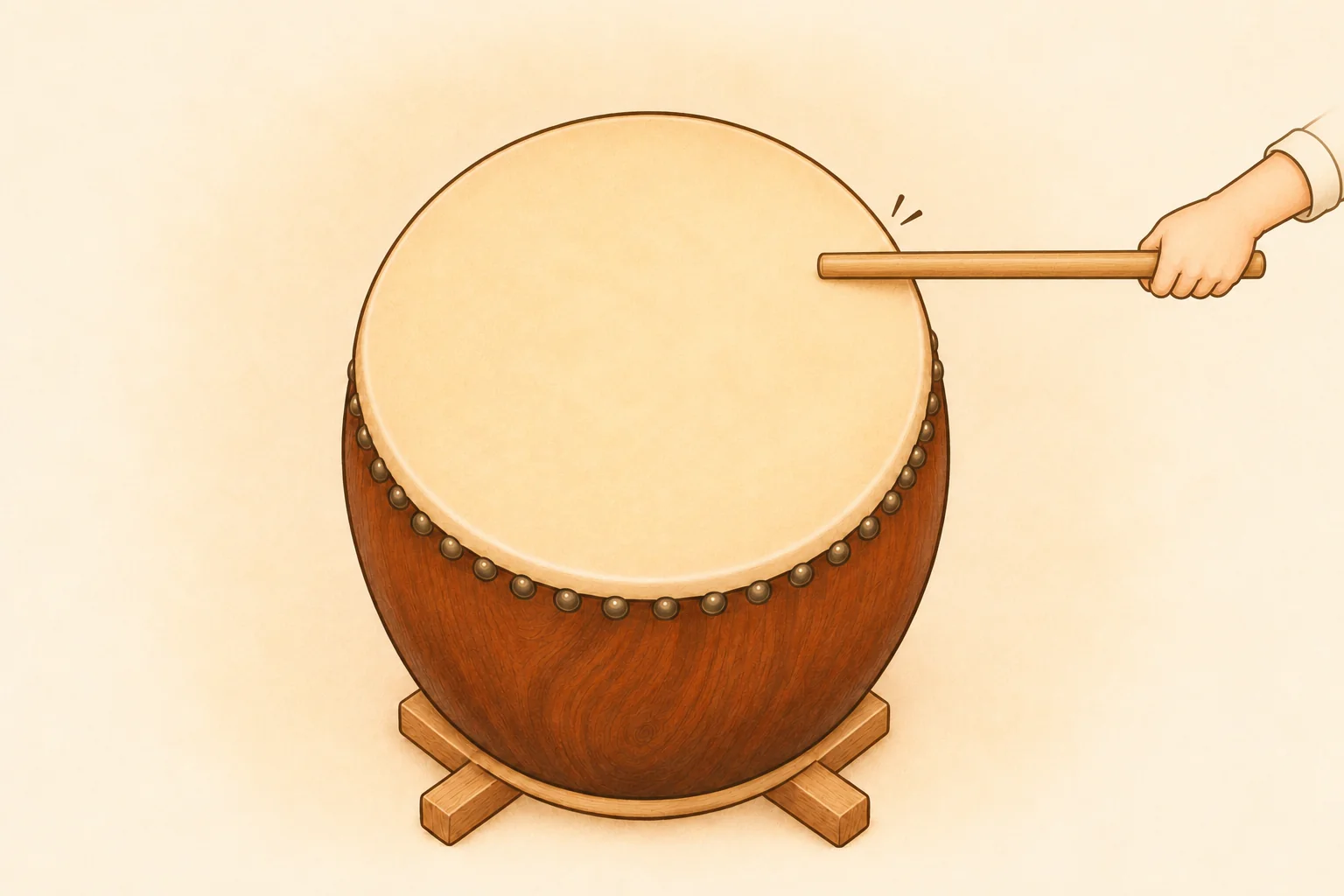
Ka: the stick strikes the wooden rim, not the head, for the dry sound.
| Drum | Body | Heads | Notes |
|---|---|---|---|
| Nagadō-daiko (miya-daiko) | Hollowed from a single section of trunk | Fixed with rows of tacks | Cannot be retuned |
| Shime-daiko | Shallow | Stretched on hoops, pulled tight by rope or bolts | Tuned very high; keeps time |
| Okedō-daiko | Staves, like a bucket | Rope-tensioned | Light enough to carry on a strap |
The tacked heads of the nagadō-daiko cannot be retuned; the shime-daiko, pulled tight by rope or bolts, can be tuned very high.
02What the Sound Does
People hearing a large drum up close for the first time rarely describe it as beautiful. They say it hit them in the chest. The low frequencies of an ōdaiko are felt as much as heard; the floor, the seats, and the body all vibrate. Japanese has a phrase for it: the sound "echoes in the belly" (hara ni hibiku).
Historically, the drum’s sound had jobs to do. At shrines it called the deity and announced that a festival had begun. At temples it marked the hours and summoned monks. In farming villages drums were beaten to drive off insect pests, to pray for rain, and to chase epidemics out of the community. It is often said that the old boundary of a village was roughly the distance at which its drum could be heard. In that sense taiko in Japan was less a musical instrument than a public voice, belonging to the shrine, the neighborhood, and the festival night rather than to any one player.
Taiko is also played with the whole body, and modern groups put great weight on form, or kata. Feet are planted wide, the center of gravity is low, the back is straight, and each stroke starts in the legs and travels through the hips and shoulders before reaching the wrists. Drummers shout to each other, calls known as kakegoe, such as sore! and ha!, which keep the group together and are part of the performance. An audience watches the music as much as it hears it: the sweat, the synchronized arms, the effort. That physicality is a large part of why taiko works so well on stage, even for listeners with no connection to Japan.
03Old Drums: Shrines, Temples, Theaters, and Festivals
Drums have been in the Japanese islands for a long time. Among the clay tomb figures called haniwa, from the Kofun period, is a sixth-century figure of a man beating a drum, excavated from a burial mound in Isesaki, Gunma Prefecture, and now in the Tokyo National Museum; it is usually described as carrying a small drum slung from the shoulder and holding a stick. Drummer haniwa are rare, but this one is evidence that drums were part of life and ritual at least fifteen centuries ago.
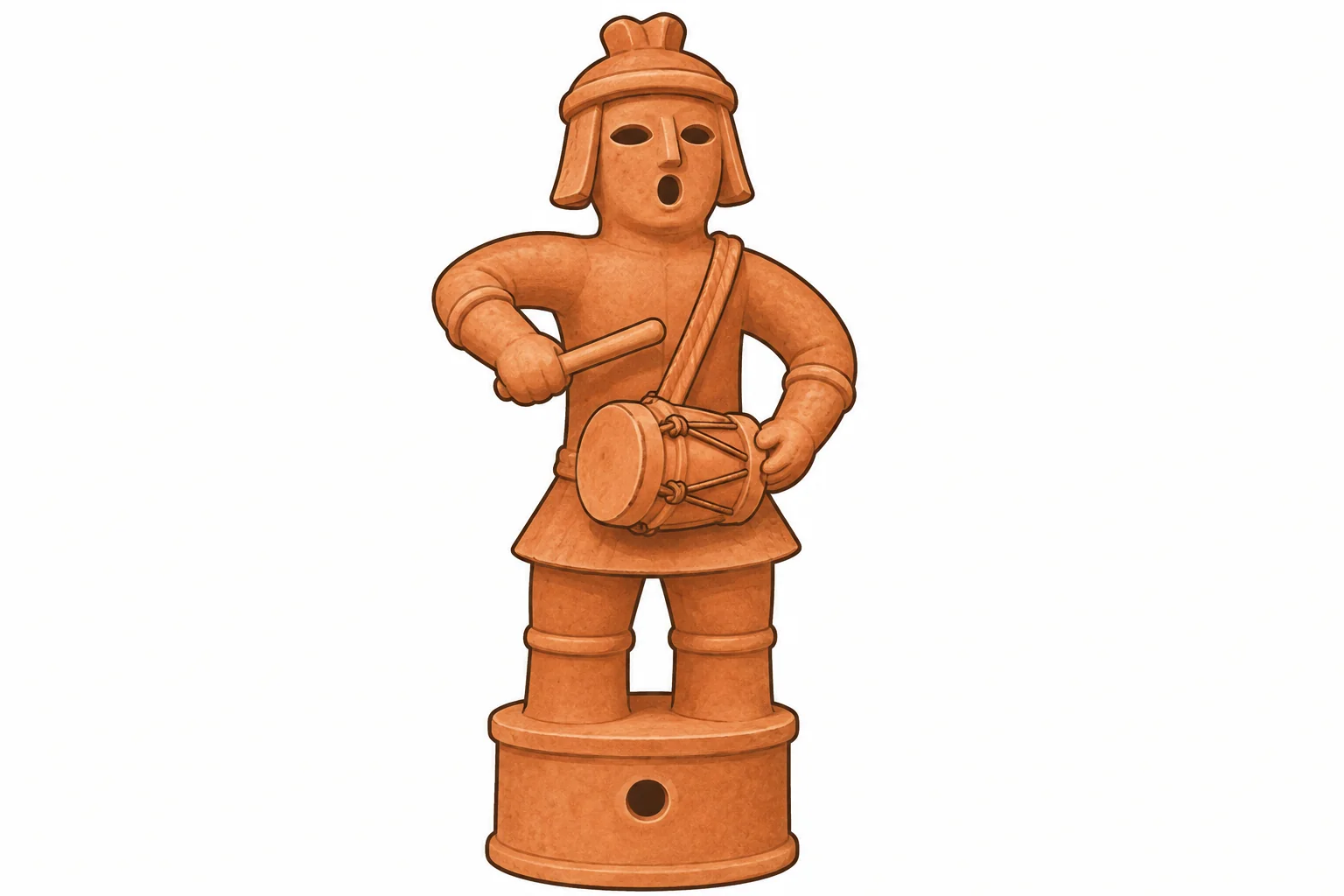
A Kofun-period haniwa of a drummer: an unglazed clay figure with a small drum at the shoulder and a stick in hand (illustration).
In the Nara and Heian periods, Buddhism and Tang Chinese court music brought further drums with them. The bugaku dances of gagaku court music use the dadaiko, a towering ceremonial drum framed in carved flames and painted with a swirling tomoe crest on its head, which is still brought out for imperial and great-shrine rituals. Buddhist temples used drums alongside chanting, and the followers of the Nichiren school carry a round, flat "fan drum," the uchiwa-daiko, beating a steady pattern as they chant the name of the Lotus Sutra; you can still hear it at temples and in processions.
From the medieval period on, drums moved into the theater and onto the battlefield. The Noh ensemble, the hayashi, consists of a flute, two hourglass drums played with the hands, and a stick-struck shime-daiko. Kabuki later added a hidden offstage music room, the geza, where a large drum imitates rain, wind, waves, and even falling snow, and a soft, swelling roll called dorodoro tells the audience that a ghost is about to appear. Armies of the Warring States period used drums to signal advance and retreat. A number of local drum traditions today trace their origins to some famous warlord’s battle drums; such stories are best treated as legend.
The drum’s deepest roots in daily life, though, are in festivals. Since the Edo period, festivals and summer bon dances across Japan have depended on drums. In Tokyo, drum carts lead portable-shrine processions. At the Chichibu Night Festival, drums inside the giant floats pound late into the night, some say almost until dawn. In Kokura, in Fukuoka Prefecture, the Gion festival is famous for drums mounted on carts and struck on both heads by two players as the carts roll through town. In Wajima on the Noto Peninsula, Gojinjo-daiko drummers wear demon masks and wild, seaweed-like hair. On Hachijō Island, far south of Tokyo, two players face each other across a single drum laid on its side. Each of these traditions has its own rhythms and techniques, handed down among local people and, until recently, rarely performed for outsiders.
04Kumi-daiko: The Postwar Ensemble
What most people now call taiko performance is kumi-daiko, "grouped drums": a set of drums of different sizes played by several people, with composed pieces that build, break, and resolve. Very little in the older tradition looks like this. It was invented in the 1950s.
The person usually credited is Oguchi Daihachi, a jazz drummer from Okaya in Nagano Prefecture. Around 1950 (some accounts say 1951) he took on an old score for the kagura drumming of Suwa Grand Shrine (by one account, given to him by a relative) and set out to revive it. As the story is usually told, he found it impossible for a single player to perform. Thinking like a jazz bandleader, he divided the rhythm among several drums of different pitches, the big drums acting like a bass, the shime-daiko like a snare, and arranged them as a drum kit spread across a group of players. The result became Osuwa Daiko. Oguchi spent the rest of his life traveling and teaching, and he helped found a large number of groups.
In 1959 a group called Sukeroku Daiko formed in Tokyo and developed a very different style. Its members played drums set on slanted stands, with large, dance-like movements and great speed, and its showmanship influenced the staging of many later groups.
The island of Sado, off the coast of Niigata, took taiko to the world. Around 1969, Den Tagayasu (whose real name is given in some accounts as Tajiri Kōzō) gathered young people on Sado into a group called Ondekoza and had them live communally: running at dawn, working, practicing, treating physical training and music as a single discipline. In 1975 members of Ondekoza ran the Boston Marathon and then went straight onto the stage to perform, a feat that made their name abroad. The image of a drummer in a loincloth, back to the audience, attacking an ōdaiko is generally thought to have become famous through them.
Disagreements within the group came to a head in 1981: Den left Sado, and the members who stayed relaunched themselves as Kodo, debuting that year at an arts festival in West Berlin. Kodo stayed on Sado, toured the world year after year, and in 1988 began Earth Celebration, a summer festival on the island that brings musicians from many countries to play alongside them. For a great many people outside Japan, a Kodo concert was their first encounter with taiko.
- c. 1950Oguchi Daihachi’s Osuwa Daiko (some say 1951)
- 1959Sukeroku Daiko, Tokyo
- 1968San Francisco Taiko Dojo
- c. 1969Ondekoza on Sado
- 1975Ondekoza runs the Boston Marathon, then performs
- 1981Kodo debuts in West Berlin
- 1988Earth Celebration begins on Sado
Kumi-daiko began with Osuwa Daiko around 1950; Kodo debuted in West Berlin in 1981 and has toured the world ever since.
The spread of kumi-daiko within Japan was remarkably fast. Towns, schools, companies, and temples formed groups. Some revived local drumming that had died out; others simply composed a new "traditional" drum piece for their hometown, to serve as a tourist attraction and a point of civic pride. Abroad, Seiichi Tanaka founded San Francisco Taiko Dojo in 1968, and in the following decades hundreds of groups appeared in North America, many in Japanese American communities and on university campuses. For many Japanese Americans, especially after the experience of wartime incarceration, taiko became a way to reclaim a heritage loudly and in public.
05Making a Drum
A good nagadō-daiko takes years to make. The zelkova log is cut to length and hollowed into a tube, then dried for several years so it will not split; the uneven carving left inside on purpose affects how the drum resonates. The heads are cowhide, soaked, scraped, and dried, then stretched with tremendous force. Jacks pull the hide down evenly while the maker listens and adjusts the pitch; some workshops are said to have workers stand and stamp on the hide as well. Finally it is tacked in place one tack at a time.
Several long-established makers are still in business. Asano Taiko in Hakusan, Ishikawa Prefecture, dates its founding to 1609 and runs Taiko no Sato, a center with more than a hundred kinds of drums from around the world on display, where visitors can try drumming. In Asakusa, Tokyo, Miyamoto Unosuke Shōten, founded in 1861, is an old maker of drums, portable shrines, and festival goods; since 1988 it has run a drum museum, the Taiko-kan, on the fourth floor of its Nishi-Asakusa store, with some 800 drums from around the world, a few of which visitors may play. Asakusa has a number of festival-supply shops, and walking its back streets you will often see drums of every size set out in front of stores.
Drum-making is leatherwork, and in Japanese history the handling of animal hides was long the work of the burakumin, a hereditary outcaste group subject to deep discrimination. The craftsmanship behind taiko includes their labor, a history that has long gone unspoken. In recent years, according to reports, some museums and researchers have begun to address it openly.
06Hearing It, and Playing It, in Japan
The most natural place to hear taiko in Japan is a summer festival or a bon dance. In July and August nearly every town holds bon odori: a wooden tower, the yagura, goes up in a park or temple yard, a drummer plays on top, and people dance in a slow circle around it. Visitors are welcome to join; just watch the person in front and copy. The drumming here is not about virtuosity. It holds the rhythm for a whole crowd, under the voice of a folk singer, and it is a very different pleasure from a concert.
For a full stage show, look for Kodo’s tours within Japan, or go to Earth Celebration in August. The car ferry from Niigata to Ryōtsu on Sado takes around two and a half hours, and from there it is a bus or car ride to the harbor town of Ogi in the south of the island, which for three days fills with concerts, workshops, and a market. Some festival drumming is worth a trip of its own: the Chichibu Night Festival on December 2 and 3, Kokura Gion Daiko on the third weekend of July, and Gojinjo-daiko at the Nafune festival in Wajima, traditionally held on July 31 and August 1 (in 2026 it took place on August 1 only).
Playing taiko yourself is easy to arrange. Tokyo, Kyoto, and other cities have drum lessons for visitors, usually about an hour long and open to complete beginners. The teacher shows you how to hold the bachi and how to stand, teaches a short phrase in kuchi shōga, and ends with everyone playing a piece together. Most people are surprised by how hard the sticks bounce back and how quickly their arms tire. Avoid hitting the tacks or the lacquered body, which is basic respect for the instrument, and leave drums at temples and shrines alone unless you are invited to play.
There is one more taiko that every Japanese child knows: Taiko no Tatsujin, "Taiko Master," the arcade rhythm game Namco released in 2001. Players beat a plastic drum along with pop songs, hitting red notes on the face and blue notes on the rim, the same don and ka that drummers chant. A coin at a game center is a perfectly respectable first lesson.