
At a glance
Why the shamisen buzzes and snaps, how it came from Ryūkyū, and how nagauta, jiuta and Tsugaru players each turned three strings into a different music.
- The shamisen has three strings and a skin-covered square body; a large ginkgo-leaf plectrum strikes string and skin together.
- The thick first string bypasses the upper nut and brushes a ridge on the neck, producing a sustained buzz called sawari.
- Its ancestor is the Chinese sanxian, which became the Okinawan sanshin and most likely reached Sakai in the 1560s.
- Three neck sizes: thin for nagauta, medium for jiuta, thick for gidayū and Tsugaru shamisen.
- Tsugaru shamisen grew from blind itinerant players in late nineteenth-century Tsugaru and won a national audience in the 1960s folk boom.
The shamisen is a long-necked lute with three strings, a square wooden body and a skin stretched tight across it. For four centuries it has been the instrument of Japanese popular theater and entertainment: it plays behind kabuki dancers, carries the storytelling of bunraku puppet plays, accompanies geisha at banquets, and, in the far north of Honshū, has become a ferocious solo instrument that sounds closer to rock guitar than to anything courtly. This introduction explains how the instrument works and why it sounds the way it does, where it came from, how it functions in two of its great classical traditions, nagauta and jiuta, and where a visitor to Japan can hear it played.
01Three Strings and a Drum
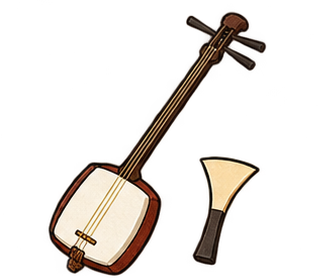
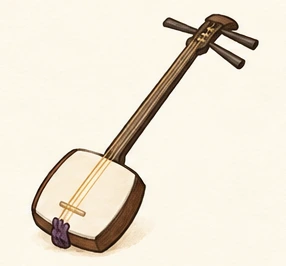
Seen up close, a shamisen is simple. The body, called the dō, is a nearly square frame of hardwood, usually karin, a hard tropical wood of the rosewood type, covered front and back with skin. Through it runs a long, slender neck, the sao, with no frets, ending in a pegbox that bends backward and holds three tuning pegs. The strings, traditionally silk, run from the pegs down to the bottom of the body, lifted off the skin by a small bridge called the koma. The player kneels in formal seated posture, rests the body on the right thigh, stops the strings with the left hand, and strikes them with a large plectrum, the bachi, shaped like a ginkgo leaf.
- 1
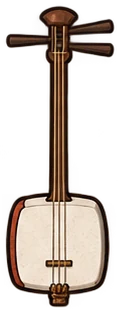 The whole instrument: long neck (sao), skin-covered body (dō) and three strings.
- 2
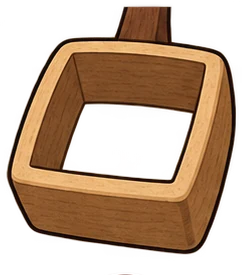 The dō: a nearly square wooden frame, skinned front and back.
- 3
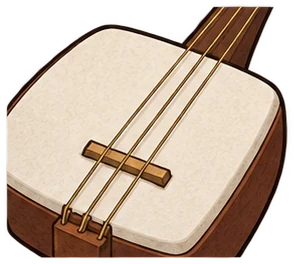 The koma: a small bridge that lifts the strings off the skin.
- 4
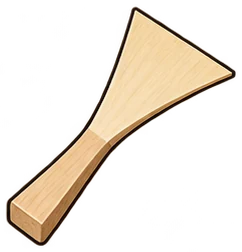 The bachi: a ginkgo-leaf plectrum that strikes string and skin.
That plectrum is the key to the shamisen’s character. When it comes down, it hits the string and the skin at almost the same moment, so every note has a percussive snap mixed into it. In effect the shamisen is part lute and part drum. The skin was traditionally cat, prized for its thinness and resonance, or dog, which is thicker and stands up to heavy playing. Animal skins have become expensive and hard to source, and synthetic heads are now common on practice instruments, though many professionals still insist on the real thing; a common complaint is that synthetic skin lacks the "moist" quality of cat or dog skin.
The other secret is a buzz. The thickest string, the first, does not rest on the upper nut like the other two. It is lifted clear of the nut and, as it vibrates, brushes against a small ridge left by a groove cut into the top of the neck, so it produces a sustained, sizzling hum. The Japanese call this sawari, literally "touch." When the player sounds a note on the other strings that matches one of the first string’s overtones, the buzz wakes up in sympathy, and the note seems to glow. Western instrument makers have spent centuries trying to remove noise like this. Japanese musicians cultivated it. The biwa lute and the shakuhachi flute share the same taste for sound with grain and breath in it, and anyone who wants to understand why the shamisen moves Japanese listeners needs to listen for that halo around each note rather than for melody alone.
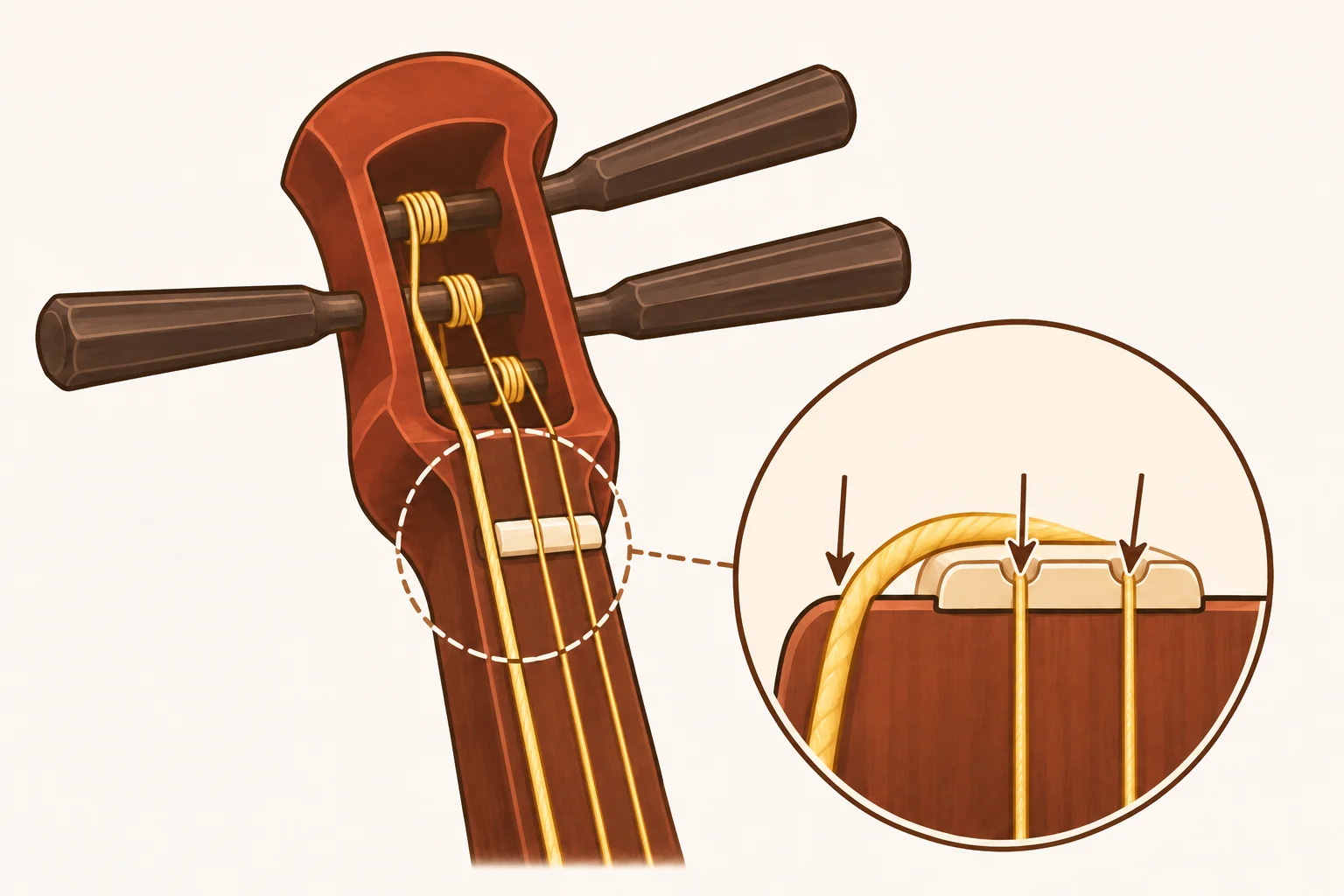
The top of a shamisen neck: the first string clears the nut and brushes a small ridge, creating sawari.
There is no single shamisen. Instruments are classified by the thickness of the neck. The thin-necked hosozao is light and bright and is used for nagauta. The medium chūzao serves jiuta and several narrative styles. The thick-necked futozao, with a heavier body, thicker skin and bigger plectrum, gives the deep, powerful sound of gidayū, the narrative music of bunraku, and of the Tsugaru shamisen. A professional usually spends a whole career on one of these.
| Type | Character | Used for |
|---|---|---|
| Hosozao | Light and bright | Nagauta |
| Chūzao | Medium | Jiuta and others |
| Futozao | Heaviest; thicker skin, bigger plectrum, deep and powerful | Gidayū, Tsugaru shamisen |
One name covers several instruments of different character; a professional usually spends a career on one.
02From Okinawa to the Pleasure Quarters
The shamisen’s ancestor is the Chinese sanxian, a three-stringed lute covered in snakeskin. It reached the Ryūkyū Kingdom, today’s Okinawa, where it became the sanshin, still the heart of Okinawan folk music. In the second half of the sixteenth century, most likely in the 1560s, the sanshin arrived in Sakai, the thriving merchant port near Ōsaka.
According to the traditional account, the first Japanese to take it up were blind biwa players, professional musicians who chanted war tales to the lute. They kept their big biwa plectrums and used them on the new instrument. Python skin was unavailable in Japan, so they substituted cat and dog. Over a few decades the proportions changed, and the biwa’s buzzing sawari seems to have been transplanted onto it. By the early 1600s the instrument was thoroughly Japanese.
Its timing was perfect. The Tokugawa peace that began in 1603 created a prosperous urban class in Kyoto, Ōsaka and Edo (now Tokyo), with money to spend and an appetite for entertainment. The shamisen was cheaper and more portable than the biwa, and it could accompany a voice in almost any style. It became the sound of the licensed pleasure quarters, of the new kabuki theater, and of the puppet theater that grew into bunraku. Nearly all of the music of the Edo period (1603–1868) is shamisen music of one kind or another, and Japanese musicologists divide it into two broad families: katarimono, narrative styles that tell a story, and utaimono, lyrical styles built around song.
03Nagauta: Music for the Kabuki Stage
Go to a dance play at the Kabukiza theater in Tokyo, and when the curtain opens you will often see, at the back of the stage, a two-tiered platform covered in red felt. On the upper tier sit a row of musicians in matching formal costume: singers on one side, shamisen players on the other (usually said to be singers on the right and shamisen on the left as seen from the audience), five to nine of each in a large production. On the lower tier sit the hayashi, the percussion and flute section, with a transverse flute, the small shoulder drum (kotsuzumi), the larger hip drum (ōtsuzumi) and a stick drum (taiko). This is a nagauta ensemble.
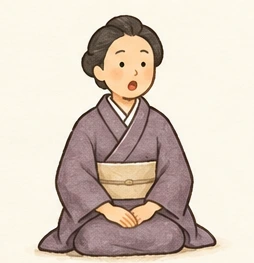
Singer (utakata): carries the text.
Shamisen player: plays the thin-necked hosozao.
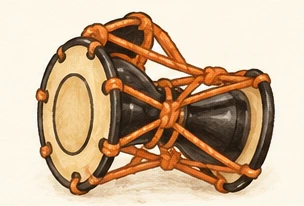
Hayashi: drums such as the kotsuzumi, with flute, on the lower tier.
Nagauta, "long song," took shape in Edo in the early eighteenth century as accompaniment for kabuki dance, and it remains the most important music of the kabuki stage. It uses the thin-necked shamisen, and its sound is clear, quick and bright, with a high, straight vocal style that suited the brisk taste of Edo townspeople. It is lyrical rather than narrative. The text sketches a season, a place or a mood, and the dancer turns those words into movement.
What makes nagauta exciting to watch is how the parts lock together. The lead singer (tateuta) and the lead shamisen player (tatejamisen) sit side by side in the center. The shamisen usually opens a section and sets the tempo. When the voice enters, the shamisen does not simply double the tune: it answers, fills the gaps between phrases, and pushes the music forward. The drummers mark the structure with strokes and with sharp vocal calls, yo! and ho!, that sound like shouts but function as cues. The flute floats above everything. The dancer’s poses and turns land on the seams between these layers. There is no conductor. The musicians coordinate by breath and by those calls, which is why a good nagauta performance feels at once loose and exact.
Two pieces show the range. Kanjinchō (1840), adapted from the noh play Ataka, tells how the warrior monk Benkei bluffs his master Yoshitsune past a hostile checkpoint, and its music builds to a thrilling climax as Benkei exits along the runway in the bounding tobi roppō step. Kyōganoko Musume Dōjōji (1753) is a showcase for a female-role actor, who dances for close to an hour through a sequence of costume changes, with the music shifting mood for each episode. Over time nagauta also developed concert pieces meant purely for listening. The oldest and largest family of nagauta musicians is Kineya; others include Imafuji, Kineie and Yoshimura.
Not all the shamisen music at kabuki is visible. On the left as the audience sees it, behind a black bamboo blind, sits an offstage ensemble, the geza, which plays entrance music, scene-setting pieces and sound effects for rain, snow and wind. Much of the shamisen an audience hears comes from behind that blind; some put it at as much as half. On stage, nagauta shares the dance repertoire with narrative styles such as tokiwazu and kiyomoto, and with gidayū borrowed from the puppet theater. Regular theatergoers can tell them apart in a few bars: gidayū is dark and heavy, kiyomoto high and ornamented, tokiwazu steady and measured, and nagauta crisp.
04Jiuta: Song, Shamisen and the Long Interlude
If nagauta is the stage music of Edo, jiuta is the chamber music of Kyoto and Ōsaka. Ji means "local," and the name referred to the Kamigata region around the old capital. Jiuta is the oldest art-music repertoire for the shamisen, older than nagauta by about a century, and it was created and handed down by blind professional musicians. In the Edo period these men belonged to a guild, the Tōdōza, with four ranks: kengyō at the top, then bettō, kōtō and zatō. Jiuta and koto music were their specialties, and many classic pieces are credited to composers bearing the title kengyō or kōtō.
Jiuta uses the medium-necked shamisen, and the player sings while playing. The texts are about love, longing, the seasons and remembrance, and the singing is subtle and intimate rather than loud. This was music for a tatami room with a few guests, and everything about its scale, from volume to pacing, fits that space.
The heart of many jiuta pieces is the tegoto, a long instrumental interlude. The song pauses after its opening verses, and the shamisen takes over for an extended passage, sometimes several minutes long, developing patterns and shifting tempo, before the voice returns to close the piece. Pieces built around such interludes, called tegotomono, flourished in Ōsaka and Kyoto from the late eighteenth into the early nineteenth century. Zangetsu (The Lingering Moon), by Minezaki Kōtō, is one of the best known; it is said to have been written in memory of a young student who died, and its brief text frames a long, calm interlude.
Jiuta is often played in sankyoku, a trio of shamisen, koto and shakuhachi (or the bowed kokyū). In the interludes the shamisen and koto frequently play interlocking lines, one chasing the other. Jiuta also accompanies jiutamai, a restrained Kamigata dance style originally performed in small rooms by candlelight. Among Kyoto geiko, the musicians who play and sing rather than dance are called jikata, and jiuta is part of what they learn.
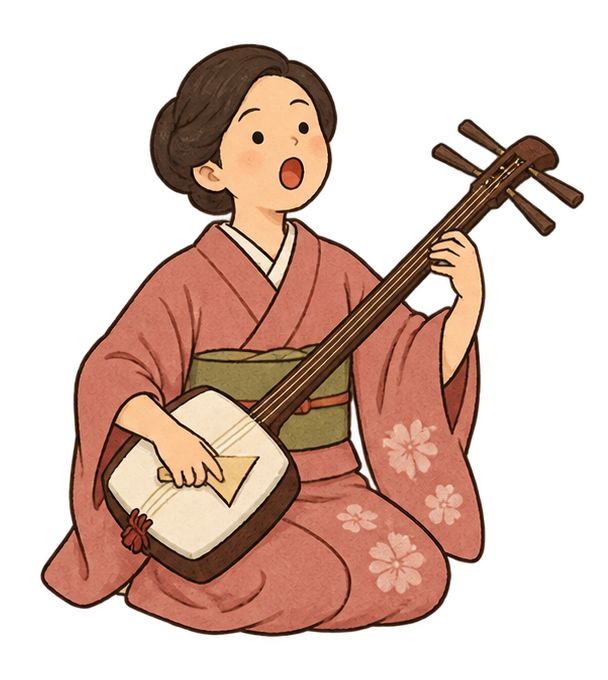
A jiuta musician sings while playing the medium-necked shamisen.
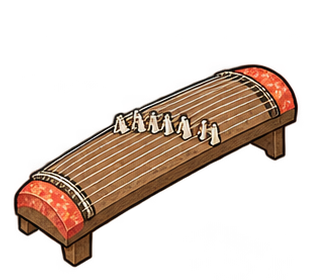
Koto: plays lines that interlock with the shamisen.
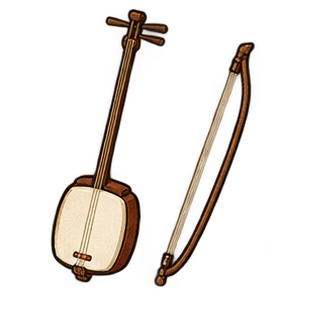
Kokyū: the bowed instrument that can take the shakuhachi’s place.
05Tsugaru Shamisen: The Northern Solo
At the northern tip of Honshū, in the Tsugaru region of Aomori Prefecture, the shamisen became something else entirely. Tsugaru players use the thick-necked instrument, but they slam the plectrum into the skin, race up and down the neck, and improvise at length. The effect is loud, rhythmic and virtuosic, and audiences who have never heard classical shamisen often find it electrifying.
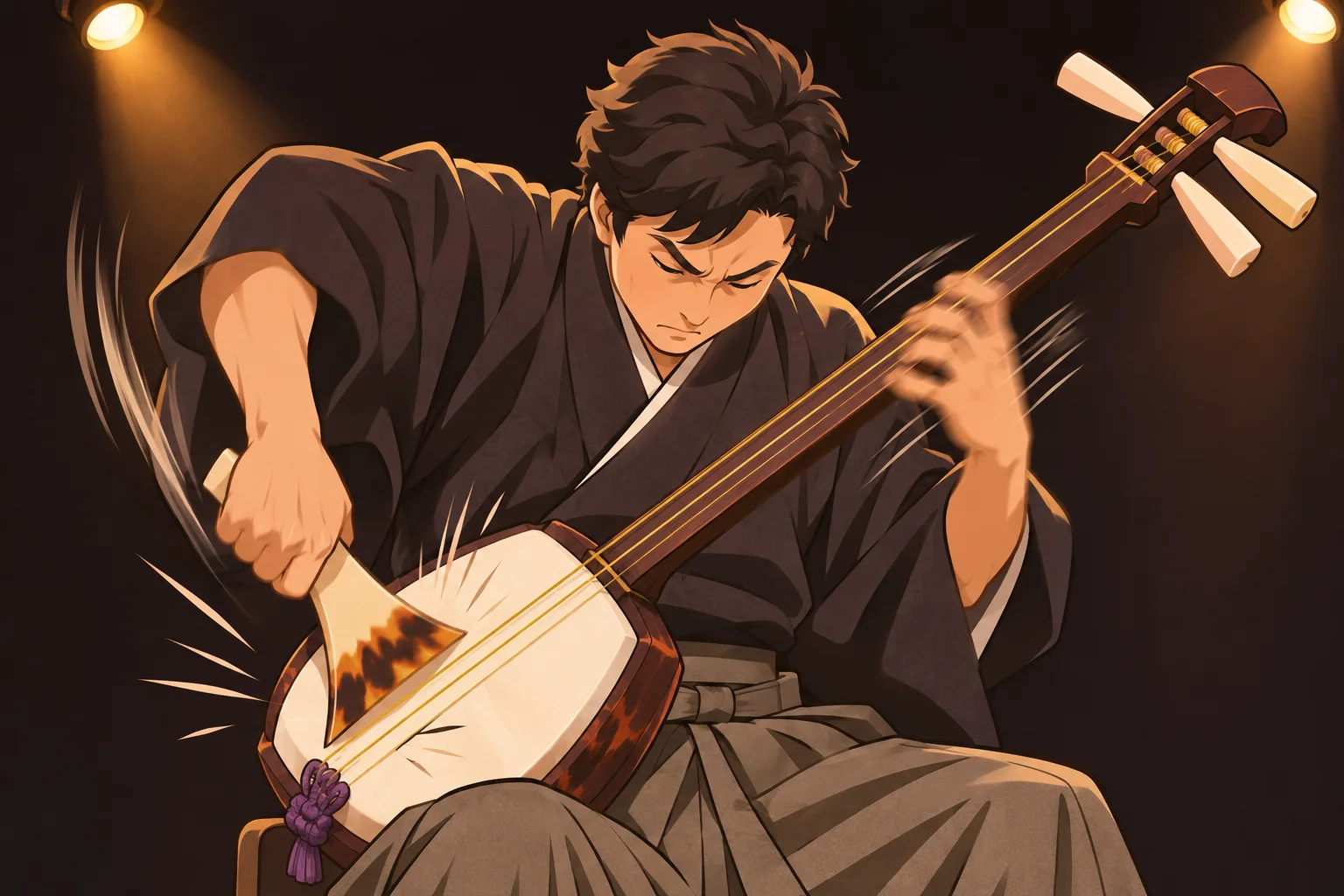
A Tsugaru shamisen solo: the player strikes the skin hard with the plectrum, left hand racing along the neck (illustration).
The style grew up in the late nineteenth century among blind itinerant musicians, called bosama, who played door to door for rice and coins in a poor, snowbound region. The usual story credits a blind performer known as Nitabō (Akimoto Nitarō), from the Kanagi area, with developing the hard, percussive technique, partly to be heard over crowds at festivals. The music began as accompaniment to local folk songs, but players competed in the instrumental introductions and interludes, and the solo improvisation gradually took center stage.
Tsugaru shamisen reached a national audience during the folk song boom of the 1960s and 1970s, when the blind master Takahashi Chikuzan won over young listeners in small Tokyo theaters and on record. Later players, notably the Yoshida Brothers, who debuted in 1999, and Agatsuma Hiromitsu, took it into pop, rock collaborations and concert halls, and toured abroad. For many Japanese people today, the Tsugaru sound is the first thing that comes to mind when they hear the word shamisen.
06Hearing It in Japan
The easiest place to hear nagauta is the Kabukiza in Ginza, Tokyo. Dance plays appear in most monthly programs, and single-act seats (hitomakumi) let you see just one piece from the top gallery. Try watching the musicians as much as the dancer: listen for the shamisen setting the pace in the opening, and for the drummers’ calls that snap the dancer’s poses into place. For the heavy futozao sound, go to the National Bunraku Theatre in Ōsaka, where the narrator and shamisen player sit together on a revolving platform at stage right, one voicing every character in the scene, the other holding the whole drama together.
Jiuta takes a little more effort. Schools in Kyoto and Ōsaka give regular recitals, listed under sankyoku or jiuta. Kyoto’s spring geiko dances, such as the Miyako Odori, show jikata lined up at the sides of the stage with their shamisen.
Tsugaru shamisen is the easiest of all to find. Restaurants and folk-song bars in Aomori and Hirosaki serve local food with live sets through the evening, and the Tsugaru Shamisen Kaikan in Kanagi, in Goshogawara City, has live performances and is said to stand right beside the childhood home of the novelist Dazai Osamu. Similar folk-song bars exist in Tokyo, including in Asakusa.
Short lessons for visitors are offered in Tokyo and Kyoto, and in an hour or two most people can pick out a simple tune such as Sakura. Buying an instrument is another matter: a beginner’s shamisen starts at roughly ¥100,000 (as of 2026), good instruments cost many times that, and the skin needs replacing every few years. Players say that the hardest thing to learn is not the fingering but the stroke itself, getting the plectrum to meet string and skin together in one clean, ringing snap.