
At a glance
How one kneeling storyteller with a fan and a cloth plays every role: rakugo’s history, famous stories, Tokyo and Ōsaka styles, and the yose theaters.
- Rakugo is comic storytelling in which one kneeling performer plays every role with only a fan and a hand towel.
- Its name comes from ochi, the punchline that closes the story.
- In 1798 Sanshōtei Karaku charged admission for talks at the Shitaya Inari shrine, usually counted as the start of Edo’s yose.
- There are two branches, Tokyo (Edo) and Kamigata (Ōsaka and Kyoto); Kamigata performers use a lectern and wooden clappers.
- Tokyo has four yose open every day: Suzumoto Engeijō, Suehirotei, Asakusa Engei Hall and Ikebukuro Engeijō.
Rakugo is comic storytelling performed by a single person kneeling on a cushion. The performer wears a kimono, holds a folding fan and a small cloth, and never stands up, changes costume or uses scenery. Everything else, from a drunken fishmonger to a scheming samurai to a whole row of bickering neighbors, comes out of one voice and one upper body. The stories usually end on a punchline called the ochi, the "drop", which gives the art its name: rakugo means roughly "fallen words". It took shape in the cities of the Edo period, and more than three centuries later small variety theaters in Tokyo and Ōsaka still put it on every day of the year. You do not need fluent Japanese to enjoy it, but it helps to know what you are watching.
01One Performer, a Fan and a Towel
A rakugo performance begins with music. Each performer has a signature entrance tune, the debayashi, played live backstage on shamisen and drums. The storyteller walks out, kneels in the formal seiza position on a cushion in the middle of the stage, and bows low to the audience. The stage itself is called the kōza, literally "high seat". Beside it stands a placard, the mekuri, with the performer’s name brushed on it, flipped to a new card for each act.
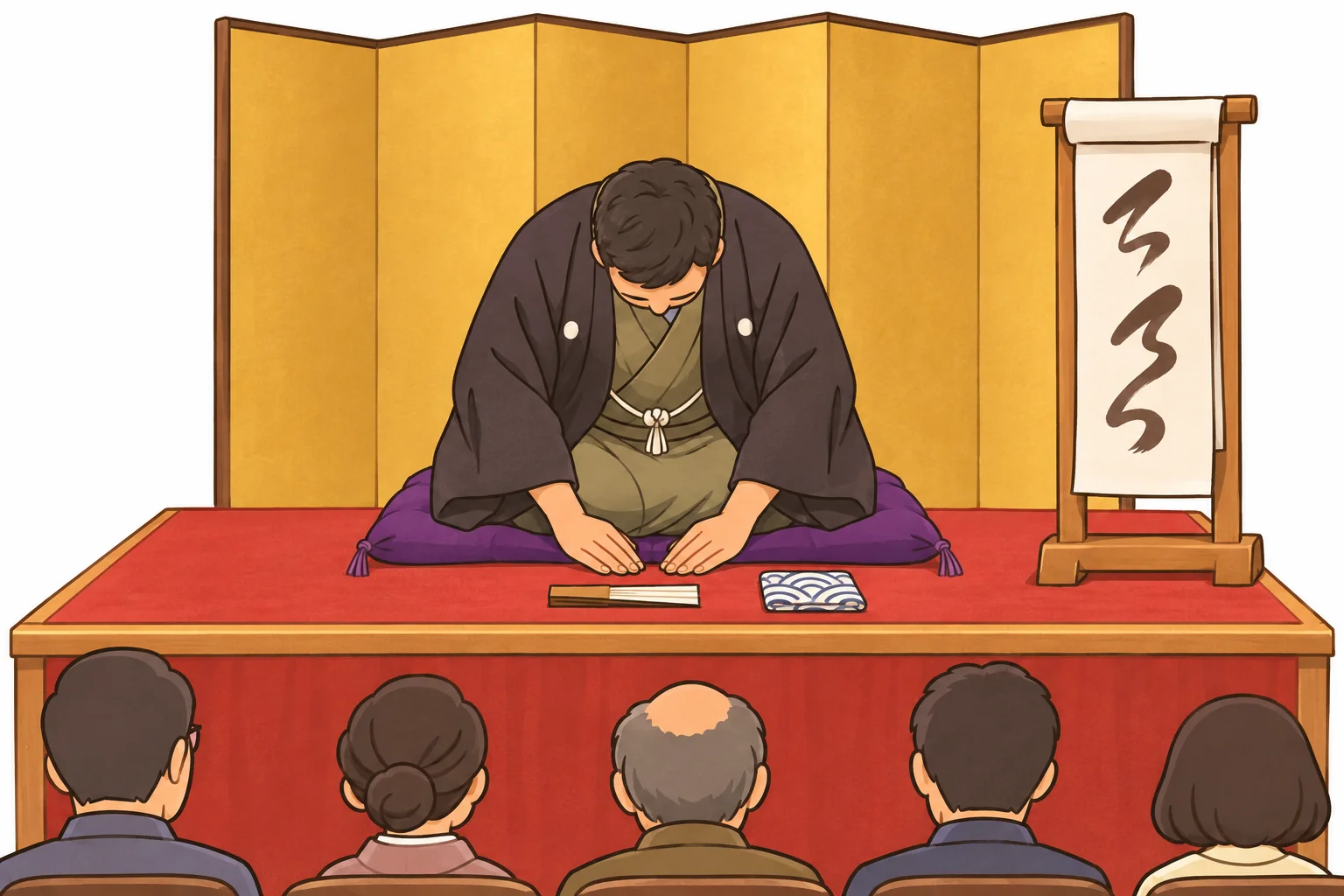
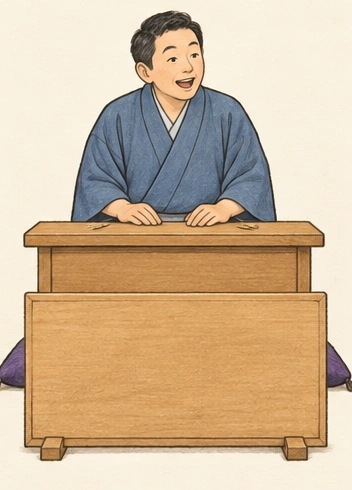
On the kōza of a yose hall, a rakugo storyteller kneels on his cushion and bows deeply to the audience (illustration).
The story does not start at once. First comes the makura, the "pillow": a few minutes of chat about the weather, the news, the performer’s own failings. It is a warm-up for the audience and a way for the storyteller to read the room. Is the crowd old or young, quick to laugh or sleepy after lunch? A skilled performer uses the makura to slip in background the story will need. A few remarks about how Edo townspeople ate their noodles, and suddenly the audience realizes the tale about the noodle stall has already begun.
Once inside the story, the performer plays every character. The key technique is called kamishimo. To show a conversation, the storyteller turns the head slightly to one side for one speaker and to the other side for the reply. By convention the senior person, or the one already inside the house, faces shimote, the audience’s left, while the junior person, or the visitor arriving at the door, faces kamite, the audience’s right. After a few lines the audience stops needing names; the angle of the face is enough.
The props are just two. The sensu, a folding fan, becomes chopsticks, a tobacco pipe, a writing brush, a sword, a fishing rod, a saké cup, or a fist knocking on a door when tapped against the floor. The tenugui, a thin cotton hand towel, becomes a wallet, a letter, an account book, a sweet potato. The most celebrated bit of mime is eating soba. The performer lifts invisible noodles from an invisible bowl with the closed fan and slurps them in with a sharp, wet sound, cheeks working, steam almost visible. Edo eaters prided themselves on slurping loudly and swallowing fast, and a good noodle scene is said to send audiences straight to the nearest soba shop afterwards.
- 1
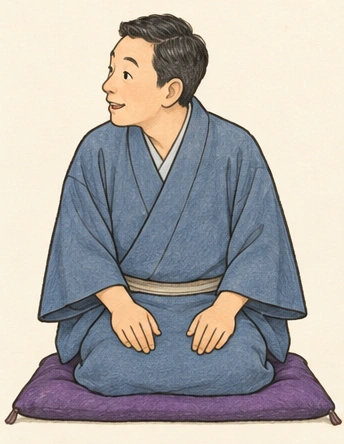 Kamishimo, part one: facing the audience’s left, the senior person or the one indoors is speaking.
- 2
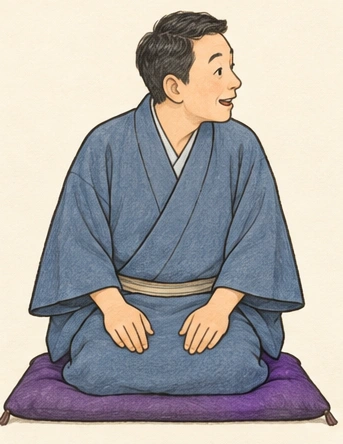 Kamishimo, part two: turning to the audience’s right, the junior person or the visitor replies.
- 3
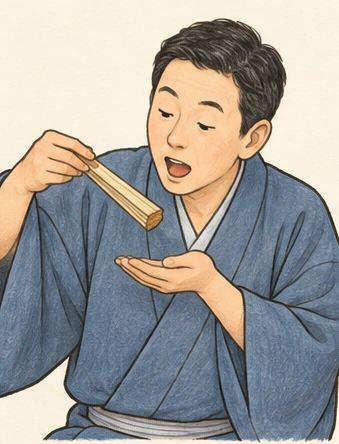 The closed fan becomes chopsticks, lifting noodles from an invisible bowl.
- 4
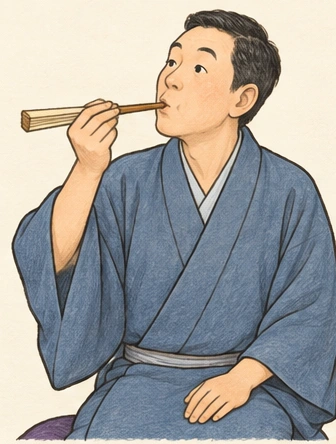 Held another way, the same fan becomes a tobacco pipe.
- 5
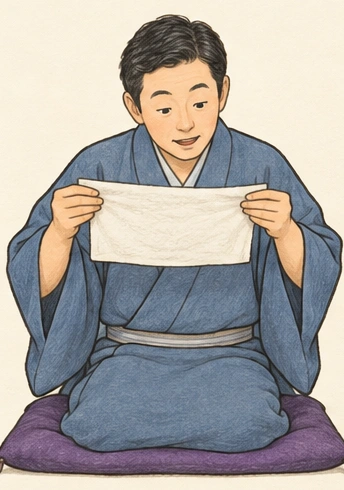 The opened tenugui can be a letter or an account book.
The bareness is the point. With no set, the listeners build the set in their heads; with no cast, the performer’s voice has to become ten people. The storyteller supplies the cues and the audience completes the picture, so the laughter is something both sides make together. This is also why Japanese fans happily hear the same classic story many times over. Two performers telling the same tale will give you two different tenements, two different sets of neighbors.
02From Court Jesters to Neighborhood Theaters
Rakugo’s roots are usually traced to the storytellers who kept warlords company in the late sixteenth century, entertaining them with anecdotes and jokes. A Kyoto monk named Anrakuan Sakuden was famous for sermons with comic twists, and in 1623 he compiled Seisuishō ("Laughs to Wake You Up"), a collection of around a thousand short humorous stories. Several of them later became rakugo pieces, and Sakuden is often called the father of the art.
In the late seventeenth century, professional joke-tellers appeared in all three of Japan’s great cities at about the same time. In Kyoto, Tsuyu no Gorobē performed in the open air near shrines and temples. In Ōsaka, Yonezawa Hikohachi drew crowds at the grounds of Ikutama Shrine. In Edo, Shikano Buzaemon was invited to perform at private gatherings. From the start, the Kamigata tradition of Kyoto and Ōsaka had the noise of the street in it, while Edo’s leaned toward the drawing room. The difference persists.
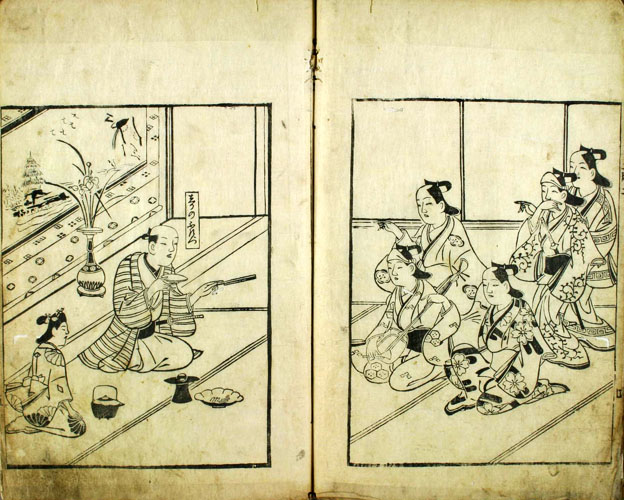
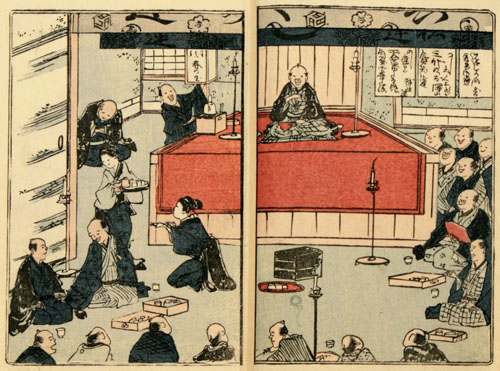
Edo’s Shikano Buzaemon performing at a private party, from Shika no makifude.Waseda University Library, illustration from Shika no makifude (illustrated by Furuyama Moroshige)
What turned rakugo into a trade was Edo at the end of the eighteenth century. In 1786 the comic poet Utei Enba began hosting gatherings, the first of them traditionally said to have been held at Mukōjima on the far bank of the Sumida, where amateurs took turns presenting new comic stories. In 1798 Okamoto Mansaku, newly arrived from Ōsaka, opened a permanent storytelling room in Kanda, and in the same year Sanshōtei Karaku I began charging admission for his shows in the grounds of the Shitaya Inari shrine (today’s Shitaya Shrine). Karaku’s show is usually counted as the start of Edo’s yose, or variety halls, and a stone at the shrine still marks the spot. Yose multiplied quickly. By the Bunsei era of the 1820s Edo is said to have had some 125 of them, small rooms where townspeople could spend an evening for, so it is said, about the price of a bowl of noodles.
The decisive figure of the modern era was San’yūtei Enchō (1839–1900). He specialized in long dramatic stories and ghost tales, such as Kaidan Botan Dōrō (The Peony Lantern), which he told in installments over many nights, by some accounts more than ten. He is generally thought to have adapted the Grimm tale "Godfather Death" into Shinigami (The God of Death), still one of the most performed pieces in the repertoire. When stenography arrived in Meiji Japan, Enchō’s performances were transcribed and published word for word. Their vivid spoken Japanese was a model for novelists trying to write the way people actually talked, and when Futabatei Shimei was struggling with the style of Ukigumo (Floating Clouds), often called Japan’s first modern novel, Tsubouchi Shōyō advised him to write it the way Enchō told his stories. A form of oral entertainment helped shape modern written Japanese.
In the twentieth century radio, records and television made star storytellers into national celebrities. Postwar Tokyo had giants such as Kokontei Shinshō, Katsura Bunraku and San’yūtei Enshō. Kamigata rakugo, by contrast, nearly died out after the war, reduced to a handful of performers. Its revival owed much to Katsura Beichō, who tracked down and reconstructed forgotten stories, and to colleagues like Shōfukutei Shokaku. Beichō was designated a Living National Treasure in 1996.
03What Makes People Laugh
The repertoire divides into two broad groups. Koten rakugo, classical rakugo, covers several hundred stories developed between the Edo and Meiji periods and handed down from teacher to pupil. Shinsaku rakugo, new rakugo, means stories written in modern times.
The classical stories have a cast of regulars. Hachigorō and Kumagorō, usually tradesmen such as carpenters, live in a nagaya, a row tenement of cramped one-room homes. They go for advice to the goinkyo, a retired old man who claims to know everything and often doesn’t. Yotarō is good-hearted and slow. There are stingy landlords, drunks, pompous samurai, and the men and women of the pleasure quarters. Nobody does anything heroic. They borrow, brag, cut corners and get caught.
A perfect first story is Toki Soba (Time Noodles). Late at night a man finishes a bowl of soba at a street stall and pays the sixteen coins, counting them one at a time into the vendor’s hand: "One, two, three … seven, eight, what time is it?" "Nine," says the vendor, naming the midnight hour in the Edo system. "Ten, eleven …" and the customer has saved a coin. A dim fellow who watched it all tries the trick the next night, but he arrives too early. At "eight" he asks the time, the vendor answers "four", and he carries on, "five, six, seven …", paying extra. The joke depends on how Edo told the time and on the rhythm of counting, and the performer gets to show two contrasting meals: the first bowl excellent, the second watery and soggy, eaten with the same gestures but a completely different face.
Jugemu is about parents who want an auspicious name for their son and use every lucky phrase the priest suggests. The resulting name takes a good while to say. In the usual ending, the boy raises a bump on a playmate’s head, and by the time the adults have recited his full name over the complaint, the bump has gone down. Many Japanese schoolchildren can rattle the whole name off. In Manjū Kowai (Scared of Buns), young men compare their fears. One claims to be terrified of sweet buns, so his friends buy a pile to torment him. He "suffers" through every last one, then admits that what he really fears right now is a nice cup of strong tea.
Not all rakugo is comic. Shibahama tells of a hard-drinking fish seller who finds a wallet full of money on the beach. His wife persuades him it was a dream; he gives up drink, works hard, and only learns the truth three years later on New Year’s Eve. It is a staple of the year-end season, and many Tokyo listeners make a point of hearing it every December. The rebellious master Tatekawa Danshi described rakugo as an affirmation of human weakness. Its characters are lazy, greedy, lustful and vain, and the stories rarely punish them for it. That forgiving view of ordinary people is much of rakugo’s charm.
New rakugo moves the same techniques into offices, family dinners, convenience stores and smartphones. Katsura Bunshi VI, long known as Katsura Sanshi, had written more than three hundred new pieces as of 2026 and is still adding to them, and Yanagiya Kyōtarō and Shunpūtei Shōta are other well-known writers of new work.
04Tokyo and Ōsaka
Rakugo today has two main branches, Edo or Tokyo rakugo and Kamigata rakugo from Ōsaka and Kyoto, and once you have seen both they are easy to tell apart.
A Kamigata performer sits behind a small lectern called a kendai, with a low screen, the hizakakushi, hiding the knees. In one hand is a pair of small wooden clappers, the kobyōshi, rapped sharply on the lectern to mark a change of scene. The kit is a legacy of street performers who needed to catch the attention of passers-by. Kamigata stories also often include hamemono, live shamisen and percussion cues that play under the action when a character sets out on a journey or starts drinking in a teahouse. Add the quick rhythm of Ōsaka dialect and a fondness for big gestures, and the effect is livelier, closer to a small play.
A Kamigata performer sits behind the small kendai lectern, with the hizakakushi screen hiding the knees.
Tokyo rakugo has no lectern. Its ideal is clean and understated, in keeping with the old Edo taste for looking effortless. Many stories exist in both traditions with the setting adjusted: Tokyo’s Toki Soba is Toki Udon in Ōsaka, where the noodles are thicker.
The two cities also organize themselves differently. Tokyo performers belong to the Rakugo Kyōkai or the Rakugo Geijutsu Kyōkai, or to two independent groups that split from them, the Enraku school and the Tatekawa school. Most Ōsaka performers belong to the Kamigata Rakugo Kyōkai.
05From Apprentice to Master
Tokyo rakugo keeps a strict ladder of rank. A would-be storyteller must first persuade an established performer to accept them as a pupil. They begin as minarai, apprentices running errands at the master’s home, learning etiquette and memorizing basic stories. After some months they become zenza, "before the seat", and can work backstage at a yose: beating the drums, folding senior performers’ kimono, serving tea, flipping name cards and turning over cushions between acts. A zenza is first to arrive and last to leave, and occasionally opens the show with a short story.
After three or four years comes promotion to futatsume, "second on the bill". A futatsume may wear a haori jacket with a family crest, takes their own bookings and is free of backstage chores, though the income is often thin. Roughly ten years later, the association promotes them to shin’uchi, full master, entitled to close a program and to take pupils. The promotion is celebrated with a run of shows across the yose, the new master closing each bill, with banners from sponsors hung outside. The whole climb usually takes about fifteen years. Kamigata rakugo has no formal ranks; standing comes from seniority and reputation.
- 1Minaraisome months, errands at the master’s home
- 2Zenzathree or four years, backstage at a yose
- 3Futatsumeabout ten years; crested haori, own bookings
- 4Shin’uchimay close a programme and take pupils
The whole climb usually takes about fifteen years; Kamigata rakugo has no formal ranks.
Names are part of the inheritance. Stage names belong to lineages, San’yūtei, Yanagiya, Kokontei, Katsura, Shōfukutei and others, and great names are passed down, which is why performers are referred to as Yanagiya Kosan V or Katsura Bunshi VI. A famous name can stay vacant for decades because no one feels worthy of it.
06Going to a Yose
In Tokyo, four yose run shows every day of the year: Suzumoto Engeijō in Ueno, Suehirotei in Shinjuku, Asakusa Engei Hall in Asakusa and Ikebukuro Engeijō. Ōsaka has the Tenma Tenjin Hanjōtei, opened in 2006, and Kōbe has the Kirakukan in Shinkaichi. Most days are split into a daytime and an evening program of three to four hours each.
A yose bill is long. A dozen or more performers appear, each for about fifteen minutes, rising in seniority as the show goes on until the headliner, the tori, who has time for a full-length story. In between come the iromono, the "colored acts": manzai comedy duos, paper-cutting artists who snip silhouettes on request, daikagura jugglers, magicians, shamisen songs. At the intermission, the nakairi, people stretch their legs and buy snacks. Suehirotei still has raised tatami seating along both sides of the hall, the best place to feel what an old neighborhood yose was like. Eating and drinking in your seat is generally fine; talking and phones are not.
If your Japanese is limited, there are two easy ways in. One is to watch for the mime: drinking, fishing, smoking and above all noodle-slurping are funny in any language. The other is English rakugo. Katsura Shijaku performed in English abroad in the 1980s, and today there are regular English-language rakugo shows in Tokyo and Ōsaka, some by performers who tour internationally. For homework, the anime Shōwa Genroku Rakugo Shinjū (Descending Stories) follows two storytellers through the postwar decades and performs long stretches of classics such as Shinigami and Shibahama. After watching it you will recognize a surprising amount when you sit down in a yose.
On television you may come across Shōten, a program running since 1966 in which a row of rakugo performers in brightly colored kimono trade witty answers to the host’s prompts, earning an extra cushion for a good line. It made storytellers’ faces familiar to the whole country, but its quick-fire ōgiri format is not rakugo itself. For that you need the yose: one performer, a cushion, and a bowl of noodles that isn’t there.