
At a glance
Why a bamboo flute with five holes is so hard to play, how wandering komusō monks used it for meditation, and how it reached concert halls and film scores.
- A standard shakuhachi is one shaku eight sun, about 54.5 cm, with four holes in front and one at the back, and no reed or whistle mouthpiece.
- Good flutes are cut from the root end of madake bamboo, and the knobbly root at the bottom is the instrument’s most recognizable feature.
- The shakuhachi came from Tang China with gagaku in the Nara period, and the Shōsōin still holds eight ancient examples.
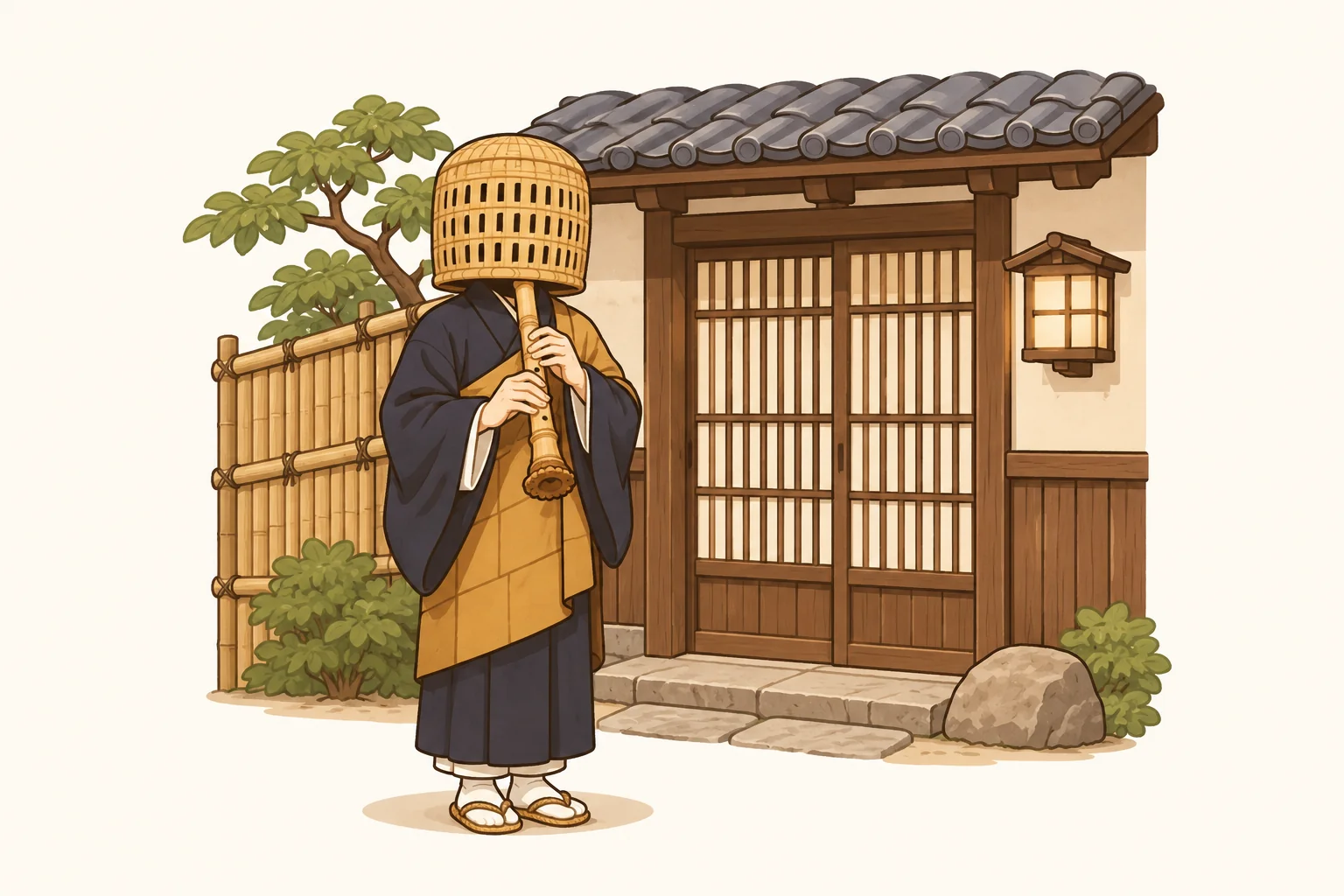
- In the Edo period, komusō monks of the Fuke sect wore basket hats and played for alms as a Zen practice; the sect was abolished in 1871.
- Takemitsu Tōru’s November Steps, premiered by the New York Philharmonic in 1967, introduced many Western listeners to the shakuhachi.
The shakuhachi is a length of bamboo root with four holes on the front, one on the back, and a sharp notch cut into its top end. That is the whole instrument. Yet it can sound like wind in a grove, like a sigh, like a cry, and it has become the sound that film composers reach for whenever they want to suggest distance, solitude, or Zen. This is an introduction to what the shakuhachi is, why it is so hard to play and so strange to hear, how it passed through the hands of wandering monks in basket hats before reaching the concert hall, and where you can hear one, or try one, in Japan.
01A Flute Named After Its Length
The name is a measurement. Shaku is the old Japanese foot and hachi means eight, so a shakuhachi is "one foot eight": one shaku and eight sun, or about 54.5 centimeters. A standard 1.8 flute has D as its lowest note. Flutes built the same way in other lengths are still called shakuhachi, and players speak of a "1.6," a "2.1," or a "2.4" the way guitarists speak of scale lengths. The longer the flute, the lower and darker the voice; long flutes of two shaku and more are favored for meditative solo pieces.
A fine shakuhachi is made from madake, a large Japanese timber bamboo, cut from the base of the stalk with part of the root system still attached. That knobby root end, with its rings of trimmed rootlets, is the instrument’s signature look. A typical flute contains seven nodes. Most modern flutes are cut in two at the middle and joined with a socket, which makes them easier to carry and allows the maker to work on the bore. Before any of that, the bamboo is heated to draw out its oils and left to dry, often for years.
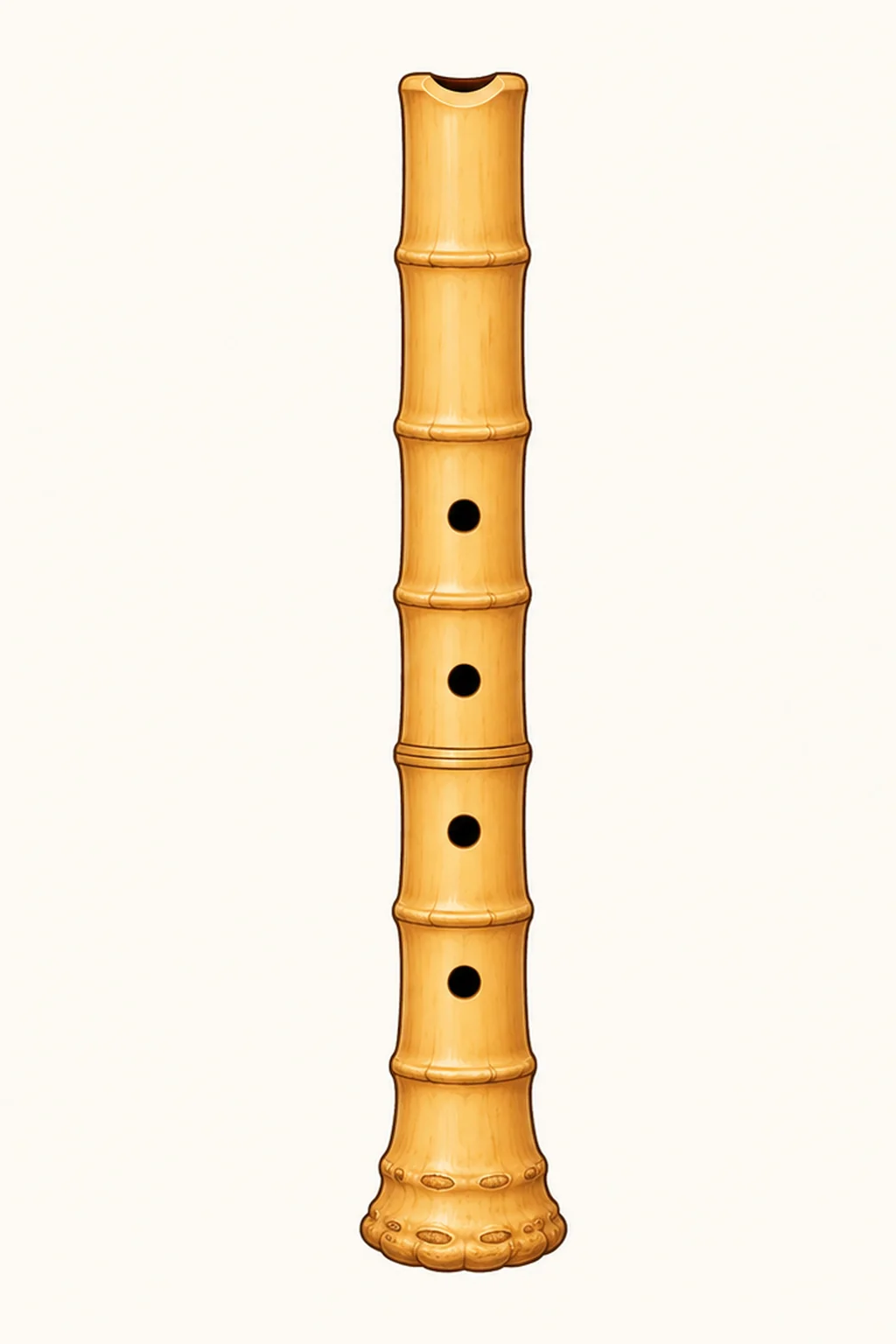
The front has four finger holes, and the knobbly root end forms the bottom.
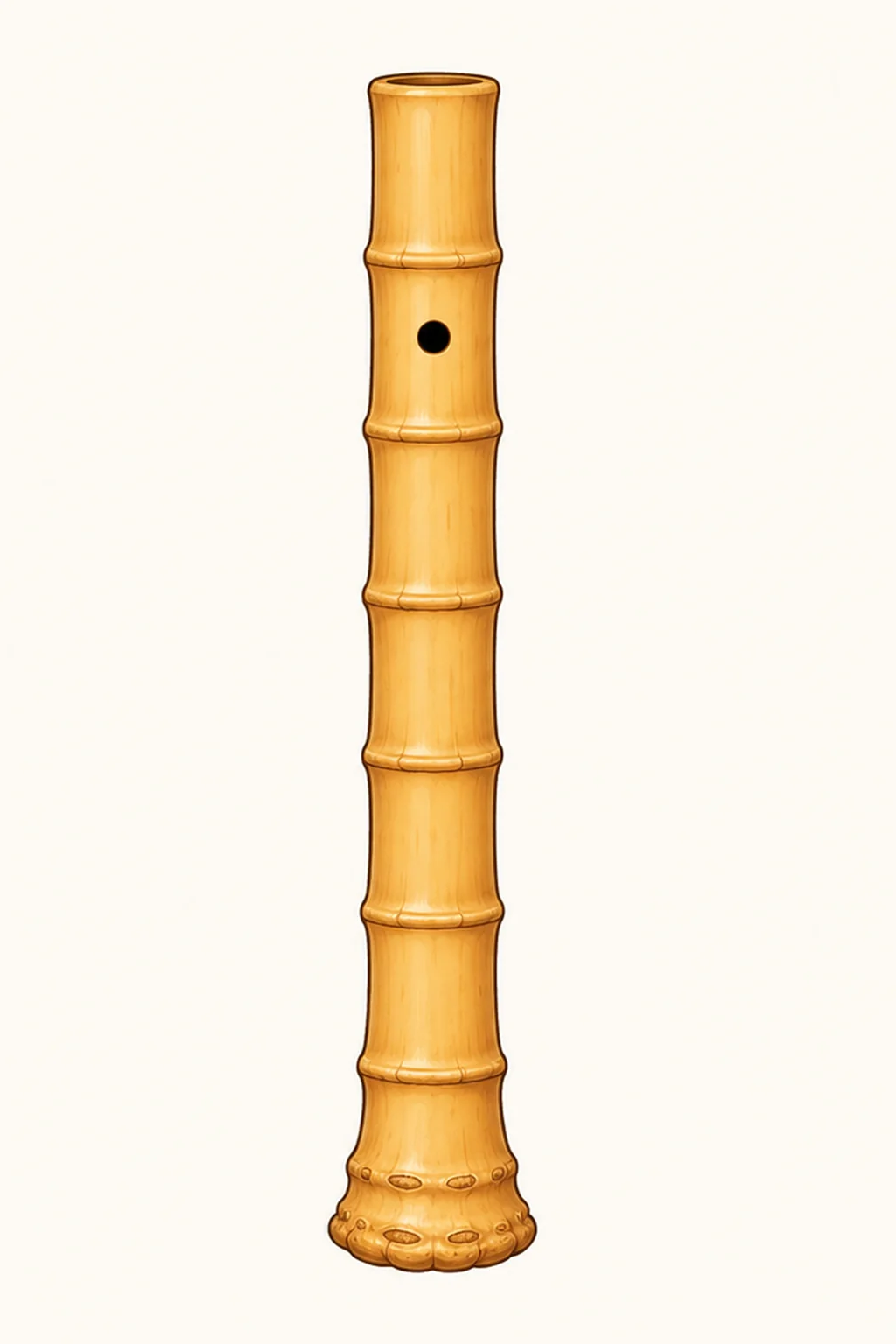
The back has a single hole, covered by the thumb.
The player blows across the utaguchi, the "song mouth," an angled edge carved into the rim at the top of the tube and usually reinforced with a small inlay of horn. The lower lip rests against the end of the tube and the player aims a narrow stream of air at the far edge. Physically this is the same thing that happens in a Western concert flute, but there is no lip plate and no channel to guide the air, as there is in a recorder. Every variable, the shape of the lips, the angle of the jet, its speed, is up to the player. Many beginners blow for days before they get a sound. Japanese players repeat a saying, kubi-furi sannen, koro hachinen: three years to learn to shake your head (to make vibrato), eight years to learn koro, a rolling finger technique.
- 1
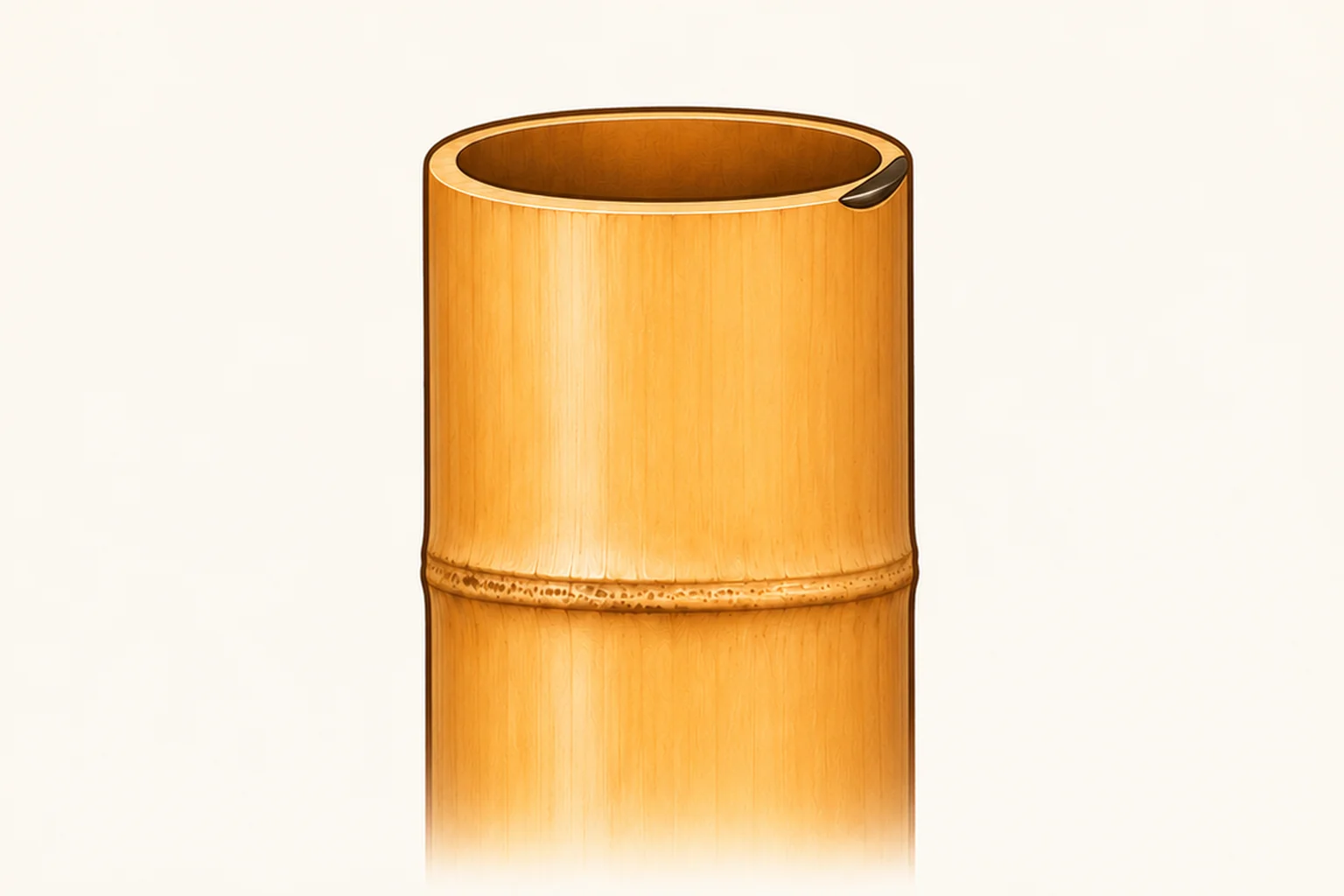 The utaguchi is an angled edge cut into the rim, usually reinforced with a small inlay of horn.
- 2
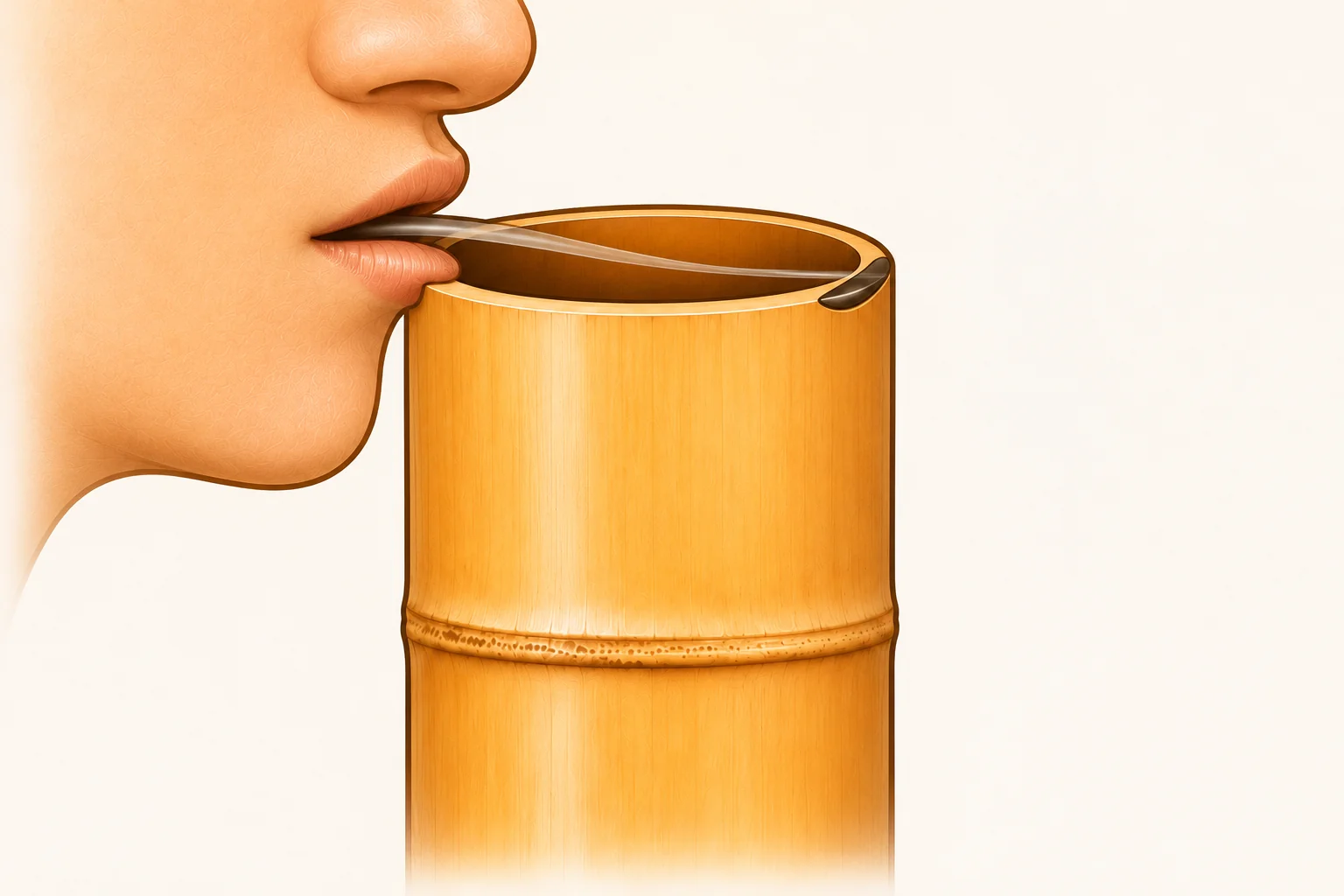 The lower lip rests against the end of the tube, and a narrow stream of air is aimed at the far edge.
- 1Utaguchiangled edge at the top, reinforced with a small inlay of horn
- 2Five finger holesa pentatonic scale
- 3Middle jointcut in two at the middle and joined with a socket
- 4Root endthe knobby root end with trimmed rootlets
- 5Seven nodesin a typical flute
- 6Lengthone shaku eight sun, about 54.5 cm
The player blows across the utaguchi at the top; the knobby root end is the instrument’s signature look.
Makers divide over what to do with the inside. Most modern flutes are ji-ari, "with paste": the bore is built up with a mixture of lacquer and powdered stone, then shaped and polished so that the flute plays in tune and projects strongly. Jinashi, "without paste," flutes leave the bamboo’s natural bore almost untouched apart from opening the nodes. They are quieter, rougher, less predictable, and no two are alike. Players devoted to the old solo repertoire often prefer them for exactly those reasons.
Prices range accordingly; as of 2026, a plastic or wooden practice flute costs a few thousand to perhaps twenty thousand yen. A decent bamboo shakuhachi from a professional maker usually starts in the low hundreds of thousands of yen, and flutes by celebrated makers can reach a million or more.
02Five Holes, Many Notes
With all holes open and closed in sequence, five finger holes give a pentatonic scale, roughly D, F, G, A, C on a standard flute. Shakuhachi music is written with katakana syllables for these notes (in the Kinko school, ro, tsu, re, chi, ri), arranged in vertical columns with small marks for duration and technique. A page of shakuhachi notation looks more like a sutra than a score.
Everything else comes from two techniques. The first is partial holing: covering only part of a hole. The second is changing the angle of the jet. Dropping the chin so that the lip covers more of the mouthpiece lowers the pitch, a technique called meri; raising it sharpens the note, called kari. A note can slide up into place from below, or overshoot and settle. The voice-like bending of pitch that listeners notice in shakuhachi music comes mostly from meri and kari.
What makes the instrument truly distinctive is its attitude toward noise. A Western flutist spends years removing breath sounds from the tone. A shakuhachi player cultivates them. Muraiki is an explosive attack in which a burst of air produces a rushing, windy roar along with the pitch. Koro-koro is a rapid alternation of fingers that makes a gurgling trill. Tamane is a flutter produced in the throat or with the tongue. There is a phrase often attached to the shakuhachi, ichion jōbutsu, "enlightenment in a single sound." For players of the classical repertoire, the shape of one note, how it begins, swells, wavers, and dies away, can be the whole point.
Most classical shakuhachi pieces have no fixed meter. Phrases are measured by the player’s breath: one breath, one phrase, then a pause to inhale. That pause belongs to the music too. Japanese aesthetics has a word for it, ma, the meaningful interval.
03From the Tang Court to the Komusō
The shakuhachi came from China. Tang-dynasty China had a vertical bamboo flute called chiba, written with the same characters, and it reached Japan along with the court music known as gagaku in the Nara period. The Shōsōin, the imperial treasure house at Tōdai-ji in Nara, still holds eight ancient shakuhachi made of bamboo, stone, and ivory. They have six holes and are slimmer and shorter than the modern instrument. This early shakuhachi fell out of the gagaku ensemble by around the mid-Heian period.
For several centuries afterward, the Japanese played a short one-node bamboo flute called the hitoyogiri, popular among monks and cultivated amateurs in the Muromachi period. The direct ancestor of today’s shakuhachi, however, is the thick root-end flute carried by the komusō, the mendicant monks of the Fuke sect in the Edo period.
The Fuke sect traced itself to Puhua (Fuke in Japanese), an eccentric Tang-dynasty Zen monk who is said to have wandered the streets ringing a hand bell. According to the sect’s own account, a disciple imitated the bell on a bamboo flute, and the lineage was passed down until the Japanese monk Shinchi Kakushin, who went to Song China in 1249 and returned in 1254, brought it back to Kōkoku-ji (then called Saihō-ji), his temple in Yura on the coast of what is now Wakayama Prefecture. Historians treat most of this genealogy as a later invention, assembled when the sect needed an impressive pedigree, but Kōkoku-ji is still honored as a birthplace of the shakuhachi.
What is certain is that by the Edo period the Fuke sect was a tightly organized body with privileges granted by the shogunate. Its members, the komusō or "monks of emptiness," wore the tengai, a deep woven basket that covered the entire head, and looked out through the weave. They traveled from town to town playing at doorways for alms. They did not describe this as performing music. They called it suizen, "blowing Zen," a form of meditation equivalent to seated zazen.
The shogunate gave the sect a monopoly: only komusō could play the shakuhachi for alms, and they could pass through domain checkpoints with unusual freedom. Many members were rōnin, masterless samurai. A man whose face was hidden and who could travel the country was bound to attract rumors, and stories spread that komusō included government spies, fugitives, and samurai hunting for a father’s killer. Kabuki plays and later samurai films used the figure often. Most of those stories are fiction, but they are why the image of the basket-hatted monk is so vivid in Japan today.
The pieces the komusō played are called honkyoku, "original pieces": solo works for spiritual practice, as opposed to gaikyoku, pieces that accompany voice or other instruments. Three of them, Kyorei, Kokū, and Mukaiji, are traditionally regarded as the oldest and are said to descend from the sect’s legendary founders. They have little melody in the ordinary sense. They are made of long tones, each a single breath, separated by silence.
The Meiji government abolished the Fuke sect in 1871. Komusō could no longer collect alms, and for a time the shakuhachi itself seemed to have lost its place; Kinko-school leaders such as Araki Kodō lobbied for it to continue as a secular musical instrument. Most of the sect’s temples disappeared. A few lineages survived, and in 1888 the Myōan Kyōkai was founded at Zen’e-in, a subtemple of Tōfuku-ji in Kyoto, reviving Myōan-ji as a center of the Myōan tradition, where the old honkyoku are still played.
04The Kinko and Tozan Schools
The shakuhachi survived the end of the Fuke sect because it had already escaped the temples.
In the eighteenth century, Kurosawa Kinko (1710–1771), a samurai from the Fukuoka domain, traveled among Fuke temples collecting honkyoku. He assembled a repertoire of more than thirty pieces, fixed at thirty-six by his grandson’s generation and known today as the Kinko-ryū honkyoku, and he and his successors served as shakuhachi instructors at Ichigatsu-ji and Reihō-ji, the sect’s two head temples in the Kantō region. The Kinko school became the dominant tradition of eastern Japan. Shakuhachi players had been joining koto and shamisen in private since the mid-eighteenth century, despite the sect’s prohibition; after the Meiji Restoration, they moved openly into sankyoku, "music for three," a chamber ensemble of shakuhachi, koto (the long zither), and shamisen (the three-stringed lute). Sankyoku was enormously popular in middle-class homes, and it turned the shakuhachi from a ritual implement into an instrument ordinary people studied.
In 1896, Nakao Tozan founded the Tozan school in Ōsaka. Rather than inheriting the Fuke repertoire, Tozan composed a large body of new honkyoku and developed a more systematic notation, with dots and lines marking rhythm, and a teaching method closer to modern music education. The school spread quickly through western Japan and became the largest shakuhachi school by membership. Most people who study the shakuhachi in Japan today belong to the Kinko or the Tozan school. Alongside them are the Myōan-derived lineages devoted to the old meditative pieces and a number of smaller schools built around individual masters.
The two main schools differ in technique, repertoire, and notation; even their katakana differ, with Kinko ri written ha in Tozan notation. An outsider would struggle to tell them apart by ear. For a student, though, the choice of school decides which scores you will read, which pieces you will learn, and whom you will play with for years.
05Concert Halls and Soundtracks
After the Second World War, composers began to treat the shakuhachi as material for contemporary music. The best-known example is Takemitsu Tōru’s November Steps, premiered in 1967 by the New York Philharmonic under Ozawa Seiji, with Yokoyama Katsuya on shakuhachi and Tsuruta Kinshi on biwa, the Japanese lute. The two instruments do not blend with the orchestra so much as confront it, and the piece made a deep impression abroad. For many Western listeners it was their first encounter with the instrument.
Players such as Yamamoto Hōzan and Yokoyama Katsuya performed, recorded, and taught widely in Japan and overseas, and the shakuhachi became one of the best-known Japanese instruments internationally. Foreigners began to study seriously, some spending years under Japanese teachers and earning teaching licenses. Today there are performers and makers in the United States, Australia, and Europe, and international shakuhachi festivals draw players from dozens of countries.
In popular culture the sound is everywhere. Hollywood scores use a shakuhachi phrase as shorthand for the East, for wilderness, or for loneliness. Synthesizers and samplers of the 1980s shipped with shakuhachi presets, and the breathy sampled flute became a fixture of pop records; the opening of Peter Gabriel’s "Sledgehammer" is a famous example. In Japan the instrument turns up in anime and video game soundtracks and in rock bands that mix traditional instruments with electric guitars.
Traditional players have mixed feelings about this. The shakuhachi can certainly evoke stillness and desolation, but it can also be bright, quick, and even playful; in sankyoku it often carries lively melodies. Hearing it only as Zen background music means hearing half of it.
06Hearing and Trying It in Japan
The easiest way to hear a shakuhachi live is at a hōgaku (traditional Japanese music) concert. The National Theatre in Tokyo closed for rebuilding in October 2023 and remains closed as of 2026; its operator stages hōgaku programs at other venues such as the New National Theatre; regional concert halls and the schools themselves present sankyoku and shakuhachi recitals throughout the year, with programs that range from honkyoku to new compositions. Audiences are quiet and applaud only between pieces. During a honkyoku, the player often closes their eyes and the hall seems to hold its breath along with them; several minutes in which the only sound is one person breathing through bamboo is something a recording does not convey.
To see komusō, go to Kyoto. Myōan-ji, housed in Zen’e-in, a subtemple of Tōfuku-ji, is the head temple of the Myōan lineage of the Fuke tradition, and it holds memorial services and offertory performances at which basket-hatted players gather. Kōkoku-ji in Yura, Wakayama, also hosts events connected with the shakuhachi. On ordinary days you may come across a komusō in the streets of Kyoto or Nara, standing at a temple gate or on a corner, playing. Most are lay enthusiasts now. You can stop and listen, and drop a coin in the bowl if you like.
If you want to try it yourself, shakuhachi teachers in many Japanese cities offer trial lessons, some aimed at visitors, with a loaner flute and an hour spent hunting for the first note. Few people get a sound on the first attempt. When the tube finally answers with a low hoot, most beginners laugh out loud. Specialist shops for traditional instruments in Tokyo, Kyoto, and Ōsaka sell flutes, and some makers will receive visitors and let them try instruments. A beginner does not need an expensive bamboo flute; a plastic practice shakuhachi plays reliably in tune and is the better tool for building a sound.