
At a glance
How Japan’s illustrated paperback imprints became a source for anime, why the prose reads as it does, and where to browse them in Tokyo.
- A light novel is first of all a publishing format: paperbacks with anime-style art from dedicated imprints such as Dengeki Bunko.
- "Light novel" is made-in-Japan English, usually said to have been coined around 1990 on the NIFTY-Serve online service.
- The illustrator is credited on the cover beside the author; volumes open with color plates and include black-and-white illustrations in the text.
- After Kyoto Animation adapted The Melancholy of Haruhi Suzumiya in 2006, sales of the novels soared and light novels and anime became partners.
- From the 2010s many hits began as serials on sites such as Shōsetsuka ni Narō, fueling the isekai boom.
If you have watched much anime from the past twenty years, there is a good chance you have already met a light novel without knowing it. Sword Art Online, The Melancholy of Haruhi Suzumiya, Re:Zero, KonoSuba and That Time I Got Reincarnated as a Slime all began as light novels: short, fast, illustrated paperbacks aimed at teenagers and young adults. In Japan they fill whole walls of bookstores, their spines color-coded by publisher, their covers bright with anime-style art, and their titles sometimes running to a full sentence. This is a guide to what light novels are, why they read the way they do, where they came from, and how to find them if you are in Japan.
01What Counts as a Light Novel
There is no tidy literary definition. The most quoted answer among Japanese fans is half a joke: a light novel is whatever the publisher says is a light novel. That is closer to the truth than it sounds. Light novels are defined less by content than by labels (rēberu), the dedicated paperback imprints that publish them. Dengeki Bunko, Kadokawa Sneaker Bunko, Fujimi Fantasia Bunko and MF Bunko J, all now under the publishing giant Kadokawa, are the biggest names, alongside Shōgakukan’s Gagaga Bunko, SB Creative’s GA Bunko and Shūeisha’s Dash X Bunko. If a book comes out under one of these imprints, readers treat it as a light novel.
The books share a recognizable shape. Most are bunkobon, the pocket-sized paperback format that Japanese publishing uses for everything from classics to thrillers, a little larger than a hand and priced at around 700 to 900 yen (as of 2025). A volume is short enough to finish on a long train ride. The cover carries a full-color illustration, there are color plates at the front, and black-and-white illustrations appear every few chapters. The illustrator is credited on the cover next to the author, almost as a co-creator. The prose leans heavily on dialogue, short paragraphs and a chatty first-person narrator.
- 1
 A bunkobon is a little larger than a hand; the cover carries a color illustration and credits author and illustrator together.
- 2
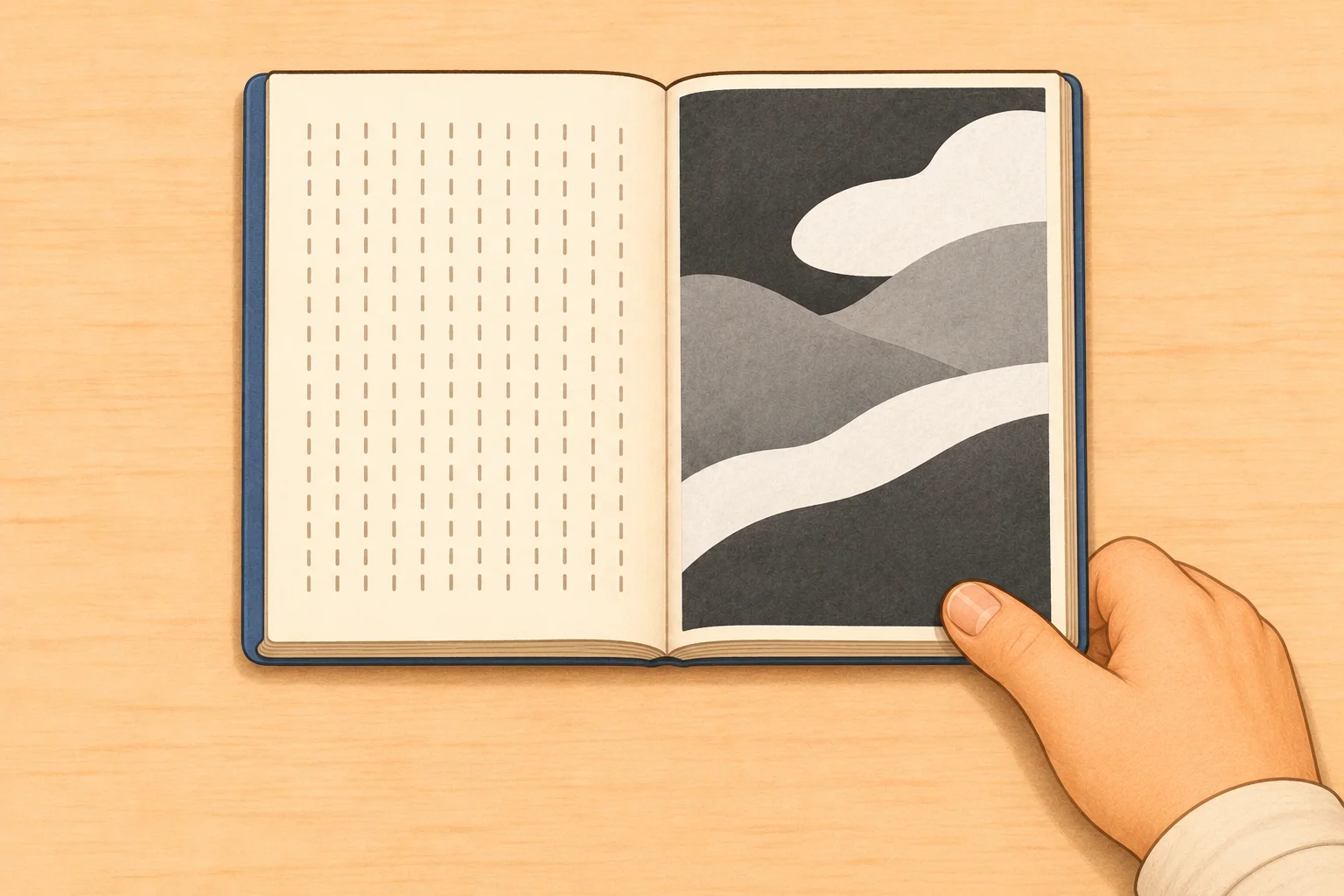 Inside, black-and-white illustrations appear among the pages of text.
Genre is wide open. Fantasy adventure, high school romantic comedy, science fiction battles, mysteries and slice-of-life comedies all sit on the same shelf, and since the 2010s a large share of new titles has been isekai, "other world" stories in which the hero is transported or reborn into a fantasy realm.
The term itself is a piece of Japanese-made English. The usual account is that it was coined around 1990 on NIFTY-Serve, an early Japanese online service, where the moderator of a science fiction and fantasy forum wanted a name for the new kind of paperback that sat somewhere between manga and conventional novels. "Light novel" stuck, though it only became common in the 2000s. Japanese bookstores often set light novels against ippan bungei, general popular fiction for adults, but the border is porous. Several writers started in light novels and moved on to mainstream success: Sakuraba Kazuki wrote the Gosick mysteries for a light novel imprint before winning the Naoki Prize, and Arikawa Hiro debuted with Dengeki Bunko.
02Before the Name: Girls’ Fiction and Fantasy Paperbacks
Paperback fiction for young readers existed long before anyone called it light novels. In the mid-1970s, Asahi Sonorama launched Sonorama Bunko for science fiction and adventure, while Shūeisha’s Cobalt Bunko became the home of shōjo shōsetsu, girls’ fiction. Writers such as Himuro Saeko and Arai Motoko, writing from the late 1970s, told their stories in the slangy, rambling voice of a teenager talking to a friend. Arai’s breathless first-person narration is often cited as a direct ancestor of light novel style.
- mid-1970sSonorama Bunko
- 1988Record of Lodoss War; Fujimi Fantasia Bunko founded
- around 1990"Light novel" coined on NIFTY-Serve
- 1993Dengeki Bunko launched
- 1998Boogiepop and Others
- 2003The Melancholy of Haruhi Suzumiya
- 2004Shōsetsuka ni Narō opens
- 2008Ore no Imōto ga Konna ni Kawaii Wake ga Nai
- 2009Sword Art Online published by Dengeki Bunko
The name "light novel" appeared only around 1990; youth paperbacks came before it, Dengeki Bunko, Haruhi and the web novels after.
The 1980s brought tabletop role-playing games and video games like Dragon Quest to Japan, and with them a hunger for sword-and-sorcery fantasy. Mizuno Ryō turned the play sessions of a tabletop gaming group into Record of Lodoss War, published as a Kadokawa paperback in 1988, and it went on to an influential anime adaptation. The same year Fujimi Shobō founded Fujimi Fantasia Bunko, and Kadokawa launched Sneaker Bunko around the same time. In 1990 Kanzaka Hajime’s Slayers appeared from Fujimi Fantasia, starring the sorceress Lina Inverse, who blows up anything in her way while keeping up a running stream of sarcastic commentary. Its mix of comedy and fantasy adventure became a template.
In 1993 MediaWorks, a company founded by staff who had left Kadokawa, launched Dengeki Bunko. It grew into the largest light novel imprint of all, and its annual Dengeki Novel Prize is still the most important door for new writers. Kadono Kōhei’s Boogiepop and Others, which won the grand prize of the fourth contest (then called the Dengeki Game Novel Prize) and was published in 1998, is a moody, fragmentary story about an urban legend at a high school, told from several viewpoints that slot together like puzzle pieces. Many later authors have said it was the book that showed them light novels could be ambitious.
03The Golden Age: Haruhi and the Anime Boom
The 2000s were the genre’s golden age, and one book stands at the center. Tanigawa Nagaru’s The Melancholy of Haruhi Suzumiya, published by Sneaker Bunko in 2003, is narrated by a wry, ordinary high school boy whose classmate announces on the first day that she is only interested in aliens, time travelers and espers. When Kyoto Animation adapted it in 2006, the ending dance went viral, sales of the novels soared, and the phrase "light novel" escaped the otaku world into general conversation.
Dengeki Bunko had its own run of hits. Kamachi Kazuma’s A Certain Magical Index, from 2004, set magic against science in a city of psychic schoolchildren and was published at a ferocious pace, spinning off A Certain Scientific Railgun. Takahashi Yashichirō’s Shakugan no Shana, Takemiya Yuyuko’s Toradora! and Hasekura Isuna’s Spice and Wolf followed. Spice and Wolf, about a traveling merchant in a quasi-medieval Europe and a wolf goddess who rides along with him, built its drama around currency exchange and trade negotiations, and showed how far the format could stretch. Nisio Isin’s Bakemonogatari series, published by Kōdansha in a larger-format paperback line, Kōdansha Box, rather than under a light novel label, is still usually counted as part of the same world, which says something about how loose the definition is.
This was when the partnership between light novels and anime became an industry in itself. Publishers, studios, music labels and others pool money in a "production committee" to adapt a popular series into a late-night anime, typically twelve or thirteen episodes. The anime works as an advertisement for the books, the books supply the anime with stories that already have fans, and a successful season sends readers back to buy every volume. Takarajimasha’s annual guidebook Kono Light Novel ga Sugoi! ("This Light Novel Is Amazing!"), first published in 2004, became the reader’s barometer for what mattered each year.
Then came the titles. Fushimi Tsukasa’s 2008 series Ore no Imōto ga Konna ni Kawaii Wake ga Nai, usually translated as Oreimo or My Little Sister Can’t Be This Cute, helped start a fashion for titles that are full sentences, often a complaint or a plot summary. The logic is practical: on a crowded shelf, a title that tells you the premise in one glance sells. By the 2010s the titles had grown to twenty or thirty characters and more, and became the feature outsiders most love to mock.
04The Web Novel Revolution and the Rise of Isekai
The biggest change since then has come from the internet. Shōsetsuka ni Narō ("Let’s Become a Novelist"), a free fiction-posting site opened in 2004, lets anyone serialize a novel and lets readers bookmark and rate it, with public rankings. Publishers began scouting the rankings and signing popular serials directly, often from amateurs who had never entered a prize contest.
The most famous example is Kawahara Reki. He had serialized Sword Art Online, about players trapped in a virtual-reality game where dying in the game means dying for real, on his own website in the early 2000s. After he won the Dengeki Novel Prize with a different book, Accel World, Dengeki Bunko published Sword Art Online in 2009. It became one of the best-selling light novel series in the world. Re:Zero − Starting Life in Another World by Nagatsuki Tappei, KonoSuba by Akatsuki Natsume, Overlord by Maruyama Kugane and That Time I Got Reincarnated as a Slime by Fuse all began as web serials before being picked up for print and then anime.
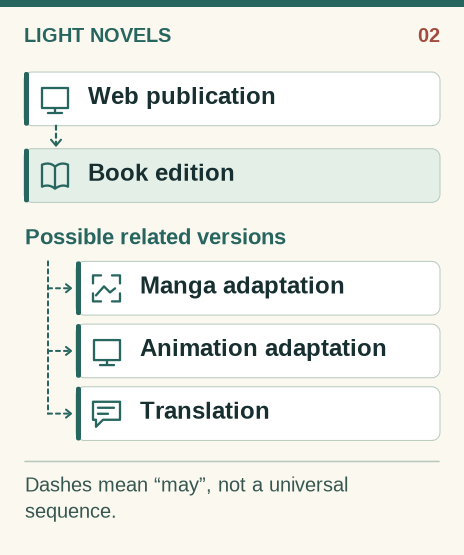
A story is serialized online, then published as a book, and may later become manga, anime or a translation.
These web-born hits made isekai the dominant genre. The hero, usually a tired young man, dies, often hit by a truck or worked to death, and wakes up in a world that runs like a role-playing game, complete with levels, skills and status screens. He keeps his memories and often an absurd advantage, and starts over. Japanese critics have offered many explanations for its appeal. The most common is that it offers exhausted students and office workers a clean restart in a world whose rules are clear and where effort shows up as visible progress, like leveling up in a game.
The web also changed the audience. Many web-origin novels are no longer published as pocket paperbacks but in a larger B6 format at well over 1,000 yen, aimed at readers in their thirties and forties, and shelved separately in stores. The traditional imprints’ readership has aged and shrunk, while sites like Narō and Kadokawa’s Kakuyomu receive a steady stream of new serials every day. The center of gravity has shifted from the editorial office to the ranking page.

A pocket-sized bunkobon beside the larger B6 format in which many web-origin novels are now published.
05Why They Read the Way They Do
Readers coming from Western fiction are often surprised by light novel prose: line after line of dialogue, lots of sound effects and exclamation marks, and a narrator who keeps commenting on what is happening. There is a reason for this. Light novels were written for readers raised on manga and games, and they borrow manga’s rhythm, moving scene by scene almost like panels. The constant first-person commentary, the tsukkomi or comic retort familiar from Japanese stand-up, puts the reader at the hero’s shoulder, as if a friend were telling the story.
The illustrations are the other half of the experience. Many readers pick up a book for the cover art before they look at the author, and a strong illustrator can make a series. Popular illustrators have their own followings and often shape the character designs when the series is animated. Because readers know exactly what the characters look like from the first page, the pleasure of light novels concentrates on character. Fans talking about a series are usually talking about a particular character.
Japan’s literary establishment has long looked down on light novels as formulaic and thinly written, and there is some truth in that. But they have also kept generations of teenagers reading at a time when publishers worried that young people had stopped, and their genre experiments are bolder than their reputation suggests: school comedy, fantasy war, economics, cooking and running a business can all end up in the same series, usually with a love triangle on top. For many Japanese adults, the paperbacks they read under the desk in junior high are as much a part of growing up as any manga.
06Finding Light Novels in Japan
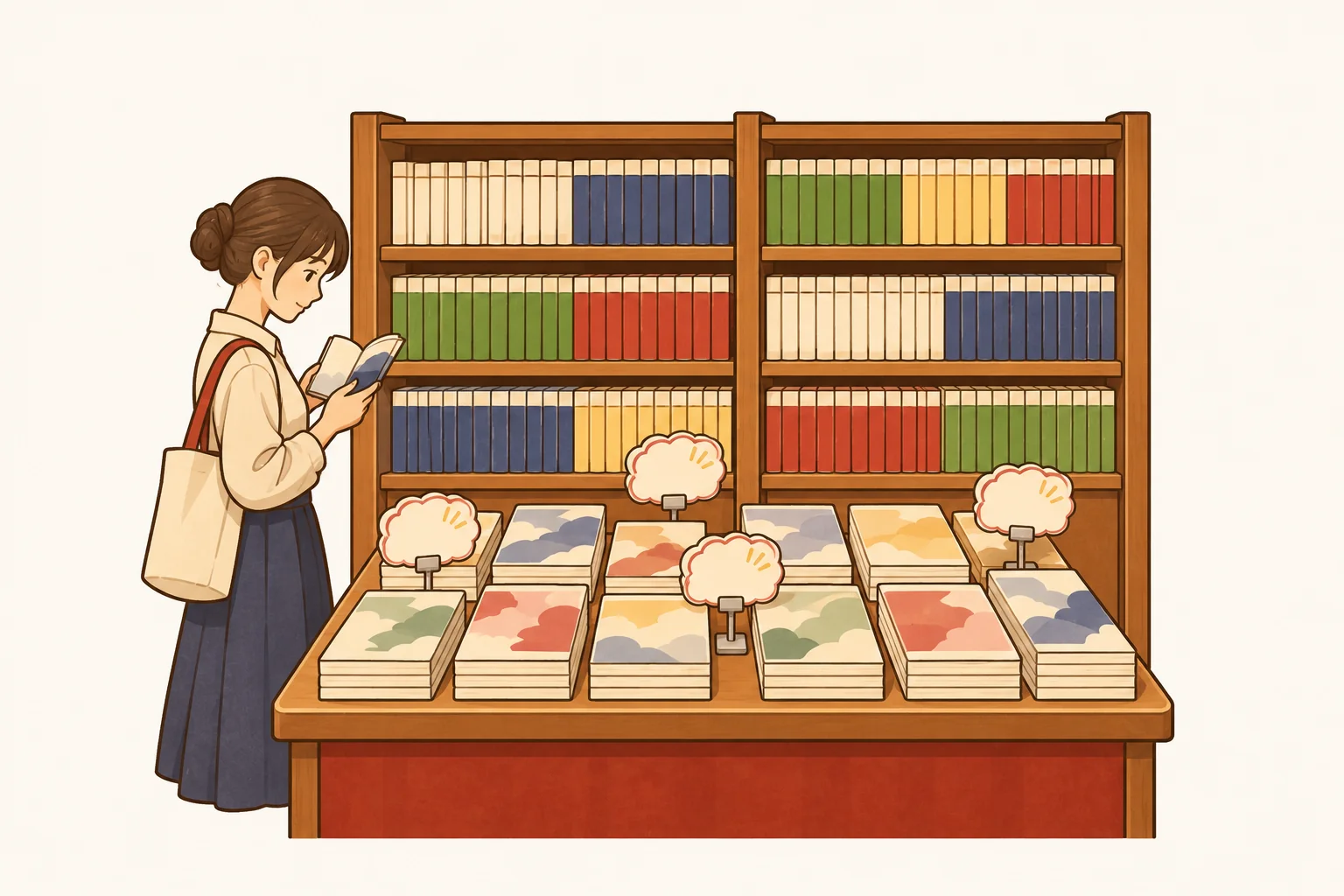
To see light novels in their natural habitat, go to Akihabara or Ikebukuro in Tokyo. Anime and manga specialty stores like Animate and Melonbooks stack new releases near the entrance with handwritten staff recommendations. Many offer store-exclusive bonuses (tokuten) with new volumes: an illustrated card, an alternate cover, or a short story printed only for that chain. Animate’s flagship in Ikebukuro is large enough to give manga and light novels a floor of their own. General bookstores such as Kinokuniya and Junkudō have light novel sections too, organized by imprint, so the color-coded spines run along the shelves in neat blocks.
New volumes arrive on fixed dates each month for each imprint, and stores pile the month’s releases up front. The obi, the paper band wrapped around the lower part of the cover, is worth reading even if your Japanese is limited: phrases like "anime adaptation confirmed" (アニメ化決定) or a cumulative sales figure tell you at a glance what is popular right now. If you cannot read Japanese, buying a volume purely for its cover art is a perfectly normal thing to do, and a bunkobon is light and cheap enough to make an easy souvenir.
Book Off, the secondhand chain, sells older light novels in bulk, often for around 100 yen a volume (as of 2025), which makes it the place to fill gaps in a series. For reading rather than collecting, many major series are available in English: Yen Press, J-Novel Club and Seven Seas publish a large catalog of licensed translations, including Sword Art Online, Spice and Wolf, Re:Zero and Haruhi, in print and as ebooks. Buying the Japanese edition in Akihabara and reading the translation at home, comparing the illustrations and the long titles, is a small pleasure many fans enjoy.