
At a glance
How a Tokyo jazz-bar owner became Japan’s most widely read novelist, why his books travel so well, and where to find his world in Japan.
- Murakami was born in Kyoto in 1949 and grew up in Nishinomiya and Ashiya, reading American paperbacks and falling for jazz.
- From 1974 he ran the jazz bar Peter Cat in Tokyo, selling it in 1981 to write full time.
- He decided to write a novel at a Jingū Stadium baseball game in 1978; Hear the Wind Sing won the Gunzō new writers’ prize the next year.
- Norwegian Wood came out in 1987 in red and green volumes and has sold more than ten million copies in Japan.
- Waseda University’s Haruki Murakami Library opened in 2021 and holds his manuscripts, books and records.
Murakami Haruki (known in English as Haruki Murakami) was running a jazz bar in Tokyo when, at 29, he decided to write a novel while watching a baseball game. Today his books have been translated into more than fifty languages, his new novels arrive with midnight launch parties, and every October the betting shops list him among the favorites for the Nobel Prize. For many readers outside Japan he is the first Japanese writer they ever read, and sometimes the only one. This introduction explains how he started, what his novels are actually like, why they travel so well, how he is seen inside Japan, and where a visitor can go to find his world.
01Why Murakami?
Ask a group of readers in London, São Paulo, Seoul or Shanghai to name a living Japanese novelist and most will name Murakami. His novels are bestsellers in China and South Korea, staples of university reading lists in the United States, and fixtures on the front tables of European bookshops. In Japan, his most devoted fans are known as Harukisuto ("Harukists"), and Japanese television has a small annual ritual: on the evening the Nobel Prize in Literature is announced, crews film a group of fans gathered in a café, waiting for news, and then film their good-humored disappointment when another name is read out.
The usual explanation for his reach is that Murakami does not write the Japan that foreigners expect. There are few kimonos, temples or tea ceremonies in his books. His narrators drink beer, cook spaghetti, iron their own shirts, listen to jazz and classical records, and read Raymond Chandler and F. Scott Fitzgerald. They live alone in cities that could be almost anywhere. The loneliness of the modern urban single person, polite and slightly detached, with a quiet sense that something has been lost, turns out to be the same in Tokyo as in New York or Berlin.
That is only half the story. Under the light surface of his books lies a very Japanese set of preoccupations: the collapse of the student movement of the late 1960s, the emptiness that followed the high-growth economy, the Kōbe earthquake and the Tokyo subway gas attack of 1995, and the long silence of his father’s generation about the war in China. His stories go down into wells, tunnels and other worlds, and what they find there is often history. That combination of an easy, almost weightless voice with something dark and heavy underneath is what keeps people rereading him.
02Growing Up Between Kōbe and Waseda
Murakami was born in Kyoto in January 1949 and grew up in Nishinomiya and Ashiya, quiet residential towns between Ōsaka and Kōbe, wedged between the sea and the Rokkō mountains. Both of his parents had taught Japanese literature, and classical Japanese texts were the talk of the household. The young Murakami, in what he has described as a mild rebellion, preferred foreign fiction. Kōbe was a port with a large foreign community, and in its secondhand bookshops he could buy cheap American paperbacks, which he read in English. It was also in Kōbe that he fell in love with jazz, after hearing Art Blakey and the Jazz Messengers live as a teenager.
In 1968 he entered Waseda University in Tokyo to study drama. It was the peak of Japan’s student movement, and Waseda was barricaded and on strike for long periods. Murakami kept his distance from the activists and was later deeply disillusioned by how quickly the movement dissolved; that disillusionment shapes Norwegian Wood, in which classmates who chanted revolutionary slogans quietly return to lectures as soon as the strike ends. For his first period in Tokyo he lived in Wakei-juku, a private men’s dormitory in Mejiro, which is widely taken to be the model for the dormitory in that novel.
He spent much of his student life in record shops and in the university’s theater library reading screenplays, and in 1971 he married a classmate, Yōko. Instead of joining a company, the couple borrowed money and in 1974 opened a jazz bar called Peter Cat in Kokubunji, a suburb in western Tokyo. It served coffee by day and drinks by night, with live music on weekends. Murakami finally graduated in 1975, and in 1977 the bar moved to Sendagaya, closer to the center of the city near the Meiji Jingū Gaien park. He washed dishes, made sandwiches and kept the books until late every night. Years of running a small business left him with a lifelong view of novel-writing as daily labor, something you clock in for.

A 1970s jazz bar, coffee by day and drinks by night. Murakami ran such a place and washed dishes there.
03The Double at Jingū Stadium
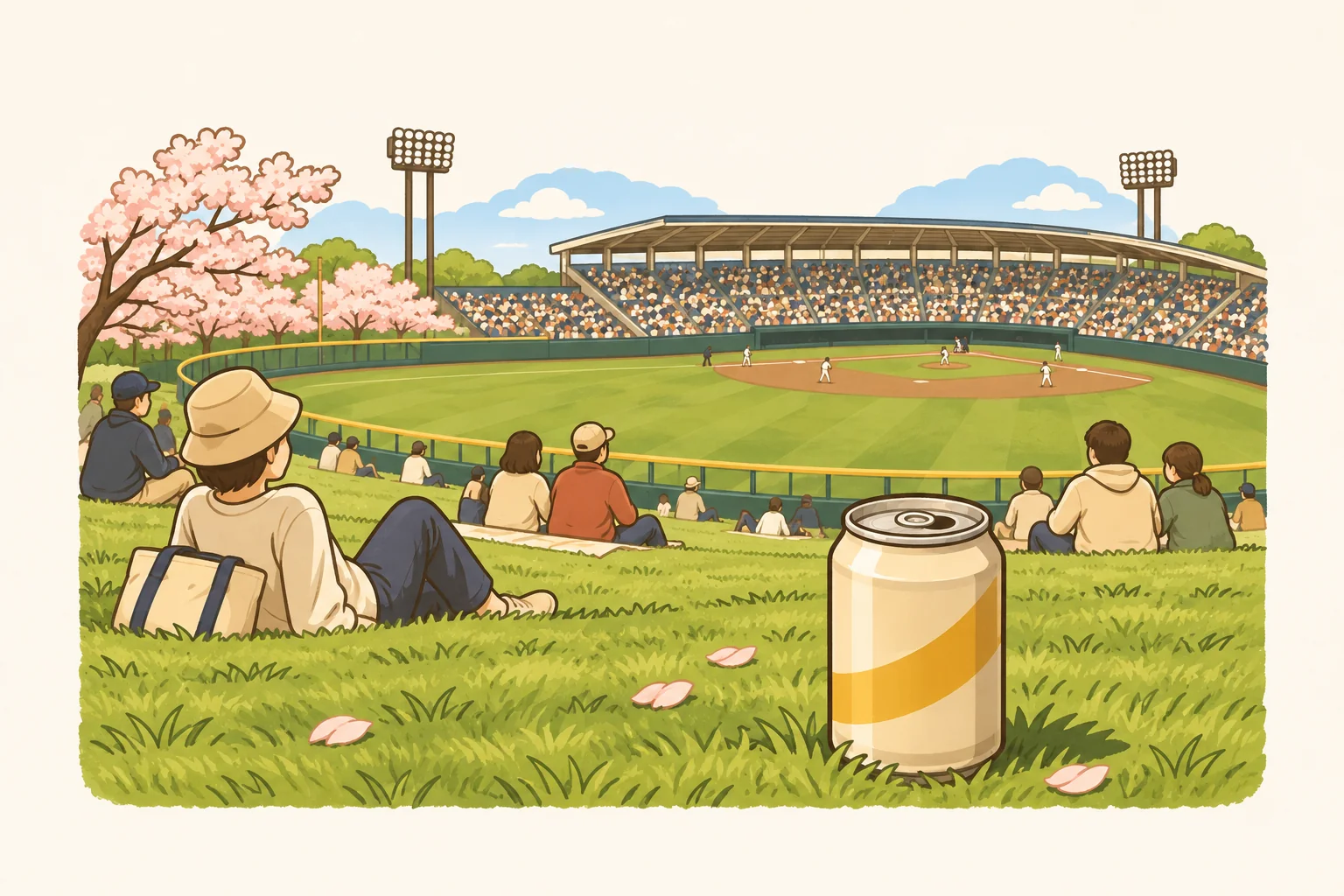
The story of how Murakami became a writer is one he has told many times. On a spring afternoon in April 1978 he was lying on the grass of the outfield bleachers at Jingū Stadium, drinking a beer and watching the opening game of the season between the Yakult Swallows and the Hiroshima Carp. In the bottom of the first inning, the Swallows’ American batter Dave Hilton hit a double, and at the moment the bat met the ball, Murakami has said, the thought came to him that he could write a novel. After the game he went to Shinjuku and bought a fountain pen and manuscript paper, by some accounts at the Kinokuniya bookstore. From then on, after coming home from the bar, he wrote at his kitchen table in the few hours before dawn. That season the Swallows, a perennial also-ran, won their first Japan Series, and Murakami has been a loyal fan ever since.
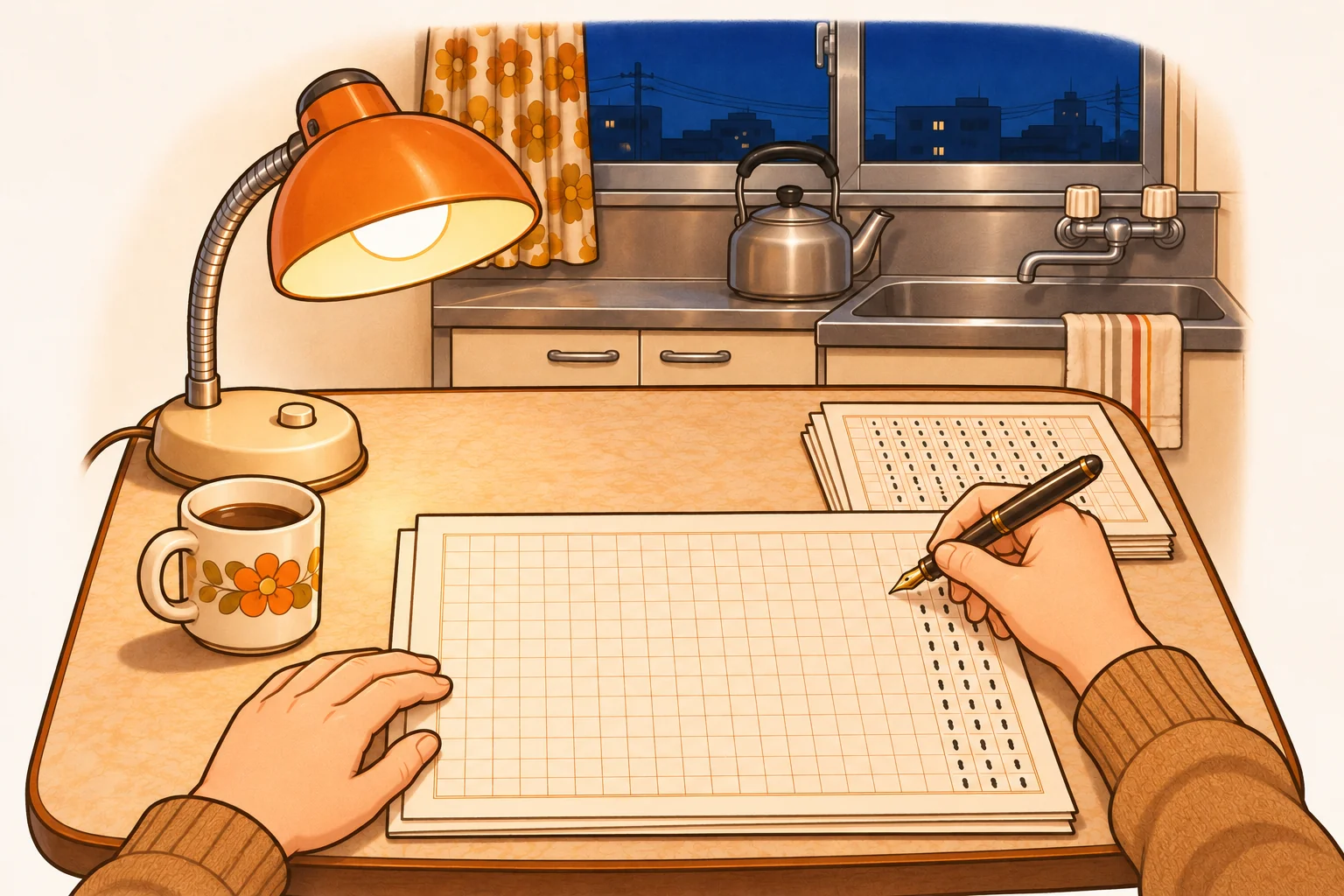
Fountain pen and manuscript paper at a kitchen table before dawn, the way he began writing.
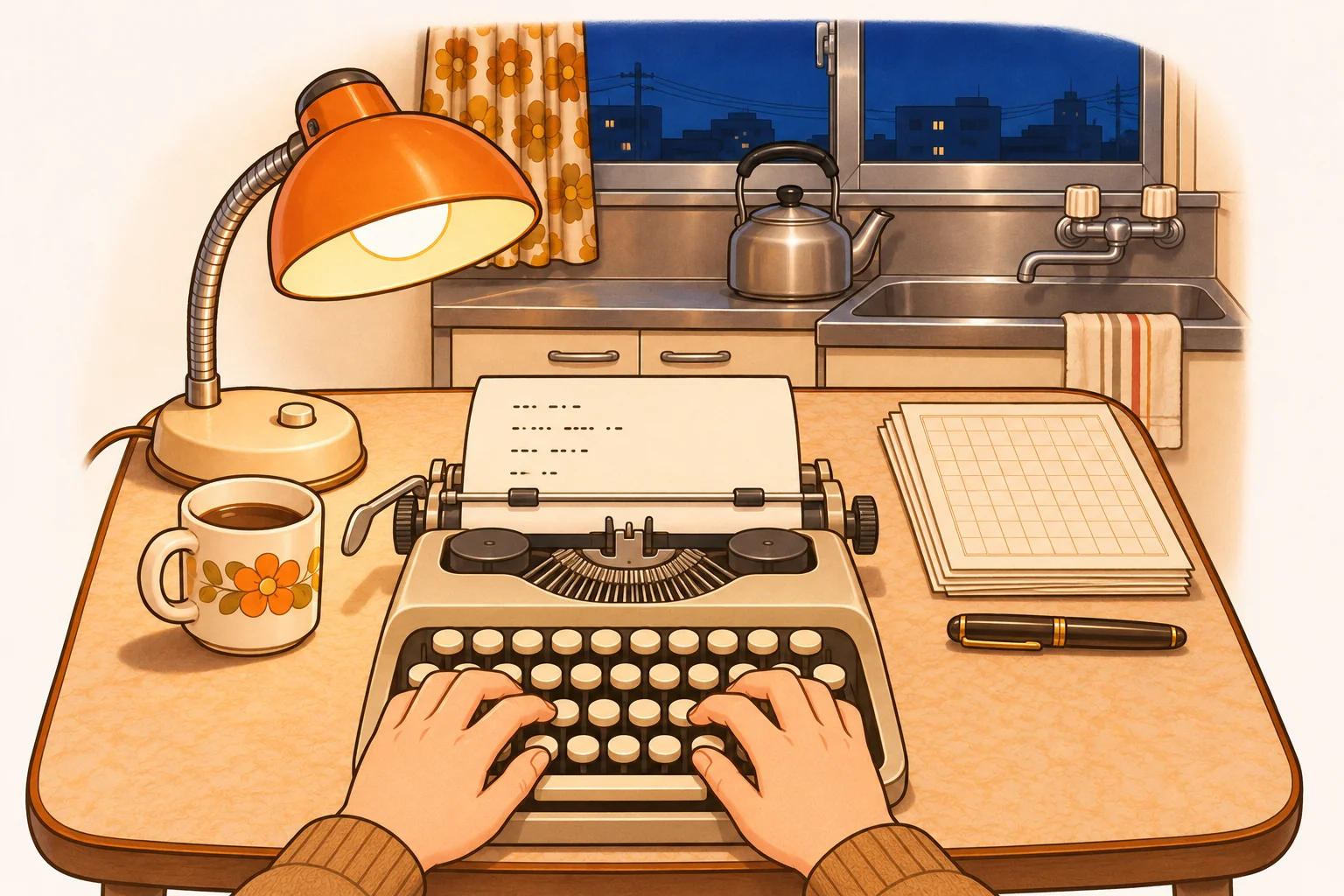
Bored by his first draft, he rewrote the opening in English on a typewriter, in short sentences and simple words.
His first draft bored him. So he tried an experiment: he wrote the opening again in English on an Olivetti typewriter. With his limited English he could only use short sentences and simple words, which forced him to strip everything down. He then translated the passage back into Japanese and found a voice nobody in Japanese literature was using: brisk, airy, faintly foreign, free of the confessional heaviness of the Japanese "I-novel" (shishōsetsu, the autobiographical fiction that had dominated serious literature for decades).
The result, Hear the Wind Sing, won the new writers’ prize of the literary magazine Gunzō in 1979. It is a short, fragmentary book about a 21-year-old student home for the summer in a seaside town, drinking beer at a bar with his friend the Rat and meeting a girl with nine fingers, interspersed with comments about an imaginary American writer named Derek Hartfield. A sequel, Pinball, 1973, followed in 1980. Both were shortlisted for the Akutagawa Prize, Japan’s most prestigious award for new literary fiction, and neither won. Japanese literary critics found his style thin and "translationese," and the fact that the prize passed over the country’s most famous novelist is still mentioned whenever the Akutagawa is discussed.
In 1981 Murakami sold the bar and became a full-time writer. Around 1982, to sit at a desk for long hours he took up running, and he has run a full marathon nearly every year since. His first full-length novel, A Wild Sheep Chase (1982), sends the narrator to the mountains of Hokkaidō at the request of a mysterious right-wing power broker, in search of a sheep with a star-shaped mark on its back. It ends with a reunion in an abandoned villa with the Rat, who is already dead. With its predecessors it forms what readers call the "Trilogy of the Rat," and it won the Noma Literary Prize for New Writers.
04Norwegian Wood and Sudden Fame
Hard-Boiled Wonderland and the End of the World (1985) alternates between two narratives. In one, a data processor in a near-future Tokyo navigates an underground world of flesh-eating creatures called INKlings; in the other, a man lives in a quiet walled town where people have been separated from their shadows, and spends his days reading "old dreams" from unicorn skulls in the library. It won the Tanizaki Prize and remains, for many longtime readers, his most ambitious early book.
What turned him into a national phenomenon, though, was Norwegian Wood in 1987. He wrote it in Greece, Sicily and Rome during three years he and his wife spent in Europe, and this time he set out deliberately to write a straightforward love story with no sheep men and no underworlds. The novel opens with the 37-year-old narrator, Watanabe Tōru, on a plane landing in Hamburg, hearing an orchestral version of the Beatles’ "Norwegian Wood" over the cabin speakers and remembering Naoko, the girlfriend of his best friend Kizuki, who killed himself at 17. Naoko later retreats to a sanatorium in the mountains north of Kyoto, while in Tokyo Watanabe meets Midori, a frank, funny student whose family runs a small bookshop. The pull between the two women is the pull between the dead past and the living present.
Kōdansha published it in September 1987 in two volumes, one bound in solid red and the other in deep green, a design said to have been Murakami’s own, with a paper band calling it a "100 percent love story." Young people gave the pair as gifts and carried them as fashion accessories. Sales ran into the millions within a year or two, and with the later paperback editions the novel has sold more than ten million copies in Japan, among the best-selling novels in the country’s history. Murakami has said that he found the fame unpleasant, like being chased by something enormous that did not belong to him. He spent much of the following years abroad, including stints from 1991 as a visiting scholar at Princeton University and from 1993 at Tufts.
In the English-speaking world his rise came more slowly. Early translations by Alfred Birnbaum, especially A Wild Sheep Chase (1989), introduced him to American readers through Kodansha International, and Jay Rubin’s translation of Norwegian Wood in 2000 made the novel a campus favorite. Philip Gabriel and, later, Ted Goossen joined the small group of translators whose voices English readers now hear as "Murakami." In East Asia the story was different again: Norwegian Wood became a defining book for a generation of readers in China, Taiwan and South Korea. A film version directed by Tran Anh Hung, starring Matsuyama Ken’ichi and Kikuchi Rinko, appeared in 2010.
05Down the Well: The 1990s
Living in the United States made Murakami look again at Japan. In the library at Princeton he read about the Battle of Nomonhan, the 1939 border war between Japan’s Kwantung Army and Soviet and Mongolian forces, and it became the heart of his next major novel, The Wind-Up Bird Chronicle, published in three parts in 1994 and 1995. Its narrator, Okada Tōru, is out of work; first his cat disappears, then his wife. He climbs down into a dry well in the garden of an abandoned house nearby and sits in the dark, and from the bottom of the well he finds a passage into another world. Interwoven with his story are wartime memories told by an old veteran, including a scene in Mongolia in which a Japanese officer is skinned alive. Murakami’s father had been drafted and sent to fight in China, and this novel was the first in which he placed wartime violence and historical responsibility at the center of his fiction. It won the Yomiuri Prize for Literature and is regarded by many critics as his most important book.
Then came 1995, a terrible year for Japan. In January the Great Hanshin earthquake devastated Kōbe and Ashiya, the towns of his childhood. In March members of the religious group Aum Shinrikyō released sarin gas on the Tokyo subway, killing more than a dozen people and injuring thousands. Murakami returned to live in Japan that year and did something unusual for a novelist: he spent a year interviewing sixty-two victims of the attack and people connected to it, and published their accounts as the nonfiction book Underground (1997). He followed it with interviews with Aum members, published as The Place That Was Promised (1998). He wanted to understand how ordinary people were swept into violence on an ordinary weekday morning, and why young believers handed themselves over to a closed, ready-made story.
The earthquake found its way into the story collection after the quake (2000). All six stories are set in February 1995; none of their characters were in Kōbe, yet each is shaken by it. The best loved, "Super-Frog Saves Tokyo," has a giant talking frog recruit a mild-mannered loan collector to go underground with him and fight a huge worm whose rage is about to cause another earthquake. It is absurd and tender at once, and a fine place to start for anyone new to his short fiction.
06The Novels Since 2000
In the new century each Murakami novel became an event. Kafka on the Shore (2002) runs on two tracks. A 15-year-old boy who calls himself Kafka Tamura runs away from home, takes a night bus to Takamatsu on the island of Shikoku and hides in a small private library. Meanwhile an elderly man named Nakata, who lost the ability to read and write after a mysterious incident during the war and can talk to cats, sets out toward Shikoku too. There is a cat-killer who goes by the name of Johnnie Walker, fish and leeches fall from the sky, and an Oedipal prophecy hangs over the boy. The English translation was a New York Times best book of 2005 and won the World Fantasy Award, cementing his reputation in the West.
1Q84 (2009–2010), his longest novel, was published in Japan in three volumes. It is set in Tokyo in 1984. A fitness instructor and part-time assassin named Aomame climbs down an emergency staircase from an elevated expressway and finds herself in a world with two moons, which she calls 1Q84; a math tutor and aspiring novelist named Tengo agrees to ghostwrite a strange novella, Air Chrysalis, by a 17-year-old girl. Behind the book stands a closed religious commune called Sakigake, in which readers recognized echoes of both Aum and the radical communes of the 1960s and 1970s. The publisher released nothing about the plot in advance, and still, by press accounts, readers lined up at bookstores and the first two volumes sold close to a million copies in little more than a week. The "Q" is a pun, since in Japanese the letter and the number nine are both pronounced kyū, and a nod to Orwell.
Colorless Tsukuru Tazaki and His Years of Pilgrimage (2013) is a quieter book about a 36-year-old railway station designer who was abruptly cut off by his four closest high-school friends and, sixteen years later, finally goes to ask them why; the title borrows from Liszt’s piano suite Années de pèlerinage. It sold a million copies in about a week. Killing Commendatore (2017) follows a portrait painter living in a mountain house near Odawara who finds a hidden painting in the Japanese style; one of its figures, the Commendatore, steps out of the canvas as a two-foot-tall man and starts talking to him. The novel touches on the Nanjing Massacre and the Nazi annexation of Austria, and drew criticism from nationalist commentators in Japan. The City and Its Uncertain Walls (2023) goes back to a novella Murakami published in a magazine in 1980 and never allowed to appear in book form. It returns to the walled town, the shadows and the dream reader of Hard-Boiled Wonderland, and reads as a writer in his seventies revisiting the place where he started.
His short stories matter as much as the novels. Collections such as The Elephant Vanishes, Blind Willow, Sleeping Woman, Men Without Women and First Person Singular contain many of his best-known pieces, among them "On Seeing the 100% Perfect Girl One Beautiful April Morning" and "Barn Burning." Film has carried these stories to new audiences. Lee Chang-dong turned "Barn Burning" into Burning (2018), and Hamaguchi Ryūsuke built Drive My Car from a story in Men Without Women; it won the Academy Award for Best International Feature Film in 2022.
International honors have accumulated: the Franz Kafka Prize in 2006, the Jerusalem Prize in 2009, the Hans Christian Andersen Literature Award in 2016 and Spain’s Princess of Asturias Award for Literature in 2023. He went to Jerusalem in 2009 despite calls in Japan to boycott the prize over the war in Gaza, and in his acceptance speech said that between a high, solid wall and an egg that breaks against it, he would always stand on the side of the egg. It remains the most quoted public statement he has made.
07The Murakami Toolkit
After two or three books, readers start to recognize the furniture. The narrator, usually called boku (a casual, slightly boyish "I"), is often around thirty, polite and a little detached. He lives alone, cooks well, does his own laundry, and keeps beer in the fridge. Music is everywhere: Bill Evans, Thelonious Monk, Beethoven, Janáček’s Sinfonietta in 1Q84, Rossini’s The Thieving Magpie overture in The Wind-Up Bird Chronicle. Cats go missing, and so do women, and to find them the narrator has to leave ordinary life and go down: into a well, a sewer, a hotel corridor, another world. There he meets the Sheep Man, the Little People, a talking Commendatore. The line between real and unreal is never drawn, and the narrator, rather than being astonished, tends to accept what happens and then go back to making dinner.
Murakami has explained his method with an image of a house. There is a ground floor where people live and talk, a basement where they keep their memories, and below that another, deeper basement that most people never visit. Writing fiction, he says, means going down alone to that lowest level, seeing something in the dark and bringing it back up. He does not plot his novels in advance; he sits down each day and follows the story to see where it goes. That is one reason his endings are so often open. He does not know the answer either.
His lightness and his heaviness belong together. The lightness is in the style: short sentences, outlandish similes, patient attention to small domestic acts, and a dry humor. The heaviness is in the material: death, loss, violence, memory, and the parts of modern Japanese history that were never properly faced. For years Japanese critics dismissed him as a product of urban consumer culture with nothing to say about society; Kenzaburō Ōe, the Nobel laureate, was publicly cool toward his work. Since the 1990s scholars have paid much more attention to the historical awareness that runs through his fiction. In Japan he is often paired with his contemporary Murakami Ryū (no relation) as "the two Murakamis," and with Yoshimoto Banana, whose Kitchen was a hit in the same late-1980s moment, as signs of Japanese fiction moving away from the old literary establishment toward a much broader readership.
The way he lives has become part of his appeal. He gets up around four in the morning, writes for five or six hours, runs or swims in the afternoon, reads and listens to records in the evening and goes to bed around nine. By his own account, when working on a novel he writes ten pages of standard 400-character manuscript paper a day, no more and no less. He has run dozens of marathons and a 100-kilometer ultramarathon, and has competed in triathlons; What I Talk About When I Talk About Running (2007) is his memoir of that life. His record collection runs to well over ten thousand discs, mostly vinyl.
He is also a prolific translator from English. He has translated all of Raymond Carver, Fitzgerald’s The Great Gatsby, Salinger’s The Catcher in the Rye, Chandler’s The Long Goodbye and much else. For him translation is a form of very close reading and a way of keeping his own prose in shape. Since 2018 he has hosted a radio program, Murakami Radio, on Tokyo FM, playing records from his collection and talking about music.
08Finding Murakami in Japan
Murakami rarely appears in public, almost never gives Japanese television interviews and does few book signings at home, so the chance of meeting him in Japan is slim. But his world is spread across real places that a reader can visit.
The first stop should be the Waseda International House of Literature, better known as the Haruki Murakami Library, on Waseda University’s campus in Tokyo, which opened in 2021. Murakami donated or deposited his manuscripts, letters, books and his record collection with his old university, and the architect Kuma Kengo renovated an existing campus building, No. 4, to house them. Just inside the entrance an arched wooden bookcase rises through three floors; Kuma describes the design as a tunnel, and walking in feels like descending into one of Murakami’s passageways. Inside there is an audio space for listening to records, a re-creation of the writer’s study on the basement floor, and a student-run café called Orange Cat, which brings Peter Cat to mind.

The entrance of Waseda's International House of Literature: an arched wooden bookshelf "tunnel" rising three storeys (illustration).
From there you can follow Norwegian Wood through the city. Watanabe and Naoko run into each other on the Chūō Line and get off at Yotsuya, then walk along the embankment of the old outer moat toward Iidabashi and on past Ochanomizu. Midori’s family bookshop is placed in the Ōtsuka area in the north of the city; by one account the novel also mentions the nearby Toden Arakawa streetcar line. Jingū Stadium is in the Meiji Jingū Gaien area; watching a Yakult Swallows game from the outfield seats with a draft beer is about as Murakami an experience as Tokyo offers. Nearby Sendagaya was the site of the second Peter Cat, though the building now houses other businesses.
In the Kansai region you can see the landscape of his boyhood. The banks of the Shukugawa river in Nishinomiya are lined with cherry trees, and the streets around Hankyū Railway’s Shukugawa and Ashiyagawa stations are still quiet residential neighborhoods. The unnamed seaside town of Hear the Wind Sing is generally thought to be modeled on this stretch of coast. In Kōbe, the Motomachi and Sannomiya areas still have secondhand record and book shops where you can picture a teenager hunting for American paperbacks. The library in Kafka on the Shore is fictional, but the novel has sent more than a few readers on the night bus to Takamatsu.
In Japanese bookshops his books sit mostly in the bunko section, the small, inexpensive paperback editions that, as of 2026, mostly still cost under a thousand yen each; Shinchō Bunko and Kōdansha Bunko both carry long runs of his work. When a new Murakami novel comes out, several big Tokyo bookstores open at midnight to sell it, and lines of fans take pictures while they wait. If you happen to be in town, buying a Japanese edition, complete with its paper band (obi) of publisher’s blurbs, makes a good souvenir even if you cannot read it.
There is no correct order in which to read him. Norwegian Wood shows his realist side. A Wild Sheep Chase or Hard-Boiled Wonderland will take you into his other worlds. The Wind-Up Bird Chronicle is the deepest of them. And if you only have one sleepless night, a single story such as "On Seeing the 100% Perfect Girl One Beautiful April Morning" is enough to understand why so many people around the world read Murakami after midnight.