

At a glance
How thirty-one sound units make a poem, how the Kokinshū set Japan’s seasonal taste, how modern poets remade the form, and where to hear it today.
- A waka (usually called tanka in modern times) has five lines of 5-7-5-7-7 sounds, thirty-one in all.
- The sounds are morae, counted roughly one per kana; long vowels and the nasal n add beats of their own.
- The Kokinshū, ordered by the emperor around 905, has twenty scrolls and about 1,100 poems.
- In 1898 Masaoka Shiki’s serialized "Letters to a Waka Poet" set waka on the road to modern tanka.
- Each January the Imperial Palace holds the Utakai Hajime; as of 2026, well over ten thousand poems are still submitted each year.
Long before haiku, Japan had a shorter-than-a-sonnet poem that everyone at court was expected to write: five lines in a pattern of 5, 7, 5, 7 and 7 sound units, thirty-one in all. In its classical form it is called waka, "Japanese song"; since the late nineteenth century the same form has mostly been called tanka, "short song." For a thousand years it was the language of courtship, apology, grief and polite conversation among the aristocracy, and its seasonal imagery still shapes how Japan decorates a sweet or chooses a kimono. It is also very much alive: newspapers print readers’ tanka every week, and each January the emperor’s poem is chanted aloud at the palace. This introduction explains how the form works, why the tenth-century Kokinshū mattered so much, how modern poets remade it, and where a visitor can meet it today.
01How Thirty-One Sounds Make a Poem
Japanese poetry does not count syllables in the English sense. It counts on or morae, roughly the beats you would tap out for each kana character. A long vowel takes two beats, as does a syllable ending in the nasal n. So sakura (cherry blossom) is three, but Tōkyō is four: to-o-kyo-o. A waka arranges these beats as 5-7-5-7-7. The first three lines are the "upper verse" (kami no ku) and the last two the "lower verse" (shimo no ku), and the turn between them is often where the poem pivots from an image to a feeling. Going a beat or two over, called ji-amari, is tolerated if the line still sounds right.
Thirty-one beats is very little. It is roughly the length of a single English sentence, and it cannot tell a story. Over the centuries poets developed several devices for packing more into it, and a reader who knows them suddenly finds the poems much denser than they look.
The most important is the kakekotoba, or pivot word: a sequence of sounds that means two things at once. The best-known example is by Ono no Komachi, a ninth-century poet famous for her beauty:
Hana no iro wa / utsurinikeri na / itazura ni / waga mi yo ni furu / nagame seshi ma ni
| Upper verse | 花の色は | hananoirowa | 6/5 |
|---|---|---|---|
| うつりにけりな | utsurinikerina | 7/7 | |
| いたづらに | itazurani | 5/5 | |
| Lower verse | わが身世にふる | wagamiyonifuru | 7/7 |
| ながめせしまに | nagameseshimani | 7/7 |
Counted in beats, Komachi’s poem runs 6-7-5-7-7: the extra beat in the first line is the ji-amari described above.
The color of the flowers has faded, in vain, while I passed through the world, gazing out. But furu means both "to pass time" and "to fall" (of rain), and nagame means both "a long gaze" and "the long rains." So the poem says two things simultaneously: the cherry blossoms have faded in the spring rain, and the woman’s own looks have faded while she sat lost in thought. No translation keeps both.
Other devices work through shared memory. Makurakotoba, "pillow words," are fixed epithets attached to certain nouns: hisakata no always introduces light, sky or moon; ashihiki no always introduces mountains. Their original meanings were obscure even to Heian poets, and they function like a musical upbeat. Utamakura, "poem pillows," are place names loaded with stock associations. Yoshino means cherry blossoms and snow; the Tatsuta River means autumn leaves; the Ōsaka barrier, east of Kyoto, means meeting and parting, because au is "to meet." A poet did not need to describe the scene, only to name it. Later, around 1200, poets practiced honkadori, quoting a line or two of a famous older poem so that the old and new poems sounded together in the reader’s mind.
What these devices have in common is that the poem does not try to say everything. It relies on a shared vocabulary of seasons, places and phrases, and leaves the reader to complete it. That is why waka can seem slight in translation and so full in the original.
02From the Man’yōshū to the Kokinshū
The earliest large anthology, the Man’yōshū ("Collection of Ten Thousand Leaves"), was compiled in the late eighth century. Its roughly 4,500 poems range from emperors to frontier guards and provincial farmers, and they were written down using Chinese characters for their sounds. Long poems (chōka) appear alongside short ones, but by this period the five-line form was already the dominant one. In 2019 the name of Japan’s new imperial era, Reiwa, was taken from a preface in the Man’yōshū, the first era name drawn from a Japanese rather than a Chinese classic.
In the early ninth century the court turned toward China. Official writing and prestige poetry were in classical Chinese, and waka retreated into private life, passed between lovers. Two things brought it back. The kana syllabaries matured, letting both men and women write Japanese naturally; and the court began holding utaawase, poetry contests in which poets on a Left and a Right team were matched poem against poem on set topics, with a judge declaring a winner. Around 905, Emperor Daigo ordered an anthology of Japanese poetry. The result was the Kokin wakashū, "Collection of Poems Ancient and Modern," usually shortened to Kokinshū. Its compilers were Ki no Tsurayuki, Ki no Tomonori, Ōshikōchi no Mitsune and Mibu no Tadamine; Tomonori died before it was finished.
The Kokinshū has twenty scrolls and about 1,100 poems, and its real innovation was the arrangement. It opens with two books of spring, one of summer, two of autumn and one of winter, and within each book the poems follow the season’s progress. Spring begins with lingering snow and the first bush warbler, moves through plum blossom to cherry blossom, lingers over the falling petals and ends with regret that spring is over. Reading straight through feels like living through a year. After the seasons come celebration, parting and travel poems, a book of mono no na poems with the names of things hidden in them, and then five books of love, arranged as the stages of an affair: longing for someone not yet seen, the first meeting, anxiety after meeting, fading, resentment and memory. Laments and miscellaneous poems follow.
- 1Seasons (6 books)two of spring, one of summer, two of autumn, one of winter
- 2Celebration
- 3Parting
- 4Travel
- 5Mono no nanames of things hidden in the poems
- 6Love (5 books)longing, first meeting, anxiety, fading, resentment, memory
- 7Laments, miscellaneous
Twenty scrolls, about 1,100 poems: seasons and love form a double spine, and within each book the poems follow the season or the affair.
This double spine of seasons and love became the template for later imperial anthologies, and it trained centuries of readers to experience the year as a sequence of small, nameable moments. When a Kyoto confectioner changes the shape of a sweet every few weeks, or a tea host chooses a scroll to match the month, the habit goes back to books like this.
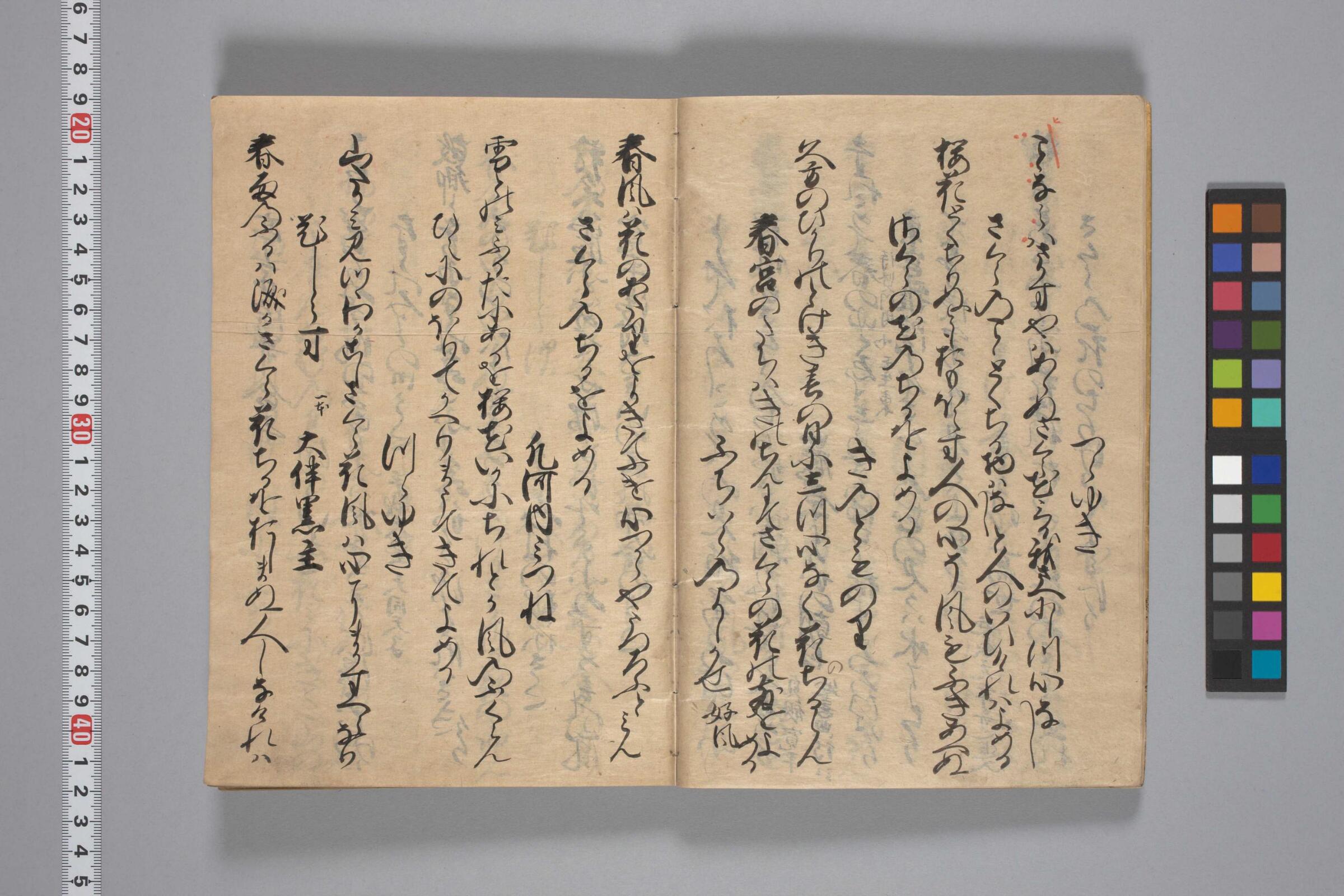
A manuscript copy of the Kokinshū, its poems written in flowing kana; the right page includes Ki no Tomonori’s "Hisakata no".
Ki no Tsurayuki also wrote a preface in kana, one of the first pieces of literary criticism in Japanese. Its opening line is famous: Yamato uta wa, hito no kokoro o tane to shite, yorozu no koto no ha to zo narerikeru, "Japanese poetry takes the human heart as its seed and grows into myriad leaves of words." The Japanese word for "word," kotoba, contains ha, "leaf," and Tsurayuki builds the whole image on that pun. The preface also assesses six earlier poets, later called the Six Poetic Immortals (rokkasen), among them Ono no Komachi and Ariwara no Narihira, whose romantic exploits were later woven into The Tales of Ise.
The Kokinshū style is witty and reflective. Poets like to look at a scene and ask why, or to reason their way to an unexpected comparison. Ki no Tomonori’s poem on cherry blossoms is typical: on a spring day of calm, gentle light, why do the blossoms scatter with such restless hearts? Nothing happens in it except a question. That mix of refinement, restraint and faint sadness became the keynote of Heian taste.
03Poetry as Social Life at Court
For Heian aristocrats, waka was not a hobby but a basic social skill. A man courted a woman by sending a poem, often on carefully chosen paper with a sprig of a seasonal plant attached. After spending the night, he was expected to send a "morning-after poem" (kinuginu no uta) as soon as he got home; a late or clumsy one was read as a sign of indifference. She could answer warmly, or turn him down with a well-placed pun. Seasonal greetings, thanks for a gift and complaints about being passed over for promotion were all done in verse. The Pillow Book of Sei Shōnagon is often cited as describing how mortifying it was to be asked for a poem on the spot and have nothing to offer. The Tale of Genji contains almost eight hundred poems, and its characters often respond to the decisive moments of their lives not with speech but with a poem.
- 1
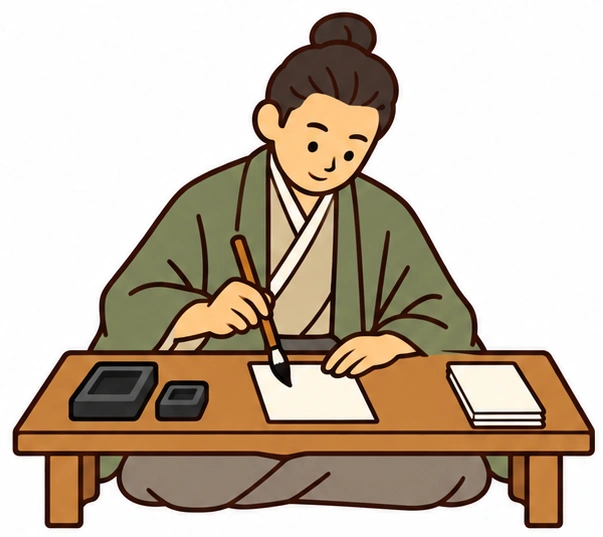 Write: a man courting, or leaving at dawn, first composes a poem.
- 2
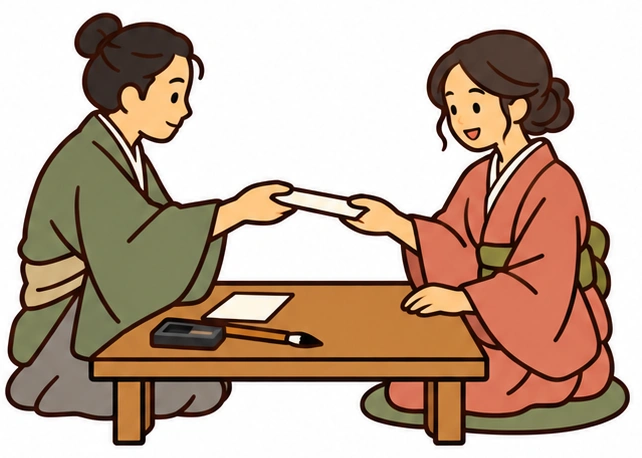 Send: it must arrive quickly; a slow poem looks cold-hearted.
- 3
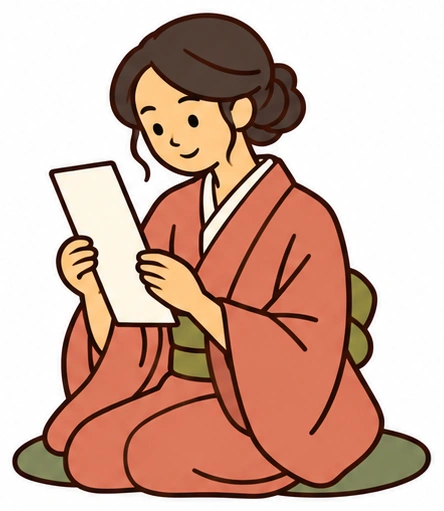 Reply: she reads it and answers with a poem, accepting or turning him down with a pun.
After the Kokinshū, anthologies commissioned by an emperor or retired emperor were known as chokusenshū, imperial anthologies. There were twenty-one in all, the last compiled in the 1430s. The most admired after the Kokinshū is the Shin Kokinshū ("New Collection of Ancient and Modern Poems"), ordered by the retired emperor Go-Toba and presented in 1205. One of its editors, Fujiwara no Teika, became the most influential poet of medieval Japan. His most quoted poem describes a view with nothing in it: look out, and there are neither blossoms nor autumn leaves, only a reed-thatched hut by the bay in the autumn dusk. The beauty of absence that it expresses was later claimed as one of the sources of the tea ceremony’s aesthetic of wabi.
Late in life, probably at a friend’s request, Teika selected one poem each by a hundred poets, from Emperor Tenji in the seventh century to his own contemporaries. This Ogura hyakunin isshu ("One Hundred Poets, One Poem Each") became a card game in the Edo period, and it is still played at New Year and as the competitive sport kyōgi karuta. For most Japanese people, these hundred poems, learned at school, are their first and most lasting contact with classical waka.
Having a poem accepted into an imperial anthology was a lifelong honor for courtiers and, later, for warriors too. Poetry became hereditary expertise: Teika’s descendants split into the Nijō, Kyōgoku and Reizei houses, and the correct interpretation of the Kokinshū was passed down as secret teaching, the Kokin denju. The warrior Hosokawa Yūsai held this transmission, and when he was besieged at Tanabe Castle in 1600 the court reportedly intervened to end the siege so that the teaching would not die with him. The Reizei family still lives in Kyoto and preserves manuscripts in Teika’s own hand.
04From Waka to Tanka
In the Edo period the energy of popular verse went into haikai and the comic senryū, while waka stayed with the court nobility and the poetry houses, its themes and diction increasingly fixed. After the Meiji Restoration, young poets declared the old form dead. In 1898 Masaoka Shiki serialized Letters to a Waka Poet (Utayomi ni atauru sho) in ten installments in the newspaper Nippon; the second letter opens by calling Ki no Tsurayuki a poor poet and the Kokinshū a worthless anthology. He championed instead the directness of the Man’yōshū and of the thirteenth-century shogun Minamoto no Sanetomo, and argued for shasei, "sketching from life," writing what one actually sees. Shiki was reforming haiku at the same time, and he is the key figure in the modernization of both forms.
From this period the word "tanka" gradually replaced "waka." Waka originally meant Japanese verse in general, as opposed to Chinese verse, and covered several forms; tanka names the 5-7-5-7-7 form specifically, and the change of name carried a sense of making a fresh start. Today "waka" usually refers to classical poems and "tanka" to modern ones, though the form is the same.
The Meiji and Taishō years produced an extraordinary burst of tanka. Yosano Akiko’s Tangled Hair (Midaregami, 1901) wrote openly about a woman’s body and desire and scandalized critics. Ishikawa Takuboku’s A Handful of Sand (Ichiaku no suna, 1910) set tanka in three lines and wrote about poverty, homesickness and exhaustion; his poem about working and working and still not getting by, and staring at his own hands, is one many Japanese can still recite. Shiki’s followers gathered around the magazine Araragi, and Saitō Mokichi’s sequence on his mother’s death, in his collection Red Light (Shakkō, 1913), is often counted among the high points of modern tanka.
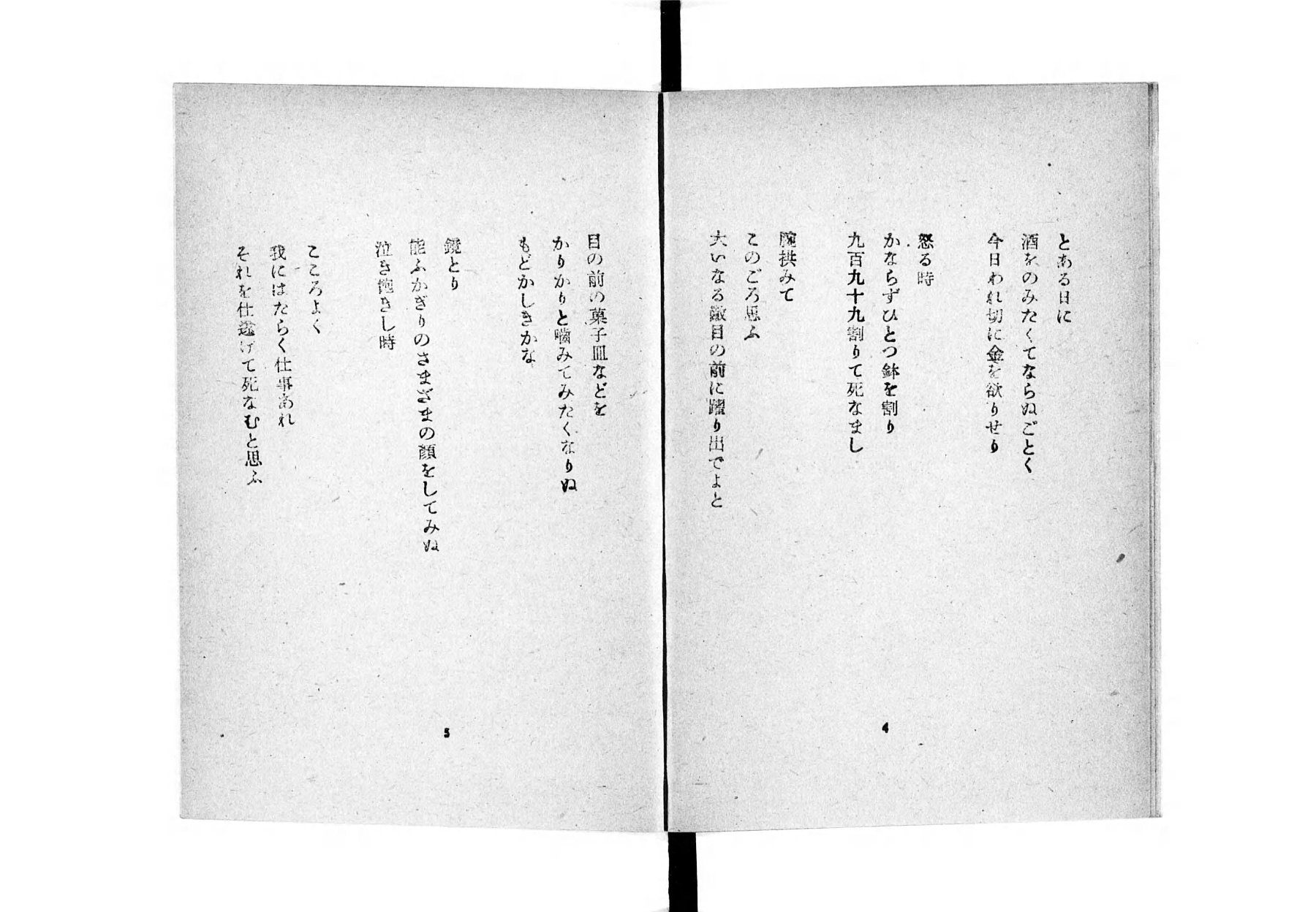
Pages of Ishikawa Takuboku’s A Handful of Sand (1946 edition), each tanka set in three lines.National Diet Library: Ishikawa Takuboku, A Handful of Sand (Takasu Shobō, 1946 edition)
The form had another popular moment in 1987, when a high school teacher named Tawara Machi published Salad Anniversary (Sarada kinenbi). Its title poem says, in effect: because you said "this tastes good," the sixth of July is now Salad Anniversary. Written in plain contemporary speech about an ordinary romance, the book sold more than two million copies within the year and more than 2.8 million in all as of 2022, and showed a generation that had never read poetry that thirty-one beats could sound like them. Much of today’s colloquial tanka, including the many poets who publish on social media, grows from that moment.
05Meeting Waka in Japan Today
The grandest occasion is the Utakai Hajime, the New Year poetry reading held at the Imperial Palace in January. The Imperial Household Agency announces a theme the year before, and anyone may submit a poem; as of 2026, well over ten thousand still arrive each year. Ten are selected, and their authors are invited to the palace, where their poems are read alongside those of the imperial family. Each poem is first read plainly by a reciter (kōji), then chanted in a slow, drawn-out traditional style by a lead singer (hassei) joined by a chorus (kōshō), and the ceremony is broadcast on television. It is the easiest way to hear how waka was meant to sound.
The everyday life of tanka is in the newspapers. The major national dailies run weekly readers’ poetry columns, each judged by well-known poets, and retirees, schoolchildren and office workers appear side by side. There are thousands of local tanka circles, and any bookshop’s poetry shelf will have new collections.
As a traveler you will run into waka more often than you might expect. Famous sites often have a kahi, a stone carved with a poem written about that place, and they cluster in areas that were utamakura: Saga and Arashiyama in western Kyoto, Mount Yoshino in Nara, the old Ōsaka barrier between Kyoto and Lake Biwa. Many shrine fortune slips (omikuji) also carry a waka to explain your luck. The Reizei family residence in Kyoto, near the Imperial Palace, is the only surviving courtier’s house of its kind. If you are in Japan in January, competitive karuta is often on television, and it is startling to watch players slap a card away after hearing only the first few beats of a poem.
You do not need classical Japanese to start. A bilingual selection of the Hyakunin isshu or the spring books of the Kokinshū is enough. Read the romanized lines aloud and count the beats on your fingers: five, seven, five, seven, seven. Many people who try this for the first time notice that the poems were made to be heard.