
At a glance
Follows Mishima from sickly childhood through The Sound of Waves, The Temple of the Golden Pavilion and his 1970 death, with advice on which books to read first.
- Mishima Yukio, born Hiraoka Kimitake in Tokyo in 1925, made his name with Confessions of a Mask in 1949.
- The Sound of Waves (1954) is set on Kamishima; The Temple of the Golden Pavilion draws on the 1950 burning of the Kinkaku.
- His last novel was the tetralogy The Sea of Fertility, held together by Honda Shigekuni meeting Kiyoaki’s reincarnations.
- On November 25, 1970, he spoke from a balcony at the Ichigaya Self-Defense Forces base, then committed seppuku, aged 45.
- The Sound of Waves is the easiest first read; the Mishima Yukio Literary Museum in Yamanakako, Yamanashi, opened in 1999.
Most people outside Japan who know one fact about Mishima Yukio (known in English as Yukio Mishima) know how he died: on November 25, 1970, at the age of 45, he addressed soldiers from a balcony in Tokyo and then killed himself by ritual disembowelment. That ending has a way of swallowing everything else. Yet Mishima was, before anything, a writer of extraordinary range and output, the author, by one count, of some forty novels, around twenty volumes of short stories, dozens of plays and a shelf of essays, and in the 1960s probably the most famous living Japanese writer in the world. This introduction looks at the boy he was, the books that made his name, the body and public persona he built, the final act, and where a curious reader might begin.
01A Sickly Boy Named Kimitake
Mishima was a pen name. He was born Hiraoka Kimitake in Tokyo in January 1925, into a family of government officials: his grandfather had served as governor of Karafuto, the Japanese half of Sakhalin, and his father worked in a ministry. The person who shaped his childhood, though, was his paternal grandmother, Natsuko. Proud, ill and given to violent moods, she took the infant from his mother and raised him in her darkened sickroom, forbidding rough games and letting him play only with girls. Mishima would later turn this strange confinement into the opening chapters of his breakthrough novel.
He was educated at the Gakushūin, the Peers’ School, which existed to educate the sons of the imperial family and the aristocracy. His literary gift showed early. At sixteen he published a novella, The Forest in Full Bloom, in a small literary magazine, and his teachers gave him the name Mishima Yukio, partly to shield the boy from a father who disapproved of literature. In 1944 he graduated at the top of his class and received a silver watch from the emperor.
When the call-up came in the last year of the war, an army doctor misdiagnosed a cold as early tuberculosis and sent him home. Many of his generation died; he did not, and the sense of having been passed over by death stayed with him. After the war he studied law at Tokyo Imperial University and joined the Ministry of Finance, but resigned within a year to write full time. His most important early patron was Kawabata Yasunari, the future Nobel laureate, who recommended one of his stories to a literary magazine in 1946. The two remained close for the rest of Mishima’s life.
02Confessions of a Mask
Mishima’s first full novel, Confessions of a Mask (1949), made him famous at twenty-four. Its narrator, a delicate boy raised much as Mishima was, slowly realizes that he is drawn to men, and to blood and death, rather than to women. A key moment comes when he sees a reproduction of Guido Reni’s painting of Saint Sebastian, the young martyr pierced by arrows, and feels his first overwhelming arousal. The rest of the book follows his attempt to perform normality, to wear the mask of the title, in a courtship with a friend’s sister. Nothing so frank had appeared in mainstream Japanese fiction, and readers took it as autobiography. Mishima encouraged and resisted that reading in equal measure.
The early 1950s were enormously productive. Thirst for Love (1950) is a study of a widow’s smothered desire on a farm outside Ōsaka; Forbidden Colors (1951–53) follows an aging novelist who uses a beautiful young gay man as an instrument of revenge against women, and takes readers into the gay bars of postwar Tokyo. In 1951–52 Mishima made his first trip abroad, traveling through North and South America and Europe. Greece affected him most. He came back convinced that the classical world had united body and mind, and that beauty could be sunlit and healthy rather than morbid.
03Two Kinds of Beauty: The Sound of Waves and The Temple of the Golden Pavilion
The first fruit of that conviction was The Sound of Waves (1954), a deliberately simple love story modeled on the ancient Greek romance Daphnis and Chloe. Set on Kamishima, a small fishing island at the mouth of Ise Bay, it tells of Shinji, a young fisherman, and Hatsue, a pearl diver, whose romance survives gossip, a rival and a storm at sea. The scene in which the two face each other across a bonfire in an abandoned lookout post on a day of storm is one of the best-known in modern Japanese fiction. The book was a bestseller and has been filmed five times. It is the easiest of Mishima’s novels to love, and in some ways the least typical.
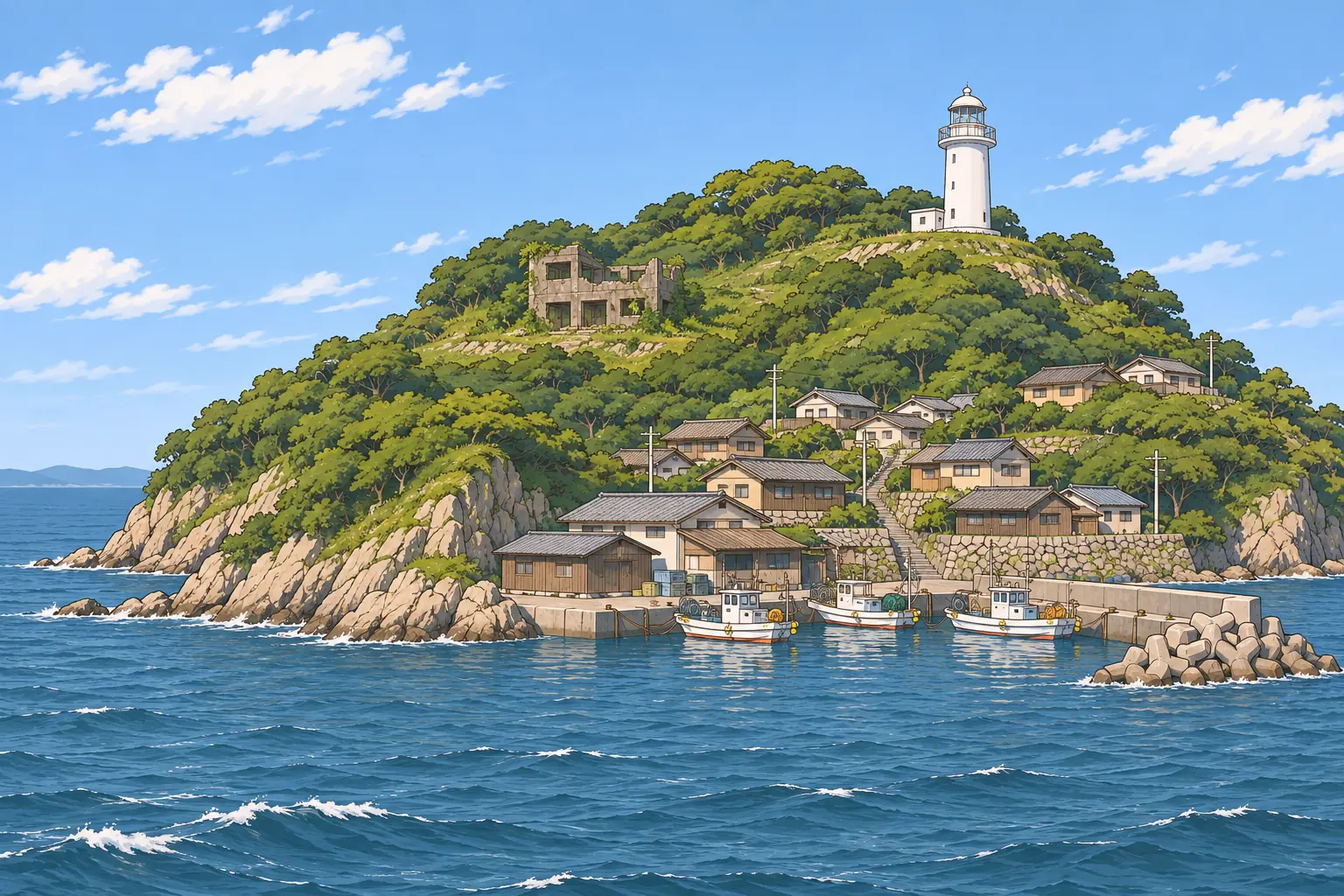
Kamishima in Mie seen from the sea: a hillside fishing village, white lighthouse and old lookout post above (illustration).
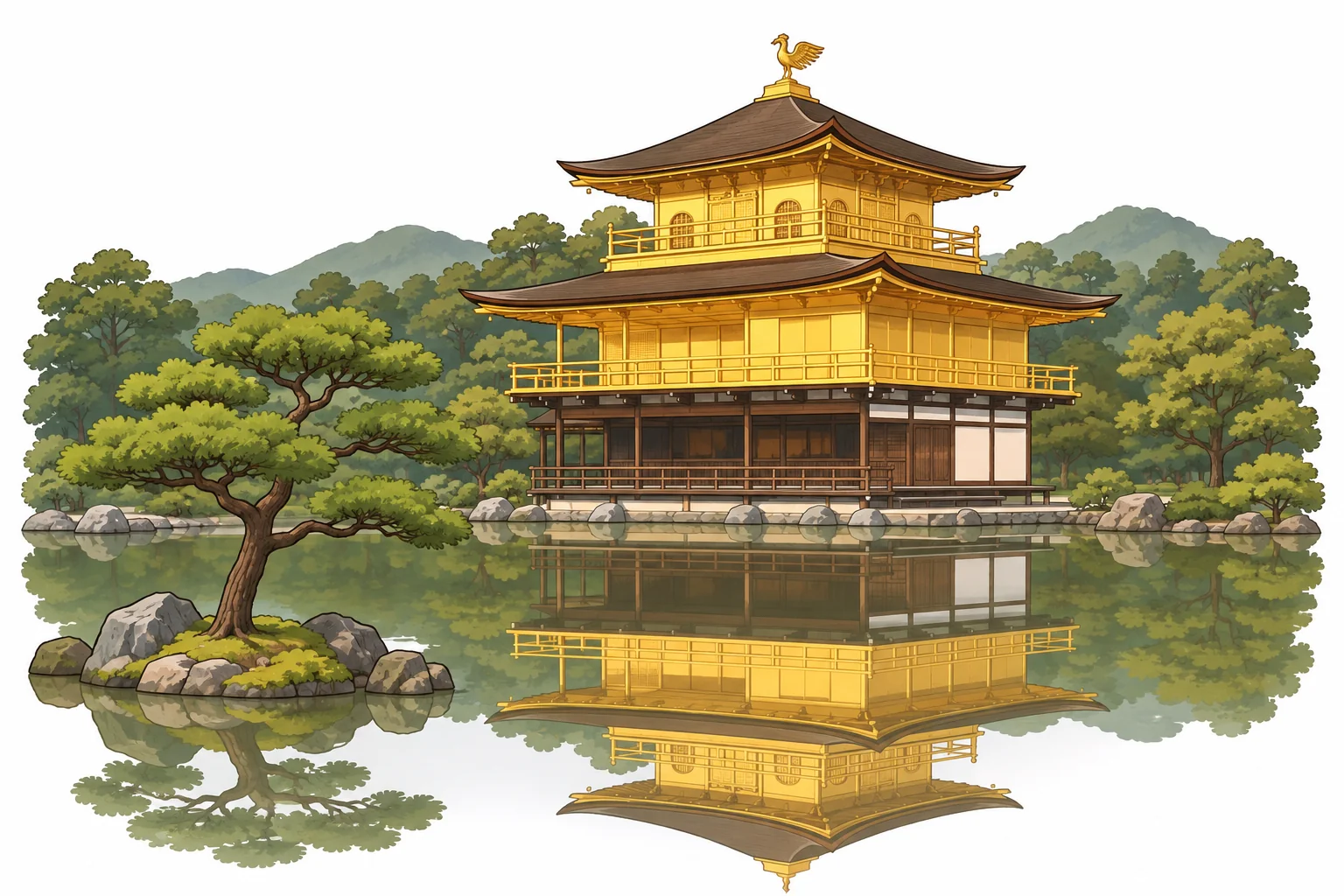
The Temple of the Golden Pavilion (1956) goes to the opposite extreme. In July 1950 a young acolyte at Rokuon-ji in Kyoto set fire to the temple’s famous gold-leafed pavilion, the Kinkaku, built by the shogun Ashikaga Yoshimitsu around 1400. The building burned to the ground; the one visitors see today is a reconstruction completed in 1955. Mishima took the facts of the case and imagined his way inside the arsonist. His narrator, Mizoguchi, is a stuttering, ugly, resentful boy who has been told since childhood that the pavilion is the most beautiful thing in the world. Over time its beauty comes to stand between him and life itself, until destroying it seems the only way to live. The prose is dense, ornate and full of argument, and the novel is often considered his masterpiece.
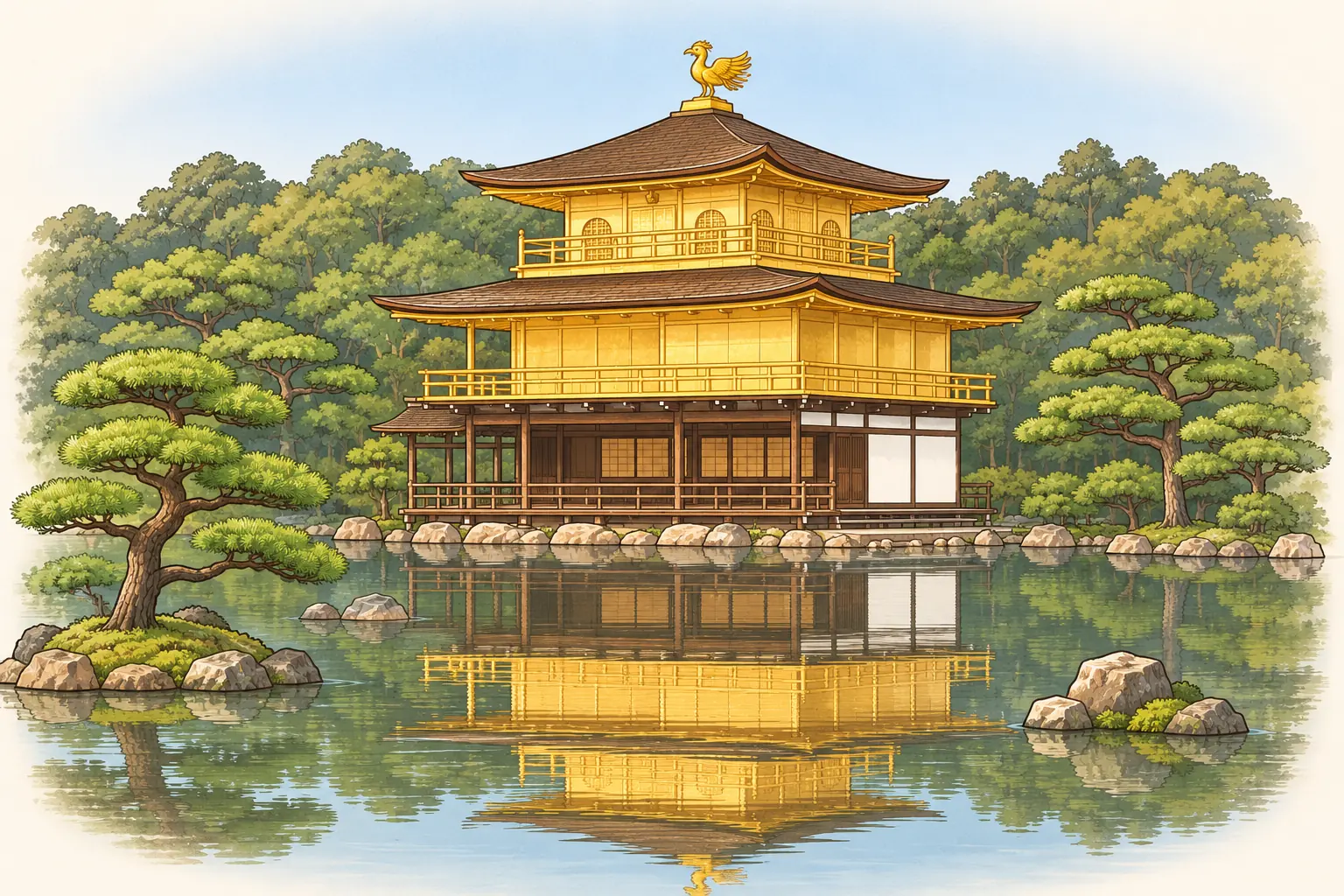
The Kinkaku seen across the Kyōko-chi pond. The pavilion burned in 1950; today’s is a reconstruction completed in 1955.
Read side by side, the two books show the obsession that runs through all of Mishima’s work: beauty as something absolute, which either lifts a person up or crushes him. His style mirrors that idea. It is lavish, symmetrical and highly worked, closer to a lacquered object than to the understated, elliptical prose of Kawabata. Admirers find it dazzling; detractors find it artificial. Both are responding to something real.
04Body, Stage and Celebrity
In 1955, at thirty, Mishima took up bodybuilding. The thin, pale young man who had been kept indoors as a child built a muscular physique within a few years, and added boxing and kendo, Japanese swordsmanship, to his routine. In the long essay Sun and Steel (1968) he explained that he had come to the world first through words, and that the body had always arrived too late; lifting iron was his way of making a body that could stand equal to his language.
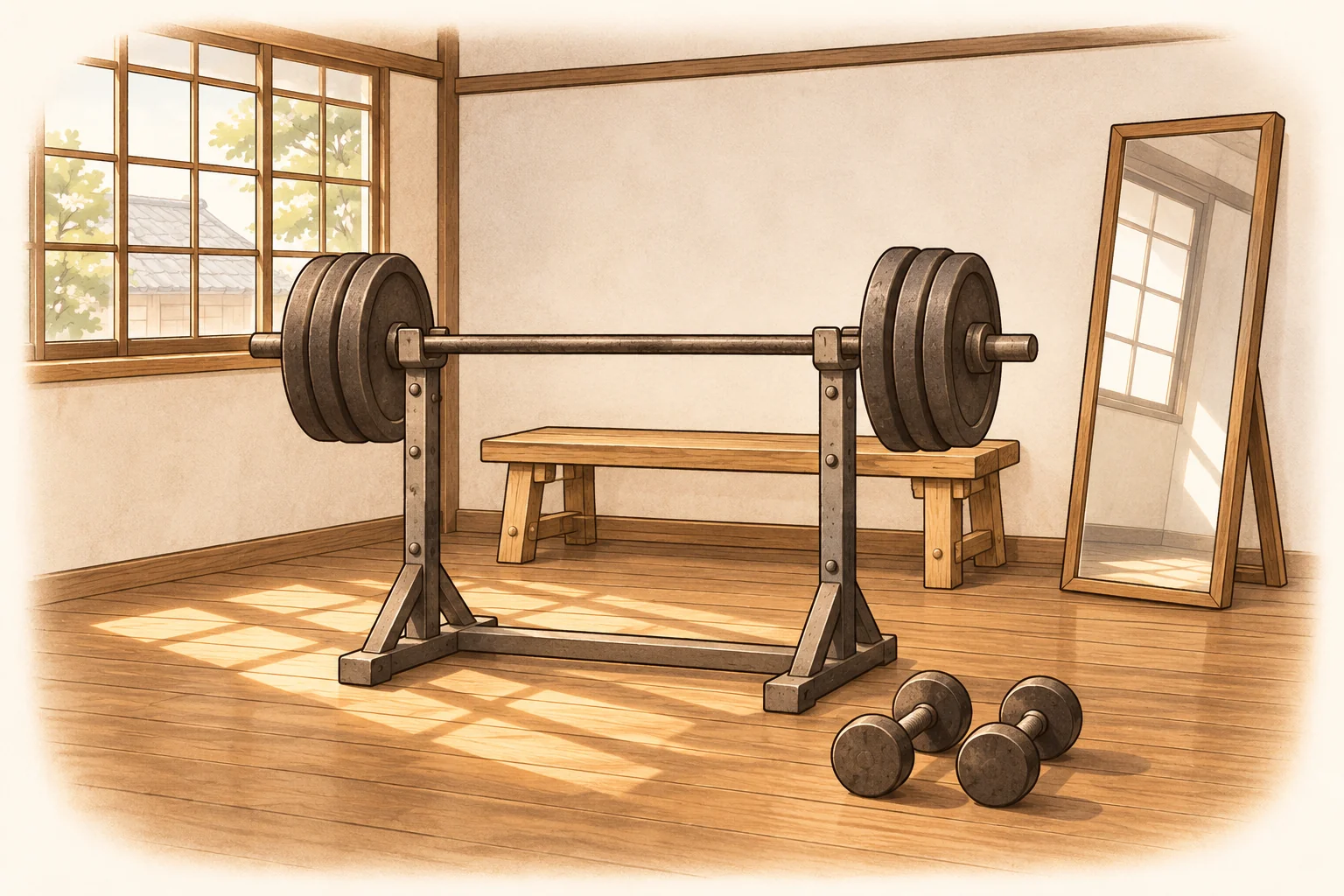
Barbell and dumbbells in a 1950s training room, the kind of iron Mishima began lifting in 1955.
He was perhaps the first Japanese writer to manage his image like a film star. He posed nearly naked for the photographer Hosoe Eikoh in the photobook Ordeal by Roses (1963), played a gangster in the film Afraid to Die (1960), and appeared as the assassin Tanaka Shinbei in Gosha Hideo’s samurai film Hitokiri (1969). He married Sugiyama Yōko in 1958 and built a white Western-style villa in the Magome district of Tokyo, with a statue of Apollo in the garden. Weekly magazines followed his every appearance.
Theater was the other half of his career. His Five Modern Nō Plays reset classical Noh dramas in contemporary Tokyo and are still staged around the world. Madame de Sade (1965), a play for six women in which the Marquis never appears, is regarded as one of the finest works of postwar Japanese drama. Through translators such as Donald Keene, Ivan Morris and Meredith Weatherby, his fiction reached English readers quickly, and he was repeatedly mentioned as a candidate for the Nobel Prize in Literature. When the prize went to Kawabata in 1968, Mishima was among the first to call on him with congratulations.
05The Sea of Fertility and November 25, 1970
Through the 1960s Mishima’s writing and his life turned increasingly toward the emperor, the samurai ideal and action. His short story "Patriotism" (1961) describes a young army lieutenant who, unwilling to move against his comrades in the failed February 26 Incident coup attempt of 1936, commits seppuku alongside his new wife; the account of his death is long and unflinching. In 1966 Mishima adapted, directed and starred in a short film version. In 1968 he founded the Tatenokai, the Shield Society, a private militia of about a hundred young men, mostly university students, who trained with Japan’s Self-Defense Forces and wore uniforms he had commissioned. Many observers treated it as another piece of theater.
At the same time he was writing his last and longest work, the tetralogy The Sea of Fertility, named for a dry plain on the moon. Spring Snow is a tragic love story among the aristocracy of the 1910s; Runaway Horses follows a young nationalist in the early 1930s who plots to assassinate business leaders; The Temple of Dawn moves to Thailand and postwar Japan; The Decay of the Angel is set around 1970. The thread joining them is Honda Shigekuni, a friend of the hero of Spring Snow, who in each volume meets a young person bearing three small moles and comes to believe they are reincarnations of his friend. In the final pages, the aged Honda visits Satoko, the heroine of the first volume, now abbess of a convent, and she tells him she has no memory of anyone of that name. The novel ends in a silent, empty garden.
- 1Spring Snowaristocratic love tragedy, 1910s
- 2Runaway Horsesa young nationalist, early 1930s
- 3The Temple of DawnThailand and postwar Japan
- 4The Decay of the Angelaround 1970
Honda Shigekuni runs through all four, meeting in each a young person with three moles whom he believes to be his friend reborn.
On the morning of November 25, 1970, Mishima delivered the final pages of the manuscript to his publisher. He then went with four members of the Shield Society to the Eastern Army headquarters of the Ground Self-Defense Force at Ichigaya, in central Tokyo, where they bound the commanding general to his chair and demanded that the troops be assembled. From the balcony Mishima urged the soldiers to rise up, restore the emperor and revise the postwar constitution that forbade Japan an army. They jeered, and helicopters drowned him out. He shouted "Long live the emperor" three times, went back inside and cut open his abdomen. Morita Masakatsu, the student leader of the group, tried to act as his second but failed to sever the head after several strokes; another member, Koga Hiroyasu, took the sword and finished it. Morita then cut his own abdomen, and Koga beheaded him too.
Prime Minister Satō Eisaku called it madness. More than half a century later there is still no agreed reading: a sincere political protest, despair at a prosperous and, to Mishima, hollow postwar Japan, the final staging of a life lived as a work of art, or all of these. What is clear is that the death has often eclipsed the books.
06Reading Mishima Today
For a first book, The Sound of Waves is short, luminous and immediately rewarding. The Temple of the Golden Pavilion is the one to read for Mishima at his most searching, and Confessions of a Mask for the man himself. The Sea of Fertility is best approached once you know his voice, though Spring Snow stands perfectly well on its own as a doomed romance. There is also a surprising side door: Life for Sale, a playful thriller he serialized in a weekly magazine in 1968 about a failed suicide who advertises his life for sale, became an unexpected bestseller in Japan again in 2015 and now has an English translation.
In Japan, the Golden Pavilion in Kyoto is the obvious pilgrimage; standing across the Kyōko-chi pond, it is easy to see why a lonely boy might feel the building was too beautiful to bear. Kamishima, reached by ferry from Toba in Mie Prefecture, still has the long stone stairway of Yatsushiro Shrine, the lighthouse and the ruined lookout post that appear in the novel; by one account there is also a literary monument to The Sound of Waves on the island. The Mishima Yukio Literary Museum, opened in 1999 in the village of Yamanakako in Yamanashi Prefecture, near Mount Fuji, holds his manuscripts, notebooks, letters and first editions. The former Ichigaya headquarters is now the Ministry of Defense; part of the old headquarters building was moved and rebuilt as the Ichigaya Memorial Hall, and according to a 2016 travel report, the room where Mishima died, the former War Minister’s office that served as the commanding general’s office in 1970, was moved there too, its door still showing three sword marks from that day.
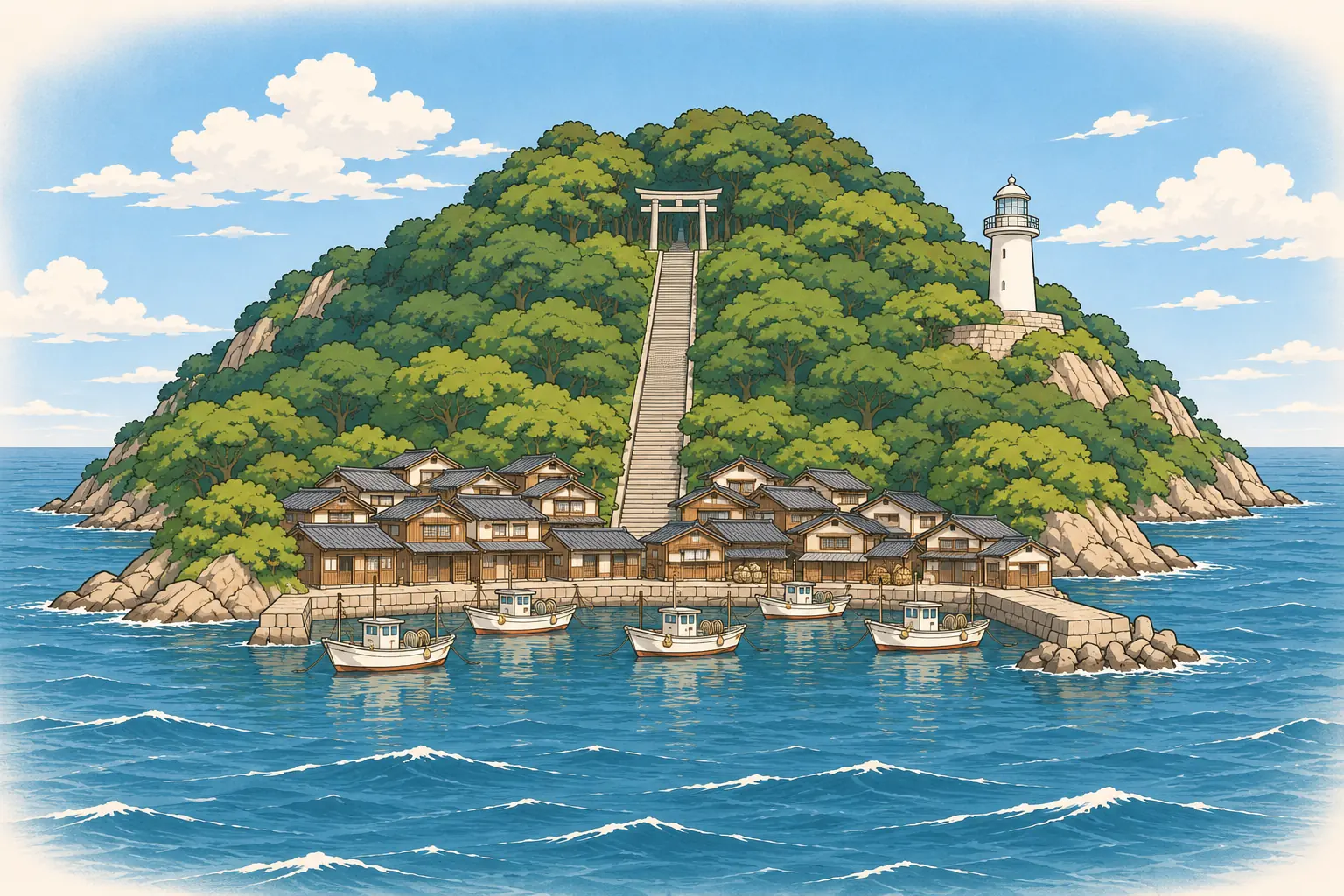
Kamishima, the fishing island of The Sound of Waves at the mouth of Ise Bay, with its shrine stairway and lighthouse.
English-language readers also have Paul Schrader’s film Mishima: A Life in Four Chapters (1985), which interweaves his life with his novels and was kept off Japanese screens for forty years until a festival screening in Tokyo in 2025, and the 2020 documentary on his 1969 debate with radical students at the University of Tokyo, which shows a witty, patient Mishima very different from the image of the balcony. In Japan his paperbacks have never gone out of print, the Mishima Yukio Prize has honored new writers since 1988, and every year around November 25 admirers gather for a memorial known as Yūkoku-ki, named after "Patriotism."