
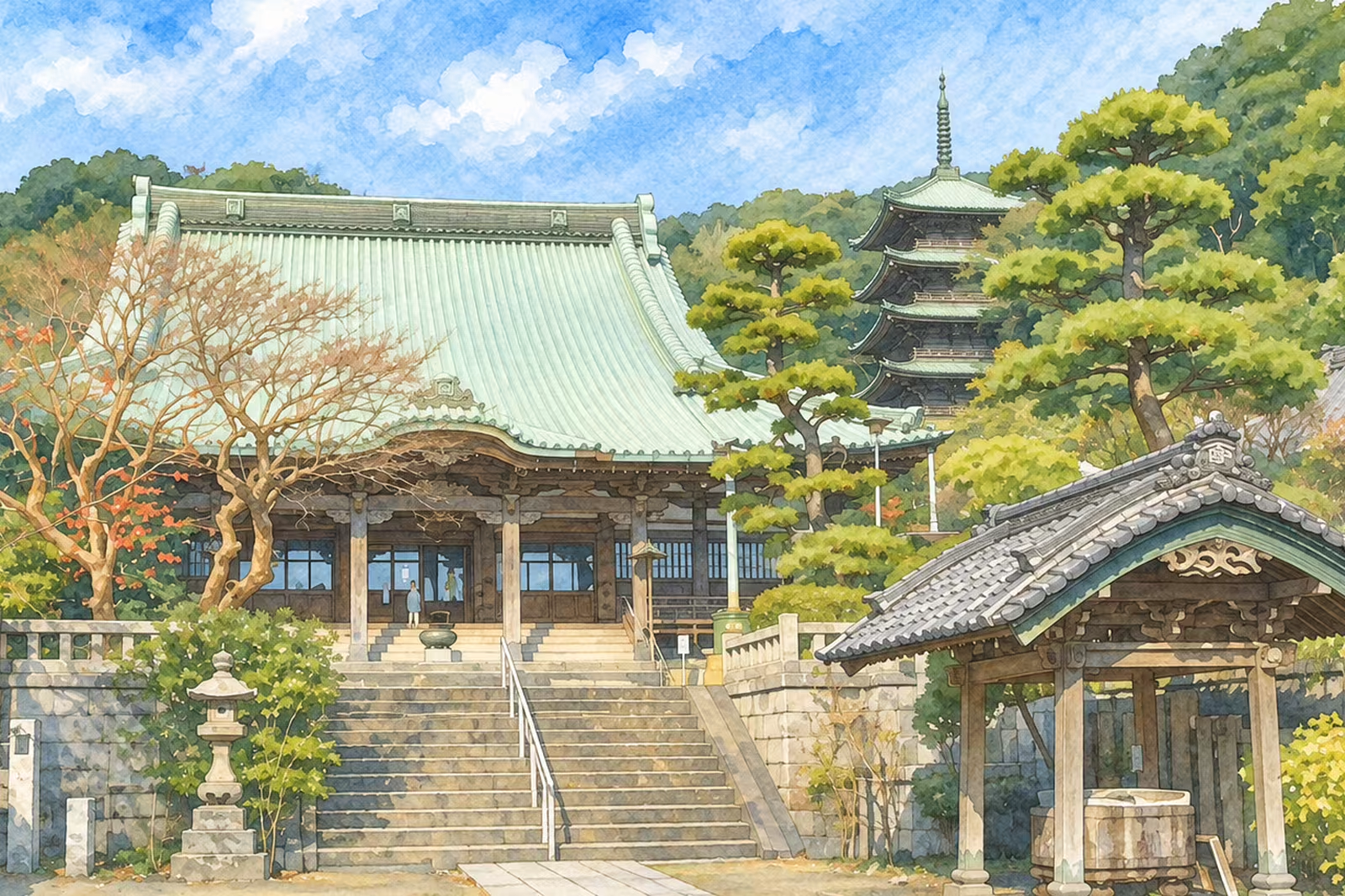
Ryūkō-ji is a temple of the Nichiren school in the Katase district of Fujisawa, Kanagawa Prefecture, close to Enoshima. In 1271 the Buddhist teacher Nichiren was nearly executed here by the Kamakura shogunate, an event his followers call the Tatsunokuchi Persecution. The temple stands on the spot tradition identifies as the execution ground and is regarded as one of the most sacred sites of the Nichiren school. Its grounds hold wooden buildings from the late Edo period to the early 20th century, including a wooden five-storied pagoda, rare in Kanagawa.
01The Tatsunokuchi Persecution
In writings such as Risshō Ankoku Ron, Nichiren sharply criticized the shogunate and other Buddhist schools, and he was persecuted repeatedly. In the ninth month of 1271, the shogunate official Hei no Yoritsuna arrested him and late at night took him to the execution ground at Tatsunokuchi. According to Nichiren’s own account and later tradition, just before the sword fell a bright object flew across the night sky from the direction of Enoshima, the executioners were terrified, and the execution was abandoned. Nichiren was moved to the residence of the Homma family at Echi and soon exiled to Sado. He saw that night as the turning point of his religious life, and his followers have commemorated it ever since.
02Founding and later history
According to temple tradition, in 1337 Nichiren’s disciple Nippō built a hall here and installed an image of Nichiren, which is taken as the temple’s beginning. For a long time the temple had no resident head priest and was looked after in rotation by several nearby Nichiren temples; a dedicated head priest was installed only in modern times. Each year from 11 to September 13 the temple holds the Tatsunokuchi Persecution memorial. On the night of the 12th, believers carrying lanterns process through the area while stalls line the approach.
03What can be seen today
The present Main Hall was completed in 1832 and is said to keep the "fur-mat stone" on which Nichiren sat awaiting execution. The richly carved gate dates from 1864, and the five-storied pagoda, built entirely of wood, from 1910. The Great Shoin on the hillside was originally a house built in the early Meiji period by a silk-trade family in Matsushiro, Nagano Prefecture, and moved here in 1935. Higher up, a white stupa was built in 1970 by the Nipponzan Myōhōji order as a peace pagoda. The temple also identifies a rock cave as the place where Nichiren was held. In 2021 Fujisawa City designated the Main Hall, gate, pagoda, and related items as municipal cultural properties. Nothing of the Kamakura-period execution ground survives; the present precinct was built up over centuries by believers around the memory of the persecution.