
Shimoda is a small harbor town at the southern tip of the Izu Peninsula in Shizuoka Prefecture. Under the 1854 Treaty of Kanagawa it became the first Japanese port opened to the United States, and for a few years the opening of Japan happened here on the ground: Matthew C. Perry’s squadron anchored here, Townsend Harris set up the first American consulate here, and the Russian envoy Yevfimy Putyatin signed a treaty here. Temples, a canal-side lane and monuments keep that short period within walking distance.
01The first open port
Shimoda’s deep, sheltered harbor had long served ships sailing between Edo and the Ōsaka region, and from the early Edo period a shogunate magistrate inspected shipping here; the post was abolished in 1720 and restored when the port opened. In the Treaty of Kanagawa, signed at Yokohama in March 1854, the shogunate conceded Shimoda and Hakodate; Shimoda, walled in by mountains, was easy to control. Perry’s ships began arriving in April, and in June the two sides signed the Additional Regulations at Ryōsen-ji. Meanwhile Yoshida Shōin and Kaneko Shigenosuke rowed out at night and asked to be taken abroad; refused, they gave themselves up.
At the end of 1854, while Putyatin was negotiating here, the Ansei Tōkai earthquake sent a tsunami through the town and destroyed most of it. The Russo-Japanese treaty was signed at Chōraku-ji in early 1855. In 1856 Harris made Gyokusen-ji, in the village of Kakisaki, his consulate; he concluded the Convention of Shimoda with the local magistrates the next year and then went on to Edo, where the Treaty of Amity and Commerce was signed in 1858. Yokohama opened in 1859, and under the commercial treaty Shimoda was closed six months later, usually dated to 1860.
02What you can see today
Ryōsen-ji, a Nichiren temple founded in 1635, generally credited to the Shimoda magistrate Imamura Masanaga, is a national historic site (designated 1951) and houses a museum of material on the Black Ships. The stone-paved lane from Perry’s landing place near Shimoda Park along the Hiraname River to the temple is called Perry Road, lined with old houses and storehouses faced in black-and-white namako tile.
Gyokusen-ji, a Sōtō Zen temple on the east side of the bay, was designated a national historic site the same year as the first American consulate. The temple moved to its present site in 1848, and its main hall, generally taken to be the building Harris used, keeps the layout of his and Heusken’s rooms and the office. The grounds hold a small Harris museum and the graves of American and Russian sailors. Near Benten-jima, where Shōin set out, stand a monument and a statue of him and Kaneko, and at Rendaiji hot spring the house of the doctor Murayama Gyōmarō, where he lodged for a few days, survives as a prefectural historic site. Chōraku-ji, where the Russian treaty was signed, and Hōfuku-ji, linked by tradition to "Tōjin Okichi," are also in town. The temples stand on their original sites; the monuments and exhibits are modern.
Shimoda
01A harbor at the end of Izu
Shimoda sits at the southern tip of the Izu Peninsula, the mountainous spur that hangs off the Pacific coast southwest of Tokyo. By sea it was close to Edo, the shogun’s capital; by land it was a long, hard walk over the Amagi range. That combination of easy water access and poor overland links explains almost everything about what happened here in the 1850s.
In the Edo period (1603–1868) the coastal route between Ōsaka and Edo carried an enormous traffic in rice, sake, cotton and oil. Ships rounding the tip of Izu often met rough water, and Shimoda’s bay, deep and enclosed by hills on three sides, was where they waited for a fair wind. Japanese call this kind of harbor a kazemachi-kō, a "wind-waiting port." Early in the period the shogunate stationed a magistrate (bugyō) here to inspect vessels bound for Edo Bay. In 1720 that inspection post moved to Uraga at the mouth of the bay, and Shimoda became a quieter place. When foreign ships began appearing off the coast, the shogunate revived the Shimoda magistracy in 1842, abolished it again within a year, and restored it only when the port opened in 1854.
So in 1854 Shimoda was a small town of fewer than four thousand people, with fishermen, shipping agents, inns and temples, and no political weight at all. Within a few years it would host an American naval squadron, a Russian embassy, a devastating tsunami and the first foreign consulate in Japan.
02Why Shimoda?
Commodore Matthew C. Perry of the U.S. Navy first arrived in Edo Bay in July 1853 with four warships, delivered a letter from President Millard Fillmore near Uraga, and said he would return for an answer. He came back in February 1854 with a larger squadron. After weeks of talks at a reception hall built at the village of Yokohama, the two sides signed the Treaty of Kanagawa on March 31, 1854. That story belongs to Uraga and Yokohama; what matters here is one clause.
The treaty opened two ports to American ships for water, provisions, coal and repairs: Shimoda immediately, and Hakodate in the far north a year later. Perry had wanted more ports and ones closer to Edo. The shogunate wanted foreigners as far away as it could manage. Shimoda suited Japanese purposes because ships could reach it easily while anyone landing there would find it hard to go anywhere else; the mountains behind it worked as a natural fence. Perry’s officers had surveyed the bay and found it a good anchorage, so the Americans accepted.
Another clause allowed the United States to station a consul at Shimoda eighteen months after signing. The English text said a consul could be sent if either government thought it necessary. The Japanese text read as if both governments had to agree. Nobody resolved the difference in 1854. Two years later it would greet Townsend Harris on the quay.
03The Black Ships in the bay
Perry’s ships came down from Edo Bay to Shimoda in April 1854. For the first time, Japan was receiving a foreign squadron under treaty terms rather than chasing it away. Sailors and officers came ashore to buy goods, stretch their legs, chart the harbor and collect plants. The expedition’s artists sketched the streets, temples and townspeople, and their pictures, printed in the official narrative of the expedition, became some of the first images of Japan widely seen in the West.
Neither side found the arrangement comfortable. Japanese officials shadowed every American who landed, and shopkeepers were told not to sell to foreigners directly. The Americans complained of surveillance and of being cheated by official intermediaries; the Japanese worried about sailors wandering into houses and starting fights. Both sides were working out what the treaty meant in practice, street by street.
In May Perry sailed north to inspect Hakodate, then returned to Shimoda in early June. Several American sailors died during the squadron’s stay and were buried at Gyokusen-ji, a temple on the east shore of the bay. Their graves are still there.
04Yoshida Shōin’s night crossing
The most famous episode in Shimoda’s history happened during the squadron’s first weeks in port.
Yoshida Shōin was a young samurai of the Chōshū domain, trained in military science and burning with the conviction that Japan could not defend itself without understanding the West. He had gone to Uraga to see Perry’s ships in 1853, and later that year had rushed to Nagasaki hoping to stow away on a Russian ship, arriving too late. When Perry returned in 1854, Shōin, then twenty-three (twenty-five by the traditional count), followed the squadron to Shimoda with a younger friend, Kaneko Shigenosuke.
Shōin was suffering from a skin complaint and lodged with a doctor at Rendaiji, a small hot-spring village just inland, partly for treatment and partly to stay out of sight. The two men managed to pass a letter to American officers on shore explaining that they wanted to travel to America to study.
Late on the night of April 24, 1854, they took a small boat from the beach at Kakisaki, near the islet of Benten-jima, and rowed out to the anchored warships. The boat had no proper oarlocks; according to the story they lashed the oars with their own loincloths. They reached the Mississippi first and were sent on to the flagship Powhatan. On board they communicated in written Chinese with the expedition’s interpreter, Samuel Wells Williams, and begged to be taken to America. Perry’s account of the expedition speaks of them with some admiration. But he had just signed a treaty, and carrying off two men who were breaking Japanese law could wreck it. He refused, and a ship’s boat took them back to shore.
Their own boat had drifted away with their papers aboard, so discovery was certain. Rather than run, they surrendered to the village authorities at Kakisaki. They were held in Shimoda, then sent to the prison at Denmachō in Edo. Shōin’s teacher Sakuma Shōzan, who had encouraged the venture, was also arrested. Eventually both young men were returned to Chōshū under guard. Shōin was confined in the Noyama prison at Hagi; Kaneko, as a man of lower status, was put in a harsher prison nearby and died there of illness in early 1855.
Shōin went on to teach at the Shōka Sonjuku, the small private school at Hagi whose students included Takasugi Shinsaku and Itō Hirobumi, and was executed in Edo in 1859 during the Ansei Purge. In Shimoda, a monument and a statue of the two men looking out to sea stand near Benten-jima, and the Murayama house at Rendaiji, where Shōin lodged, is preserved as a prefectural historic site, with the small upstairs room where he hid kept as it was.
05Ryōsen-ji and the Additional Regulations
When Perry came back from Hakodate, the remaining business was the detailed rules for how Americans would actually use the two ports. The talks were held at Ryōsen-ji, a temple of the Nichiren school founded in 1635 and generally credited to the Shimoda magistrate Imamura Masanaga.
On June 17, 1854, Perry and the Japanese commissioners, led by the Confucian scholar Hayashi Fukusai, signed the Additional Regulations, thirteen articles in the Japanese text (twelve in the English), often called the Shimoda supplementary treaty. They set the area in which Americans could walk freely at about seven ri (roughly 28 kilometers) from Shimoda and five ri from Hakodate; designated Ryōsen-ji and Gyokusen-ji as resting places for Americans, with Gyokusen-ji as their burial ground; fixed landing places; and required purchases to go through Japanese officials. They are dull articles, and that is their interest: for the first time, Japan was writing down rules for the everyday presence of foreigners on its soil.
Around the signing Perry marched to the temple with several hundred sailors and marines and a band. The route from the landing place near today’s Shimoda Park, along the narrow Hiraname River to Ryōsen-ji, is now called Perry Road. The canal is lined with willows, stone bridges and old houses and storehouses faced in namako-kabe, black tiles set in raised white plaster in a diamond grid, a style used against fire and damp. Most of these buildings date from the late Edo period to the early twentieth century, a little later than Perry, but the lane keeps the scale of the old port town.
Ryōsen-ji now houses a museum of material on the Black Ships, with Japanese woodblock prints and broadsheets that show how ordinary people imagined the Americans alongside the images the Americans published of Japan. Shimoda’s annual Black Ship Festival, held since 1934, re-enacts the landing. Ryōsen-ji and Gyokusen-ji were designated national historic sites together in 1951.
Perry left Shimoda in late June 1854 for Okinawa and home. For him the mission was complete. For Shimoda, life as an open port was just starting.
06Putyatin and the tsunami of 1854
Six months later a Russian envoy arrived. Vice Admiral Yevfimy Putyatin had been at Nagasaki in 1853 seeking a border settlement and trade, and had negotiated there with the shogunate’s commissioners Kawaji Toshiakira and Tsutsui Masanori without result. Now the Crimean War had broken out, Russia was fighting Britain and France, and his ships risked meeting an Anglo-French squadron anywhere in East Asian waters. In December 1854 he sailed into Shimoda aboard the frigate Diana and asked to resume talks. Kawaji and Tsutsui were sent to meet him. The first formal session was held at the temple of Fukusen-ji on December 22, and talks later continued at Chōraku-ji and other places in town.
On the morning of December 23, 1854, the day after that first session, a great earthquake struck the Tōkai region, the area along the Pacific coast west of Izu. Not long afterward a tsunami poured into Shimoda Bay. The bay’s shape, narrow at the mouth and deep inside, made it worse: the water surged in and out several times. According to the town’s own records, 841 of its 875 houses were swept away and 30 more half-destroyed, leaving only four untouched; of some 3,850 inhabitants, 99 died, though a figure of 122 is also often given. A second great earthquake hit the Nankai region farther west the next day. Because the era name was changed to Ansei a few weeks later, these are known as the Ansei Tōkai and Ansei Nankai earthquakes, even though they happened in the last weeks of the Kaei era.
The Diana was spun around in the harbor by the waves, forty-two times in half an hour by Russian accounts, struck bottom and lost her rudder; some of her crew were killed or injured. Even so, Russian sailors came ashore to help, and the ship’s doctor treated injured townspeople. Russian accounts also describe pulling Japanese out of the water as the tsunami swept them past the ship. These acts were remembered on the Japanese side.
07The Treaty of Shimoda and the schooner Heda
Talks resumed among the ruins. The Diana needed repairs, and the shogunate allowed her to go to Heda, a fishing village on the west coast of Izu with a sheltered inlet. On the way she was caught by bad weather and driven to the coast off Miyajima village at the head of Suruga Bay, where the crew got ashore. On January 19, 1855, Japanese fishing boats tried to tow the empty ship on to Heda, and she sank in another storm. Her crew, around five hundred men, walked to Heda and were stranded there.
On February 7, 1855, Kawaji and his colleagues signed a treaty with Putyatin at Chōraku-ji. In English it is usually called the Treaty of Shimoda. It drew the Russo-Japanese border in the Kuril Islands between Etorofu and Urup, with Etorofu and the islands south of it Japanese and Urup and those north of it Russian. Sakhalin was left undivided, open to both peoples. Japan opened Shimoda, Hakodate and Nagasaki to Russian ships. Japan today marks February 7 as Northern Territories Day, taking the date from this treaty.
The stranded Russians still had to get home. At Heda, Japanese shipwrights working under Russian officers built a two-masted Western-style schooner, using plans and knowledge the Russians had brought. It was launched in April 1855, and Putyatin named it Heda in thanks before sailing home in it that month with forty-seven of his men. It was the first Western-style ship the Heda shipwrights had ever built, and the shogunate had six more built to the same design, known as the Kimisawa type, an early step in Japan’s modern shipbuilding. The rest of the crew left in stages aboard chartered foreign merchant ships.
Russian sailors who died in Shimoda are buried at Gyokusen-ji alongside the Americans. Within a single year this small town had signed Japan’s first treaty provisions with both the United States and Russia.
08Townsend Harris at Gyokusen-ji
On August 21, 1856, the American warship San Jacinto entered Shimoda harbor carrying Townsend Harris, the first U.S. consul general to Japan. Harris was a New York merchant who had served on the city’s board of education and then traded for years in Asia; he was fifty-one when he arrived. With him came his interpreter Henry Heusken, a Dutch-born young man in his twenties whose Dutch allowed him to work through the Japanese interpreters, who had learned their languages through the Dutch trade at Nagasaki.
The Shimoda officials were dismayed. In their reading of the treaty, a consul required Japanese consent, which had not been given; the town was still rebuilding after the tsunami; surely he should leave. Harris insisted on the American reading of the treaty and refused to go. In the end the officials lodged him at Gyokusen-ji in the village of Kakisaki, across the bay from the town center; the temple had moved to that site only in 1848. In early September he raised the American flag there, the first consular flag flown in Japan.
Harris and Heusken lived at the temple for nearly three years, until June 1859, the main hall serving as residence and office while the monks are said to have moved elsewhere. Harris’s journal records the life in detail: loneliness, illness, endless negotiations with the magistrates’ office, fury at what he saw as deliberate delay, and also sharp observations of the bay and the people of the town. At first he was closely watched, his purchases routed through officials, his movements accompanied, and his contact with the outside world limited to occasional ships.
A monument at Gyokusen-ji commemorates a story about milk. Harris, often ill, is said to have asked for cow’s milk, which the Japanese did not drink; the officials at first refused and later supplied it, and the temple is remembered as an early place where milk was provided and cattle slaughtered for foreigners. The details come largely from later retelling, but disputes over food are a recurring theme in Harris’s journal.
09The Convention of Shimoda and the road to Edo
Harris had not come to sit in a wind-waiting port. His real assignment was a commercial treaty, and his first step was to settle the practical problems left by the Treaty of Kanagawa on the spot.
On June 17, 1857, he signed the Convention of Shimoda with the two Shimoda magistrates, Inoue Kiyonao and Nakamura Tokimasa. It opened Nagasaki to American ships; allowed Americans to reside at Shimoda and Hakodate; provided that Americans who committed crimes in Japan would be tried by the American consul under American law, an early form of the extraterritoriality written into the later treaty; set the exchange of gold and silver coin by equal weight of the same metal; and allowed the consul general to travel beyond the seven-ri limit. Several of these provisions, especially consular jurisdiction and the currency terms, passed into the 1858 treaty and became long-running grievances.
What Harris wanted most was to go to Edo, meet the shogun and present the president’s letter in person. The shogunate debated this for months before agreeing. In late 1857 Harris traveled up the Tōkaidō highway and on December 7 was received at Edo Castle by the thirteenth shogun, Tokugawa Iesada. Days later, at the residence of the senior councillor Hotta Masayoshi, he delivered a long presentation on the state of the world: Britain and France might soon force a treaty on Japan at gunpoint, and Japan would do better to sign first, peacefully, with the United States, which had no territorial ambitions in Asia.
Negotiations followed at Harris’s lodgings in the shogunate’s Bansho Shirabesho, the institute for Western studies at Kudan in Edo, with the shogunate’s plenipotentiaries Inoue Kiyonao and Iwase Tadanari, and by early 1858 the text was largely agreed. Hotta went to Kyoto to obtain the emperor’s sanction and was refused. After Ii Naosuke became great elder (tairō), Inoue and Iwase signed the Treaty of Amity and Commerce with Harris on July 29, 1858, aboard the Powhatan, anchored off Kanagawa in Edo Bay. It was the same flagship Yoshida Shōin had climbed aboard at Shimoda four years earlier. In the spring of 1858, once the text was agreed, Harris had gone back to Shimoda and fallen seriously ill there, and the shogunate sent doctors from Edo to treat him; throughout these years Shimoda remained his base.
The new treaty opened Kanagawa, Nagasaki, Hakodate, Niigata and Hyōgo, and provided that Shimoda would close six months after Kanagawa opened. In 1859 Harris became minister resident and moved to Edo, setting up the legation at the temple of Zenpuku-ji in Azabu. Kanagawa, in practice the new town of Yokohama, opened in July 1859, and Shimoda was closed as the treaty required six months later, usually dated to 1860, little more than five years after it opened.
10The legend of Tōjin Okichi
Any account of Harris in Shimoda runs into the story of "Tōjin Okichi." Saitō Kichi was a young geisha of Shimoda. In 1857 the magistrates’ office sent her to Gyokusen-ji, nominally as a nurse for the ailing Harris, and another woman, Ofuku, was sent to Heusken. In the usual account Okichi was sent home after only three days because of a skin eruption. What exactly the arrangement was has been argued over ever since.
Okichi’s later life was hard. Mocked as "Tōjin Okichi," tōjin being a word for foreigners, she moved from place to place, worked as a hairdresser, ran a small eating house in Shimoda from 1882, drank heavily, and drowned herself in 1890. In the late 1920s and 1930s her story was turned into novels, plays and films, and she became a national symbol of the woman sacrificed to the opening of Japan, often described as Harris’s mistress. Historians generally see that image as largely a modern creation that goes well beyond the evidence. Her grave and a small museum are at Hōfuku-ji in Shimoda, a temple that served during the treaty-port years as headquarters for the shogunate’s envoys and as an office of the Shimoda magistrate.
11Walking Shimoda today
Most of the sites lie around the harbor and can be visited on foot.
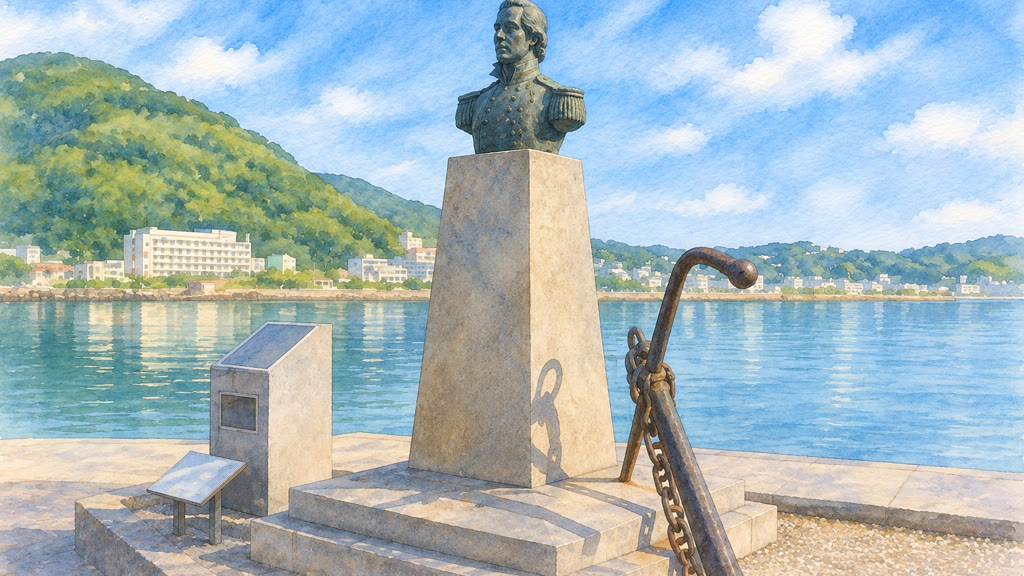
Near Shimoda Park on the southwest side of the harbor stands the monument marking Perry’s landing, with a bust of the commodore by the water. From there Perry Road follows the Hiraname River past namako-kabe storehouses to Ryōsen-ji, the temple where the Additional Regulations were signed, with its Black Ship museum.
In the town are Chōraku-ji, where the Russian treaty was signed; Hōfuku-ji, with Okichi’s grave; and the Shimoda Kaikoku (Opening of Japan) Museum, with displays on the treaty-port years. The site of the old magistrates’ office is in town as well, though nothing of its buildings survives.
Following the shore east brings you to Kakisaki. Gyokusen-ji stands at the foot of a low hill. Its main hall still keeps the layout of Harris’s room, Heusken’s room and the office, and is generally believed to be the building Harris lived in. The temple’s small Harris museum shows objects connected with him, the cemetery holds American and Russian sailors’ graves, and the milk monument stands in the grounds. A short walk to the water brings you to Benten-jima, where Shōin and Kaneko pushed off, with their monument and statue on the shore. From here you look back across the bay where the Black Ships lay at anchor.
The Murayama house where Shōin lodged is a little inland at Rendaiji.
Keep in mind that the tsunami of 1854 flattened most of Shimoda, so much of the town was rebuilt after Perry’s visit. The temples stand on their original sites, and Gyokusen-ji’s main hall is among the few structures thought to date from the consulate years. The monuments, statues and museums were built in the twentieth century to commemorate the opening of Japan.