
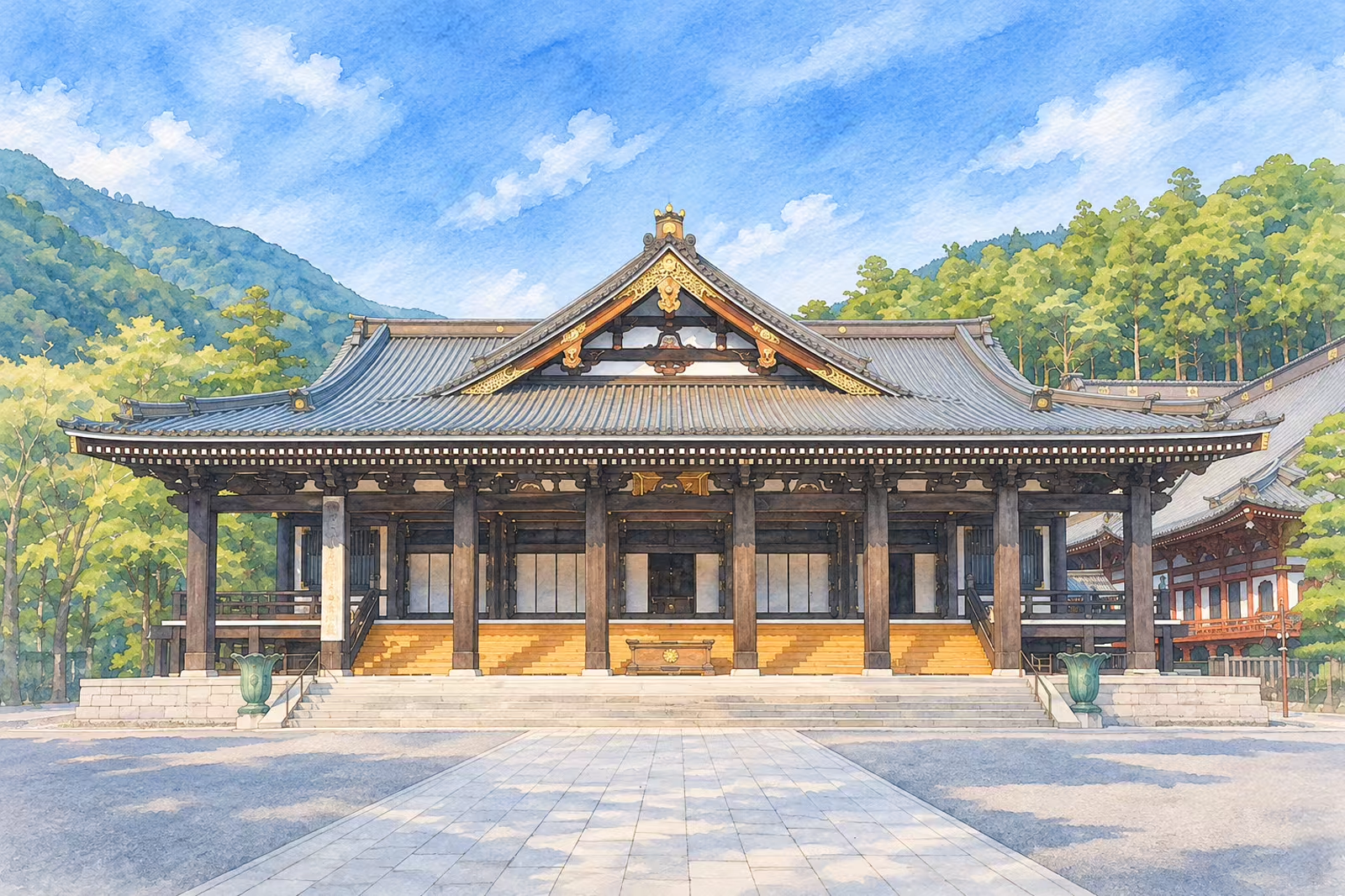
Minobusan Kuon-ji stands on Mount Minobu in the town of Minobu, Minamikoma District, Yamanashi Prefecture, and is the head temple of the Nichiren Shū. The Kamakura-period monk Nichiren spent the last nine years of his life here, and his remains were buried on the mountain. For followers of the school, Kuon-ji is both the founder’s home and his grave.
01Nichiren on Mount Minobu
In 1274, after returning from exile on Sado and failing once more to persuade the Kamakura shogunate to heed his warnings, Nichiren accepted an invitation from the local steward Hakii Sanenaga (also known as Nanbu Sanenaga) and settled in a hut in Nishidani, a valley on the mountain. Over the next nine years he lectured, wrote and trained disciples. As followers gathered, the hut grew into a temple, and the name Kuon-ji is generally thought to date from this period. In 1282, ill, Nichiren left the mountain intending to recuperate in Hitachi, but died on the way at Ikegami in Musashi Province (now Ōta Ward, Tokyo), aged 60 (61 by traditional count). As he had asked, his remains were brought back to Minobu.
02Relocation and growth
In the second half of the 15th century the eleventh abbot, Nitchō, judged Nishidani too cramped and damp and moved the main complex to its present site, expanding it. The hermitage site and Nichiren’s tomb remained in Nishidani. From the Warring States period through the Edo period, the temple enjoyed the patronage of warrior houses including the Takeda of Kai and the Tokugawa, and it became the center of Nichiren devotion, drawing a steady stream of pilgrims.
03What survives today
A great fire in 1875 destroyed most of the buildings, and what stands now is largely post-Meiji reconstruction. The Sanmon gate and the Founder’s Hall date from the Meiji and Taishō eras, the Main Hall was rebuilt in the 1980s, and the five-story pagoda was recreated in the 2000s in its Edo-period form. The Bodaitei, a flight of 287 steep stone steps, climbs straight from the Sanmon to the Main Hall. On the summit stands the Oku-no-in Shishinkaku; according to tradition Nichiren often climbed there to look toward his home province of Awa and remember his parents. The hermitage site and mausoleum in Nishidani remain central to pilgrimage. The temple holds calligraphy and old books associated with Nichiren, some reportedly designated National Treasures or Important Cultural Properties. Its weeping cherry trees are also well known.