
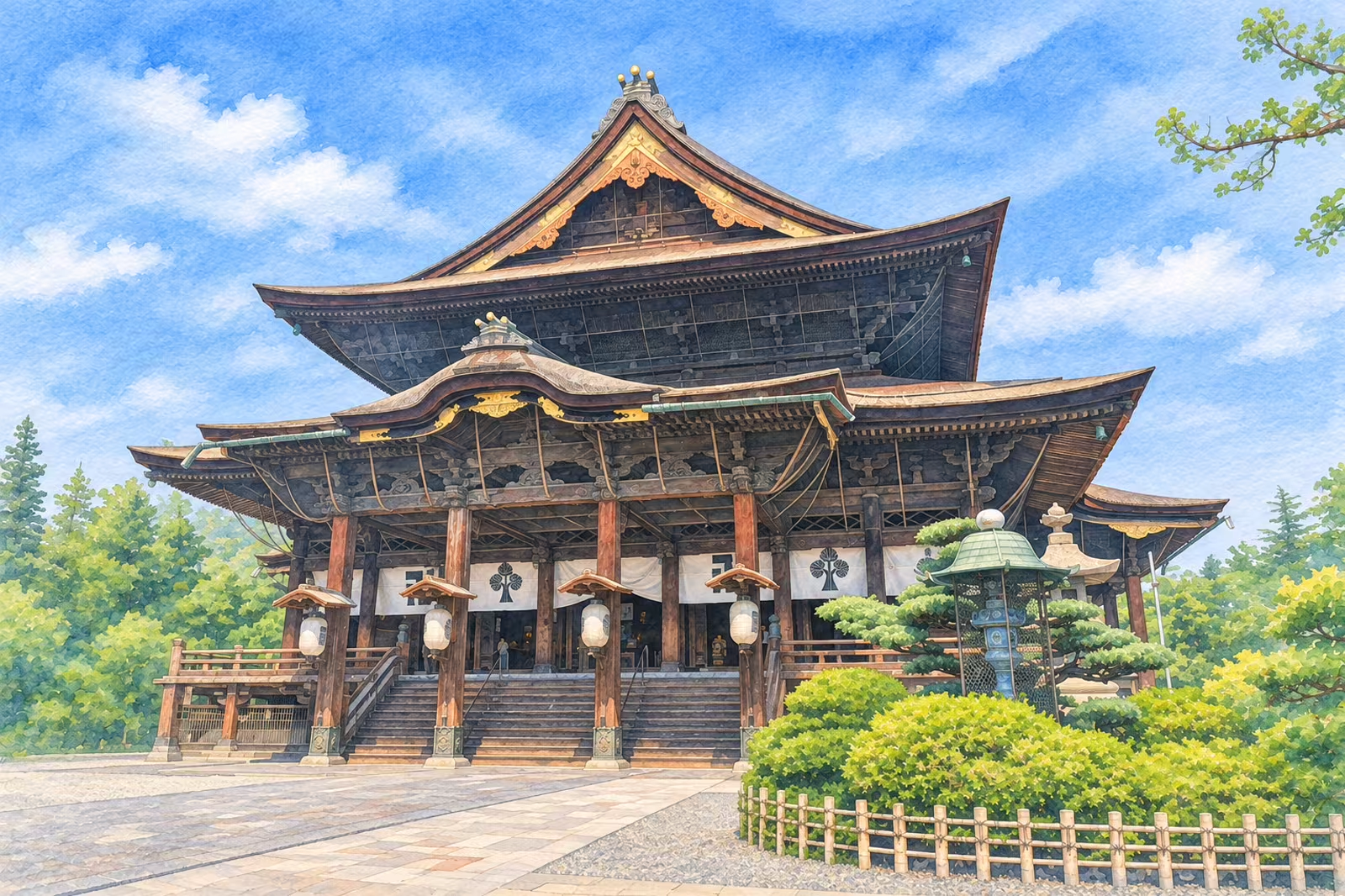
Zenkō-ji, in the northern part of Nagano City, Nagano Prefecture, is one of the best-known pilgrimage temples in Japan. It belongs to no single school of Buddhism and has long welcomed worshippers of every sect and of both sexes, and the city of Nagano grew up around it. Its principal image is said to be the first Buddhist statue to reach Japan, yet it is never shown to anyone.
01Origins and Legend
According to the temple’s founding legend, the principal image, a triad of Amida Buddha with two attendant bodhisattvas sharing a single halo, was presented to the Japanese court from Paekche in the 6th century. Opponents of Buddhism threw it into a canal at Naniwa, and later a man from Shinano named Honda Yoshimitsu pulled it from the water and carried it home on his back; the temple takes its name from the Sino-Japanese reading of his name, Zenkō. The image is traditionally said to have been moved to the present site in 642, with the temple founded in 644. None of this can be confirmed from historical records, but roof tiles from the late 7th century found on the site show that a substantial temple stood here by then.
From the medieval period onward, itinerant nenbutsu preachers spread devotion to Zenkō-ji across the country, and many "New Zenkō-ji" temples housing copies of the image were founded. During the Warring States period the image was repeatedly carried off by warlords. Takeda Shingen moved it to Kai during his wars with Uesugi Kenshin, after which it passed through the hands of the Oda and Tokugawa; Toyotomi Hideyoshi installed it for a time at Hōkō-ji in Kyoto before it was returned to Shinano at the end of the 16th century. Under the Tokugawa shogunate the temple received an estate, and pilgrimage to Zenkō-ji flourished.
02What Can Be Seen Today
The temple has burned many times, and most present buildings date from the Edo period or later. The Main Hall, completed in 1707, is one of the largest wooden Buddhist halls in Japan and is designated a National Treasure. The Sanmon gate of 1750 and the sutra repository of 1759, which contains a revolving octagonal bookcase, are Important Cultural Properties. The Niōmon was rebuilt in 1918, with guardian figures by the modern sculptors Takamura Kōun and Yonehara Unkai.
The principal image is an "absolutely hidden" Buddha kept in the innermost part of the Main Hall; it is said that not even the chief priests may see it. A Kamakura-period stand-in, the Maedachi Honzon, an Important Cultural Property, is shown only at the Gokaichō held every seven years by traditional count. In the Kaidan Meguri, worshippers grope their way through a pitch-dark passage beneath the hall in search of the "key to paradise" below the image. The temple is maintained jointly by the Daikanjin of the Tendai school and the Daihongan of the Jōdo school, the latter traditionally headed by a nun.
Zenkō-ji (Nagano)
01A City Built Around a Temple
Walk north from Nagano Station along Chūō-dōri and the street rises gently for about two kilometers until it ends at the gates of Zenkō-ji. Nagano is now a prefectural capital and was host of the 1998 Winter Olympics, but it began as a monzenmachi, a "town before the gate" that grew up to feed, house and sell to pilgrims. The temple came first; the city followed.
Zenkō-ji is unusual among Japan’s great temples in that it belongs to no single Buddhist school. It is run jointly by two institutions: Daikanjin, a Tendai-school temple headed by a male abbot, and Daihongan, a Jōdo (Pure Land) school convent headed by an abbess. The temple has long welcomed everyone regardless of sect or sex, and an old saying holds that one should visit Zenkō-ji at least once in a lifetime.
Everything here turns on a single statue that, by tradition, no living person has ever seen.
02The Statue From Paekche
According to the temple’s foundation legend, the Zenkōji engi, the principal image is an Amida triad: Amida Buddha, the Buddha of the Western Paradise, standing between the bodhisattvas Kannon and Seishi, all three sharing a single boat-shaped halo. This arrangement is called ikkō sanzon, "three figures in one light."
The Nihon shoki, Japan’s first official history, records that in 552 King Song of Paekche, a kingdom on the Korean peninsula, sent a gilt-bronze Buddha and sutras to the Yamato court. (Other sources put the event in 538.) The temple legend identifies its image with that gift, making it, in the temple’s telling, the first Buddhist statue to reach Japan.
The new religion split the court. The Soga clan favored worshipping the foreign god; the Mononobe and Nakatomi opposed it. When an epidemic broke out, the Nihon shoki says, the anti-Buddhist faction burned a temple and threw the statue into the Horie canal at Naniwa, present-day Ōsaka. That episode is part of the official chronicle. The claim that the statue in the canal is the one now at Zenkō-ji belongs to the temple legend.
03Honda Yoshimitsu Carries It Home
The legend continues in the reign of Empress Suiko. A man from Shinano Province named Honda Yoshimitsu, in the capital on official duty, passed the canal and heard the Buddha call his name from the water. He lifted the statue onto his back and carried it home to Omi in Ina district, where he first enshrined it in his own house. The site is now Moto-Zenkō-ji, "the original Zenkō-ji," in the city of Iida.
In 642 the image was moved north to Imoi in Minochi district, the present site, and in 644 a temple was built there by imperial command. It took its name from Yoshimitsu, whose name can also be read "Zenkō." Inside the main hall today, statues of Yoshimitsu, his wife Yayoi and their son Yoshisuke sit beside the altar that holds the hidden Buddha.
None of this can be checked against contemporary records. What archaeology does show is that roof tiles of the late seventh century have been found in the temple area, so a sizeable temple stood here not long after the dates the legend gives.
04The Absolute Hidden Buddha
The principal image is a zettai hibutsu, an "absolute hidden Buddha." It rests in a closed shrine cabinet in the innermost sanctuary of the main hall and is said never to be shown to anyone, the temple’s own leaders included.
To let the faithful form a bond with it, the temple keeps a stand-in, the maedachi honzon or "image standing in front." This is a Kamakura-period gilt-bronze Amida triad made in the same form, and it is designated an Important Cultural Property. It too is normally kept out of sight. Once every seven years by the traditional inclusive count (in practice every six years, in the years of the ox and the sheep), it is brought out for a gokaichō, a public unveiling. A tall wooden pillar is raised in front of the main hall and linked to the statue’s hand by a colored cord. Pilgrims touch the pillar to touch the Buddha. A single unveiling, lasting about two months, draws several million visitors.
Copies of the image, known as Zenkō-ji-style Amida triads, were cast in large numbers during the Kamakura period and spread across Japan, along with hundreds of temples named Shin-Zenkō-ji, "New Zenkō-ji," or simply Zenkō-ji. A compact, portable, reproducible image helped the cult travel.
05Shoguns and Wandering Holy Men
By the late Heian period Zenkō-ji was already famous. After a fire in 1179, rebuilding was backed by the new warrior government in Kamakura. Minamoto no Yoritomo, the first Kamakura shogun, ordered his vassals in Shinano to help and came to worship in person in 1197. The Hōjō regents who succeeded him continued the patronage, and the temple became one of the great religious centers of eastern Japan.
The faith was carried outward by Zenkō-ji hijiri, itinerant holy men who traveled the provinces, preached reliance on Amida and raised money. Pure Land belief, the hope of rebirth in Amida’s paradise, was spreading at every level of society, and the Zenkō-ji Amida was regarded as a "living Buddha" with unusual power to save.
In 1271 the monk Ippen, later founder of the Ji school, made a retreat at Zenkō-ji. There he received a vision of the "two rivers and the white path," a parable of the narrow way to paradise, and copied it as a painting that he took back to Iyo for solitary practice before beginning his life of wandering. Shinran, founder of the True Pure Land school, is also said to have visited, and many True Pure Land temples own Zenkō-ji-style triads, though his visit rests mainly on later tradition.
Zenkō-ji also became known for receiving women. Many of the great mountain monasteries barred them; Zenkō-ji did not, and women formed a large share of its pilgrims. The convent of Daihongan, led by an abbess, carries that tradition today.
06A Buddha Taken Hostage
The plain around Zenkō-ji lay on the border between two of the most formidable warlords of the sixteenth century, Takeda Shingen of Kai and Uesugi Kenshin of Echigo. Between 1553 and 1564 they met five times at nearby Kawanakajima, the fourth battle, in 1561, being the bloodiest.
Both men wanted control of the temple. Kenshin took some of its treasures and clergy north to Echigo, where a new Zenkō-ji was established in what is now Jōetsu. Shingen went further. He removed the principal image itself to his capital at Kōfu and in 1558 built a temple for it, Kai Zenkō-ji. (Some accounts date the removal to 1555.) The Buddha would not return to Shinano for forty years.
When the Takeda fell in 1582, Oda Nobutada, eldest son of Oda Nobunaga, took the image to Gifu in Mino. After Nobunaga’s death at Honnō-ji later that year it passed to Oda Nobukatsu, who moved it to Jimoku-ji in Owari; Tokugawa Ieyasu then took it to Kamoe-ji in Tōtōmi and later returned it to Kōfu.
In 1597 Toyotomi Hideyoshi, the unifier of Japan, brought the image to Kyoto and installed it in the great Buddha hall of Hōkō-ji, whose giant statue had been wrecked by an earthquake. Soon afterwards Hideyoshi fell ill, and some attributed his sickness to the Buddha’s displeasure. In the eighth month of 1598 the image was sent back to Shinano. Hideyoshi, it is said, died the day after it left. Later storytellers made the episode into a tale of a homesick Buddha that willed its own return.
07Building the Great Hall
Back home, Zenkō-ji enjoyed Tokugawa protection and an estate assessed at 1,000 koku of rice. It also kept burning. A fire in 1700 destroyed the main hall.
Rebuilding on the scale the temple wanted required money from the whole country. The temple sent its stand-in statue on tour, staging degaichō, "traveling unveilings," in Edo, Kyoto, Ōsaka and elsewhere to raise funds. The shogunate assigned the Sanada lords of Matsushiro domain to oversee the project, and design and construction were led by Kōra Muneyoshi, a master carpenter in the shogunate’s service. The new hall was completed in 1707, and it is the building you see today.
The hall is about 54 meters deep, 24 meters wide and some 27 meters high, one of the largest wooden buildings in eastern Japan, roofed in layered cypress bark. Seen from above, its roof forms a T, a plan called shumoku-zukuri after the T-shaped mallet used to strike a temple bell. The form is rare for a large Buddhist hall. The main hall was designated a National Treasure in 1953.
The two-story Sanmon gate followed in 1750 and the sutra repository in 1759; both are Important Cultural Properties. The core of the precinct as it stands today took shape in the first half of the eighteenth century.
08Pilgrims, a Cow and an Earthquake
In the Edo period the pilgrimage to Zenkō-ji became a national pastime. The Hokkoku Kaidō highway passed the temple gate, and the town grew into the largest in northern Shinano, crowded with inns, teahouses and pilgrims’ lodgings.
The best-known Zenkō-ji tale dates from this popular culture. An unbelieving old woman of Chiisagata district had a length of cloth hung out to dry. A cow caught it on its horn and wandered off; she chased it all the way to Zenkō-ji, where she found herself in front of the Buddha for the first time and was converted. "Led by a cow to Zenkō-ji" became a proverb for being drawn into something good by chance or by another’s lead.
On the night of May 8, 1847, during an unveiling that had filled the town with pilgrims, a magnitude 7.4 earthquake struck northern Shinano. Houses collapsed and fire swept the town. Estimates of the dead across the affected region usually run from about 8,000 to 10,000; thousands died in the temple town alone, many of them visiting pilgrims. The main hall survived; the town around it was largely destroyed.
09Modern Times
The Meiji government confiscated the temple’s estates, but popular devotion held. The Niōmon, the gate of the guardian kings, was first built in 1752 and burned twice, once in the 1847 earthquake; the present gate was rebuilt with donations from across the country in 1918, and its guardian statues were carved by the sculptors Takamura Kōun and Yonehara Unkai.
The railway reached Nagano from Naoetsu on the Sea of Japan coast in 1888, and once the line over the Usui Pass opened in 1893 pilgrims could travel by train all the way from Tokyo. At the opening ceremony of the 1998 Winter Olympics, the temple bell rang out across the world.
Like other temples, Zenkō-ji gave up metal to the war effort; the bronze Six Jizō on the approach were taken in 1944 and recast after the war. Between 2002 and 2007 the Sanmon underwent a major restoration that replaced its cypress-bark roof with the sawara-wood shingles it had when first built.
10Walking the Precinct
Enter through the Niōmon. The paved approach beyond runs roughly 400 meters to the main hall, lined first by the shops of the Nakamise. In the lanes to either side are more than thirty shukubō, temple lodgings, attached either to Daikanjin or to Daihongan and still taking guests.
Daihongan lies on the left beyond the Niōmon. Its abbess bears the title shōnin; by tradition the office has often been held by women from noble families. Farther along on the right is the bronze Enmei Jizō, nicknamed the "wet Buddha" because it sits in the open, cast in 1722, and beside it the Six Jizō.
The Sanmon carries a large plaque reading "Zenkō-ji." It is called the "pigeon plaque" because five pigeons are said to be hidden in the brushwork; visitors stand underneath trying to spot them. The plaque now hanging is a replica made during the recent restoration. The gate’s upper story can be visited.
Beyond it is the main hall. Inside, the outer worship area holds a worn wooden statue of Binzuru, one of the Buddha’s disciples. People rub the part of the statue that corresponds to their own ailment, and its features have been polished smooth.
Farther in lie the inner sanctuary and, at its back, the innermost sanctum where the hidden Buddha sits on the left side. From the inner sanctuary you can take the kaidan meguri: steps lead down into a pitch-black corridor that runs beneath the altar. Keeping your right hand on the wall, you feel for a metal lock, the "key to paradise," that hangs at the point directly below the Buddha. Touching it is said to secure rebirth in the Pure Land.
East of the main hall stands the sutra repository, which contains a revolving octagonal bookcase holding a complete Buddhist canon. Pushing it clockwise once round is said to bring the same merit as reading all the scriptures.
Every morning at dawn the temple holds a service called o-asaji. As the abbot of Daikanjin and the abbess of Daihongan walk to and from the hall, worshippers kneel along the path, and each leader lightly touches their heads with a rosary. The rite is called o-juzu chōdai, and it has been performed for centuries.
Before leaving, look back down the approach. The hall dates from 1707, the Sanmon from 1750, the Niōmon from 1918. The statue they all exist to shelter has, so the temple says, never been seen.