
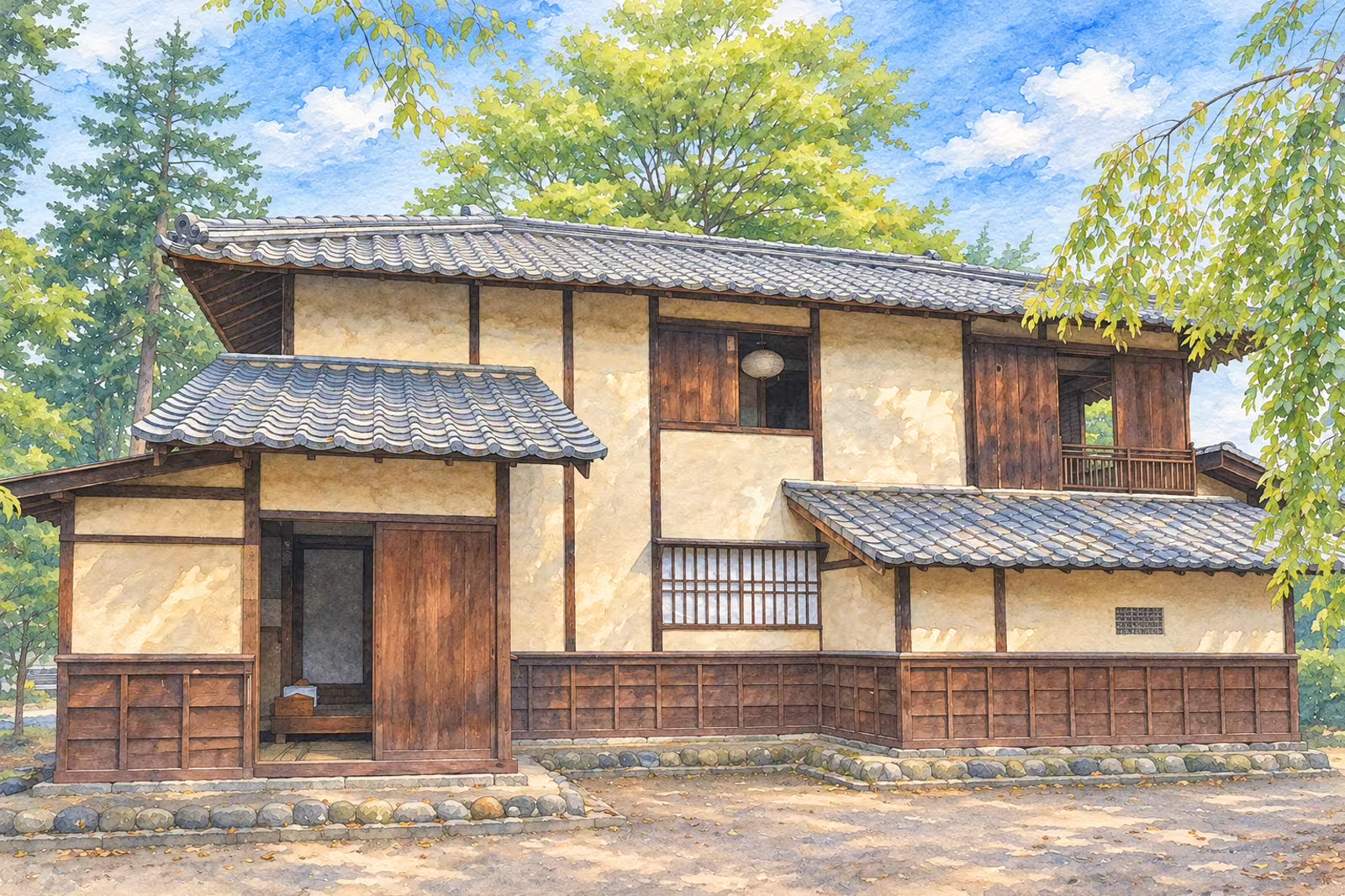
Matsushiro, in the southern part of Nagano City, Nagano Prefecture, was the castle town of the Sanada family’s Matsushiro domain, assessed at 100,000 koku, during the Edo period. The Bakumatsu thinker Sakuma Shōzan was born here, and the town still holds a cluster of sites connected with him: the site of his residence, a shrine, and several relocated buildings. Shōzan is remembered for the slogan "Eastern ethics, Western science," and Katsu Kaishū, Yoshida Shōin and Sakamoto Ryōma were among those who studied with him. The sites differ in date and origin, and together they show how a controversial figure of the late Edo period came to be commemorated in his home town.
01Sakuma Shōzan
Born in 1811 to a Matsushiro samurai family, Shōzan trained in Zhu Xi Confucianism and went on to study in Edo. In 1842 his lord, Sanada Yukitsura, became a senior councillor of the shogunate with responsibility for coastal defense, and assigned Shōzan to investigate Western affairs. Shōzan studied Western gunnery under Egawa Hidetatsu and that same year submitted his "Eight Policies for Coastal Defense," which called for stronger shore defenses and Western-style warships. He then taught himself Dutch, cast cannon in Matsushiro, and is said to have experimented with a telegraph and other devices. Around 1851 he opened a private school in Edo teaching gunnery and Dutch learning.
In 1854 his student Yoshida Shōin tried to stow away on one of the American ships, and Shōzan was implicated. After a spell in prison he was sent back to Matsushiro under house confinement, which lasted about nine years. In 1864 the shogunate summoned him to Kyoto, where he argued for union of court and shogunate and for opening the country. In the seventh month of that year he was assassinated in the Sanjō–Kiyamachi area of Kyoto, at the age of 53 (54 by traditional count). The assassin is generally identified as Kawakami Gensai of Higo.
02What Can Be Seen Today
The site of Shōzan’s residence in the old castle town is a designated historic site, though most of the original buildings are gone. Next to it, Shōzan Shrine, founded in 1938, enshrines him; it is a later memorial, not a place he used. Within the shrine grounds stands the relocated Kōgitei, recorded as the house where he lived and received visitors during his confinement, and the En’u-tei, a tea room said to have been moved from his last residence in Kyoto. The town’s Shōzan memorial museum had closed as of 2025, and the display of its collection is being reorganized. Nearby, the Matsushiro Castle ruins, the former domain school Bunbu Gakkō and the Sanada Treasure Museum help set him in the context of his domain. Locally his name is usually read "Zōzan," after the hill of that name behind the residence.