
Most clothes are finished the day they are sewn. A kimono is not. Its panels are cut straight, its seam allowances are folded inside rather than trimmed away, and its stitches are meant to come out. That means a silk kimono can be unpicked, washed flat, resewn to a new body, relined for an older wearer, dyed a darker colour for a daughter, and finally cut down into a jacket, a sash, a child’s robe, a cushion cover and a rag rug. Follow one garment through those stages and you see why the kimono is built the way it is, and who has kept it alive: tailors, cleaners, dyers, mothers, second-hand dealers and, increasingly, people far from Japan.
01A Roll of Cloth Becomes a Garment
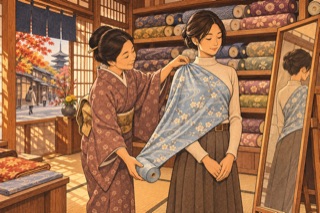
Every kimono starts as a tanmono, a bolt of cloth rolled into a tight cylinder. One standard bolt, called an ittan, is roughly 36 centimetres wide (the standard "narrow width", 9.5 sun on the traditional cloth rule) and around 12 metres long: enough for one adult kimono and very little else. In a kimono shop, a salesperson will unroll a length and drape it diagonally over a customer’s shoulder in front of a mirror so she can judge how the colour and pattern fall on her body. Nothing has been cut yet.
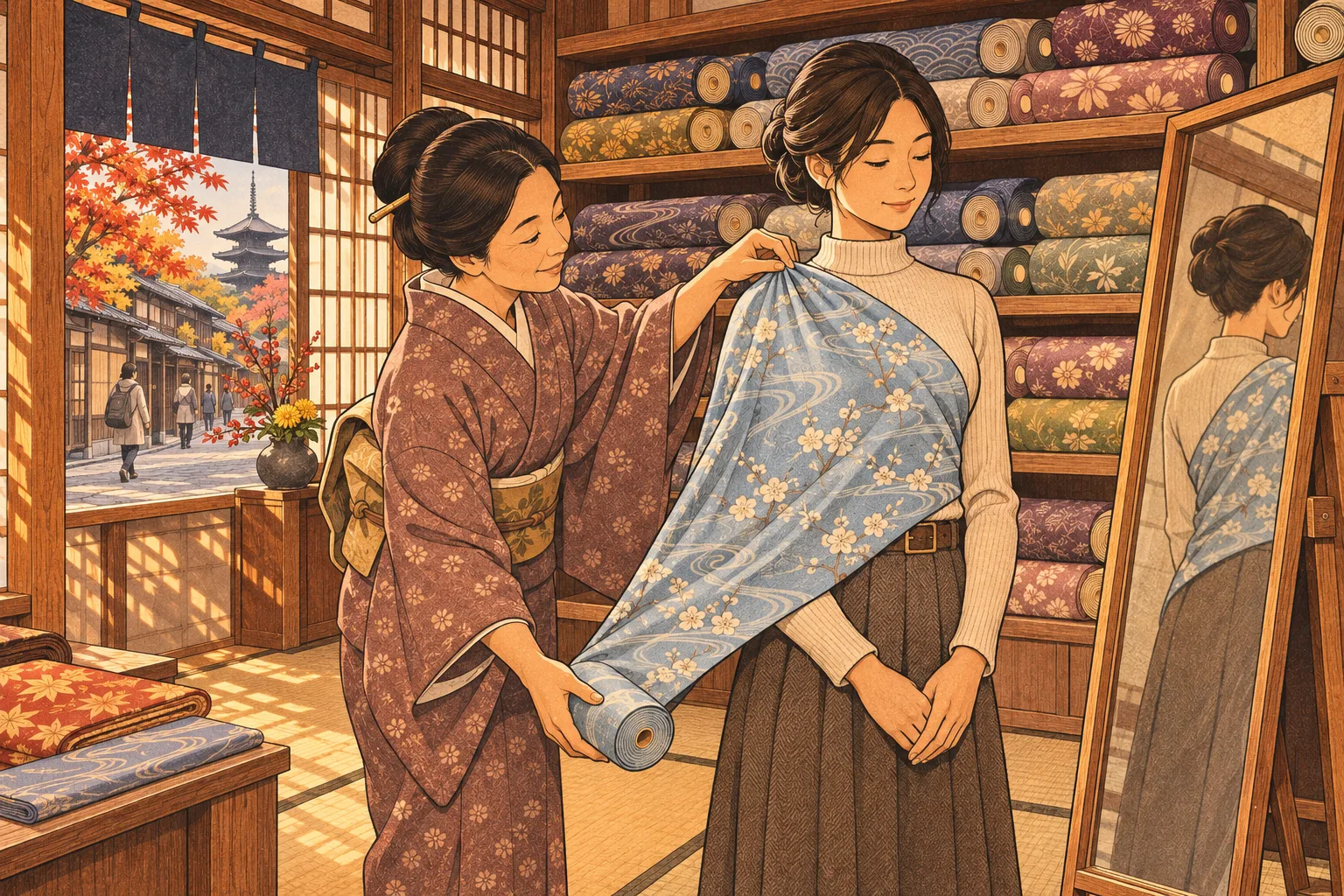
In a kimono shop, the assistant unrolls a length from the bolt and drapes it over the customer’s shoulder so she can judge it in the mirror.
Before cutting, the cloth is usually given a yunoshi, a steam treatment that relaxes the stresses left by weaving and dyeing and evens out the width. Silk that skips this step can shrink unevenly the first time it meets humidity.
Then comes measurement. A traditionally made kimono is not sold in small, medium and large; it is tailored to a set of personal measurements called sunpō. The key figures are the mitake (body length from the top of the shoulder to the hem, which for women is close to the wearer’s full height, because the surplus is folded up at the waist into a tuck called the ohashori), the yuki (from the centre back seam to the sleeve opening, which should fall near the wrist) and the sodetake (the vertical depth of the sleeve, typically 1 shaku 3 sun, about 49 centimetres, on an everyday women’s kimono, and long enough to nearly reach the ankles on the longest furisode). Many kimono tailors still work in the old whale-bone foot, the kujirajaku, of about 37.9 centimetres.
The tailor, or wasaishi, cuts the bolt into straight rectangles. What makes kimono tailoring unusual is what happens to the excess. A Western tailor trims seam allowances and finishes the edges. A kimono tailor folds every allowance inside and tucks extra body length away at the waist. The finished garment carries hidden cloth that can be let out later.
Hand sewing is the core of the craft. The tailor works at a low bench, using small, even running stitches and a near-invisible slip stitch called kuke at the collar and cuffs. The thread is deliberately weaker than the silk, so that under strain the stitches give before the cloth tears, and so the seams can be unpicked without damage. A lined silk kimono takes a skilled tailor several days of work, and the wait from order to collection is often a few weeks. Today hand sewing in Japan, hand sewing contracted abroad, and machine sewing all exist side by side. Machine stitching is standard for cotton yukata and washable synthetic kimono, and it is much harder to take apart.
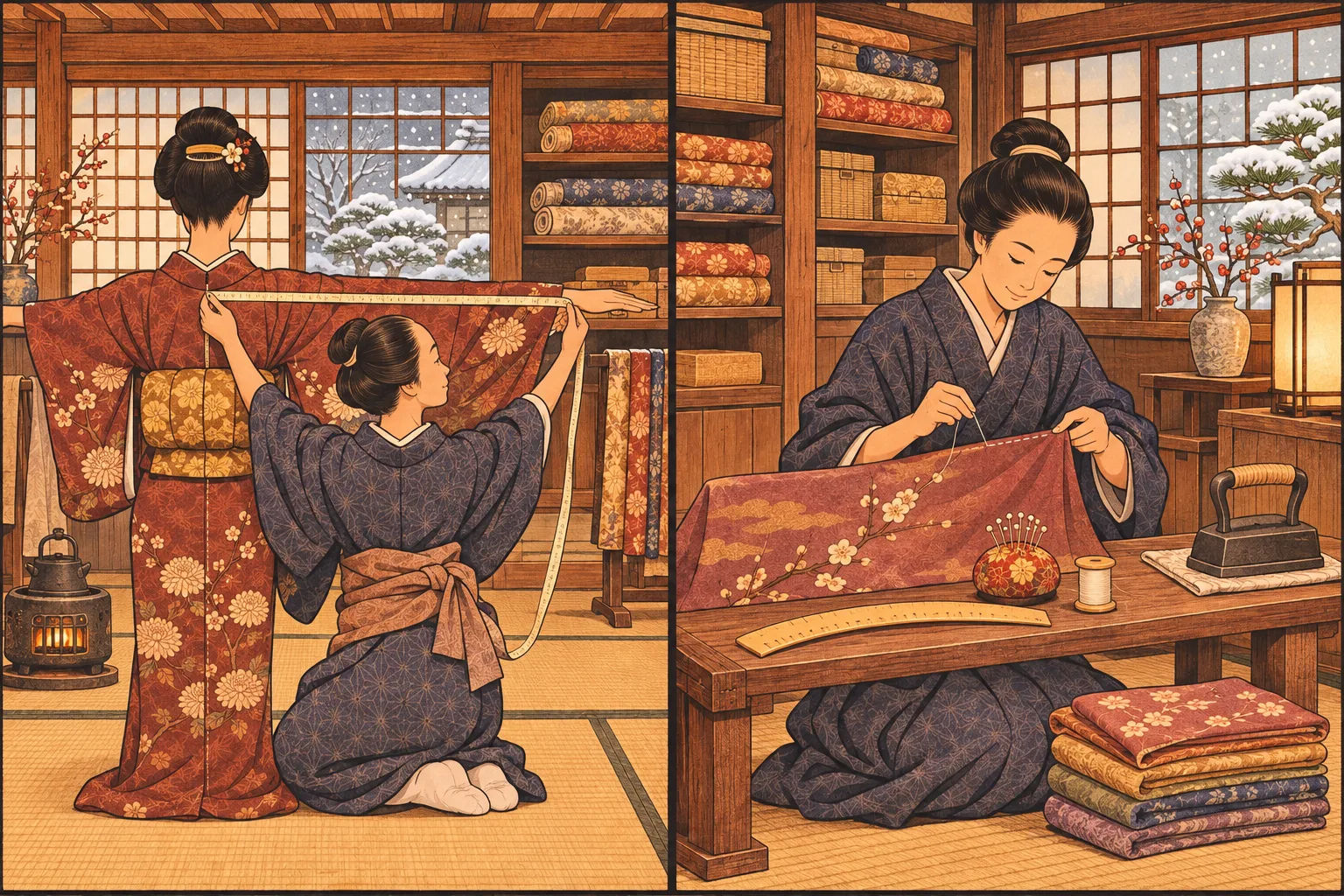
Left: taking measurements, the client’s arms held out straight while the tailor measures across her back. Right: the wasaishi sewing by hand at a low bench, with ruler, pincushion and cut panels beside her.
Kimono worn from autumn to spring, called awase, are lined. On a woman’s kimono the lining comes in two parts (men’s and children’s kimono usually have a single full lining). The upper lining, the dōura, is usually plain white silk. The lower lining, the hakkake (also called susomawashi), runs around the hem, the overlaps and the inside of the cuffs, and takes its name from the eight pieces it is cut in: two for each body panel’s hem, two for the overlaps and two for the collar ends. Its colour flashes at the hem as the wearer walks and shows as a thin line at the sleeve openings, so it is chosen with care. Unlined kimono, hitoe, are worn in June and September; summer gauzes are unlined too.
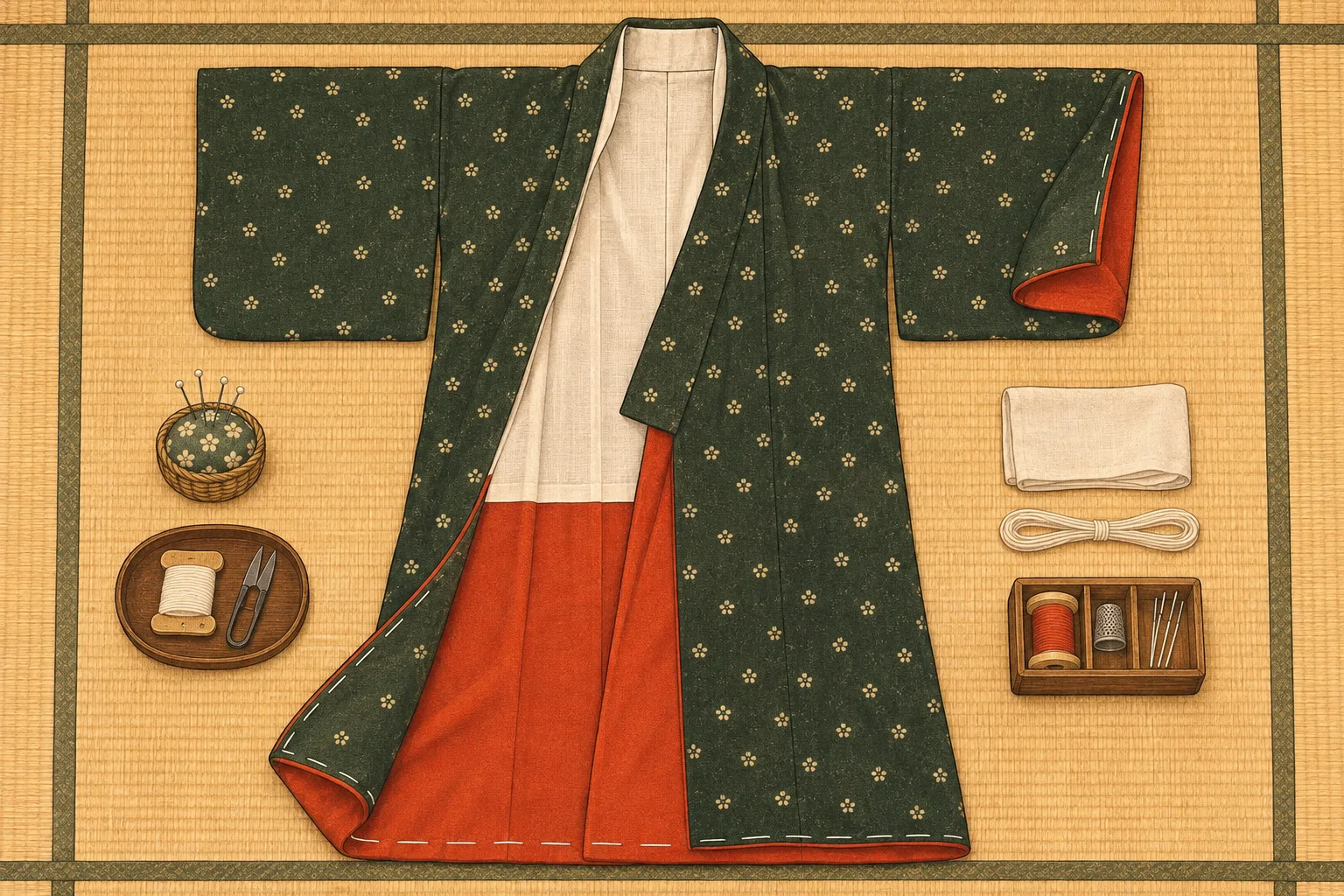
The lining of an awase: the white dōura in the upper body, and the red hakkake running around the hem, the overlaps and the inside of the cuffs.
The new garment arrives with loose white basting threads, shitsukeito, holding the collar, cuffs and hem in shape. These are pulled out before the first wearing. Going out with them still in is a classic beginner’s slip.
02Living With a Kimono: Airing, Folding, Storing
Silk kimono are not washed after each wearing. When a kimono comes off, it goes onto a kimono hanger with its arms stretched straight out, in a room out of direct sun, for half a day or overnight. The point is to let body heat and moisture escape before the garment is shut away. Older homes used an ikō, a wooden stand shaped a little like a torii gate, over which the kimono hangs open like a folding screen.
While it hangs, the wearer checks the usual trouble spots: foundation and sweat at the collar, grime at the cuffs, mud and rain at the hem, shine and creasing at the seat and knees. Stains are noted and left for a professional rather than rubbed at home. The han’eri, a strip of fabric stitched over the under-kimono’s collar, is unpicked and washed every few wearings, and the under-kimono itself (the nagajuban) is cleaned far more often than the outer layer. Together they catch most of the sweat.
The kimono is then folded along its own seams in the standard method, hon-datami, so that creases fall on stitching rather than across open silk. It goes into a tatōshi, a large folder of handmade paper tied with strings, sometimes with a small window and a label. The paper absorbs moisture and keeps out dust, but it yellows and turns acidic with age, so careful owners replace it every few years.
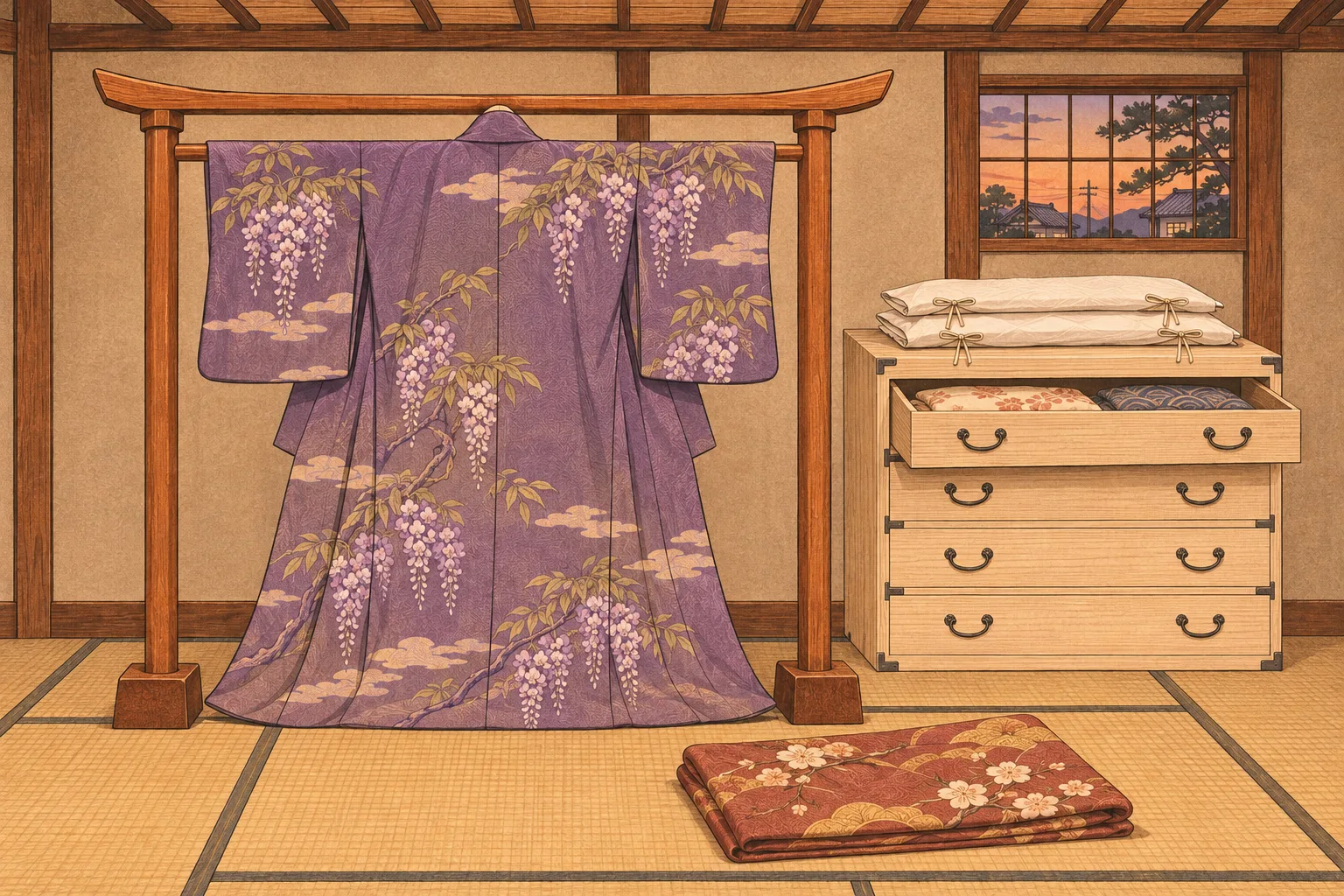
After wearing, three steps: aired overnight on a stand, folded along its own seams, then wrapped in paper and laid flat in a paulownia chest.
The traditional destination is a chest of paulownia wood, a kiri-dansu. Paulownia is light and fine-grained, and it swells slightly in damp weather, sealing the drawers more tightly; in dry weather it shrinks back and breathes. It is also widely said to discourage insects and to resist fire. Those reputations are real in Japan, though probably larger than the wood’s actual powers. One firm rule passed down by older relatives: use only one type of insect repellent, because mixing them can cause reactions that stain silk.
Once a year, everything comes out for mushiboshi, the airing that keeps insects and mould away. The classic time is the summer doyō, the 18 days before the start of autumn in the old calendar, roughly late July to early August, when the rainy season has ended and clear days follow one another; hence the alternative name doyōboshi. A second airing around October is called akiboshi, and one in the dry months from December to February kanboshi. On a low-humidity day after two or three days of fine weather, for a few hours around noon, windows and doors are opened and the kimono are hung inside out on hangers indoors where air moves, out of direct sunlight, which fades dyes. It is a chance to spot moth holes, mildew and yellowing. Temples and the court have aired their treasures on a schedule for centuries; the annual autumn inspection of the Shōsōin treasury at Tōdai-ji in Nara rests on the same logic.
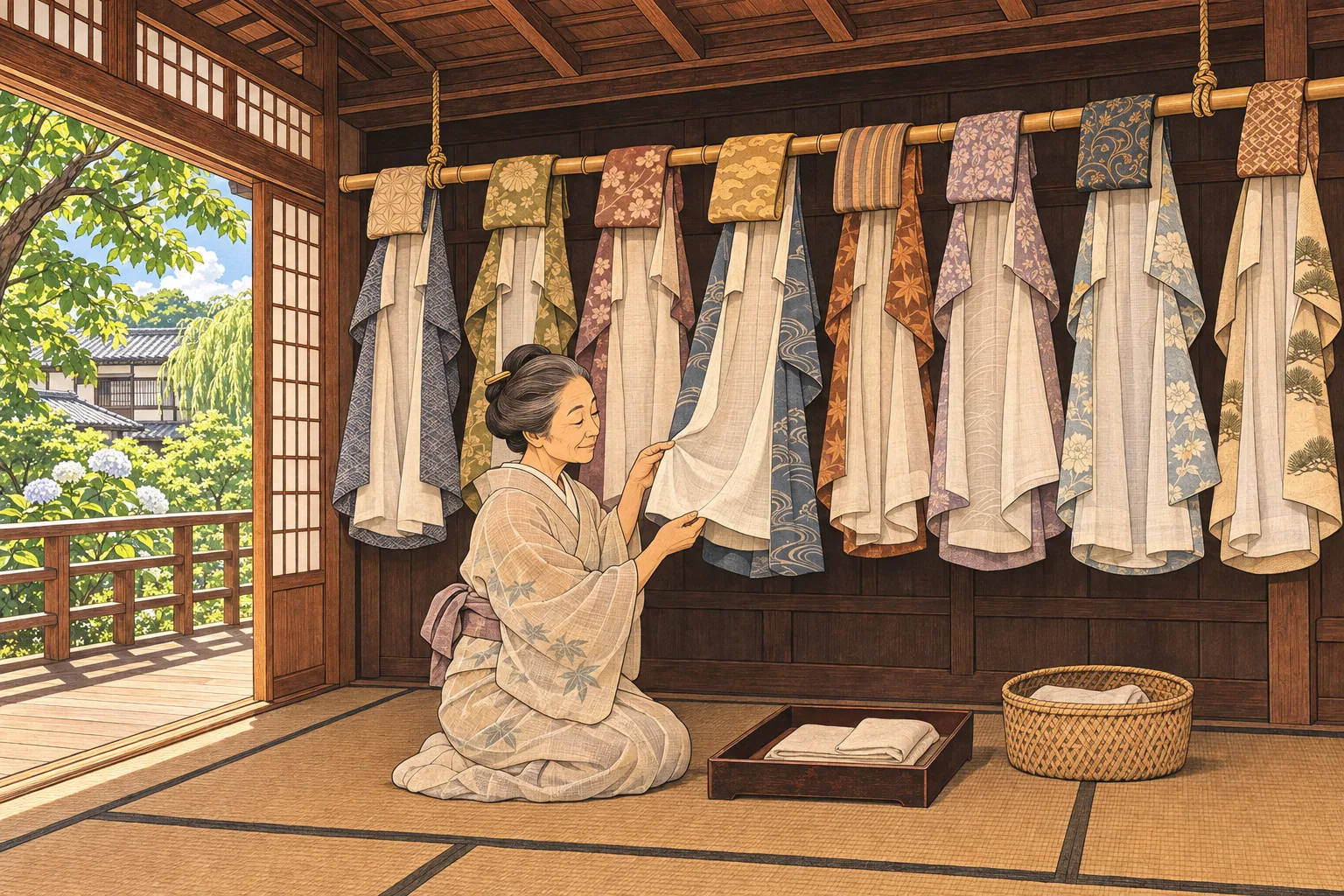
Mushiboshi: the kimono hang inside out in an airy room with the doors wide open. The sun reaches the veranda, never the silk.
03Cleaning: The Shikkaiya and the Hidden Specialists
A dirty silk kimono does not usually go to an ordinary dry cleaner. It goes to a kimono shop or a shikkaiya. The word means roughly "everything shop": in the Edo period a shikkaiya was an Osaka agent who took orders for dyeing, redyeing and washing of every kind and sent the work to specialist craftsmen in Kyoto. In the Kansai region the name later came to cover any business handling kimono washing and dyeing. Many kimono shops still play this role, fronting a chain of specialists the customer never meets.
The routine treatment is maruarai, "whole washing": the kimono is cleaned intact in a petroleum-based solvent. It lifts oils, skin sebum and make-up without shrinking or distorting the garment, and suits a kimono worn a few times or about to be put away for the season. Its weakness is sweat. Sweat is water-soluble, the solvent leaves it behind, and over months or years the salts and proteins left behind turn into yellow-brown patches.
That is what asenuki, sweat removal, is for. A specialist treats the underarms, back and waist with water or high-pressure steam, drawing out salts and proteins while keeping the silk from shrinking. A kimono worn in summer and packed away without it may come out the next year with a faint yellow bloom across the back.
Spot stains go to a shiminuki craftsman. Soy sauce, wine, lipstick, mud, blood and mould each need a different solvent and sequence. The work happens on a suction table with fine spray guns, small brushes and a steam gun, pushing the stain out of the fibres and drying as it goes so no tide mark forms. Old yellowed stains may need bleaching and then retouching, in which the lost ground colour is painted back with a fine brush.
The deepest cleaning is araihari, "washing and stretching". The main kimono article covers the idea; here is the process. Every seam is unpicked, in the reverse order of sewing, a job once done by the women of the household. If the cloth is to be dried on stretchers, the panels are stitched end to end back into one long strip, so the garment becomes something close to its original bolt. The cloth is scrubbed with soapy water on a flat board. Then it is dried flat under tension, either by shinshi-bari, used for silk crepes and similar fabrics, in which the strip is pulled taut at both ends and thin bamboo stretchers with pins at each end are set across the width every few centimetres so the cloth hangs like a long ladder in the open air, or by ita-bari, suited to cotton and other cloth that does not shrink when wet, in which the pieces are pasted to wooden boards to dry. A final steaming brings the width and grain back into line; today the stretching is often skipped and the washed cloth simply steamed.
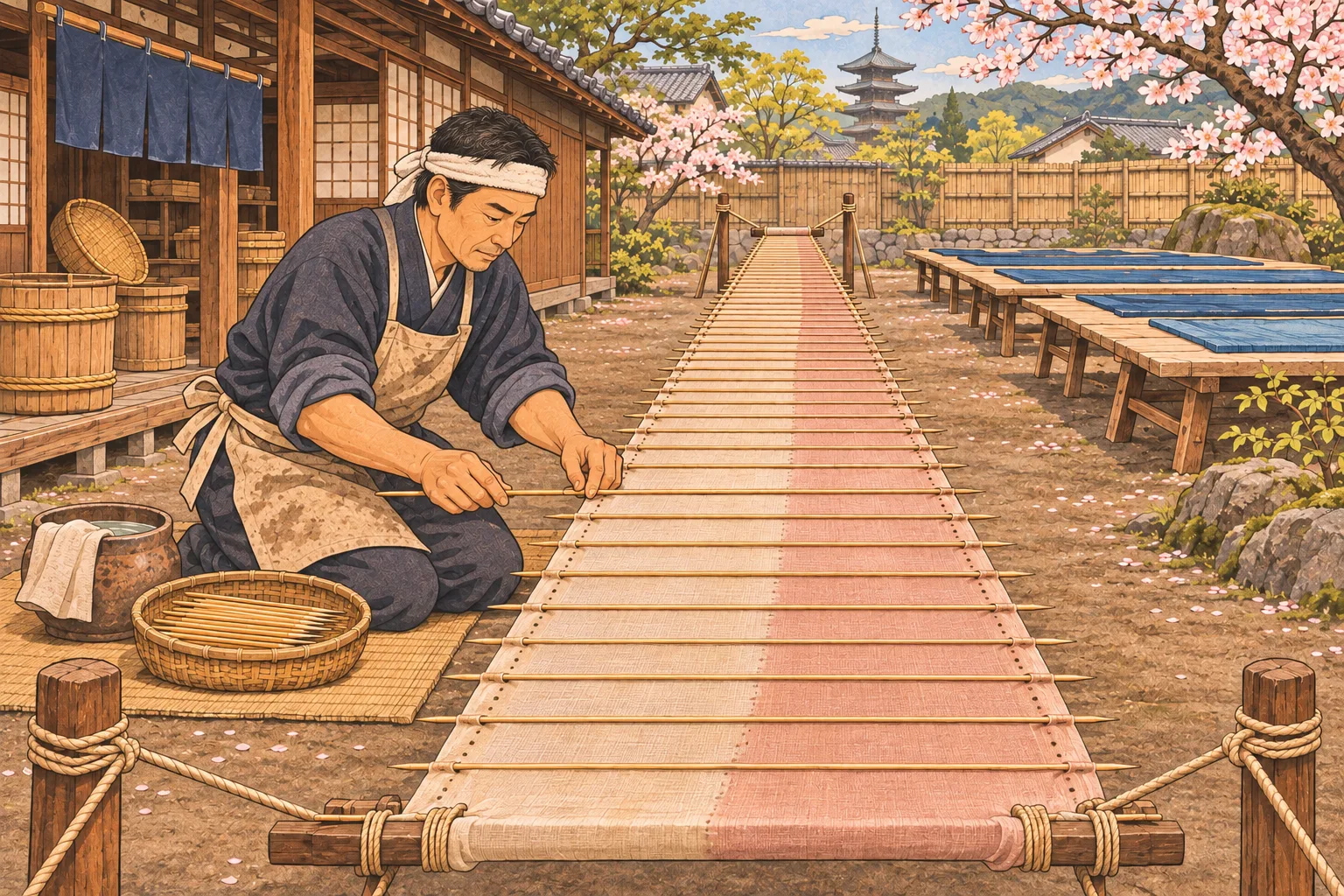
Shinshi-bari, the stretching stage of araihari: the unpicked panels, stitched back into one long strip, are pulled taut while the craftsman sets thin bamboo stretchers across it one by one.
The washed silk feels new, and it is a reset: the garment is cloth again. Until the Second World War it was commonly done at home, and yards were often hung with strips of cloth stretched on bamboo. Few workshops now do it the traditional way, and most owners send a kimono for araihari only when they plan to remake it.
04Remaking: Same Silk, Different Garment
Remaking is possible because of the straight panels and hidden seam allowances. Rectangles can swap places; folded-in cloth can be let out.
The simplest change is a new hakkake. Because the lower lining shows, its colour signals age. A young woman’s kimono might flash vermilion or bright yellow at the hem; in middle age the same kimono might be relined in a quiet tone close to the outer colour. Nothing on the outside is touched, yet the garment now belongs to a different stage of life. The hem lining is also the first part to wear out, so relining doubles as repair.
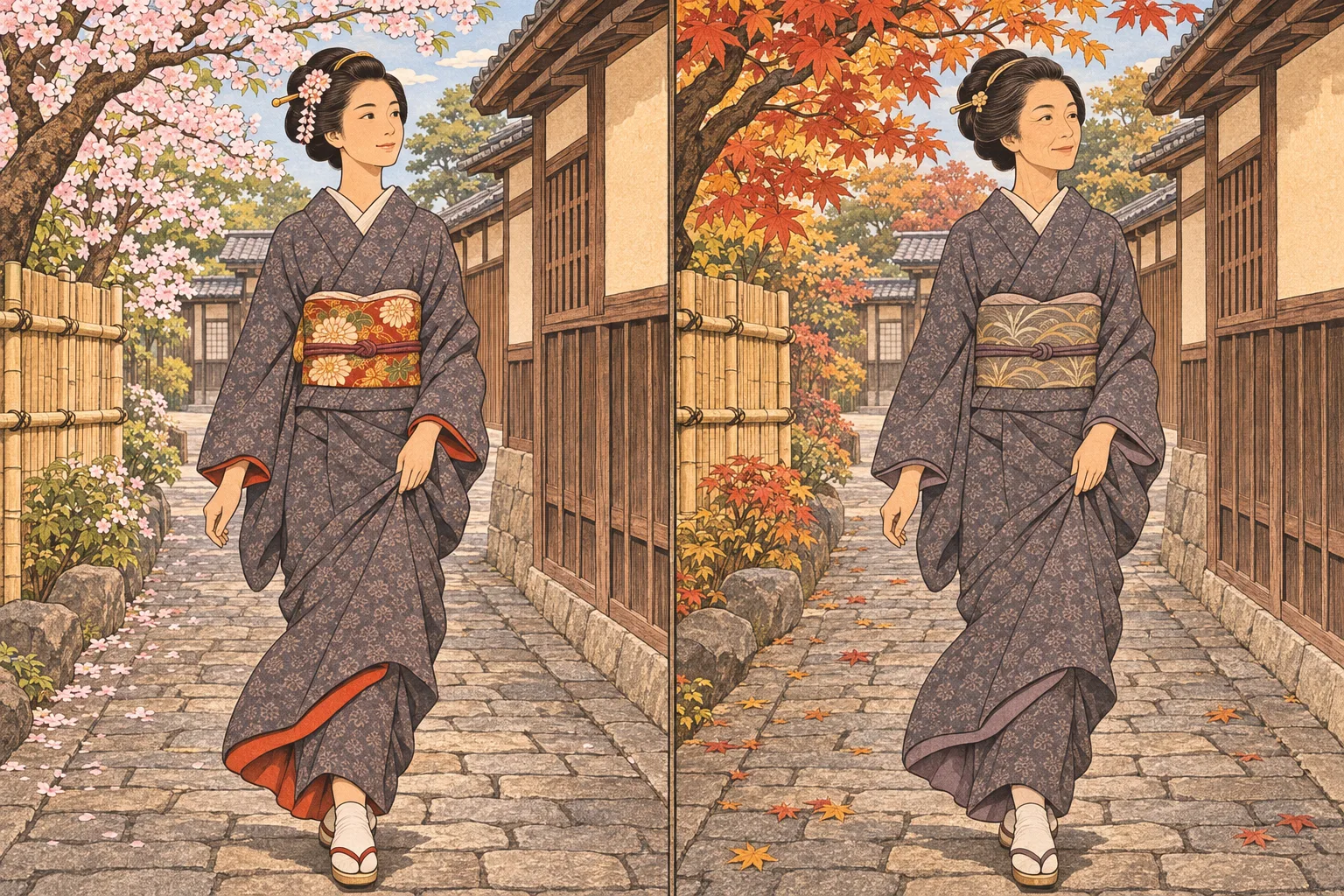
The same kimono, relined. Left: in youth, a bright red hakkake flashes at the hem. Right: years later, the lining has been changed to a quiet grey-purple, with a soberer obi to match.
Sunpō-naoshi, resizing, lets seam allowances out or takes them in. How far a sleeve can be lengthened depends on how much cloth the original tailor folded into the shoulder seam. Women’s kimono are forgiving in length because the ohashori tuck can simply be made smaller.
Shitate-naoshi, resewing after unpicking, usually follows araihari. It is the moment to move worn areas out of sight. Each body panel runs in one piece from the front hem over the shoulder to the back hem, so it can be turned end to end, putting the worn back to the front; left and right panels can trade places, overlaps can be turned upside down, sleeves can change sides. Tailors call this kind of rotation kurimawashi. A seat that has worn thin may get an inner reinforcement patch, the ishikiate, especially on unlined kimono.
Somekae, redyeing, has one rule: you can go darker, not lighter. Pink can become a greyish purple, red can be pushed to brown. Going lighter means stripping the colour chemically first, which is harder on the silk. A bright plain kimono from a woman’s twenties dyed to a sober shade for her forties was once a normal plan. Patterned kimono can be overdyed too, leaving the old design glowing faintly under the new colour, or a craftsman can add motifs to an existing design.
Before any of this, the tailor reads the old garment. Laid out after araihari, the panels show where the sun has faded the silk, where the seat has gone shiny, where a stain was retouched, and how much folded-in cloth survives along each edge. From that map the tailor decides which panel goes where, whether the new owner’s measurements can be met, and whether a sleeve or overlap panel must be pieced with an extra seam hidden under the obi. A faded kimono can sometimes be turned inside out, so that the less faded reverse becomes the new face; this works best with yarn-dyed weaves and cottons, whose two sides look much alike. The customer usually sees none of this; the remade kimono simply comes back looking like a new garment that fits.
All of this made sense because silk was expensive and kimono shapes barely change with fashion. A remade kimono twenty years old is not out of date in cut; only colour and pattern can date it, and those can be dyed or balanced with a different obi.
05Handing It Down
A kimono often outlives its first owner. Passing kimono from mother to daughter, or grandmother to granddaughter, is ordinary in Japan.
The great moment for this used to be marriage. A bride’s family assembled her yomeiri dōgu, her trousseau, and at its heart stood one or more paulownia chests filled with kimono for every season and occasion: a black tomesode for formal family events, black mourning dress, visiting kimono, a plain-coloured kimono that could be dressed up or down, everyday fine-patterned and pongee kimono, and summer weights. In some regions the trousseau was displayed to neighbours before the wedding. There is a popular story that families planted a paulownia tree when a daughter was born, so that by her marriage it would be tall enough to make her chest. Paulownia grows fast enough for this to be plausible; how widely it was really done is hard to say.
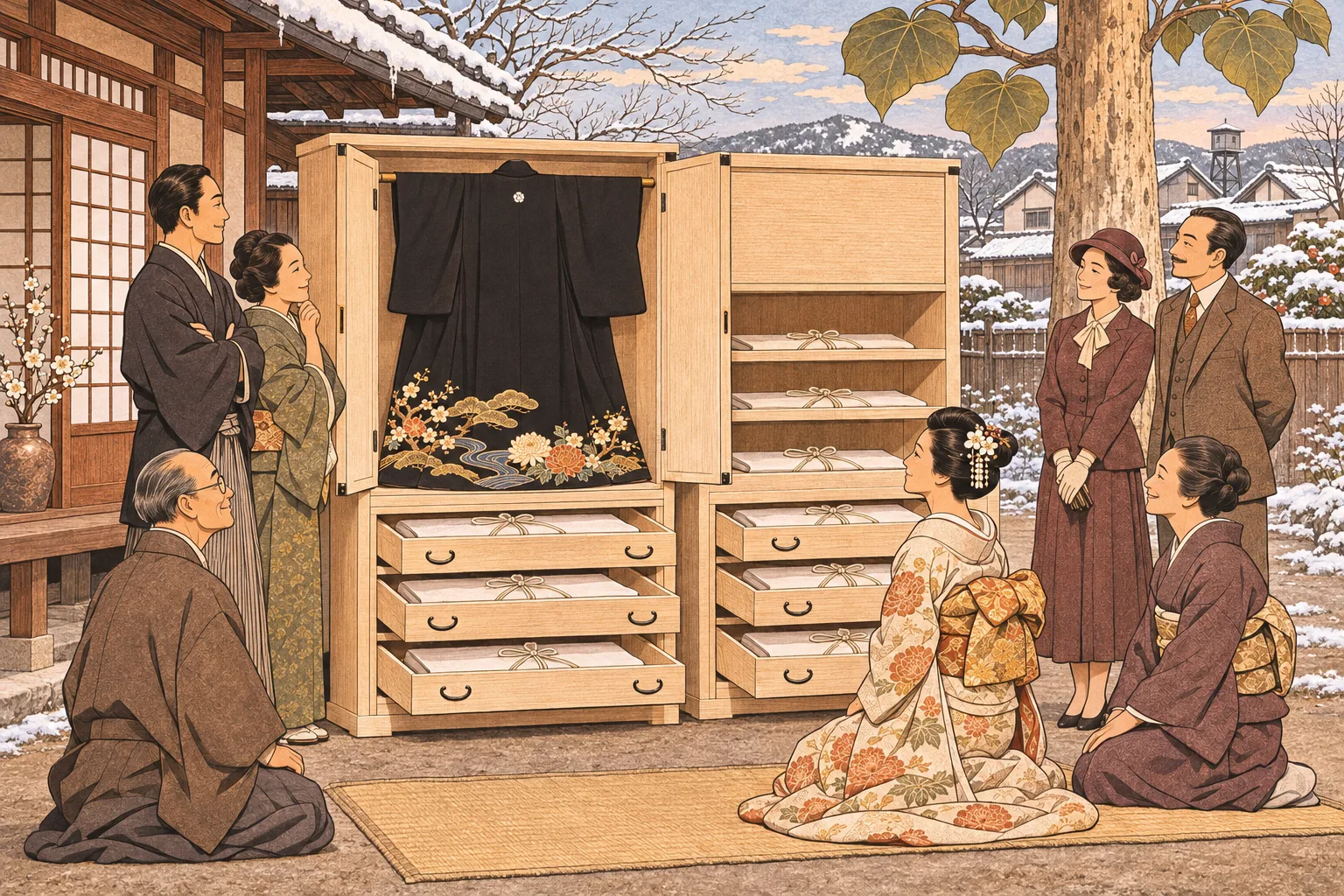
A trousseau on display before a wedding: two new paulownia chests, drawers full of wrapped kimono, a black tomesode hung on top, and a paulownia tree behind (artist’s impression)
Formal kimono carry family crests, and handing them on can mean changing the crest. Customs vary on whether a married woman uses her own family’s crest or her husband’s; in the Kansai region some families pass a "women’s crest" from mother to daughter. To change one, the old crest is removed and a specialist crest painter hand-paints the new one.
The best-known inheritance is the furisode: a daughter wearing her mother’s long-sleeved kimono to her own Coming of Age ceremony, covered in the article on that ceremony. In the Edo period a woman’s long sleeves were shortened when she came of age or married, the swinging part of the sleeve being sewn shut against the body; this is generally given as the origin of the name tomesode, "fastened sleeves". Accounts differ on whether coming of age or marriage was the usual occasion.
Kimono also change hands at death, in the distribution of keepsakes called katamiwake. Each handover tends to bring another cleaning, another resizing, another new lining, so the stitches in an old kimono record a succession of bodies and decades. Many chests today, though, hold kimono that nobody in the family will wear, and that is where the second-hand trade begins.
06Afterlives: Smaller and Smaller
When a kimono can no longer serve as a kimono, it moves down a ladder of smaller uses, each time cutting away the worn parts and keeping the sound ones.
The first step is often a haori, the short over-jacket. It needs less cloth and stops at the hip or knee, conveniently above the frayed hem. Haori cut from old kimono are popular now, worn over Western clothes like a cardigan. A michiyuki, a square-necked travel coat, is another option.
Heavier silks, such as pongee or woven brocade, can become an obi. A Nagoya obi needs only part of the cloth plus an interlining, and an old kimono’s best motif can be placed exactly on the drum-shaped bow at the back. Soft, thin kimono make good under-kimono, where faded patches and faint stains are never seen.
Then come children’s clothes. One adult kimono yields several small ones. Because children grow fast, these are made with tucks sewn at the shoulders and waist, kata-age and koshi-age, let out year by year. Children’s kimono have their own cuts. A hitotsumi has a back cut from a single width of cloth, with no centre seam, and is worn up to about the age of three; a mitsumi is for children of roughly three to five; and a yotsumi, whose body panels are cut from a length four times the body length, fits children from about four or five to around ten. An adult bolt or an adult kimono taken apart supplies these easily, and the leftover lengths become the matching jacket. Many outfits for the Shichi-Go-San festival were once cut from a mother’s or grandmother’s kimono, as were padded jackets and sleeveless vests for winter.
Below clothing come household goods: cushion covers, futon covers, bags, purses, wrapping cloths. Old cotton yukata became nappies, valued for being soft from washing, and then dusters and floor cloths, layered and quilted with running stitches.
The last stage is sakiori, "torn weaving". Cloth too far gone to sew is torn into strips about a centimetre wide and woven as weft on a cotton warp. The result is thick and streaky, each band of colour from a different old garment, and it makes sashes, vests, table mats and rugs. It flourished in the Tōhoku, Hokuriku and San’in regions along the Sea of Japan and in remote mountain and fishing villages, where cotton could not be grown at home and was hard to obtain. From the mid-Edo period, kitamaebune coastal freighters brought used cotton from Osaka and the Kamigata region, and it was torn and rewoven until nothing remained; Aomori’s Nanbu and Tsugaru sakiori grew out of this trade. Today it has revived as a craft, with workshops across the country.
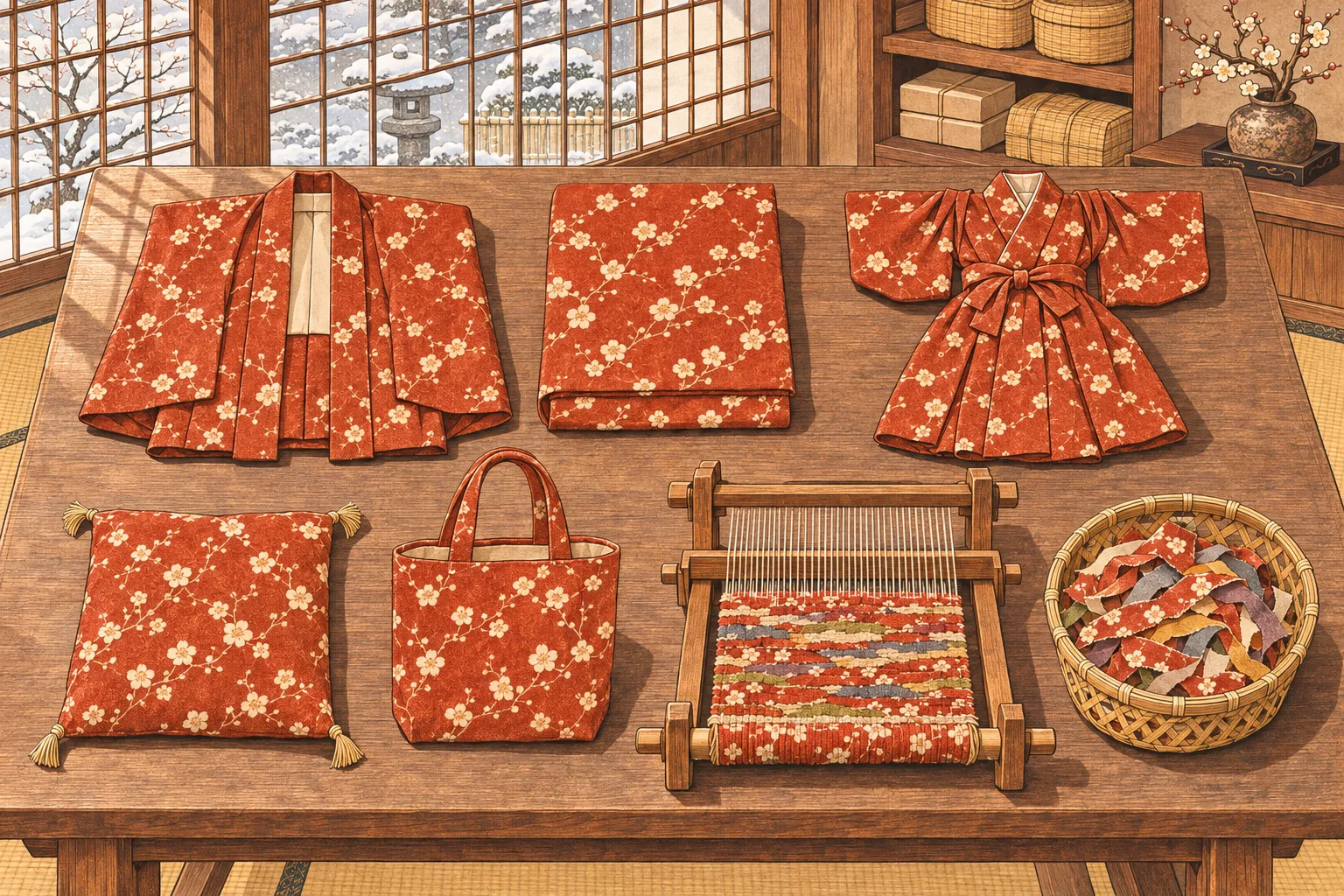
Where one cloth can go. Top row, from left: a haori, an obi, a child’s kimono. Bottom row: a cushion cover, a bag, sakiori on a small loom, and a basket of cloth torn into strips.
In Edo, the story often goes, the chain ended in ash: rags too worn even for dusters went into the stove as fuel. Ash collectors, haikai, really did go door to door buying up household ash, which was resold for fertiliser and for use by dyers and brewers. The complete rag-to-ash chain, though, is probably a later tidying of Edo’s recycling economy rather than something on record. The principle holds all the same: cloth was used to the end.
07Side by Side: One Bolt in Four States
Picture one length of silk at four points in its life, laid out in a row.
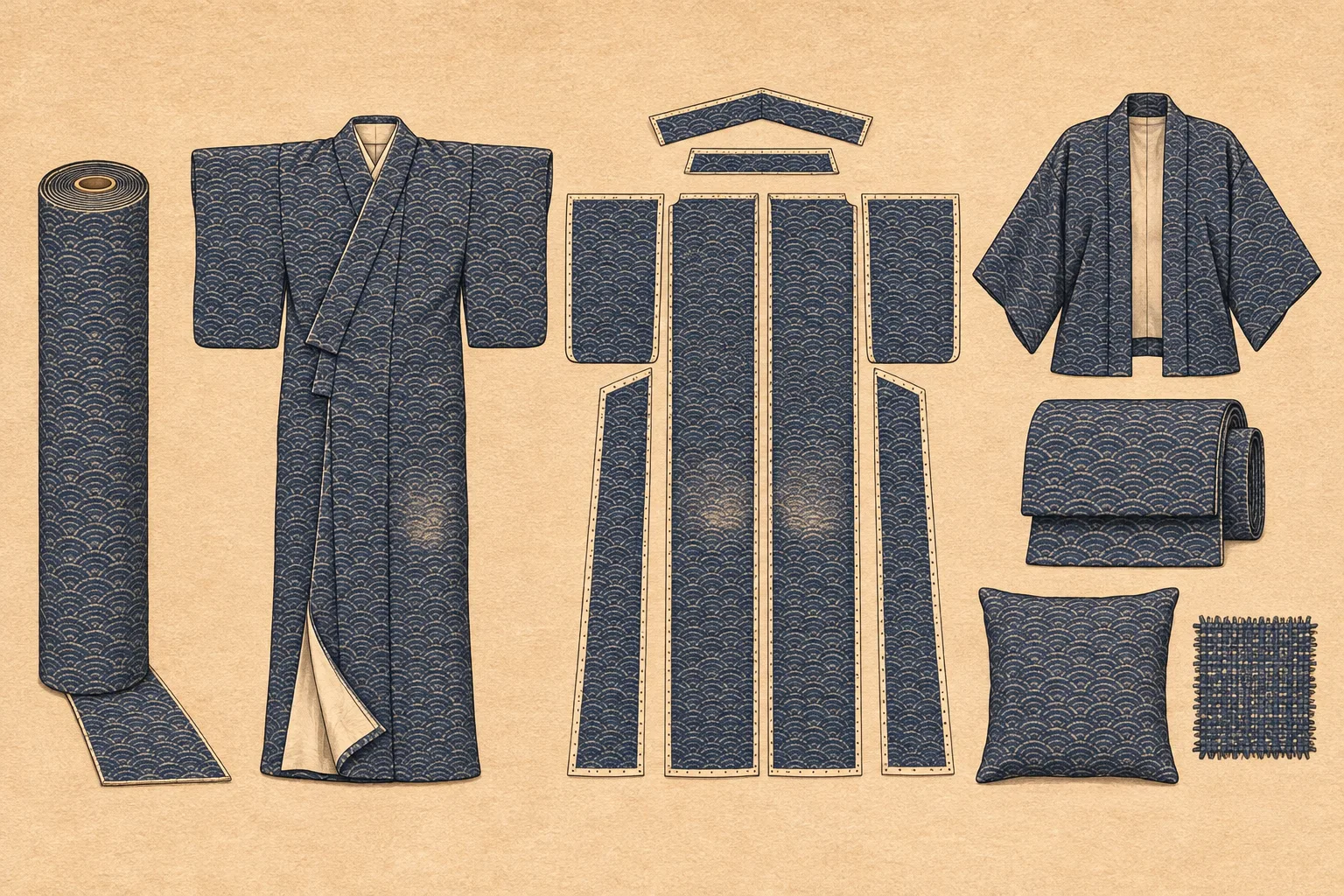
One bolt in four states, from left: the bolt; the finished kimono; the rectangular panels after unpicking for araihari; and, in the right-hand column from the top, a haori, an obi, a cushion cover and a square of sakiori.
First, the bolt. A tight cylinder, about 36 centimetres wide and 12 metres long unrolled, edges crisp, no creases, no needle holes, the pattern running continuously down its length. A label from the weaver or region is often stuck to one end.
Second, the finished kimono. Laid flat it forms a T: two square sleeves, a straight body, two narrow overlap panels at the front, a collar running down the front edge. Every piece is a rectangle; there are no curves and no darts. Inside, the wide folded seam allowances are visible, and on a lined kimono the hem turns back to show the contrasting hakkake. Folded, it becomes a neat oblong that fits its paper folder.
Third, the pieces after araihari. With the stitches removed, the panels lie flat or are joined back into a strip on bamboo stretchers. Here the garment’s history is easiest to read. Cloth hidden in the seams is bright; exposed cloth has faded, and a sharp line divides them. Needle holes march along the old seam lines. Worn areas are shiny or thin. Set these pieces beside the original bolt and they are clearly the same thing, merely cut into lengths.
Fourth, the small things. A haori, shorter, its worn hem gone. A Nagoya obi with the finest motif centred on the bow. A cushion cover pieced from squares. A sakiori mat in which one stripe of colour is this kimono.
Between the first three states, almost nothing has been cut away, and each can return to the one before; a kimono can shuttle between garment and cloth many times. The step to small things is a real cut, and the step to sakiori destroys even the shape of the cloth. A kimono’s long life is spent going back and forth between the first moves until, finally, it can only go down.
08Reading an Old Kimono at a Flea Market
For a traveller, the end of this story is the easiest part to meet. Many of Edo’s townspeople dressed mainly in furugi, second-hand clothes, bought from dealers clustered in Tomizawa-chō in Nihonbashi and along the Yanagiwara embankment on the south bank of the Kanda River, and in equivalent districts in Kyoto and Osaka. Garments drifted down from rich households to modest ones and from city to countryside. In the hungry years just after the Second World War, city families sold kimono and household goods piece by piece or traded them to farmers for rice, peeling away their possessions like the sheaths of a bamboo shoot, a way of life remembered as takenoko seikatsu, the "bamboo-shoot life".
Today, used kimono shops buy from family chests and resell after cleaning; online marketplaces carry huge numbers; and the monthly markets at Tō-ji and Kitano Tenmangū in Kyoto, mentioned in the main kimono article, are lined with stalls where kimono lie heaped on blue tarpaulins beside boxes of obi and offcuts. Shrine and temple antique fairs across the country are similar. The customers are often young Japanese trying kimono for the first time and visitors from abroad, for whom a used kimono and a used obi are an easy way in.
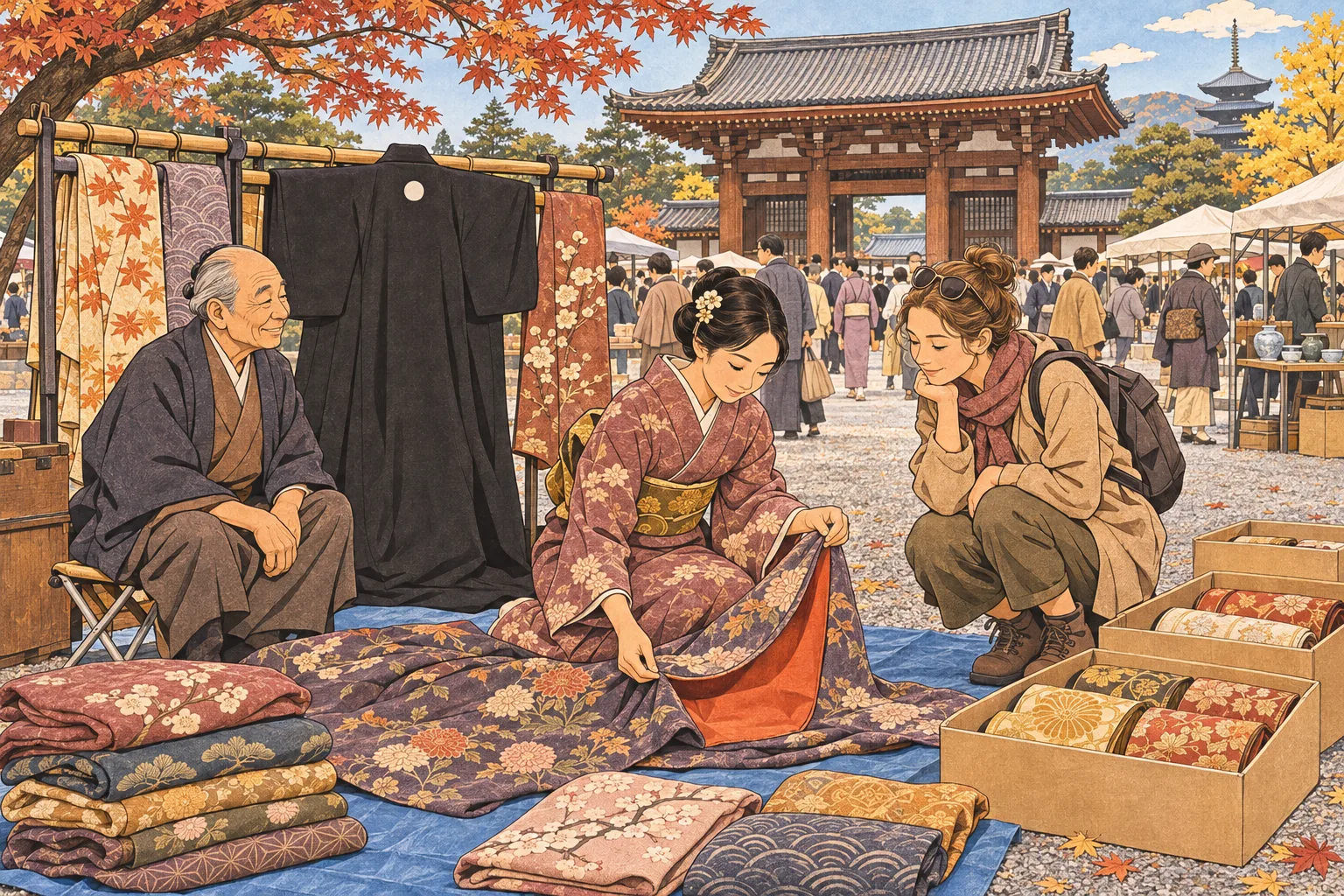
A used-kimono stall at a temple market: kimono heaped on a blue tarpaulin beside boxes of obi. Turning back the hem to check the lining is one way to read a garment’s history.
A few signs tell you an old kimono’s story. A hem lining newer than the outer silk means it has been relined. Wide allowances you can feel inside the seams mean it can still be let out. Faint straight lines of needle holes or old creases mean it has been unpicked and resewn. A slight colour difference between panels may mean they were rotated. A plain white circle where a crest should be is usually a kokumochi, a space reserved for a crest that was never painted in, common on ready-made formal kimono; it does not necessarily mean a crest was removed.
Huge numbers of used kimono and obi are also exported in bulk to Europe, North America, Australia and the rest of Asia. Abroad they are rarely worn as kimono. Haori become jackets and dressing gowns, obi become table runners, and the silk is cut into dresses, cushions and quilts or framed on walls. Designers in Japan and elsewhere build whole lines from old kimono cloth. It is the Edo habit of cutting down old clothes, relocated.
The other side of this market is decline. As the main article notes, fewer people wear kimono, chests full of them are cleared when their owners die, and supply far outruns demand; some end up sold simply as fabric by weight. A kimono can live a very long time, but only while someone is willing to keep unpicking, washing and resewing it. The Japanese word mottainai, regret at wasting something before its value is used up, is often attached to kimono for exactly this reason.
More deep dives on this topic
 Kimono Types and Their RankSpend a Saturday afternoon in the lobby of a big hotel in Tokyo or Kyoto and you will see kimono that look, to an outsider, like variations on a single garment.
 The Obi and Its KnotsStand on a street corner in Kyoto’s Gion and watch two women in kimono walk away from you.
 Kimono Motifs and the SeasonsWalk through Kyoto in early March and you will see cherry blossoms on kimono sleeves weeks before a single tree has opened.
 Japanese Hairstyles and KanzashiLook closely at a woodblock print of a street in late Edo or Meiji Japan and you can read the women in it like name tags.
 Men’s KimonoMost visitors to Japan see far more women in kimono than men, and when a man does walk past in kimono, he can look oddly uniform: dark colours, a short jacket, a narrow belt, flat…
 Putting On a Kimono, Layer by LayerWhen you rent a kimono in Kyoto or Asakusa, you stand in front of a mirror for fifteen or twenty minutes while someone wraps, pulls, tucks and ties, mostly out of your sight.
 KamonWalk through any old Japanese town and you will start to notice the same kind of image again and again: a small black-and-white emblem, perfectly symmetrical, usually inside a…
 The Life of a KimonoMost clothes are finished the day they are sewn.
- Back to the main article: Kimono →