
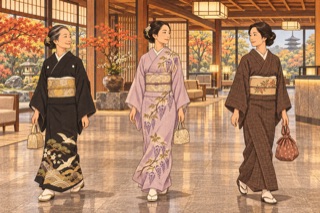
Spend a Saturday afternoon in the lobby of a big hotel in Tokyo or Kyoto and you will see kimono that look, to an outsider, like variations on a single garment. To a Japanese eye they are as different as a morning coat, a cocktail dress and a good tweed jacket. One woman in black with gold cranes along the hem is the mother of the bride. Another, in pale lilac with branches drifting up over one shoulder, is a wedding guest. A third, in a muted brown check with a slightly nubbly surface, is simply out shopping, and her kimono may well be the most expensive of the three.
The system that sorts them is called kaku, usually translated as "rank" or "formality." It decides where a kimono can be worn, who may wear it and which sash goes with it. What sets the rank is not money but a handful of visible conventions: where the pattern sits, whether it flows across the seams, how many family crests are on the back and chest, how long the sleeves are, and whether the cloth was dyed after weaving or woven from dyed thread. Once you know those few things you can read a room full of kimono at a glance.
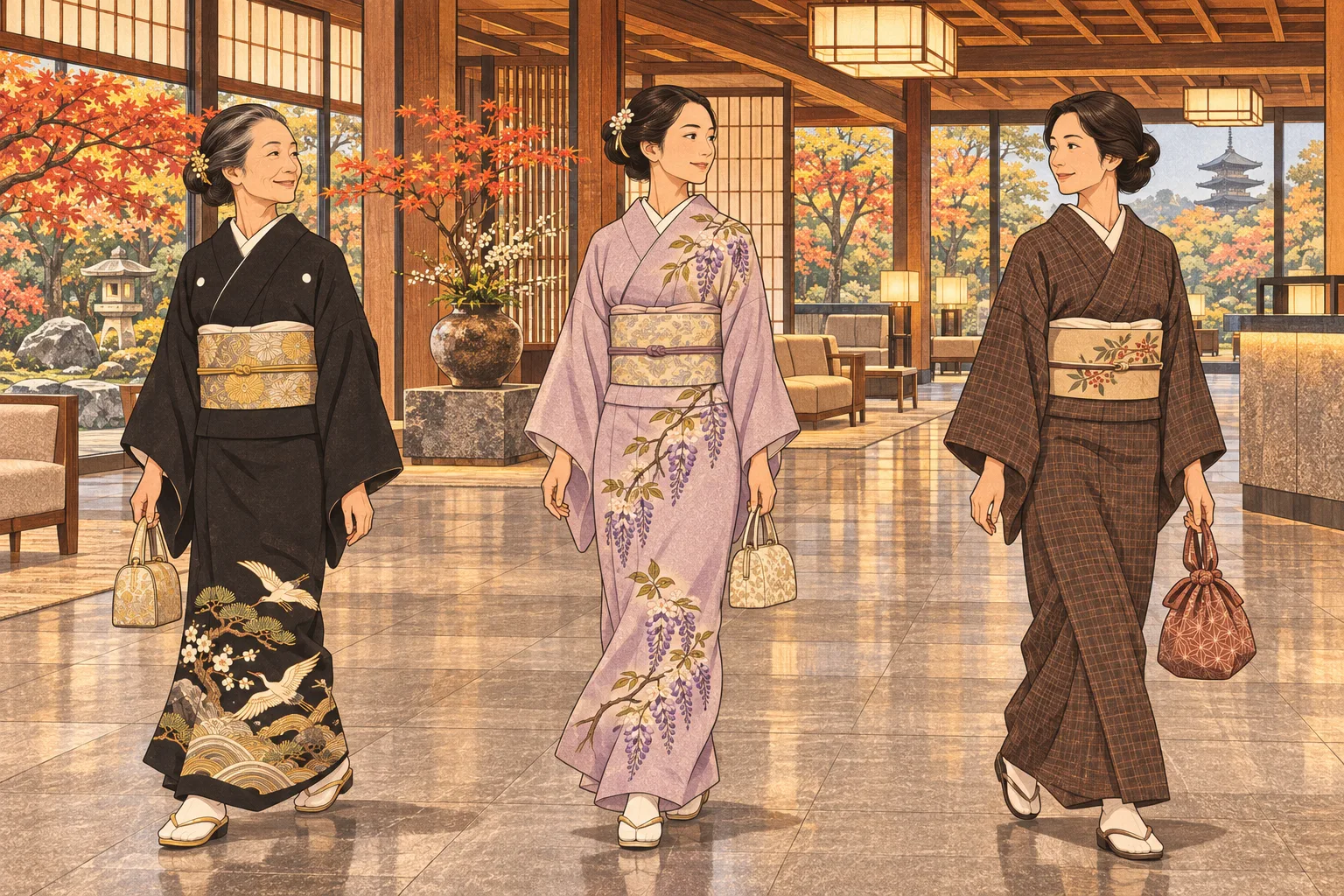
Three women crossing a hotel lobby, from left: a kurotomesode with cranes and pines on the hem; a hōmongi whose design climbs from hem to shoulder; a checked tsumugi.
01Six Questions That Tell You the Rank
Japanese kimono guides usually arrange women’s kimono in a ladder. At the top is dai-ichi reisō, first formal wear, for close family at weddings and for state ceremonies. Below it come semi-formal wear for wedding guests and serious tea gatherings, then informal-formal wear for parties and school ceremonies, then outing wear for the theatre and dinner, and finally everyday wear. Many guides drop the informal-formal step and use four tiers instead, and they do not always agree on where a given kimono belongs: tsumugi, for instance, is outing wear in some lists and everyday wear in others.
This ladder is younger than it looks. In the Edo period (1603–1868), dress rules followed social status: samurai, court nobles and townspeople each had their own conventions, and fashions differed between Edo and Kyoto. The neat modern ranking was assembled step by step after 1868: in the Taishō and early Shōwa years kimono shops and department stores launched new categories such as the hōmongi for a growing round of social occasions, the war produced the tsukesage, and after the Second World War kimono-dressing schools and the trade wrote the rules into textbooks. That is why sources disagree on details, and why an old Kyoto family may have rules a Tokyo dressing school would not recognise.
Still, nearly every guide agrees on the questions to ask.
Where is the pattern? Only on the hem, from hem to shoulder, or everywhere?
Does it cross the seams? A kimono is sewn from straight panels. If a branch of plum blossom runs unbroken from the back panel onto the sleeve, the kimono was laid out as a single picture, a technique called eba that our main kimono article explains. Eba generally marks a dressier garment.
Does every motif point upward when worn? Repeating prints do not care, so half the flowers on the back may be upside down.
How many crests? Five, three, one or none. Five is the most formal.
How long are the sleeves? Long sleeves belong to unmarried women.
Was it dyed or woven? This last question surprises people. A plain white silk that is dyed afterwards (somemono, "dyed things") outranks a cloth woven from pre-dyed threads (orimono, "woven things"), however skilled the weaving. Silk that came off a loom already patterned is, by convention, casual.
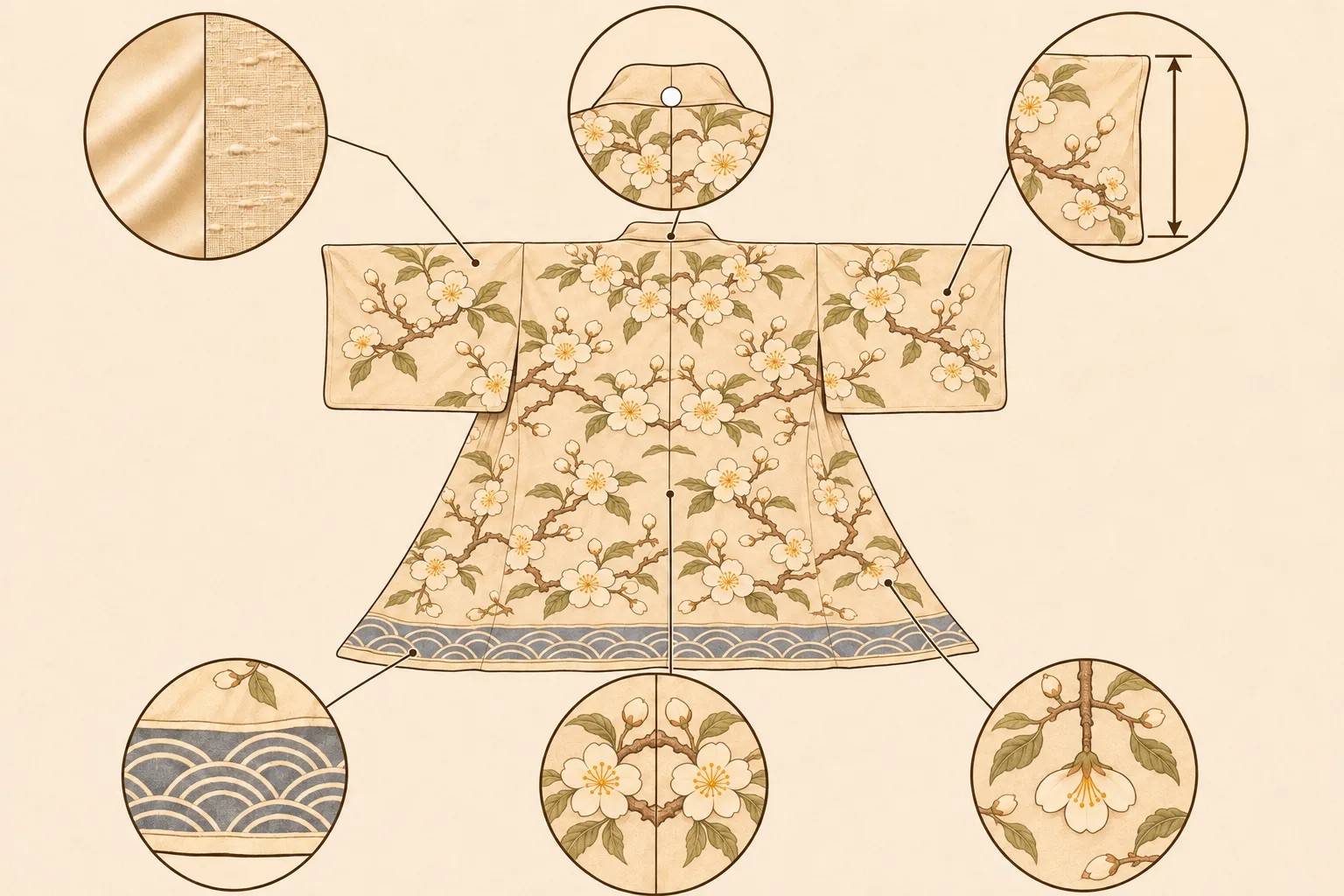
Six places to look. Top, from left: dyed surface or woven surface; the crest at the centre back; sleeve length. Bottom, from left: the pattern at the hem; whether it runs unbroken across the back seam; whether any motif hangs upside down.
02The Top Tier: Kurotomesode, Irotomesode and Furisode
The kurotomesode, literally "black short-sleeve," is the formal kimono of married women and the easiest one to spot in a wedding photograph. The ground is deep black crêpe silk. Above the obi it is completely plain. Below, a single picture runs around the hem from the left front panel to the back: pine, bamboo and plum, cranes and tortoises, phoenixes, treasure ships, court carriages, folding fans. Gold leaf and embroidery are common. The lower-left front corner usually carries the densest part of the design, since that is what shows most once the kimono is wrapped.
Five crests are dyed in white reserve on the black: one at the centre of the back, one on the back of each sleeve and one on each side of the chest. The more mature the wearer, the lower and quieter the hem design tends to be; a younger woman’s pattern may reach well up toward the knee, an older woman’s may be only a low band along the hem.
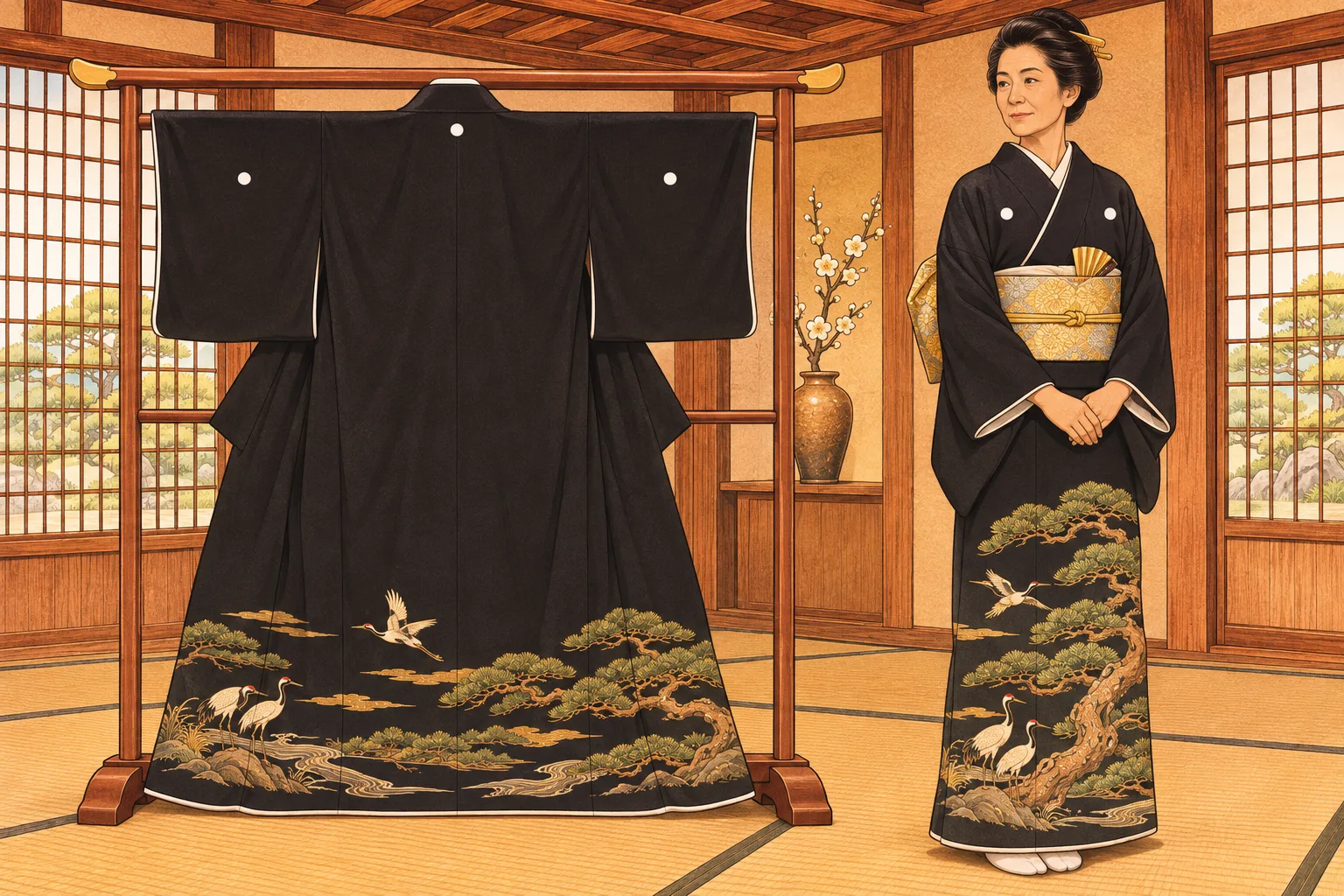
A kurotomesode from the back and the front: black ground, a design on the hem only, white crests on the back and sleeves, and a white edge showing at the collar.
Look at the collar, cuffs and hem and you will see a white layer peeping out. In most modern kurotomesode this is a false lining called hiyoku, sewn in to imitate the second full robe that formal dress once required. It is worn with a white under-kimono and white collar, a heavy gold-and-silver fukuro-obi tied in the doubled nijū-daiko knot (doubling for "happiness upon happiness"), gold or silver sandals, and a small folding fan tucked into the obi.
The name has nothing to do with the colour. Tomesode, "stopped sleeves," comes from the Edo custom of shortening a young woman’s long sleeves when she came of age or married, and in Edo the word simply meant a married woman’s kimono. An older name, Edo-zuma, survives from the Edo fashion for putting the design on the front corners (tsuma) of the robe. By the Bunka and Bunsei eras (1804–1830), black crêpe Edo-zuma with the family crest had already become the celebratory formal dress of married townswomen. When women stopped trailing their hems and began folding up the extra length at the waist, the design shifted toward the hem and front panel, and the name tomesode gradually took over. Some accounts add that Western formal dress, which treated black as the most correct colour, helped fix the black five-crest form after the Meiji Restoration.
At a wedding, the convention is clear. The mothers of the bride and groom wear kurotomesode. So do grandmothers, married sisters, aunts and the wife of the go-between, if there is one. Ordinary guests, even married friends, avoid it so as not to be mistaken for family.
The irotomesode, "coloured short-sleeve," has exactly the same layout, with the design only on the hem, but on a coloured ground: shell pink, pale lavender, celadon, a soft incense brown. Its rank depends on its crests. With five it is equal to the black version. With three or one it drops to semi-formal and can be worn much as a visiting kimono would be.
It has two roles the black version cannot fill. Unmarried women may wear it, so an older unmarried sister of the bride can be dressed at the top rank without wearing long sleeves. And before the war the imperial court avoided black, usually explained as a colour of mourning, so the formal kimono there was the irotomesode. Reference works disagree on whether any such rule still applies, but coloured tomesode remain the usual choice for court events and decoration ceremonies.
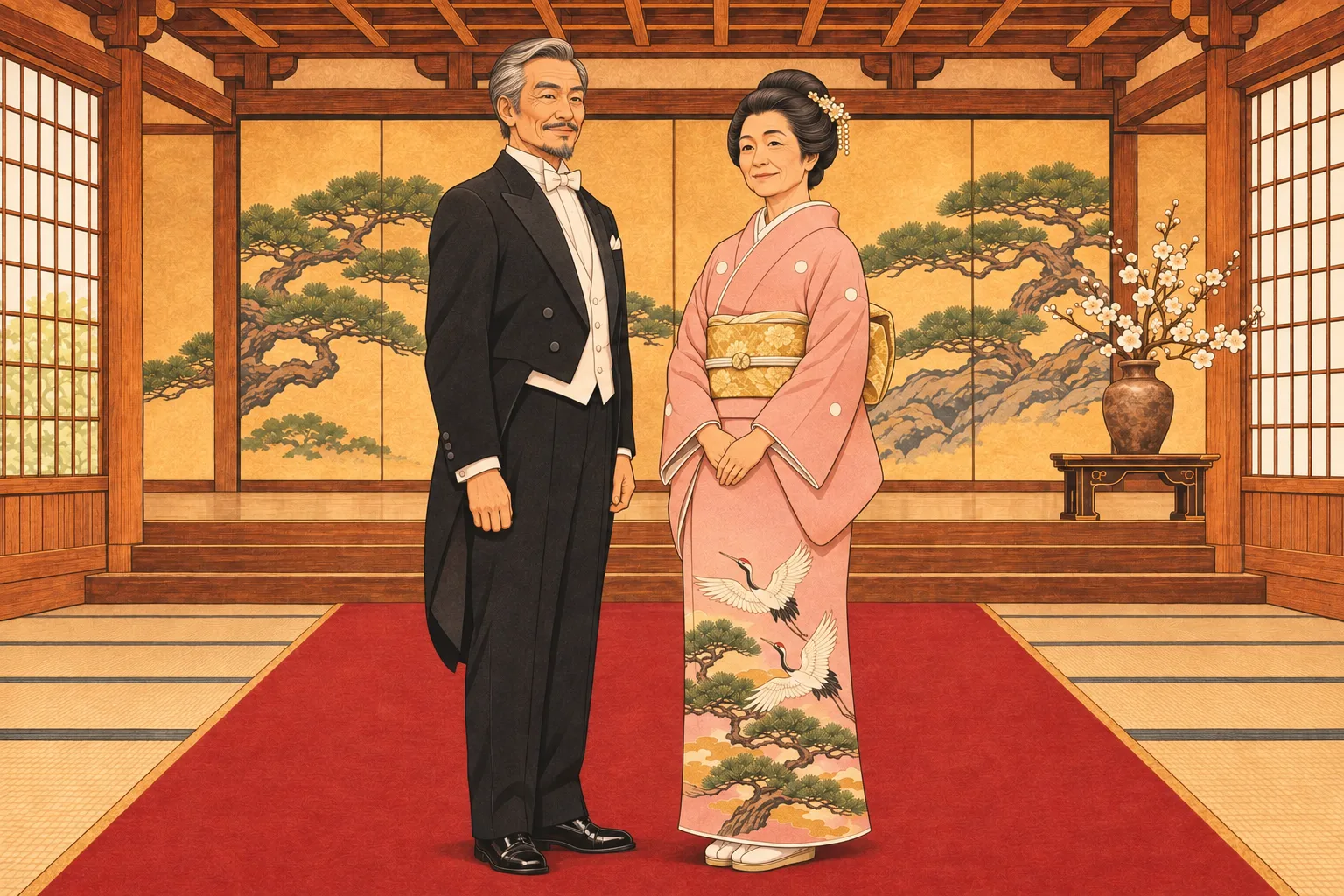
Dressed for a decoration ceremony: the husband in a tailcoat, the wife in a pale pink irotomesode, patterned on the hem only like its black counterpart.
Furisode means "swinging sleeves," and the sleeves are the whole story. On a standing woman they fall to the calf or the ankle and sway with every movement. The pattern is an eba picture covering most of the body: bold reds, vermilion, saffron, royal blue, with flower carts, bundled noshi ribbons, seasonal flowers and embroidered balls. Modern furisode usually carry no crest.
They come in three lengths. The ōfurisode, the longest, has sleeves of roughly 105–114 cm that reach almost to the ankle; it is the most formal, and the one a bride changes into during the reception. The chūfurisode, at roughly 95–100 cm, falls to the calf; both it and the ōfurisode are common at Coming-of-Age Day. The kofurisode, around 85 cm, ends near the knee and can be worn with hakama trousers; a short furisode with dark hakama and lace-up boots is now the classic look at university graduations in March. These measurements vary between sources and are adjusted for height.
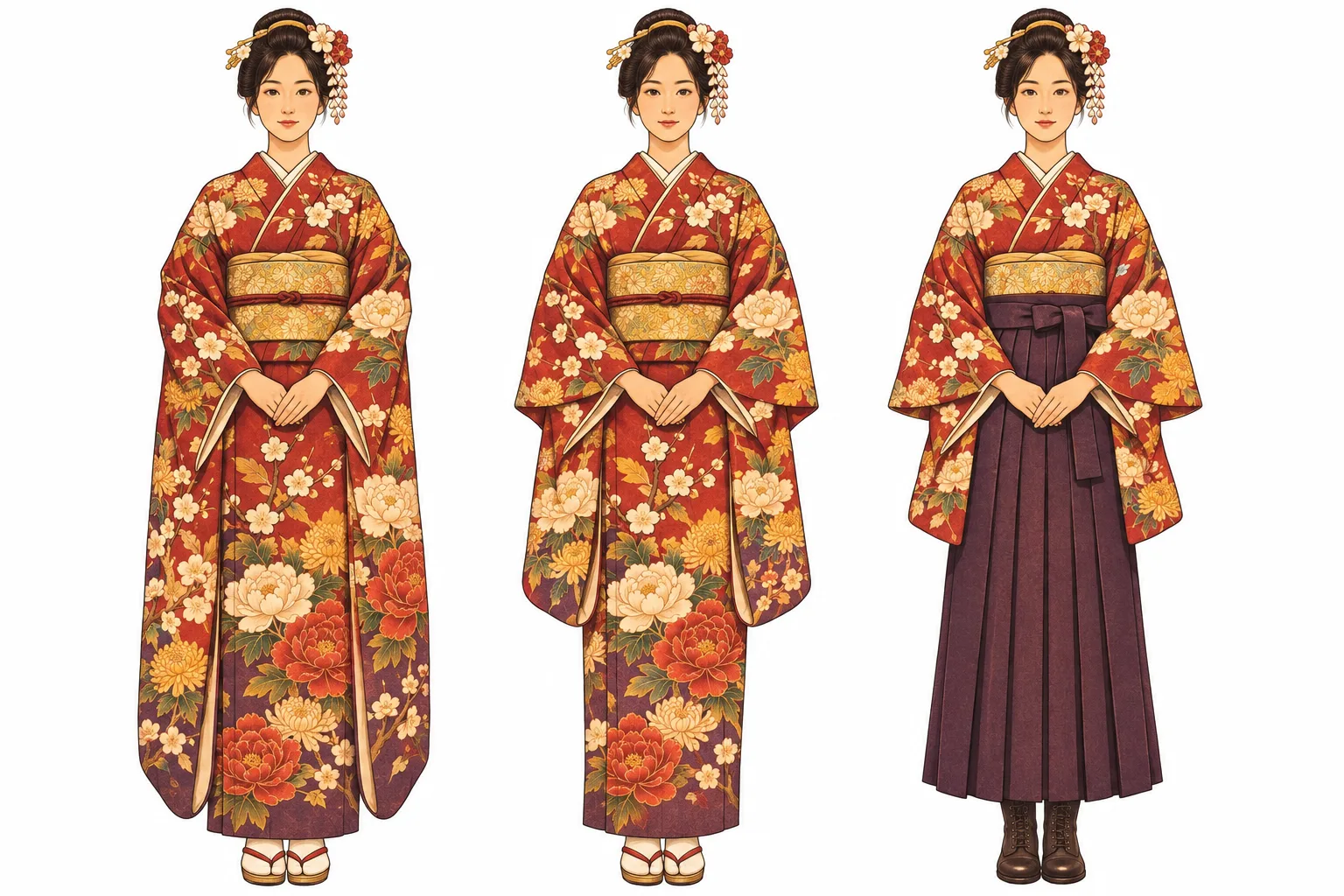
Three sleeve lengths, from left: ōfurisode, reaching almost to the ankle; chūfurisode, to the calf; kofurisode, ending near the knee and worn here with hakama and boots.
The usual account of the long sleeve runs as follows. In the early Edo period, children and young girls wore kimono with open underarm slits and slightly longer sleeves, said to help them stay cool. After that the sleeves grew steadily longer, from about 73 cm in a sewing manual of the Genroku era (1688–1704) to around 100 cm by the late Edo period, a change usually linked to ever wider obi and to women past eighteen keeping the open, swinging sleeve. The long sleeve became a place for display. There is a popular story that young women flirted with their sleeves, swinging them to signal interest, but this looks like later embellishment. The "Furisode Fire" legend of 1657 is told in our main kimono article.
Coming-of-Age Day, the custom of wearing one’s mother’s furisode, and the 2018 collapse of the rental company Harenohi are covered in our article on the coming-of-age ceremony. At weddings, the bride’s unmarried sisters, cousins and friends wear furisode, sharing the top rank with the married women in black. Guests are advised to avoid white, and not to outshine the bride’s own change of costume.
03The Middle Tier: Hōmongi, Tsukesage and Iromuji
This is the most useful layer of the wardrobe, and the most confusing. Most of these can be worn by married and unmarried women alike, to a wedding reception, a tea gathering, a school ceremony or a formal dinner.
The hōmongi, "visiting wear," has an eba design that crosses the seams like the formal kimono above, but it does not stop at the waist. It climbs over the obi to the shoulder, across a sleeve and onto the chest. One common composition starts at the lower left, sweeps up across the back to the right shoulder and finishes on the left sleeve. Turn the wearer around and the two back panels meet at the centre seam with every petal aligned. Today a hōmongi usually has no crest, or one for slightly greater formality; before the early Shōwa era three or one were common.
The name is modern. Garments of this kind first appeared after the Meiji Restoration as social outing wear for upper-class women; in the Taishō era (1912–1926), as women’s social life widened, kimono shops marketed showy but less stiff party kimono, and the name hōmongi became general only in the Shōwa era. A popular story credits the Mitsukoshi store in Tokyo with coining it on the model of the Western visiting gown, but there is no solid record of this. Whatever the exact origin, the hōmongi is a product of modern city social life: calling on people, going to the theatre, attending receptions.
In a shop, a hōmongi hangs on a stand already basted into kimono shape, in a form called kari-eba, so that the whole picture can be seen. How such pictures are painted and resist-dyed belongs to the yūzen process, described in our article on yūzen.
The tsukesage is the hōmongi’s simpler cousin. Its motifs are placed on the hem, shoulder and sleeve, and they all face upward when the kimono is worn, but most of them do not cross a seam. Each flower or fan is finished within its own panel. The dyer calculates where each motif will land and dyes them directly onto the uncut bolt of cloth, without basting it into shape first. So a tsukesage is often sold rolled up as a bolt (tanmono), and you only see the layout when it is unrolled.
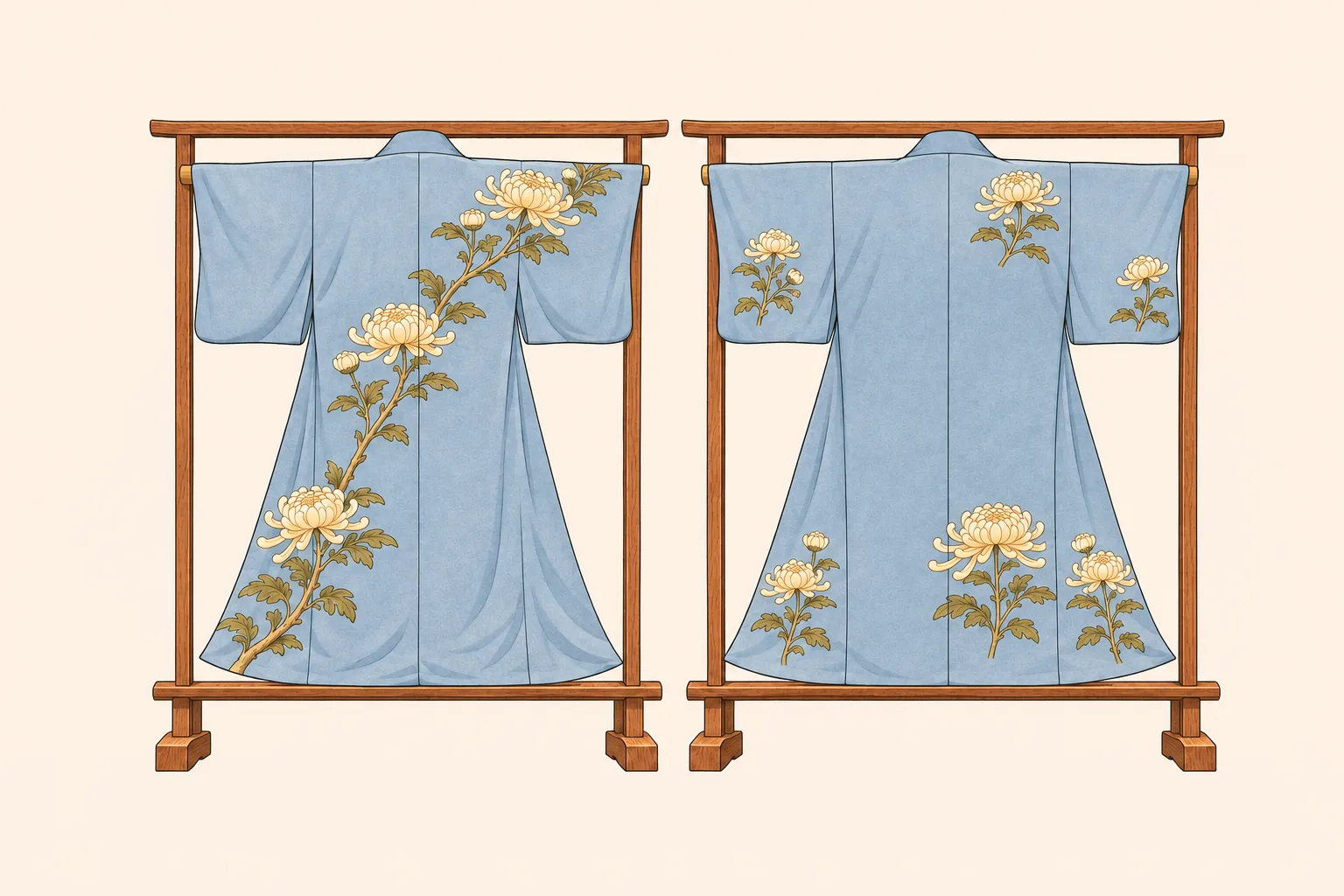
Left: a hōmongi, one chrysanthemum stem running from the hem across the back seam to the shoulder. Right: a tsukesage, each flower upright and contained within its own panel.
The garment is usually dated to the war years, when lavish hōmongi and similar kimono were banned and the sparser, simpler tsukesage came onto the market in their place. A widely repeated account ties it to the luxury-goods restrictions that took effect in July 1940. One reference work adds that it began as a simplified eba in which only the front overlap seam matched, with matching later extended to the side and back seams. After the war the tsukesage stayed popular, and a hybrid, the tsukesage-hōmongi, with some motifs crossing the seams, now blurs the line further.
On paper, tsukesage rank a little below hōmongi. In practice a finely made tsukesage can cost far more than a plain hōmongi, and the two are often interchangeable. Tea practitioners tend to like the tsukesage because its sparse design does not compete with the scroll and the tea bowls.
The iromuji, "plain colour," is a kimono of a single colour other than black, with no dyed pattern. Look closely and the silk often has a woven figure (jimon) that appears and disappears with the light: flowing water, clouds, an interlocking key pattern called sayagata, small flowers. The crests decide everything. Five or three make it semi-formal; one makes it suitable for most receptions and tea gatherings; none brings it close to outing wear.
In the tea world the one-crest iromuji is almost a uniform. It is also the most practical first formal kimono, because the same garment changes with its obi: a gold brocade obi for a celebration, a black or grey one for a Buddhist memorial service. For mourning the woven figure should be neutral rather than auspicious, and the colour subdued, such as grey, purple or blue-grey. This use is called iro-mofuku, "coloured mourning."
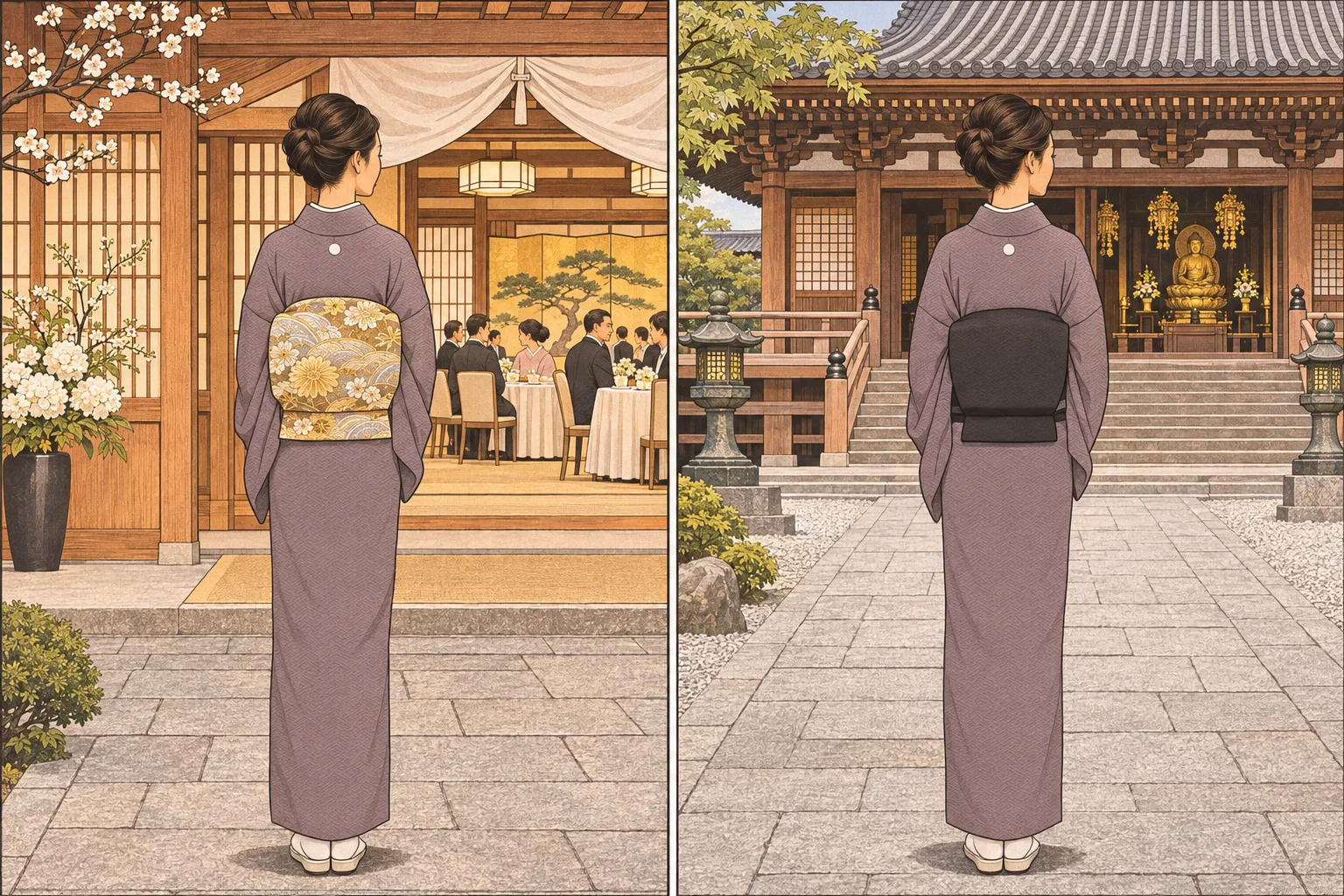
One iromuji with a single crest, two obi. Left: gold brocade for a wedding reception. Right: black for a Buddhist memorial service.
04The Everyday Tier: Komon and the Edo Komon Exception
The komon, literally "small pattern," is the dyed kimono for outings and daily life. It reverses all the rules above. The design repeats over the entire bolt like printed fabric. It ignores the seams. It ignores direction, so half the motifs on the back are upside down. There are no crests. The name originally meant a fine pattern, and early komon were minute stencilled designs; today any dyed kimono with an all-over repeat counts, and the motifs may be big peonies, scattered cherry petals, stripes, checks, rabbits, goldfish or dragonflies.
Komon began as stencil dyeing: a paper stencil was laid on the cloth, rice-paste resist brushed through it, and the stencil moved along, section by section. Kyoto’s kyō-komon uses several stencils for multicoloured effects; Kanazawa has its own Kaga-komon. Komon are what you wear to the theatre, to lunch with friends or to a kimono club meet-up, usually with a Nagoya obi or a narrow half-width obi. Most kimono rented to tourists in Kyoto are komon or polyester prints imitating them. A komon, however gorgeous, does not go to a wedding.
The exception is the Edo komon. From across the room it looks like a solid colour: slate grey, indigo, tea brown, plum. Step closer and the whole surface turns out to be covered in tiny white dots or fine lines, arranged in fish-scale arcs, grids or diagonals. A single square inch of stencil may hold hundreds of holes, punched by hand into layered mulberry paper toughened with persimmon tannin. These Ise katagami stencils come from Shiroko and Jike, in what is now Suzuka in Mie Prefecture.
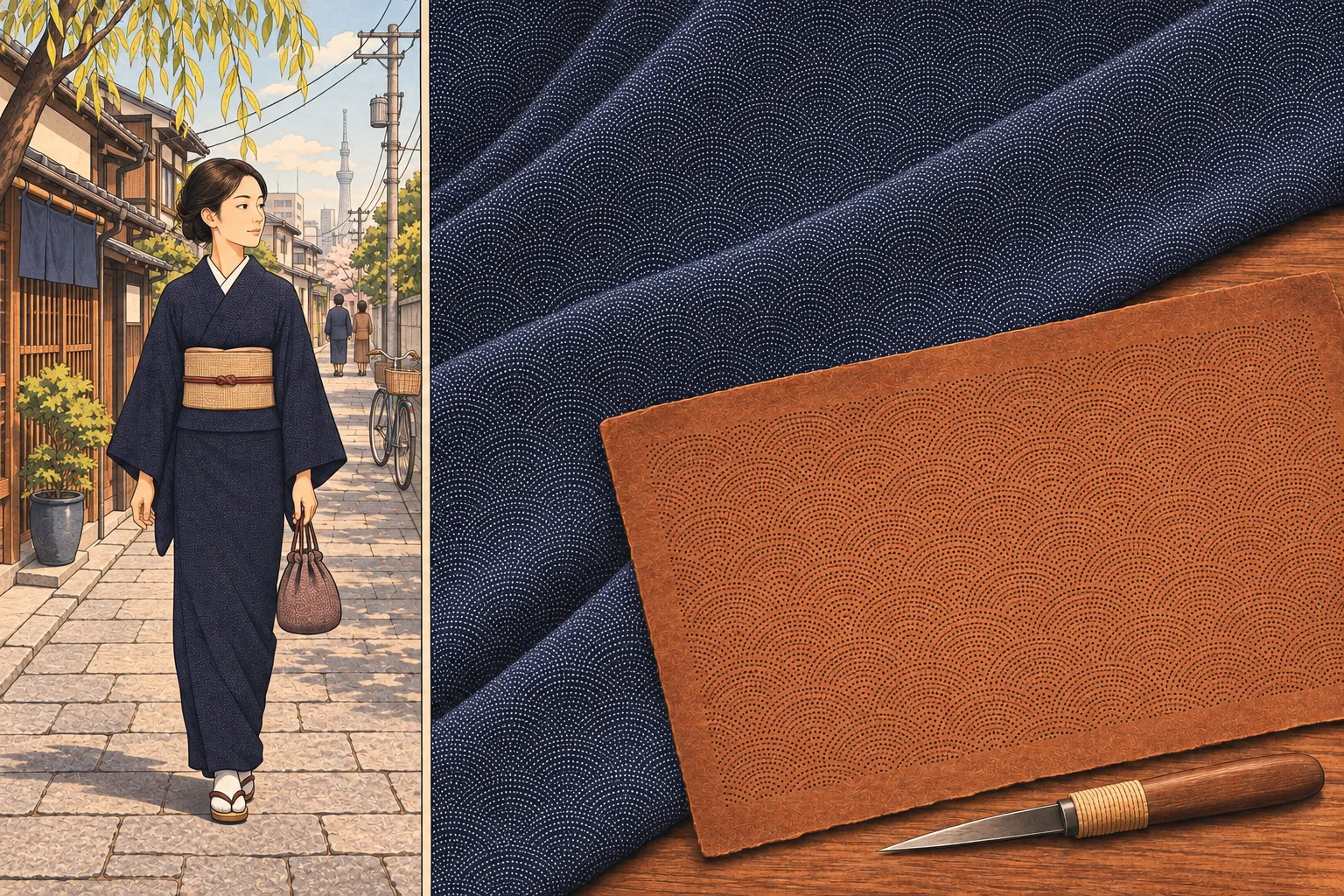
Edo komon. Left: from a distance it reads as a solid colour. Right: up close, tiny white dots in fish-scale arcs, shown with the paper stencil used to dye them and a carving knife.
The source is samurai formal dress. In the Edo period a retainer on duty wore kamishimo, a stiff sleeveless jacket over hakama, made in these fine stencilled patterns. Daimyo houses claimed particular designs as their own, called sadame komon, "fixed patterns," that others could not use. The example most often cited is same, "sharkskin," with dots in overlapping arcs, associated with the Kii branch of the Tokugawa family. There is also gyōgi, "good manners," with dots in neat diagonal rows, and kakudōshi, dots in a square grid. These three are known as the san’yaku, the three principal patterns; lists of five add fine stripes (manzuji) and mixed-size dots, among others, though sources differ on exactly which. Kamishimo were meant to be sober, so the houses competed in fineness instead, producing cloth that looked plain from a distance and astonishing up close.
The name "Edo komon" is surprisingly recent. In 1952 the national Committee for the Protection of Cultural Properties selected the fine single-colour stencil work of the Tokyo dyer Komiya Kōsuke, rooted in Edo kamishimo patterns, for state support, and named it Edo komon to set it apart from ordinary komon. In 1955 it was designated an Important Intangible Cultural Property and Komiya was recognised as its holder, a so-called Living National Treasure.
What sets Edo komon apart is rank. Ordinary komon is outing wear, full stop. An Edo komon in one of the classic patterns, with a single crest added, is treated as equal to a one-crest iromuji and can be worn to tea gatherings and moderately formal receptions.
05Expensive but Casual: Tsumugi and Omeshi
Here is the point visitors find hardest to accept. A kimono can cost more than a visiting kimono, take far longer to make than a furisode, and still be wrong for any formal occasion.
Tsumugi is a plain-weave silk, but traditionally its thread is not reeled from intact cocoons. The cocoons are boiled and stretched into floss, and the thread is hand-spun from that floss, so it comes out slightly uneven. The finished cloth has small slubs, a dry matte sheen and a faintly rough hand. Patterns are woven: checks, stripes and kasuri (ikat), in which the threads are bound and dyed before weaving so that the design emerges with soft, feathery edges.
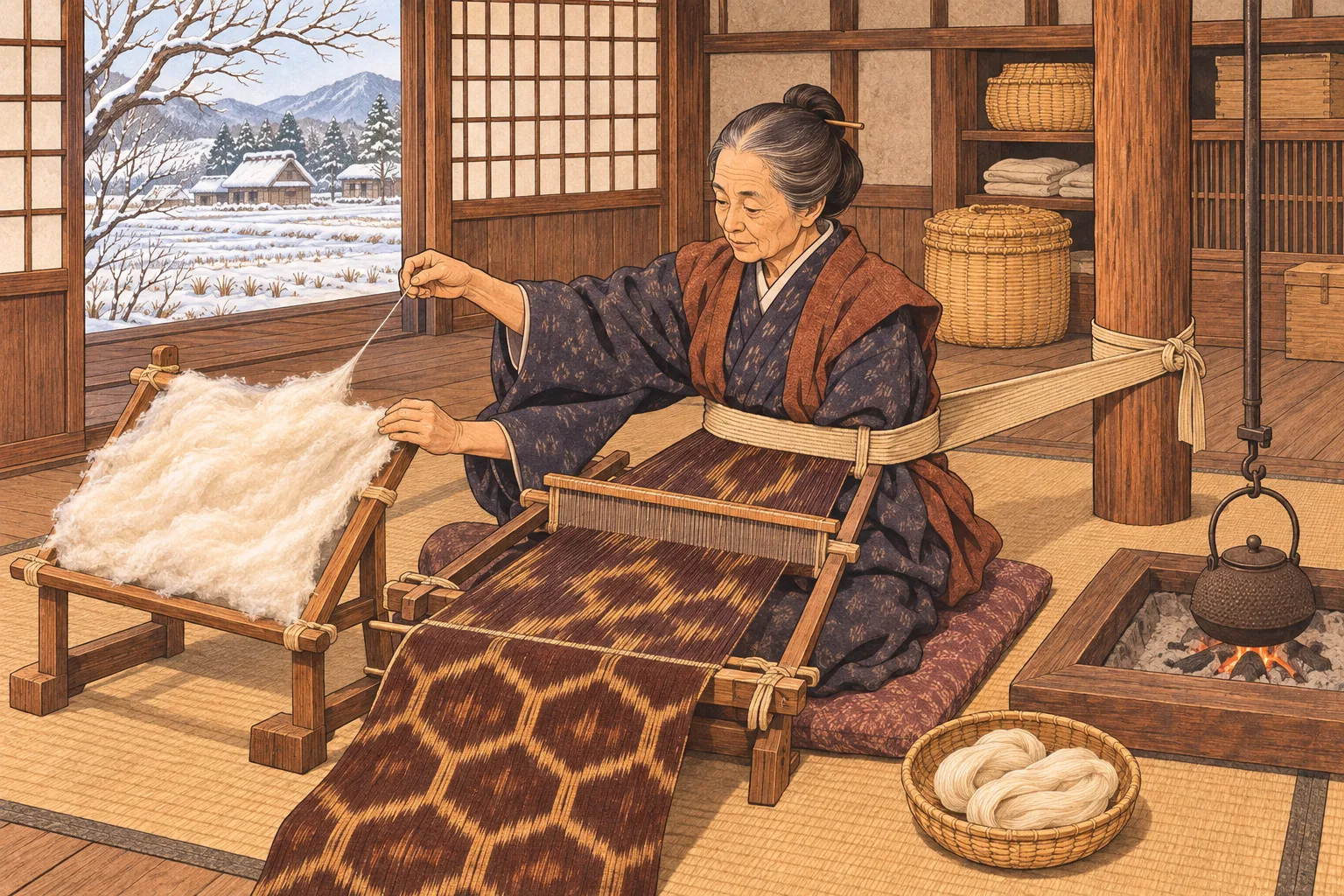
How tsumugi begins: thread is hand-spun from stretched silk floss, then woven; the cloth on the loom carries a kasuri pattern of hexagons (artist’s impression)
Its rank comes from its origins as farmhouse cloth spun from damaged cocoons, a story told in our article on yūzen and Japanese textiles. In the Edo period some regional tsumugi became fashionable among townspeople as a discreet luxury, and after Meiji, as silk production industrialised, the hand-spun cloth became rare and prized. Many centres also began mixing in other yarns, and some famous names, Ōshima among them, now have a smooth, lustrous surface with little of the hand-spun roughness, though they keep both the name and the rank.
The famous names: Yūki tsumugi, from the Yūki area on the border of Ibaraki and Tochigi, is hand-spun, hand-bound and woven on a backstrap loom (jibata); the weaving alone takes about fifty days a bolt, and with spinning and binding the whole process runs to months. It was designated a national Important Intangible Cultural Property in 1956 and added to UNESCO’s intangible heritage list in 2010. Ōshima tsumugi, from Amami Ōshima, is the easiest to spot on the street: a glossy black-brown mud-dyed ground covered in minute ikat crosses. Its dyeing is described in the yūzen article. Others include Ushikubi in Ishikawa, Shiozawa in Niigata and the yellow-checked kihachijō of Hachijō Island.
The finest tsumugi can cost many times what a hōmongi does, but it remains outing wear. Wearing Yūki tsumugi to a wedding or a formal tea gathering is a faux pas, much like turning up in a bespoke tweed suit where the invitation says black tie. In kimono circles tsumugi is sometimes described as the cloth of connoisseurs and well-off gentlemen, precisely because it is costly without looking it. Recently some weavers have made tsumugi with eba layouts, even "tsumugi hōmongi," which pass at relaxed parties, but not at weddings or ceremonies.
Omeshi, short for omeshi chirimen, is another woven silk. Like crêpe it uses tightly twisted thread, giving a fine crinkle, but the yarn is dyed before weaving and the patterns are woven in: small figures, stripes, damask-like motifs. The name is usually explained by the eleventh shogun, Tokugawa Ienari, said to have had striped crêpe improved, reserved it for his own use and worn it constantly; omeshi is an honorific word for the clothes of an exalted person. Nishijin in Kyoto is the best-known centre, with Kiryū, Tōkamachi, Shiozawa and Yonezawa also producing it.
Omeshi sits between tsumugi and the dyed kimono and is often called the most formal of woven kimono. A quiet omeshi with one crest can go to a casual reception or an ordinary tea gathering. It is still a woven kimono, and never formal wear.
06Mourning Kimono
The mofuku is the simplest kimono of all: solid black, with no pattern anywhere, and five white crests in the same places as on a kurotomesode. Under it go a white under-kimono and white collar. Everything else is black: the obi, the cord, the sash scarf, the cloth sandals. Side by side with a kurotomesode, the difference is the hem, which is bare, and the absence of the white false layer.
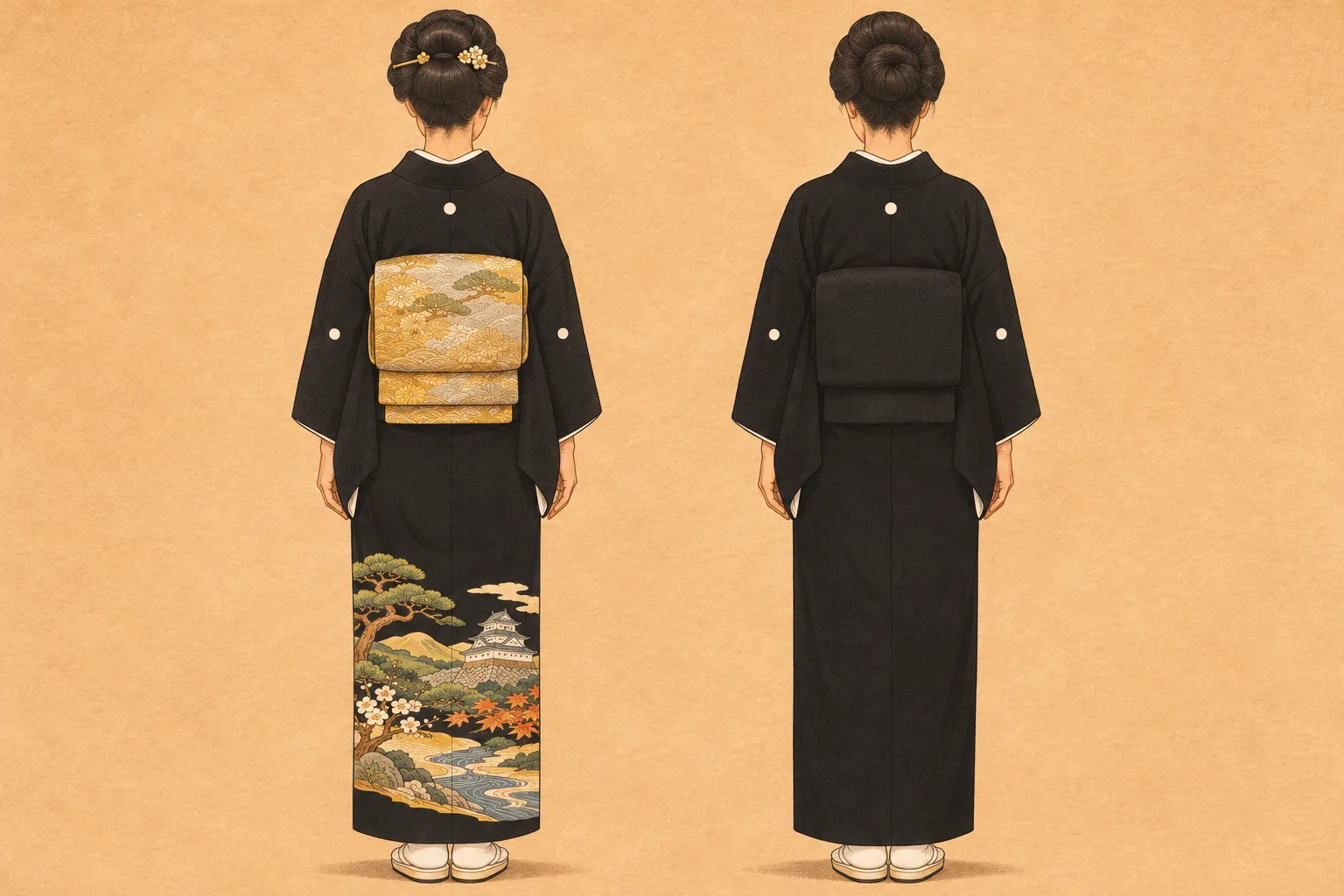
Two black kimono from behind. Left: a kurotomesode, with a coloured hem design and a gold obi in the double drum knot. Right: a mofuku, black throughout, with a black obi in the single knot.
The obi is tied in the single ichijū-daiko knot, not the doubled one, so that misfortune is not "doubled." Summer mofuku are made of open-weave hira-ro gauze; the rest of the year, matte crêpe or plain silk. Jewellery is limited to a single strand of pearls, if anything.
The black mofuku is worn by the women of the bereaved family, such as the widow, daughters and daughters-in-law, at the funeral. Ordinary mourners, especially at the wake the night before, usually wear Western black or a subdued one-crest iromuji with a black obi; one traditional view holds that arriving at a wake fully dressed in formal mourning suggests you had been expecting the death. At memorial services in later years, family members often move to coloured mourning, the colours lightening over time.
Black for mourning is fairly recent. Heian-period aristocrats mourned in black or dark grey (nibi-iro), darker the closer they had been to the dead. The Edo shogunate set no mourning dress; men wore hemp kamishimo and women white, and women in a funeral procession were dressed entirely in white. In the Meiji era the imperial household fixed black for court mourning and, with Western practice also in view, men moved to black crested kimono, while women in the cities still wore white. Only in the Shōwa era did women’s white give way to black crested kimono and a black obi, and black is generally thought to have become standard across the country only after the Second World War. White mourning dress is said to survive in a few regions.
Today many families wear Western clothes at funerals, and kimono mofuku are worn mostly by older women of the family, often rented. A black mofuku with the family crest was traditionally part of the trousseau a mother prepared for a daughter’s marriage.
07Side by Side: Telling Them Apart
Here is how to sort the kimono above, in the order your eye will take them in.
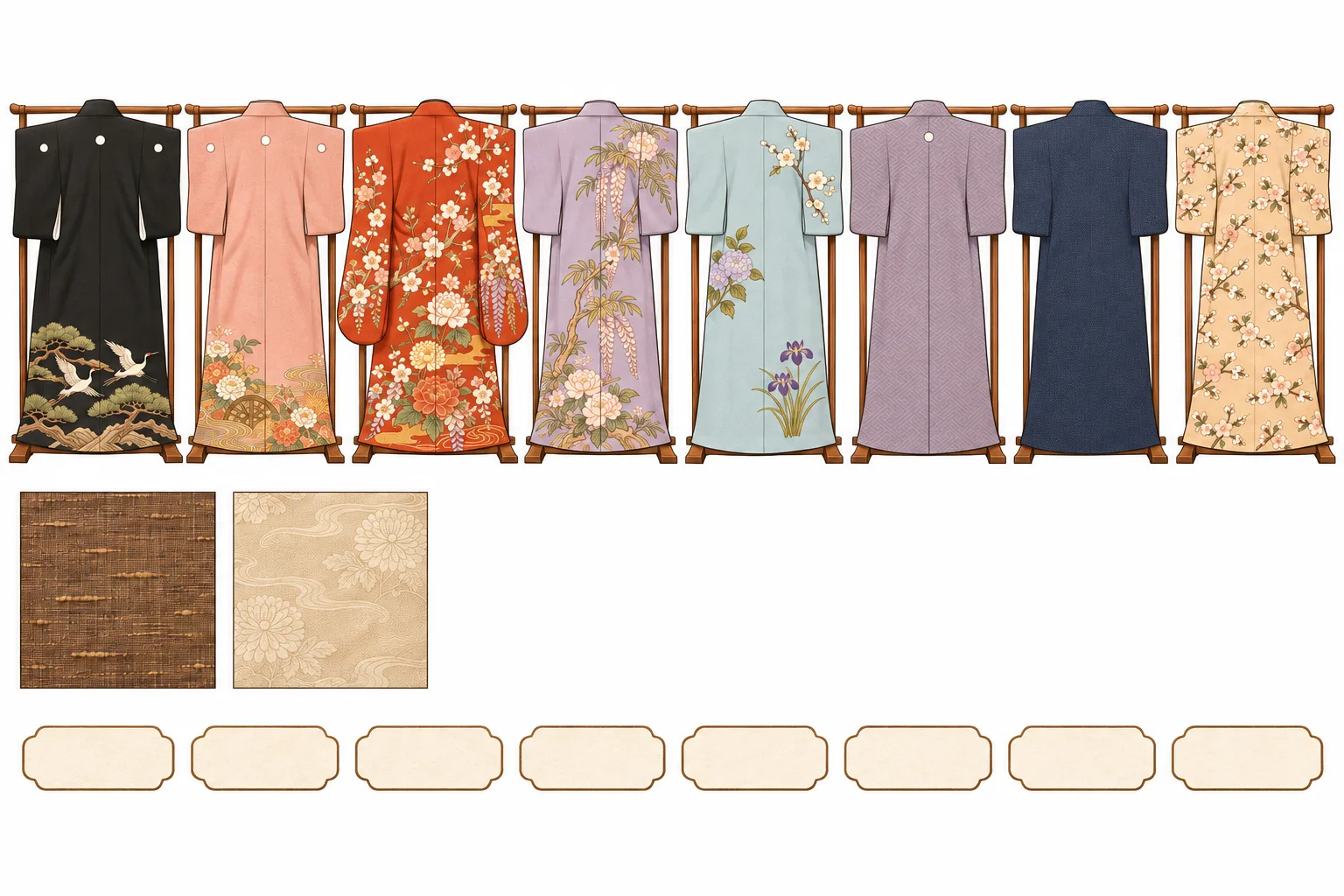
Top row, from left: kurotomesode, irotomesode, furisode, hōmongi, tsukesage, iromuji, Edo komon, komon. The two swatches below: tsumugi on the left, omeshi on the right.
Black ground. Two candidates. If there is a coloured or gold design on the hem and a white edge at the collar and cuffs, with a gold obi, it is a kurotomesode, for a celebration. If it is solid black from collar to hem, with a black obi, it is mofuku, for mourning.
No visible pattern. A single colour with at most a woven figure in the silk is an iromuji. A single colour from a distance that turns into a field of pin-prick dots up close is an Edo komon. With one crest each, they are interchangeable at tea.
Pattern on the hem only. A kurotomesode if black, an irotomesode if coloured.
Pattern rising from hem to shoulder, crossing the seams as one picture. A hōmongi.
Pattern on hem, shoulder and sleeve, all facing up, but each motif contained in its own panel. A tsukesage.
Pattern repeated all over, some motifs upside down. A komon.
Sleeves to the calf or ankle. A furisode; where the sleeve ends tells you whether it is an ōfurisode, chūfurisode or kofurisode. Every other kimono here has sleeves of about 50 cm, falling to the hip.
Matte, slubby surface with checks, stripes or feathery-edged ikat. Tsumugi. Crisp, slightly lustrous crêpe with woven figures. Omeshi. Both are woven kimono and sit on the casual side however fine they are.
Count the crests. Five: kurotomesode, five-crest irotomesode, mofuku. Three or one: irotomesode, iromuji. None or at most one: hōmongi, tsukesage, furisode, Edo komon. None: komon, tsumugi.
Ranked, from the top: kurotomesode, five-crest irotomesode and furisode (married family, family of either status, and unmarried women respectively); then three-crest irotomesode, hōmongi and three-crest iromuji; then tsukesage, one-crest iromuji and one-crest Edo komon; then omeshi, komon and plain Edo komon; then tsumugi. Mourning dress stands on its own ladder. Men’s kimono follow a simpler scale, with the black five-crest haori jacket and striped sendaihira hakama at the top, covered in a separate article.
Put it all in a wedding photograph. In the front row, both mothers in kurotomesode, five white crests, gold obi in the double knot. The bride’s unmarried sister in a scarlet chūfurisode, sleeves swinging as she bows. The groom’s married sister, also in kurotomesode, her hem design higher and brighter than her mother’s. An unmarried aunt in a five-crest irotomesode the colour of pale incense. Among the guests, the bride’s university friends split between furisode and hōmongi, and the wife of the groom’s boss in a dove-grey one-crest iromuji. Nobody in tsumugi, nobody in komon.
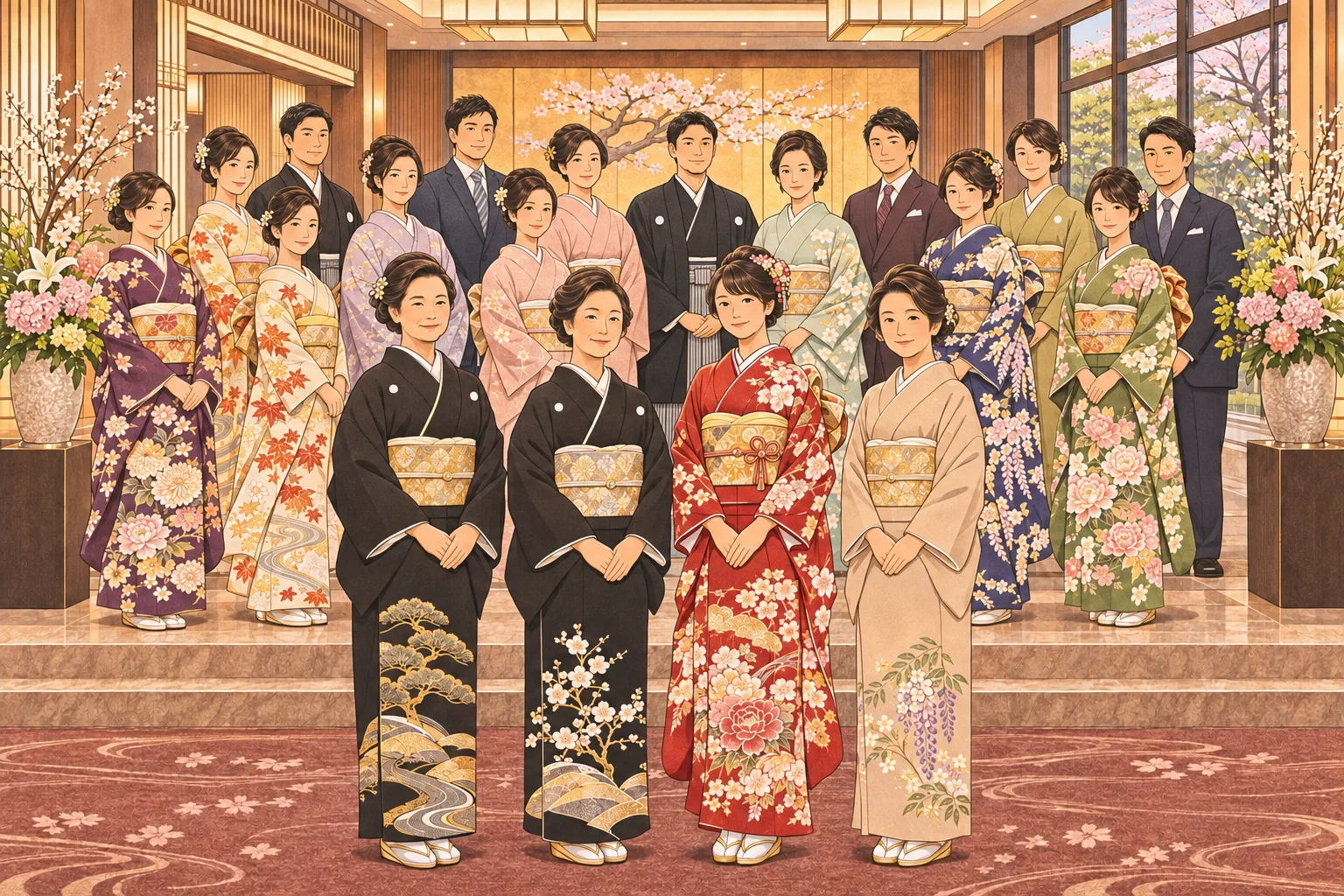
A wedding photograph. Front row, from left: the two mothers in kurotomesode, the unmarried sister in a scarlet furisode, an unmarried aunt in a pale irotomesode. Behind them, guests in furisode and hōmongi.
At a New Year’s first tea gathering (hatsugama), hosts and guests wear hōmongi, tsukesage, one-crest iromuji or one-crest Edo komon in soft colours with restrained obi. At a weekly lesson, students come in komon, Edo komon or an old favourite tsumugi.
Behind the chart sit a few plain ideas. Celebration calls for colour and gold; mourning calls for black and nothing else. Dyed outranks woven. Hosts and family dress above their guests, and guests do not outshine the family. Sleeve length marks whether a woman is married. Hold on to those and you can usually guess where a woman in kimono is heading before she gets there.
More deep dives on this topic
 Kimono Types and Their RankSpend a Saturday afternoon in the lobby of a big hotel in Tokyo or Kyoto and you will see kimono that look, to an outsider, like variations on a single garment.
 The Obi and Its KnotsStand on a street corner in Kyoto’s Gion and watch two women in kimono walk away from you.
 Kimono Motifs and the SeasonsWalk through Kyoto in early March and you will see cherry blossoms on kimono sleeves weeks before a single tree has opened.
 Japanese Hairstyles and KanzashiLook closely at a woodblock print of a street in late Edo or Meiji Japan and you can read the women in it like name tags.
 Men’s KimonoMost visitors to Japan see far more women in kimono than men, and when a man does walk past in kimono, he can look oddly uniform: dark colours, a short jacket, a narrow belt, flat…
 Putting On a Kimono, Layer by LayerWhen you rent a kimono in Kyoto or Asakusa, you stand in front of a mirror for fifteen or twenty minutes while someone wraps, pulls, tucks and ties, mostly out of your sight.
 KamonWalk through any old Japanese town and you will start to notice the same kind of image again and again: a small black-and-white emblem, perfectly symmetrical, usually inside a…
 The Life of a KimonoMost clothes are finished the day they are sewn.
- Back to the main article: Kimono →