
Most visitors to Japan see far more women in kimono than men, and when a man does walk past in kimono, he can look oddly uniform: dark colours, a short jacket, a narrow belt, flat sandals. Yet a Japanese observer reads a great deal from that outfit in a second or two. Five small white circles on black silk mean a wedding or a ceremony. A striped divided skirt means formality; its absence means an evening out. A grey jacket cord instead of a white one moves the whole outfit down a notch. Men’s kimono is a system of quiet signals, and much of what a man actually spends money on is hidden on the inside, where only someone who knows to look will see it.
01Why men dress so plainly
It was not always this way. Heian courtiers wore layered robes in strong colours, and warlords of the sixteenth century wore campaign surcoats in scarlet and gold. The muted palette of men’s kimono today is largely a product of the Edo period (1603–1868).
Part of the reason was law. The shogunate issued sumptuary edicts again and again, restricting what townspeople could wear: no silk crepe for certain classes, no bright reds and purples, no gold leaf. The crackdowns of the Kyōhō era in the early eighteenth century and the Tenpō reforms of the 1840s were especially strict. Rich merchants could not dress like lords, so they learned to dress in browns, greys and indigo, and then to compete within those limits. Edo had a saying, shijūhatcha hyakunezumi, "forty-eight browns and a hundred greys", for the dozens of named shades that a fashionable eye could tell apart.
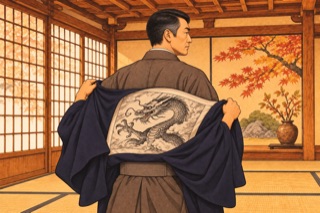
The other reason was taste. Late Edo townsmen prized iki, a kind of understated, knowing chic. The ideal was summed up in the phrase ura-masari, "the lining outdoes the face". A plain navy jacket might open to reveal an ink painting of a dragon, a woodblock-style portrait of a kabuki actor, or a poem brushed across silk. That flash of colour was seen only when the wearer took the jacket off and draped it over his arm.
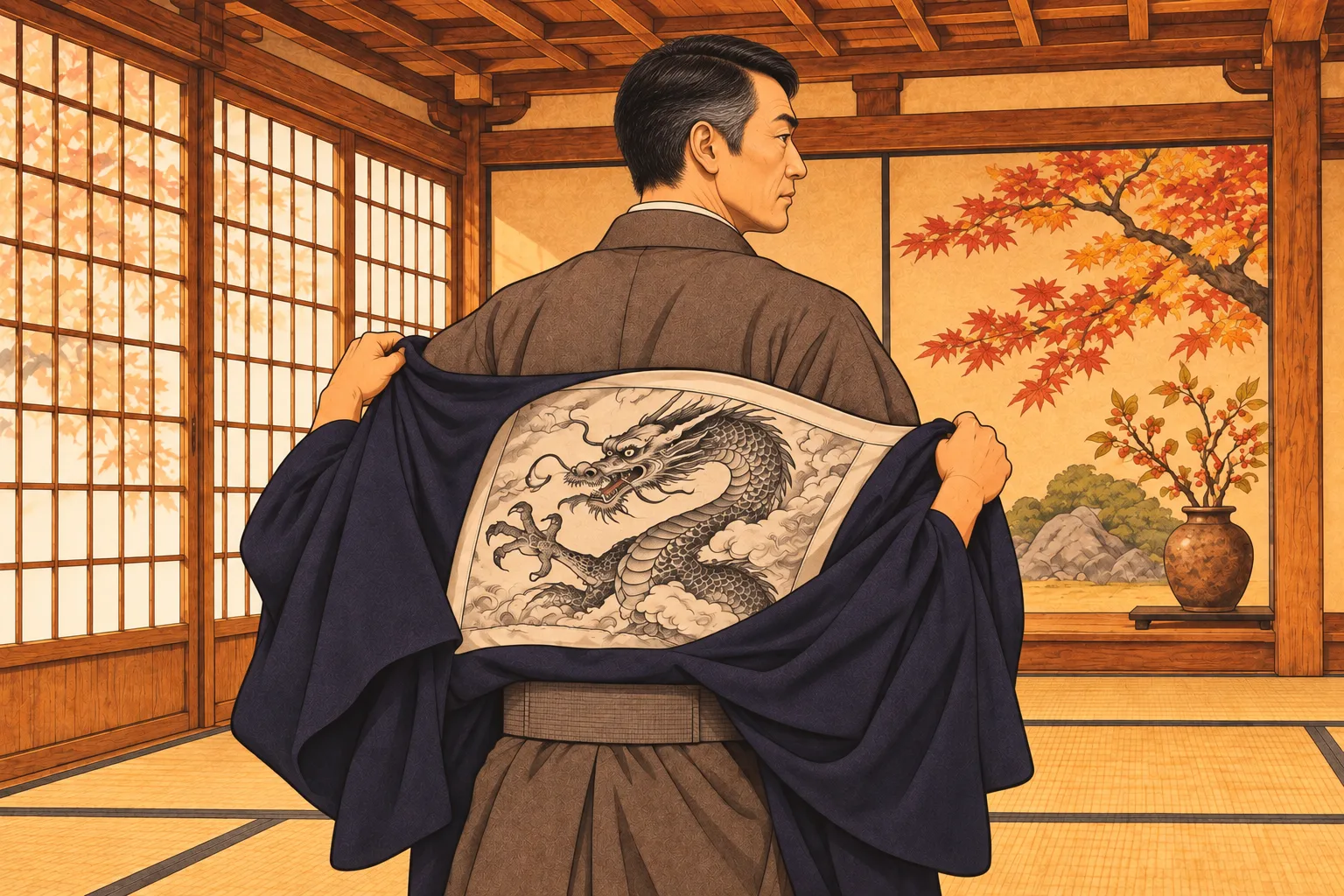
Ura-masari, "the lining outdoes the face": a plain navy haori slips off the shoulders to show an ink-painted dragon across its lining.
So when you look at a man in kimono, look for different things than you would on a woman. Not the pattern, which is usually absent, but the texture of the cloth, the number of crests, the stripes of the skirt, the colour of the jacket cord, and the narrow strip of collar at the neck.
02From shoulder-wings to black crests: how formal dress changed
The most formal kimono a Japanese man wears today is the black, five-crested jacket and skirt. A samurai of the Edo period would not have recognised it as formal dress. His ceremonial outfit was the kamishimo.
A kamishimo was a matching pair: a sleeveless vest called a kataginu over a pleated skirt, both cut from the same cloth. The kataginu is the part that stays in the mind. Its shoulders were stiffened with starch and backing to stand out horizontally, like a pair of wings. It is usually explained as a Muromachi-period warrior’s robe called the suō with the sleeves removed, though its exact origin is unclear. Under the Tokugawa it became the standard official dress of the warrior class, crested on the back and chest, often in a fine stencilled komon pattern that looks plain from a distance and dotted up close.
There were grades within the kamishimo too. For the grandest ceremonies, daimyo and senior retainers wore the naga-gamishimo, whose trousers were far longer than the leg and trailed behind on the floor like a train. Ordinary official duties called for the han-gamishimo, with normal-length trousers. Townsmen could also put on a kamishimo for a wedding, a funeral or a summons to the magistrate. The easiest place to see one today is on the kabuki or bunraku stage, or in a festival procession of costumed retainers.
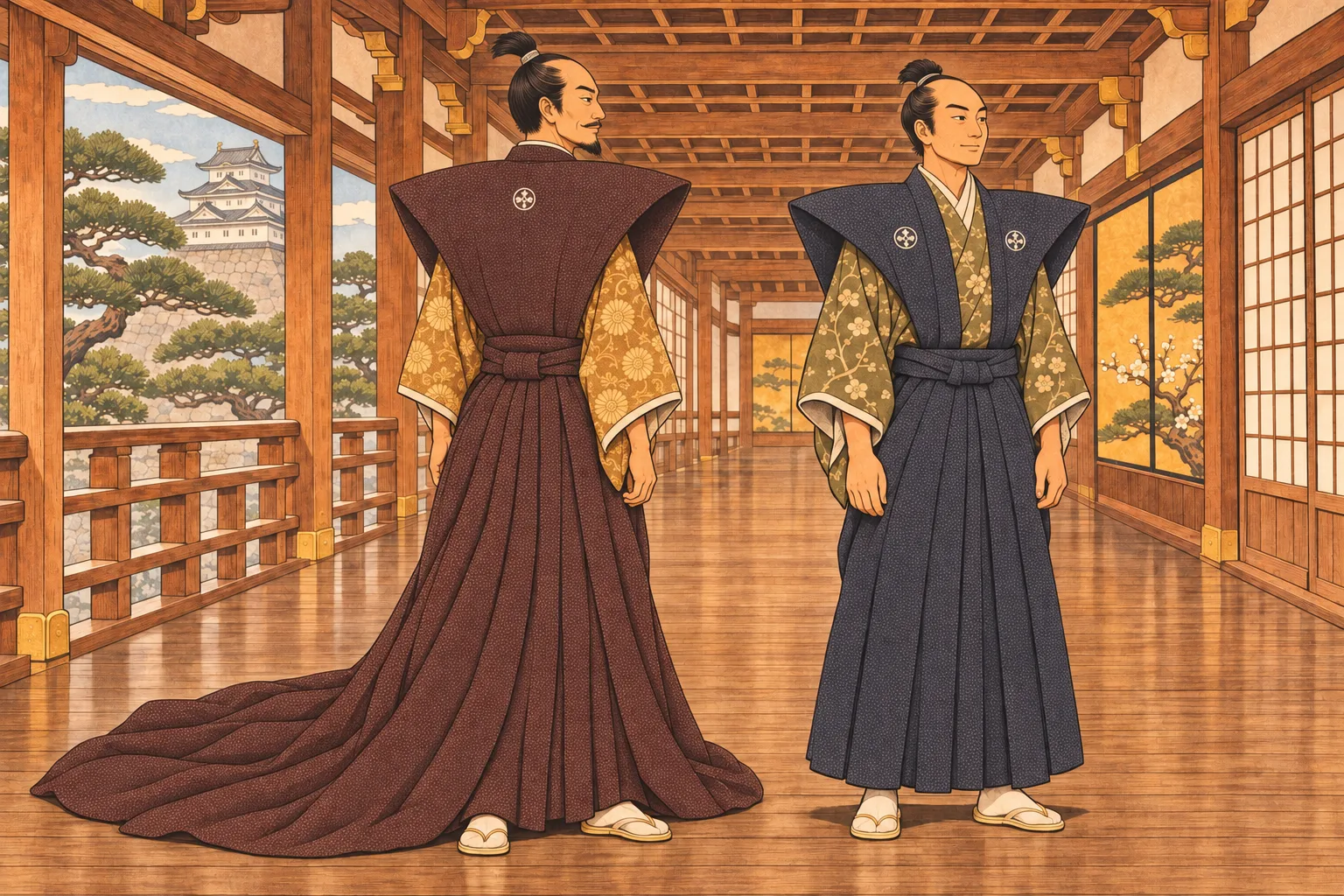
Edo samurai in kamishimo. Left: the naga-gamishimo, its trousers trailing behind on the floor like a train. Right: the han-gamishimo, with trousers of normal length (artist’s impression)
The haori, the hip-length jacket, was a more casual garment in the Edo period. A haori with hakama was semi-formal; the kamishimo was the real thing.
The Meiji Restoration of 1868 swept that order away. On 12 December 1872 (the twelfth day of the eleventh month of Meiji 5 by the old calendar), Grand Council of State Proclamation No. 339 made Western dress the full and ordinary formal attire for officials and court functions, and abolished the hitatare, the kariginu and the kamishimo. But Western formal dress was hard to come by, even for junior officials. In 1877 a Grand Council of State directive allowed officials of the lowest grade (hannin) and below to wear haori and hakama in place of the prescribed formal dress, the first time the everyday haori and hakama were recognised as official formal wear. In the decades that followed, the black five-crested set settled into place as men’s formal dress across society. The result is clear: a semi-formal Edo outfit was promoted to the highest form of formal Japanese dress for men, and it has held that position ever since.
For the next several decades, Japanese men lived in two wardrobes. A bank clerk, a civil servant or a schoolteacher went to work in a suit and hat, came home in the evening, took the suit off, and changed into a cotton or silk kimono with a soft sash before sitting down to dinner on the tatami. Writers of the period, Natsume Sōseki among them, describe men reading, writing and receiving guests at home in kimono as a matter of course. "Western clothes outside, kimono at home" held from the late Meiji years into the early Showa period.
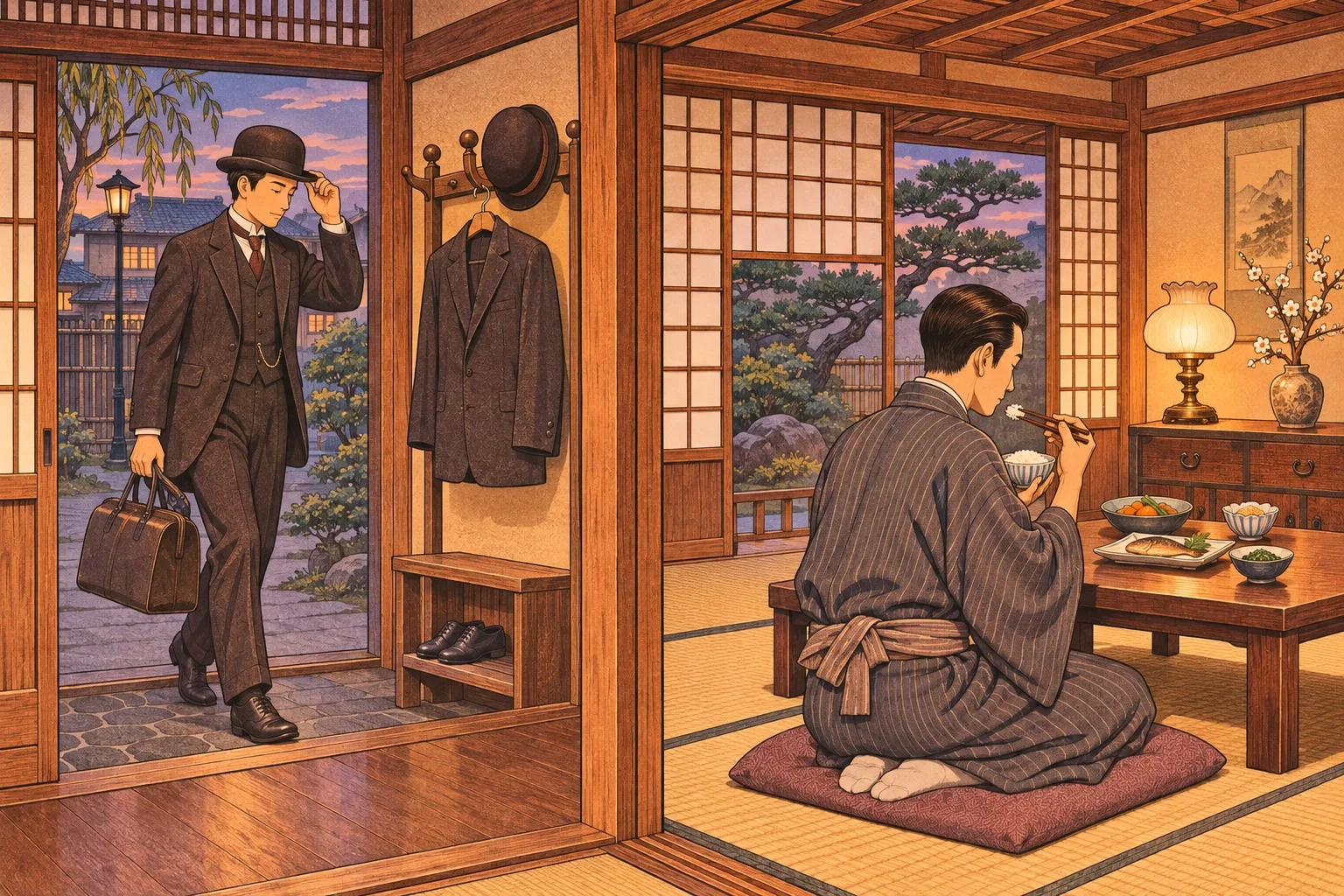
Western clothes outside, kimono at home. Left: coming in from work in suit and hat. Right: changed into a kimono with a soft sash, at dinner on the tatami (artist’s impression)
War and then postwar life ended it. In 1940 the government introduced a khaki "national uniform" for civilian men. After 1945 came shortages, then urbanisation, apartments with chairs and sofas, and a new habit of changing into a sweater and slacks after work. By the high-growth years of the 1960s, a man relaxing at home in kimono had become a rarity. Many Japanese men today wear kimono two or three times in their lives, usually rented.
03The five grades
Men’s kimono is simpler to read than women’s. Three questions do most of the work: Is it black? How many crests? Is there a hakama and a haori?
The top grade is the black five-crested haori and hakama, kuro montsuki haori hakama. Both the kimono and the haori are made of kuro habutae, a smooth, soft black silk with a faint sheen. The five crests sit where they do on any formal kimono (back, sleeves, chest); for first-grade formal wear they are dyed-out hinata-mon, "sunlit crests", so on black silk each reads as a crisp white circle three or four centimetres across, visible from several paces away. The hakama is striped grey and black sendaihira silk. The haori cord is white, the collar strip white or pale grey, the tabi socks white, the sandals have white thongs, and a white folding fan is tucked into the sash. The quick test: all black, two white dots on the chest, a white tassel at the centre, striped skirt. Grooms, their fathers, go-betweens and men at state and traditional ceremonies wear it.
Next comes the coloured crested kimono with hakama, iro montsuki. The kimono and haori come in grey, navy, brown or dark green, with crests, usually three (back and both sleeves) or one (back only). It still takes a hakama, but the haori cord can be grey or coloured. This is the equivalent of a dark lounge suit: fine for a friend’s wedding, a tea gathering, New Year calls or a recital of traditional arts. If you see colour and no crests on the chest, you are at the lower edge of this grade. Some grooms choose a dark grey or navy five-crested set for a second outfit at the reception, which sits somewhere between the first and second grades.
The third grade is kimono and haori without hakama; Japanese has no single fixed name for it. Here the outfit drops the skirt and keeps the jacket, which may carry one crest or none. Two fabrics define this grade. Omeshi, short for omeshi chirimen, is a yarn-dyed silk with tightly twisted threads that give it a fine, dry, pebbly hand and a crisp drape. The name is usually explained as "the crepe worn by the shogun", with one story crediting the shogun Tokugawa Ienari’s fondness for it. It is the dressiest of everyday cloths, and with a one-crest haori it can go to fairly formal occasions.
Tsumugi, the slubby pongee once woven by farming households from broken cocoons, comes from the opposite end of society. Its rule, "expensive is not the same as formal", bites hard in menswear: a man in Ōshima tsumugi that cost more than a black crested set is still wrongly dressed for a wedding. Ōshima has a smooth surface and the deep black-brown of mud dyeing, often with tiny cross or hexagon motifs; Yūki is soft and warm, with the irregular texture of hand-spun thread. A tsumugi kimono with a haori is the classic smart-casual look: the theatre, an old restaurant, a visit to friends.
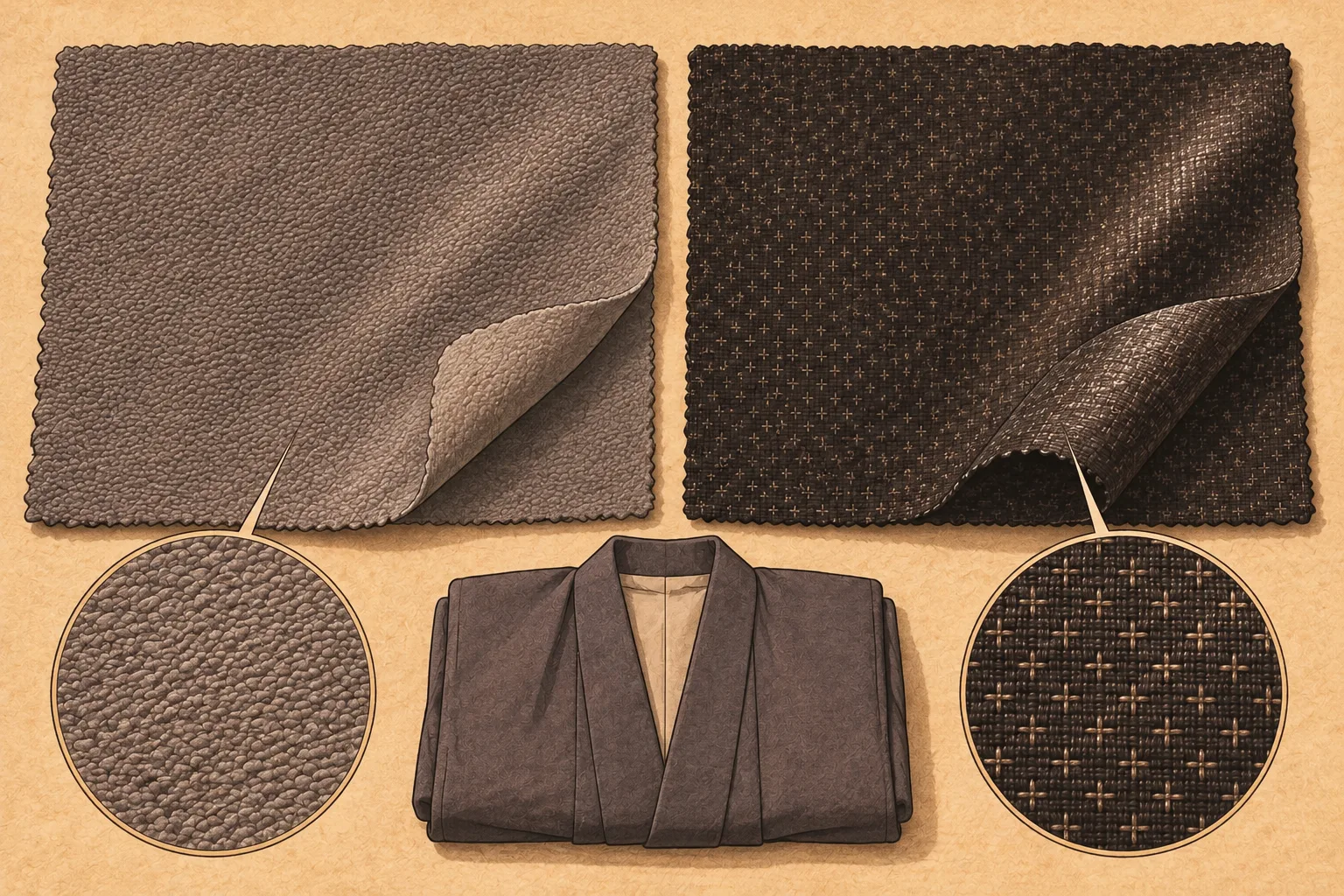
Two cloths. Left: omeshi, with its fine pebbly surface. Right: Ōshima tsumugi, deep black-brown with tiny cross motifs. Between them, a folded haori.
Fourth is kinagashi: kimono and sash only, no haori, no hakama. Definitions vary: some dictionaries describe kinagashi as kimono without hakama or haori, while many people use it for any outfit without hakama, haori or not, which is how the main kimono page divides things. Here the haori outfit is kept as a grade of its own, and kinagashi means a man without the jacket too. The word itself carries a loose, unbuttoned feel. In Edo, a samurai seen in kinagashi was off duty or masterless, and period-drama drifters are usually dressed this way. Today it is perfectly correct at a hot-spring town, a summer festival, at home or at the local bar, and quite wrong at a wedding.
Below kinagashi come the unlined cotton yukata, the standard outfit for summer festivals and fireworks, and the jinbei, a two-piece top and shorts closer to pyjamas. Both have their own pages; what matters here is that they sit at the bottom of the scale and are not part of the formal system.
04The haori, and the coat over it
The haori is where a man shows his taste. It counts as part of the outfit rather than as an overcoat: indoors a man may take it off or keep it on, and at a wedding or ceremony the crested haori is part of the formal outfit itself and normally stays on.
Fashion has pushed its length up and down. Late Edo saw both very long haori, falling below the knee, and very short ones that stopped at the waist. The modern standard ends around the upper thigh. The two front panels do not overlap the way a kimono’s do; they hang parallel and are joined at the chest by a cord. That open front is the easiest way to tell a haori from a kimono at a glance.
The cord, haori-himo, passes through small loops called chi sewn at the collar edges of the front panels. There are two main types. Marugumi is round braided silk, often with a fluffy tassel at each end. Hirauchi is flat braid, which ties into a neater, flatter knot. Formal dress calls for a white cord. At weddings the usual choice is thick white marugumi with fluffy tassels, which sits on the black chest like a white flower, though some hold that white hirauchi is the more correct; both are worn. For everyday wear men use grey, brown, navy or tone-on-tone cords, or styles joined by an ornament of stone or shell instead of a knot.
Traditionally the two cords are tied together at the centre, with both tassels hanging level. Many modern cords come pre-knotted with a small metal hook at each end that clips onto the loops, which makes putting the haori on and taking it off quicker; a practised eye can tell the difference. The knot should sit roughly at the solar plexus. A cord that dangles down to the stomach looks sloppy.
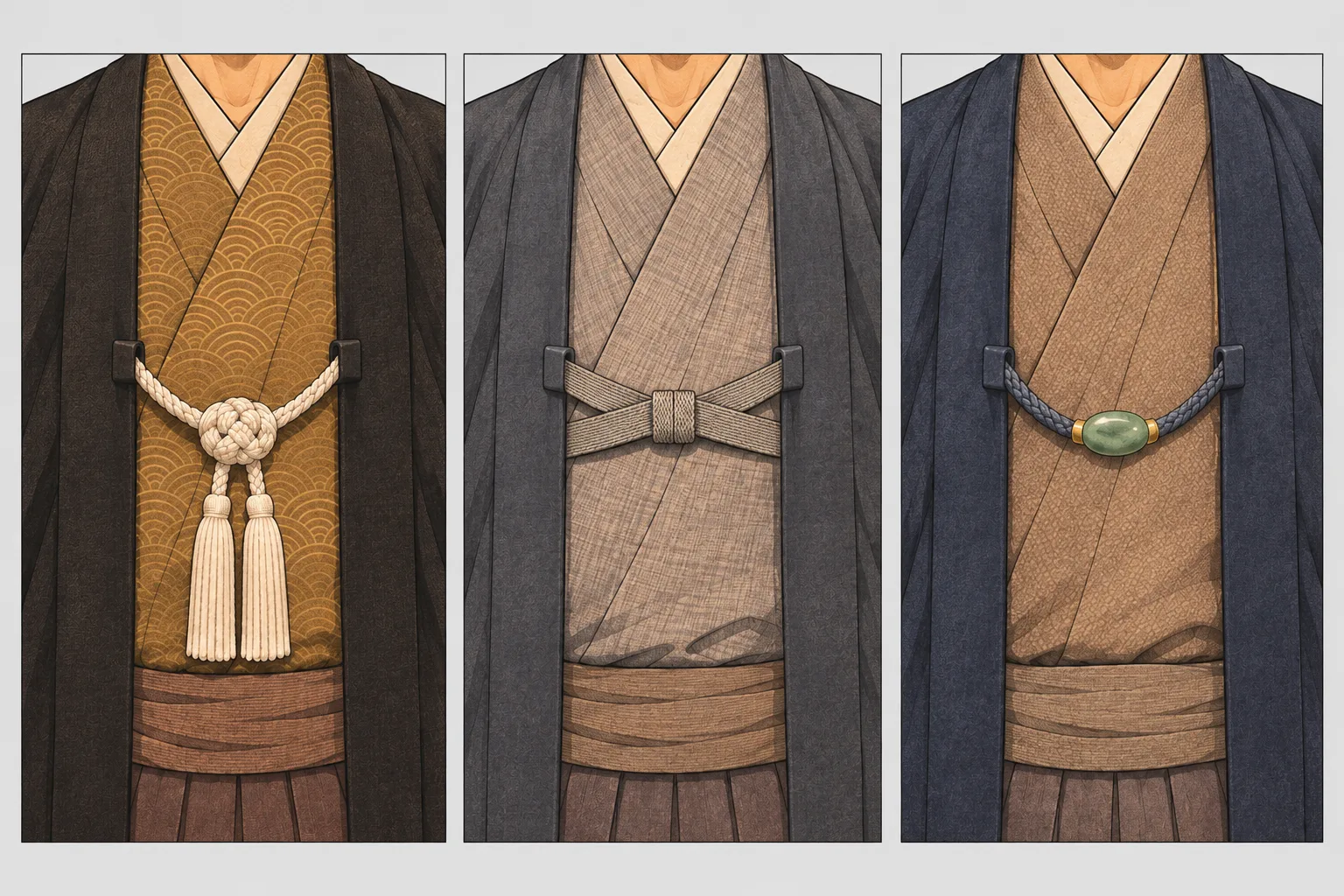
Three haori-himo, from left: white marugumi with fluffy tassels, for formal dress; flat hirauchi tied in a neat knot; a cord joined by a stone ornament, with no knot at all.
Then there is the lining, haura. The outside of a man’s haori may be almost featureless, while the lining is a canvas. The classic form is the gakuura, "framed lining", with a single picture set in the centre of the back like a framed painting. Others cover the whole lining. Subjects range from ink dragons and tigers, Mount Fuji and the Seven Lucky Gods to beauties from woodblock prints, kabuki scenes, calligraphy, dice and flower cards; in the twentieth century, cars and aeroplanes appeared. In vintage kimono shops in Tokyo and Kyoto, an old haori is often priced for its lining rather than its face.
In winter a haori is not enough, and men once added another layer. These coats are rare today but common in old photographs and vintage shops.
The kakusode, "square-sleeve coat", is a long overcoat made for kimono, reaching the calves, with wide square sleeves that swallow the kimono sleeves whole. Collars are usually Western lapels or a stand collar; the cloth is wool, in black, navy or grey. From the Meiji period on, a kakusode with a bowler hat and a Western umbrella was the winter look of the professional man.
The nijūmawashi, "double wrap", also called inbanesu, is a Japanese adaptation of the Inverness cape and is usually said to have arrived in the mid-Meiji period. It has two layers: a sleeveless or half-sleeved coat underneath and a short cape on top that falls from the shoulders to the waist. The kimono sleeves do not need to go into anything; the hands simply come out from under the cape, which is why it caught on. Photographs from the Taishō and early Showa years show writers, doctors and merchants walking through Ginza in nijūmawashi and felt hats. It was also called tonbi, "kite", one explanation being that the cape spreads like a kite’s wings; some reserve that name for a version with the cape over the shoulders only, and the names were never used consistently.
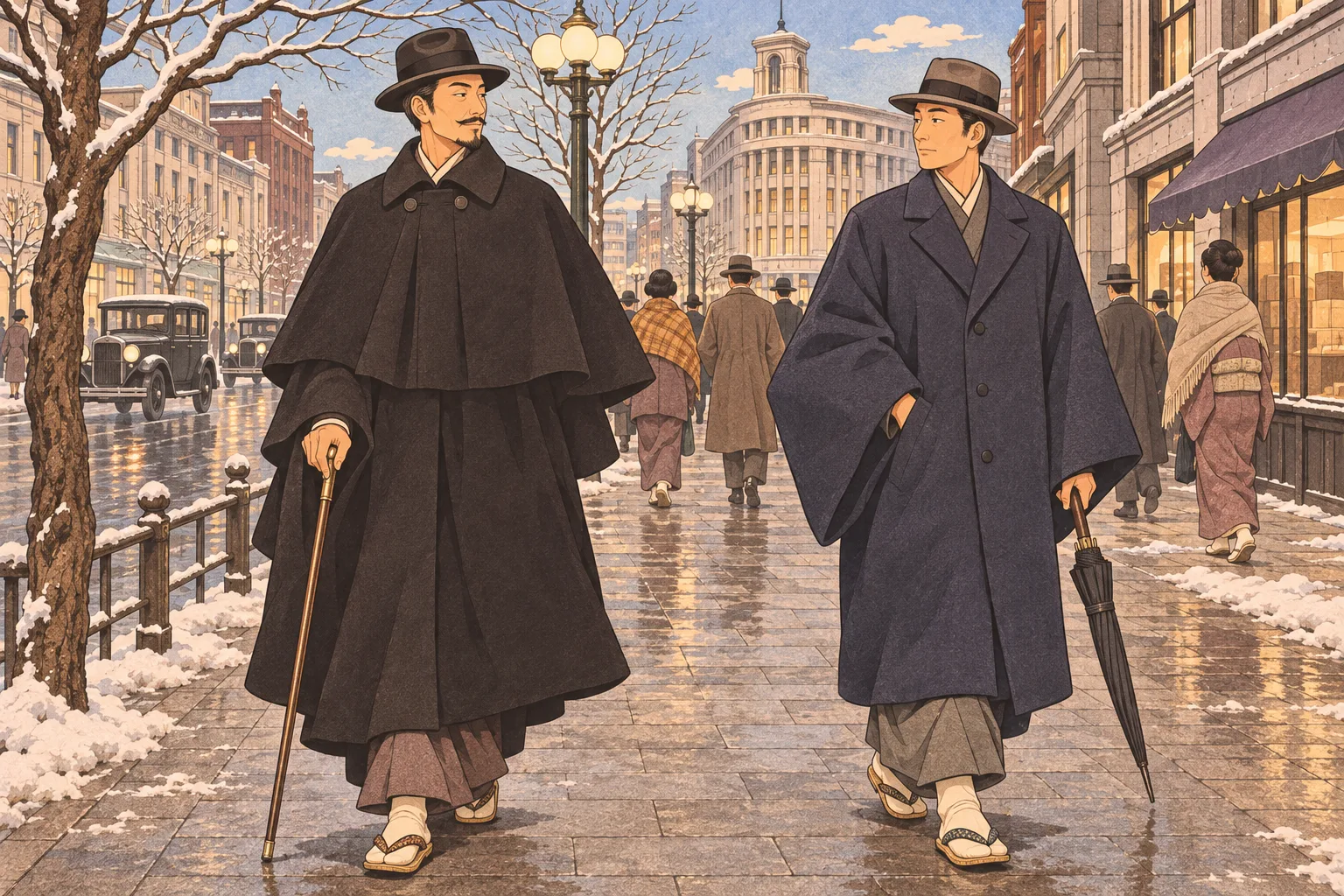
Two winter coats on a city street. Left: the nijūmawashi, with a short cape the hands come out from under. Right: the kakusode, its square sleeves wide enough to take kimono sleeves whole (artist’s impression)
The dōchūgi, "travel coat", was originally an outer layer for journeys, knee-length and wrapped at the front against dust and cold. Kimono shops today sell it mostly as a women’s garment, though men historically had similar travel wear. At home in winter there was also the thick padded tanzen or dotera, still found over the yukata in old-fashioned ryokan.
05The hakama
The hakama decides whether an outfit is formal. The same kimono and haori become formal dress with it and everyday wear without it.
There are two cuts. The umanori-bakama, "horse-riding hakama", is divided into two legs, essentially very wide trousers. The andon-bakama is a single undivided tube, like a skirt; the name is usually explained by its resemblance to an andon paper lantern. Standing still, they look the same, because the pleats hide everything. You notice the difference only when the wearer takes a long stride, sits or steps over a threshold. Traditionally the divided cut is the more formal, and formal dress in principle uses it. The hakama worn by Meiji and Taishō schoolgirls were of the undivided type, and men are generally said to have adopted it later as an informal option because it was easier to put on and to use the toilet in. Rental shops today stock both.
The finest hakama cloth is sendaihira, a stiff, dense silk with a very close warp and an untwisted weft that is soaked before weaving and beaten in hard. It holds a knife-sharp pleat and springs back after sitting. The classic pattern is a fine vertical stripe in grey, black and white. The name comes from the Sendai domain. The usual account is that around the Jōkyō and Genroku eras (1684–1704) the domain retained official weavers to make hakama cloth and noh costumes, often credited to the fourth lord, Date Tsunamura; "sendaihira" was what Edo and Kamigata buyers called the prized cloth from the mid-Edo period on. Hand-woven sendaihira is made in tiny quantities today, its weaving is designated an Important Intangible Cultural Property, and it costs far more than ordinary hakama cloth. Most men wear machine-woven cloth in the same style. Look for the cool silk sheen and the crisp, regular stripes.
A hakama has five pleats in front and two at the back. A widely repeated explanation says the five front pleats stand for the five Confucian virtues of benevolence, righteousness, propriety, wisdom and fidelity (other lists also circulate), and the two back pleats for loyalty and filial piety, or for yin and yang. This reading is taught mainly in martial arts and etiquette circles as a moral reminder; it is hard to say whether it had anything to do with the original design. Martial-arts teachers often use it to get students to fold their pleats neatly.
At the back of the waist sits the koshiita, a trapezoid board of stiff card or thin wood covered in the hakama fabric. It keeps the lower back straight and gives the hakama its clean rear line. A small tongue called a hera below it is often tucked into the sash to hold the hakama in place. Men’s hakama have a koshiita; women’s usually do not, which is one of the simplest ways to tell them apart. The front ties are wrapped around the body, the back ties brought round to the front, and the whole is finished with a flat knot, most often a cross-shaped jūmonji.
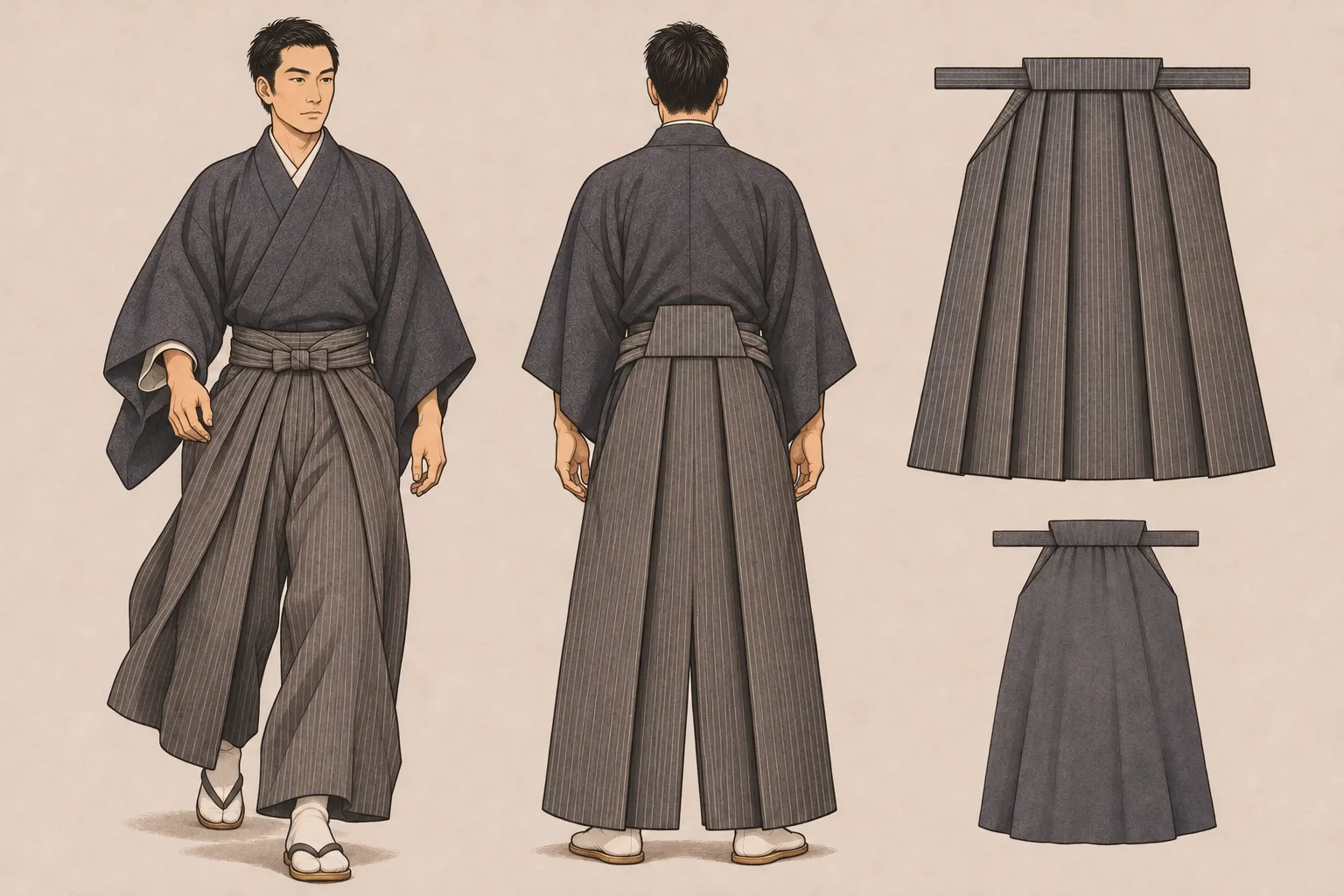
Hakama. Left: a long stride shows the divided legs of the umanori-bakama. Centre: the trapezoid koshiita at the back of the waist. Right: hakama laid flat, the upper one showing the front pleats.
A boy’s first hakama, put on at age five for Shichi-Go-San, is covered on its own page.
06Sashes, collars, footwear and the fan
Men use only two kinds of sash. The kaku-obi is stiff and narrow, about nine or ten centimetres wide and four metres long, woven heavy or reinforced with a core. It is tied low, across the hips below the belly, sitting a little lower at the front than at the back. The best known is Hakata weave in the kenjō ("presented") design, a vertical pattern built around the stylised Buddhist ritual implement called a tokko, named for the cloth the Kuroda lords of Fukuoka presented to the shogun. The usual knot is the flat kai no kuchi, which lies against the back; knots have their own page. Under a hakama, the kaku-obi is tied first and only a sliver shows at the front.
The heko-obi is the opposite: a long, soft length of crepe or tie-dyed cotton or silk, sometimes more than half a metre wide, gathered loosely, wrapped two or three times and tied in a soft bow at the back. Heko is a Satsuma word for young men in their teens and early twenties; the usual story is that Satsuma samurai of the 1860s and 1870s wore a soft white cotton sash over their tight-sleeved military dress, and that the sash took its name and spread from there. The heko-obi has always been for home and leisure, with yukata and house kimono, never with formal dress.
The han’eri is a strip of cloth sewn onto the collar of the nagajuban, the under-robe worn beneath the kimono. It is the narrow band, a centimetre or two wide, that shows at the neck. For formal wear it is white or very pale grey; otherwise grey, navy, brown, black or a fine weave. Some men match it to the haori cord and the tabi, so that a single colour runs from collar to feet. The nagajuban itself is another place for hidden display: some are dyed with bold patterns that show only at the cuff.
For footwear there are zōri and setta. Zōri have flat soles faced with woven rush (tatami-omote) or leather. For formal wear, the footwear is rush-faced with thick white thongs, as zōri or as setta. Setta look similar but have a leather sole stitched under a woven bamboo-sheath top, with a small metal plate, the shirigane, nailed to the heel. On stone paving they make a light metallic click. Their invention is traditionally credited to the tea master Sen no Rikyū, the leather sole keeping out damp; the characters for "snow" in the name are a later phonetic spelling. From the Genroku era (1688–1704) the metal heel plate became the fashion, and in Edo setta were the shoes of the stylish townsman, their click part of the image. Rush-faced setta with white thongs are worn with formal dress today; bamboo-faced pairs with coloured thongs go with haori-and-kimono or kinagashi. Wooden geta belong with yukata.
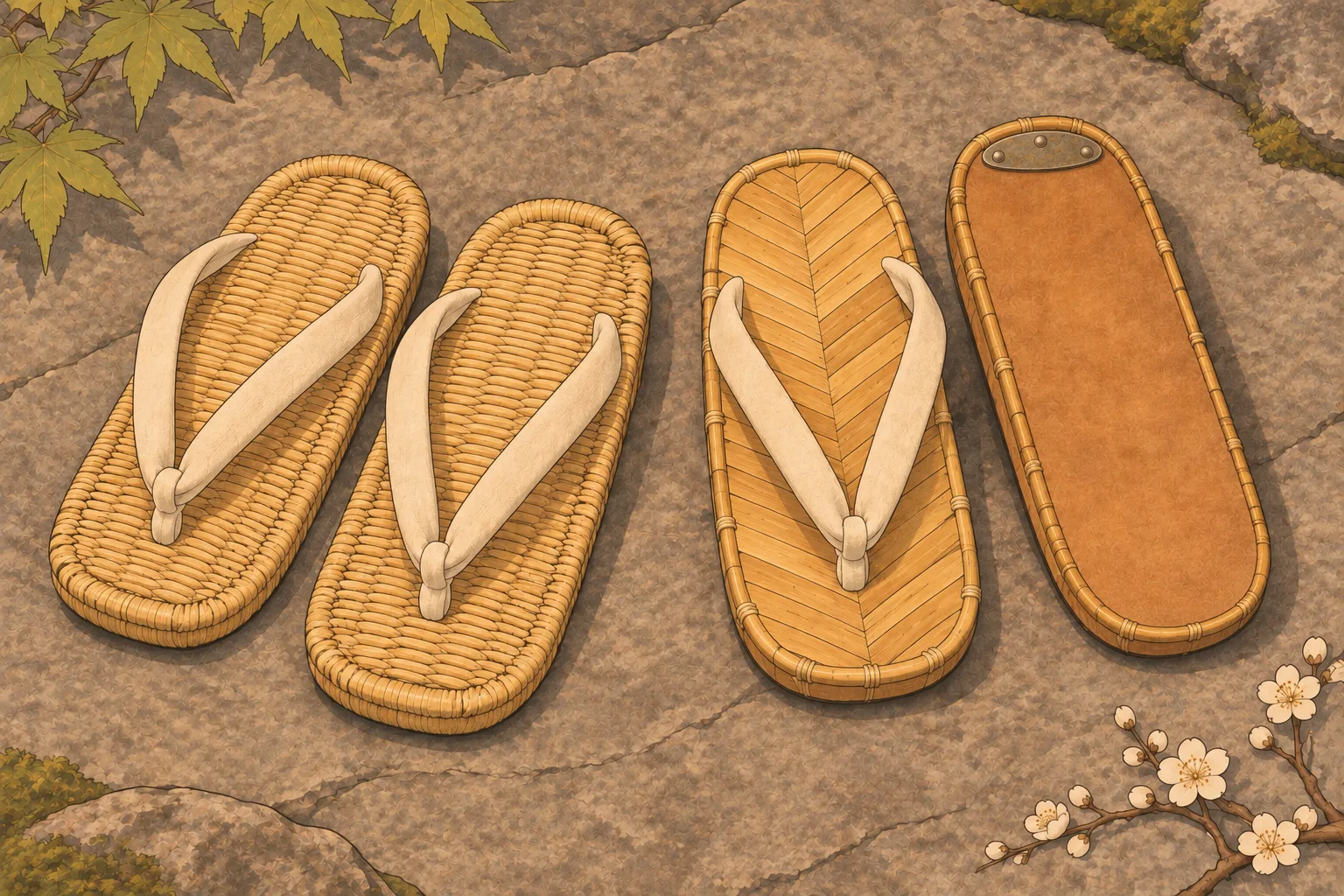
Left: zōri faced with woven rush, with thick white thongs. Right: setta, one turned over to show the leather sole and the metal shirigane at the heel.
Tabi are always white for formal wear; with tsumugi or kinagashi, many men wear black, navy or grey.
The last piece is the fan. The formal white fan, called suehiro, "spreading wide", has black-lacquered or plain bamboo ribs and a white or metallic leaf. It is held in the hand or tucked into the sash at the front left with only the head showing. It is a ceremonial object, not for cooling: opening it at a wedding would be a gaffe. To bow formally, a man draws it out and lays it horizontally on the floor in front of his knees, a gesture you will see at tea ceremonies and traditional weddings.
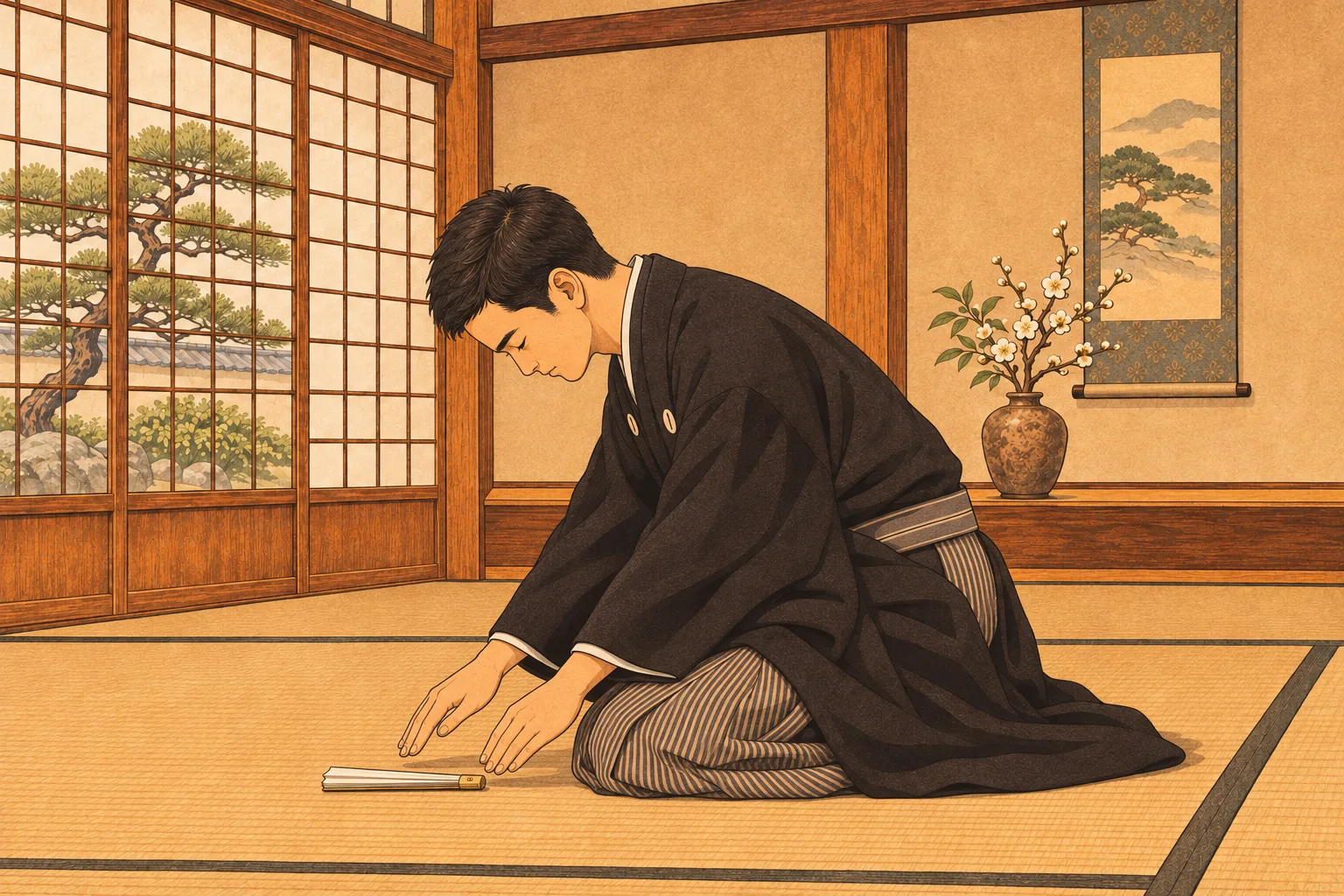
The formal fan is not for cooling. To bow, a man lays it horizontally on the floor in front of his knees.
07Side by side: five men in a row
Picture five men standing in a line, from most to least formal.
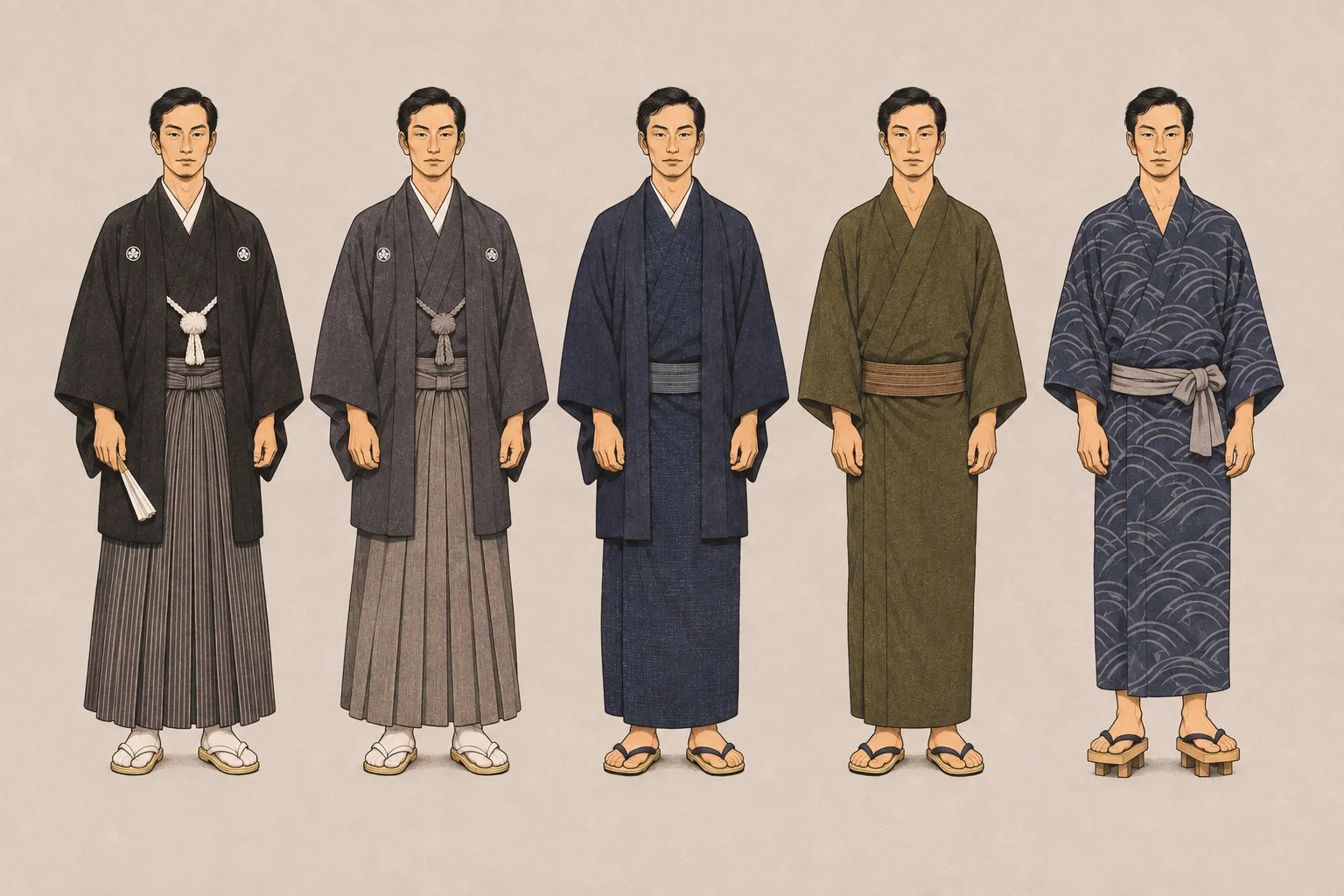
Five grades of men’s kimono, from left: black crested haori and hakama; iro montsuki with hakama; kimono and haori without hakama; kinagashi, kimono and kaku-obi only; yukata with a heko-obi and bare feet in geta.
The first wears black habutae with two white crests on the chest, a thick white tasselled cord, striped sendaihira hakama, white tabi, rush-faced zōri or setta with white thongs and a white fan in his hand. Black, white crests, white cord, striped skirt: all four signals present.
The second wears dark grey or navy with crests on the back and sleeves, perhaps none on the chest, a grey cord and a plain or finely striped hakama. The colour is not black and the cord is not white.
The third wears a navy tsumugi or grey-brown omeshi with a matching haori, one crest or none. No hakama, so the kaku-obi shows at the waist. Setta or zōri, perhaps dark tabi. The skirt is gone.
The fourth wears kimono and kaku-obi only, the front and sleeves fully visible, setta on his feet. The haori is gone.
The fifth wears a cotton yukata, navy or white with an indigo pattern, a heko-obi or narrow sash, and bare feet in geta. The cloth is thin cotton, and there is no collar strip at the neck because there is no under-robe.
Five questions, asked in order, will place almost any man you see: Is it black? Are there crests? Is there a hakama? Is there a haori? Is there a collar strip at the neck?
08Who still wears it
At Shintō weddings the groom nearly always wears the black five-crested set; the wedding page covers the details. At Coming of Age Day, some young men rent a crested hakama outfit, and in Kitakyūshū there is a well-known custom of loud, flamboyant hakama, which has its own page.
Rakugo storytellers are among the most constant wearers. They wear kimono and haori on stage, and crested hakama for formal shows and name-succession ceremonies. The haori has a job to do. The storyteller often opens in his haori with the makura, the chatty preamble, and slips it off his shoulders around the move into the story proper, usually explained as marking the shift from chat to story; after he leaves, the zenza (in Osaka, a stage assistant called an ochako) clears the haori and turns the cushion. Other explanations of when and why the haori comes off also circulate. By custom in Tokyo, rank shows in dress: the lowest tier, zenza, may wear only kinagashi with no haori, and the right to wear haori and hakama comes with promotion to futatsume. Watch a programme at a variety hall and you can guess a performer’s seniority from his jacket.
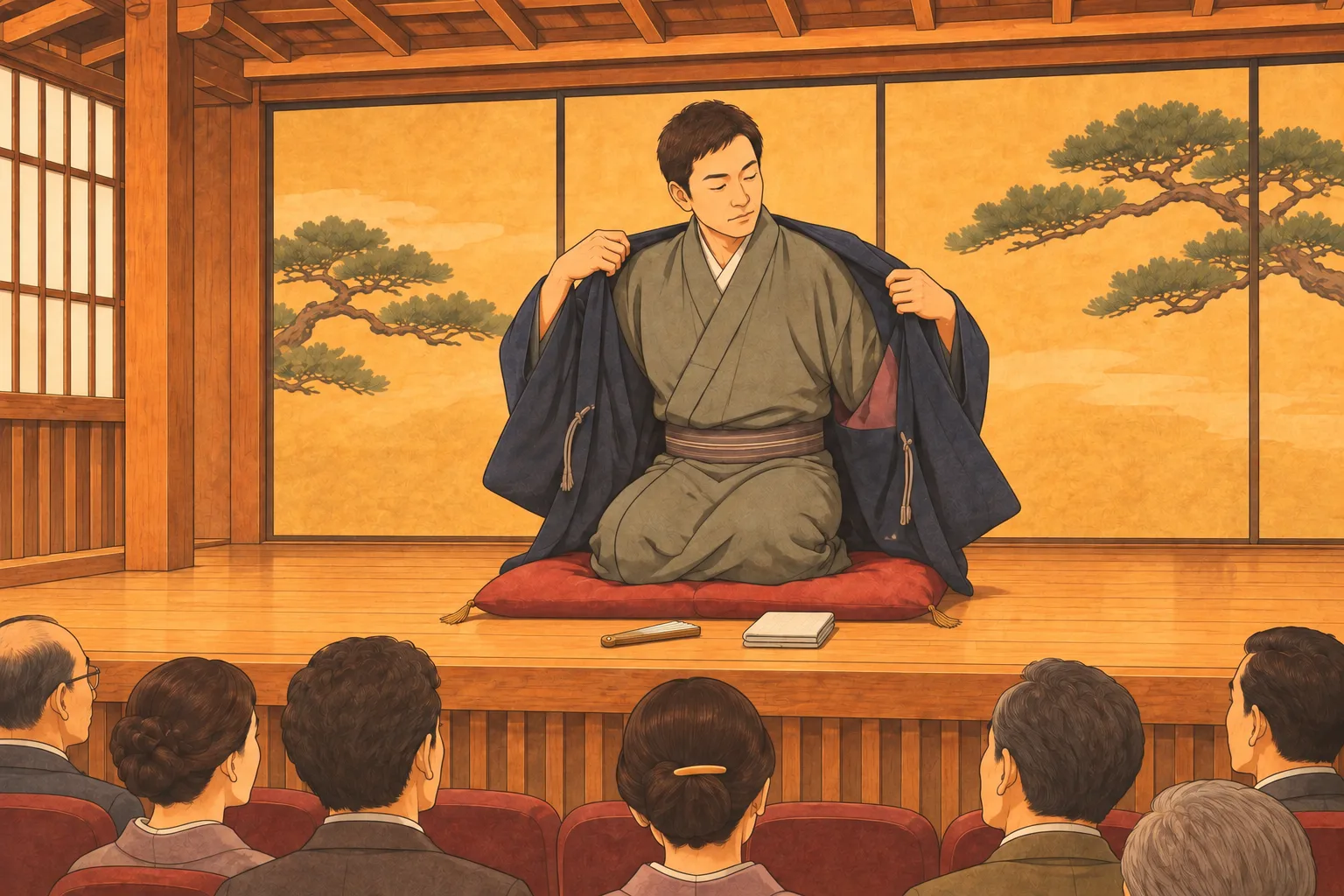
A rakugo storyteller on stage slips his haori off his shoulders; fan and hand towel lie in front of him.
Sumo wrestlers come next. By custom, rikishi appear in public in Japanese dress, and what they may wear follows their rank, mostly by unwritten rule. Wrestlers in the lowest divisions, jonokuchi and jonidan, wear yukata or simple kimono and only geta; setta and tabi come with promotion to sandanme; the Hakata sash and a winter coat wait until makushita; the salaried sekitori of jūryō and above may wear crested haori and hakama for formal occasions. On a cold morning near Ryōgoku Station, you may see a young wrestler in a thin cotton yukata clattering past in geta.
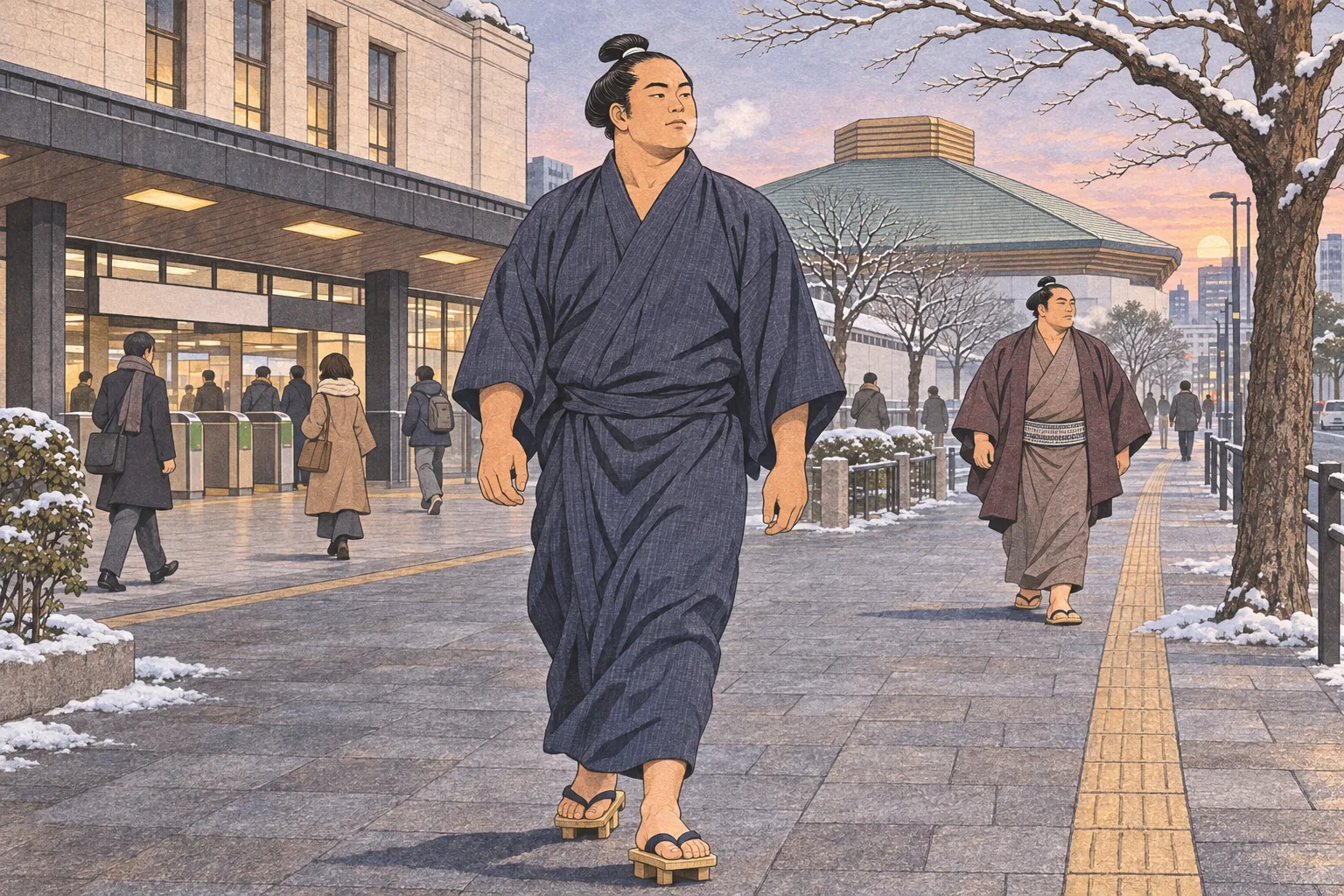
Winter in Ryōgoku: a young rikishi walks past in a thin yukata and geta, while the wrestler behind him wears kimono and haori.
In the martial arts, kendō, kyūdō and aikidō all use hakama, mostly the divided cut. Kendō hakama are usually indigo. In kyūdō, men wear kimono and hakama for grading examinations and high-rank demonstrations, traditionally slipping the left sleeve off the shoulder to draw the bow and revealing a white undergarment. In aikidō, many dojos reserve the hakama for black belts, though rules vary by school. Folding the five front pleats properly is one of the first things a beginner learns.
Tea is the last stronghold. Men attending a tea gathering usually wear a plain-coloured kimono with one crest or none, with or without hakama, white tabi, a small tea fan in the sash, and a silk wiping cloth and paper folded into the front of the kimono. Senior tea masters sometimes wear a jittoku, a black jacket shaped like a haori, its ties sewn onto the garment rather than a separate haori cord. Pattern is almost absent; everything rests on cloth and colour.
And then there is the ordinary middle-aged man you might pass in a Kyoto side street: navy tsumugi, grey haori, setta clicking on the paving. He is not in a play and not on his way to a ceremony. He simply likes kimono, and it is a Tuesday afternoon.
More deep dives on this topic
 Kimono Types and Their RankSpend a Saturday afternoon in the lobby of a big hotel in Tokyo or Kyoto and you will see kimono that look, to an outsider, like variations on a single garment.
 The Obi and Its KnotsStand on a street corner in Kyoto’s Gion and watch two women in kimono walk away from you.
 Kimono Motifs and the SeasonsWalk through Kyoto in early March and you will see cherry blossoms on kimono sleeves weeks before a single tree has opened.
 Japanese Hairstyles and KanzashiLook closely at a woodblock print of a street in late Edo or Meiji Japan and you can read the women in it like name tags.
 Men’s KimonoMost visitors to Japan see far more women in kimono than men, and when a man does walk past in kimono, he can look oddly uniform: dark colours, a short jacket, a narrow belt, flat…
 Putting On a Kimono, Layer by LayerWhen you rent a kimono in Kyoto or Asakusa, you stand in front of a mirror for fifteen or twenty minutes while someone wraps, pulls, tucks and ties, mostly out of your sight.
 KamonWalk through any old Japanese town and you will start to notice the same kind of image again and again: a small black-and-white emblem, perfectly symmetrical, usually inside a…
 The Life of a KimonoMost clothes are finished the day they are sewn.
- Back to the main article: Kimono →