
At a glance
From "a piece of cloth" to pleats, A-POC and BAO BAO, and the black-clad Paris shock of Yamamoto and Kawakubo: how Japanese designers rethought clothing.
- Miyake Issey was born in Hiroshima in 1938 and lived through the atomic bombing at seven.
- His central idea was that clothing is "a piece of cloth," starting from flat fabric rather than elaborate cutting.
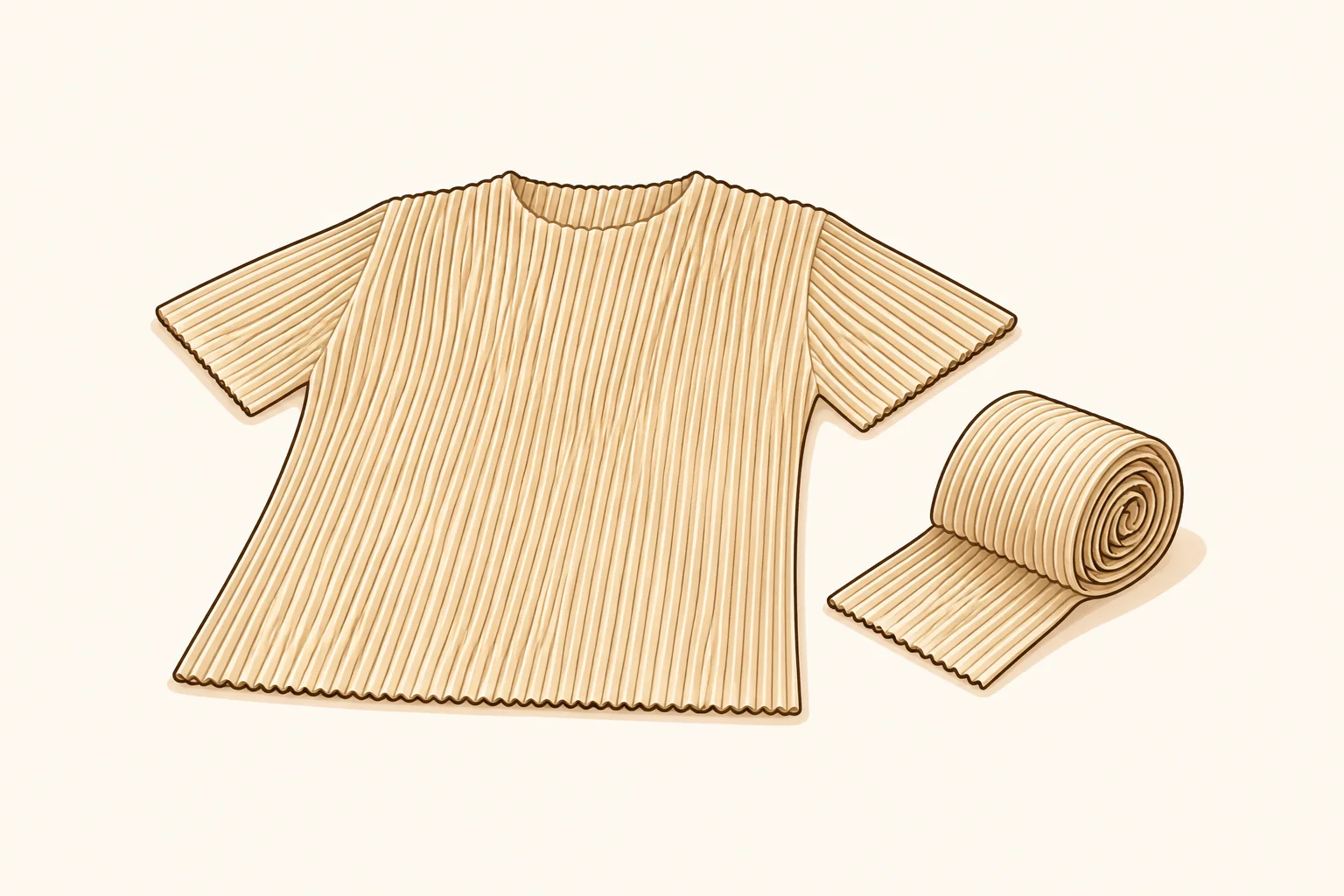
- For PLEATS PLEASE, garments are sewn two and a half to three times their finished size, then pleated whole.
- A-POC knits a tube of cloth by computer; the wearer cuts the garment out along the lines. MoMA acquired it in 2006.
- From 1981, Yamamoto Yohji and Kawakubo Rei showed black, asymmetrical clothes in Paris, the "black shock."
Walk down Omotesandō in Tokyo on any afternoon and you will pass someone in a finely pleated top that looks like folded paper, and someone else carrying a bag made of small triangles that shifts shape as it swings. Both come from Miyake Issey (known in English as Issey Miyake). Along with Yamamoto Yohji and Kawakubo Rei, he belongs to the generation of Japanese designers who, from the 1970s onward, forced Paris to rethink what clothes were for and how they should sit on a body. This piece looks at where Miyake came from, the inventions that made his name, the "black shock" that Yamamoto and Kawakubo delivered to Paris in the early 1980s, and where in Tokyo you can see and buy their work today.
01A Piece of Cloth
Miyake liked to describe his work with one phrase: ichimai no nuno, "a piece of cloth." The phrase makes more sense against the tradition he was reacting to. European tailoring starts from the body and works inward. Cloth is cut into many curved pieces, darted and shaped, and sewn into a three-dimensional shell that tells the body what shape it should be. The kimono works the other way. A bolt of cloth about 36 centimeters wide is cut almost entirely in straight lines; take a kimono apart and you get rectangles again. It goes on by wrapping, folding, and tying, and it leaves air between body and fabric.
Miyake never made kimono and disliked being cast as the man who brought "the Orient" to Paris. What he took from that tradition was a method: start with a flat piece of cloth, and treat the space between the fabric and the body as something to design. Almost everything he made over the next fifty years can be read as a different answer to the same set of questions. How little cutting can a garment get away with? Can one piece fit many different bodies? Can a garment be beautiful and still go through the washing machine and into a carry-on bag?
That last question set him apart from most of his peers. He was less interested in fashion, in the sense of seasonal statements, than in clothing that ordinary people would wear every day. He insisted he was a designer rather than an artist, and he cared about manufacturing as much as about the runway.
02From Hiroshima to Paris
Miyake was born in Hiroshima in 1938. He was seven and at school when the atomic bomb fell on the city on August 6, 1945. His mother was badly burned and died about three years later. For decades he refused to talk about it, not wanting to be known as "the designer who survived the bomb." He broke that silence in 2009, in an op-ed for The New York Times urging nuclear disarmament, where he wrote that he preferred to think of things that can be created, not destroyed. As a teenager in postwar Hiroshima he had watched the Peace Memorial Park take shape, with Tange Kenzō’s buildings and Isamu Noguchi’s bridge railings, and he later said those were what first showed him what design could do.
He studied graphic design at Tama Art University in Tokyo. While still a student, he wrote to the organizers of the 1960 World Design Conference in Tokyo asking why clothing had been left off the program. After graduating he moved to Paris, studied at the school of the Chambre Syndicale de la Couture, and worked as an assistant to Guy Laroche and then Hubert de Givenchy. He then spent time in New York working for the American designer Geoffrey Beene. Being in Paris during the student uprisings of May 1968 left a mark: the young people in the streets wore jeans and T-shirts, and haute couture made by hand for a few wealthy clients suddenly looked like the past.
He returned to Tokyo and founded the Miyake Design Studio in 1970, showing in New York in 1971 and in Paris from 1973. His early clothes used traditional Japanese textiles in new ways; at his first Paris show in 1973 he was already using heavy cotton stitched with sashiko (a quilting stitch once used by farmers and firefighters), and some accounts say his early work also used tenugui cloth of the kind made into summer yukata and farmhouse indigo-dyed fabric. From 1971 he worked closely with the textile designer Minagawa Makiko, who traveled to weaving workshops across Japan looking for fabrics and techniques that could be adapted for industrial production. That partnership ran through everything he did afterward. In the 1980s he made a series of sculptural "bodyworks" from plastic, rattan, and silicone; a rattan bodice from this period appeared on the cover of the February 1982 issue of Artforum, the first time fashion had appeared on the art magazine’s cover.
03Pleats Please
If people know one thing by Miyake Issey, it is the pleats.
Pleated skirts were nothing new. The usual method is to pleat the fabric first and then cut and sew it. In the late 1980s Miyake’s studio reversed the order. They cut and sewed each garment two and a half to three times larger than its finished size, sandwiched it between sheets of paper, and fed the whole thing through a heated press that pleated it in one pass. The technique is known as garment pleating. Because the fabric is a fine polyester jersey, the heat sets the pleats permanently. The result lies flat as a sheaf of paper, rolls up into a suitcase, stretches as the wearer moves, never needs ironing, and comes out of the wash ready to wear.
- 1
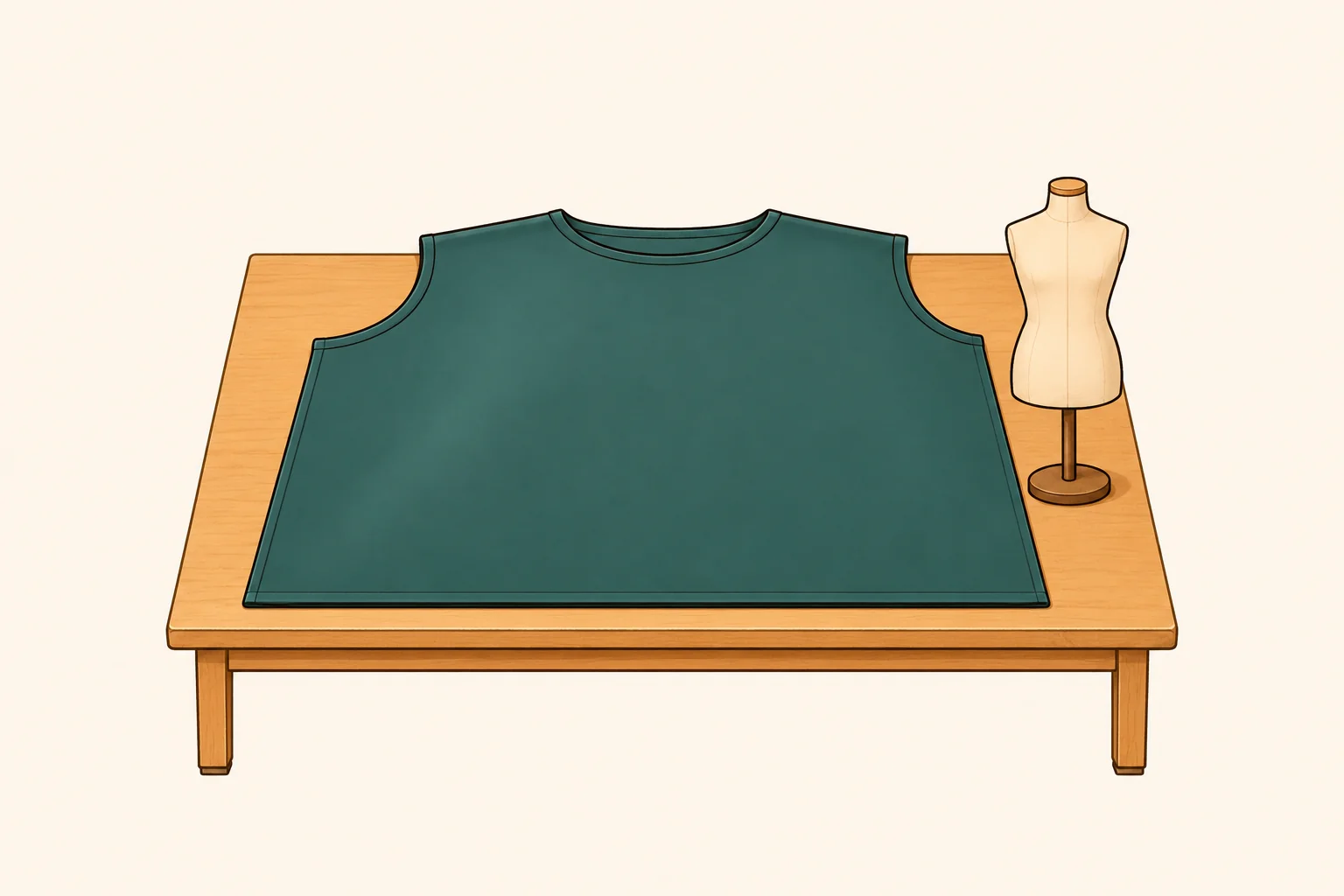 The garment is cut and sewn two and a half to three times its finished size, with no pleats yet.
- 2
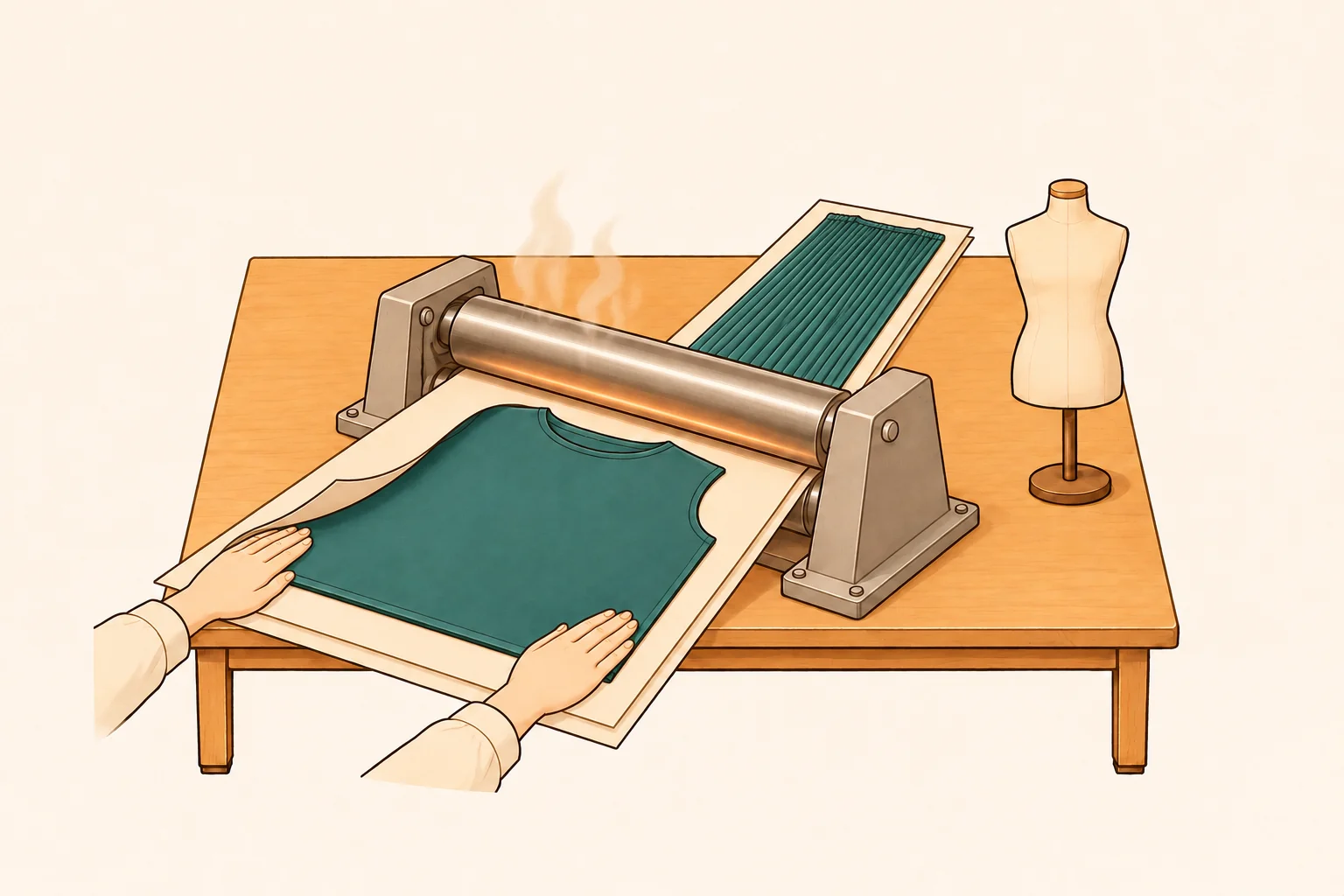 Sandwiched between sheets of paper, the whole garment goes through a heated press that pleats it in one pass.
The usual method
- Pleat the fabric
- Then cut and sew
Garment pleating
- Cut and sew at two and a half to three times the finished size
- Sandwich between sheets of paper
- Feed through a heated press, pleated in one pass
- Polyester: the heat sets the pleats permanently
The usual method pleats the fabric first; Miyake’s studio made the whole garment oversized and pleated it in one pass.
In 1991 Miyake began making costumes for William Forsythe’s Frankfurt Ballet. The dancers leapt and twisted in pleated garments that moved with them and sprang back into shape, and the collaboration showed that the pleats were a structure rather than a decoration. In 1993 he launched the line as PLEATS PLEASE ISSEY MIYAKE, and from spring/summer 1994 it ran as a label of its own. The pieces came in bright colors and simple shapes, cost far less than his main collection, and quickly found a following among architects, academics, museum curators, and anyone who traveled for work and wanted two garments that could cover a three-day trip of meetings and dinners. A men’s line, HOMME PLISSÉ ISSEY MIYAKE, followed in 2013.
04A-POC and Later Experiments
In the late 1990s Miyake handed the design of his main line to his longtime assistant Takizawa Naoki, who became its creative director in 1999, and turned to research. With the textile engineer and designer Fujiwara Dai he started A-POC in 1998 and launched it in 1999. The name stands for "A Piece Of Cloth."
A-POC used a computer-controlled knitting machine to produce a long tube of fabric with the outlines of a dress, sleeves, socks, and a hat already knitted into it. The customer took the roll home and cut along the lines. The knit structure meant the cut edges did not unravel, and no sewing was needed. Cut the sleeve long or short, the hem high or low: the wearer finished the design. The Museum of Modern Art in New York added A-POC to its permanent collection in 2006, and the project is often cited as an early example of digital manufacturing in clothing.
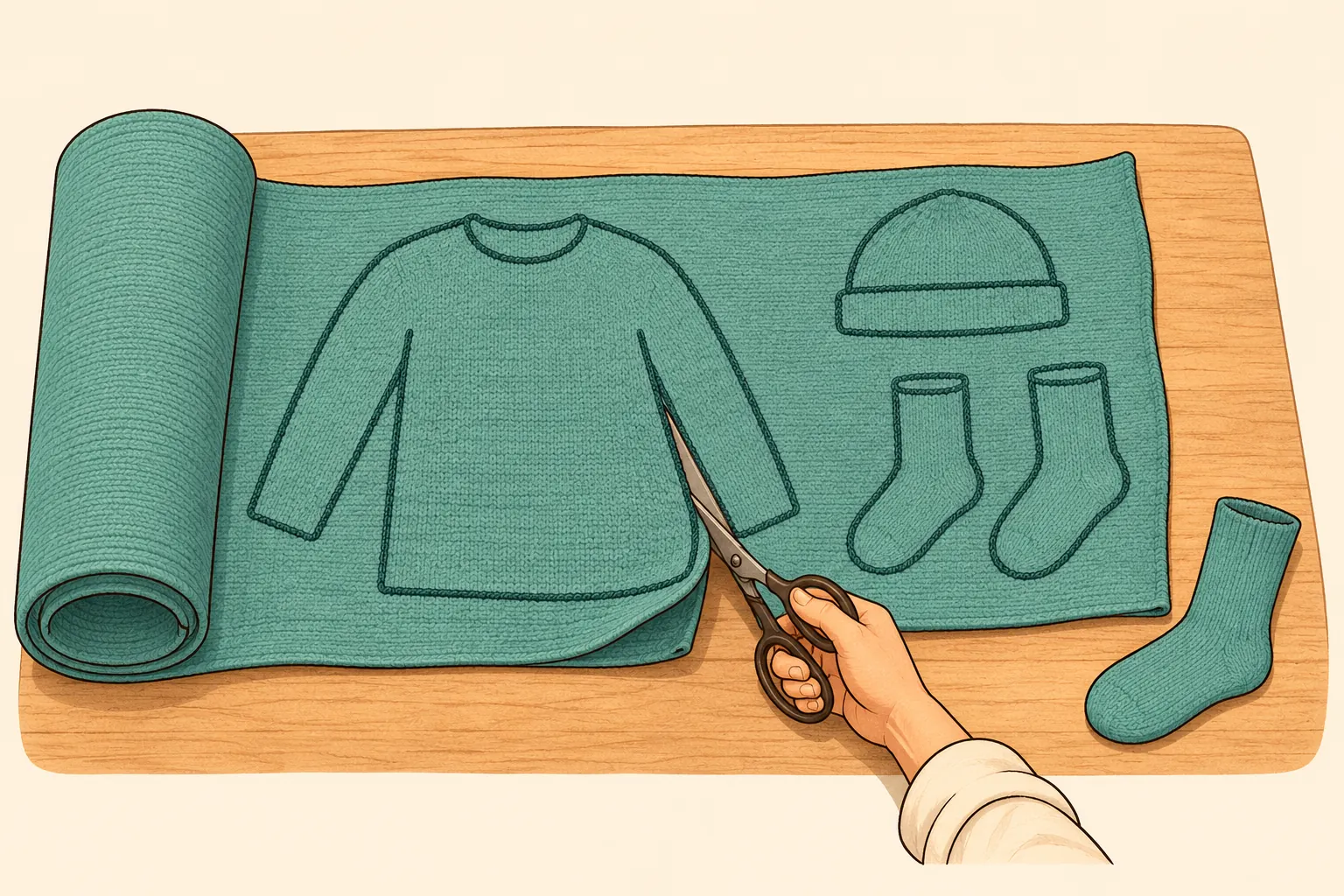
The A-POC idea: outlines are knitted into a long tube of fabric, and cutting along the lines yields garments with no sewing.
- 1Computer-controlled knitting machine
- 2A long tube of fabricoutlines of a dress, sleeves, socks and a hat knitted in
- 3The customer cuts along the linesno sewing; cut edges do not unravel
- 4Cut long or shortthe wearer finishes the design
The outlines are knitted into the fabric; the wearer finishes the design.
In his seventies Miyake assembled a new young team called Reality Lab. In 2010 it released 132 5. ISSEY MIYAKE, garments based on computer-generated origami: folded flat, each piece is a geometric shape; lift it by the shoulders and it opens into a shirt or dress. The numbers stand for one piece of cloth, three dimensions, two-dimensional folding, and a fifth dimension, the moment it is worn. Around the same time came BAO BAO ISSEY MIYAKE, which began as a bag series within PLEATS PLEASE and became a separate label in autumn/winter 2010: the bags are built from small triangular tiles set on a mesh backing, which collapse flat when empty and take on the shape of whatever is inside. In much of Asia they are now the most visible Miyake product on the street.
One of his most famous pieces of clothing did not carry his label at all. Steve Jobs’s black mock turtleneck was made by Miyake, and Jobs reportedly ordered around a hundred of them.
Miyake also built a home for design in Tokyo. In 2007 he co-founded 21_21 DESIGN SIGHT, a gallery in the gardens of Tokyo Midtown in Roppongi, designed by Andō Tadao with a roof that folds down like a single sheet of steel, an idea taken from Miyake’s piece of cloth. He died of liver cancer on August 5, 2022, at the age of 84. The company continues under a team of designers, and the gallery still runs exhibitions about everyday design.
05The Black Shock: Yamamoto Yohji and Kawakubo Rei
Miyake was not the first Japanese designer in Paris. Takada Kenzō opened a shop there in 1970 and became famous for cheerful prints and loose shapes under the name KENZO. Mori Hanae, known for her butterfly motifs, was admitted to the Chambre Syndicale de la Haute Couture in 1977, the first Asian designer to be accepted as a member. But the moment that changed Western fashion came in 1981 and 1982, when two designers from Tokyo began showing in Paris.
Yamamoto Yohji was born in Tokyo in 1943, the son of a dressmaker, and trained at Bunka Fashion College. He founded his first label, Y’s, in 1972. Kawakubo Rei, born in Tokyo in 1942, studied in the philosophy department at Keiō University and had no formal fashion training. She began making clothes under the name Comme des Garçons, French for "like the boys," in 1969. Their Paris shows of 1981–82 stunned the press. The models wore little makeup. The clothes were almost entirely black, oversized, asymmetrical, deliberately frayed and torn, with uneven hems and dropped shoulders, hiding the waist instead of defining it. Western critics called it "Hiroshima chic" and talked of a post-atomic look. The language was ugly, but it captured how unfamiliar it was to see clothes that rejected the hourglass figure and refused to look finished.
In Tokyo, the look was already a street style. Young people dressed head to toe in loose black were nicknamed the karasu-zoku, the "crow tribe." Within a few years Paris came around. Black, deconstruction, and asymmetry became the vocabulary of high fashion in the late 1980s and 1990s, and the Belgian designers known as the Antwerp Six, among others, are generally seen as having learned from them; by some accounts, members of the group said so openly.
Yamamoto has said that he makes clothes to protect the wearer, and that loose garments let the body keep a space of its own. Kawakubo pushed further. Her spring 1997 collection, "Body Meets Dress, Dress Meets Body," padded the garments with irregular lumps so the models looked swollen; the press nicknamed it "lumps and bumps." Her company also launched other designers, most notably Watanabe Junya, and labels such as sacai (Abe Chitose) and UNDERCOVER (Takahashi Jun) grew out of the same circle.
Miyake is often grouped with Yamamoto and Kawakubo, but his path was different. His clothes were colorful and light, and he cared about technology and daily use. Yamamoto and Kawakubo were more concerned with attitude and with testing the limits of what counts as beautiful. What the three shared was a refusal to begin from the Western ideal of the body, and a willingness to treat the space between cloth and skin as the real subject.
06Seeing Japanese Design in Tokyo
The best place to see Miyake is Minami-Aoyama and Omotesandō. The ISSEY MIYAKE flagship is in Aoyama, with separate shops for PLEATS PLEASE, HOMME PLISSÉ, and BAO BAO nearby, many of them designed by well-known architects and laid out more like galleries than stores. There are also branches in Ginza, Kyoto, and Ōsaka, and counters in major department stores. PLEATS PLEASE tops and BAO BAO bags mostly cost tens of thousands of yen: roughly ¥20,000 to ¥30,000 for a top and from ¥30,000 to ¥40,000 for a bag, as of about 2026 (check the shop tags). Popular pieces are said to be especially sought after by visitors from China, and staff often point out which items are sold only in Japan. Overseas visitors can reclaim consumption tax: as of November 2026 they pay the tax-inclusive price in the shop and get the tax refunded after customs checks the goods on departure. When trying on pleats, walk around and raise your arms; the point of the garment only shows when it moves.
A few minutes away are the Aoyama stores of Comme des Garçons and Yohji Yamamoto. The Comme des Garçons shop has no obvious sign; its curved glass front is part of the design. In Ginza, Dover Street Market, run by Kawakubo’s company, fills a whole building with her own lines and those of younger designers, and the displays change often enough that it is worth a visit even if you buy nothing.
In Roppongi, 21_21 DESIGN SIGHT holds several exhibitions a year, usually built around ordinary things such as water, rice, or bones. The National Art Center nearby held a major Miyake retrospective in 2016. If the textiles interest you, the trail leads out of Tokyo to weaving regions such as the cotton mills around Hamamatsu or the denim workshops of Kojima in Okayama; Miyake’s studio has long developed fabrics with producers in places like these, and Miyake and Minagawa are said to have sourced cloth from just such places. Japan’s older dress traditions, kimono and its dyeing and weaving, along with its graphic design (see also: Kimono: How Eight Straight Panels of Silk Became Japan’s Most Eloquent Garment; Kimono Textiles: How Japan Dyes, Binds, Embroiders and Weaves Its Cloth; Japanese Graphic Design: A Red Sun, Four Scripts and a Plywood Butterfly), grew from the same soil as the work of Miyake’s generation.