
At a glance
How Japanese narrative handscrolls are read right to left, the painters’ tricks for telling stories in them, the four great scrolls, and where to see emaki.
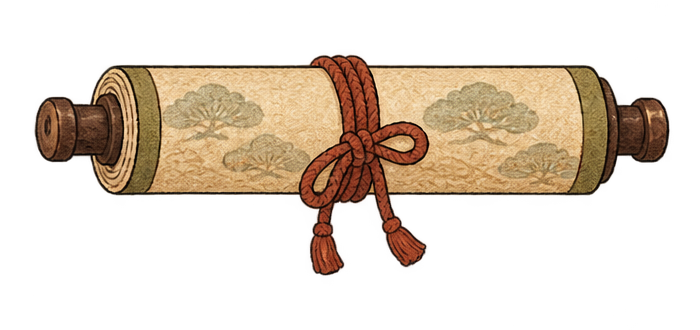
- An emaki is a narrative painting with pictures and text on a long strip of paper or silk, rolled for storage: about 30 cm tall and ten meters or more long.
- The reader opens a new section with the left hand and rolls up the seen part with the right, so only about a shoulder’s width shows as the story moves right to left.
- The oldest surviving example, the Nara-period E-inga-kyō, runs pictures above a band of sutra text.
- The “four great emaki” of the late Heian period are the Genji scrolls, Shigisan Engi, Ban Dainagon and the Chōjū-giga.
- Painters told stories on the narrow strip with roofless interiors (fukinuki yatai), repeated figures within one scene, and drifting bands of mist.
An emaki is a Japanese illustrated handscroll: a long strip of paper or silk carrying pictures, and often text, that you unroll from right to left and read as you go. Between roughly the twelfth and fourteenth centuries, court painters and temple artists used the format to tell love stories, miracle tales, political scandals, battles and visions of hell, and a handful of those scrolls are now among the most treasured objects in Japan. They are also some of the hardest to see, because they are fragile and rarely shown. This is a guide to what emaki are, how they were meant to be read, which ones matter most, and where you might catch them on display.
01A Story in Your Hands
Most emaki are around 30 centimeters tall, but they can run for ten meters or more. They were not designed to hang on a wall. A reader sat on the floor with the scroll laid out in front of them, opening a new section with the left hand and rolling up the part already seen with the right, so that only about a shoulder’s width of the picture was visible at any moment. The reader set the pace. You could linger over a single scene or roll quickly past it to reach the next turn in the story.
- 1
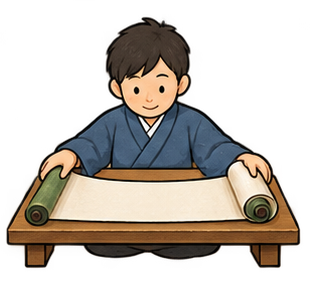 With the scroll laid out in front, the left hand opens new sections and the right rolls up what has been seen
- 2
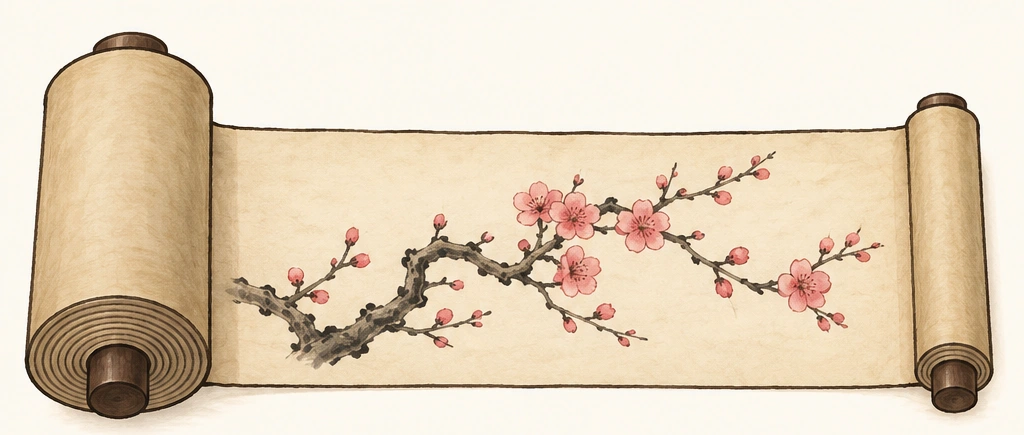 At the start, the unread roll on the left is thick and the rolled-up part on the right is thin
- 3
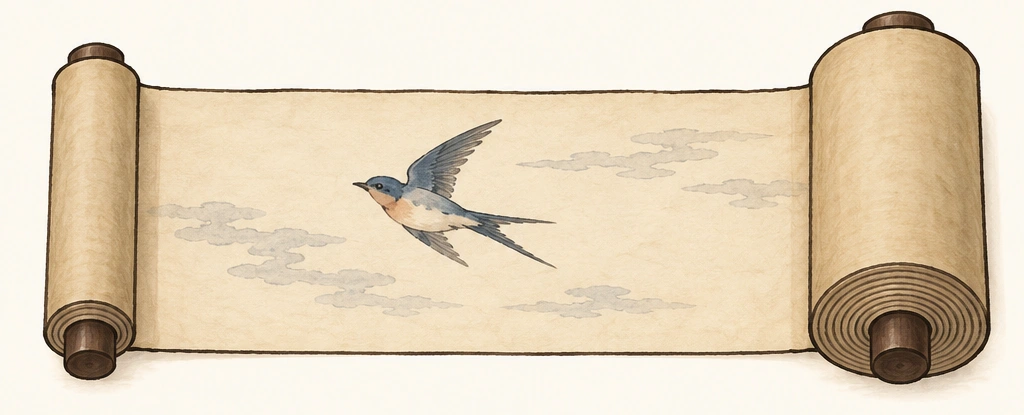 Reading on: about a shoulder’s width is open, and new scenes appear from the left
- 4
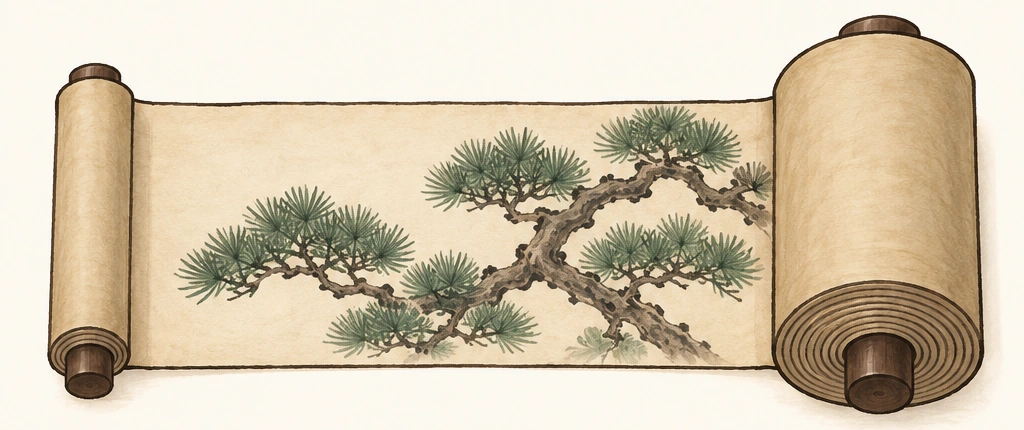 Near the end, the left roll has shrunk and the seen part on the right has grown
That way of viewing shaped everything about the art. Japanese was written in vertical columns from right to left, and emaki move in the same direction. Figures tend to walk leftward, ox-carts roll leftward, pursuers charge leftward. Painters knew the eye would keep traveling to the left, so they laid time out across space: what happens first is on the right, what happens next is to its left. Unrolling the scroll is watching the story unfold.
Many emaki alternate between passages of text, called kotobagaki, written in elegant calligraphy, and painted sections that show what the text has just described. Others use text sparingly and let long painted passages carry the story, as in the Legends of Mount Shigi; the first scroll of the Frolicking Animals has no text at all.
The format came from China. Tang-dynasty handscrolls reached Japan along with Buddhist scriptures and the official embassies of the seventh and eighth centuries. The oldest surviving Japanese example, the Illustrated Sutra of Past and Present Karma (E-inga-kyō) from the Nara period, has a band of pictures running above a band of sutra text telling the life of the Buddha, and its style is still recognizably Chinese. During the Heian period, as aristocratic culture turned toward native themes, painters began depicting Japanese stories, Japanese landscapes and Japanese seasons in a style known as yamato-e, "Japanese painting," and the handscroll became a Japanese art in its own right.
02The Painter’s Tricks
Telling a story on a strip of paper a foot tall required some ingenious solutions, and emaki painters developed a visual language that still feels fresh.
The most famous is fukinuki yatai, "blown-away roof." When showing the inside of a palace, the painter simply leaves out the roof and ceiling, so we look down into the rooms from above at an angle. We can see who sits behind which blind, who is eavesdropping, who is weeping into a sleeve. It solves a practical problem, and it also offers the pleasure of looking in on private lives, which suits stories of court romance perfectly.
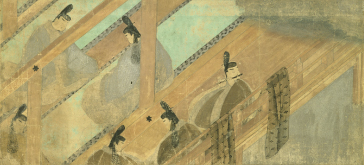
The Tale of Genji Scroll, "Suzumushi II": the roof is left out, so we look down into the room. Gotoh Museum.
A second device is showing the same figure several times within one continuous scene to mark different moments. In one celebrated passage of the Ban Dainagon Scroll, a quarrel between two boys escalates: the boys grapple, one boy’s father rushes out and kicks the other child, and then the mother leads her son back home. The same father and the same boy appear several times within one small area, and you follow the sequence the way you would follow panels in a comic.
Bands of stylized mist or cloud, often in gold or white, drift horizontally across the picture. They hide what doesn’t need to be shown and serve as transitions from one scene to the next, much like a dissolve in film.
Faces come in two styles. Court scrolls use hikime kagibana, "line for an eye, hook for a nose": aristocrats have pale, rounded faces with a single stroke for each eye and a tiny hook for the nose, almost expressionless. This was a deliberate choice. A blank face lets viewers project their own feelings onto the character, while emotion is carried by posture, by the fall of robes, by a garden or a season outside the room. The other style belongs to scrolls about commoners, monks and miracles, where figures are drawn in quick, lively ink lines with exaggerated expressions. Crowds gape, runners’ clothes fly behind them, and the whole page seems noisy.
The court style is built up through a technique called tsukuri-e, "constructed painting": an ink underdrawing, layers of opaque mineral pigment, and then fine outlines redrawn on top, giving rich color and a still, hushed mood. The livelier scrolls rely mainly on the brush line itself, with color washed on lightly.
03The Four Great Scrolls
Japanese art history traditionally singles out four works from the late Heian period as the "four great emaki." Between them they show the range of the form.
The Tale of Genji Scrolls (Genji monogatari emaki), painted around the first half of the twelfth century, are the oldest surviving illustrations of Murasaki Shikibu’s novel and the defining example of tsukuri-e and hikime kagibana. The original set probably ran to about ten scrolls; what survives is 19 paintings and about 20 text sections, most of it at the Tokugawa Art Museum in Nagoya and the rest at the Gotoh Museum in Tokyo. In one scene Genji cradles the infant Kaoru, who he knows is not his son. In another, Yūgiri’s wife creeps up behind him to snatch a letter she suspects is from another woman. The faces give nothing away, yet the tilted screens, rumpled robes and night shadows say everything. The pigments have flaked badly over nine centuries, and modern scientific reconstructions reveal colors so vivid they come as a shock.
The Legends of Mount Shigi Scrolls (Shigisan engi emaki), three scrolls kept at Chōgosonshi-ji temple in Nara Prefecture, tell of Myōren, a monk living on Mount Shigi. The first scroll is the one everyone remembers. A wealthy man refuses to put rice in the monk’s begging bowl, so the bowl flies down, lifts his entire granary onto its back and carries it off into the sky, while the man and his household gallop after it and villagers stare upward. In the second scroll Myōren heals Emperor Daigo by sending a divine guardian, a boy clad in swords who races through the clouds behind a spinning wheel. Almost everything is done with line, and the sense of speed is remarkable.
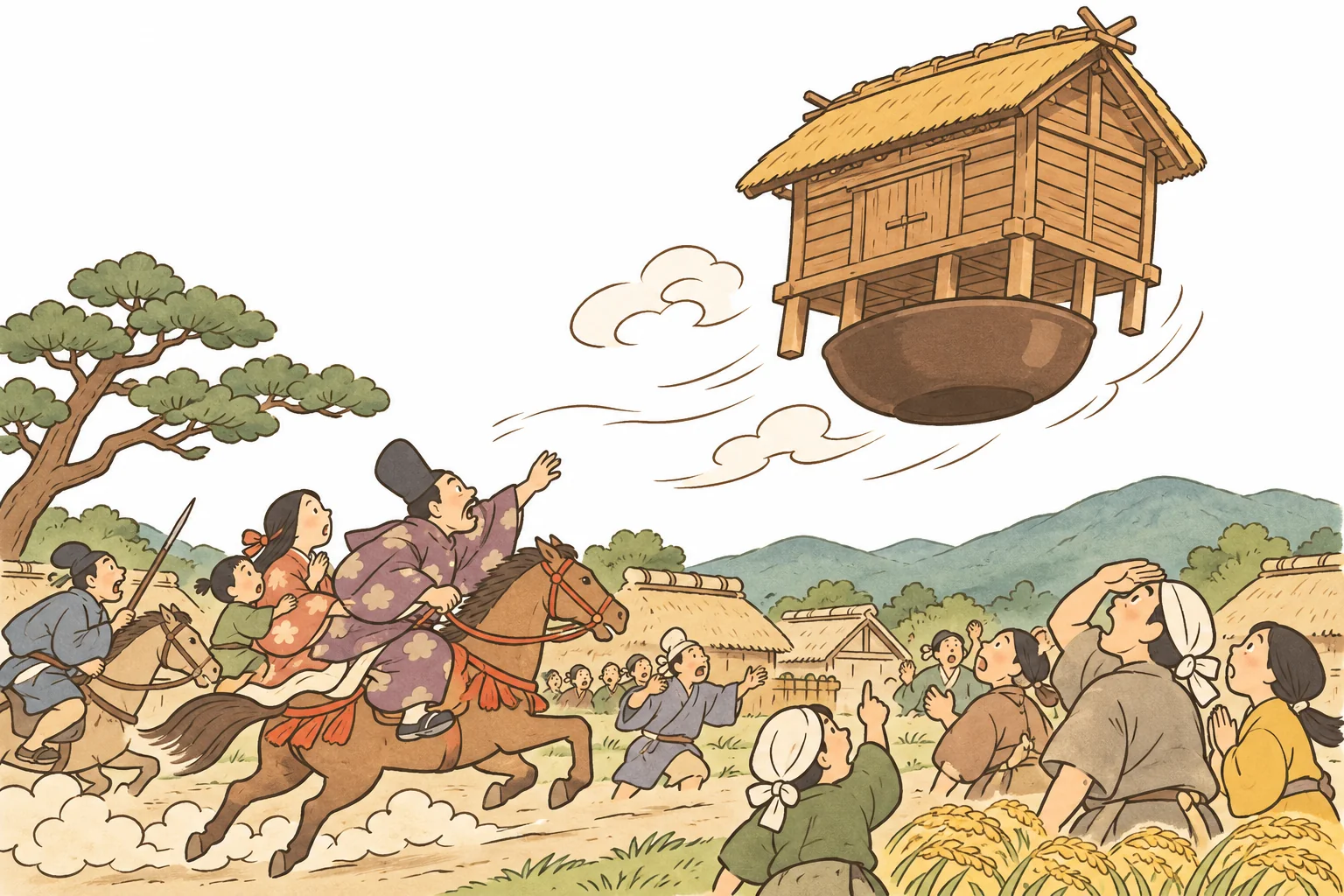
A flying alms bowl carries off a whole rice granary while the rich family gives chase on horseback (illustration).
The Ban Dainagon Scroll (Ban Dainagon ekotoba), three scrolls now at the Idemitsu Museum of Arts in Tokyo, depicts a real event: the burning of the Ōtenmon gate of the imperial palace in 866. The courtier Tomo no Yoshio, the dainagon or Major Counselor of the title, set the fire and tried to pin the blame on a rival minister, Minamoto no Makoto. The truth came out only after a fight between the children of two households’ servants. The scroll opens with crowds streaming toward the burning gate, and the billowing smoke and hundreds of individually characterized onlookers make it one of the great crowd scenes in Japanese art.
The Scrolls of Frolicking Animals and Humans (Chōjū jinbutsu giga), four scrolls belonging to Kōzan-ji temple in Kyoto and known as Scrolls A through D, are the most widely loved. Scroll A has no text at all. In brisk ink lines, rabbits, frogs and monkeys behave like people: they swim, wrestle, shoot arrows and hold a Buddhist service. A frog throws a rabbit to the ground, a monkey in monk’s robes chants sutras, and a frog sits on the altar as the Buddha. Nobody knows for certain who drew them or why. Tradition credits the monk Toba Sōjō Kakuyū, but the four scrolls differ in style and date and were almost certainly made by different hands at different times. The Japanese often call them the oldest manga in Japan. That is an exaggeration, but the way they use pure line to create movement and comedy does feel like a direct ancestor.
04Warriors, Saints and Hungry Ghosts
In the Kamakura period, from the late twelfth century onward, the number of emaki multiplied and their subjects broadened.
With the rise of the samurai, war became a major theme. The Heiji monogatari emaki depicts the Heiji Disturbance of 1159; its scroll on the Night Attack on the Sanjō Palace, now in the Museum of Fine Arts, Boston, is a whirl of flames, stampeding ox-carts and slashing warriors. The Mongol Invasion Scrolls (Mōko shūrai ekotoba) were commissioned by Takezaki Suenaga, a warrior from Higo province in Kyūshū, to record his own deeds during the Mongol attacks of 1274 and 1281. They show the Mongol ranks and an exploding bomb, and they remain an important visual source for the invasions. The scrolls also show Suenaga traveling to Kamakura after the first invasion to plead his case in person before Adachi Yasumori, the official in charge of rewards, and finally receiving one. He is generally thought to have commissioned the work to hand his deeds and that story down to later generations.
Religion was the other great engine. Temples and shrines commissioned engi emaki, illustrated founding legends, such as the Kitano Tenjin engi, which tells how the courtier Sugawara no Michizane died in exile, returned as a vengeful thunder god, and was finally enshrined as Tenjin, the god of learning. Lives of eminent monks were painted at length. The Illustrated Biography of the Monk Ippen (Ippen hijiri-e), completed in 1299 on silk, follows the wandering founder of the Ji sect across Japan, and its markets, ferry crossings, temples, coastlines and crowds of ecstatic dancing chanters make it almost a travelogue of medieval Japan. The Kasuga Gongen genki-e, completed around 1309 under the court painter Takashina Takakane, recounts the miracles of the Kasuga deity in sumptuous color.
Then there are the scrolls of the unfortunate realms of rebirth: the Hell Scrolls (Jigoku zōshi), the Hungry Ghosts Scroll (Gaki zōshi) and the Diseases and Deformities scroll (Yamai no sōshi). Hungry ghosts with swollen bellies and stick-thin limbs crouch unseen among ordinary people in city streets, feeding on filth. The diseases scroll studies strange ailments with an almost clinical curiosity. These were meant to make viewers feel the suffering of existence and turn toward the Buddha. Today they also read as unusually candid pictures of medieval society.
From the Muromachi period, emaki became more popular in tone. The short tales known as otogi-zōshi, including stories such as Issun-bōshi, the inch-high samurai, and Urashima Tarō, were painted on smaller scrolls and in picture books. The Night Parade of One Hundred Demons (Hyakki yagyō emaki) at Shinju-an, a subtemple of Daitoku-ji in Kyoto, shows a procession of old household objects come to life as spirits: pots, kettles and other household things sprouting arms and legs. Its descendants run through Edo-period yōkai pictures to modern monster manga. Scrolls continued to be painted in the Edo period, but popular narrative pictures had largely moved to woodblock-printed books and ukiyo-e.
05Why the Format Matters
What makes emaki compelling is that they put time inside a picture. A hanging scroll or a folding screen is taken in at a glance. An emaki has to be seen section by section, at a pace the viewer controls, with what came before rolled away and what comes next not yet revealed. Painters exploited that for suspense. In the Mount Shigi scroll you first see people running in alarm after something; only as you unroll further do you discover the granary sailing through the sky.
The director Takahata Isao, co-founder of Studio Ghibli, argued in his book Twelfth-Century Animation that emaki use pans, cuts and close-ups much as film does, and that Japanese ways of reading animation and comics have roots in them. Manga still reads right to left, and its motion lines and comic exaggeration are often compared with the brushwork of the old scrolls. Calling emaki the ancestor of manga is too neat a story, but the two share a way of thinking about how pictures move a narrative along.
06Seeing Emaki in Japan
Because they are paper or silk and suffer every time they are rolled and unrolled, original emaki are rarely on long-term display. Major works appear in special exhibitions or during set periods each year, typically for a few weeks, and usually only one section is open at a time, with changes partway through the run.
The Tokugawa Art Museum in Nagoya usually shows a few scenes from the original Genji scrolls in late November each year (still the practice as of 2026), and displays reproductions and reconstructions the rest of the time. The Tokyo National Museum and the Kyoto National Museum are the most dependable places to see emaki in general; works from their collections and on deposit rotate through the permanent galleries, and their major special exhibitions can bring many famous scrolls together at once. The originals of the Chōjū giga are deposited with those two national museums, while Kōzan-ji, in the hills of Toganoo northwest of Kyoto, displays reproductions in its Sekisui-in hall, where you can study the frogs and rabbits in the quiet of a mountain temple. Chōgosonshi-ji on Mount Shigi has its own treasure hall, and the temple grounds, full of tiger statues, are worth the trip on their own.
In the gallery, remember to read from right to left and move with the figures. When the queue is slow, it is better to pick one or two scenes and look closely than to push through the whole length: look into the roofless rooms to see what each person is doing, find the children and dogs watching from the corners, notice the season changing behind a bank of mist. Museum shops often sell full-length facsimiles or folding reproductions. Laid out on a table at home and opened a section at a time with both hands, they give you the closest thing to reading an emaki the way it was meant to be read.