
At a glance
Why daruma have no limbs and get one eye painted at a time, which paw a maneki-neko raises and why, and where to find both in Japan.
- The daruma is modeled on Bodhidharma, first patriarch of Zen; it has no limbs because of the legend of his nine years facing a wall.
- Takasaki in Gunma is the largest producer, said to make around 80 percent of Japan’s daruma.
- A new daruma has blank eyes: you paint its own left eye when you make a wish, and the other when it comes true.
- A raised right paw is usually said to invite money, a left paw customers; Gōtoku-ji’s white cats raise the right paw and hold no coin.
- Shōrinzan Daruma-ji in Takasaki holds its Daruma Market on January 6 and 7 each year.
Walk into almost any small business in Japan and you will meet one of two figures. One is a round red doll with a fierce bearded face and blank white eyes, waiting for someone to paint in a pupil. The other is a cat sitting upright with one paw raised beside its ear, often clutching an oversized gold coin. The doll is a daruma; the cat is a maneki-neko, the "beckoning cat." Both are engimono, objects bought for good fortune, and both took their familiar shape among the townspeople and farmers of the Edo period (1603–1868). This piece explains where they came from, how to read the details on them, how Japanese people actually use them, and where to see the best of them on a trip.
01A Zen Patriarch Who Cannot Be Knocked Down
The daruma is named after Bodhidharma, called Daruma in Japanese, the Indian monk who by tradition carried meditation-centered Buddhism to China around the fifth or sixth century and became revered as the first patriarch of Zen. The most famous story about him says that he sat facing a wall at the Shaolin Temple on Mount Song for nine years without moving. A later embellishment adds that his arms and legs withered away from disuse. That is why the Japanese daruma has no limbs at all: it is a body wrapped in a red robe, with a face peering out of a hood.
The doll’s shape comes from somewhere else entirely. China had long made weighted toys with rounded bottoms that rock back upright whenever they are pushed over. In Japan these became known as okiagari-koboshi, "little self-righting monks," and small versions are still sold as folk toys in Aizu, in Fukushima Prefecture. During the Edo period, makers began giving these tumbler toys the face and robe of Bodhidharma. The match was a happy one. The patriarch who refused to move for nine years became a doll that refuses to stay down, and the proverb most often printed on daruma is nana korobi ya oki, "fall down seven times, get up eight."
Why red? Paintings of Bodhidharma traditionally show him in a red robe, which is one answer. The other is that in Edo-period Japan, red was believed to ward off the deity of smallpox. Red toys and red prints were given to children as protection against the disease. A red daruma was therefore both a holy figure and a charm for health.
02Takasaki and the Paper Doll Trade
Most daruma sold in Japan today come from one city: Takasaki, in Gunma Prefecture, about an hour north of Tokyo by shinkansen. Locals say the city makes around 80 percent of the country’s daruma, and in the weeks before New Year the workshops on its outskirts are stacked to the rafters with them.
The industry is tied to Shōrinzan Daruma-ji, a Zen temple on a wooded hill outside the city. According to the temple’s tradition, the area suffered badly in the 1780s, when the eruption of Mount Asama and the Tenmei famine left farmers desperate. A priest at the temple wanted to give them a way to earn money in the idle winter months. Using a portrait of Bodhidharma drawn by the temple’s founding master, the Chinese monk Shin’etsu, he taught villagers in nearby Toyooka to make papier-mâché daruma by pressing layers of paper over wooden molds. The farmers sold them at the temple’s New Year market, and daruma making became a winter side business that was handed down through farming families. That is the temple’s account; Yamagata Tomogorō, the Toyooka villager usually named as the first maker, was born in 1793, so the craft most likely grew into a real industry in the early nineteenth century, in the Bunka and Bunsei eras.
- 1
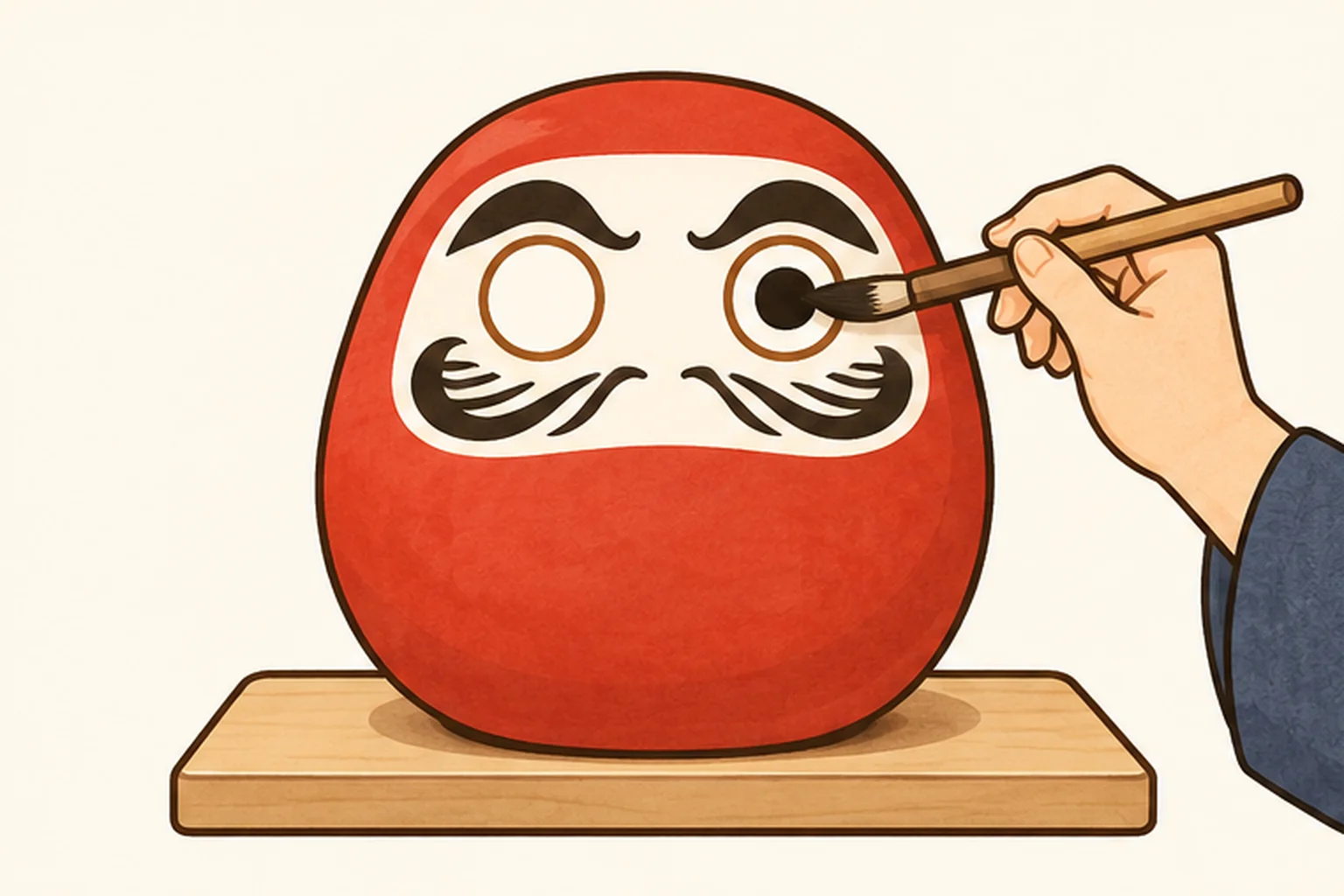 On making a wish, you usually paint the daruma's own left eye first, the one on your right as you face it.
- 2
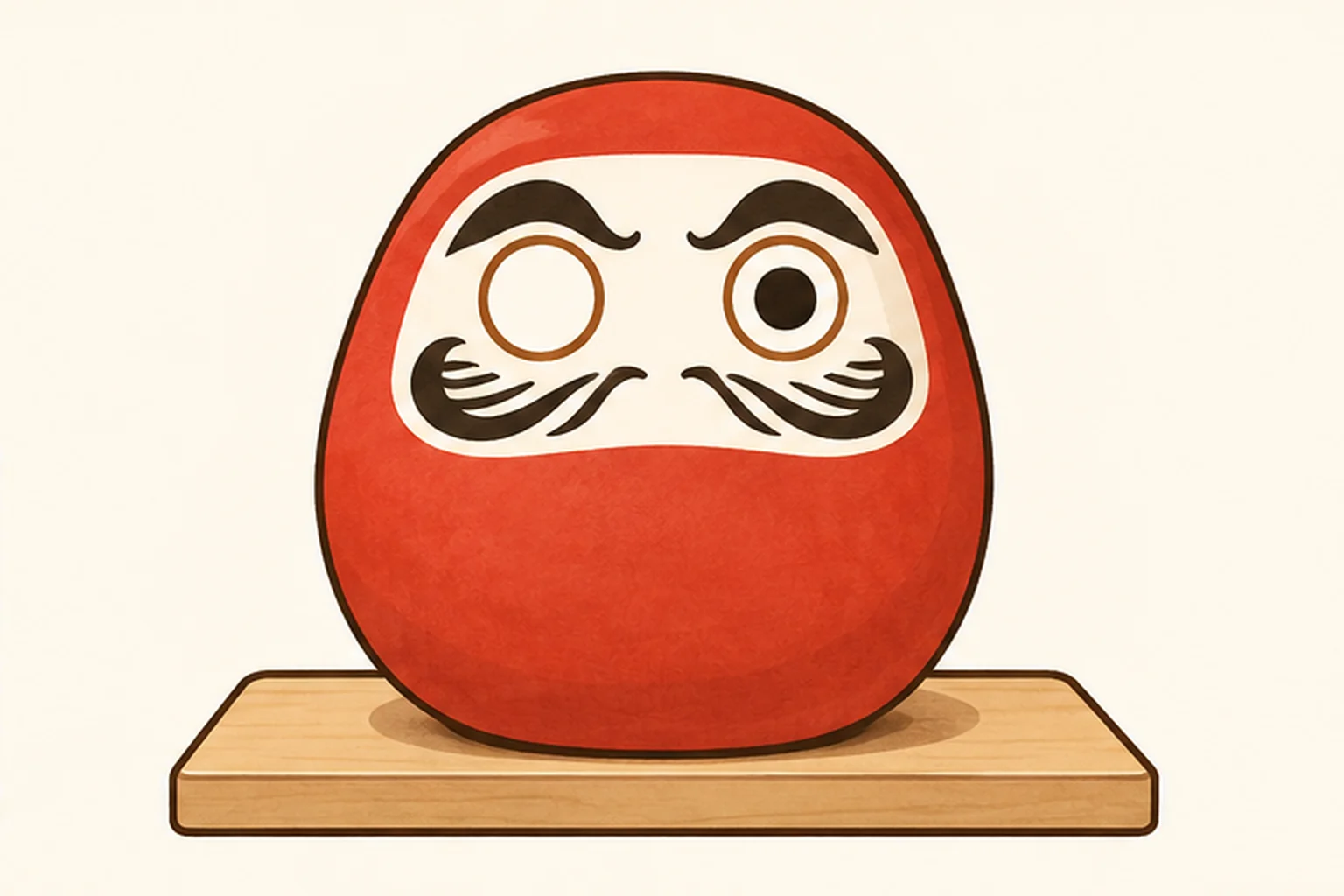 The one-eyed daruma then sits on a shelf at home or in the office for the year.
- 3
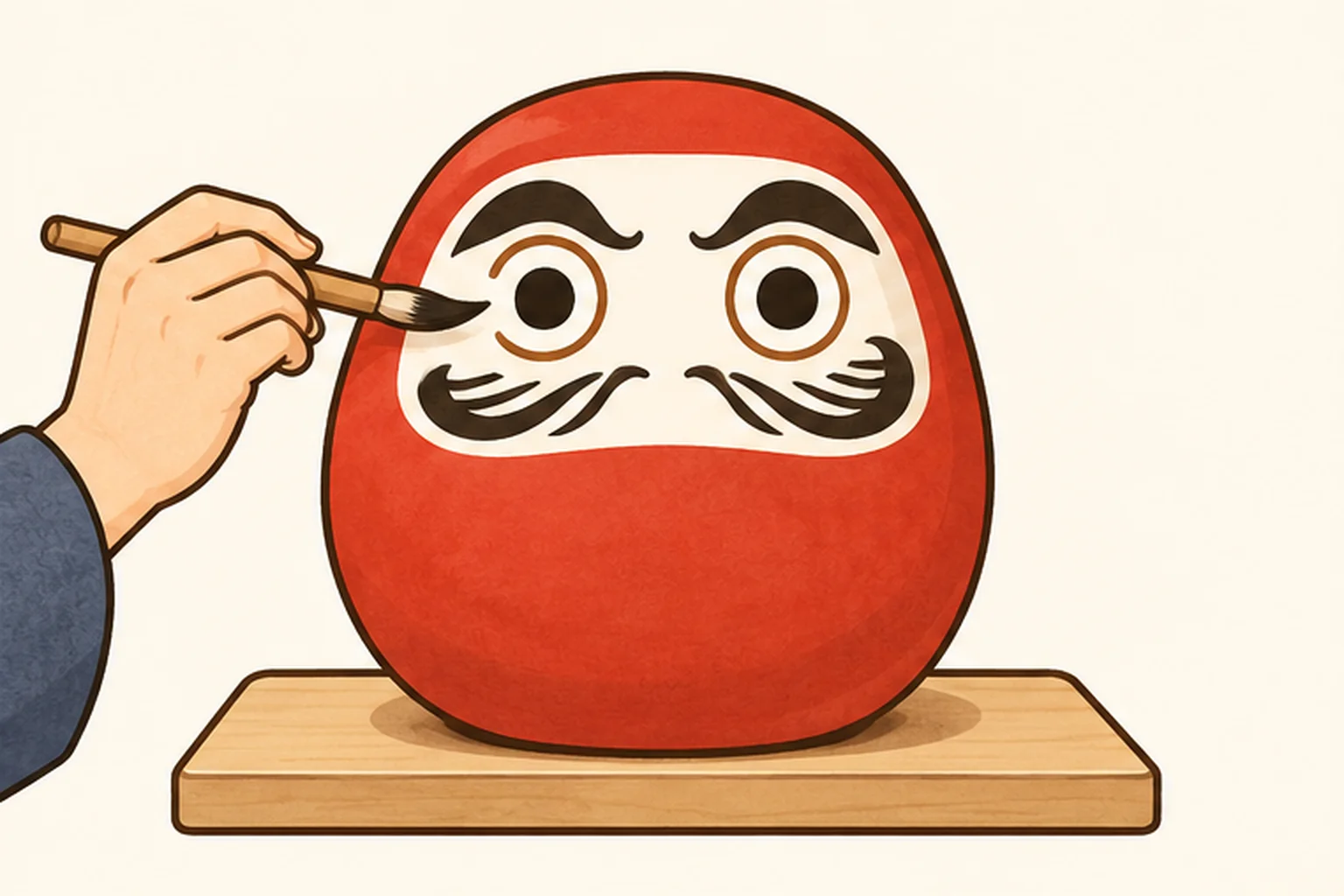 When the wish comes true, you paint in the second eye.
Takasaki daruma are still made the same basic way, though today the paper shells are reportedly mostly pressed by machine. The shell is painted red, then the face is painted by hand. Look closely and you will see that the face is a visual pun. The eyebrows are painted in the shape of a crane, and the beard in the shape of a tortoise. In Japanese folklore the crane lives a thousand years and the tortoise ten thousand, so the face itself is a wish for long life. Gold characters on the belly usually read fuku iri, "fortune within," and the shoulders carry wishes such as household safety or thriving business.
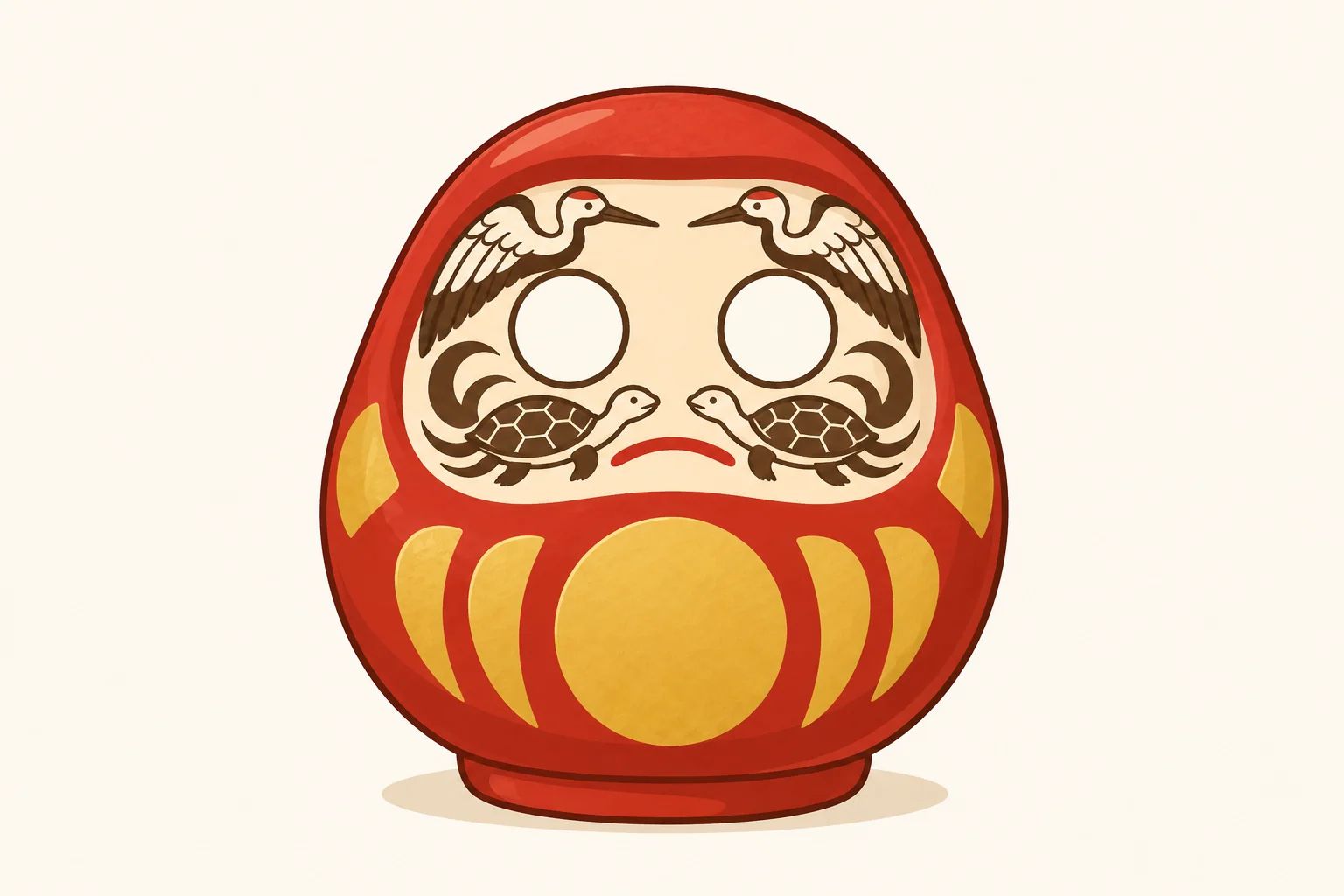
A Takasaki daruma: crane-shaped eyebrows, tortoise-shaped beard and blank white eyes.
- 1New: both eyes blank
- 2Make a wish: paint one pupilthe daruma’s own left eye, on your right as you face it
- 3Wish comes true: paint the second eye
- 4Taken back to the temple and burneddaruma kuyō, dondo-yaki
- 5Buy a new one, slightly larger
Paint the daruma’s own left eye first, the one on your right as you face it; the new daruma is bought slightly larger than last year’s.
03The Ritual of the Eyes
What makes the daruma more than a decoration is its eyes. A new daruma comes with both eyes blank. When you buy one, you make a wish or set yourself a goal, and you paint in one pupil with black ink. This is called me-ire, "putting in the eyes." The usual practice is to paint the daruma’s own left eye first, which is the one on your right as you face it. The one-eyed daruma then sits on a shelf at home or in the office for the year, a slightly reproachful reminder of what you promised yourself. When the wish comes true, you paint in the second eye.
The most public version of this ritual happens on election night. Japanese campaign offices keep a large daruma with one eye filled in, and when a candidate’s victory is declared, he or she paints in the second eye in front of supporters and television cameras. Students facing entrance exams, companies starting a new venture, and shop owners opening a new business all buy daruma for the same reason.
A daruma is not meant to be thrown away. At the end of the year, or at the New Year, people take their old daruma back to the temple where they bought it. Temples hold memorial burnings called daruma kuyō, and many neighborhoods burn their old New Year decorations and daruma together in bonfires called dondo-yaki in mid-January. Then you buy a new one. A common custom is to buy one slightly larger than last year’s, to show that your fortunes are growing.
Takasaki is not the only daruma town. At Jindai-ji, a temple in Chōfu on the western edge of Tokyo, the daruma market held every March paints the eyes with Sanskrit letters instead of plain black dots: when you buy, a monk writes a, the first sound, in the left eye, and when the wish comes true, un, the last, goes in the right. Sendai’s Matsukawa daruma are trimmed in deep blue and, by most descriptions, painted with a treasure ship. Shikoku and Kyūshū have hime daruma, "princess daruma," shaped like little girls. And Katsuō-ji, a temple in the hills of Minoh north of Ōsaka, is famous as a temple of victory; its stone walls, steps and eaves are lined with thousands of small red daruma left behind by people whose wishes were granted. The name has also slipped into everyday Japanese. A snowman is a yuki daruma, a "snow daruma," and Japanese children play a version of Red Light, Green Light called daruma-san ga koronda, "the daruma fell over."
04The Cat at the Temple Gate
The maneki-neko’s gesture is the first thing to understand about it. In Japan, you call someone toward you by holding up your hand with the palm facing outward and bending your fingers downward. To many Western eyes this looks like waving goodbye, which is why the cat is sometimes called the "waving cat"; abroad it is better known simply as the "lucky cat." To a Japanese viewer, the cat is beckoning: calling customers, money and luck in through the door.
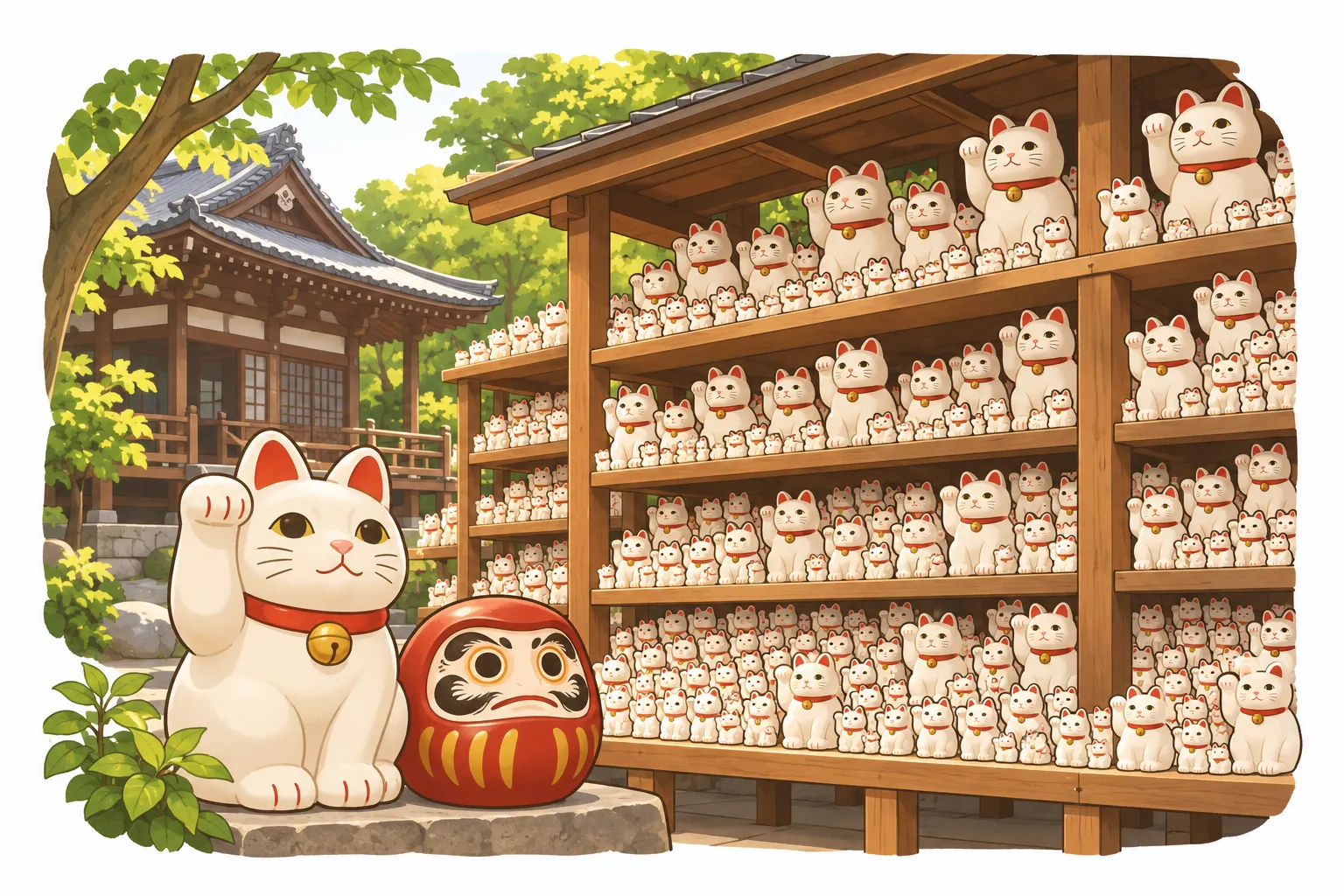
Several places in Tokyo claim to be the birthplace of the beckoning cat, and each has a story. The best known belongs to Gōtoku-ji, a temple in Setagaya. In the early Edo period, the story goes, Ii Naotaka, lord of the Hikone domain, was passing a poor little temple on his way back from hunting when he noticed a cat at the gate raising its paw as if to call him inside. He went in to rest, and moments later a violent thunderstorm broke. Grateful to have been spared the downpour, and pleased with his conversation with the priest, Naotaka made the temple his family’s funerary temple, and its fortunes rose. After the cat died, the story continues, it was honored as manekineko, written with characters meaning "beckoning fortune." Gōtoku-ji’s cats are plain white, raise the right paw, and hold no coin. The temple explains that the cat brings an opportunity; what you make of it is up to you.
A second story comes from Asakusa and neighboring Imado. A tale that went around Edo in 1852 tells of a poor old woman in Hanakawado, Asakusa, who was forced to give up her beloved cat, which then appeared to her in a dream and told her to make an image of it and enshrine it. Cat figures in Imado-yaki, the local earthenware, were sold by the torii of the Sanja Gongen shrine at Sensō-ji (today’s Asakusa Shrine), where they became popular. These were called marushime-neko, after a circled 〆 mark stamped on the back. Imado Shrine, in the old pottery district, now presents itself as one birthplace of the beckoning cat; it is known as a place to pray for finding a partner, and its pair of large beckoning cats draws couples and hopeful singles. A third claim belongs to Jishō-in in Shinjuku, where a black cat is said to have guided the warrior Ōta Dōkan during a battle.
All of these are legends recorded later, and nobody can say which cat was first. What is clearer is that ceramic cat figures were sold around Asakusa by the mid-nineteenth century, and that by the Meiji era (1868–1912) the beckoning cat had become a common fixture in shops.
05How to Read a Beckoning Cat
Every part of a maneki-neko carries a meaning, at least according to the people who sell them. The most frequent question is which paw is raised. The usual answer is that a raised right paw invites money and a raised left paw invites customers. A restaurant or bar that lives on foot traffic might choose a left-pawed cat; a household hoping for wealth might choose a right-pawed one. Cats raising both paws exist too, though some people joke that a cat with both hands up looks like it is surrendering. A paw raised high is said to call fortune from far away.
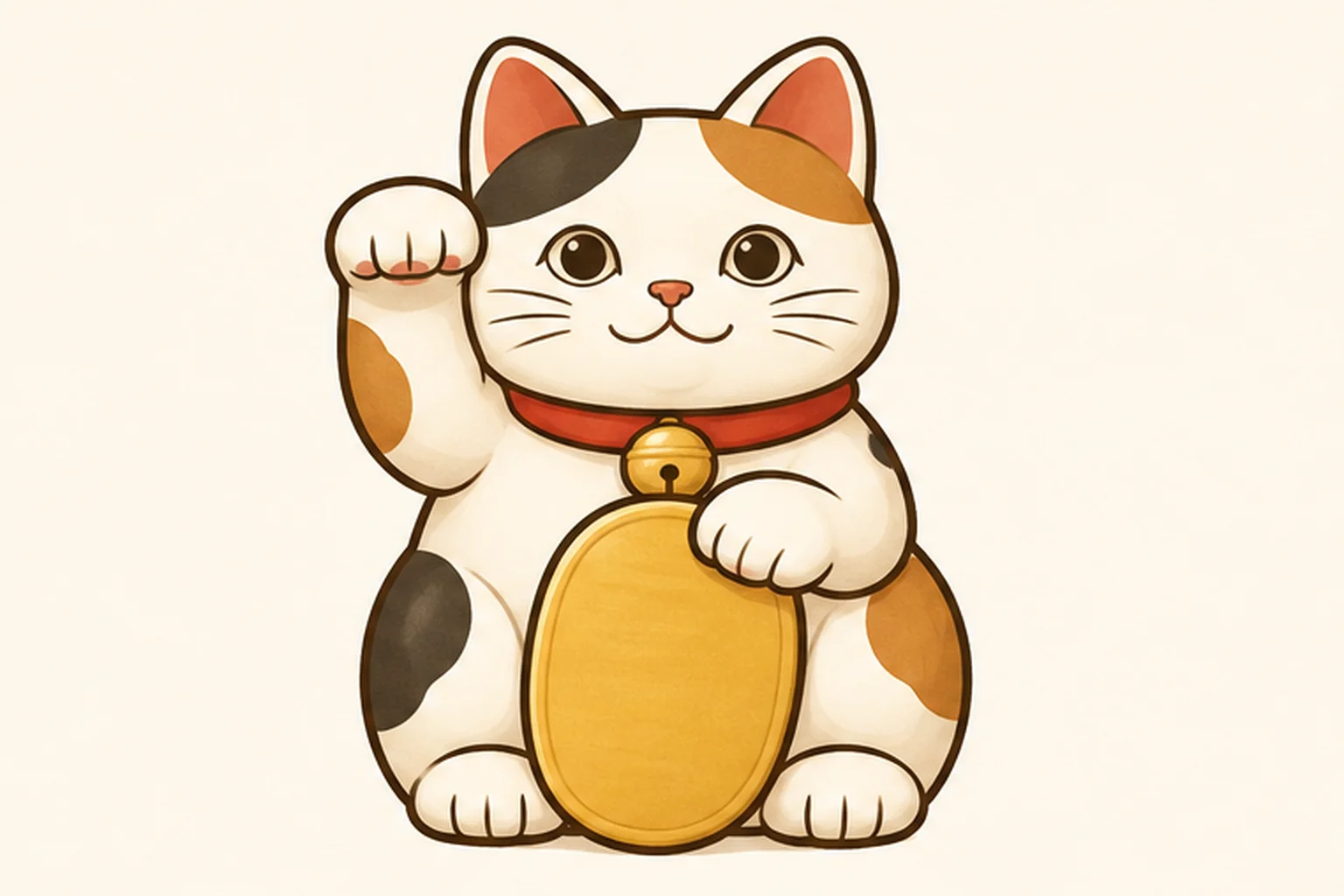
A raised right paw is usually said to invite money.
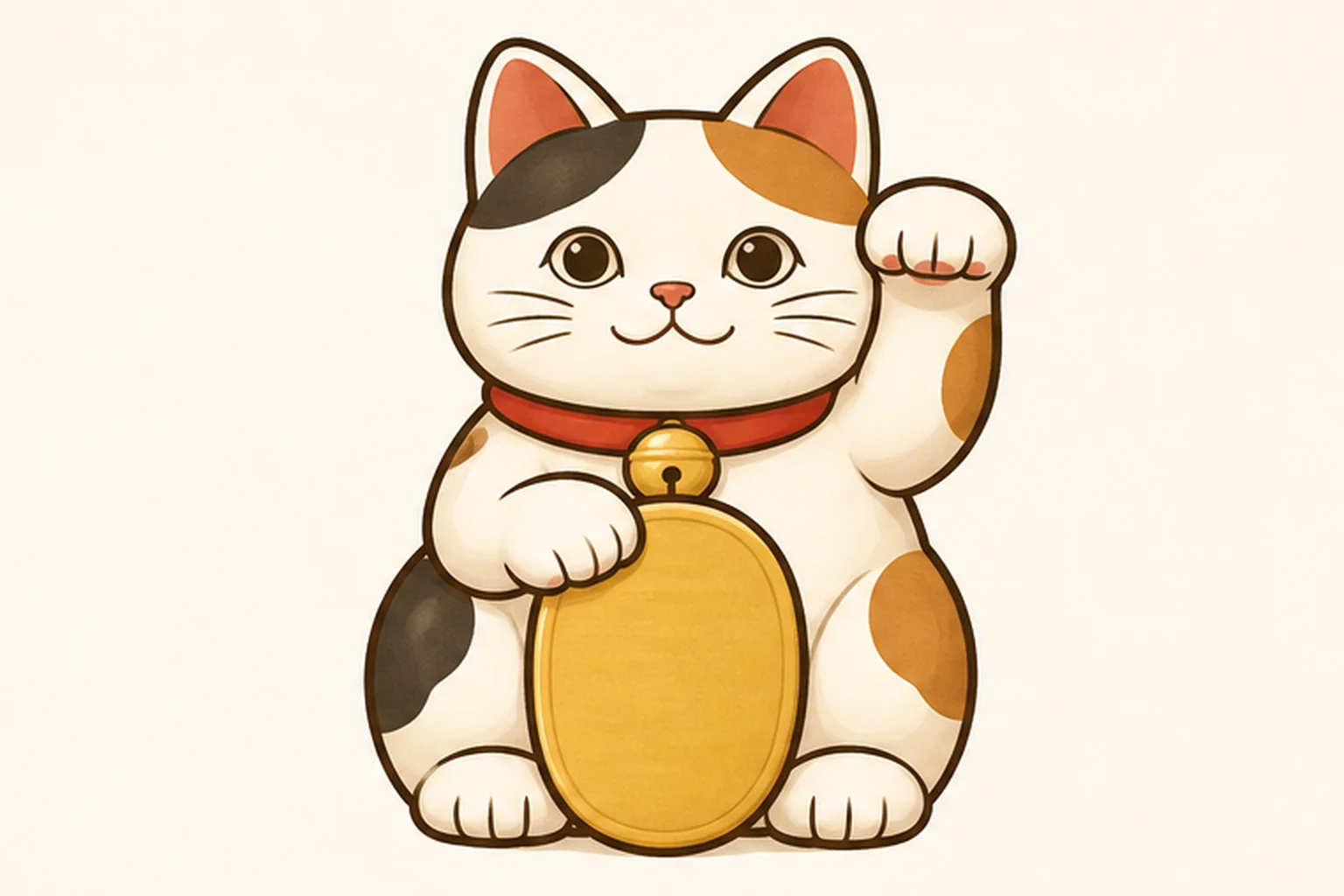
A raised left paw is said to invite customers, which suits a restaurant or bar that lives on foot traffic.
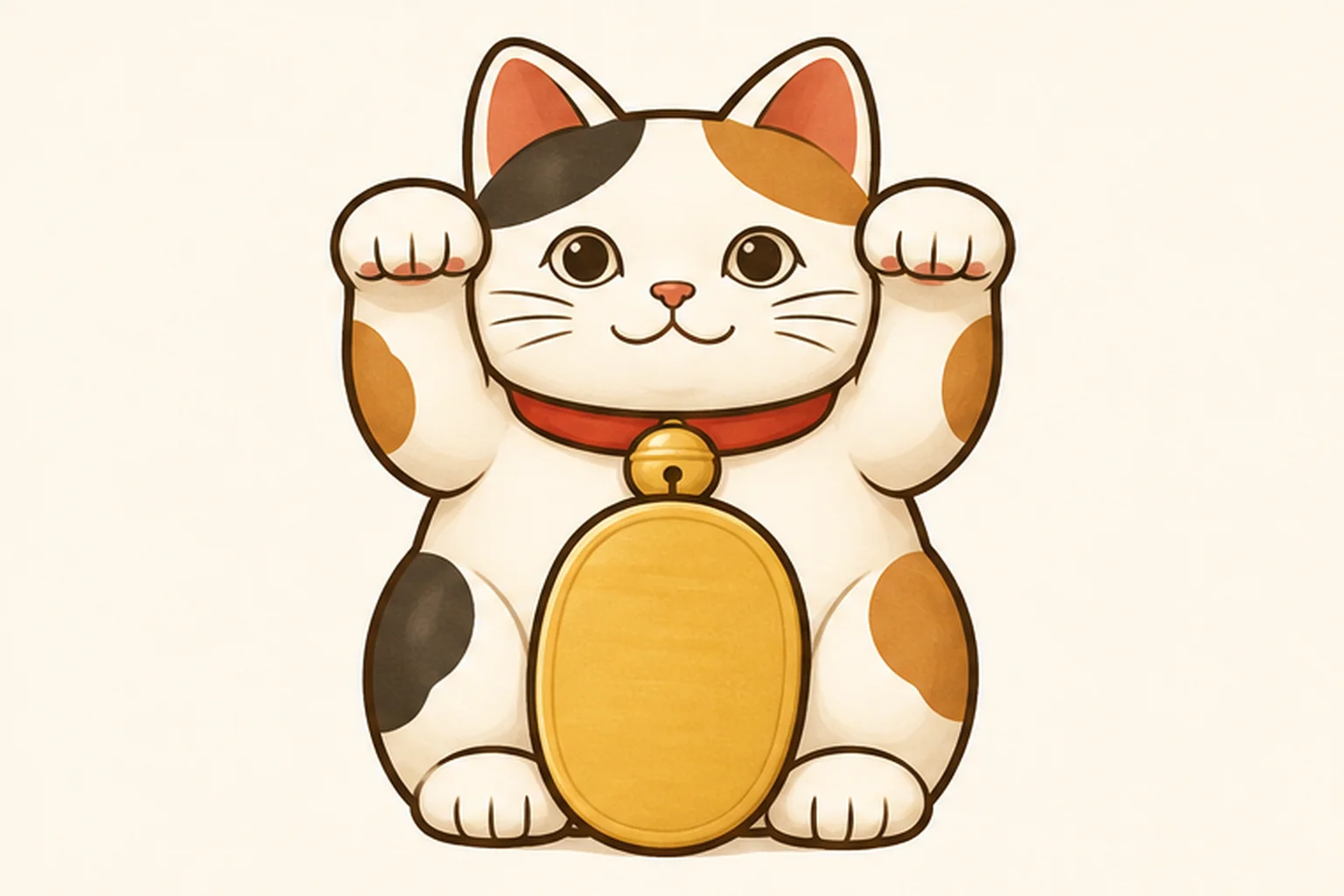
Cats raising both paws exist too, though some people joke that they look like they are surrendering.
The accessories come from the Edo merchant world. The red collar and small bell copy the way wealthy households dressed their pet cats. The large gold coin is a koban, the oval gold coin of the Edo period, usually marked sen man ryō, "ten million ryō," a sum no real koban ever came close to.
The most traditional coloring is calico, white with black and brown patches, a coat Japanese people have long considered lucky. Other colors have acquired their own meanings: white for general good fortune, black for warding off illness, gold for money, red for warding off evil, pink for love. Most of these color codes are recent and commercial, so there is no harm in simply choosing the one you like.
The cat most people picture today, with its round face, huge eyes and stubby two-heads-tall body, is largely a product of Tokoname in Aichi Prefecture, an old pottery town south of Nagoya that turned out cats in vast numbers after the Second World War. Older cats from nearby Seto are slimmer and more realistic. The gold plastic cat with a battery-powered arm that swings back and forth, found in Chinese restaurants and shops around the world, is a later relative of the Japanese original. In Japan, September 29 has been Maneki-neko Day since 1995, when a collectors’ group, the Japan Maneki-neko Club, chose it because the numbers 9-2-9 can be read as ku-ru-fuku, "fortune comes."
06Where to See Them
The most spectacular place to meet daruma is the Daruma Market at Shōrinzan Daruma-ji in Takasaki, held on January 6 and 7 each year. Stalls line the approach to the temple, piled with daruma from palm-sized to the size of a beer keg. Vendors will ask your wish and write it on the one you choose, and regular customers and stallholders are said to seal a sale by clapping together and calling out a blessing. At other times of the year, several workshops in Takasaki let visitors watch the painting or decorate a daruma of their own. As of 2026, small daruma reportedly cost a few hundred yen; the giant ones bought by politicians and big companies run to tens of thousands.
In Tokyo, the Jindai-ji Daruma Market takes place on March 3 and 4 and pairs well with a bowl of the soba noodles the temple area is famous for. Katsuō-ji in Minoh takes some effort to reach from central Ōsaka, but the sight of a whole temple covered in red dolls is worth it.
For the beckoning cat, start with Gōtoku-ji, about five minutes on foot from Miyanosaka Station on the Tōkyū Setagaya Line, or fifteen from Gōtokuji Station on the Odakyū Line. It is a quiet temple with a three-story pagoda whose wood carvings hide a few cats. The temple office sells white cats in several sizes. The idea is that you take one home, and when your wish is granted, you bring it back and leave it with the others. The result is the temple’s famous display: thousands of identical white cats crowded together, all raising their right paws. Imado Shrine fits easily into a day in Asakusa, and the old Yanaka neighborhood, a short ride away, has shops devoted to cat goods. In Tokoname, Maneki-neko Street is lined with 39 ceramic cats by local artists set along a wall, and a giant cat named Tokonyan, 3.8 meters tall, peers out of the wall over the road.
If you bring one home, a few customs are worth knowing. Paint the daruma’s first eye yourself, at the moment you make your wish, and be clear about what you are wishing for. Place a maneki-neko near the entrance or the cash register, facing outward toward the people who will come in. Daruma are meant to be renewed every year. Beckoning cats are not: many shops in Japan keep the same cat for decades, its paint chipped and an ear missing, still beckoning by the door.