
At a glance
How Edo kiriko cut glass grew from an Edo merchant shop and a Meiji factory, what its patterns mean, how a cup is cut, and where to see it.
- Edo kiriko is usually dated to 1834, when the Edo glass dealer Kagaya Kyūbei began engraving glass with an emery abrasive.
- Most pieces today are iro-kise glass: a thin colored layer fused over clear glass, cut through to reveal the clear glass beneath.
- Its style is crisp, with sharp edges between line and face, the opposite of Kagoshima’s Satsuma kiriko with its thick, gradated (bokashi) color.
- In 1881 the Shinagawa glass works hired the British cutter Emanuel Hauptmann to teach wheel cutting, laying the basis of the modern craft.
- A glass passes through waridashi, arazuri, sanban-gake, ishikake and polishing before its frosted cuts turn clear and bright.
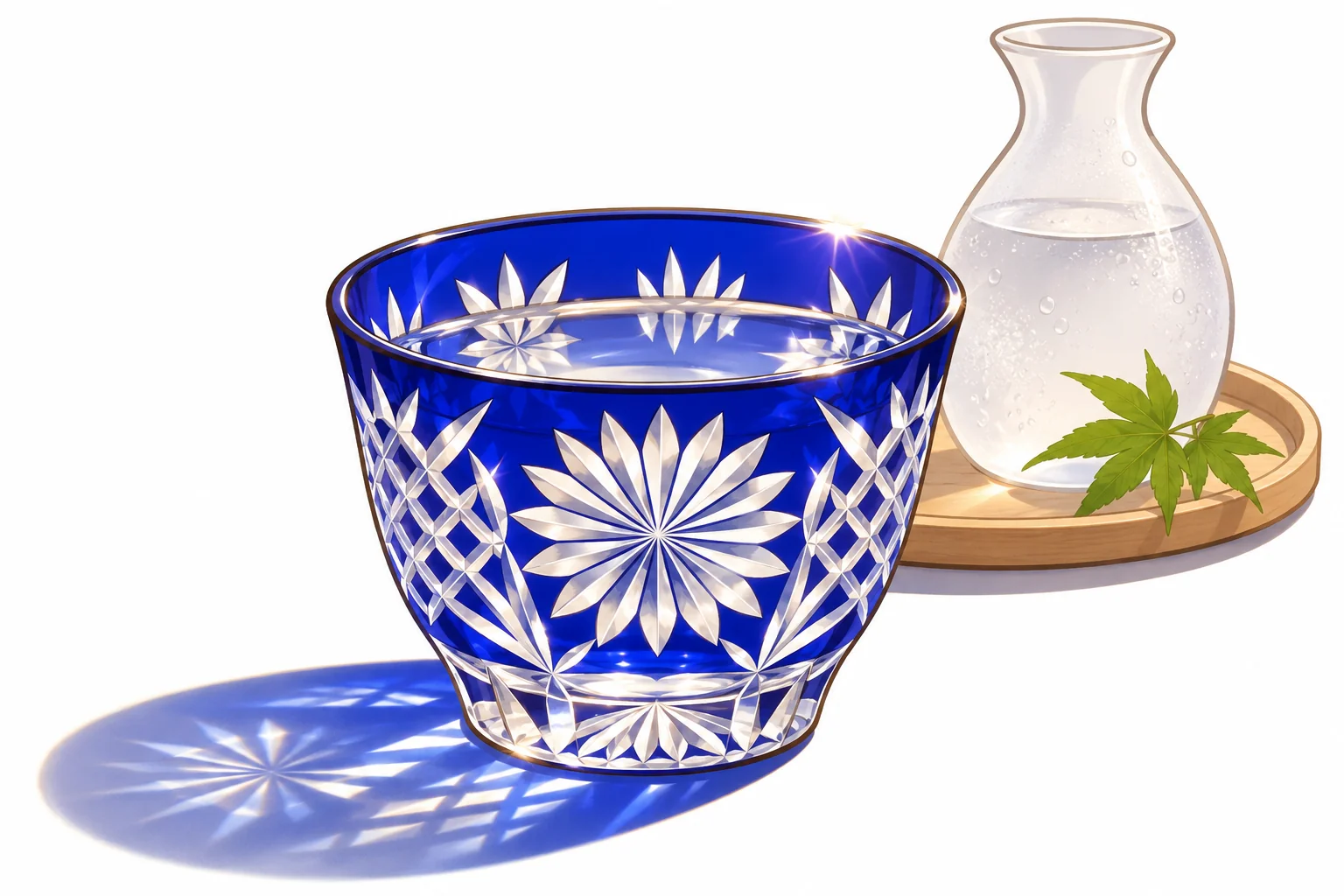
Pick up an Edo kiriko glass and the first thing you notice is the weight of the pattern rather than the glass. A skin of cobalt blue or ruby red covers clear crystal, and through it runs a lattice of fine, bright cuts: chrysanthemums, hemp leaves, a field of tiny diamonds that flash like fish roe. The craft began with a glass merchant in Edo in the 1830s, took on European cutting methods in the 1880s, and survives today in a few dozen small workshops, most of them in the old east side of Tokyo. This is an introduction to what Edo kiriko is, how a piece is made, why the Japanese prize it, and how a visitor can see it, buy it, and even cut a glass of their own.
01What Edo Kiriko Is
Kiriko means, roughly, "cut piece." The word once described a cube with its corners sliced off, and it came to be used for glass decorated by cutting and grinding, the craft the English-speaking world calls cut glass. Edo kiriko is the tradition that grew up in Edo, the city renamed Tokyo in 1868.
The look most people associate with it is the colored kind. A glassblower fuses a thin layer of colored glass, called iro-kise (color overlay), onto the outside of a clear vessel. The cutter then grinds through that layer to expose the clear glass beneath, so the design appears as bright, transparent lines against the color. Because each cut has angled facets, it acts like the face of a gemstone, bending light. When the glass is filled with cold sake or water, the pattern seems to move as you tilt it.
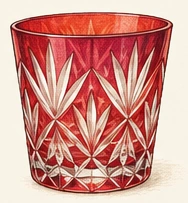
Cuts through the red outer layer expose clear glass, so the design reads as color against transparency.
The house style is crisp. The colored layer is thin and the cut edges are sharp, so color stops and clarity begins with no transition. Patterns are built from straight lines crossing and recrossing. That sets Edo kiriko apart from its southern cousin, Satsuma kiriko from Kagoshima, which uses a much thicker colored layer, so that where it is cut the color fades gradually into clear glass, an effect called bokashi (gradation). Satsuma kiriko feels soft and heavy; Edo kiriko feels clean and precise. Once you have seen the two side by side, they are hard to confuse.
02A Merchant’s Experiment and a Government Factory
Western glassmaking methods reached Japan through Nagasaki, generally said to be Dutch lead-glass techniques, and by the late Edo period glassware, known as biidoro or giyaman, had become a fashionable luxury in the cities. The origin of Edo kiriko is usually dated to 1834, when Kagaya Kyūbei, a glass dealer in the Ōdenmachō district of Edo, began engraving patterns into glass using an emery abrasive. An illustrated advertising handbill his shop issued around 1849–1854 survives; it reads like a catalog of the Japanese, Chinese, and Western glassware he sold, and by one account it already pictures sake vessels and dishes with cut patterns. These early pieces were clear glass with cut designs; the colored overlay came later.
Around the same time, the Satsuma domain in southern Kyūshū was building an industrial program under its lord, Shimazu Nariakira, and its glassworks produced colored cut glass of remarkable quality, especially a deep red. That industry did not last. Nariakira died in 1858, the domain’s industrial complex was damaged when the British navy bombarded Kagoshima in 1863, and Satsuma kiriko production faded out in the early Meiji years. It was revived only in 1985. So the colored cut glass that survived in Tokyo owes less to Satsuma than to a later wave of Western technology.
In 1873 a private company, Kōgyōsha, opened a glass factory at Shinagawa in Tokyo, and in 1876 the Ministry of Public Works bought it and ran it as the state-owned Shinagawa Glass Works. In 1881 the factory hired Emanuel Hauptmann, a cut-glass specialist from Britain, to teach European wheel-cutting techniques to Japanese apprentices. Only a small number of students, traditionally said to be a little over ten, trained under him, but they carried the method into the private workshops of Tokyo. From then on Edo kiriko was made the modern way, by pressing glass against spinning wheels, rather than by hand-engraving with abrasive.
In the Taishō period (1912–1926) glass materials and the polishing of crystal glass improved, and by the early Shōwa years cut glass had become a major line of Tokyo tableware and sake sets, and reportedly of lampshades as well. Colored overlay glass became common. One account holds that the workshops clustered in Sumida and Kōtō only after the war. Today most workshops are in Kōtō and Sumida wards, the low-lying shitamachi (old downtown) neighborhoods east of the Sumida River, where small family factories are packed together. Tokyo Metropolitan Government designated Edo kiriko a traditional craft in 1985, and in 2002 the national government added it to its list of officially recognized traditional crafts. The name "Edo kiriko" is now a registered regional trademark managed by the Edo Kiriko Cooperative Association: only glass handmade by its members, cut mainly with rotary tools in the designated area, may be sold under that name. Members’ pieces are said to carry a label that sets them apart from other glass.
03Reading the Patterns
Most Edo kiriko patterns have names, and most come from the stock of motifs that decorated kimono, lacquerware, and architecture in the Edo period. Learning a few of them turns a pretty glass into something you can read.
The signature pattern is nanako, "fish roe." It is a grid of extremely fine crossing cuts that leaves hundreds of tiny raised diamonds, each catching the light, so the surface glitters like a mass of fish eggs or frost. Nanako is unforgiving: if the spacing wavers even slightly, the eye catches it at once, and so it is often treated as a test of a cutter’s skill.

Nanako, "fish roe": a grid of extremely fine crossing cuts leaves hundreds of tiny raised diamonds, each catching the light.

Kiku-tsunagi, "linked chrysanthemums": fans of radiating lines make chrysanthemum heads that join one to the next.

Asa-no-ha, "hemp leaf": a geometric star of diamond shapes radiating in a hexagon.
Kiku-tsunagi, "linked chrysanthemums," uses fans of radiating lines to make chrysanthemum heads that join into a continuous band. Asa-no-ha, "hemp leaf," is a geometric star of diamond shapes radiating in a hexagon; hemp grows fast and straight, and the pattern was traditionally used on babies’ clothing as a wish for healthy growth. Hakkaku-kagome, the eight-sided basket weave, imitates the mesh of a bamboo basket. Yarai copies the crossed bamboo of a fence. Shippō, overlapping circles, stands for harmony and good fortune. Sasa-no-ha uses short slanting cuts arranged like bamboo grass.
A typical glass combines several of them: a band of chrysanthemums around the body, a belt of nanako below it, and a large chrysanthemum cut into the base, which you see magnified through the drink when you look down into the glass. More pattern means more cuts and more hours, and the price climbs accordingly. Younger cutters increasingly design their own motifs or leave large areas of uncut color, giving the craft a more contemporary look while keeping the same wheels and the same eye.
04How a Glass Is Cut
An Edo kiriko workshop does not blow its own glass. Blanks with the color layer already fused on come from glassblowers, and the workshop’s job begins with a smooth, colored cup. Because the blanks are made by hand, the color layer varies slightly in thickness, and cutters sort them on arrival to match each to a suitable pattern. By trade accounts, the blanks come largely from long-established glassworks such as Kagami Crystal in Ryūgasaki, Ibaraki, and Tajima Glass in eastern Tokyo.
The first step is waridashi, marking out. The cutter draws guide lines on the glass with a pen, dividing it into equal sections vertically and horizontally. Only this skeleton is drawn. The pattern itself is not sketched; it lives in the cutter’s hands and memory.
- 1
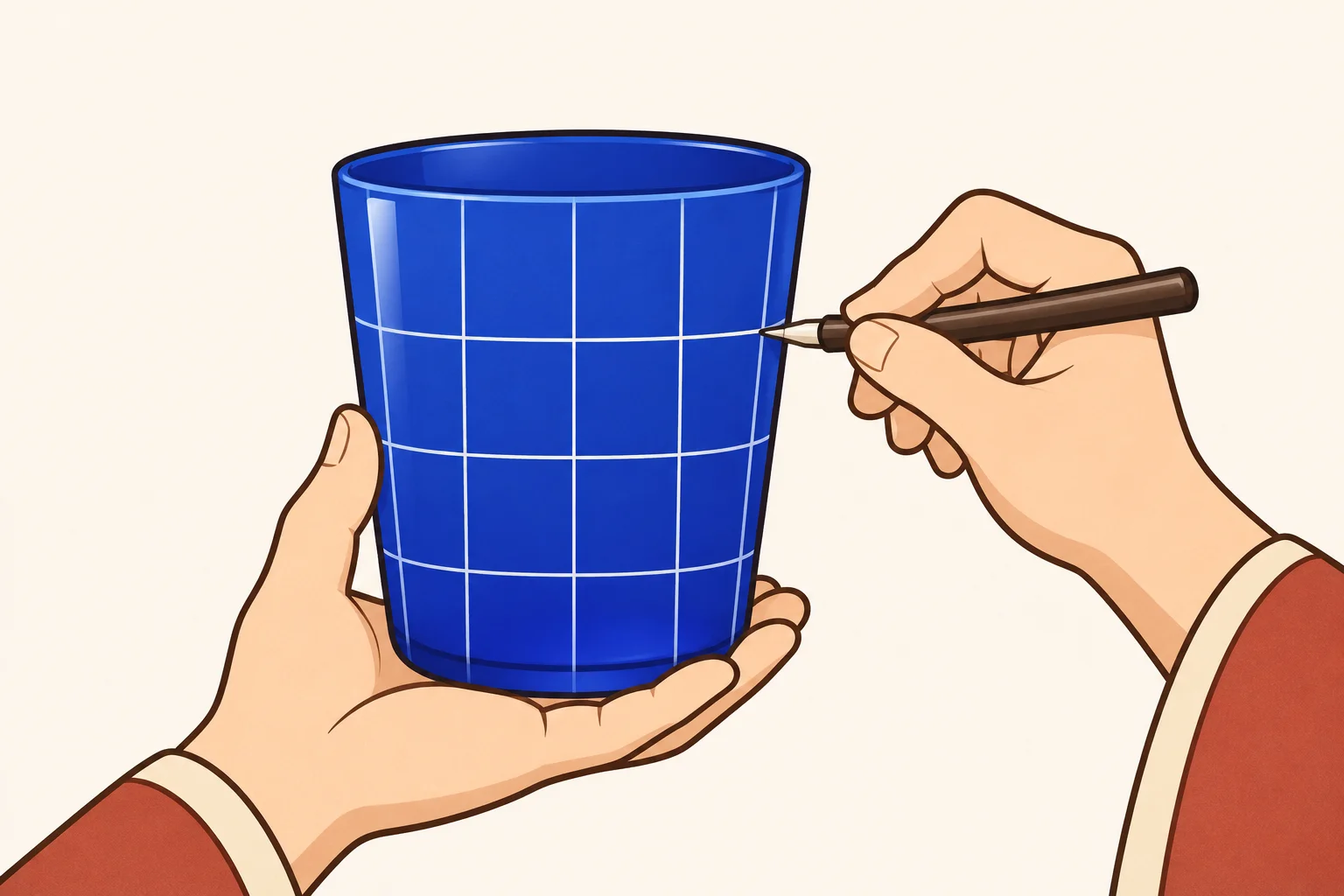 Waridashi, marking out: guide lines drawn with a pen divide the glass into equal sections.
- 2
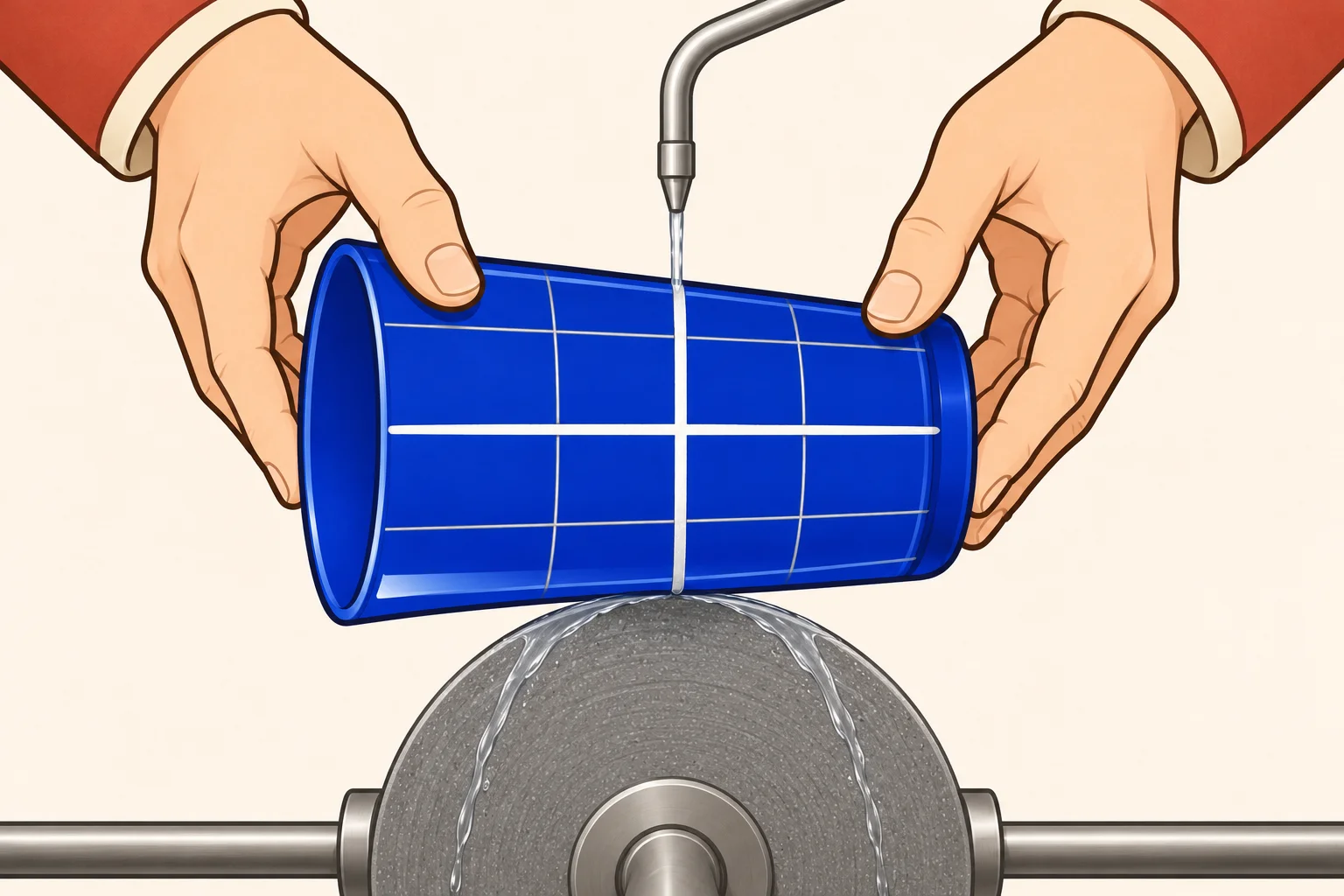 Arazuri, rough cutting: the glass is held in both hands and pressed down onto the wheel, which is underneath it.
- 3
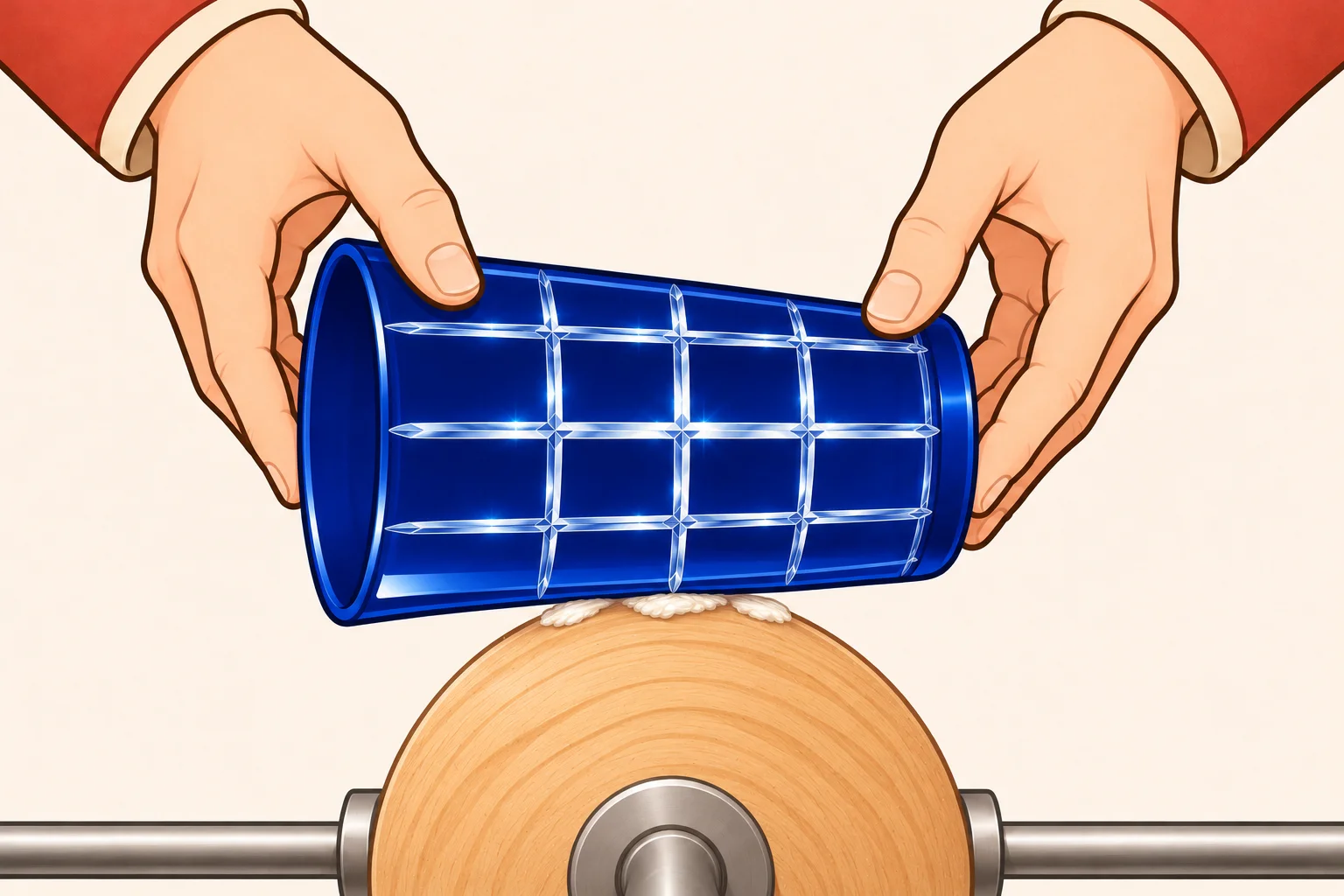 Polishing: a paulownia wheel charged with paste works the frosted cuts until they turn clear and brilliant.
Next comes arazuri, rough cutting. The cutter sits at a wheel turning in a trough of water, holds the glass in both hands, and presses it down onto the edge of the wheel to cut the main lines. Modern wheels are diamond wheels, spun fast and kept wet, quick and accurate. The difficulty is that the cutter cannot see the wheel directly: it is underneath the glass, and the line being cut is watched through the glass, from the inside. This is one reason colored overlay suits the craft so well. As soon as the color is breached, the clear line shows up plainly.
A finer diamond wheel then cuts the details of the pattern, a stage called sanban-gake, and a whetstone wheel smooths the cut surfaces, a stage called ishikake. At this point the cuts are frosted white, like sandblasted glass.
The last stage is polishing. In the traditional method, te-migaki (hand polishing), the cutter works each cut with wheels of paulownia wood, cork, or rubber charged with a cerium oxide paste until it turns clear and brilliant, then gives it a final pass on a cloth buffing wheel. The alternative is san-migaki (acid polishing), in which the glass is dipped in a bath containing hydrofluoric acid that brightens every surface at once. Acid polishing is quick and suits volume production but tends to soften the edges; hand polishing keeps the facets sharp and gives a deeper sparkle, so fine pieces are often sold specifically as hand-polished. The more complex the pattern, the more hours go into it between first line and final polish; cutters say an elaborate glass can take several days.
- 1WaridashiPen guide lines, marking out
- 2ArazuriDiamond wheel cuts the main lines
- 3Sanban-gakeFiner diamond wheel cuts details
- 4IshikakeWhetstone wheel smooths; cuts frosted white
- 5PolishingHand or acid polishing; cuts turn clear
After ishikake the cuts are still frosted white; only the final polish makes them clear and brilliant.
05Why the Japanese Love It
Part of the appeal is simply light. The facets split and gather it, and the effect is best with something in the glass. In Japan cut glass belongs to summer; kiriko is even a summer season word in haiku: cold sake in a small kiriko cup, iced water, ice cubes seen through a lattice of clear lines. Japanese table culture likes to match vessels to the season, and kiriko is a summer vessel in the way a heavy, rough ceramic cup is a winter one. In midsummer you will see it in restaurants serving chilled sake.
The other part is the hand. Edo kiriko is not factory glass. It comes out of workshops with one, two, or a handful of cutters, and every piece differs very slightly. For Tokyoites it carries the flavor of old Edo itself, the downtown pride in doing something small extremely well without making a show of it, which the Japanese call iki, a kind of understated urban chic.
That makes it a standard formal gift. A pair of Edo kiriko sake glasses is a correct present for a wedding, a retirement, or a parent’s milestone birthday. Japanese companies are said to give it to important clients, and kiriko glasses turn up now and then in manga and anime. The national and Tokyo governments have reportedly presented it to foreign guests many times, and Japanese prime ministers have given it to foreign leaders: at the Japan-ASEAN commemorative summit in Tokyo in 2023, the gifts to ASEAN leaders included Edo kiriko by Kumakura Takayuki, third-generation master of Hanashō.
06Seeing, Buying, and Cutting Your Own
The easiest place to see Edo kiriko is the Kinshichō area of Sumida Ward. The Sumida Edo Kiriko-kan, about six minutes’ walk from Kinshichō Station, is a shop and working studio where you can watch cutters through the window and browse everything from sake cups to large bowls. In neighboring Kōtō Ward, Hanashō in Kameido is a well-known maker with a showroom full of traditional patterns and a second shop in Nihonbashi. Tokyo department stores also commonly carry kiriko, and it is said to be sold in the shopping complex at the foot of Tokyo Skytree and in Ginza as well.
Prices reflect the hours. As of 2026, a small sake cup, a guinomi, typically costs between 10,000 and 30,000 yen; a hand-polished rocks glass with a dense pattern often runs to 40,000 yen and more, and the work of well-known cutters costs considerably more. Machine-cut or overseas-made "kiriko-style" glass is far cheaper; only handmade work by members of the cooperative may be sold as Edo kiriko.
Many workshops offer a cutting experience, and it is one of the best craft activities in Tokyo. You choose a colored glass, a cutter explains the wheel, you mark a few guide lines with a pen, and then you press the glass to the spinning wheel yourself. At the Sumida Edo Kiriko-kan, for example, an adult session lasts 90 minutes, and you take the glass home the same day. The moment you try to cut a straight line while watching through the glass, you understand why a band of perfect nanako commands the price it does.
At home, keep kiriko out of the dishwasher, microwave, and oven, and away from sudden changes of temperature. Wash it by hand with a soft brush and dry it with a soft cloth. Then pour something cold, hold it up to a lamp, and turn it slowly.