
At a glance
How Japan’s neighborhood shopping streets grew from temple gates and railway stations, boomed after the war, emptied into shutter streets, and still thrive in big cities.
- A shōtengai is a street of independent shops with no single owner, held together by a merchants’ association.
- The word spread in the 1920s and 1930s, and a 1932 law on commercial cooperatives let small merchants organize legally.
- The 1962 Shopping District Promotion Association Act let shopping streets register as legal bodies and get subsidies for roofs and lighting.
- As suburban malls rose, many provincial shopping streets emptied into what Japanese calls 'shutter streets’.
- Ōsaka’s Tenjinbashi-suji runs about 2.6 km with roughly 600 businesses and is often called Japan’s longest shopping street.
Step out of almost any suburban train station in Tokyo or Ōsaka and within a minute or two you will find yourself under a long glass or plastic roof, walking between rows of small shops. A butcher is frying croquettes at the counter, a greengrocer has stacked daikon radishes out onto the pavement, and a speaker somewhere overhead is playing a cheerful tune that has been looping since the 1980s. This is a shōtengai, a neighborhood shopping street. It is not a tourist attraction in the usual sense, yet few places show you as plainly how ordinary Japanese people live. What follows explains what a shōtengai is, where it came from, why so many emptied out, why others are still thriving, and how to spend an hour in one.
01A Street Without a Landlord
A shōtengai is a stretch of street lined with independent, mostly family-run shops and eateries. The word combines shōten (shops) and gai (street or district). What separates it from a shopping mall is that nobody owns the whole thing. Each shop is its own business, and in the classic arrangement the family owns the building, trades on the ground floor and lives upstairs. Some shops have passed through three or four generations behind the same shutter.
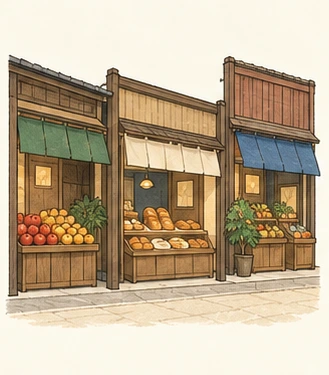
A greengrocer and a bakery side by side on one street, each running its own business.
What holds the street together is the merchants’ association, either an informal shōtenkai or a legally registered promotion cooperative. The association pays for the streetlights, the banners on the lampposts, the roof, the background music and the seasonal decorations. It organizes the summer festival and the year-end lottery, negotiates with the ward office, and often invents a mascot character whose face ends up on every flag.
The mix of shops is remarkably consistent from one street to the next. At the core are the butcher, the fishmonger, the greengrocer and the tofu maker. Around them you find a rice dealer, a liquor store, a pharmacy, a shop selling wagashi (traditional sweets), a bakery, a tea merchant, a stationer, a bookshop, a watch-and-spectacles shop, a clothes shop aimed at older women and a futon store. Wedged between them are a kissaten (an old-style coffee house), a ramen counter, a soba shop, a couple of izakaya pubs, a barber, a dry cleaner, a small clinic and perhaps a roadside shrine no bigger than a cupboard. A household could meet nearly all its daily needs without leaving the street, and for decades many did.
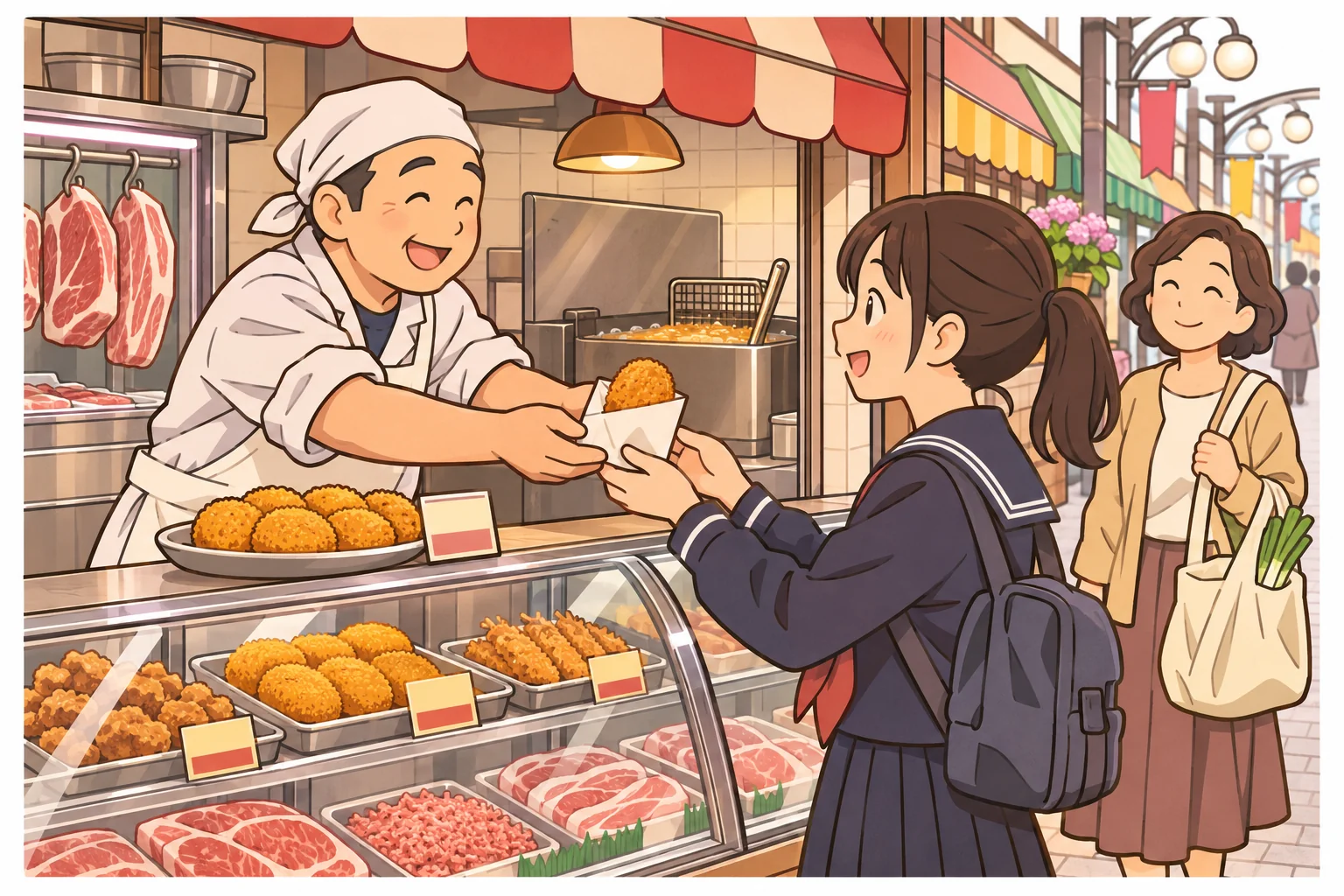
At a shōtengai butcher's counter, a fresh croquette wrapped in thin paper is handed to a schoolkid (illustration).
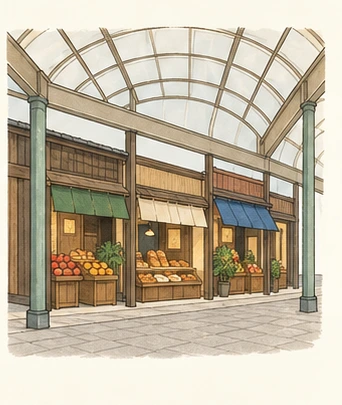
Many shōtengai are covered by an arcade roof, which in Japanese is simply called an ākēdo. The roof keeps off rain, snow and summer sun, which matters a great deal to shops that live on customers who drop in every day. Cars are usually barred during shopping hours, so the street becomes a long, sheltered pedestrian corridor where bicycles, shopping carts and toddlers all share the space.
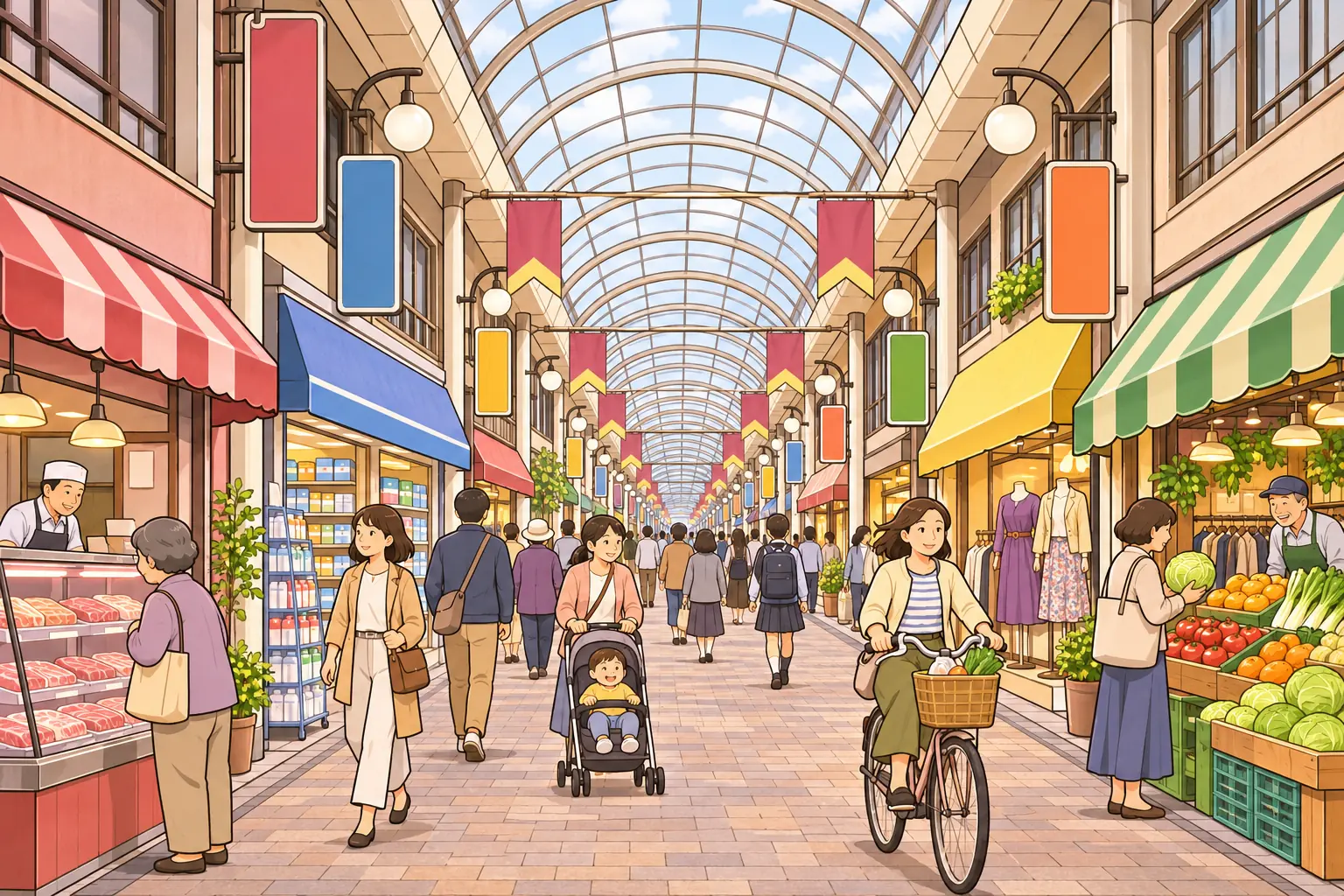
A long covered shōtengai: small shops under a translucent arcade roof, walkers and cyclists passing (illustration).
02Temple Gates, Railway Stations and a Hundred Ginzas
Clusters of shops along a single street are old in Japan. Merchants gathered at the gates of temples and shrines to sell incense, food and souvenirs to pilgrims, creating what were called monzen-machi, "towns before the gate." Castle towns of the Edo period (1603–1868) grouped traders by street, and post towns along highways such as the Tōkaidō lined the road with inns and teahouses. Nakamise-dōri, the approach to Sensō-ji temple in Asakusa, is a direct descendant of that pilgrim trade. Nishiki Market in Kyoto, a narrow covered lane of food stalls, was a fish market in the Edo period and is still nicknamed "Kyoto’s kitchen."
The shōtengai as a modern institution, though, is a product of the twentieth century. As Tokyo and Ōsaka swelled with migrants from the countryside, new residential districts spread outward along private railway lines. Every new station attracted a strip of shops, which then crept along the road leading to the housing beyond. By the 1920s and 1930s these streets were everywhere, and their shopkeepers began to band together, partly to compete with the department stores that were transforming urban shopping. The word shōtengai came into common use in this period, and a 1932 law on commercial cooperatives gave small merchants a legal framework for organizing.
That era also left behind one of the most common names in Japanese geography. Ginza in Tokyo was the most fashionable shopping district in the country, and towns everywhere borrowed its glamour. Togoshi Ginza, in Tokyo’s Shinagawa ward, is usually said to be the first. According to the local story, after the Great Kantō Earthquake of 1923 the street took in bricks cleared from the rubble of Ginza to solve its drainage problems, and adopted the name along with them. Hundreds of "Ginzas" followed, and today you can find one in almost every prefecture.
03Black Markets and the Golden Age
In 1945 most Japanese cities had been burned flat by air raids. The first commerce to revive was the black market, open-air stalls that sprang up around railway stations selling military surplus, smuggled goods and food brought in from farms. Ameyoko, the market street running under the tracks between Ueno and Okachimachi stations in Tokyo, grew out of one of these. Its name is explained either by the candy (ame) sellers who crowded there or by the American goods that changed hands, and both stories are told. Many postwar shōtengai trace their beginnings to stalls like these.
The 1950s through the early 1970s were the shōtengai’s best years. The economy was growing at extraordinary speed, cities were packed, and before refrigerators became standard, shopping for dinner was a daily routine. At year’s end the busiest streets were so crowded you could barely move. In 1962 the government passed the Shopping District Promotion Association Act, which let shopping streets register as legal bodies and apply for subsidies to build roofs, lighting and parking. Many of the arcade roofs still standing date from this period.
This was also when the shōtengai settled into its yearly rhythm. In December came the fukubiki lottery: customers earned tickets with their purchases and spun a wooden octagonal drum until a single colored ball dropped out. Gold or red won a prize; white usually meant a pack of tissues. July brought bamboo decorations for the Tanabata star festival, and in some cities the shopping streets’ displays grew into the main event, as in Sendai and Hiratsuka, both famous for enormous paper streamers hung along their arcades. Summer meant bon dancing, and autumn the local shrine festival, with a portable shrine carried down the middle of the street. Children grew up knowing every shopkeeper by name, and the shopkeepers knew which children had passed which exams.
04Supermarkets, a Protective Law and "Shutter Streets"
The challenge arrived early. In 1957 Nakauchi Isao opened the first Daiei store, a discount drugstore by Senbayashi station in Ōsaka, buying medicines, cosmetics and household goods in bulk and selling them cheaply; food soon followed. Supermarkets multiplied through the 1960s and grew into large general merchandise chains. Small merchants pushed back politically, and in 1973 the Large-Scale Retail Store Law required big stores to negotiate with local businesses before opening. In practice it made it very hard for a large retailer to move in next to an existing shopping street.
That protection fell away in the 1990s. American trade negotiators treated the law as a barrier to foreign retailers, Japan loosened it in stages, and in 2000 it was replaced by a new law concerned mainly with traffic and environmental impact. By then the country had taken to the car. Large malls on bypass roads offered parking, cinemas, food courts and everything under one roof, and convenience stores were open around the clock on every corner. In provincial cities the old town centers went quiet. Shopkeepers aged, their children took salaried jobs in Tokyo or Ōsaka, and one shutter after another came down and stayed down.
Japanese has a name for the result: shattā-dōri, "shutter street." You walk in under the arcade, the music is still playing from the speakers, and on both sides there is nothing but gray roller shutters, broken here and there by an old pharmacy or a clothes shop with its lights still on. National surveys by the Small and Medium Enterprise Agency have long found, as recently as the 2021 survey, that over a tenth of shopfronts on Japan’s shopping streets stand empty, with the worst rates in regional towns. Since the late 1990s the government has passed laws and handed out subsidies to revive city centers, with mixed results.
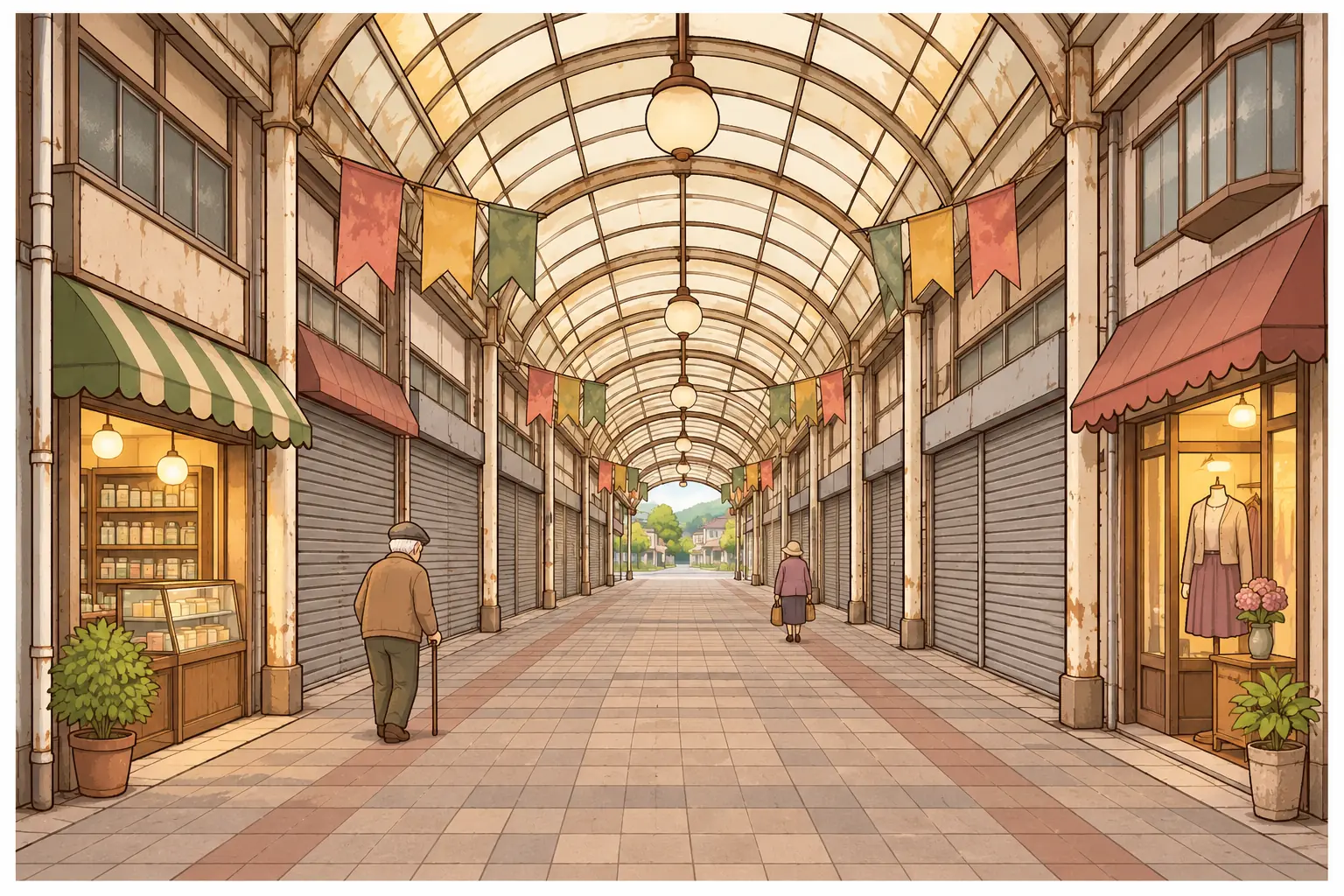
A provincial "shutter street": mostly closed shutters under the arcade, only a shop or two still lit (illustration).
05The Streets That Are Still Busy
In the big cities the story is very different. Shōtengai close to dense residential neighborhoods and busy stations still do steady trade, because the people around them do not drive and shop on foot or by bicycle every day.
Tenjinbashi-suji in Ōsaka runs north from near the Tenmangū shrine for about 2.6 kilometers, and is often described as the longest shopping street in Japan. Walking its full length, from the first block to the seventh, takes about forty minutes even without stopping, past roughly six hundred businesses. Togoshi Ginza, at about 1.3 kilometers, is one of the longest in Tokyo and known for its fried snacks. Sunamachi Ginza in Kōtō ward is famous for its delicatessens, where locals come in the late afternoon to pick up side dishes for dinner. Yanaka Ginza in Taitō ward is short, but the flight of steps at its entrance, nicknamed "Yūyake Dandan" (sunset steps), and the temples and wooden houses around it have made it a favorite introduction to shitamachi, the old working-class quarters of Tokyo.
Nishiki Market in Kyoto is only about 400 meters long and a few meters wide, packed with more than a hundred stalls selling pickles, fish cakes, Kyoto vegetables, tofu skin and kitchen knives. As tourist numbers rose, the merchants put up signs asking visitors not to eat while walking. Kuromon Market in Ōsaka’s Nipponbashi district is known for fresh fish and blowfish. Ōsu in Nagoya mixes electronics, used clothing and street food, and Motomachi in Kōbe has the cosmopolitan air of a port city. In western Tokyo, the shopping streets around Kōenji, Nakano and Kichijōji are full of record shops, vintage clothing and small theaters, which gives younger people something that malls cannot.
Some streets are reinventing themselves. Marugamemachi in Takamatsu, on the island of Shikoku, was rebuilt block by block by separating land ownership from the right to use it, and is often cited as a model for reviving a regional shopping street. Elsewhere, empty units are rented cheaply to young people opening cafés, bookshops and workshops, or the street is closed off once a month for a market. Shōtengai also turn up constantly in anime and film. Tamako Market is set entirely in a fictional covered street, Usagiyama Shōtengai, where the heroine’s family runs a shop making rice cakes. For many Japanese the shopping street carries a strong nostalgia for the Shōwa era (1926–1989): a world in which the neighbors all knew one another.
06How to Visit One
You need no plan. The best approach is to pick the shōtengai nearest your hotel, or to wander into one on your way somewhere else. In big cities they usually begin at a station exit, and there is often a map at the entrance showing every shop.
Timing matters. In the morning the shutters go up and the fish and vegetables are at their freshest. Late afternoon, from around four, is the liveliest hour, when people come to buy ingredients for dinner and the delicatessens start putting discount stickers on their bento and fried food before closing.
Buy the way locals do: in small amounts. Croquettes are sold one at a time, side dishes can be bought by the hundred grams, and the fishmonger will clean and fillet your fish. Many small shops take only cash, though more now accept transit cards and phone payments. If you buy something hot, eat it in front of the shop or on the bench the owner has set out; some streets, especially crowded markets, ask visitors not to eat on the move, part of a broader Japanese etiquette worth reading about separately.
A shōtengai is also a good place to notice other everyday fixtures of Japanese life: the kōban police box on the corner, an old public bathhouse squeezed between the shops, a row of vending machines, a coffee house with a curtain over its door. If you are looking for gifts to take home, the sweet shops, tea merchants and old rice-cracker makers on a shopping street are often more interesting and better value than the souvenir counters at the station. A simple arigatō on the way out will usually get a smile and a bow in return.