
At a glance
How sugoroku went from aristocratic gambling board to printed New Year race game, how the kendama got its three cups, and why kites still anchor town festivals.
- "Sugoroku" first meant ban-sugoroku, a board game that reached Japan via China before the Nara period.
- Empress Jitō banned sugoroku in 689, and the court issued repeated bans after that.
- Woodblock-printed e-sugoroku spread in the Edo period: roll one die and race from furidashi to agari.
- The kendama’s three cups come from a Taishō-era redesign; Hatsukaichi began making it in 1921.
- The Japan Kendama Association was founded in 1975, giving the toy ranks and grades.
Most traditional Japanese toys need nothing more than a die, a length of string or a few pieces of turned wood. Many of them belong to the New Year, when children once flew kites and spun tops in the street while families sat around a printed board game called sugoroku. Sugoroku itself has a long double life in Japan: for centuries it was a backgammon-like gambling game played by aristocrats, and only later became the paper race game every child knew. Alongside it sit two toys of pure hand skill, the kendama and the daruma otoshi, and the kite, which in several Japanese towns is still the center of a noisy annual festival. All of them can still be bought, played and watched in Japan today.
01Games for the First Days of the Year
Ask an older Japanese person about shōgatsu asobi, New Year games, and a familiar picture comes back. Boys flew kites and spun wooden tops. Girls in new kimono played hanetsuki, a kind of badminton without a net, hitting a feathered shuttlecock back and forth with decorated wooden paddles called hagoita; whoever let it drop got a stroke of ink on the face. Indoors there was fukuwarai, in which a blindfolded player arranges paper eyebrows, eyes, nose and mouth on a blank face, to general laughter at the result. There were card games too: the poetry-matching Hyakunin isshu karuta and hanafuda, the flower cards (see also: Hanafuda: Japan’s Flower Cards and the Year in Forty-Eight Pictures). And there was sugoroku, spread out on the floor while everyone took turns with the die.
The games gathered around New Year for practical reasons. It was one of the few times when shops closed, adults stopped working and children had pocket money and new clothes. Many of the games also carried small wishes. A kite that flew high meant a child who would grow up healthy. A top that spun steadily stood for a household that kept turning over. The black seed at the base of a hanetsuki shuttlecock comes from the soapberry tree, mukuroji, which can be written with characters meaning "a child free of illness." Few people took these meanings literally, but they were part of the fun.
Children in Japanese cities today are more likely to spend the holiday on a game console, and power lines have made kite flying difficult in most neighborhoods. The old toys have not vanished, though. Department stores still sell ornamental hagoita at the end of the year, and the hagoita fair at Sensō-ji temple in Asakusa each December draws large crowds. Kindergartens and primary schools teach kite making and kendama around the New Year, and plenty of families still bring out a sugoroku sheet. These toys have moved from everyday play to seasonal play, and the ones that survived are the ones that feel most like New Year.
02Ban-Sugoroku: Japan’s Backgammon
In modern Japanese, sugoroku means a printed race game. The word originally meant something else: a two-player board game with pieces and two dice that is now called ban-sugoroku, "board sugoroku," to tell the two apart. Anyone who knows backgammon will recognize it at once. The board is a long wooden tray with twelve lines marked on each side, each player has fifteen black or white stones, and players take turns rolling two dice and moving their stones by the numbers shown, racing to bring all their pieces home. Backgammon and ban-sugoroku descend from the same family of ancient West Asian games, which reached Japan through China, where the game was called shuanglu.
The game arrived early. The Shōsōin, the eighth-century imperial treasure house at Tōdai-ji temple in Nara, preserves a sugoroku board of red sandalwood decorated in fine wood marquetry (mokuga) with birds, flowers and other motifs, reportedly inlaid with materials such as ivory and boxwood, an object once kept close to Emperor Shōmu. It was also a gambling game from the start. The Nihon shoki, Japan’s early official chronicle, records that Empress Jitō banned sugoroku in 689, and the court issued further bans repeatedly in the following centuries, which suggests the earlier ones did not work. Heian nobles wagered robes, horses and even estates on a game. A famous passage in The Tale of the Heike has the retired emperor Shirakawa, the most powerful man in the realm, complain that three things would not obey him: the waters of the Kamo River, the dice of sugoroku and the warrior monks of Mount Hiei.
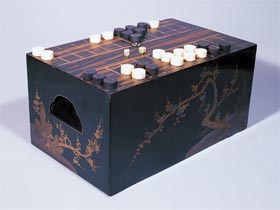
An Edo-period ban-sugoroku board: a lacquered box decorated in gold, with black and white pieces on top. Tamagawa University Museum of Education.
It was a game of judgment as well as luck. In Essays in Idleness (Tsurezuregusa), written around 1330, the monk Yoshida Kenkō records the advice of a sugoroku master: do not play to win, play so as not to lose, and on each move choose the option that will lose most slowly. The line has been quoted ever since as advice about life rather than dice.
Although the boards look almost identical, the Japanese and Western games drifted apart over the centuries. Ban-sugoroku kept its own starting position and its own rules for how a game ends, and never acquired backgammon’s later doubling cube. In the Edo period (1603–1868), a daimyo’s daughter often took to her marriage a set of three gold-lacquered boards, for go, shogi and sugoroku, set beside the painted shells for the shell-matching game; by one account, wealthy townspeople also kept sugoroku boards as display pieces. But the board game had been declining since the sixteenth century, and as the cheap printed race game spread from the mid-Edo period on, it faded, and its rules were nearly forgotten. Today the boards are museum pieces, and a small number of enthusiasts and researchers have reconstructed the rules from old texts. For most Japanese people, sugoroku now means the paper game.
03E-Sugoroku: A Journey on a Sheet of Paper
The printed game is e-sugoroku, "picture sugoroku." It is a large printed sheet divided into squares. The start is called furidashi and the finish agari. Each player puts a small marker on the start, and players take turns throwing a single die and moving forward by the number shown. The first to reach the finish wins. The rules are simple enough for a child who cannot yet read, which is exactly why the game spread so widely.
Its ancestor is the Buddhist jōdo sugoroku, "Pure Land sugoroku," which appeared around the late Muromachi period. The board showed the realms of rebirth: hell, hungry ghosts, animals, humans and heavenly beings, rising to the Pure Land of Amida at the top. A bad throw could send a player down into hell. It was a teaching picture as well as a game, a tour of the Buddhist cycle of rebirth in a single sitting.
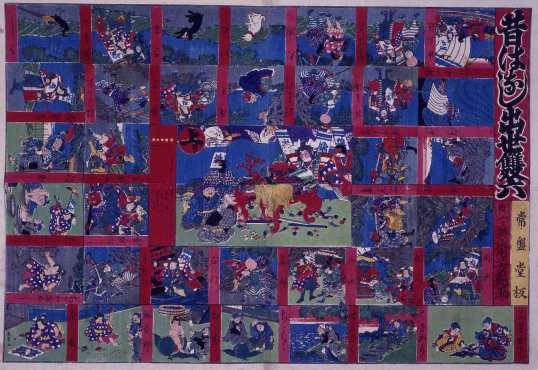
With the growth of woodblock printing in the Edo period, publishers produced new sugoroku sheets for every New Year. The most popular kind was the dōchū sugoroku, the travel game, and the favorite route was the Tōkaidō highway with its fifty-three post stations. Players set off from Nihonbashi bridge in Edo, passed through Shinagawa, Hakone, Fuchū and Kuwana, and finished at Sanjō bridge in Kyoto. Ukiyo-e artists including Utagawa Hiroshige designed these sheets, packing the squares with roadside scenery, so that people who had never traveled could walk the whole Tōkaidō on their tatami. Shusse sugoroku, "success sugoroku," took a player from shop apprentice or lowly samurai up to wealthy merchant or daimyo, and yakusha sugoroku filled the squares with kabuki stars in their best-known roles.
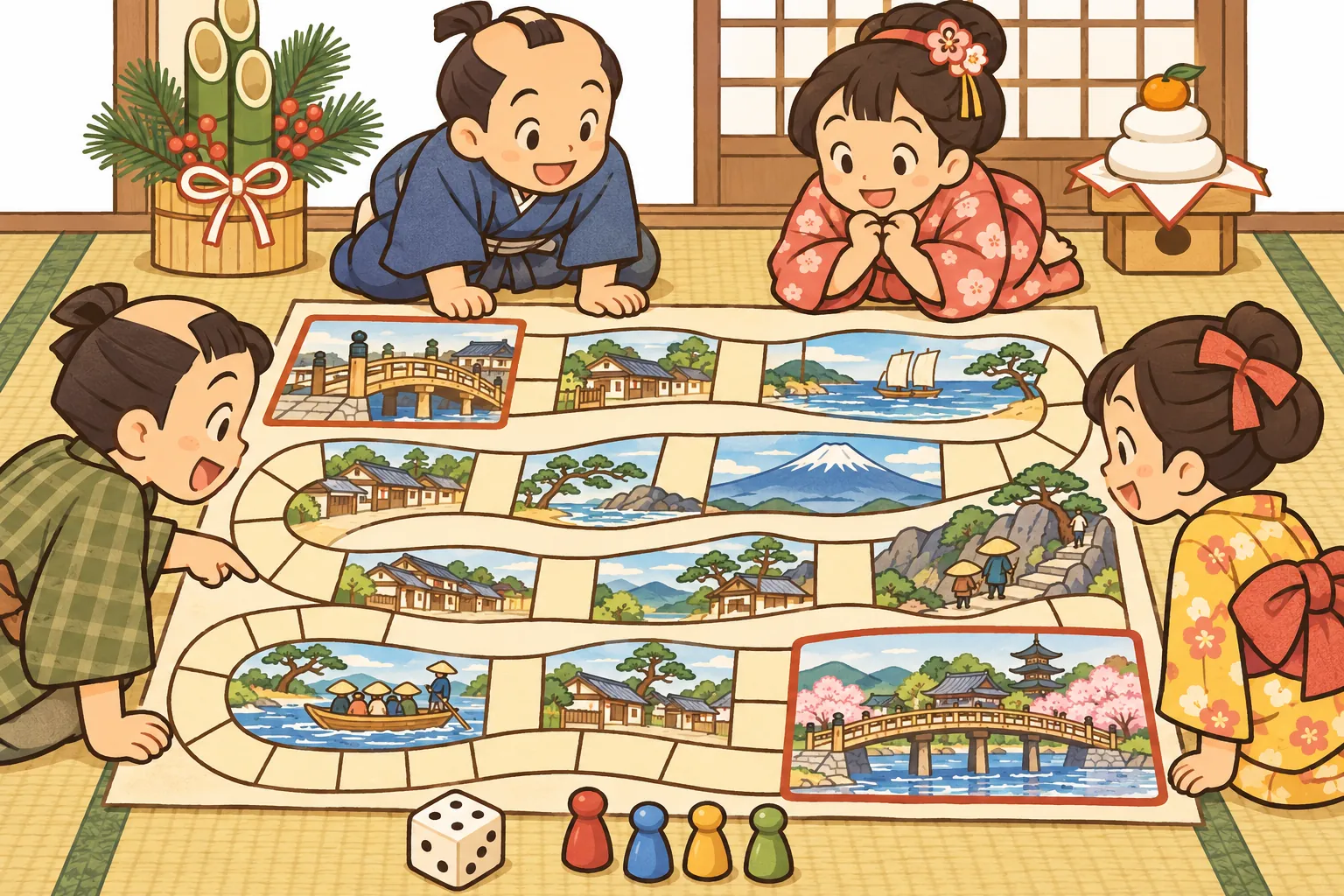
A Tōkaidō sugoroku board on tatami, its route winding from Edo's Nihonbashi to Kyoto's Sanjō Ōhashi (illustration).
Picture sugoroku came in two basic forms. In mawari sugoroku, the squares form a single winding track, and you move along it square by square, obeying instructions like "go back three" or "miss a turn." In tobi sugoroku, "jumping sugoroku," each square tells you which square to jump to for each number from one to six, so the marker leaps around the picture. The Pure Land game and many Edo sheets used the jumping form. The first resembles a modern track game; the second is closer to pure chance.
Mawari sugoroku: the squares form one winding path, and you move square by square
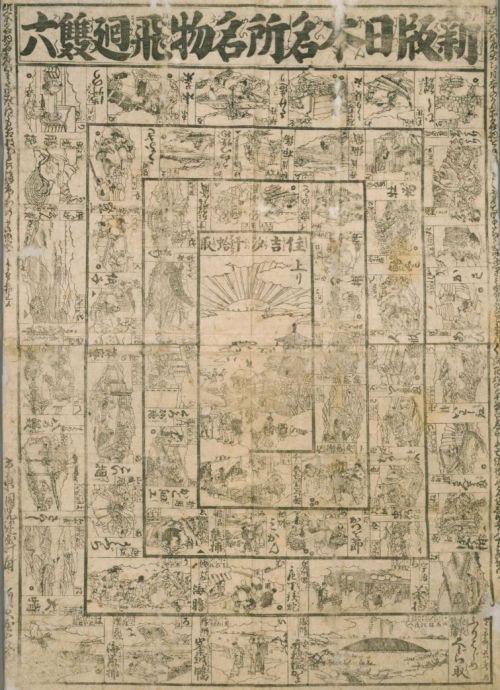
A tobi sugoroku, the Shinpan Nihon Meisho Meibutsu Tobimawari Sugoroku: famous places around the edge, the goal in the centerNational Diet Library, Yūrakusai Chōshū, sugoroku of famous places and products of Japan (late Edo period)
After the Meiji Restoration, sugoroku spread through newspapers and magazines. From the 1910s through the 1930s, children’s magazines such as Shōnen Kurabu often included a large color sugoroku with the New Year issue (by one account, Shōnen Kurabu did so every year), with themes that followed the times: a trip around the world, a railway journey, film stars, and later on television characters. For many Japanese people, New Year meant unfolding the magazine supplement on the kotatsu, the heated low table. The phrase furidashi ni modoru, "back to the start," is still everyday Japanese for having to begin all over again. The Japanese edition of The Game of Life, released in 1968, can be seen as a descendant of the picture sugoroku in the age of board games.
04Kendama: Three Cups and a Ball
The kendama is the best-known Japanese skill toy. It has two parts. The ken, or "sword," is a wooden handle whose top end tapers to a spike and whose bottom end is a shallow cup. A crosspiece is fitted across the middle of the handle, with a large cup on one end and a small cup on the other. The tama, a wooden ball with a hole drilled into it, is tied by a string to the crosspiece. The player holds the handle and swings the ball up, catching it in one of the three cups or landing the hole of the ball on the spike.
- 1Kenthe wooden handle
- 2Spikethe top end of the handle
- 3Bottom cupa shallow cup at the bottom end
- 4Crosspiecefitted across the middle of the handle
- 5Large cupone end of the crosspiece
- 6Small cupthe other end
- 7Tamaa wooden ball with a hole drilled into it
- 8Stringties the ball to the crosspiece
The ball can be caught in any of the three cups or landed on the spike.
Cup-and-ball toys exist all over the world; the French bilboquet, with a single cup and a spike, is a well-known example. The toy is generally thought to have reached Japan through Nagasaki in the middle of the Edo period, where adults played it at drinking parties; a book of 1809 on parlor games presents it as one, and by tradition a player who missed the catch had to drink. The three cups that make the Japanese version distinctive came later. In 1918, Egusa Hamaji of Kure, Hiroshima Prefecture, applied for a utility model for a toy called the nichigetsu-bōru, the "sun and moon ball," with side cups added to the handle; it was registered in 1919 and gave the kendama its modern form. He had it made in Hatsukaichi, another Hiroshima Prefecture town known for lathe-turned wooden toys, where production began in 1921. Hatsukaichi became the main center of production and now calls itself the birthplace of the kendama.
Kendama went through several crazes among Japanese children in the twentieth century. The Japan Kendama Association, founded in 1975, standardized the competition kendama and introduced a ranking system of grades (kyū) and degrees (dan), so that, like calligraphy or the abacus, it became something you can be tested in. The tricks have fixed names. Catching the ball in the big cup is simply ōzara, "big cup." Sekai isshū, "around the world," passes the ball from cup to cup and ends on the spike. In tōdai, "lighthouse," the player holds the ball and balances the whole ken upright on top of it, resting on its bottom cup. In hikōki, "airplane," the player holds the ball, lets the ken hang, then swings it up and around so that the spike lands in the hole.
The secret of kendama is in the knees, not the wrist. Beginners tend to flick with the hand, and the ball wobbles away. Good players bend their knees slightly as the ball rises and falls, using the up-and-down movement of the whole body to send the ball up and to cushion it as it lands, while the hand only adjusts the angle. This is one reason Japanese schools like teaching it: it rewards focus and rhythm, and progress is visible within minutes.
- 1
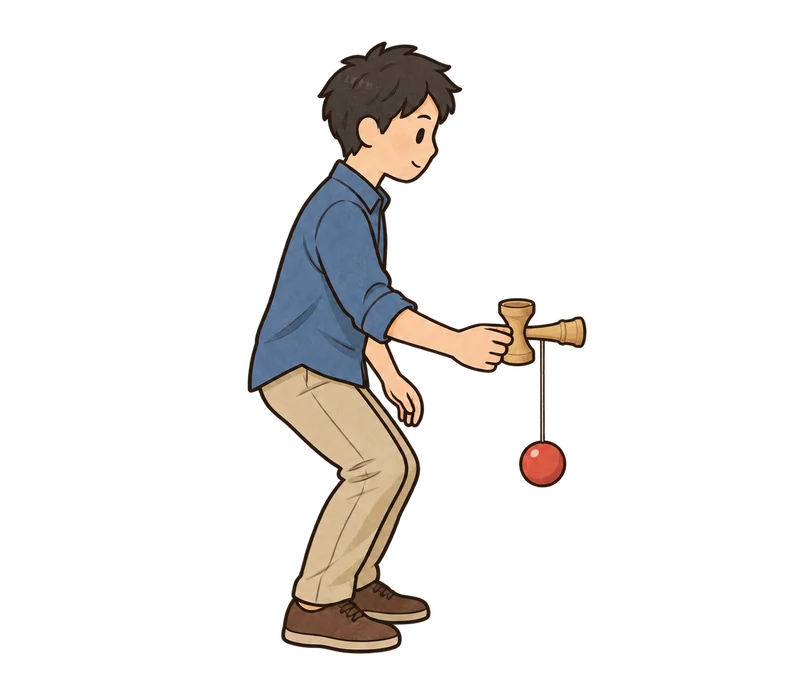 Hold the ken and bend your knees slightly
- 2
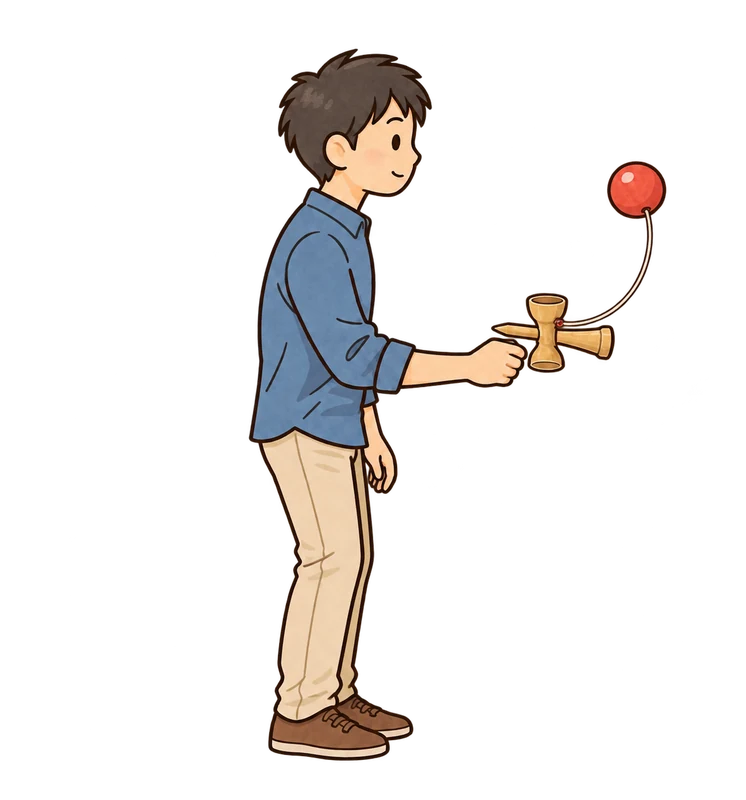 Straighten your knees and send the ball up with your whole body
- 3
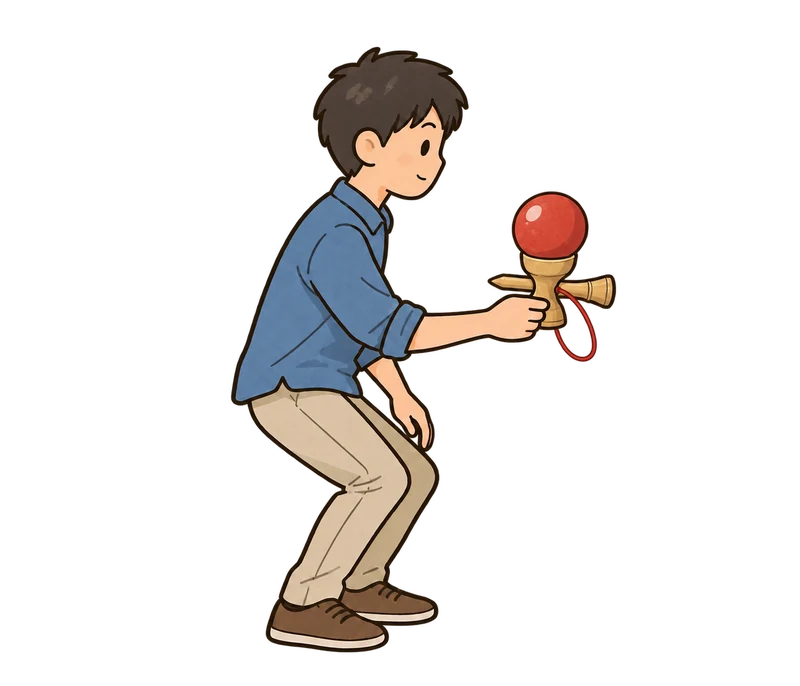 Bend again as the ball falls and catch it softly in the cup
From the late 2000s, the kendama found a new audience abroad. Young people in the United States and Europe took it up as a street toy, treated it a little like skateboarding, filmed new tricks and shared them online. Since 2014, Hatsukaichi has hosted the Kendama World Cup, which as of the 2020s draws players from many countries each summer. In Japan, kendama are sold in toy shops and souvenir shops at every price. Simple ones cost a few hundred yen, association-approved competition models generally cost one to two thousand yen or more (some retailers put the starting price at about 2,000 yen, as of 2026), and versions with a grippy lacquer finish cost more.
05Daruma Otoshi: Knock Out the Middle, Keep the Head
The daruma otoshi explains itself at a glance. Several colored wooden discs are stacked in a column, topped by a wooden block painted with the face of Daruma, and the set comes with a small wooden mallet. The player strikes the bottom disc sideways with the mallet to knock it out of the stack. If the strike is right, everything above drops straight down by one level and stays standing. The player works down disc by disc until Daruma sits on the base. Hit too slowly or at an angle, and the whole tower topples.
The trick is to be fast and level. The mallet should sweep flat along the table in one decisive stroke. The faster the struck disc flies out, the less time the pieces above have to move with it, and they simply drop. This is inertia, and the toy is often used to demonstrate it, reportedly even in Japanese elementary school science classes. Push hesitantly and friction drags the upper discs along.
The head is Daruma for a reason. In Japan, the round Daruma figure, modeled on Bodhidharma, the monk said to have founded Zen, is a symbol of getting back up. The weighted Daruma doll rights itself when pushed over, and the saying nana korobi ya oki, "fall down seven times, get up eight," goes with it. Election candidates and students facing exams paint in one of a Daruma’s eyes when they make a wish and the other when it comes true. In the daruma otoshi, Daruma falls all the way down but never falls over. The discs are usually bright red, blue, yellow, green and white, turned on a lathe. The toy’s origin is unclear; it is usually described simply as a wooden toy handed down since the Edo period, though one account places its appearance between the late Edo and Meiji periods, and it is said to come mostly from woodturning areas such as Hakone and the Tōhoku region. It remains one of the most common wooden toys in Japanese homes and kindergartens.
06Kites: Wind, String and Festivals
The Japanese word for kite is tako, written with a character invented in Japan. In the Kansai region kites were once called ika nobori, "rising squid," because a kite with a long tail looked like a squid in the sky. A popular story says that kite flying in Edo got so rowdy, with fights, damaged roofs and kites crashing into the processions of daimyo, that the shogunate banned ika nobori, whereupon Edo townspeople said they were flying not squid but octopus, tako, and carried on. It is a later anecdote rather than recorded history, but the regional difference in names was real.
A traditional Japanese kite has a bamboo frame covered with washi paper and painted with a bold design. The commonest Edo kite was the rectangular kakudako, painted with warriors, kabuki actors or a single large character such as "dragon" or "longevity." The yakko dako takes the shape of a samurai’s footman with arms outstretched, a comic figure children loved. Other regions have their own shapes. In Nagasaki, kites are called hata and are roughly diamond-shaped, and fliers use string coated with ground glass to cut each other’s lines. In Niigata, kites are six-sided.
In several Japanese towns, the kite is the center of a major festival. At the Hamamatsu Festival in Shizuoka Prefecture, held every year from May 3 to 5, families celebrate the birth of a first child by flying a hatsudako, a "first kite" printed with the child’s name, a custom said to go back to a castle lord celebrating the birth of his eldest son. Teams from each neighborhood fly their kites at the kite field beside the Nakatajima dunes and tangle their lines in the air, trying to saw through each other’s strings in a kite battle. Below, trumpets blare and teams chant; in the evening, ornate festival floats parade through the city. In Sagamihara, Kanagawa Prefecture, the Sagami giant kites are flown each year on May 4 and 5 over the riverbed of the Sagami River; the biggest, the hachiken dako, is about the size of 128 tatami mats and needs dozens of people on the rope, by some accounts as many as a hundred. Higashiōmi in Shiga Prefecture is also known for giant kites. In early June, the Shirone Giant Kite Battle in Niigata sets teams on opposite banks of the Nakanokuchi River. They fly enormous six-sided kites, tangle them above the water until they drop into the river, and then haul on the lines from both banks until one side’s rope snaps.
These festivals turn the kite from a toy into a neighborhood undertaking. A big kite takes months to build, and the frame, the paper, the painting and the rope crews are all divided among young and old residents. During the festival days, the town fills with people wearing happi coats printed with their neighborhood’s name.
07Seeing and Playing in Japan
For a concentrated look at traditional toys, the Japan Toy Museum in Himeji, Hyōgo Prefecture, opened in 1974, holds some 90,000 toys from Japan and abroad, about 30,000 of them Japanese regional folk toys, and is said to include sugoroku and hagoita going back to the Edo period, and in winter often mounts exhibitions on New Year and zodiac themes. City history museums also tend to bring out their picture sugoroku around the New Year. Up close, the tiny scenes in the squares are a window onto everyday life in Edo.
Playing is better than looking. Kendama and daruma otoshi are sold in souvenir shops, folk craft shops and toy stores across Japan, and some shops leave a sample on the counter to try. Hatsukaichi still has woodworking firms making kendama, and it hosts the Kendama World Cup each summer. At shrines over the New Year, stalls along the approach sell kites, tops and hagoita, and toys like these are a common gift for families with children, part of the Japanese custom of bringing souvenirs. To see kites, plan around Golden Week in early May for Hamamatsu or Sagamihara, or June for Shirone, and check the dates in advance, because kite festivals depend on the wind and are postponed when it is too weak or too strong.
If you buy a kendama, look for the Japan Kendama Association mark on the handle, which means it meets the standard used for grading. Start with the big cup: swing the ball to about chest height and bend your knees as you catch it. Once you can do that ten times in a row, try the lighthouse. It is a fine way to spend an evening in a hotel room, as long as you keep clear of the lamp and the window.