
At a glance
What each instrument does in Japan’s ancient court music, how Tang and Korean repertoires became Left and Right, how families kept it alive, and where to hear it.
- Gagaku is the classical music and dance of the Japanese imperial court; most of its instruments and pieces arrived from the continent and the Korean Peninsula over 1,000 years ago.
- The instrumental ensemble is built on three winds, two strings and three drums, with the shō, hichiriki and ryūteki at its core.
- The Taihō Code of 701 created the Gagakuryō; in the ninth century the court sorted the repertoire into Chinese-derived music of the Left and Korean-derived music of the Right.
- In bugaku, dancers of the Left wear mainly red and dancers of the Right green or blue, and paired pieces from each side are performed in turn.
- Today the Music Department of the Imperial Household Agency carries it on, and gagaku was inscribed on UNESCO’s intangible heritage list in 2009.
Gagaku, literally "elegant music," is the ceremonial music and dance of Japan’s imperial court, and it has a fair claim to being the oldest orchestral tradition still performed anywhere. Most of its instruments and much of its repertoire arrived from China and the Korean peninsula more than a thousand years ago, settled into their present form in the Heian court, and were then handed down within hereditary families of musicians to the present day. To a first-time listener it can sound slow, strange, almost weightless. Once you know what each instrument is doing, why one of them has to be warmed over a brazier, and why the dancers come on stage in red from one side and green from the other, the strangeness turns into something you can follow and even love.
01What It Sounds Like
Many visitors hear gagaku before they know its name. It drifts out of the main hall of a shrine during a wedding, or plays over the loudspeakers at New Year, or accompanies an imperial ceremony on the evening news. The piece you are most likely to hear is Etenraku, a melody so familiar in Japan that it functions almost as the sound of formality itself.
A typical performance opens with a single flute playing a short phrase alone. Then the other instruments enter: a sustained, shimmering cluster of tones that seems to hang in the air without beginning or end; a piercing, nasal reed whose melody bends and slides like a human voice; a flute weaving above it. Drums mark the time sparsely, often with long silences between strokes. There is no conductor. Tempo is set by the player of a small drum, the kakko, and everyone else follows by breath and by ear. Many pieces begin extremely slowly and gradually tighten as they go.
That arc of slow opening, development, and quickening close is called jo-ha-kyū. The term later spread far beyond music. Zeami used it to describe the structure of Noh plays, and it turns up in discussions of the tea ceremony, martial arts, and even modern Japanese storytelling. Its roots are in gagaku.
The music does not sound "Chinese" or "Korean" to most ears today, and it does not sound like anything else in Japan either. The Japanese tend to treat it as the most formal sound they have: the music you use when an occasion must be set apart from ordinary life.
02Three Winds, Two Strings, Three Drums
The standard instrumental ensemble, called kangen, is built from three wind instruments, two strings, and three percussion instruments. The winds carry the music, and each has a traditional symbolic role.
The shō is a mouth organ made of 17 slender bamboo pipes set in a cup-shaped wind chamber. Its silhouette was compared to a phoenix with folded wings. Unlike almost every other Japanese instrument, it plays chords, clusters of five or six notes called aitake, and it plays them continuously, shifting from one to the next while the player breathes both in and out. That uninterrupted sound is the luminous background against which everything else happens. The reeds are metal, and condensation from the player’s breath throws them out of tune, so before and between pieces shō players hold their instruments over a small charcoal brazier, turning them slowly to keep them warm and dry. The shō is said to represent light descending from heaven.
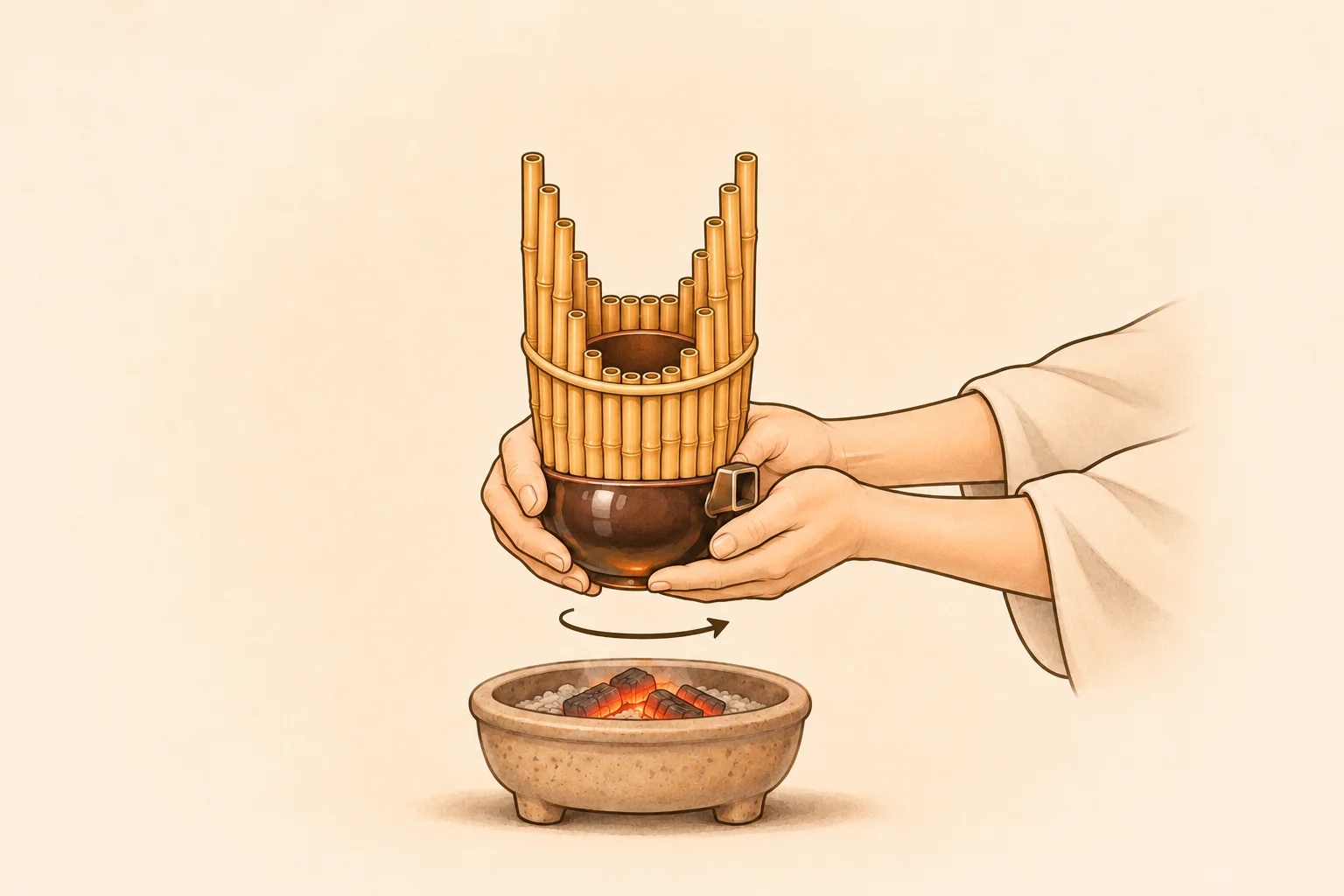
A shō player turns the instrument slowly over a small charcoal brazier to keep its metal reeds warm and dry.
The hichiriki is a short cylindrical bamboo pipe, not much longer than a hand, fitted with a large double reed made from a river reed. It is astonishingly loud for its size and carries the main melody. Players shape pitch with the lips, sliding into and around notes in a technique called enbai, which gives the instrument its crying, vocal quality. It is said to represent the human voice, the sound of earth.
The ryūteki, or "dragon flute," is a transverse bamboo flute with a wide range. It doubles and ornaments the melody, darting above the hichiriki, and is said to be the dragon that flies between heaven and earth. Gagaku musicians still explain the three winds this way: heaven, earth, and the space between.
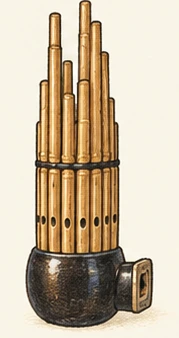
Shō: 17 slender bamboo pipes set in a cup-shaped wind chamber, likened to a phoenix with folded wings.
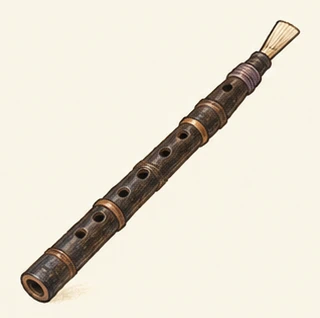
Hichiriki: a bamboo pipe not much longer than a hand, fitted with a large reed.
The strings are the gakubiwa, a pear-shaped lute, and the gakusō, a 13-string zither. In gagaku they do not play melodies. They play fixed patterns of plucked notes that outline the structure and rhythm of a piece, crisp and dry against the sustained winds. Both instruments later left the court and gave rise to independent traditions: the koto music and narrative biwa singing that Japan knows today descend from them.
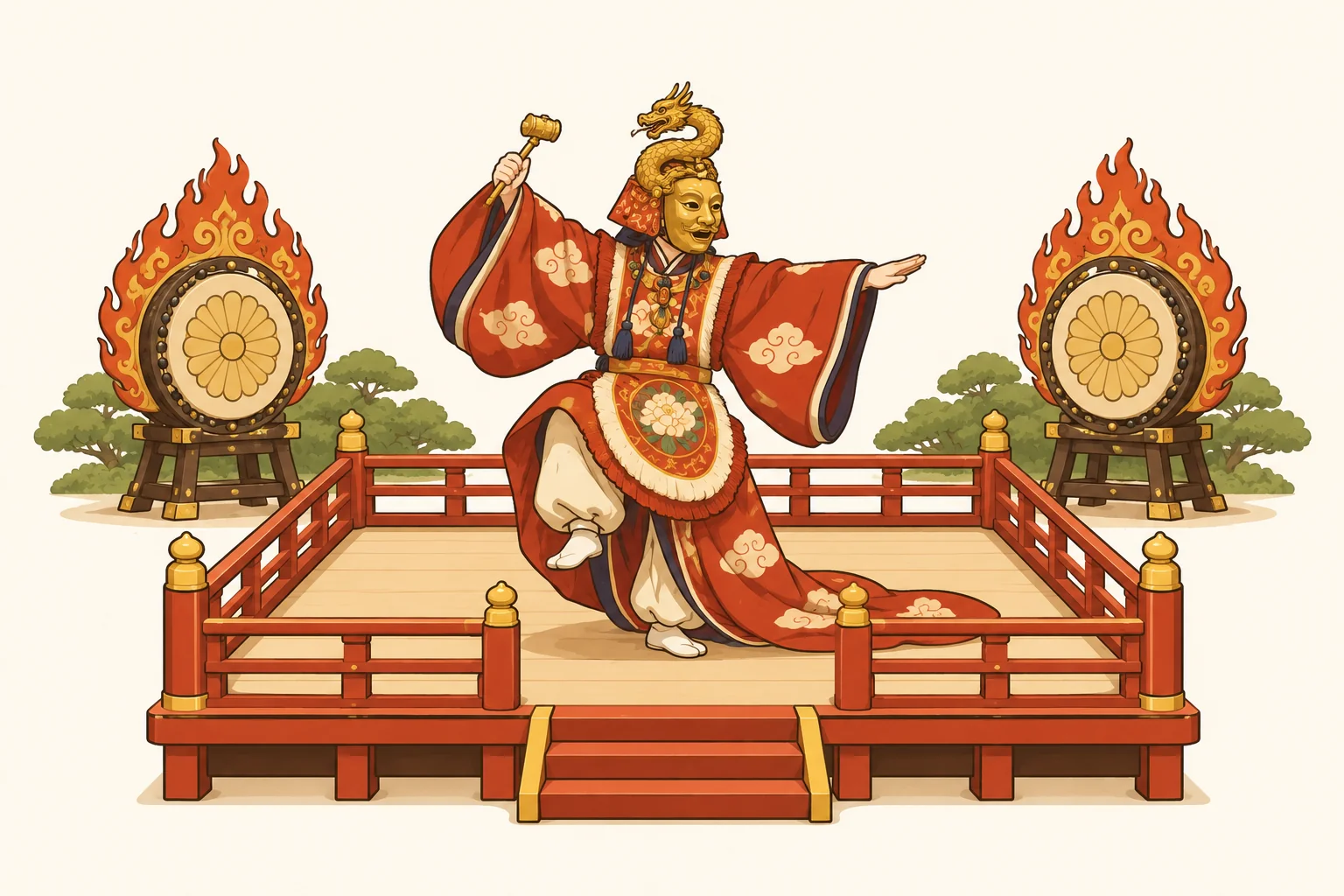
The percussion section is led by the kakko, a small barrel drum struck with two thin sticks, which controls tempo. The taiko, a large drum hung in an ornate round frame, marks the major divisions of each phrase, and the shōko, a small bronze gong, adds bright accents. For outdoor dance performances these are replaced by the dadaiko, a pair of enormous drums several meters tall, framed by carved flame-shaped ornaments. They are the most spectacular objects in the whole tradition.
| Instrument | Section | Role | Said to be |
|---|---|---|---|
| Shō | Wind | Chords (aitake) | Light descending from heaven |
| Hichiriki | Wind | Main melody | The human voice, the sound of earth |
| Ryūteki | Wind | Ornaments the melody | The dragon between heaven and earth |
| Gakubiwa | String | Fixed patterns: structure and rhythm | — |
| Gakusō | String | Fixed patterns: structure and rhythm | — |
| Kakko | Percussion | Controls tempo | — |
| Taiko | Percussion | Marks the divisions of each phrase | — |
| Shōko | Percussion | Bright accents | — |
The three winds stand for heaven, earth and the space between; the strings outline the structure; the kakko controls tempo.
03From the Continent to the Court
Japan received music from the mainland along with Buddhism, writing, and statecraft. Over the sixth to eighth centuries, musicians and dancers came from Tang China and from the Korean kingdoms of Baekje, Silla, and Goguryeo. When the Taihō Code reorganized the state in 701, it created a government bureau of music, the Gagakuryō, to train performers in Chinese, Korean, and native Japanese repertoires.
The most famous early performance took place in 752, at the dedication of the Great Buddha at Tōdai-ji in Nara, the "eye-opening" ceremony. Musicians and dancers presented Chinese, Korean, Southeast Asian, and other works before a vast assembly of monks and courtiers; later accounts put the number of musicians and dancers in the hundreds. Some of the instruments, masks, and costumes from that era still survive in the Shōsōin, the imperial storehouse at Tōdai-ji, among them lutes and other instruments that are now among the oldest of their kind in the world.
In the ninth century, during the reign of Emperor Ninmyō, the court reorganized this sprawling inheritance. Music of Chinese origin, along with pieces said to come from India and Southeast Asia, was grouped as tōgaku and assigned to the "Left." Music from the Korean peninsula and from the northeastern kingdom of Bohai was grouped as komagaku and assigned to the "Right." Many continental instruments were dropped, and the ensemble shrank to roughly what is played now. After this reform gagaku was no longer foreign music performed in Japan; it was Japanese court music.
The Tang court banquet music that gagaku descends from was lost in China itself as dynasties rose and fell. That is a large part of why music historians value gagaku: it preserves, in altered but continuous form, a branch of East Asian music that otherwise exists only in old documents.
Heian aristocrats did not simply listen. They played the shō and the biwa and danced at court entertainments, and musical skill was part of what made a cultivated nobleman. In The Tale of Genji, the hero Genji dances Seigaiha ("Waves of the Blue Sea") alongside his friend Tō no Chūjō, first at a rehearsal in the palace that moves the onlookers to tears, then beneath the autumn leaves at the Suzaku-in. The court also developed sung genres accompanied by gagaku instruments: saibara, folk songs set in a Tang style, and rōei, chanted recitations of Chinese and Japanese poems.
Alongside the imported repertoire, gagaku includes indigenous ritual songs and dances known as kuniburi no utamai. Among them are kagura-uta, sung for the gods in the palace and at shrines; azuma-asobi, derived from dances of eastern Japan; and kume-mai, traditionally associated with an ancient warrior clan. These are still performed at imperial rites and major shrine festivals, and they sit closer to the heart of Shinto ritual than the continental pieces do.
04Bugaku: Red and Green, Left and Right
Gagaku performed with dance is called bugaku. The division into Left and Right is clearest here. Dancers of the Left perform Chinese-derived pieces in costumes dominated by red and enter from the left side of the stage, accompanied by all three winds, with the kakko setting the tempo. Dancers of the Right perform Korean-derived pieces in green or blue, enter from the right, and are accompanied by the komabue, a smaller flute, with the hichiriki and a drum called the san-no-tsuzumi, and without the shō. In a formal program, a piece from the Left is paired with a matching piece from the Right, and the two are performed in turn.
| Left | Right | |
|---|---|---|
| Pieces | Chinese-derived | Korean-derived |
| Costume | Dominated by red | Green or blue |
| Entrance | From the left | From the right |
| Winds | All three winds | Komabue and hichiriki, without the shō |
| Drum | Kakko | San-no-tsuzumi |
| A paired example | Ryōō | Nasori |
Left and Right differ in color, entrance and accompaniment; in a formal program a Left piece is paired with a Right piece and the two are performed in turn.
The stage itself is a raised square platform with a low railing, its floor, by some descriptions, covered in green cloth, and flanked outdoors by the great dadaiko drums. The dancers move slowly and symmetrically, with broad arm gestures, long held poses, and deliberate turns that bring them to face each direction in turn. Few pieces tell a story in any detailed way. What you watch is closer to a ritual unfolding in space.
The best-known dance is Ryōō, also called Ranryōō, from the Left. According to legend it portrays Prince Lanling of the Northern Qi dynasty in sixth-century China, who was so beautiful that he wore a fierce mask into battle so his enemies would take him seriously. The solo dancer wears a gilded mask topped by a coiled dragon and wields a short golden baton, and the dance is vigorous and commanding. Its paired dance from the Right is Nasori, performed by two dancers in blue-green dragon masks, often described as a pair of dragons at play. Seigaiha, the dance from Genji, is performed in robes embroidered with wave patterns and plovers, with long trains dragging behind.
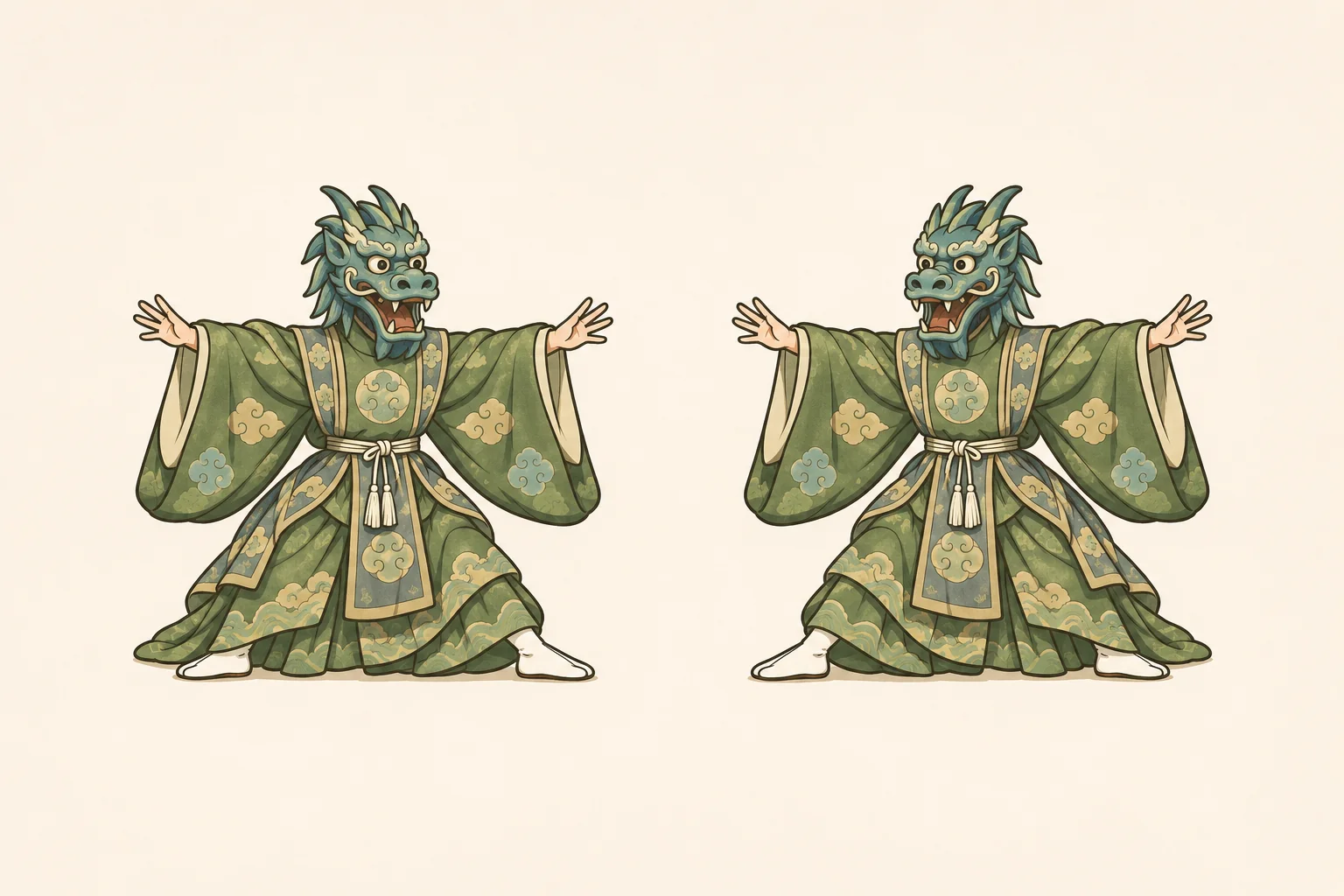
Nasori, a dance of the Right for two dancers in blue-green dragon masks, is the paired piece to Ryōō.
Bugaku masks and costumes are works of art in their own right, and some temples and shrines preserve masks centuries old. When the red and green costumes, gold masks, trailing robes, and flame-framed drums all appear together, bugaku becomes one of the most visually striking things in Japanese classical performance.
05How It Survived
Gagaku lasted more than a millennium because it was the business of families. From the Heian period onward, particular instruments and dances became the hereditary specialties of musician lineages, among them the Ō, Abe, and Toyohara families, and later the Tōgi, passed from father to son.
The Ōnin War of the late fifteenth century devastated Kyoto, and court gagaku nearly collapsed. It survived because there were two other centers: the Nanto musicians of Nara, attached to Kōfuku-ji and Kasuga Shrine, and the Tennōji musicians of Shitennō-ji in Ōsaka. From around the Tenshō era in the late sixteenth century, the court called musicians from Nara and Ōsaka to fill out the depleted Kyoto ranks, and the three groups came to be known as the sanpō gakuso, the "three music offices," taking turns serving at court. In the Edo period the shogunate, which valued ritual music, gave them stipends and protection and supported the revival of lost pieces. Musicians also served in Edo itself for ceremonies at the Tokugawa shrines.
After the Meiji Restoration moved the emperor to Tokyo, the government gathered musicians from the three centers in the capital in 1870 and created a new office of court music. It standardized the repertoire and compiled official scores that are still the basis of performance. That office, renamed several times, is today the Music Department of the Board of Ceremonies of the Imperial Household Agency, the Kunaichō Shikibushoku Gakubu. It has only around two dozen musicians, and each must master wind, string, and percussion instruments, dance, and song. Since the Meiji era, the same musicians have also played Western orchestral instruments, performing European classical music at state banquets.
Teaching is still largely oral. Students begin not with instruments but with shōga, singing the melody in syllables that imitate the instrument’s sound. Only after a piece has been absorbed by voice, with its breathing and timing, do they pick up the instrument. The written scores record only the skeleton. The music lives between teacher and student.
The gagaku of the Imperial Household Agency was designated an Important Intangible Cultural Property in 1955, and in 2009 gagaku was inscribed on UNESCO’s Representative List of the Intangible Cultural Heritage of Humanity.
06Where to Hear It in Japan
The most authoritative performances are given by the Imperial Household Music Department itself. As of 2026 it still holds public concerts each autumn in its own hall inside the East Gardens of the Imperial Palace in Tokyo. The hall has a proper bugaku stage, and the audience sits close enough to see the shō players warming their instruments between pieces.
To see bugaku outdoors in its original setting, the best occasion is the Kasuga Wakamiya Onmatsuri in Nara, a festival dating to the twelfth century and held each December, with its main day on December 17. The deity is carried by night to a temporary shrine, and through the following day and into the evening a long sequence of ancient performing arts is offered before it: kagura, azuma-asobi, dengaku, early forms related to Noh, and bugaku, the last dances performed by firelight. At Shitennō-ji in Ōsaka, the Shōryōe ceremony on April 22 presents bugaku on the temple’s stone stage, carrying on the Tennōji tradition. At Itsukushima Shrine on Miyajima, bugaku is offered on a raised dance stage set in a platform built out over the water; at high tide the stage seems to float on the sea.
Most visitors will meet gagaku more casually, at a shrine. During weddings at large shrines such as Meiji Jingū, the procession and the ritual sharing of sake are often accompanied by gagaku, sometimes live and sometimes recorded. At New Year or during shichi-go-san blessings for children, the sound of shō and hichiriki often drifts out of the main hall.
Gagaku has also found a place in contemporary music. In 1973 the composer Takemitsu Tōru wrote Shūteiga ("Autumn Garden"), commissioned by the National Theatre for the Imperial Household ensemble, and in 1979 expanded it into In an Autumn Garden, one of the most admired modern works for these ancient instruments. Tōgi Hideki, born into one of the hereditary musician families and formerly a member of the palace ensemble, went on to play the hichiriki in a pop and crossover style that introduced it to a new generation. The melody of Etenraku itself long ago escaped the court: the Fukuoka folk song Kuroda-bushi is set to it.
If you go to a performance, do not try to follow the melody at first. Listen to the shō’s chords changing slowly underneath, then to the hichiriki bending above them, then to the sparse strokes of the drums. When the piece quickens toward its close and stops on a final held note, you will understand why Japan has kept this sound for its most solemn moments.