
At a glance
How a would-be painter became Japan’s best-known director, what Rashomon and Seven Samurai actually show, why they work, and which Kurosawa films to watch first.
- Kurosawa was born in Tokyo in 1910, trained as a painter, and joined the P.C.L. studio as an assistant director in 1936.
- Rashomon won the Golden Lion at Venice in 1951, and the world began to see Japanese cinema.
- Seven Samurai (1954) runs 207 minutes and was the most expensive Japanese film made up to then.
- Mifune Toshirō made sixteen films with him, ending with Red Beard in 1965.
- He died in 1998 at the age of eighty-eight and was given the People’s Honour Award that year.
If you have seen The Magnificent Seven, A Fistful of Dollars or Star Wars, you have already seen some of the work of Kurosawa Akira (known in English as Akira Kurosawa) secondhand. Between 1943 and 1993 he directed thirty films, and a handful of them—Rashomon, Seven Samurai, Ikiru, Yojimbo, Ran—changed what audiences around the world expected from Japanese cinema, and from action cinema in general. This introduction explains who he was, what makes his films so watchable, what actually happens in Rashomon and Seven Samurai and why they still matter, and where a newcomer might begin.
01A Painter Who Went to the Movies
Kurosawa was born on March 23, 1910, in Ōimachi, then a town just south of Tokyo and now part of Shinagawa ward. He was the youngest of eight children, four boys and four girls. His father, Isamu, came from a samurai line in Akita and had served at the army’s Toyama school, its physical-training academy, before moving into civilian education—a strict man, reportedly devoted to kendo, but also, unusually for his class and time, someone who thought motion pictures were good for children.
In his memoir, published in English as Something Like an Autobiography, Kurosawa describes himself as a weepy, slow child who blossomed under one encouraging schoolteacher and discovered drawing. The person who shaped him most, though, was Heigo, the brother four years older than him. Heigo was a benshi, one of the narrators who stood beside the screen during the silent era and performed the film for the audience. Working under the stage name Suda Teimei, he became a star of the foreign-film houses in Tokyo’s Kanda district. He took Akira to see everything. After the Great Kantō Earthquake of 1923, he also walked his younger brother through the ruined city, past heaps of corpses, and—as Kurosawa remembered it—told him to look, because looking away is what makes you afraid.
When sound films arrived, the benshi lost their livelihood. Heigo killed himself in July 1933, at twenty-seven as usually recorded (the counting method is unclear). The memoir is frank about it, though Kurosawa is said to have rarely spoken about it in interviews, and anyone who watches his films sees the lesson he took from his brother: the camera does not look away.
Kurosawa first meant to be a painter. He studied Western-style painting, had a still life accepted at the Nika exhibition in 1928, and the following year joined the Japan Proletarian Artists’ League. Painting did not pay. In April 1936 he answered a newspaper advertisement from the film studio P.C.L.—soon to become part of Toho—which was looking for assistant directors. He was hired and assigned to Yamamoto Kajirō, a popular director who believed assistants should learn everything: editing, second-unit work and, above all, screenwriting. "If you want to direct, write scripts" was the advice Kurosawa credited to him. During the war years Kurosawa wrote screenplay after screenplay, some of which were produced by other directors; by most accounts much of the fee money went on drinks for his colleagues.
His own debut came in 1943 with Sanshiro Sugata, a judo story adapted from a novel by Tomita Tsuneo. Wartime censors trimmed it, but the climactic duel, fought in a field of wind-whipped pampas grass under racing clouds, already shows the instinct that would define him: weather and landscape doing as much work as the actors.
02Postwar Tokyo, Mifune and Shimura
Kurosawa’s first postwar successes were contemporary stories set in a ruined, hungry Tokyo. Drunken Angel (1948) is about an alcoholic doctor working beside a black-market swamp and the young gangster with tuberculosis he tries, and fails, to save. The doctor was played by Shimura Takashi. The gangster was played by a demobilized soldier who had stumbled into Toho’s new-talent audition: Mifune Toshirō. The story goes that Mifune, asked to act out anger, unleashed such genuine fury that the panel was alarmed; Kurosawa saw something animal and fast in him and fought for him.
These two actors became the poles of Kurosawa’s cinema. Shimura was quiet, watchful, often cast as an older man who knows how the world works and takes responsibility anyway. Mifune was all velocity—a coiled, barking, scratching presence who could switch to boyish delight in a second. In Stray Dog (1949), Mifune plays a rookie detective whose pistol is stolen on a crowded bus, and Shimura plays the veteran who helps him track it through a sweltering summer of black markets and baseball stadiums. The film is often cited as a forerunner of the police procedural. Mifune would make sixteen films with Kurosawa, ending with Red Beard in 1965.
The finest of Kurosawa’s contemporary dramas is Ikiru ("To Live," 1952). Shimura plays Watanabe Kanji, a section chief at a city office who has spent thirty years stamping documents without reading them. Learning he has stomach cancer and only months to live, he tries nightclubs and pleasure, fails to find any meaning there, and finally pushes through a petition from local mothers to turn a stagnant, mosquito-ridden lot into a children’s playground—walking from desk to desk through the bureaucracy that had always ignored them. The film then jumps forward to his wake, where his colleagues, drinking, argue over what happened to him. The film is said to have been used by some government offices in training civil servants. The image everyone remembers is Watanabe on a swing in the finished playground on a snowy night, softly singing the old 1915 song "Gondola no Uta" ("The Gondola Song"), whose lyrics tell young people that life is short. In 2022 the film was remade in Britain as Living, with a screenplay by Kazuo Ishiguro.
03Rashomon: One Incident, Four Stories
In 1950 Kurosawa made a modest period film for the Daiei studio. He combined two short stories by Akutagawa Ryūnosuke: the plot came from "In a Grove" (Yabu no naka), and the frame setting came from "Rashōmon," named for the great southern gate of the old capital, Heian-kyō (today’s Kyoto). In a downpour, under that crumbling gate, a woodcutter, a priest and a cynical commoner sheltering from the rain talk about a case heard at the magistrate’s court a few days before.
The facts seem simple. A samurai was traveling through the forest with his wife on horseback. A bandit named Tajōmaru saw them. The samurai ended up dead; the wife was raped. Then the testimonies begin, and they do not agree.
Tajōmaru (Mifune, sprawling and laughing) says he lured the samurai into the grove with a tale of buried treasure, tied him up, and raped the woman, who then insisted the two men fight because she could not live having been shamed before both; he claims he untied the husband and killed him in a long, honorable duel—twenty-three bouts, by his own boast. The wife (Kyō Machiko) says that after the bandit left, her husband looked at her with such cold contempt that she approached him with her dagger and fainted, and woke to find it in his chest; she then tried and failed to kill herself. The dead samurai (Mori Masayuki) testifies through a spirit medium: his wife, he says, begged the bandit to kill him, which disgusted even Tajōmaru, and he took his own life with her dagger.
Each version flatters the speaker. The bandit becomes a dashing swordsman, the wife a victim driven past endurance, the husband a man who died with honor. Then, back at the gate, the woodcutter admits he saw everything and gives a fourth account: the husband at first refused to fight for his wife at all, and when she goaded both men into it, the duel was clumsy, frightened and ugly, two men scrambling and flailing in the dirt. But the commoner points out that the woodcutter almost certainly stole the valuable dagger from the scene. His story, too, has a hole cut out of it.
What makes Rashomon memorable is that it never tells you which story is true. In his memoir Kurosawa wrote that human beings cannot be honest with themselves about themselves; they embellish, and he called that egoism a sin people carry from birth. His characters go on embellishing even after death. The ending, in which the woodcutter takes home an abandoned baby found at the gate and the priest says he can still have faith in people, has been called sentimental, but it gives the film a moral direction: if nobody can be trusted to tell the truth, people can still choose how to act.
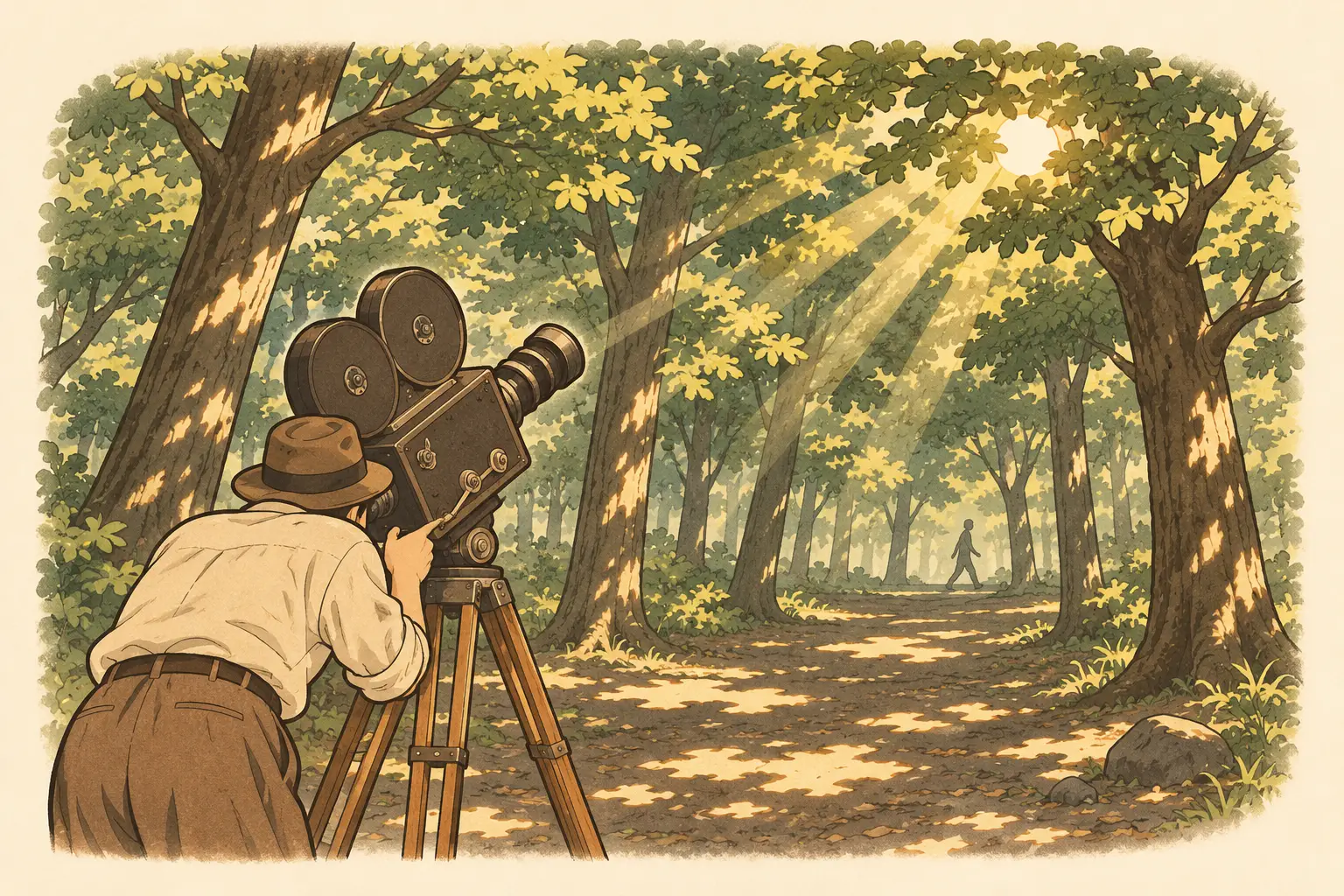
Miyagawa Kazuo pointed the lens straight at the sun through the leaves, then a taboo, reportedly for fear it would burn the film; light flickers in patches and figures move between light and shade. An illustration, not a film frame.
The film’s look was as daring as its structure. Cinematographer Miyagawa Kazuo pointed his camera straight into the sun through the forest canopy, which was then considered taboo; the fear, it is said, was that the sun would burn the film. The dappled light keeps sliding across faces, so the forest scenes feel hot, restless and erotic. The rain at the gate, pumped from fire engines and studio hoses, did not show up against the sky, so the crew mixed black ink into it. The forest scenes were shot in the old-growth woods around Nara and at the temple Kōmyō-ji outside Kyoto. The gate itself was a set at Daiei’s Kyoto studio so large that a full roof would have crushed its pillars, so only half a roof was built.
The film opened in Japan in August 1950 to divided reviews, though it was Daiei’s fourth-highest earner of the year. Daiei’s president, Nagata Masaichi, reportedly found it incomprehensible. It reached the Venice Film Festival largely because Giuliana Stramigioli, who headed the Italian film company Italifilm in Japan, championed it; the Japanese studios would have preferred to send a film by Ozu. Nobody in Japan expected much. On September 10, 1951, it won the Golden Lion, and in March 1952 it received an honorary Academy Award as the best foreign-language film released in the United States—there was not yet a competitive category. Overnight, Japanese cinema had a place in the international conversation, and in the following years European and American audiences discovered Mizoguchi Kenji, Ozu Yasujirō and others.
"Rashomon" also became a word. In English, social scientists and lawyers speak of the "Rashomon effect" when witnesses give contradictory accounts of the same event. In Japanese and Chinese the word turns up in news headlines whenever the parties to a scandal tell incompatible stories.
04Seven Samurai: How Farmers and Masterless Warriors Defended a Village
If you watch only one Kurosawa film, most people who love him will tell you to watch Seven Samurai, released in April 1954. It runs 207 minutes, was the most expensive Japanese film made up to that time, and was shot over 148 working days stretching from May 1953 into the following year, with Toho repeatedly halting production as costs ballooned. The screenplay was written by Kurosawa with Hashimoto Shinobu and Oguni Hideo, the three of them sequestered at an inn in Atami for more than six weeks. The village was an open set at Toho’s studios in Setagaya, with location work in Shizuoka and Hakone.
The setting is the Sengoku period, the century of civil war in the 1500s. Farmers in a mountain village learn that a gang of about forty bandits will return to take their barley once it is harvested. The village elder tells them to hire samurai—hungry ones. A few farmers go to town with bags of rice, the only payment they can offer, and are scorned again and again by the masterless samurai, or rōnin, they approach.
Then they witness Kanbei (Shimura). An aging warrior with a long record of lost battles, he shaves his head, topknot and all—a grave humiliation for a samurai—without a moment’s hesitation, to disguise himself as a priest and rescue a child taken hostage by a thief. That one scene tells the farmers, and us, everything about him. Kanbei agrees to help and recruits the others one by one: his old comrade Shichirōji; the good-natured strategist Gorobei; Heihachi, a cheerful woodchopper of a swordsman; Kyūzō, a silent master obsessed with perfecting his art; Katsushirō, a young man who wants to become Kanbei’s disciple; and finally Kikuchiyo (Mifune), a loud, ragged, comic figure carrying a stolen family register to prove he is a samurai, which he obviously is not.
The first half of the film is recruiting; the second half is defense. When the samurai arrive, the villagers hide—they fear the warriors as much as the bandits. Kikuchiyo breaks the deadlock by ringing the alarm and shaming them into coming out. Kanbei studies a hand-drawn map of the village, builds fences, floods the paddies, and turns the settlement into a fortress with a single deliberate opening where the bandits can be let in a few at a time and killed. He drills the farmers in bamboo-spear formations. He keeps a tally of the bandits, crossing off each one as he falls. Because of that tally and that map, you always know exactly where the battle stands.
The emotional core comes when the samurai discover that the farmers have, in past wars, killed fleeing warriors and stripped them of armor and spears. The others are disgusted. Kikuchiyo explodes. Farmers are mean, cunning, cowardly liars, he shouts—but who made them that way? Samurai did, burning their villages, taking their crops, forcing them into labor. Then he weeps. We realize he was born a farmer’s son. In one scene the film lays bare its subject: samurai and farmers need each other, but they will never truly be on the same side.
The final battle is fought in torrential rain. The mud is ankle-deep; horses plunge through it; men slip, swing and die in a gray churn where it is hard to tell people from earth. Four of the seven samurai are killed. Afterward, the villagers plant rice to the sound of drums and singing, already turning away from the survivors. Looking at the burial mounds of his comrades, Kanbei says that they have lost again: the farmers are the ones who won.
Part of what makes Seven Samurai so gripping is its clarity. Kurosawa spends more than an hour letting you know each man, so each death in the second half lands. He also shot the final battle with three cameras running at once from different angles, often fitted with telephoto lenses, which let him cut between angles during editing and keep movement continuous—an approach that was unusual at the time and that he relied on for the rest of his career. The basic structure—gather a team of specialists, then send them against impossible odds—has become one of the most borrowed templates in film. Hollywood turned it into the Western The Magnificent Seven in 1960, and remade that again in 2016.
05How He Worked: Weather, Lenses and "the Emperor"
Watch a few Kurosawa films in a row and you notice how much weather there is. The rain of Rashomon, the mud of Seven Samurai, the fog that rolls through Throne of Blood, the dust and wind that blow down the empty street in Yojimbo. He is said to have remarked that weather lets audiences feel a film physically. Crews grew used to waiting days for the right cloud.
He controlled everything. He edited his own films, often cutting each day’s footage at night during the shoot, so a rough version existed soon after filming wrapped. He painted. For his late films Kagemusha and Ran he produced hundreds of vivid color storyboard paintings, later exhibited and published. He insisted on real materials: one widely repeated story holds that the drawers of the medicine cabinets in Red Beard’s clinic were filled with actual medicines that no camera would ever see, because he believed the actors would feel the difference; another holds that he once had a roof torn off because it spoiled a shot. Many such stories circulate, and not all can be confirmed, but together they explain the nickname people used behind his back: Tennō, "the Emperor"—a mixture of awe and complaint.
His perfectionism served a purpose: he wanted audiences to believe the world on screen. Throne of Blood (1957) transposes Macbeth to feudal Japan, replacing the Scottish heath with the fog-shrouded forests on the slopes of Mount Fuji and the witches with a single ghostly spirit at a spinning wheel. Yamada Isuzu plays the Lady Macbeth figure with movements and a masklike face drawn from Noh theater. In the famous ending, Mifune’s warlord Washizu is shot full of arrows by his own men; real arrows were fired by archers from just off camera into the set around the actor, and the terror on Mifune’s face, by most accounts, was not entirely acted.
The Hidden Fortress (1958) follows a general escorting a princess and a hoard of gold through enemy territory, told largely from the point of view of two greedy, squabbling peasants. George Lucas has acknowledged that this device—a grand adventure seen through two lowly bickering companions—shaped the droids of Star Wars. Yojimbo (1961) and its sequel Sanjuro (1962) feature Mifune as a nameless ronin who walks into a post town split between two gangs and plays them against each other. Asked his name, he glances at a mulberry field and calls himself Kuwabatake Sanjūrō—"mulberry field, thirty-ish." His shrugging, itching, wry warrior led directly to Sergio Leone’s A Fistful of Dollars (1964), which copied Yojimbo so closely, without permission, that Toho sued; the case was settled out of court.
Kurosawa’s contemporary thrillers are just as good. High and Low (1963), adapted from Ed McBain’s novel King’s Ransom, begins in the hilltop house of a shoe-company executive in Yokohama who has mortgaged everything to win control of his firm. Kidnappers take a boy they believe is his son but who is actually his chauffeur’s. Will he pay a ransom that will ruin him, for someone else’s child? The first hour unfolds almost entirely inside that air-conditioned living room; the second descends into the hot streets below, among detectives and heroin addicts. Kurosawa hoped the film would make the case for harsher sentences for kidnapping; instead, kidnappings in Japan rose after its release, and he was blamed.
06Collapse and Late Glory
Red Beard (1965) was Kurosawa’s last black-and-white film and his last with Mifune. Television was hollowing out the Japanese film industry, and studios were less willing to finance his huge productions. He looked abroad. Twentieth Century Fox hired him to direct the Japanese half of its Pearl Harbor epic Tora! Tora! Tora!, but after about three weeks of shooting, in December 1968, he was removed; Fox announced he had left because of "fatigue." Accounts of what really happened still differ.
To prove he could still work, Kurosawa joined fellow directors Kinoshita Keisuke, Ichikawa Kon and Kobayashi Masaki in a production group formed in 1969 called the Club of the Four Knights (Yonki no Kai). Its only film was Kurosawa’s Dodes’ka-den (1970), his first in color, about the residents of a garbage-dump shantytown on Tokyo’s edge, including a boy who drives an imaginary streetcar, chanting the "dodes’ka-den" sound of its wheels. It failed commercially. On December 22, 1971, at the age of sixty-one, Kurosawa attempted suicide with a razor. He survived.
His rescue came from the Soviet Union. Dersu Uzala (1975), shot in the taiga of the Soviet Far East and based on the memoirs of the Russian explorer Vladimir Arsenyev, tells of the friendship between a Russian army surveyor and a Nanai hunter who lives in the taiga. In 1976 it won the Academy Award for Best Foreign Language Film. Then George Lucas, a longtime admirer, persuaded Fox to help finance Kagemusha (1980), with Francis Ford Coppola joining as a producer of the international version. The film is the story of a petty thief recruited as a body double for the warlord Takeda Shingen. Its original star, Katsu Shintarō, quarreled with Kurosawa and was dismissed early in the shoot; Nakadai Tatsuya took over. Kagemusha shared the Palme d’Or at Cannes with All That Jazz and was a big hit in Japan, by some accounts setting a box-office record for a Japanese film at the time.
Ran (1985) is the summation of his late style. It borrows the frame of King Lear, replacing the daughters with the three sons of an aging warlord, Ichimonji Hidetora, and adds the legend of the daimyo Mōri Motonari, who taught his sons that one arrow breaks easily but three bundled together do not. Nakadai plays Hidetora in a white, Noh-like old man’s makeup. The armies of the three sons are color-coded—yellow, red, blue—so their banners fill the plains like a painted screen. In the central battle a burning castle is stormed while all natural sound drops away beneath Takemitsu Tōru’s score, and Hidetora, insane, walks down the steps out of the flames. A full castle set was built on the slopes of Mount Fuji (some accounts place it near Gotemba) and burned for that sequence. Wada Emi won the Academy Award for Best Costume Design. Most of the location work was done in the volcanic landscape around Mount Aso, with scenes at the Kumamoto and Himeji castles.
Kurosawa made three more films: Dreams (1990), which Steven Spielberg helped bring to Warner Bros. for distribution; Rhapsody in August (1991); and Madadayo (1993), a gentle portrait of a retired professor and his devoted former students. In 1990 he received an honorary Academy Award, presented by Lucas and Spielberg; in his acceptance he said he did not feel he understood cinema yet, and promised to keep working at it. Kurosawa died of a stroke at his home in Setagaya, Tokyo, on September 6, 1998, at the age of eighty-eight, and that year was posthumously given the People’s Honour Award, the first film director to receive it. He is buried at the temple Anyō-in in Kamakura.
07How Japan Sees Him
For decades Kurosawa simply meant "Japanese film" to many Western viewers. At home his standing is just as high, but more complicated. Some Japanese critics in the 1950s found him too Western. He grew up reading Tolstoy and Dostoevsky, adapted The Idiot, Gorky’s The Lower Depths and Shakespeare, and built his films around humanist ideas of individual conscience. His muscular style looked nothing like the still, low-angle family dramas of Ozu. In a twist, once Western critics discovered Ozu and Mizoguchi, many began to rank them above him, and Japanese critics sometimes accused him of pandering to foreign audiences. Japanese cinema is a large subject of its own; it is enough here to say that Kurosawa belonged to its golden age in the 1950s alongside Ozu, Mizoguchi, Naruse Mikio and Kinoshita, and that they differed from one another enormously.
To ordinary Japanese audiences he is Sekai no Kurosawa, "Kurosawa of the world." The phrase shichinin no samurai is often borrowed for any small, hand-picked team, especially in sports and business reporting. Japanese television, it has been reported, often reruns his films around his birthday or the anniversary of his death. Hashimoto’s memoir of their collaboration, published in English as Compound Cinematics, gives a vivid account of how the three writers argued over every scene of Seven Samurai.
People who worked with Kurosawa tend to remember him with a mixture of reverence and fear. He and Mifune never made another film after Red Beard, for reasons that remain a matter of speculation, and they are generally said to have seen little of each other in later years. Mifune died in December 1997. Kurosawa, recovering from a fall, could not attend the public funeral in January 1998, and his son Hisao read his eulogy: none of his films, it said, could have been made without Mifune. Kurosawa died eight months later.
08Where to Start, and What to Watch For
Begin with Seven Samurai. It is long, but it is not hard going: the first half plays almost like an ensemble comedy of recruitment, and the second half is a model of how to stage action. Then watch Rashomon, which is only 88 minutes long; afterward, think about what each witness had to hide. From there, Yojimbo shows Mifune at his most charismatic, Ikiru reveals the tenderness in Kurosawa’s modern dramas, and High and Low is a superbly paced crime film. Save Ran for the biggest screen you can find.
A few habits are worth watching for. Kurosawa loved the wipe, a transition in which one image is pushed off screen by the next like a sliding door, long after most directors had abandoned it. He often lined characters up across the frame or arranged them in triangles, with both foreground and background sharp; telephoto lenses compressed the space so groups look tightly packed. Notice the weather in every important scene. And watch hands and walks—every itch and swagger of Mifune’s Kikuchiyo or Sanjūrō is character.
In Japan, retrospective screenings turn up at the National Film Archive of Japan in Kyōbashi, Tokyo, and at revival houses around the country; Seven Samurai and Rashomon have been restored in 4K and return to theaters on anniversaries. Travelers in Kyoto can walk a few minutes west of the temple Tō-ji to the site of the real Rashōmon (Rajōmon): nothing remains but a stone marker in a children’s park, but standing there you can picture the ruined gate in the rain that Akutagawa imagined and Kurosawa built. Some fans also make the trip to his grave in Kamakura, or to the Kinuta area of Setagaya where Toho’s studios still stand.
Best of all, wait for a rainy night, turn off the lights and watch Seven Samurai from start to finish. When it ends three and a half hours later, the rain will still be falling, and you will understand why directors around the world are still borrowing from a would-be painter from Tokyo.