
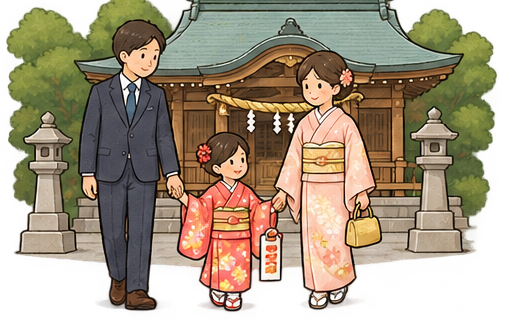
At a glance
Why Japanese families take newborns and children of three, five and seven to shrines, and what the kimono, candy and small rituals mean.
- Shichi-Go-San is a family rite in which parents take children who have safely reached three, five or seven to a shrine to give thanks and pray.
- The traditional day is November 15, but most families now visit on weekends from late October to the end of November.
- The three ages correspond to three old coming-of-age rites: kamioki, hakamagi and obitoki.
- Chitose-ame is a long red-and-white candy stick sold in a bag printed with cranes, turtles, pine, bamboo and plum, a wish for long life.
- Miyamairi comes about a month after birth, when the family carries the baby to meet the local god for the first time.
On a fine Sunday in November, the approach to almost any large shrine in Japan fills with very small people in very formal clothes. A three-year-old girl in a red kimono and a padded vest shuffles along in wooden sandals. A five-year-old boy in a black crested jacket and pleated trousers holds a fan as if he has been told not to drop it. A seven-year-old girl, hair pinned up, sash tied in an elaborate bow, walks carefully so as not to step on her own sleeves. Each of them carries a long paper bag printed with cranes and turtles. This is Shichi-Go-San, "Seven-Five-Three," the day families thank the gods that a child has reached one of these ages safely. Earlier still, about a month after birth, most of these children made their first shrine visit, carried in a grandparent’s arms under a brilliant kimono. That visit is called miyamairi. This piece explains both rites: where they come from, why these ages and this date, how families celebrate them now, and what a visitor is actually looking at when one passes by.
01What Happens in November
The traditional date for Shichi-Go-San is November 15, but few families hold to it exactly. Most go on whichever weekend in late October or November suits the parents’ work schedules and avoids the worst crowds. The outline of the day is simple. The family arrives at the shrine, the child is dressed in kimono, the mother often in a quiet formal kimono as well, the father in a suit, the grandparents carrying cameras. At the shrine office they write down the child’s name and pay a fee called hatsuhoryō, literally "first-ears-of-rice money," a reminder that offerings to the gods were once made in grain. A priest then performs a short prayer ritual, kitō, inside the hall, waving a purification wand over the family and reading the child’s name aloud to the deity. Afterward come photographs in front of the torii gate and the main hall, and then a family lunch. The whole thing takes half a day.
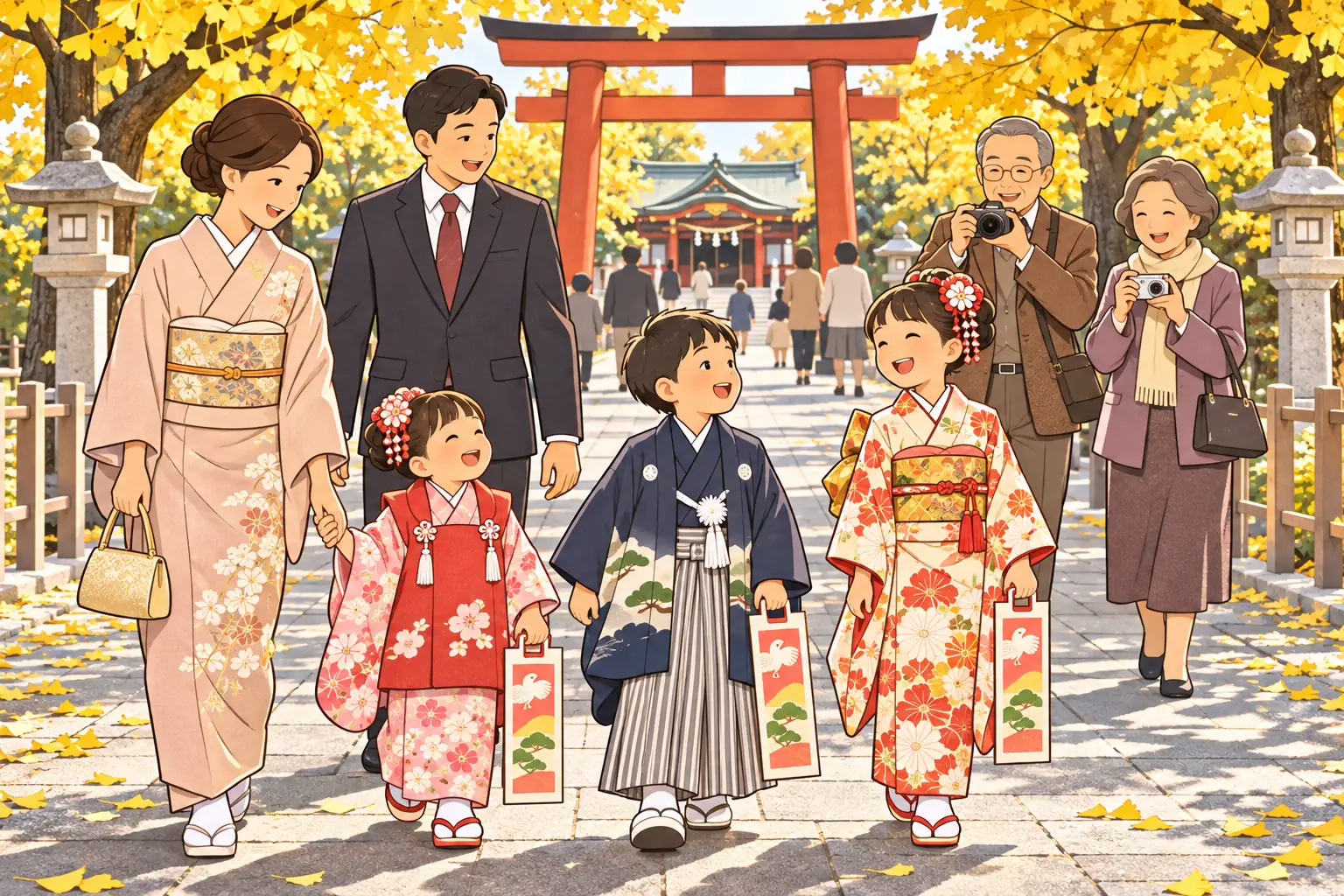
A Shichi-Go-San weekend: three generations walk a kimono-clad child along a shrine approach (illustration).
The ages are divided by sex. Traditionally boys are celebrated at three and five, girls at three and seven. In practice there is plenty of variation: in many places boys mark only age five, while some families celebrate a three-year-old boy as well. The ages were once counted in kazoedoshi, the old East Asian reckoning in which a child is one at birth and gains a year every New Year. Many families now use the child’s actual age instead, though some still choose the traditional count, especially when it lets siblings celebrate in the same year.
Shichi-Go-San is not a public holiday and there is no national ceremony. It is entirely a family affair. Yet nearly everyone who grew up in Japan has a photograph of their own: a slightly oversized kimono, a fistful of candy, an expression somewhere between solemn and fed up.
02Three, Five, Seven
Each age corresponds to an older coming-of-age rite, originally separate and practiced by the court nobility and later by the warrior class.
At three came kamioki, "leaving the hair." Small children in premodern Japan commonly had their heads shaved, a practice thought to keep them clean and to make the hair grow thicker later. At three the shaving stopped and the hair was allowed to grow. In some households a tuft of white silk floss was placed on the child’s head during the ceremony, a wish that the child would live long enough to have white hair.
At five came hakamagi, "putting on the hakama." The hakama, a pair of wide pleated trousers, belonged to adult male dress, and wearing it for the first time marked the passage from infant to boy. In the Heian court the ceremony was held for girls as well as boys and at varying ages; over time, in warrior society, it settled into a rite for boys of five. One custom had the boy stand on a Go board while being dressed, so that he would stand firmly and win in every direction.
At seven came obitoki, "untying the sash," also called himo-otoshi, "dropping the cords." Young children’s kimono were fastened with narrow ties sewn directly onto the garment. At seven a girl switched to an adult-style kimono held closed by a true obi sash. From then on, at least in her clothing, she was a small adult. Modern seven-year-olds wear the most elaborate outfits of all: a long-sleeved kimono, a showy sash knot, a small brocade purse called a hakoseko tucked into the front of the collar, a folding fan at the waist, and hair ornaments. Three-year-old girls usually wear a sleeveless overvest called a hifu over their kimono, because a child that age cannot manage a heavy obi.
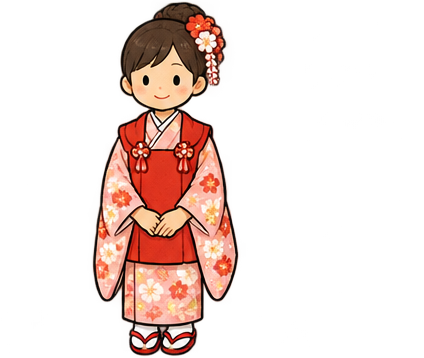
Girl of three: a sleeveless hifu over the kimono
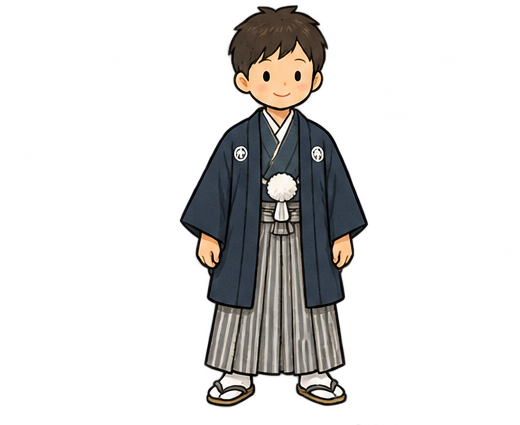
Boy of five: haori with white family crests, and hakama
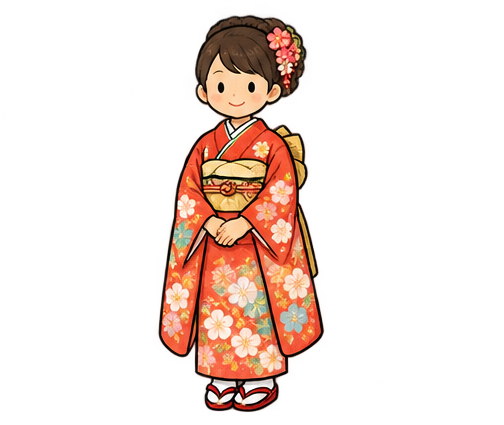
Girl of seven: long-sleeved kimono tied with a real obi for the first time
During the Edo period (1603–1868) these separate rites came to be celebrated together on the fifteenth day of the eleventh month. When the collective name Shichi-Go-San appeared is disputed; it seems to have become common only after the Meiji era began. Odd numbers are considered lucky in Japan, as in China, and three, five and seven are especially auspicious, so the name itself carries a sense of good fortune.
03Why November 15
The most widely told explanation for the date involves the Tokugawa shoguns. According to the story, the fifth shogun, Tokugawa Tsunayoshi, held a ceremony on the fifteenth day of the eleventh month of 1681 by the old lunisolar calendar, to pray for the health of his sickly son Tokumatsu, and townspeople later copied the date for their own children. It is a later tradition rather than a documented origin, and it ends sadly: Tokumatsu died two years later, in 1683, at the age of four (five by the traditional count).
Another explanation comes from the calendar. Under the old lunar calendar the fifteenth of the month was the full moon, a common day for festivals, and the fifteenth of the eleventh month was said to be kishukunichi, the day the Chinese system of twenty-eight lunar mansions counted as the most auspicious of all, good for everything except weddings. The eleventh month, moreover, was the end of the agricultural year. With the harvest in, villages already gave thanks to their local gods, and thanking them for the children at the same time was a natural extension. These explanations do not exclude one another; the date was probably fixed by several such reasons at once. When Japan switched to the Western calendar in 1873, November 15 was kept.
The deeper reason for the ceremony is the question of why a family would thank the gods for a child at all. Before modern medicine, infant and child mortality in Japan was high, and many children did not survive their first few years. A much-quoted saying holds that "until seven, a child belongs to the gods" (nanatsu made wa kami no uchi). A young child’s soul was thought to be only loosely attached to this world, liable to be called back at any time. Each milestone safely passed was a reason to return to the shrine, give thanks, and ask for continued protection. In some places only after seven did a child become a full member of the local community and a registered ujiko, a parishioner of the local shrine. The saying is often presented as an ancient belief, though some historians argue it was a modern saying from a few localities, spread by folklore studies; either way it captures the feeling underneath Shichi-Go-San: what the day celebrates, first of all, is that the child is still alive.
04From Samurai Households to Every Family
During the Edo period the custom spread first among samurai and wealthy merchants, especially in the city of Edo, the shogun’s capital and today’s Tokyo. Ordinary townspeople in Tokyo are generally said to have taken it up in the Meiji era (1868–1912), when dressing children up and buying candy became the standard routine. Villages elsewhere had their own celebrations for children of three, five or seven, but most marked only one or two of those ages, with differing rules for boys and girls. Shichi-Go-San became a truly national occasion only after the Second World War, above all during the high-growth 1960s.
The best-known accessory is chitose-ame, "thousand-year candy": a long, thin stick of red and white sugar candy, sold in a paper bag decorated with cranes, turtles, pine, bamboo and plum blossom. The length stands for long life; red and white are the colors of celebration; cranes and turtles are traditional emblems of longevity. Its origin is told several ways; a common version credits Shichibei, a candy seller in Edo’s Asakusa district around 1688–1711, who packed candy sold as "thousand-year candy" into bags printed with cranes and turtles for visitors to Sensō-ji temple. Today shrines often hand a bag to each child after the prayer ritual, and many children carry the stick around for days before it is finally broken into pieces and shared at home.
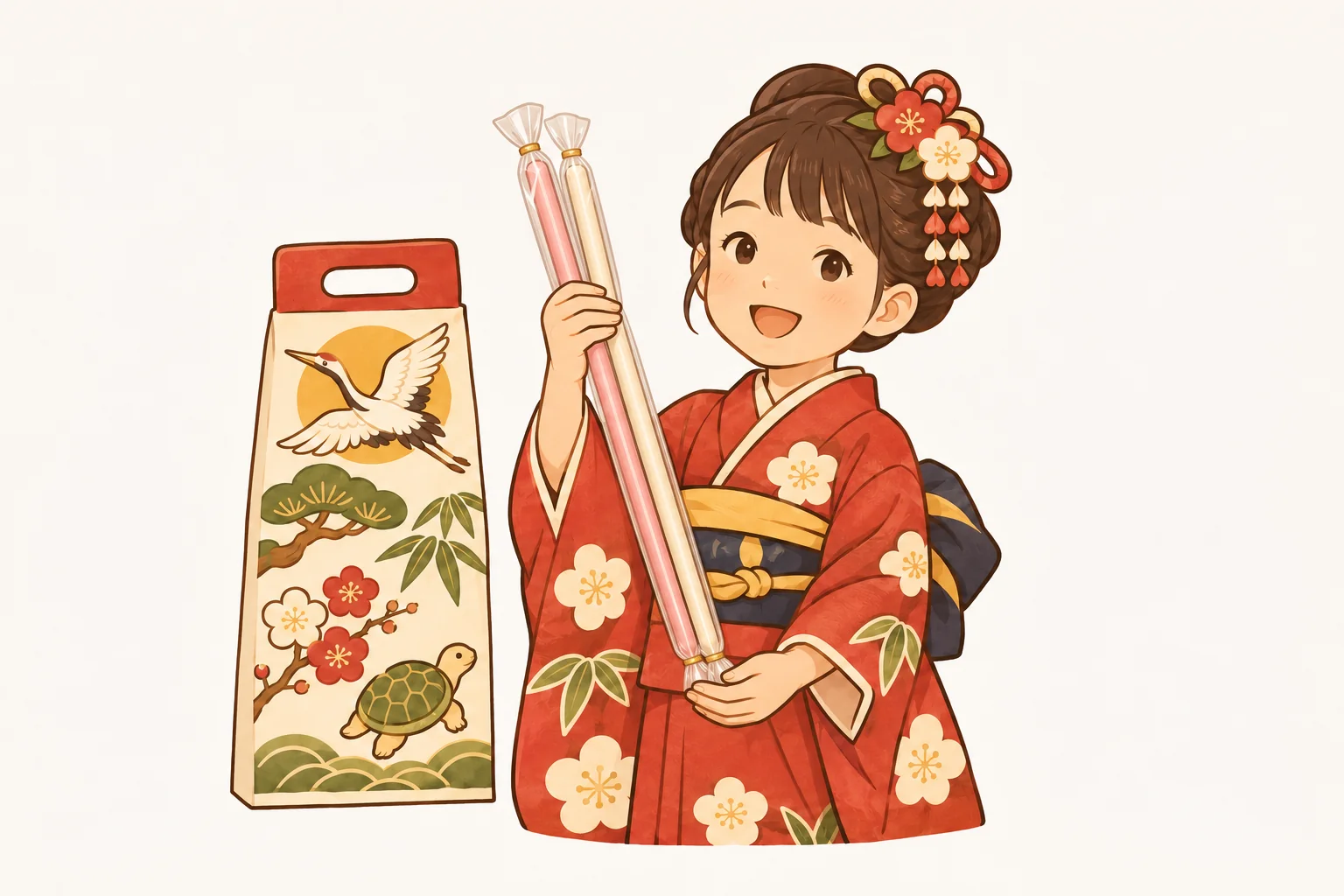
Chitose-ame: a long red-and-white candy stick in a paper bag decorated with cranes, turtles, pine, bamboo and plum.
As it spread, the custom also changed. From the high-growth decades onward, Shichi-Go-San gradually shifted from a shrine-centered rite to a photography-centered family event. Studios specializing in children’s portraits now operate across the country, offering kimono rental, dressing, hair and makeup, and professional photographs as a package. Many families book a maedori, a "pre-shoot," in summer or early autumn when studios are quieter, and then go to the shrine in November in simpler clothes or a lighter kimono, sparing a restless child hours in formal dress. Rental, dressing and photography together commonly run to tens of thousands of yen (as of 2026), and grandparents often pay for a grandchild’s kimono as a gift.
Some Japanese grumble that the occasion has become a commercial package. For most families, though, the studios are part of how the custom has survived. The core of the day is unchanged: the family brings the child before the local god, reports that the child has reached this age, and takes a photograph together.
05Miyamairi: The First Shrine Visit
Before Shichi-Go-San comes miyamairi, "shrine visiting," a baby’s first trip to a shrine. Roughly a month after birth, the family carries the infant to the local shrine to announce the birth, give thanks that mother and child came through it safely, and ask the god to watch over the child’s growth.
The shrine is ideally the one dedicated to the family’s ubusunagami or ujigami, the tutelary deity of the place where the child was born and of the people who live there. Part of the meaning of miyamairi is introducing a new member of the community to that god for the first time. Customary timing is about the thirty-first or thirty-second day after birth for a boy and the thirty-second or thirty-third for a girl, though the numbers vary from region to region. Modern families are rarely so precise. They pick a day around the one-month mark when the weather is mild and mother and baby are both up to it, and postponing it in midsummer heat or winter cold is common.
The most striking part of miyamairi is the iwaigi, the celebration kimono. The baby wears a simple white garment, and over it the person holding the baby drapes a bright, full-size kimono, tying its sleeve cords behind their own neck so that the robe hangs down like a cape and covers the infant entirely. Boys’ kimono tend toward black, deep blue or green, with hawks, dragons, samurai helmets or treasure ships. Girls’ are red or pink, with flowers, butterflies and embroidered balls. The same garment is often remade later into the kimono a girl wears for her three-year-old Shichi-Go-San, so one robe can see a child through two ceremonies.
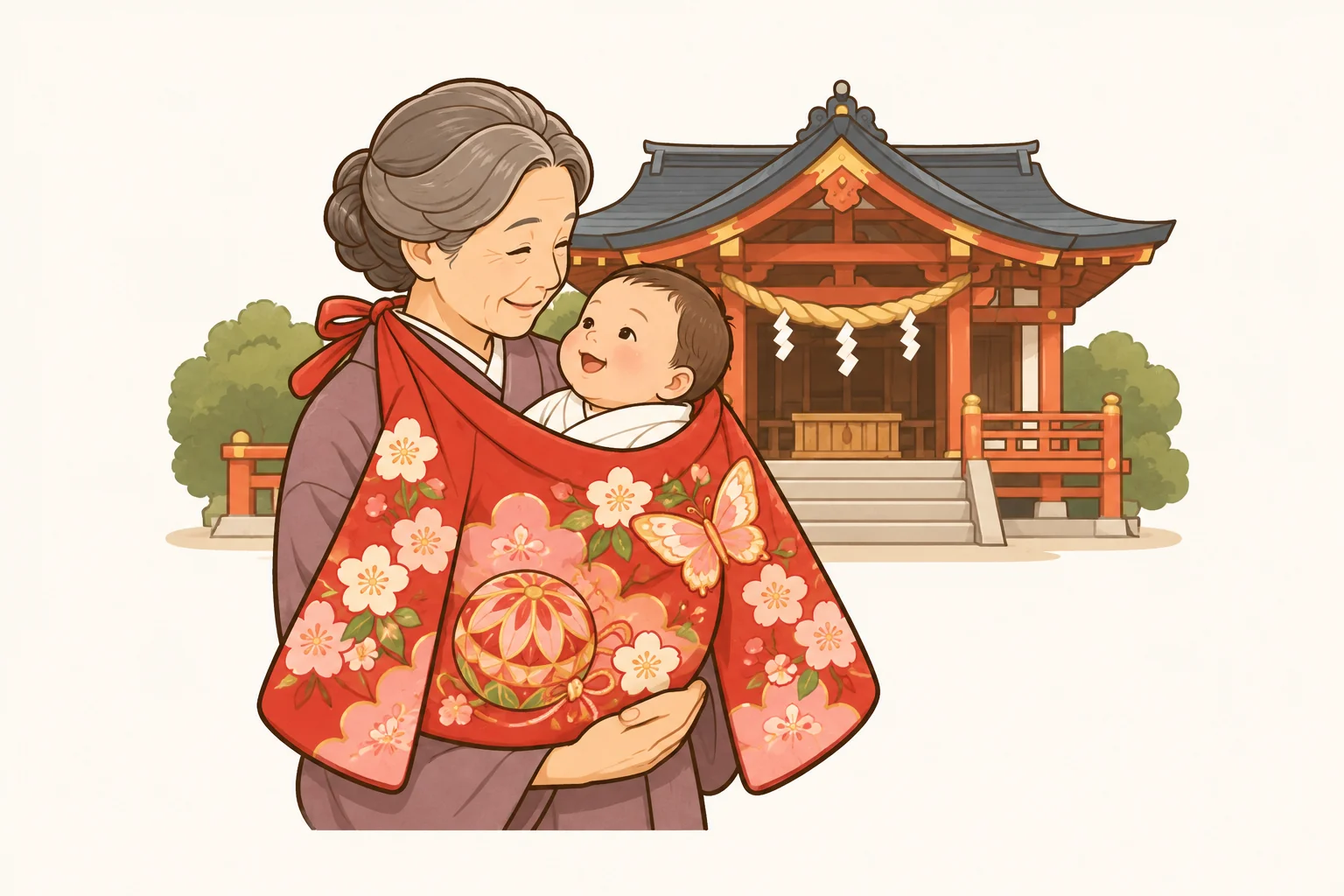
Miyamairi: a grandmother holds the baby under a bright iwaigi kimono, its sleeve cords tied behind her neck.
Traditionally it is the paternal grandmother who holds the baby. The custom goes back to old ideas of birth pollution: childbirth was considered a source of ritual impurity, and the new mother was kept away from sacred ground for a period after delivery, so the grandmother went in her place. That belief has largely faded. Mothers now usually attend, and who carries the baby is a family decision. Still, in a great many family albums the standard composition survives: grandmother in the middle with the baby in her arms, parents on either side.
Regional touches abound. In some areas the character for "dog" or "big" is written on the baby’s forehead in pot soot or rouge, because puppies are thought to grow sturdy and easy to raise. In some places the baby is deliberately made to cry in front of the god, so that the deity will notice and remember the child. Relatives may bring an inu-hariko, a papier-mâché dog, since dogs symbolize easy births and healthy offspring. Around the hundredth day comes another small rite, okuizome, "first eating," in which a tray with sea bream and red rice is set before the baby, who is offered a token mouthful to wish that the child will never go hungry.
Miyamairi, Shichi-Go-San and, at twenty, the Coming of Age ceremony together mark out the first part of a Japanese life. In all of them the shrine works less as a place of doctrine than as a witness to family memory. At the same torii gate, grandparents, parents and children may all have been photographed at roughly the same age.
06Seeing It for Yourself
Anyone visiting Japan in November is likely to come across Shichi-Go-San without trying. In Tokyo, Meiji Jingū, Kanda Myōjin and Asakusa Shrine are crowded with families on autumn weekends; in Kyoto, Heian Jingū and Fushimi Inari Taisha draw large numbers. Major shrines open dedicated reception windows for Shichi-Go-San prayers, and the queues can be long. Miyamairi happens all year round, most often on weekend mornings or on days the almanac considers lucky. Look for an older woman in formal dress holding what appears to be a bundle of richly colored silk; there is a baby inside.
Once you know what you are seeing, the scene reads easily. The tiny girls in sleeveless vests over kimono are three. The boys in crested black haori jackets and striped hakama, white family crests on the chest and back, are five; some carry a fan or a toy sword and wear an expression of great seriousness. The girls with upswept hair, full obi and a brocade purse at the collar are seven, and they walk with the care of someone who has been warned repeatedly about the hem.
These are important days in other people’s family lives. Keep a respectful distance when photographing, and ask the parents before taking a picture that shows a child’s face. Many will happily agree, but some prefer that their child’s image not circulate. Avoid standing directly in front of the main hall or in the center of the torii, which is usually where families are waiting for their turn at a group photo. Families visiting Japan with their own children can take part: kimono rental shops in many cities offer children’s outfits for Shichi-Go-San, and some shrines will perform the prayer for foreign families who fill in a form at the shrine office.
In the Kansai region around Kyoto and Ōsaka there is a related rite for an older child, jūsan-mairi, the "thirteen visit." At thirteen by the traditional count, children visit a temple of Kokūzō Bosatsu, a bodhisattva associated with wisdom and memory, to ask for wisdom and good fortune. The best known is Hōrin-ji in Kyoto’s Arashiyama. On the way home across the Togetsukyō bridge the child must not look back; according to the tradition, turning around means giving back the wisdom just received. It is one step past Shichi-Go-San, marking the move from childhood into adolescence.