
At a glance
Pine gates, mirror rice cakes, shrine visits and New Year cards all serve one purpose: welcoming the god of the year, then sending it home.
- The heart of shōgatsu is January 1 to 3, the sanganichi, when many companies and shops close.
- Kadomatsu, shimenawa and kagami mochi all serve one purpose: welcoming the god of the year, who comes once a year, and then sending it home.
- Japan has celebrated New Year on the solar January 1 since January 1, 1873 (Meiji 6).
- On New Year’s Eve people eat toshikoshi soba while temples ring the joya no kane, traditionally 108 times.
- New Year cards peaked around 2003 at over 4 billion issued; the first print run of cards for 2026 was about 750 million.
For a few days at the turn of the year, Japan goes quiet. Office towers go dark, shopping streets pull down their shutters, and a Tokyo commuter train on the morning of January 1 can feel almost empty. At the same time, queues hundreds of meters long form outside shrines, front doors sprout arrangements of pine and bamboo, and families sit down to food packed in stacked lacquer boxes. This is shōgatsu, the Japanese New Year, the most important holiday on the calendar. Its customs can look like a scattered list: pine decorations, rice-cake offerings, envelopes of money for children, a flood of postcards, a first visit to a shrine. In fact they hang together around one idea. Every year a god comes to visit each household, and the New Year is the business of receiving that god properly and then sending it home. This essay follows that visit from the December cleaning to the January bonfires, and ends with what a traveler will meet in Japan at this time of year.
01A Guest from the Mountains
Shōgatsu literally means "the first month," but in everyday speech it refers to the holiday period around January 1. The heart of it is sanganichi, the first three days of January, when many businesses close. A looser span is matsu no uchi, "within the pines," the period when the New Year pine decorations stay up: until January 7 in Tokyo and much of eastern Japan, and until the 15th in many parts of the Kansai region around Kyoto and Ōsaka.
At the center of the old New Year is a deity called the toshigami, the god of the year. In Japanese folk belief, this god descends at the New Year from the mountains, or from somewhere far off, to visit each home and bring a good harvest and health for the coming twelve months. People also called it toshitoku-jin or, affectionately, Shōgatsu-sama, "Mr. New Year." The folklorist Yanagita Kunio argued that the toshigami blends two older figures: the spirit of the rice crop and the spirits of the family’s ancestors, who after death become protective deities and return home at the turning points of the year. Ideas about who the god is varied from village to village, but what people did about it was remarkably consistent. You cleaned the house at the end of the year. You put a marker by the gate so the god could find its way. You set out an offering inside where it could stay. During the holiday the family gathered and ate food that had been offered to the god. Then on a set day you burned the decorations and saw the god off.
Seen this way, the Japanese New Year is a kind of hospitality. The pine arrangement at the door is a signpost for the god. The straw rope over the entrance marks the house as purified ground. The round rice cakes in the living room are the god’s temporary seat. Even the money children receive descends, by a long route, from a share of the god’s blessing. With that in mind, the individual customs fall into place.
One more thing surprises visitors from elsewhere in East Asia: Japan celebrates the New Year on January 1 of the Western calendar, not at the lunar new year. The Meiji government switched to the solar calendar at the end of 1872, declaring that the third day of the twelfth month of the old calendar would become January 1, 1873. Many rural communities kept the old lunar date for decades, but by the mid-twentieth century the lunar New Year had largely faded on the main islands, surviving mainly in Okinawa and in scattered local customs. The holiday Japan celebrates today is a January 1 holiday filled with customs that originally followed the moon.
02Cleaning Up and Putting Up the Pines
Preparations traditionally began in mid-December. December 13 was known as shōgatsu koto-hajime, "the beginning of New Year affairs." In the Edo period (1603–1868), samurai households and merchant houses held their susuharai, "soot sweeping," on that day, clearing away a year’s grime from hearth smoke, and it was also the day to go into the hills to cut pine for the decorations. In Kyoto’s Gion district, maiko and geiko still make the rounds on December 13 to thank the teahouses and teachers who have looked after them through the year. Most families now leave their big clean, the ōsōji, until the last days of December, but the reasoning hasn’t changed. A guest is coming, and the house has to be clean.
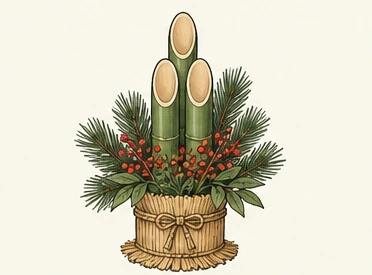
Then the entrance is decorated. Kadomatsu, "gate pines," stand in pairs on either side of the door. The most familiar form has three thick stalks of green bamboo, cut off at a sharp diagonal and set at staggered heights, wrapped with pine boughs and sometimes plum branches or the red berries of nandina, all bound at the base with straw rope. Outside banks, hotels and department stores these can be taller than a person, the bamboo tips cut as clean as a blade. Homes usually make do with small versions, or simply a sprig of pine fastened to each gatepost.
The real point of the kadomatsu is the pine, not the bamboo. Pine stays green through winter, and in Japan it has long been regarded as a tree that gods can inhabit. The kadomatsu serves as a yorishiro, an object that a descending deity can occupy, and it shows the toshigami where to land. Bamboo, prized for growing straight and fast, became prominent later. A popular story explains the diagonal cut: after Tokugawa Ieyasu was badly beaten by Takeda Shingen at the Battle of Mikatagahara in 1573, he is said to have slashed the bamboo of his New Year pines on the slant as a vow to cut down the Takeda next time. This is best treated as later folklore. Both the slanted sogi cut and the flat-topped zundō cut are found across Japan, and the flat style has an older, plainer look; some say old-fashioned households in Kyoto and the Kansai region prefer it.
The kadomatsu has a partner, the shimenawa, a rope of twisted rice straw. At shrines, shimenawa hang across torii gates or around sacred trees to mark off holy space. At New Year, households hang a smaller version over the front door called a shimekazari: straw shaped into a ring, a fan or a long braid, decorated with zigzag white paper streamers called shide, a bitter orange, fronds of urajiro fern and other good-luck tokens. It tells the god that the house has been purified, and it keeps impurity out. Regional styles vary enormously. Around Ise, in Mie Prefecture, the shimekazari stays up all year, marked with the words "descendants of Somin Shōrai," a reference to an old legend about a man who sheltered a wandering god and was protected from plague.
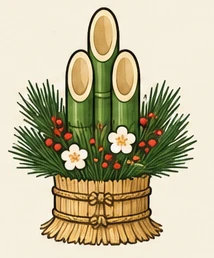
Kadomatsu: three slant-cut bamboo stalks of staggered height with pine, plum blossoms and red nandina berries, bound in straw.
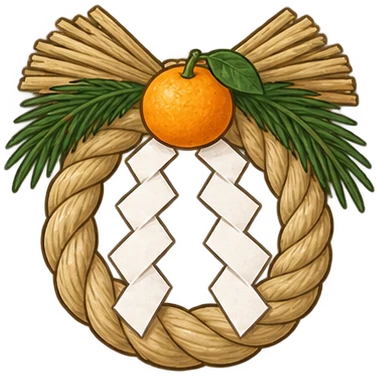
Shimekazari: a ring of braided straw hung with white paper streamers (shide) and a bitter orange.
Even the timing matters. The 29th is generally avoided because ku, nine, sounds like the word for suffering. Putting decorations up on the 31st is called ichiya-kazari, "one-night decorating," and is thought to be a discourtesy to the god, like tidying up only once the guest is at the door. So many families finish by the 28th or put things up on the 30th. Nobody enforces these rules, but enough people follow them that the supermarket racks of kadomatsu and shimekazari are at their busiest around the 28th.
03Kagami Mochi: The God’s Seat
Inside, the most conspicuous decoration is kagami mochi, "mirror rice cake." It consists of two flat, round cakes of pounded rice, a large one with a smaller one on top, set on a small wooden stand called a sanbō over white paper. On top sits a daidai, a bitter orange with its leaves still attached, and the arrangement is often finished with fern fronds, a paper fan, a strip of kelp or dried persimmons. Traditional homes place it before the household Shinto altar or in the tokonoma alcove. In a modern apartment it might sit on top of the TV cabinet or the shoe cupboard by the front door.
It is called a "mirror" because its shape recalls ancient round bronze mirrors. Mirrors are sacred objects in Shinto. One of the three imperial regalia is a mirror, the Yata no Kagami, and the object enshrined in the inner sanctuary of many shrines is a mirror as well. The two tiers are often explained as the sun and moon, or as one good year stacking on another, and the orange is a pun: daidai also means "generation after generation," wishing the family line a long continuation. Most of these readings are later good-luck glosses. Older and more fundamental is the idea that the god lodges in the mochi during the holiday and fills it with its power.
Kagami mochi usually goes up around December 28 and comes down on the day of kagami biraki, "opening the mirror," most commonly January 11. In the Edo period the date is said to have been the 20th, until the third shogun Tokugawa Iemitsu died on the 20th day of the fourth month in 1651 and the ritual was moved to the 11th to avoid his death date. Around Kyoto it is often done on the 4th, and many Kansai households do it around the 15th. By then the mochi has dried rock-hard and is often cracked. Custom forbids cutting it with a knife, because cutting evokes a samurai’s ritual suicide, so it is broken with a wooden mallet, and people avoid the word for "split" in favor of "open," which also suggests opening up good fortune. The broken pieces go into sweet red bean soup to make zenzai, or get toasted and dipped in soy sauce. Eating mochi that has been offered to the god takes the god’s strength into each person’s body, which was the point all along.
- 1
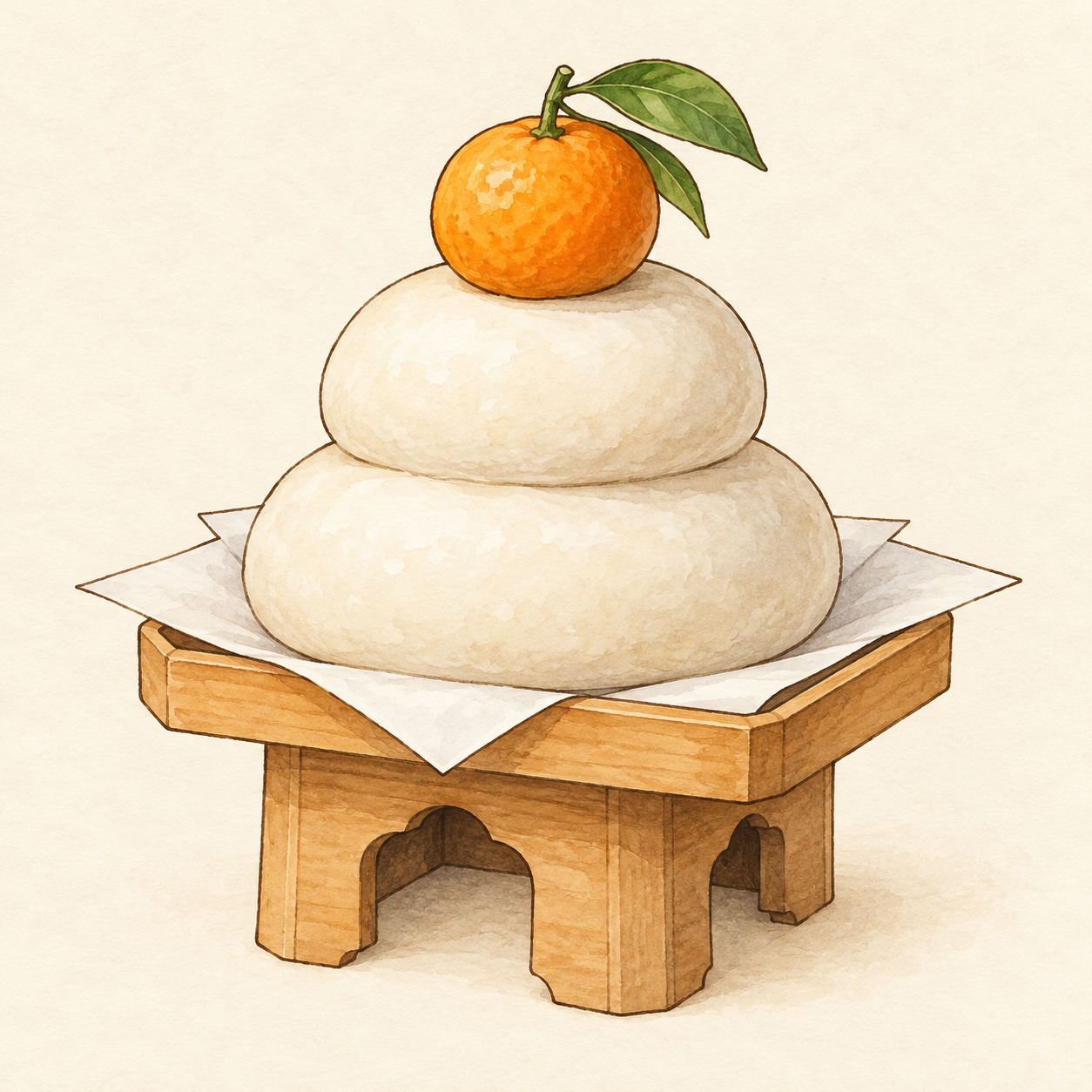 Around December 28, two stacked round cakes go on a paper-lined sanpō stand, topped with a leafy bitter orange.
- 2
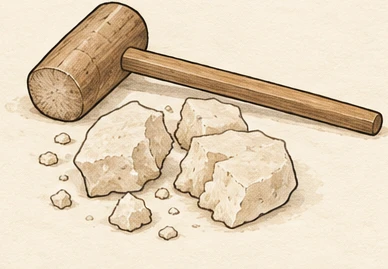 On kagami biraki the dried, rock-hard mochi is broken with a wooden mallet, never cut with a knife.
- 3
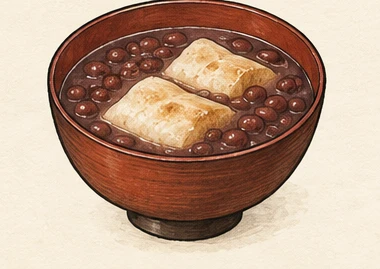 The pieces go into sweet red bean soup to make zenzai, shared by the family.
Kagami biraki has also become a ceremony in its own right. Martial arts dojo hold a training session followed by a shared bowl of zenzai, and at celebrations of every kind, from weddings to company launches, the "opening" of a cask of sake by smashing its wooden lid with mallets is also called kagami biraki.
Most kagami mochi bought today is a plastic shell molded in the shape of the two tiers, filled with individually wrapped pieces of mochi and topped with a plastic orange. It never goes moldy and never needs a hammer. Purists find it a little sad, but most households still bring one home at the end of December.
04New Year’s Eve: Noodles, Song and Bells
December 31 is ōmisoka. The day goes to final cleaning and cooking. In the evening, families eat toshikoshi soba, "year-crossing" buckwheat noodles. Explanations vary. The long noodles stand for long life. Soba breaks easily, so eating it cuts off the hardships of the old year. Edo-period goldsmiths are said to have used balls of buckwheat dough to gather stray gold dust, linking soba with money. Merchant households in Edo ate misoka soba on the last day of every month, and the year-end bowl was the biggest of them. Today soba shops have lines out the door on the afternoon of the 31st, and convenience stores stack up fresh noodles and tempura to go with them.
After dinner, many households turn on NHK’s Kōhaku Uta Gassen, the "Red and White Song Battle." The program began on radio in 1951, has been televised since 1953 and settled into its New Year’s Eve slot. The year’s leading singers are divided into a women’s red team and a men’s white team and perform in alternation until about 11:45 p.m., when the audience and judges pick a winning side. In the Shōwa era its ratings were astonishing, at times over 80 percent of households. Viewers have since scattered, but being invited onto Kōhaku remains one of the year’s top honors for a Japanese performer, and for many people the show is how they know the year is really ending.
When Kōhaku finishes, NHK switches to Yuku Toshi Kuru Toshi, "The Going Year, the Coming Year," cutting from the bright stage to snowy temple courtyards around the country as the bells begin. This is joya no kane, the New Year’s Eve bell. Buddhist temples strike their great bells late on the 31st, traditionally 108 times. The number is usually explained as the count of human worldly desires, one dispelled with each stroke. Many temples begin before midnight and save the last stroke for the new year. Some let everyone in the queue take a turn and hand out cups of warm amazake, a sweet, mild drink made from rice, afterward. At Chion-in in Kyoto, whose bell is one of the largest in Japan, a team of 17 monks works the massive log striker by ropes. The lead monk calls out, the others lean back almost horizontal and swing the log into the bell, and the low tone carries across the eastern hills of the city.
05Hatsumōde: The First Shrine Visit
By the time the bells stop, many people are already standing at shrine gates. The first visit of the year to a shrine or temple is hatsumōde, and it is the most widely observed New Year custom of all. Plenty of Japanese people never set foot in a shrine for the rest of the year, but over the first three days of January the largest shrines receive visitors in the millions. Meiji Jingū in Tokyo, Naritasan Shinshō-ji in Chiba and Kawasaki Daishi in Kanagawa have long topped the national rankings, with Meiji Jingū drawing around three million people over the three days in recent pre-pandemic years. In Kyoto, Fushimi Inari Taisha is packed; so are Sumiyoshi Taisha in Ōsaka and Atsuta Jingū in Nagoya.
Hatsumōde looks ancient but is surprisingly modern in its present form. Before the Meiji era (1868–1912), a common way to greet the year was toshigomori, spending New Year’s Eve in vigil at the local shrine until morning. Another was ehō mairi, visiting a shrine or temple that lay in the year’s lucky compass direction. When railways arrived, they carried city dwellers out to famous temples in the suburbs, and the railway companies advertised New Year trips in the newspapers. Kawasaki Daishi and Naritasan both prospered enormously once trains reached them; the company that became today’s Keikyū line began as a short electric railway built in 1899 to carry pilgrims to Kawasaki Daishi. The word hatsumōde spread during this period, describing a visit no longer tied to your home shrine or the year’s lucky direction, but made to any well-known shrine you chose. In that sense hatsumōde grew up alongside trains, newspapers and city life, which is why it is most spectacular in the big cities.
Basic shrine etiquette is simple. Bow lightly as you pass under the torii gate. Walk to the side of the approach path, since the center is regarded as the path of the gods. At the temizuya water basin, take the long-handled ladle, rinse your left hand, then your right, pour a little water into your cupped left hand to rinse your mouth, then tip the ladle upright so the remaining water runs down the handle. At the hall of worship, toss a coin into the offering box, ring the bell if there is one, and follow the pattern "two bows, two claps, one bow": bow deeply twice, clap twice at chest height, keep your hands together for a silent wish, then bow once more. Any amount is fine as an offering, and many people use a five-yen coin because go-en, five yen, sounds like the word for a good connection. At Buddhist temples you put your palms together and bow, but you don’t clap.
- 1
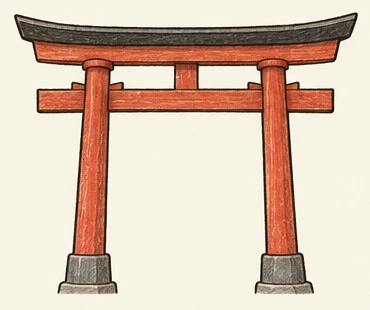 Bow slightly as you pass under the torii, and keep to the side of the approach.
- 2
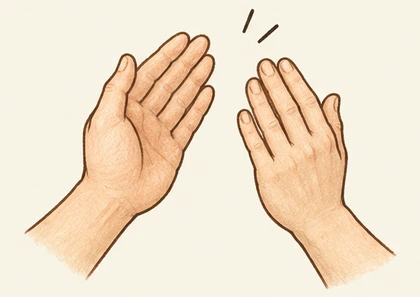 Offer a coin, ring the bell, bow deeply twice, then clap twice at chest height.
- 3
 Press your palms together and make your wish silently, then bow once more. At temples, skip the clapping.
At New Year the shrine grounds are far livelier than usual. Food stalls line the approach, selling takoyaki, yakisoba, grilled squid, candy apples and amazake. Crowds press around the counters where shrines offer new omamori amulets and hamaya, white-feathered "evil-breaking arrows." People draw an omikuji, a paper fortune, graded from daikichi, great blessing, through several levels of blessing down to kyō, bad luck. A bad fortune is usually tied to a designated rack or tree branch and left behind, handing the bad luck over to the god. Last year’s amulets and arrows are brought back and dropped into a collection point, and the shrine burns them.
06Osechi and Ozōni: What People Eat
On the morning of the 1st, the family gathers, exchanges akemashite omedetō gozaimasu, the standard New Year greeting, takes a sip of toso, spiced ceremonial sake, and opens the New Year food.
That food is osechi ryōri. Osechi once referred to offerings made at any of the year’s seasonal festivals; it came to mean the New Year set specifically. It is packed into jūbako, square lacquered boxes stacked in tiers so that good fortune "piles up." Almost every item carries a meaning, usually through a pun or its shape. Sweet black soybeans, kuromame, stand for working mame ni, diligently. Kazunoko, herring roe, with its countless eggs, stands for many descendants. Tazukuri, tiny dried sardines candied in soy sauce and sugar, were once used to fertilize rice paddies, and the name means "making the fields," a prayer for a good harvest. Rolls of kelp, kobumaki, play on yorokobu, "to rejoice." Shrimp, curled over with long feelers, represent living to a bent old age. Red and white slices of kamaboko fish cake stand for warding off evil and for purity. Kuri kinton, a golden paste of sweet potato with chestnuts, looks like gold and wishes for wealth. Datemaki, a sweet rolled omelet made with fish paste, resembles a scroll and wishes for learning. Vinegared red-and-white radish and carrot, namasu, and simmered root vegetables, nishime, fill out the boxes, and every family’s set is a little different.
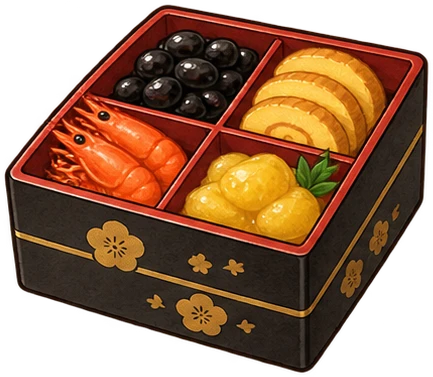
One tier of a jūbako: black beans, shrimp, datemaki and golden kuri kinton, each carrying a wish.
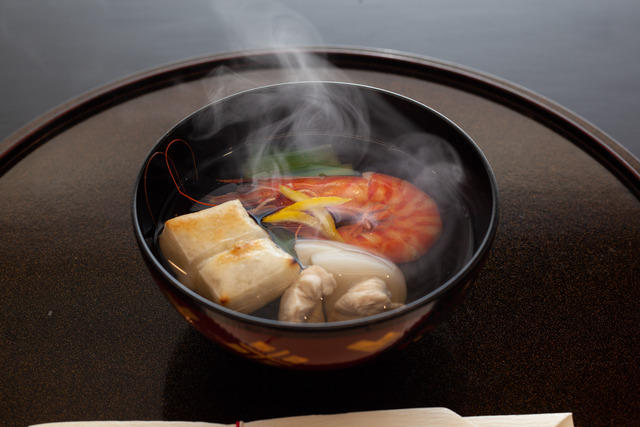
Tokyo-style zōni: grilled square mochi in clear broth with shrimp and chicken.
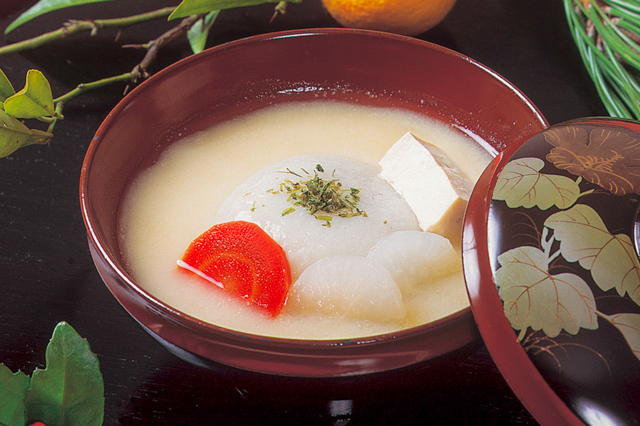
Kagawa-style zōni: round mochi with a sweet bean filling in white miso soup.
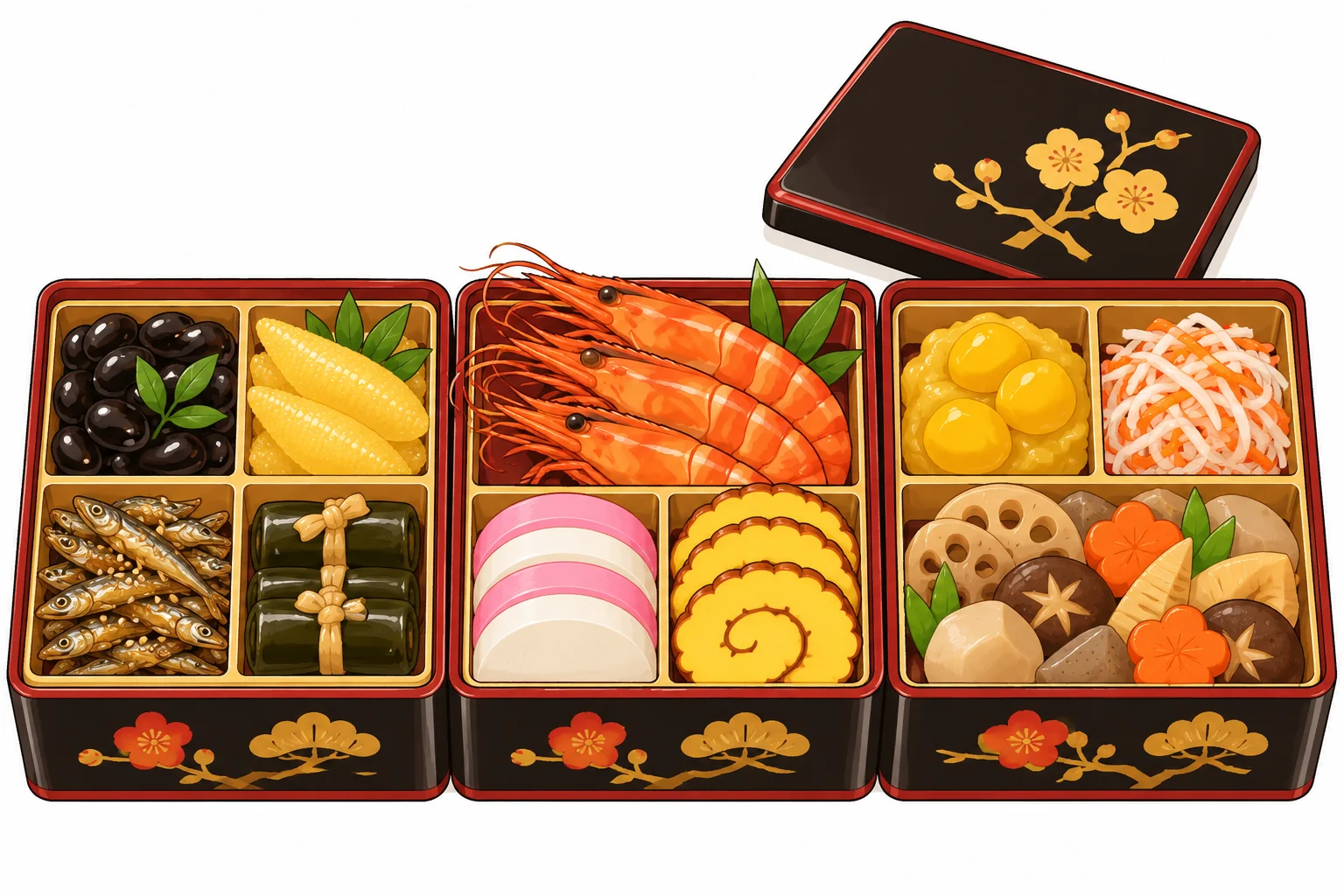
Three tiers of a lacquer box laid out, filled with osechi: black beans, herring roe, prawns, kamaboko and more (illustration).
Osechi tends to be sweet and salty, and is mostly eaten cold. There is a reason. Traditionally the kitchen fire was not used during the first three days, giving the hearth god and the housewife a rest, so the food had to be prepared in advance and keep for days. Fewer families make a full set at home now. Department stores, famous restaurants and even convenience stores take osechi orders from the autumn; as of the 2026 New Year, prices ran from around ten thousand yen for a small box to well over a hundred thousand for a deluxe three-tier set packed with lobster, abalone and wagyu. Plenty of households make a few favorite dishes and fill in with roast beef and sushi.
Alongside the osechi comes ozōni, a soup with mochi in it, and nothing shows Japan’s regional differences better. Broadly speaking, the Kantō region around Tokyo uses square mochi, toasted, in a clear broth of bonito and kelp stock with chicken, leafy greens and fish cake. The Kansai uses round mochi, boiled soft, in a sweet, rich broth of Kyoto-style white miso with taro and daikon. Within that broad divide the variations go on and on. Shimane makes a sweet ozōni with red beans. Kagawa puts mochi stuffed with sweet bean paste into white miso soup. Niigata and parts of the northeast add salmon and salmon roe. In parts of Iwate, people dip their mochi in a sweet walnut sauce. Japanese people tend to hold strong views about how ozōni should taste, and newly married couples who grew up with different versions often have to settle what "our family’s ozōni" will be.
Even the chopsticks are special. Iwai-bashi, celebration chopsticks, are tapered at both ends: one end for the person, the other for the god, so that the family eats with the toshigami at the same table. They usually come in paper sleeves inscribed with each family member’s name and are used through matsu no uchi. Toso is drunk in order from youngest to oldest, so that the vitality of the young passes up to their elders.
07Otoshidama: From the God’s Gift to a Child’s Envelope
For Japanese children the highlight of New Year is otoshidama. On the 1st, grandparents, aunts and uncles hand them small envelopes of cash.
Otoshidama didn’t start out as money. The tama in the word is commonly linked with tama meaning soul or spirit, and the idea is that otoshidama was a share of the toshigami’s spirit. Mochi offered before the god was taken down and distributed by the head of the household to everyone in it, and eating it meant receiving a year’s worth of life force from the god. Another explanation takes tama to mean a precious gift. Either way, otoshidama was originally something the household head gave to all members of the house, servants included, and it was usually mochi, sometimes a fan, a writing brush or other small goods. Merchant households in the Edo period handed out money or goods to apprentices and children at New Year, and in the cities the custom gradually shifted toward cash.
Giving children money in small decorated envelopes became the standard form only in the mid-twentieth century, and especially during the high-growth decades after the war. The envelopes are called pochibukuro. Pochi in Kansai dialect means "just a little," and the envelopes were originally used to tip geisha and teahouse staff, which is why they are so small. By late December, stationery shops and convenience stores have whole walls of them, from traditional pine-and-crane designs to anime characters.
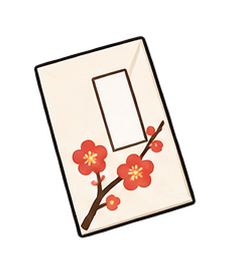
Pochibukuro are small envelopes, printed with anything from traditional motifs to anime characters.
The amount tends to rise with age. Surveys typically find preschoolers receiving around a thousand yen from each relative, elementary schoolchildren three to five thousand, junior high students about five thousand, and high school students around ten thousand, though families vary widely. A child who visits all the relatives can easily come home with several tens of thousands of yen, and many parents have children put a share in the bank. The bills should be crisp and new, so in December bank counters see a stream of people exchanging old notes for fresh ones. Amounts with four or nine in them are avoided, since shi, four, sounds like death and ku, nine, like suffering.
Unlike Chinese red envelopes, pochibukuro don’t need to be red. Money goes downward, from older to younger. You don’t give cash to your peers or to your elders. Even for your boss’s children, a plain otoshidama envelope is widely thought improper, so people relabel the gift as a New Year present; giving it to your boss would be an insult. Japanese people absorb these rules growing up; a visitor need not worry much about them.
08Nengajō: A Stack of Postcards on New Year’s Morning
The other thing many people look forward to on the morning of the 1st is the mail. The postman delivers a thick stack of nengajō, New Year cards, held together with a rubber band. Some carry family photos, some are brushed by hand, many feature the animal of the year from the Chinese zodiac. They come from relatives, old classmates, colleagues and people you haven’t seen since last New Year.
Exchanging New Year greetings by letter has a long history in Japan; a model-letter collection from the late Heian period already includes a New Year letter. But for most of history, what really mattered at New Year was nenshi mawari, visiting in person: after the 1st, you called with a gift at the homes of relatives, superiors and teachers to offer the year’s first greeting. Letters were for people too far away to visit. Japan’s modern postal service was founded in 1871 and the postcard soon followed. Cheap and quick to write, New Year postcards caught on rapidly and in many cases replaced the visit itself.
That created a problem. Everyone posted their cards in the first days of January, and post offices were swamped. The solution was special handling for New Year mail. Cards marked as New Year greetings and posted within a set window at the end of December were held by the post office and delivered all together on January 1. The system began in 1899 at designated post offices and was in force nationwide from 1905, establishing the rhythm that still holds. Post offices start accepting nengajō in mid-December, and cards posted by around the 25th are delivered on New Year’s Day. The morning of January 1 is the busiest delivery of the year for Japan Post, and many students take seasonal jobs sorting cards in late December.
In 1949, Japan began issuing otoshidama-tsuki nenga hagaki, prepaid New Year postcards printed with lottery numbers, with the draw held in mid-January. The idea came from a private citizen, a Kyoto resident who ran a tailoring shop in Ōsaka’s Shinsaibashi. The top prize in the first year was a sewing machine, then a luxury, and the other prizes included woolen suit fabric, children’s baseball gloves and children’s umbrellas. Later prizes ran to televisions, travel vouchers and cash, while the lowest prize has long been a sheet of commemorative stamps featuring the zodiac animal. In the lean postwar years these prizes were a real draw, and New Year cards became a near-universal habit.
Nengajō come with conventions. The front carries the address; the back carries a set greeting such as kinga shinnen, "respectful congratulations on the New Year," or geishun, "welcoming spring," a few lines of personal news, and the year. Words like "leave," "lose" or "break" are avoided. If someone in the household has died during the year, the family sends no New Year cards. Instead, in November or early December, they send a mochū hagaki, a mourning postcard, letting people know they are in mourning and asking them not to send greetings. People who receive one may reply after matsu no uchi with a kanchū mimai, a midwinter greeting.
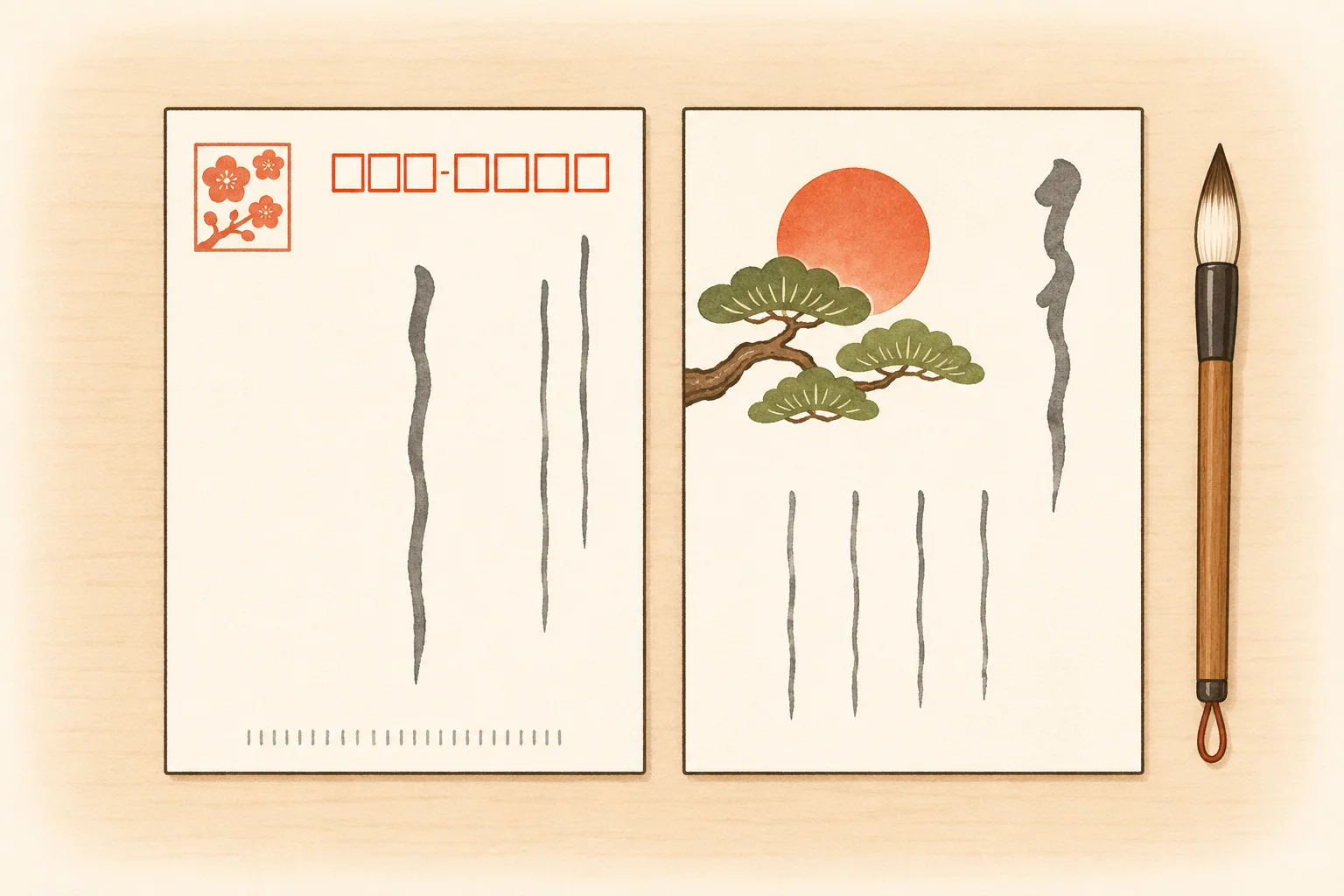
Postcard layout (illustration): the address side with postal-code boxes, and the side for greetings and news.
The number of nengajō peaked around 2003, when Japan Post issued well over four billion. Since then email, mobile phones and messaging apps have steadily eaten into the custom, and the initial print run for 2026 cards was about 750 million, roughly a sixth of the peak, a decline sped along by rising postage. Many younger people send greetings by message instead, and some companies have announced they will stop exchanging cards. There is even a recognized genre, the nengajō jimai, a final New Year card telling the recipient that this will be the last one. Even so, leafing through a stack of cards on New Year’s morning to see whose children have grown remains, for many Japanese, one of the warmest images of the holiday.
09Seeing the God Off
The celebrations wind down after the third. Folk belief holds that hatsuyume, the first dream of the year, usually taken as the dream on the night of the 1st or the 2nd, foretells the year’s fortune. The luckiest things to dream of are, in order, Mount Fuji, a hawk and an eggplant. January 2 is also traditionally the day of kakizome, the first calligraphy of the year, when children brush a wish or a set phrase in large characters. Businesses and government offices reopen around the 4th.
On the morning of January 7, many families eat nanakusa-gayu, rice porridge with seven spring herbs: seri (water dropwort), nazuna (shepherd’s purse), gogyō (cudweed), hakobera (chickweed), hotokenoza (here not the henbit that now bears the name, but a small yellow-flowered plant of rice-field edges, koonitabirako), suzuna (turnip) and suzushiro (daikon). It is said to ward off illness and gives a stomach tired from holiday food a rest. The custom traces back to the Chinese practice of eating a broth of seven greens on the seventh day of the first month. The Heian court already ate fresh young greens early in the year; the greens later merged with the porridge of the 7th, and once the Edo shogunate made that day one of the five official seasonal festivals, the porridge spread nationwide. Supermarkets sell small packs of the seven herbs ready to drop into the pot.
The 7th is also the end of matsu no uchi in eastern Japan, and around this time the kadomatsu and shimekazari come down. They are not simply thrown in the trash. Traditionally they are burned at a bonfire held around January 15, koshōgatsu or "little New Year." The fire festival goes by different names in different regions, among them sagichō, dondo-yaki and onibi-taki. Villagers build a tall pyre of bamboo and straw in a rice field or on shrine grounds, pile on the households’ pine decorations, straw ropes and the first calligraphy of the year, and set it alight. If your calligraphy rises high in the flames, your handwriting will improve. Mochi toasted on bamboo poles over the embers is eaten to keep illness away for the year. And the toshigami, it was believed, rides the smoke back to where it came from.
With kagami biraki on the 11th and the bonfires around the 15th, the New Year is finally over. Early February brings Setsubun, when people throw roasted soybeans to drive out demons, marking the eve of spring in the old calendar. The second Monday of January is Coming of Age Day, when twenty-year-olds in long-sleeved kimono and suits attend ceremonies across the country, and many stop at a shrine for photos, one more echo of the New Year season.
10New Year in Japan as a Visitor
Visit Japan at New Year and you will find a country that feels quite different from usual.
First, a lot of places close during sanganichi. Small restaurants, family-run shops and some museums close from around December 29 through January 3, as do bank counters and government offices. Convenience stores, fast-food chains and large supermarkets mostly stay open, and in big cities you will not go hungry. Department stores and malls usually close only on January 1, reopening on the 2nd for hatsuuri, the first sales of the year. Lines form early for fukubukuro, "lucky bags": sealed bags sold at a fixed price, holding goods worth more than you pay, with contents you can’t see before you buy. Clothing brands, electronics stores and sweet shops all sell them, and the most popular ones require a lottery or an advance online order.
Travel peaks from about December 28 to January 3, when people head to their hometowns and back, so book shinkansen seats and flights early. On New Year’s Eve some lines run all night or extend late service for people heading to hatsumōde. For the 2025–26 New Year, for example, JR’s Yamanote Line and the Keisei lines in Tokyo and the Kintetsu and Keihan lines in Kansai ran through the night, while Tokyo’s and Ōsaka’s subways did not. Arrangements change every year, so check before you go.
For hatsumōde itself, you have two choices. One is the crowd: go to Meiji Jingū, Fushimi Inari or Kawasaki Daishi and feel what it’s like to inch forward with hundreds of thousands of other people. Midnight and the daytime hours of the 1st are the most crowded. Police with loudspeakers direct the flow, and the walk from the station to the worship hall can take an hour or two. The other is to find a small neighborhood shrine and go early on the morning of the 1st or after the 3rd. There may be only a few elderly people and families with children, a priest may hand you a cup of amazake, and you won’t need to queue for a fortune. It is often closer to how Japanese people actually feel about the holiday. Many do both: the famous shrine, then the local tutelary shrine near home. Any visit during matsu no uchi counts.
Outside the big crowds, there are quieter ways to take part. At Yasaka Shrine in Kyoto, worshippers at the okera mairi on New Year’s Eve take home a flame from the sacred fire on a length of slow-burning rope, said to be made of bamboo fiber, swinging it in circles to keep it alight, and traditionally use it to cook the year’s first ozōni. Many people climb a hill or go to the coast before dawn on the 1st to see hatsuhinode, the first sunrise of the year; the area around Mount Fuji and the Chiba coastline are well-known spots. Spending the holiday at a hot-spring inn is another option, and many ryokan serve a small osechi and a bowl of ozōni on the morning of the 1st, giving guests a taste of a family New Year.
As for what to say: akemashite omedetō gozaimasu is used only when you meet someone for the first time in the new year. Before the year ends, when parting, you say yoi otoshi o, "have a good year." If you are invited to a Japanese home over New Year, bring a box of sweets, try a little of everything in the osechi when your hosts offer it, and take your sip of toso when it comes around. That is all the participation anyone will expect.